Friday, January 30, 2009

BOOKLE’ARNED. adj. [from book and learned.] Versed in books, or literature: a term implying some slight contempt.


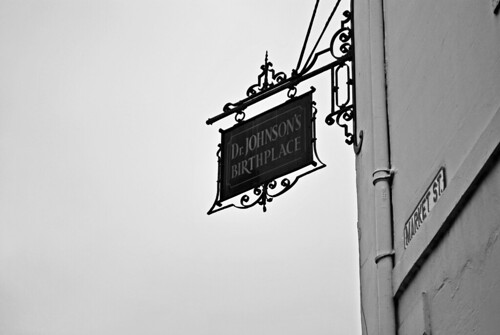
{Photos by rocketlass.}

In a review of two new biographies of Samuel Johnson (including Peter Martin's, about which I've written a bit before) in this week's New York Times Book Review, Leah Price succinctly notes one of the reasons that Johnson these days is more heard of than read:
We tend to go to past authors looking for kinds of writing that remain familiar today: single-authored, volume-length, recognizably literary works, especially novels.
Aside from Rasselas, which can be tough sledding for someone not already attuned to Johnson's thought and times, Johnson wrote no novels, nor did he write anything of convenient book length, the sort of work that one can chuck in one's bag and read on the subway for a week, from start to finish. Rather, as Price explains,
His best work was topical, collaborative, and either journalistic (especially the twice-weekly essay-periodicals like The Rambler, which he turned out as regularly as any blogger) or editorial (whether in the form of compilations, abridgments, translations or even a library catalog).
That said, the obstacles to reading Johnson today really aren't that great, once one realizes that he is best encountered in his essays: Oxford World's Classics publishes a bulky and satisfying volume, The Major Works, that provides a more than satisfactory introduction to Johnson, offering the best of his essays for the Rambler and Idler, a selection of his poetry, a few of his Lives of the Poets, and a generous selection of his incidental prose. It's a volume to leave on the nightstand or keep perpetually in one's shoulder bag, to be read a few pages at a time over the course of years.

That method doesn't really work, however, for Johnson's most astonishing achievement, his Dictionary. It's hard to find in unabridged form and unbearably awkward if so found--and even then, its form doesn't lend itself to the sort of constant, slow perusal appropriate to his other works. After all, dictionaries aren't exactly books for reading; even the best of them tend to pall once one's read a few pages straight through. Despite the Dictionary's many fascinating idiosyncracies, it's hard to imagine anyone without a professional interest in Johnson actually reading the whole volume cover to cover.
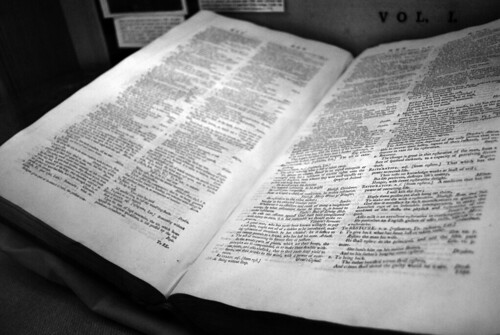


Fortunately, Yale University's Beinecke Library (the same people who bring you the wonderful Room 26 Cabinet of Curiosities blog) has come to the rescue: to celebrate Johnson's tercentenary, the Beinecke has started a blog on which they will post a new word from the first edition of the Dictionary every day. We're less than a month into the year--they've just crossed into "C"--and the project has already offered numerous delightful definitions.

Probably my favorite thus far is By-Coffeehouse--
BY-COFFEEHOUSE. n.s. A coffeehouse in an obscure place.
I afterwards entered a by-coffeehouse, that stood at the upper
end of a narrow lane, where I met with a nonjuror.
Addison. Spectator, No 403.
--which makes me want to adopt the term By-Bar, for a second-floor or alley bar; your help in the word's promulgation will be appreciated.

I'm also very partial to Browbeat, which Johnson defines thus:
To BRO’WBEAT. v.a. [from brow and beat.] To depress with
severe brows, and stern or lofty looks.
It is not for a magistrate to frown upon, and browbeat those
who are hearty and exact in their ministry; and, with a grave,
insignificant nod, to call a resolved zeal, want of prudence.
South.
What man will voluntarily expose himself to the imperious
browbeatings and scorns of great men? L’Estrange.
Count Tariff endeavoured to browbeat the plaintiff, while he
was speaking; but though he was not so imprudent as the
count, he was every whit as sturdy. Addison.
I will not be browbeaten by the supercilious looks of my ad-
versaries, who now stand cheek by jowl by your worship.
Arbuthnot and Pope’s Mart. Scriblerus.
Today, Merriam-Webster's defines browbeat a bit more metaporically--
To intimidate or disconcert by a stern manner or arrogant speech : bully
--which definition it does seem that the good Doctor, who was not known for the subtlety or tolerance of his disputation, might have grudgingly appreciated.

There's so much more worth perusing, from defunct words that could bear resurrection--such as "breakpromise"--to words whose definitions run off the rails, as in the case of "bezoar.". Put this one in your RSS reader, folks--you won't regret it.

{The Beinecke will also be mounting an exhibition this summer on the writing of Boswell's Life of Johnson, which means I really need to find a way to make it to New Haven the next time I'm in New York.}

Wednesday, January 28, 2009

"Great poets / foretell their own deaths in a single line"; I, instead, use up several on trifles


{Photos by rocketlass.}

The morning's snow is but a memory, the clouds that brought it now on their way to New York, leaving us with a cold sliver of moon . . . and what's that it illuminates? Oh, no--it's that lazy columnist's friend and succor . . . the Notes Column! Like a Rod Blagojevich press conference, this post is unlikely to offer any coherent theme or defense of its existence, but it might quote some poetry!

It's been months since I've resorted to one of these; how about this time rather than a numbered list, I tart the blog up as if it were a gossip column?

ITEM! I ventured to Chicago's Harold Washington Library on Monday to pick up some supplementary volumes for a review that is due now. {Note the italics. They're to remind me of what I ought to be doing right now rather than assembling this list. They're not, you'll note, working.}

I easily found the books I was after, but when I laid them on the circulation desk I hit a snag: according to the librarian, one of the volumes I had handed him, The Selected Poems of Tomaž Šalamun (1988), didn't exist. Or at least it didn't exist in their system; despite what the computer asserted, the physical book did to all eyes appear to be right there in hand.

I'm familiar with the frustration of looking on a library shelf for a missing book that the system assures you is there, but this was my first experience with its opposite. Could this be some tendril of the Invisible Library infecting an actual library?

Oh, and I owed an $.80 fine. Ed, do we levy fines at the Invisible Library?

ITEM! Speaking of looking for books on shelves: anyone who has ever worked in a bookshop has experienced the dreadful moment when, as you search the shelves in vain for a book requested by a customer, you realize that the customer looming at your elbow is the author of the book in question, attempting in a decreasingly subtle way to determine whether his fears of irrelevance and disregard are quite justified. It is a singularly awkward situation, for which the only remedy is the white lie, a suddenly recovered memory of the satisfied customer who left the store mere moments ago, beaming with joy, day made because you'd sold her that very book. You're sure you'll have another copy in any day now, in anticipation of another such customer.

Well, reading Fanny Burney's journals has confirmed my suspicion that authors were always so--as, fortunately, were quick-witted booksellers:
We amused ourselves, while we waited there, at a Bookseller's shop, where Mrs Thrale enquired if they had got the Book she had recommended to them. "Yes, Ma'am," was the answer; "and it's always out--the Ladies like it vastly."


ITEM! Speaking of the Invisible Library: this blog has been remarkably free lately of writing about that master of invisible book creation, Roberto Bolaño. My mind, on the other hand, has not: nearly five months after I read it, 2666 still staggers around in my thoughts. If you're having the same problem, you might as well go read what I think might be the best review of the novel yet, Sam Sacks's at Open Letters Monthly. More than anyone else I've read, Stark assembles a coherent argument about the book's aims, starting with this proposition:
But it must be reemphasized that, with one significant exception that I’ll look into later, every character, every occurrence, and every development of this book is brought into existence for the purpose of being negated. Nothingness is the single connecting motif of the five disparate sections, and it doesn’t bind them so much as drape across them like a shroud.
His overall assessment is a more harsh than mine, but it is forceful and convincing, one of the few writings on 2666 that I'm confident will stay with me and inform my eventual rereading of the novel.

Bolaño fans should also check out the appreciative review of his collection of poetry, The Romantic Dogs, that Ed Pavlic (author of the exceptionally good prose poem collection Winners Have Yet to Be Announced: A Song for Donny Hathaway) wrote for Verse. Pavlic opens with a quotation from the fragments of Empedocles that reads like an uncanny anticipation of Bolaño's fictions:
I shall tell thee a twofold tale. At one time it grew to be one only out of many; at another, it divided up to be many instead of one. There is a double becoming of perishable things and a double passing away. The coming together of all things brings one generation into being and destroys it; the other grows up and is scattered as things become divided. And these things never cease continually changing places, at one time all uniting in one through Love, at another each borne in different directions by the repulsion of Strife.
The Romantic Dogs has mostly been drowned out by the hubbub surrounding 2666, but Pavlic makes a good case for why it's worth taking a look at.

ITEM! Way back in June when I read The Savage Detectives, I unexpectedly found myself comparing the young, horny, violent infrerealists of Bolaño's Mexico City to Giacomo Casanova. Casanova's wonderfully amoral twelve-volume History of My Life frequently finds him reciting poetry, but always in an instrumental fashion: poetry is a marker of his refinement and sensibility, one of many tools that he uses in his neverending quest to get into women's pants. There is never a sense, as Casanova is recounting his recitation of a poem, of a poem truly affecting him; the reader--or at least the contemporary reader--gets the sense that he would have used whatever was to hand, that if knowing obscure facts about CC Sabathia or Dungeons and Dragons would have pitter-patted the hearts of the ladies, he would have been just as happy to deploy those.

The infrarealists, on the other hand, while they certainly do use poetry as an aphrodisiac (part of the overly masculine atmosphere of the early part of the novel that would have turned me off were Bolaño's prose not so captivating). At the same time, however, Bolaño makes us believe that poetry also is a crucial part of their self-definition, and even their way of understanding the world. Of all the poses to adopt, they've chosen a relatively marginalized one, and the enthusiasm and vigor with which they enact it--especially late in the novel when the youngest of them, Garcia Madero, reveals an encylopedic knowledge of poetic form--is bracing. Poetry is an instrument for these young men, but it's not solely or merely an instrument; its roots and its effects run far deeper.

ITEM! Which reminds me: I promised you some poetry, didn't I? How about this, which Melville includes in the "Extracts" assembled by a "poor," "hopeless, sallow" sub-sub-librarian with which he opens Moby-Dick--and which thus, almost Ouroborically, brings us back to where we started, with libraries:
Leviathan maketh a path to shine after him;
One would think the deep to be hoary.
It's from Job, which I believe Blagojevich has yet to quote--but fear not, Rod! There's still time to work it in!

Monday, January 26, 2009

Gimme gimme gimme shock treatment!


{Photo by rocketlass.}

Over the weekend I read Steven Johnson's The Invention of Air (2008), a brief biography of eighteenth-century English scientist and thinker Joseph Priestley. While neither as compelling nor as surprising in its association of unexpected ideas as Johnson's excellent The Ghost Map, The Invention of Air is lively and fun nonetheless, offering a cast full of the sort of endlessly interesting polymaths in which the late eighteenth century abounds, including Benjamin Franklin, Thomas Jefferson, John Adams, the Lunar Men, and even, briefly, Samuel Johnson and Edmund Burke.

The scene that stuck in my mind, however, was an account early of a demonstration by an "electrician," as both scientists and performers working with electricity were then known. Priestley was an early devotee of the study of electricity, and Johnson describes an electrical performance to give a sense of the sensationalized public face of the science at that time:
In this case, a young boy suspended in the air with silk ropes is positively charged by a machine that generates static electricity. First the boy's hair spikes up. Then, as the onlookers gasp in amazement, he reaches to touch a small girl, and sparks shoot between their fingertips. Willing volunteers were regularly pulled out of the audience to experience the voltage firsthand.
That scene reminded me of one from my own childhood. Once or twice each year one of my middle school science teachers, Mr. Elliott, would climb up into the junk-laden attic space above his classroom and emerge with an old hand-cranked electrical generator that he'd built around the time Ben Franklin was tying the key to the tail of his kite. Ordering the students to join hands in a circle around his desk, he would hand one alligator clip to the student on his left and one to the student on his right, then demonstrate the workings of electricity by cranking the generator with all the mania of a character out of Melville. The shock would start slowly--a tiny, even ticklish twinge--then build and build alongside the whining of the machine until it became distinctly uncomfortable and, despite our brave fronts, we began casting our eyes around the circle, wondering who would have the guts to save us by dropping their hands.

Eventually someone would do just that, to a gasp of inarticulate appreciation from the class. Then Mr. Elliott--old, leathery, smelling of tobacco and either whiskey or aftershave--would laugh. His was not, as I remember it now, a malicious laugh, but almost a companionable one, suggesting something along the lines of "We're all in this together"--though of course as Mr. Elliott had one hand busily cranking the generator and the other pressed to its wooden base, both well out of the human circuit he'd created, that was far from the case.

Being middle school students, we didn't complain; this was just one more semi-inscrutable behavior on the part of the generally inscrutable adults in our lives, little different in kind from the various punishments that awaited us every day in gym. In fact, on a couple of different occasions when the generator was on display and Mr. Elliott made the mistake of leaving the room, some of the more adventurous students took turns seeing how much current they could stand all by themselves. Few clandestine classroom activities were ever more gripping.

Friday, January 23, 2009

Relative costs


{Photo of the Jerusalem Tavern by rocketlass.}

As I was reading Ross Macdonald's The Moving Target on the train today, a scene in a bar reminded me of a line from the Paris Review interview with James M. Cain that I drew from on Wednesday. Cain talks about visiting a brothel in 1910, when he was eighteen and too nervous (or fearful of disease) to do much more than dance with the women and drink the expensive beers at the bar:
At one of these places you could buy a bottle of beer for fifty cents. "Small as a whorehouse beer" was an expression then. They'd serve them up in glasses so small that thimbles were twice as big.
What brought Cain's whorehouse beer back to mind today was a scene where Macdonald's bruised paladin Lew Archer finds himself in a swank Hollywood bar:
The back room of Swift's was paneled in black oak that glowed dimply under the polished brass chandeliers. It was lined on two sides with leather-cushioned booths. The rest of the floor space was covered with tables. All of the booths and most of the tables were crowded with highly dressed people eating or waiting to be fed. Most of the women were tight-skinned, starved too thin for their bones. Most of the men had the masculine Hollywood look, which was harder to describe. An insistent self-consciousnesss in their loud words and wide gestures, as if God had a million-dollar contract to keep an eye on them.
Hoping to make contact with a lead on a case, Archer has no choice but to belly up to the bar:
I went to the bar against the third wall and ordered a beer.

"Bass ale, Black Horse, Carta Blanca, or Guinness stout? We don't serve domestic beer after six o'clock."

I ordered Bass, gave the bartender a dollar and told him to keep the change. There wasn't any change. He walked away.
If that's an expensive beer in 1949, it makes that fifty-cent whorehouse beer from 1910 seem pricey, no?

Of course, with Archer, true costs are never measured in dollars, and this scene is no exception. Over the course of several hours and several bars, Archer purposefully pushes a washed-up, aging actress deep into an unpleasant drunkenness and holds her head under the alcoholic waves, hoping she'll slip up and tell him what he needs to know about her role in his case. The further she sinks into drunknenness, the further Archer sinks into self-loathing:
I tried smiling to encourage myself. I was a good Joe after all. Consorter with roughnecks, tarts, hard cases and easy marks; private eye at the keyhole of illicit bedrooms; informer to jealousy, at behind the walls, hired gun to anybody with fifty dollars a day; but a good Joe after all. The wrinkles formed at the corner of my eyes, the wings of my nose; the lips drew back from the teeth, but there was no smile. All I got was a lean famished look like a coyote's sneer. The face had seen too many bars, too many rundown hotels and crummy love nests, too many courtrooms and prisons, post-mortems and police lineups, too many nerve ends showing like tortured worms. If I found the face on a stranger, I wouldn't trust it.
Yet he keeps the woman's glass full, for he's pledged himself to find a missing man, and her dipsomania is the only tool to hand. If the cost of using that tool is a bitter self-knowledge that most of us would prefer to lie ourselves away from, he's willing to bear it. It's an excruciating scene.

Wednesday, January 21, 2009

"My father was all hell for people talking as they should talk."


{Photo by Flickr user Marxchivist. Used under a Creative Commons license.}

I slip into the vulgate every once in a while--an affectation I only half-understand. There I am speaking impeccable English and suddenly I lingo it up.
That's James M. Cain, interviewed by David L. Zinsser for the Paris Review in January of 1977, nine months before his death at age eighty-five. The interview is full of interesting nuggets about his background and vocation, with side notes along the way about style and other writers.

The son of a college president and professor of English, Cain came to novel-writing late, after several years of working in newspapers and magazines. He started out working at the American Mercury for H. L. Mencken (who, we learn, never read Alice in Wonderland, which Cain, apparently serious, calls "the greatest novel in the English language"). A few years later, after a spell in the "lung house" to recover from tuberculosis, Cain moved to New York and started working for the World. His account of how he landed that job--on the wings of a glowing recommendation from Mencken--is amusing:
I suggested a job where I would just sit around and think up articles, ideas. I said I knew articles didn't grow on trees. . . . I went on like this, with [Walter] Lippmann staring at me while I tried ot talk myself into a job. I knew I was getting somewhere in a direction altogether different, that he was listening to what I had to say, and though disregarding it, he was meditating. I thought, What the hell is with this guy? He interrupted to ask if I had any specimens of my writing. Writing, I thought, what has writing got to do with it? I was still talking about thinking up articles. Later, when we got to be easy friends, I asked him about this first interview and he said, I began to realize as I listened to you talk, that none of your infinitives were split, all of your pronouns were correct, and that none of your pariciples dangled. That was true. I talked the way my father had beat into me; he was a shot for style, and that's what got me the job.
Yet by listening to the way people actually talked, Cain the novelist became an expert chronicler of the American vernacular.

Perhaps the most interesting moment in the interview, however, comes when Zinsser asks Cain about Raymond Chandler and Dashiell Hammett, the two writers with whom he is most often grouped. Cain replies,
I read a few pages of Dashiell Hammett, that's all. And Chandler. Well, I tried. That book about a bald, old man with two nympho daughters. That's all right. I kept reading. Then it turned out the old man raises orchids. That's too good. When it's too good, you do it over again. Too good is too easy. If it's too easy you have to worry. If you're not lying awake at night worrying about it, the reader isn't going to, either.
I'll admit to being surprised that Cain wasn't a fan of Hammett; I would have expected the brutal executioner's justice of Red Harvest at least to have appealed to him. His response to Chandler, on the other hand, makes sense: in the Cain novels I've read, darkness emerges from resolutely ordinary circumstances and characters, to which the almost gothic trappings of some of Chandler's best work would be entirely foreign. The producer of the film of The Postman Always Rings Twice had it right when he told Cain,
What I like about your books--they're about dumb people that I know and that I bump into in the parking lot. I can believe them and you put them into interesting situations.
Like almost everything else in the Paris Review Interviews, Volume One, in which it's collected, the whole interview is worth reading--I haven't even gotten to Cain's explanation of how the idea for Double Indemnity originated in a lingerie ad that carried a key typo in the slogan, "If These Sizes Are Too big, Take a Tuck in Them." If you're looking for a way to help out our new president in his efforts to drag our ailing economy out of the lung house, you could do worse than wandering to your local bookstore at lunch and picking up a copy.

Monday, January 19, 2009

See Also:


{Photos by rocketlass.}

From A Whaler's Dictionary (2008), by Dan Beachy-Quick
A book is a depth that presents itself as a surface. A first page sits upon the future. A last page sits beneath its own history, a text that is a depth above it. The present tense of the open page is a surface floating between opposing depths--anticipation and memory.
Though I am not generally one for making resolutions--my life tending to continue more or less the same, unresolved but pleasant, from year to year--at the request of Scott Esposito, editor of the Quarterly Conversation, I recently assembled a small list of reading resolutions for 2009. Given that my reading is generally governed only by a butterfly haphazardness, I enjoyed setting out some possibilities, directions I might head on those rare afternoons when, between books, my shelves stymie me. You can find my resolutions here.

Now we find ourselves three weeks into the year . . . and the resolutions remain just notions, thus far defeated by the new reading ideas that seem to pop up every day. Like picking up Ross Macdonald's The Barbarous Coast (1956) at St. Mark's to read on the subway while I was in New York last week, which led to my picking up his The Way Some People Die (1952) at the Mysterious Bookshop to read on the plane on the way home. Father confessor Lew Archer, rueful and weary, seems the right companion for these wan winter afternoons, and I can already tell that these won't be the last Macdonalds I read this year.

And then there's Dan Beachy-Quick's extraordinary A Whaler's Dictionary, which, Beachy-Quick assures the reader in the Introduction (and user's guide),
does not finish Ishmael's failed cetological endeavor--it simply repeats the failure in a different guise.
Spied at St. Mark's when I bought the Macdonald, bought on a return trip made specially for that purpose, it almost fits one of my resolutions: Beachy-Quick is by trade a poet, and I have resolved to read more poetry this year. But A Whaler's Dictionary is not poetry but cracked reference, a meditation both on that old favorite Moby-Dick and on books and obsessions in general--which seems appropriate since on some days Moby-Dick in its capacious madness seems like it might just contain all books and obsessions itself (and what it doesn't contain surely "Bartleby the Scrivener" does). And I can already tell from brief acquaintance that this book is going to force me to re-read Moby-Dick itself . . .

In other words, despite my resolutions, my reading thus far continues as it always has, one book suggesting another suggesting another, a chain unimaginable until its links are formed, but unforgettable thereafter. Now that I think about it, if one is likely to fail to follow through on one's resolutions, A Whaler's Dictionary just might be the perfect book with which to do so, for at the end of each of its alphabetical entries lie cross-references, arresting in themselves, as this one from the entry I quoted to open this post, "Reading (Water)," attests:
See also
Aleph
Inspiration
Lightning
Ocean
Writing
Thus the web begins to be woven, and soon another year will have passed, defined by books as yet unglimpsed. Resolutions or no, it's a good life.

Saturday, January 17, 2009

"If you love the man of letters, seek him in the privacies of his study."

After a very pleasant, but long, week of meetings, appointments, and professional conversations in my non-blogging life, I'm heartened by the following anecdotes from Isaac D'Israeli's "Men of Genius Deficient in Conversation", found in his Curiosities of Literature (1791).

{Not that I would by any stretch of the imagination ever claim to be a genius, mind you--I'm just tired of hearing myself talk . . .}
The great Peter Corneille, whose genius resembled that of our Shakespeare, and who has so forcibly expressed the sublime sentiments of the hero, had nothing in his exterior that indicated his genius; on the contrary, his conversation was so insipid that it never failed of wearying. Nature, who had lavished on him the gifts of genius, had forgotten to blend with them her more ordinary ones. He did not even speak correctly that language of which he was such a master.

When his friends represented to him how much more he might please by not disdaining to correct these trivial errors, he would smile, and say—“I am not the less Peter Corneille!

. . . .

The deficiencies of Addison in conversation are well known. He preserved a rigid silence amongst strangers; but if he was silent, it was the silence of meditation. How often, at that moment, he laboured at some future Spectator!

Mediocrity can talk; but it is for genius to observe.

The cynical Mandeville compared Addison, after having passed an evening in his company, to “a silent parson in a tie-wig.” It is no shame for an Addison to receive the censures of a Mandeville; he has only to blush when he calls down those of a Pope.

. . . .

Chaucer was more facetious in his tales than in his conversation; and the Countess of Pembroke used to rally him by saying that his silence was more agreeable to her than his conversation.
And now to the quiet of my house, and the next book on the pile.

Thursday, January 15, 2009

"I am persuaded that of all persons in the kingdom, none are more neglected than those who devote themselves entirely to literature."

A couple of weeks ago, after I quoted some lines from Isaac D'Israeli's Curiosities of Literature (1791) that I'd come across in The New Oxford Book of Literary Anecdotes, a kindly reader sent me a link to the entire text of D'Israeli's volume online. It's separated conveniently into its constituent essays--and with titles such as "The Bibliomania," "Literary Impostures," "Literary Blunders," and "Professors of Plagiarism and Obscurity," how could it not be great? I've only poked around in it a tiny bit, but it's already yielded some great nuggets, many of which I'm sure will find their way here eventually.

The most fun essay I've come across so far is "The Good Advice of an Old Literary Sinner," which D'Israeli opens with the lament that,
Authors of moderate capacity have unceasingly harassed the public; and have at length been remembered only by the number of wretched volumes their unhappy industry has produced.
He then recounts the story of the graphomaniacal Abbé de Marolles,
a most egregious scribbler; and so tormented with violent fits of printing, that he even printed lists and catalogues of his friends. I have even seen at the end of one of his works a list of names of those persons who had given him books. He printed his works at his own expense, as the booksellers had unanimously decreed this.
Along with his 133,124 poems--of which, on being told by the Abbé that they had cost him little to print, a fellow poet sarcastically remarked, "They cost you what they are worth"--the Abbé was also known for his "detestable versions" of works from other languages. D'Israeli notes,
He wrote above eighty volumes, which have never found favour in the eyes of the critics; yet his translations are not without their use, though they never retain by any chance a single passage of the spirit of their originals.

The most remarkable anecdote respecting these translations is, that whenever this honest translator came to a difficult passage, he wrote in the margin, “I have not translated this passage, because it is very difficult, and in truth I could never understand it.”
D'Israeli--who, by the way, was the father of Victorian novelist and Prime Minister Benjamin Disraeli--seems, at least on short acquaintance, inclined to leaven his harsh criticisms with at least a dollop of kindness. In the case of the Abbé, he acknowledges that, aside from his literary sins, he was a "most estimable and ingenious man." And he even verges on praise for one of the Abbé's productions, writing that his bitter and self-pitying Memoirs are "not destitute of entertainment."

I took the title of this post from D'Israeli's quotations from that book, which offers this line as well:
I have omitted to tell you, that I do not advise any one of my relatives or friends to apply himself as I have done to study, and particularly to the composition of books, if he thinks that will add to his fame or fortune.
But, especially given the news out of the publishing world these days, you all knew that already, didn't you?

Tuesday, January 13, 2009

Showing off

One last passage from Shirley Hazzard's The Transit of Venus before I leave it and return to Fanny Burney's Journals and Letters. In this one, a woman waits for a friend in a tea-room:
Admitting only seemly sounds, the room sheltered none but the decorous. All tables were occupied by women. Waitresses like wardresses kept a reproving eye on performance, repressively mopping a stain or replacing a dropped fork.
Try reading that last sentence aloud, hearing its lovely rhythm, the back-and-forth of consonance and assonance, enjoying the imagination that casts a waitress in the warder's role, the fine eye that sees a stain mopped "repressively." Then remember that this line is required to do nothing but set the scene in the tea room--yet Hazzard lavished sufficient attention on it to make it a thing of beauty on its own. That showiness could easily seem too much: when I read that line aloud to rocketlass, though she understood what I admired she found it overwritten. But encountering the unnecessary perfection of that sentence in the midst of a 340-page novel made me gasp with admiration, reminded of the countless hours of writing and revision necessary to work prose up to such a pitch. As I'd already fallen under the spell of Hazzard's writing, that line struck me like the flourish of a great athlete reveling in his talents--like Randy Johnson breaking off a wicked slider to a banjo-hitting backup just because he can. It's extravagant, even flagrant, but beautiful and breathtaking nonetheless.

Sunday, January 11, 2009

The Transit of Venus, part two

Friday's post about Shirley Hazzard's The Transit of Venus (1980) focused on her prose; today I'll turn to how she uses that prose to delineate character. Hazzard brings to her descriptions of people the same tone—grave, authoritative, and confident—that she uses to depict landscapes and objects. Her words are pronouncements as much as sentences, judgments on the way that people have always been at the same time as they are descriptions of a particular set of people. This account of a difficult step-daughter is a good example:
Josie had the eyes noticeable in troubled young women, eyes that are sidelong even when direct. She had the inanition that announces self-engrossment. She was already setting up an apparatus of blame, in apprehension of failure.
In a single paragraph, Hazzard offers three broad generalizations, drawn from a specific character. It's an approach that demands the reader's complicity, his willingness to accept these judgements—and it could easily wear, if mishandled. But in the 300-plus pages of The Transit of Venus, Hazzard rarely missteps, in part because she is also good when she resorts to the truly specific, the details of a person, as in this introduction to a young heiress:
So sleekly pretty, so fair and tall that she seemed an advertisement for something very costly. She had driven a car from the castle, and her hair was bound with a strip of pink silk that passed behind her ears. Her eyes were light blue—shining with what at a distance passed for sheer delight, and perhaps in childhood had truly been. Up close, however, the clarity was stinging, and neither gave nor received a good impression. Nothing about her appeared to have been humanly touched.
A few paragraphs later, we are treated to a physical manifestation of her self-regard:
Tertia Drage plucked a leaf from her dress and flung it emphatically in the empty grate. It was something they were to notice again in Tertia—that she handled objects or pushed doors with punitive abruptness, seeing no reason to indulge an uncompliant world. The occasional human anger felt against inanimate things that tumble or resist was in her case perpetual.
Then there's this particularly sharp rendering of a relatively familiar type, the person who, through their self-pity and frustration, showers gloom, if not madness, on all around them:
Caro was coming round to the fact of unhappiness: to a realization that Dora created unhappiness and that she was bound to [her guardian half-sister] Dora. . . . At least for the present, Caro was stronger than [her sister] Grace, and was assuming Dora as moral obligation. Dora herself was strongest of all, in her power to accuse, to judge, to cause pain: in her sovereign power. Dora's skilled suspicion would reach unerringly into your soul, bring out your worst thoughts and flourish them for all to see, but never brought to light the simple good. It was as if Dora knew of your inner, rational, protesting truth, and tried to provoke you into displaying it, like treason. On the one hand, it was Dora seeking havoc, and, on the other, the sisters continually attempting to thwart or divert.
This later passage allows a hint of irony to creep in, but without dissipating the seriousness of the difficulty posed by Dora's blightedness:
Dora could always die, so she said. I CAN ALWAYS DIE, as if this were a solution to which she might repeatedly resort. She told them that death was not the worst, as if she had had the opportunity of testing. She said she could do away with herself. Or she could disappear. Who would care, what would it matter. They flung themselves on her in terror. Dora don't die, Dora don't disappear. No, she was adamant: It was the only way.

How often, often, she drew upon this inexhaustible reserve of her own death, regenerated over and over by the horror she inspired by showing others the very brink. It was from their ashen fear that she rose, every time, a phoenix. Each such borrowing from death gave her a new lease on life.
Even with its humor, that pasage retains the fundamental seriousness of Hazzard's narration. Every emotion, every action, every reaction must be rigorously analyzed, and all that prodding and poking of her characters invests their story with a feverish intensity and a sense of deep consequence; by the end of The Transit of Venus we fully believe that in the private griefs and irrevocable mistakes of everyday lives lies the stuff of great tragedy.

Friday, January 09, 2009

The Transit of Venus

On the first page of her novel The Transit of Venus (1980), Shirley Hazzard describes the approach of a storm:
That noon a man was walking slowly into a landscape under a branch of lightning. A frame of almost human expectancy defined this scene, which he entered from the left-hand corner. Every nerve—for even barns and wheelbarrows and things without tissue developed nerve in those moments—waited, fatalistic. Only he, kinetic, advanced against circumstances to a single destination.
The prose of this paragraph offers much to admire: the action occurring "under a branch of lightning," as if lightning were as much a part of our landscape, and as near, as the trees; the phrase "almost human expectancy" to describe the tension inherent in the ion-charged pre-storm air; the man being "kinetic," advancing "against circumstance" just as the prose of the paragraph advances the action against its own deliberate pace. Best of all, and what made me pause in admiration, is the line about "every nerve" waiting, "fatalistic." It's the sort of thought I might have put down, had I tried to write a scene of incipient violence, human or natural. But on re-reading, I would certainly have stricken the thought: there's only one human in the landscape, only one set of nerves to tense--to write of every nerve tensing is to invite skepticism. Hazzard, however, not only allows that suggestion to stand, but adds the assertion that, in such teetering moments, inanimate objects do have nerves—"develop" them, even. She almost dares the reader to disagree, to deny what he himself has felt in similar situations. It's the heart of a brilliantly realized paragraph, and it's emblematic of the pregnant qualities of Hazzard's prose. Hazzard's metaphorical richness is reminiscent of Dickens. Though her stately prose bears none of Dickens's manic intensity, it shares with his a fecundity that imbues the many inanimate objects of our thing-filled world with discernible life. A Bentley is "rolled backwards to a herbaceous border, where it crouched to spring." A new road is "fanned out across a rise, houses splayed back like buttons released over a paunch." A barn squats "by the roadside like an abandoned van." A bus "plunged forward. At its roaring, a small car withdrew into a hedge: an animal bayed." Between two headlands "the Pacific rolled, a blue toy between paws." A room is described as appearing
unawed by him—not from any disorder but from very naturalness. A room where there had been expectation would have conveyed the fact—by a tension of plumped cushions and placed magazines, a vacancy from unseemly objects bundled out of sight; by suspense slowly dwindling in the curtains. This room was quite without such anxiety. On its upholstery, the nap of the usual was undisturbed.
This is description that acknowledges the constant interplay between person and surroundings, the way that our every action ripples out into our environment, soaking it with our intentions and emotions; it sets scenes indelibly and with economy. Jenny Davidson at Light Reading the other day quoted from a Gary Lutz article from the Believer about the sentence:
[N]arratives in which the sentence is a complete, portable solitude, a minute immediacy of consummated language—the sort of sentence that, even when liberated from its receiving context, impresses itself upon the eye and the ear as a totality, an omnitude, unto itself.
While it would be a stretch to claim that The Transit of Venus quite fits that description, it is nevertheless rife with that sort of sentence, as piercingly perfect as an aphorism:
"Whatever heresy had existed in this house had come from upper servants." "She was one of those persons who will squeeze into the same partition of a revolving door with you, on the pretext of causing less trouble." "You felt that the walls of such houses might topple inwards, that they would crush but not reveal."
The perfection of these and many other of Hazzard's sentences is such that their polish makes invisible the worrying and working over that surely were their origins; they feel natural, as if they had sprung from her pen fully-formed. Hazzard sets a deliberate, stately pace which even such arrows as the above cannot disrupt. Her prose unfolds extremely slowly, the meanings of her sentences shifting word by word, as much left unsaid or implied as is said directly. One cannot read The Transit of Venus quickly. Like Ivy Compton-Burnett, Hazzard demands close attention; anything less risks missing her meanings entirely, as into any descriptive passage might be interwoven a moral insight or observation of character. Hovering near every line is the authorial presence, yet that proximity somehow avoids seeming overbearing, coming across instead more like the kindly attentions of a guide or assistant. Hazzard's words slow the reader to molasses pace, and cast a powerful spell, one not dissimilar to that which descends on the solitary reader of a horror novel: the world itself sinks into a background silence, little registering, and re-emergence—especially if occasioned by noise or surprise—is jarring, even disheartening.

Wednesday, January 07, 2009

Fanny Burney on Russian Royal Bling

While reading Fanny Burney's Journals and Letters the other night, I came across the scene below in a letter to Burney's family friend Charles Crisp from November and December of 1775. Burney, aged 23, wrote of a party for Prince Orloff of Russia, a "handsome and magnificent Figure," whose height prompted her to confess,
I felt myself so Dwarfish by his high Highness, that I could not forbear whispering Mr Chamier , who had met with him elsewhere.
The Prince was dressed, as princes are wont to be, in dazzling raiment, including a
a Picture of the Empress Hung from his Neck, which was set round with Diamonds of such magnitude and lustre that, when near the Candle, they were too dazzling for the Eye. His Jewels, Dr King says, are Valued at above £100,000.
Near the end of the night, Burney wrote, one of the attendees at the party, James Harris,
told me he wished some of the ladies would express a desire of seeing the Empress's Picture nearer; "I, you know," said he, "as a man, cannot, but my Old Eyes can't see it at a distance."
Unconstrained by any manly reticence, Burney obligingly asked to see the medallion, and
When we got it, there was hardly any looking at the Empress for the glare of the Diamonds. Their size is almost incredible. One of them, I am sure, was as big as a Nutmeg at least.
All of which reminded me of something . . . but what? Oh, right--Ludacris:
Watch out for the medallion, my diamonds are reckless--
Feels like a midget is hanging from my necklace.
Plenty of less Ludacris Fanny Burney highlights on the way in coming weeks--this book is a treasure.

Monday, January 05, 2009

"'Tis the most dangerous employment you can have"

I picked up Penguin's one-volume selection of the journals and letters of Fanny Burney, a novelist and friend of Samuel Johnson, after Johnson biographer Peter Martin claimed that her journal was nearly the equal of the diaries of Pepys and Boswell. I've just begun to read it, so I can't vouch for Martin's position yet, but I can already tell that it's going to provide two of my favorite literary pleasures: the revelation of how very different the thoughts and emotions of people in other ages could be from ours, and the reminder that they could also at times be nearly as recognizable and familiar as our own.

Frances Burney began her journal at age sixteen, and even knowing that the place and life of an upper-class sixteen-year-old in Georgian England were wildly different from those of any teen today, a recognizable teenage vitality and self-absorption shine through the distancing effect of the eighteenth-century prose in the early entries. What sixteen-year-old's journal hasn't opened with some entry like the following?
27 March 1768
To have some account of my thoughts, manners, acquaintance and actions, when the Hour arrive at which time is more nimble than memory, is the reason which induces me to keep a Journal: a Journal in which I must confess my every thought, must open my whole Heart!
The second entry in this selection offers even more recognizable youthful enthusiasm and drama:
July 1768
I am going to tell you something concerning myself, which, if I have not chanced to mention it before will I believe a little surprise you--it is, that I scarse wish for any thing so truly, really, and greatly, as to be in love--upon my word I am serious--and very gravely and sedately assure you that it is a real and true wish. I cannot help thinking it is a great happiness to have a strong and particular attachment to some one person, independent of duty, interest, relationship or pleasure: but I carry not my wish so far as for a mutual tendresse--No, I should be contented to love sola--and let Duets be reserved for those who have a proper sense of their superiourity. For my own part I vow and declare that the mere pleasure of having a great affection for some one person to which I was neither guided by fear, hope of profit, gratitude, respect--or any motive but mere fancy would sufficiently satisfy me, and I should not at all wish a return.
At the same time, we're reminded of the difference in eras by the vigor with which those around Burney discouraged her when they discovered her occupation. A year before starting her journal, she had sworn off writing as a waste of a woman's time, burning a manuscript containing "Elegies, Odes, Plays, Songs, Stories, Farces, Tragedies, and Epic Poems," as well as a novel, The History of Caroline Evelyn. Though her plunge into journal-keeping less than a year later may have demonstrated a change of heart on her part, it didn't reflect a change in the beliefs of her social circle, as this entry about a conversation with a friend of her mother reveals:
August 1768
I have been having a long conversation with Miss Young on journals. She has very seriously and earnestly advised me to give mine up--heighho-ho! Do you think I can bring myself to oblige her? What she says has great weight with me; but, indeed, I should be very loath to quite give my poor friend up. She says that it is the most dangerous employment young persons can have--it makes them often record things which ought not to be recorded, but instantly forgot.
The most dangerous employment young persons can have! Seems a bit quaint now, no?

But what I'm really looking forward to in the journals and letters are appearances by Johnson, Boswell, and others of their set. The account of a visit with Boswell in this long letter to her sister of October 1790 is priceless:
[Mr Guffardiere] proposed bringing [Mr Boswell] to call upon me; but this I declined, certain how little satisfaction would be given here by the entrance of a man so famous for compiling Anecdotes! But yet I really wished to see him again, for old acquaintance' sake, and unavoidable amusement from his oddity and good humour, as well as respect for the object of his constant admiration, my revered Dr Johnson.
Later, as Burney and Boswell approached the royal palace, where she was to attend to the Queen, Boswell made quite a scene:
He then told me that his Life of Dr Johnson was nearly Printed: and took a proof sheet out of his pocket to shew me! with crowds passing and re-passing, knowing me well, and staring well at him! . . . [H]e stopt me again at the Gate, and said he would read me a part of his work!

There was no refusing this: and he began,--with a Letter of Dr Johnson's to himself: he read it in strong imitation of the Doctor's manner, very well, and not caricature. But Mrs Schwellenberg was at her Window--a crowd was gathering to stand round the Rails,--and the King and Queen and Royal Family now approached from the Terrace.--I made a rather quick apology; and with a step as quick as my now weakened limbs have left in my power, I hurried to my apartment.
How fortunate we are, nearly two hundred and fifty years later, to have that scene--and to have the ability to know, intimately, through their own private accounts of their thoughts and feelings, both its actors!

Friday, January 02, 2009

R. I. P. Donald E. Westlake (1933-2008)


From Nobody Runs Forever (2004), by Richard Stark
Parker kept climbing. There was no way to know how high the hill was. He climbed to the north, and eventually the slope would start down the other side. He'd keep ahead of the dogs, and somewhere along the line he'd find a place to hole up. He could keep away from the pursuit until dark, and then he'd decide what to do next. He kept climbing.
Donald E. Westlake himself warned us that this day was coming: the title of his twenty-second novel about Parker the heister, Nobody Runs Forever, serves as a reminder that even those of us who work in less risky occupations are nonetheless living on borrowed time. And what better use to make of that time than to sit down every single day at the typewriter and explore the vicissitudes of humanity, inventing characters and getting them into trouble just to see how they might get out of it? Do it long enough, do it well enough, and you just might create something that runs forever after all.

No bookie will quote you odds on forever, but I'll lay a bet that Westlake's creations will keep running for a long, long time. A master craftsman, he's known primarily for two very different series: the comic caper novels featuring hard-luck heister John Dortmunder and the hard-boiled heist novels featuring Parker, written under the name Richard Stark. I've written extensively already about the Parker novels; for now, suffice to say that if you love crime novels, or even just good, smart, meticulously crafted writing, you should grab a copy of The Hunter and clear your schedule for the night.

I'm proud to have been able, a year ago, to play a part in the decision by my employer, the University of Chicago Press, to begin republishing the early volumes of the series; watching the books find new readers has been a sheer joy. While I think Westlake was amused by the idea of Parker stalking the staid, respectable halls of a university press, I also know that he was pleased to have joined a list that includes one of his own favorite writers, Anthony Powell. And though I never met Westlake, in all the e-mail exchanges my colleagues and I had with him, we found him to be unfailingly kind, warm, appreciative, and witty--everything you want your literary heroes to turn out to be. The raft of other tributes that have appeared since his death paint a similar picture.

Late last night I got to thinking about the sort of afterlife that one ought to imagine for Donald Westlake. I initially pictured a world full of the heists of Parker's dreams, the ones that run like clockwork, where you don't even have to draw your gun and there's not a layabout, double-crosser, goofball, or incompetent in sight.

But would that really suit someone as interested in human foibles as Donald Westlake? We wouldn't want him to get bored, after all. So, whoever sets up the strings to knock off the heavenly vaults, you might consider tossing in a grifter, a hothead, or even an idiot once in a while. Don't worry: Westlake will know how to keep them in line.

Wednesday, December 31, 2008

"Now comical then tragical matters"


{Photos by rocketlass.}

From Best Thought, Worst Thought (2008), by Don Paterson:
There is no day. The sun interrupts a continuous night. Our ancestors were correct: the sun abandons us.
The new year has issued its summons, requiring our attendance, and whether we leap enthusiastically into its unknown reaches or grudglingly edge up to the starting line trembling with suspicion, it seems worth commemorating the moment with a passage from Robert Burton's evergreen The Anatomy of Melancholy. This passage, which Anthony Powell invokes near the end of A Dance to the Music of Time as almost a precis of what has come before, never fails to remind me simultaneously of the transitory nature of most human endeavor and the abiding fascination with which we follow it regardless:
I hear new news every day, and those ordinary rumours of war, plagues, firs, inundations, thefts, murders, massacres, meteors, comets, spectrums, prodigies, apparitions, of towns taken, cities besieged, in France, Germany, Turkey, Persia, Poland, &c., daily musters and preparations, and suchlike, which these tempestuous times afford, battles fought, so many men slain, monomachies, shipwrecks, piracies, and sea-fights, peace, leagues, stratagems, and fresh alarms. A vast confusion of vows, wishes, actions, edicts, petitions, lawsuits, pleas, laws, proclamations, complaints, grievances, are daily brought to our ears. New books every day, pamphlets, currantoes, stories, whole catalogues of volumes of all sorts, new paradoxes, opinions, schisms, heresies, controversies in philosophy, religion, &c. Now come tidings of weddings, maskings, mummeries, entertainments, jubilees, embassies, tilts and tournaments, trophies, triumphs, revels, sports, plays: then again, as in a new shifted scene, treasons, cheating tricks, robberies, enormous villainies in all kinds, funerals, burials, deaths of Princes, new discoveries, expeditions; now comical then tragical matters. Today we hear of new Lords and officers created, to-morrow of some great men deposed. And then again of fresh honors conferred; one is let loose, another imprisoned, one purchaseth, another breaketh; he thrives, his neighbor turns bankrupt; now plenty, then again dearth and famine; one runs, another rides, wrangles, laughs, weeps, &c.
Burton's effusion puts me in the mind a couple of lines from poet, translator, and scholar D. J. Enright, who died on a New Year's Eve early in this decade. Taken from his Interplay: A Kind of Commonplace Book (1995), they seem worth carrying with us to our various dinners and parties tonight:
One mistake: to suppose you are so different from other people; another: to suppose other people are just like you. Common v. uncommon: lifeblood of many a commonplace.
Here's to another year, different as it's sure to be, same as it's sure to be.

Monday, December 29, 2008

"I doubt whether ten per cent of our customers knew a good book from a bad one," or, George Orwell, Bookseller


{Photos by rocketlass.}

From "Bookshop Memories," by George Orwell, originally published in the Fortnightly, November 1936
Given a good pitch and the right amount of capital, any educated person ought to be able to make a small secure living out of a bookshop. . . . Also it is a humane trade which is not capable of being vulgarized beyond a certain point. The combines can never squeeze the small independent bookseller out of existence as they have squeezed the grocer and the milkman.
Good to see that even the best prognosticators can be wrong sometimes--though it's somewhat depressing to realize that in this case Orwell was wrong because he shed his habitual pessimism about society's ability to dehumanize any activity. Actually, I suppose we can at worst give Orwell half-marks for this prediction: having in my time worked in a small, serious independent bookshop (as well as in a small London chain), I agree with the sense of his first statement, that an independent bookstore is still a viable proposition for a smart (and, as he later notes, hard-working) entrepreneur. And the combines--which do some things extremely well, it must be said--have certainly not wiped out the independents; though their ranks are considerably thinned, there are still good independents in most good-sized American cities, while those of us who work in Hyde Park in Chicago are particularly spoiled by the riches of the Seminary Co-op stores.

"Bookshop Memories," which I encountered in Books v. Cigarettes (2008), a new volume in Penguin's beautifully conceived and designed Great Ideas series, also offers some skewering of the typical bookstore customer that will still resonate with booksellers today. Take this, which would fit comfortably with the retail horror stories found at the Book Lady's Blog:
Many of the people who came to us were of the kind who would be a nuisance anywhere but have special opportunities in a bookshop. For example, the dear old lady who "wants a book for an invalid" (a very common demand, that,), and the other dear old lady who read such a nice book in 1897 and wonders whether you can find her a copy. Unfortunately she doesn't remember the title or the author's name or what the book was about, but she does remember that it had a red cover. . . . In a town like London there are always plenty of not quite certifiable lunatics walking the streets, and they tend to gravitate towards bookshops, because a bookshop is one of the few places where you can hang around for a long time without spending any money.
None of this would have come as a surprise to a reader who had already encountered Orwell's first novel, Keep the Aspidistra Flying, which had been published about seven months earlier. Its opening chapter paints about as unromantic a picture of bookselling--and, it must be said, of humanity--as is possible. On the second page we get this:
This was the lonely after-dinner hour, when few or no customers were to be expected. He was alone with seven thousand books. The small dark room, smelling of dust and decayed paper, that gave on the office, was filled to the brim with books, mostly aged and unsaleable. On the top shelves near the ceiling the quarto volumes of extinct encyclopedias slumbered on their sides in piles like the tiered coffins in common graves.
Later, two of the customers of the shop's lending library enter:
"Good afternoon, Mrs Weaver. Good afternoon, Mrs Penn. What terrible weather!"

"Shocking!" said Mrs Penn.

He stood aside to let them pass. Mrs Weaver upset her rush basket and spilled on to the floor a much-thumbed copy of Ethel M. Dell's Silver Wedding. Mrs Penn's bright bird-eye lighted upon it. Behind Mrs Weaver's back she smiled up to Gordon, archly, as highbrow to highbrow. Dell! The lowness of it! The books these lower classes read! Understandingly, he smiled back. They passed into the library, highbrow to highbrow smiling.

Mrs Penn laid The Forsyte Saga on the table and turned her sparrow-bosom upon Gordon. She was always very affable to Gordon. She addressed him as Mister Comstock, shopwalker though he was, and held literary conversations with him. There was the free-masonry of highbrows between them.
Little does Mrs. Penn know that Gordon holds her love of Galsworthy in as low esteem as Mrs. Weaver's preference for Ethel M. Dell. In fact, Orwell soon shows us ably fielding a request from the other end of the spectrum:
"Oh no, not her. She's too Deep. I can't bear Deep books. But I want something--well, you know--modern. Sex-problems and divorce and all that. You know."

"Modern, but not Deep," said Gordon, as lowbrow to lowbrow.
Gordon, we realize, has succumbed to that toxic mix of contempt and general misanthropy (always accompanied by a dash of the bitters of self-loathing) that perpetually tempts every retail drudge. It reaches its dizzying, soul-staining height in this exchange, which Orwell surely wrote from repeated personal experience:
A couple of old creatures, a tramp or a beggar and his wife, in long greasy overcoats that reached almost to the ground, were shuffling towards the shop. Book-pinchers, by the look of them. Better keep an eye on the boxes outside. The old man halted on the kerb a few yards away while his wife came to the door. She pushed it open and looked up at Gordon, between grey strings of hair, with a sort of hopeful malevolence.

"Ju buy books?" she demanded hoarsely.

"Sometimes. It depends what books they are."

"I gossome LOVELY books 'ere."

She came in, shutting the door with a clang. The Nancy glanced over his shoulder distastefully and moved a step or two away, into the corner. The old woman had produced a greasy little sack from under her overcoat. She moved confidentially nearer to Gordon. She smelt of very, very old breadcrusts.

"Will you 'ave 'em?" she said, clasping the neck of the sack. "Only 'alf a crown the lot."

"What are they? Let me see them, please."

"LOVELY books, they are," she breathed, bending over to open the sack and emitting a sudden very powerful whiff of breadcrusts.

''Ere!" she said, and thrust an armful of filthy-looking books almost into Gordon's face.

They were an 1884 edition of Charlotte M. Yonge's novels, and had the appearance of having been slept on for many years. Gordon stepped back, suddenly revolted.

'We can't possibly buy those," he said shortly.

"Can't buy 'em? WHY can't yer buy 'em?"

"Because they're no use to us. We can't sell that kind of thing."

"Wotcher make me take 'em out o' me bag for, then?" demanded the old woman ferociously.
Could there be a phrase more apt than "a sort of hopeful malevolence?" Nearly ten years after I left bookselling, there are days when I still miss it; a quick flip through Keep the Aspidistra Flying is usually enough to cure it. Forevermore, a browser and a buyer I'll be.

Wednesday, December 24, 2008

Time to pour the egg nog.


{Photo by rocketlass.}

From Alain-Fournier's Le Grand Meaulnes (1912, translation from 2007 by Robin Buss)
Rounds and rarandoles were being arranged int he corridors. From somewhere, there was thee sound of music: a minuet . . Meaulnes, whose head was half hidden in the collar of his overcoat, as though in a ruff, felt he was someone else. Caught up in the game, he too began to chase the great pierrot through the corridors of the chateau, as though in the wings of a theatre where the performance has spread off the stage. In this way, for the rest of the night, he mingled with a happy throng in fanciful attire. At times, he would open a door and find himself in a room where a magic lantern show was going on and children were applauding loudly. . . . Meaulnes cautiously put his head round the door. There was a kind of parlour, in which a woman or girl, with a large brown cloak over her shoulders and her back to him, was very quietly playing ditties or part songs. Side by side on the divan six or seven little boys and girls, lined up like in a picture and obedient as children are late at night, were listening. . . . After the party, where everything had been delightful, but crazy and agitated, and where he had so madly charged after the big pierrot, Meaulnes now found himself in the midst of the most tranquil happiness imaginable.
My family's holiday celebration will certainly be more subdued than the one Meaulnes stumbles into, but I'm willing to believe that a similar gentle magic will pervade it.

Here's hoping you and yours find some tranquil happiness as well this weekend.

Monday, December 22, 2008

"This might do," or, J. F. Powers and human frailty

From "A Losing Game," by J. F. Powers, collected in The Stories of J. F. Powers (2000)
Father Fabre, coming from the bathroom, stopped and knocked at the pastor’s door—something about the door had said, Why not? No sound came from the room, but the pastor had a ghostly step and there he was, opening the door an inch, giving his new curate a glimpse of the green eyeshade he wore and of the chaos in which he dwelt. Father Fabre saw the radio in the unmade bed, the correspondence, the pamphlets, the folding money, and all the rest of it—what the bishop, on an official visitation, barging into the room and then hurriedly backing out, had passed off to the attending clergy as “a little unfinished business.”

“Yes? Yes?”

“How about that table you promised me?”

The pastor just looked at him.

“The one for my room, remember? Something to put my typewriter on.”

“See what I can do.”

The pastor had said that before. Father Fabre said, “I’m using the radiator now.”

The pastor nodded, apparently granting him permission to continue using it.
Thus begins my favorite of J. F. Powers's stories, an opening that makes me laugh every time. Father Fabre, we know almost instantly, is up against a force stronger than he is: his pastor is a master of obstruction and obfuscation, instintively throwing up impenetrable roadblocks to any request while ever maintaining what in a more openly political context would be called plausible deniability.

Powers's stories, as well as his two novels, are almost exclusively concerned with priests, and Father Fabre's pastor could serve as an extreme example of the form in which Powers paints them: creatures not of faith but of habit, routine, and drudging vocation, believing in rules far more than in verities, and relentlessly focused on the here and now, the everyday, the earthly. Most of Powers's priests in fact are far more worldly than the pastor in this story: the main character of his enchanting novel More D'Urban (which won the National Book Award in 1963), Father Urban, for example, is as worldly as his overly symbolic name would suggest. He drives a fine (borrowed) car, gives talks to Chamber of Commerce sorts, and spends as much time in the company of successful businessmen as did any of the philistines who provoked Jesus' wrath.

For these men, though the priesthood may once have been a calling, it is now a job; they have surrendered not to faith but to the daily dictates of the hierarchy that stretches above them. They live on the verge of society (a very late-1950s society at that, whose clubs and restaurants and social groupings are of particular interest to a reader encountering them half a century later), respected yet at the same time never quite allowed in; it is an awkward position, and in many of Powers's priests we can see pure (or rather impure) yearning for that apparently simpler--and more obviously remunerative--life. James Wood, in The Irresponsible Self, writes,
[Graham] Greene is enjoyed by Catholics in part, one suspects, because his pessimism is not threatening. He tells us, in effect, that the religious life is more complicated than we imagined, which ultimately consoles us. But Powers is very threatening, and ought not to be easily enjoyed by Catholics, because the cumulative suggestion of his work is that the religious life, at least for priests, has become practically unattainable. Hardly ever, in over a thousand pages of fiction, do we see one of Powers's priests reflect spiritually on a spiritual matter. . . . [T]hey are slaves to what Kierkegaard attacked as "Christendom"--the business of priestly activity rather than the practice of Christian witness, love of the world rather than imitation of Christ.
Wood is right that Powers's stories are more about work than about faith, but at the same time I think he is a bit too quick to see despair of religion in them. Yes, Powers's priests spend their days worried more about their building funds than their parishioners' souls, about their frustrations with the housekeeper than the difficulties of faith, but his refusal to portray these men as anything but workers with a job to do affords their rare moments of actual testing--of principle, if not necessarily of faith, in action--all the more powerful. After a lifetime of mostly thoughtless self-indulgence, Father Urban achieves a certain grace when unexpectedly forced to make an ethical choice; similarly, in the moving (yet still hilarious) sequel to "A Losing Game," "The Presence of Grace," Father Fabre's pastor reveals that the very weapon of rebarbative inarticulacy that he uses out of habit against his curate can also be deployed in support of human love and kindness (of which he may know more, it turns out, than the inexperienced Father Fabre.)

I can't speak for Catholics, or even for believers, being neither. But as a reader, I find that Powers's priests--with their mix of daily spiritual failures and occasional moral triumphs--feel not just real, but inspiring in a way that, say, Tolstoy's self-denials and hectoring in the pursuit of the purity of Christ could never be. Their lives and the petty frustrations thereof are recognizable and familiar, a reminder that no matter our spirituality, we are all always compromised, could always be better, do more.

These questions of faith and grace should not cloud the fact that Powers deserves better than to be pigeonholed as solely a Catholic writer, a label that has been responsible, it would seem, for at least a part of the benign neglect into which he's fallen over the years. As I wrote above, these are largely stories about work, and Powers is as astute as any writer at understanding and depicting the relationships (good and bad) between bosses and employees, colleagues and contacts, and all the mistakes, compromises, and petty brutalities we can't help but encounter in earning our daily bread.

His prose is precise, even delicate, yet frequently very funny, his dry wit driven by understatement and irony. V. S. Pritchett is the first writer he brings to mind, Penelope Fitzgerald another. This passage from "A Losing Game," which finds Father Fabre and his pastor in the junk-filled basement, gives an idea of his eye for telling detail, as well as the elegance of his comedy:
It was impossible to decide what it all meant. In the clothes tree alone, Father Fabre noticed a cartridge belt, a canteen stenciled with the letters U.S., a pair of snowshoes, an old bicycle tire of wrinkled red rubber, a beekeeper's veil. One of Father Fabre's first services to the pastor had been to help John carry two workbenches into the basement. At that time he had thought the pastor must have plans for a school in which manual training would be taught. Now he felt that the pastor had no plans at all for any of the furniture and junk. A few of the unemployed statues when seen at a distance, those with their arms extended, appeared to be trying to get the place straightened up, carrying things, but on closer examination they, too, proved to be preoccupied with a higher kind of order, and carrying crosiers.
The last few lines, with their half-serious, wholly futile attempt to discern meaning amid chaos, remind me of no one so much as Anthony Powell, while the sheer exhaustion of Father Fabre's survey calls to mind poor Bartleby. Fans of any of the writers I've named could do far worse than picking up the three Powers volumes published by the New York Review of Books: the volume of stories and the novels Morte D'Urban and Wheat That Springeth Green.

"Comic realism," James Wood writes, "attends to the human exception, . . scathes our pretensions and blesses our weaknesses." What better time than than the holidays for such generosity of spirit?

Saturday, December 20, 2008

Too much liquid, even for two such large men


{Photos by rocketlass.}

This post began with the return of my grisly obsession with the horrors of medicinal bloodletting, prompted by this passage from Peter Martin's Samuel Johnson: A Life (2008):
[Johnson's] imagination was playing tricks on him, and he feared the worst for his lungs. "My physician bled me yesterday and the day before, first almost against his will, but the next day without any contest. I had been bled once before, so that I have lost in all 54 ounces." It was the third time he was bled that winter. Like many of his contemporaries, he was already well into phlebotomy, the surgical opening or puncture of a vein to draw out blood, a lifelong madness that he inflicted on his ailing body with more assiduity than most. Rather than wait on a physician, he often impatiently bled himself with grisly deliberateness for all manner of ailments: coughs and colds, flatulence, an "inflamed" eye, and especially breathing difficulties and shortness of breath. Fifty-four ounces is a great quantity of blood, though to the end of his life he believed that the practice was effective only if it were done in copious amounts.
I think Martin is understating the case: the entire human body only contains about 190 ounces. Blood donors often feel faint after giving a mere pint; I would describe a medicinal bloodletting that drained more than three times that amount as wildly insane, even by the standards of Johnson's day.

The memory of Johnson's copious bloodletting came to mind instantly Thursday when I encountered the following exchange between Archie Goodwin and Nero Wolfe in Rex Stout's Fer-de-Lance (1934):
"[W]e're licked as sure as you're full of beer."

[Wolfe's] eyes opened. "I'm going to cut down to five quarts a day. Twelve bottles. A bottle doesn't hold a pint."


Even for a man of Nero Wolfe's bulk (think Sydney Greenstreet, who, perhaps inevitably, was cast as Wolfe on the fun, but short-lived radio adaptation) five quarts per day of beer would seem to be a bit much. And that's the diet ration! A doctor hired to bleed Wolfe might be well-advised to get acquire a liquor license beforehand: then he could hang a neon sign and start pouring frothy pints straight from Wolfe's arm!

Thursday, December 18, 2008

Archie Goodwin on Shysters, Shysterball on Archie Goodwin


From Rex Stout's Fer-de-Lance (1934)
"Oh no." I shook my head. "That's not the way us geniuses work, you can't shake us empty like a bag of peanuts."
A couple of days ago, at the suggestion of Terry Teachout, I picked up a Rex Stout two-fer, containing the first two Nero Wolfe mysteries, Fer-de-Lance (1934) and The League of Frightened Men (1935). Back in high school, I read the couple of Wolfe mysteries that my local library carried, but they didn't make much of an impression. This time around, spending time with Nero Wolfe has been a sheer joy.

When I read Stout all those years ago, I was interested almost exclusively in crime novels of a hard-boiled bent--having just progressed from Robert B. Parker to Lawrence Block. Wolfe, however, is decidedly soft-boiled, a willfully eccentric Sherlock Holmes who wholly eschews the physical component of the detective's art, in part because of his hippopotamean bulk. "You must pardon me," he tells a client, "for engineering reasons I arise only for emergencies."

All investigative activities that cannot be performed from the comfort of Wolfe's West 35th Street townhouse he leaves to his operative Archie Goodwin, who narrates the adventures in a voice that is somewhere between Huck Finn and Bertie Wooster, spinning a vibrant, slang-filled running monologue that offers a splendid contrast to Wolfe's lofty certainties. Here he is crossing off a suspect in Fer-de-Lance:
One look at Dr. Bradford was enough to show me that I had been wasting a lot of pleasant suspicions which might have been avoided if I had happened to catch sight of him somewhere. He was tall and grave and correct, the distinguished old gentleman type, and he had whiskers! There may have been a historical period when it was possible for a guy with whiskers to pull a knife and plunge it into somebody's back, but that was a long time ago. Nowadays it couldn't be done.
That's probably enough to give you a sense both of Archie Goodwin's mind and his voice--and also of the larger reason why I wasn't impressed with the Wolfe books back in high school: I simply wasn't attuned to the fun Stout was having with language and character. Revisit Agatha Christie's novels as an adult, and you find them almost murdered by their flat, even awkward prose and cardboard characters; revisit Stout's as an an adult and you find them offering pleasure after pleasure that simply didn't register when you were younger.

And now to explain this post's headline: in Fer-de-Lance, Archie describes the feeling of awe that always overtakes him when he enters the presence of Wolfe's enormous collection of orchids:
It was like other things I've noticed, for instance no matter how often you may have seen Snyder leap in the air and one-handed spear a hot liner like one streak of lightning stopping another one, when you see it again your heart stops.
Loving that image, I began to wonder what ballplayer Goodwin was talking about; when Baseball Reference turned up no appropriate Snyders, I appealed to Craig Calcaterra, proprietor of the wonderful baseball blog Shysterball. Craig was kind enough to put the question to his readers today, and you can read his post, along with his readers' thoughtful guesses, here.

In thanks, it's only right to share the following passage. Craig, as his blog's name indicates, is a lawyer, and it turns out that Archie Goodwin has a decided impression of lawyers:
When I consider the different kinds I've seen it seems silly to say it, but somehow to me all lawyers look alike. It's a sort of mixture of a scared look and a satisfied look, as if they were crossing a traffic-filled street where they expect to get run over any minute but they know exactly the kind of paper to hand the driver if they get killed and they've got one right in their pocket. This Derwin looked like that; otherwise he seemed very respectable.
I assume Craig has such a paper in his pocket at all times--unless, like Nero Wolfe, he's so powerful that he doesn't even need to leave the house?