
Showing posts with label J. G. Ballard. Show all posts

Monday, March 21, 2011

Ballard, Wolfe, and a Sci-Fi question


{Photos by rocketlass.}

Finding my thoughts a bit scattered today, I turn to numbers in hopes of giving them a pretense of order. But since I'm writing about science fiction, let's make it a countdown!

3 For the past year and a half, I've been ever-so-slowly making my way through the 1,200 or so pages of J. G. Ballard's Complete Stories. I'm only about 350 pages in--up to 1962--and the thought that keeps returning to my mind (and that I can't be the first to dsicover) is that Ballard is clearly writing in the tradition of Joseph Conrad: Ballard's scientists, marooned on far-flung outposts throughout the galaxy, are merely Conrad's company agents and traders thrown into the future.

Like Conrad's characters, Ballard's have been nominally put in charge of places that are only barely understood back home--and whose history, culture, traditions, and dangers are almost entirely a secret. Their knowledge is limited where it isn't totally useless; their true dominion extends no farther than the walls of their base camp; and the culture they represent is utterly unwanted, even insignificant when set against against the inescapable age of the universe around them.

Look at the opening of "The Waiting Grounds," for example:
Whether Henry Tallis, my predecessor at Murak Radio Observatory, knew about the Waiting Grounds I can't say. On the whole it seems obvious he must have done, and that the three weeks he spent handing the station over to me--a job which could easily have been done in three days--were merely to give him sufficient time to decide whether or not to tell me about them. Certainly he never did, and the implied judgment against me is one I haven't yet faced up to.
Sounds self-consciously Conradian, no? That passage also signals the other key similarity between the writers: their characters, symbols of power without its substance, ultimately have only their honor to fall back on, and even, eventually, to hold them together.

If you're a Conrad fan who hasn't tried Ballard, you've got a treat in store (and vice-versa).
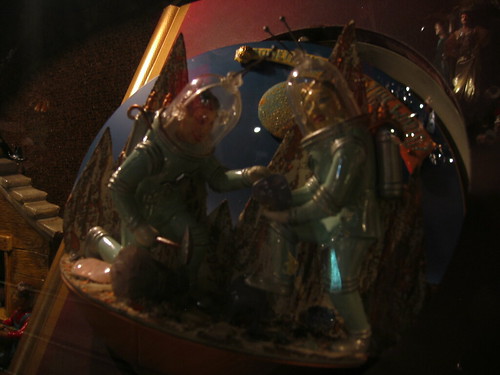


2 I've also been reading The Best of Gene Wolfe: A Definitive Retrospective of His Short Fiction, which offers different charms. If Ballard's stories are of a space colonialism, about Western civilization's endless attempts to extend its domain into areas where it's not necessarily wanted or needed, Wolfe's are often about our attempts to exert that sort of control over our own selves and beings here at home. His stories are full of mad doctors operating on humans, psychological experiments that kill, houses of human horrors. Wolfe's world is one of knowledge perverted: it's not surprising that he has a story called "The Island of Doctor Death and Other Stories." (Though it is surprising that he also has stories called "The Doctor of Death Island" and "Death of the Island Doctor"--both written to answer a dare from Isaac Asimov.)

They make a good pair for reading in alternation, Ballard and Wolfe, the antiseptic, plainspoken loneliness of space set against the gothic nightmares we can produce here at home.



1 Which leads me to a question for you all: what good sci-fi writers am I missing? Ballard and Wolfe I enjoy, Bradbury--for all his occasional sentimentalism--is a long-standing favorite, Philip K. Dick and Stanislaw Lem are as well. I tried Iain M. Banks last year, and he decidedly was not for me; I felt the same about Samuel R. Delaney's Nova, though in his case I'm not sure that I ought to give up on his whole ouevre.

Any suggestions?

Friday, May 01, 2009

J. G. Ballard (1930-2009), R. I. P.

When the news of J. G. Ballard's death came across the wires, I happened to have just finished reading Harry Harrison's Make Room! Make Room! (1966), and it was only natural to find myself comparing Harrison's novel to the two Ballard catastrophe novels I've read, The Drowned World (1962) and The Drought (1964).

The difference was stark: Harrison's novel, which presents 1999 Manhattan, teeming with people and scrapping for resources, is perfectly fine science fiction, its occasional striking image--like the rusting hulks of the Brooklyn Navy Yard re-imagined as secret freshwater lagoons--balancing its structural problems and didacticism. But that's all it is: a fairly straightforward working-out of the problems that might face a 35-million-strong Manhattan in a world of depleted resources. Harrison's New York remains recognizably our own world, populated by people we know living lives we easily understand. Their environment has changed, even turned on them, but they remain fundamentally the same.

Ballard's catastrophe novels argue that there is much more at stake: where Harrison is content to imagine the physical consequences of changes in our way of life, Ballard wants to explore how those changes affect the very core of our being, how the radical alteration of society can't help but generate a radical alteration in the self. I wrote about the pair of novels last year for the New York Moon, so I won't go into great detail here. I think a couple of passages from The Drought will suffice to give a sense of the strangeness with which Ballard invests his dystopias.

First, because Ballard's landscapes were always lavishly--if coldly--described, here's a depiction of the coast in this future where rain has forsaken us:
Under the empty winter sky the salt-dunes ran on for miles. Seldom varying more than a few feet from trough to crest, they shone damply in the cold air, the pools of brine disturbed by the inshore wind. Sometimes, in a distant foretaste of the spring to come, their crests would be touched with white streaks as a few crystals evaporated out into the sunlight, but by the early afternoon these began to deliquesce, and the grey flanks of the dunes would run with a pale light.

To the east and west the dunes stretcehd along the coast to the horizon, occasionally giving way to a small lake of stagnant brine or a lost creek cut off from the rest of its channel. To the south, in the direction of the sea, the dunes gradually became more shallow, extending into long salt flats. At high tide they were covered by a few inches of clear water, the narrowing causeways of firmer salt reaching out into the sea.

Nowhere was there a defined margin between the shore and sea, and the endless shallows formed the only dividing zone, land and water submerged in this grey liquid limbo.
The precision of that description is what impresses me most, the way that Ballard offers not just the view, but a sense of its changes through the day, as salt crystals evaporate and "pale light" touches the dunes; the dunes are fully realized in space and time, to the point that you can immediately imagine trudging over them in search--you immediately assume--of the sea.

So we are prepared for the figures who soon come over the rise--but nothing could prepare us for their unsettlingly odd appearance and actions:
At this moment, a shout crossed the air. A dozen men rose from behidn the bank surrounding the lagoon and with long paddles of whalebone began to shovel the wet salt into the breach. Sliding up to their waists in the grey slush, they worked furiously as the crystals drained backwards towards the sea. Their arms and chests were strung with strips of rag and rubber. They drove each other on with sharp cries and shouts, their backs bent as they ladled the salt up into the breach, trying to contain the water in the lagoon before the tide turned.

Watching them from the edge of the bank was a tall, thin-faced man wearing a sealskin cape over his left shoulder, his right hand on the shaft of his double-bladed paddle. His dark face, from which all flesh had been drained away, seemed to consist of a series of flint-like points, the sharp cheekbones and jaw almost piercing his hard skin.
It's a chilling scene, one into which the reader is plunged with almost no foreknowledge, no guidelines with which to interpret the people or their actions, and the effect is frighteningly dislocating. If Harrison's book is a warning of what might go wrong, Ballard's novels are closer to reminders that, when something eventually does go very wrong, no warning is going to be able to help us.

I finished those two novels last summer determined to read much more Ballard, and the many tributes to his work--far more able than mine--that appeared last week have only strengthened my resolve. I recommend the one by Simon Reynolds at Salon and Martin Amis's in the Guardian; the reviews of Ballard that Amis collected in his The War Against Cliche are also well worth seeking out.

In the meantime, U.S. publishers take note: there's a lot of Ballard that's out of print and ripe for republishing . . .

Saturday, August 02, 2008

Parched


{Photos by rocketlass.}

From "Exterminate All the Brutes", by Sven Lindqvist (1992, translated into English in 1996 by Joan Tate)
The hotel is embedded in drifting sand, alone by a deserted road across a deserted plain. I plod out into the deep sand. The sun hammers down relentlessly. The light is as blinding as darkness. The air against my face is like thin ice crackling. . . . I tape the map up on the wall and consider the distances. It is 170 miles to the nearest oasis in the West, Reggane. It is 240 miles of desert road to the nearest oasis in the north, El Golea, from which I have just come. It is 250 miles as the crow flies to the nearest oasis in the east, Bordj Omar Driss. It is 400 miles to the nearest oasis in the south, Tamanrasset. It is 600 miles as the crow flies to the nearest sea, the Mediterranean, and 800 miles as the crow flies to the nearest river, the Niger. It is 900 miles to the sea in the west. Eastward the sea is so far away, it doesn't matter.

Every time I see the distances surrounding me, every time I realize that here, at the zero point of the desert, is where I am, a stab of delight goes through my body. That is why I stay.

Appropriately timed for this boiling hot August weekend, the newest issue of the New York Moon, on a desert theme, hit the Internet yesterday. Along with some original, desert-inspired music; an investigation (with audio) of singing sands; articles on New York food and water; and some great illustrations; this issue includes a couple of contributions from me: a brief piece on two of J. G. Ballard's world-destruction novels, The Drought and The Drowned World, as well as a trawl through the more arid and sandy reaches of my library, capped by a short story that forms part of a longer work perpetually in progress.

From The History, by Herodotus, translated by George Campbell Macauley
This however is added to the story by the Ammonians themselves:--they say that as the army was going from this Oasis through the sandy desert to attack them, and had got to a point about mid-way between them and the Oasis while they were taking their morning meal a violent South Wind blew upon them, and bearing with it heaps of the desert sand it buried them under it, and so they disappeared and were seen no more.

I recommend enjoying the New York Moon with a tall, glistening glass of iced tea, while sitting in the shade. Perhaps while wearing a pith helmet.

Tuesday, January 22, 2008

And in this corner, Anthony Dymoke Powell!


Though I understand that lists of the best this, the most that, and the greatest the other have an ineluctable appeal to editors--as well as an undeniable role to play in warming the air around barstools--I generally don't get too worked up about them. If this blog as a whole argues for anything, it's for the pleasures of creating one's own canon, pawing the stacks of the world's literatures to determine--and shout to the rooftops about--what belongs nearest one's own heart. It thus seems barely worth arguing about the vagaries of quasi-objective rankings, especially if I don't know the underlying aesthetic sensibilities of the compilers.

A few days ago, however, Ed from the Dizzies called on my services as a fan of Anthony Powell to argue against Powell's placement in the twentieth position, one behind Martin Amis, on the Times's list of the fifty greatest postwar British writers. Having been thus entered into the lists on behalf of my favorite writer, how could I refuse?

In some ways, the ranking seems absurd on its face: Amis's three or so good novels look paltry next to the twelve-novel stack of Powell's masterpiece A Dance to the Music of Time--let alone Powell's early and late comic novels, which stand at least equal with some of Evelyn Waugh's lesser works.

But that doesn't quite seem fair to Amis's novels, some of which I like a lot. While nowhere near as good as his father's best, Lucky Jim (1954), Martin Amis's The Rachel Papers (1973) is still one of the funniest books I've ever read--and, much like Joe Matt's comics, it's impressive in its ability to make me squirm with shame at certain elements of maleness I can't deny having at times shared with the feckless young narrator. London Fields (1989), though it ultimately shambles to a messy, disappointing conclusion, is nearly redeemed by the sheer audacious electricity of its prose.

And while I tend to prefer Powell's looser, more anecdotal approach when it comes to writing criticism, Amis's critical writing is also sharp and thoughtful, driven by an appreciation of precisely crafted descriptive prose and alert to humbuggery (yet without descending nearly so often as Christopher Hitchens into smug self-righteousness). The opening paragraphs of his reappraisal of J. G. Ballard's Crash on the occasion of the release of the David Cronenberg film give a good sample of the latter characteristic, accompanied by another trademark of Amis the reviewer: self-deprecation.
I reviewed Crash when it came out in 1973; and, as I remember, the critical community greeted Ballard's novel with a flurry of nervous dismay. But of course reviewers do not admit to nervous dismay. Nervous dismay is a response that never announces itself as such, and comes to the ball tricked out as Aesthetic Fastidiousness or Moral Outrage.

Crash provoked much fancy dress. Some reviewers reached for their thesauri and looked up "repellent"; cooler hands claimed to find the novel "boring." I'm not sure if anyone else adopted the guise I wore: sarcasm. Haughtily (and nervously), I sent Crash up. I was twenty-three. Later that year my first novel appeared, and, like Ballard, I stood accused of displaying a "morbid sexuality." In comparison, thought, my sexuality--and my novel--were obsequiously conventional.
Having said all that, I still choose Powell. With Dance he has given me dozens of characters who have quite simply become part of my mental universe. They are so richly imagined and sympathetically depicted that they inflect my everyday experience of the world; they're the sort of characters who, to the initiated, serve as topics of conversation, common reference points, aids to understanding new acquaintances, clarifying punch lines to real-life situations.

On top of that, Dance is consistently funny, its humor often grounded in the bewilderment created when those who care only for money or power are confronted with the world of art. Here, for example, Nick Jenkins fields a question from his friend and sometime nemesis Kenneth Widmerpool about his job:
"I was in publishing. Art books. Now it is the film business."

"Indeed? What unusual ways you choose to earn a living."
Or take this exchange, which finds Nick discussing books with the enthusiastic, if gruffly fuddled, octogenarian General Conyers:
"I've been reading something called Orlando," said the General. "Virginia Woolf. Ever heard of it?"

"I read it when it first came out."

"What do you think of it?"

"Rather hard to say in a word."

"You think so?"

"Yes."
Unsatisfied, the General presses Jenkins:
"Odd stuff, Orlando," said the General, who was not easily shifted from his subject. "Starts about a young man in the fifteen-hundreds. Then, about eighteen-thirty, he turns into a woman. You say you've read it?"

"Yes."

"Did you like it? Yes or no?"

"Not greatly."

"You didn't?"

"No."

"The woman can write, you know."

"Yes, I can see that. I still didn't like it."

The General thought again for some seconds.

"Well, I shall read a bit more of it," he said, at last. "Don't want to waste too much time on that sort of thing, of course. Now, psychoanalysis. Ever read anything about that? Sure you have. That was what I was on over Christmas."
Powell's characters--and the gentle irony of his tone--serve as a reminder that we're all strange in our own ways, and we apprehend one another poorly at best; a healthy response is to accept, and attempt to understand, as much of that odd individuality as we can. It's an approach to the world that I ultimately find far more congenial than Amis's more corrosive, biting, and often nasty perspective.

Powell, who didn't mind a literary feud, might enjoy being given the last word; perhaps the following excerpt from the fourth volume of his autobiography, The Strangers All Are Gone (1982) will serve as an acute reminder of the proper relation between himself and Martin Amis. Describing a visit to Kingsley and Hilly Amis early in Kingsley's career, Powell writes:
During the Swansea visit the three Amis children were in some skilful manner relegated so that the Uplands house was entirely free from them throughout our stay. Since Waugh was very keen on the doctrine that children should neither be seen or heard, Violet mentioned to him the adroitness of the Amises in having so resourcefully disposed of their family.
I wouldn't go so far as to say that Martin should be neither seen nor heard, but perhaps he should cede his hold on the nineteenth position to his elder and better?