Showing posts with label Edmund Gosse. Show all posts

Monday, January 09, 2012

John Sutherland and James Hogg

For the past few weeks, I've been taking great delight in dipping into John Sutherland's Lives of the Novelists: A History of Fiction in 294 Lives, which was published in the fall in the UK by Profile Books and will appear stateside from Yale in the spring. Here's how much fun it is: Sutherland's survey, which he acknowledges is idiosyncratic, leaves out Penelope Fitzgerald, Barbara Pym, P. G. Wodehouse, Dorothy Dunnett, Donald Westlake, Rex Stout, and others of my favorites, while including such far less interesting figures as Michael Crichton, Paul Auster, Patricia Cornwell, to name just a few; Sutherland also evinces a very English casualness about grammar that sees him peppering the page with dangling and misplaced modifiers; in addition, when he approvingly quotes the best, most laugh-out-loud funny line in Lucky Jim, he misquotes it and leaves out the most important, funniest word ("the smallest glass Jim had ever been offered" rather than "the smallest drink he'd ever seriously been offered"); and on top of that he mistakenly identifies Nick Charles as the "thin man" of the title of Hammett's novel about him--yet despite all of those reasonably serious quibbles, I heartily recommend the book to any lover of literature and biography, especially Anglophiles. It's witty, it's perceptive, it's crammed full of great lines and unusual bits of information conveyed in the best telegraphic brief lives tradition. It's clear that it's a book I'll be consulting and enjoying for years to come.

Today, I'll share a tidbit from Sutherland's entry on James Hogg. Hogg, explains Sutherland, wrote his masterpiece, The Private Memoirs and Confessions of a Justified Sinner, "[i]n a desperate attempt to raise money for family dependants now as numerous as a small clan." Perhaps he should have chosen a more straightforward tale, something like what his friend and patron Walter Scott was retailing from nearby, for Hogg's truly strange, powerful tale of predestination and the devil at his work in rural Scotland,
failed spectacularly to hit the public taste of the time. It earned the author £2 in "profits" (miscalled) in the two years Longman kept the book in print. There were moves on their part to recover the £ advance. The few reviews the novel received concurred in finding it "trash"--and indecent. It was certainly far rawer meat than most fiction offered the circulating libraries. One strains, for example, to imagine Isabella Thorpe and Catherine Morland reading it together before going off to their morning session at the Bath Pump Room.
Even a century later, the book was still dividing readers: Edmund Gosse, in a piece taking up a book published in praise of Hogg, wrote,
When it first appeared, in 1824, it was received very coldly and suspiciously, but it presently found admirers, and has never completely lacked them. Those, however, who have occupied themselves with it have always done so cautiously. They have admitted its incoherence, but have insisted on its vigour and intensity. They have apologised for its faults of construction.
Goss, after actually stooping to a "whole Hogg" joke, continues,
But there are many readers who are not affected by inconsistency of handling, and are indifferent to logic if a tale amuses them. They may still find entertainment in the imbroglio of the unfortunate Colwin family, many of whose remarkable adventures are told with great vigour and picturesqueness.
Gosse does acknowledge that it is "an extraordinary book," but he closes his essay by questioning Hogg's purported literary bravery--he "was no Moliere."

It seems sadly appropriate that, after skating on the thin ice over poverty for nearly his entire career as a writer, Hogg, Sutherland tells us, "while curling, . . . fell through the ice on Duddingston Loch, below Arthur's Seat, and never fully recovered." For most of the dead, even this nonbeliever can't help but vaguely wish that they spend eternity in something approximating heaven; for Hogg, I find myself also wishing that he at least got to stop off for a bit in Hell and receive the thanks of its monarch for his unforgettable, convincing portrayal.

Wednesday, February 25, 2009

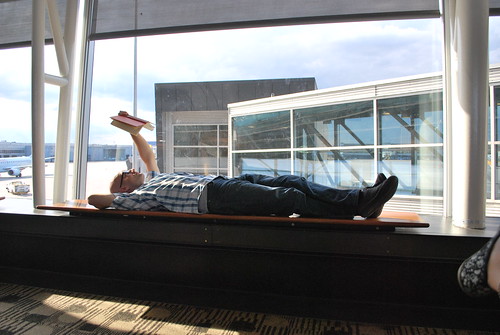
"Some dilate upon the number and kind of books suitable for a journey . . . "


{Photo by rocketlass.}
As travelling companions books have no corrival. If they lacked other purpose or defence, this alone would justify them before men. How many hours they have scattered pleasantly on lone and long journeys; what limitless tedium they have relieved or circumvented, how they have filled the waking hours, or composed the weary brain for sleep, every reader can support.
Those lines from Holbrook Jackson's seventeenth-century-style The Anatomy of Bibliomania (1948) seem right for this post, the last that I've lined up in advance to run while I'm off in Japan. For while the 600-plus posts on this blog surely put my love of books beyond question, I have to part with Jackson here: were the choice necessary, I would always select congenial living companions over books on a journey.

The following, too, seems worth quoting, if only to remind me that, however much my shoulders may ache from the weight of too many books at this point in my trip, my bibliomania could always be worse:
Some have gone so far as to construct travelling libraries for themselves, like Sir Julius Caesar, Master of the Rolls in the reign of King James I. His library went wherever he did. It was arranged in a box, shaped like a folio volume, covered with olive-green morocco, finely tooled in an elaborate pattern. On the inside lid was a catalogue of the forty-four books which comprised the library.
Which leads me to this closing line, the italicized part of which Jackson draws from Edmund Gosse's Library of Edmund Gosse:
I might here insert many more opinions, but they all tend to one conclusion: books are not entirely valued or intimately loved unless they are ranged about us as we sit at home.
And that is where, to sit quietly with my martinis and my cats, I am headed.

Friday, September 26, 2008

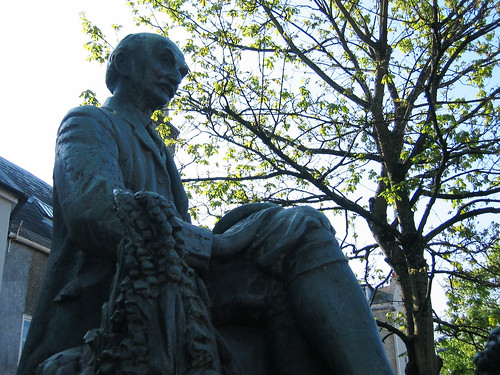
"Mr. Hardy was of medium height and figure . . . his expression placid rather than sad."


{Photo of Thomas Hardy's boyhood home by rocketlass.}

Earlier this week I raved about the many pleasures to be found in The New Oxford Book of Literary Anecdotes (2007), offering a couple of examples from the entry for Lord Byron, whose life spun off enough rich anecdotes to fill a personal Decameron.

It would seem wrong, however, to close discussion of the book without also turning to another of this blog's favorite preoccupations, Thomas Hardy; fortunately, the volume doesn't disappoint when it comes to Dorchester's greatest export. First, we learn that Hardy had something unexpected in common with Vladimir Nabokov: both were synesthetes, as Elliot Felkin's "Days with Thomas Hardy" (published in Encounter in 1962) reveals:
He went on to talk about days of the week and colours and associations. Monday was colourless, and Tuesday a little less colourless, and Wednesday was blue--"this sort of blue" pointing to an imitation Sevres plate--and Thursday is darker blue, and Friday is dark blue, and Saturday is yellow, and Sunday is always red.
And Tess fans can't help but marvel at this story, told by Hardy's second wife, Florence, in her The Later Years of Thomas Hardy (1930), of a hospital visit to Hardy's friend Lord Pembroke:
He [Pembroke] was now ill at a nursing home in London, and an amusing incident occurred while his visitor was sitting by his bedside one afternoon, thinking what havoc of good material it was that such a fine and handsome man should be prostrated. He whispered to Hardy that there was a "Tess" in the establishment, who always came if he rang at that time of day, and that he would do so then that Hardy might see her. He accordingly rang, whereupon Tess's chronicler was much disappointed at the result; but endeavoured to discern beauty in the very indifferent figure who responded, and at last persuaded himself that he could do so. When she had gone the patient apologized, saying that for the first time since he had lain there a stranger had attended to his summons.
The New Oxford Book of Literary Anecdotes includes a handful of additional Hardy stories, all good--but really nothing can touch the trove that is Thomas Hardy Remembered (2007), edited by Martin Ray. A compilation of firsthand accounts of Hardy by both the well- and the little-known, it offers page after fascinating page of sheer pleasure for the Hardy fan. Sure, it costs £55 (which, until John McCain unsuspends the suspension of the suspension of his campaign and flat-out superheros this economic crisis, is something like $1,000,000,000.34), but where else are you going to find such a collection of Hardy anecdotes?

Hell, I would argue that this one from Augustus John's Chiaroscuro: Fragments of Autobiography (1952) is worth nearly £55 on its own, if for no other reason than the vehemence of Hardy's protest:
Thomas Hardy had good reason to view with anxiety the demonstrations of some of his admirers. One of these, hailing from the USA, on the strength of a few minutes interview, produced a book entitled Thomas Hardy's Universe [Ernest Brennecke, 1952--ed.], in which the poet was described as soliloquizing before the fire, while smoking a succession of cigarettes. "But," said Hardy, with a gesture of despair, "I have never smoked a cigarette in my life!"
Or this nuanced appraisal from Edmund Gosse's obituary of Hardy in the Sunday Times of January 15, 1928:
[Hardy] needed all the natural magic of his genius to prevent his work, interpenetrated as it was by this resigned and hopeless melancholy, from becoming sterile, but joy streamed into it from other sources--the joy of observation, of sympathy, of humour. Yet, after all, the core of Hardy's genius was austere and tragical, and this has to be taken into consideration, and weighed in every estimation of his writings. It was a curious fact, and difficult to explain, that this obvious aspect of his temperament was the one which he firmly refused to contemplate. The author of Tess of the d'Urbervilles conceived himself to be an optimist.
Or, returning to Tess, this account of authorial travails from Frank A. Hedgcock's "Reminiscences of Thomas Hardy" (published in the National and English Review of October 1951):
He thought that public opinion was probably right in regarding it as his best novel; but he had put too much feeling into it to recall it with pleasure.
However, my favorite of Hardy's references to Tess (aside, that is, from this one) comes from Desmond MacCarthy's "Thomas Hardy: The Writer" (published in the BBC magazine The Listener on June 6, 1940). For its sheer disingenuousness, this anecdote alone is definitely worth £55, exchange rates be damned:
Once when we were passing some spot in Tess he said to me, "If I had thought that story was going to be such a success, I'd have made it a really good book."
Methinks a re-read of Tess may be on my autumn calendar.


{Photo by rocketlass.}

Thursday, September 13, 2007

A pert wanton


{Edmund Gosse and his father, Philip}

Midway through Edmund Gosse's thoughtful, moving autobiography, Father and Son (1907), there's a moment that will amuse any lover of dictionaries. Young Edmund, who after the death of his mother is being raised under the stern, even stifling, hand of his deeply religious father, is describing the unexpected appearance in their relatively cloistered life of Miss Wilkes, an attractive young fellow member of their religious sect, the Plymouth Brethren. Edmund's father is by nature a solitary, unsociable sort--Edmund describes him as "a fortress that required to be stormed"--but Miss Wilkes manages to worm her way into his good graces and becomes a regular visitor to the house. Years later, Edmund is still uncertain whether she was aiming for anything more than friendship, though the circumstances and her determination would seem to indicate that she was, but he does recall overhearing the housekeeper telling the cook that, "quite as between you and me," Miss Wilkes was a "minx." Gosse, displaying the curiosity that makes his young self endearing despite his priggishness, writes:
I had the greatest curiosity about word, and as this was a new one, I looked it up in our large English Dictionary. But there the definition of the term was this:--"Minx: the female of a minnock; a pert wanton." I was as much in the dark as ever.
But it gets even better: as Michael Newton, editor of the Oxford World's Classics edition (to which he contributes a remarkably interesting Introduction), notes:
EG may be making this up. The edition of Nathan Bailey's An Universal Etymological English Dictionary (1721), that we know the Gosses owned, defines "minx" as "a proud Girl."
Once in a while, the uheralded grunt work done by patient literary scholars really pays off for us ordinary readers.

Gosse really is a fascinating figure--and not a bad one with which to follow a post about Ring Lardner, actually. In her Thomas Hardy, Claire Tomalin explains that he "had appointed himself as the fixer of the London literary world," the man who knew everyone--including Hardy, with whom he became close friends--and who "dedicated himself to living the literary life more seriously than anyone else has ever done," but without producing much himself beyond some unexceptional poetry. Evelyn Waugh, to whom Gosse was related, says of him in A Little Learning:
I held Gosse in disdain. His polished art of pleasing was not effectively exercised on children. I remember him once, when I was, I suppose, eight or nine, greeting me with: "And where do you carry those bare knees?"

I answered pertly, "They carry me wherever I want to go."

"Ah the confidence of youth! To be able to envisage an attainable destination!"

Newton describes him, in old age, as exactly the sort of figure the youthful Waugh would rail against:
That pitiful thing, the unsmiling public man. He was the official representative of letters; a tame author. . . . He had crucified poetry on the cross of respectability. No one believes a laureate will write a good poem, and Gosse was the laureate of belle lettres.
Yet with Father and Son, initially published anonymously, he surprised everyone. It is a remarkable, emotionally open picture of, as Gosse describes it, a conflict of temperaments, relating the growing estrangement between Edmund and his father--an estrangement propelled by Edmund's experience of a process that will be familiar to all readers of late-Victorian biography, the loss of faith. While Edmund writes the book, in a sense, against his father, it is, as Newton describes it, "a loving attack"--the very depths of emotion and analysis that he brings to the writing render his father at least as compelling a figure as Edmund himself.

And if that's not enough to tempt you into reading it, Gosse's vocabulary might--I learned a handful of great new words along the way. There's jobation, defined as "a lengthy and tedious rebuke." There's a French word, detraquee, defined as "someone unhinged, who's gone 'off the rails,' though without the usual suggestion of a drift into dissipation." Fuliginous, meaning "smoky or sooty," and a Latin term, quidnuncs, defined as "gossips or busybodies."

Add a pert wanton, and what more could a reader want?

Sunday, February 25, 2007

Claire Tomalin on Thomas Hardy

Claire Tomalin's Samuel Pepys: The Unequalled Self (2003) is, hands down, the best biography I've read. In choosing Pepys as her subject, Tomalin set herself a tremendously difficult task--after all, how can any biography top the story Pepys himself tells?
29 June 1663
In Westminster Hall fell in talk with Mrs Lane and after great talk that she never went abroad with any man as she used heretofore to do, I with one word got her to go with me and to meet me at the further Rhenish wine-house--where I did give her a lobster and do so towse her and feel her all over, making her believe how fair and good a skin she had; and endeed, she hath a very white thigh and leg, but monstrous fat. When weary, I did give over, and somebody having seen some of our dalliance, called aloud in the street, "Sir, why do you kiss the gentlewoman so?" and flung a stone at the window--which vexed me--but I believe they could not see my towsing her; and so we broke up and went out the back way, without being observed, I think.
Pepys is an unparalleled narrator of his own life, yet Tomalin's biography is full of verve, so affecting that his death at the close of the book feels like the death of a friend.

Her biography of Thomas Hardy is not quite as powerful, but the fault lies, I judge, less with Tomalin than with Hardy, who, for all his frequent charm, has little of Pepys's self-involved liveliness--but who among us does? Tomalin regardless brings her formidable biographical skills to bear, and despite the frequent assertions by Hardy's friends that he was essentially inscrutable, she succeeds in creating a convincing portrait. Her Hardy is a man whose complicated internalization--and overcoming--of early disappointments fueled a lifetime of tremendous achievements, achievements which were perpetually undercut by a deep-rooted melancholy and doubt. Trapped in an unexpectedly unhappy marriage, resentful his whole life of the class structure that blighted his youth, and unable to will a belief in a higher purpose or eternal reward, Hardy as revealed by Tomalin is frequently a sad, even sometimes pathetic figure. But at the same time, we marvel along with her at Hardy's unflagging curiosity and drive, and she never lets us lose sight of the remarkable talent that makes his life worth remembering.

Tomalin's greatest gift as a biographer is her wide-ranging sympathy. Though realizing that our knowledge can never be perfect, she really wants to understand everyone's reasons, see everyone's point of view. Her inclination is to give each person the benefit of the doubt, but she doesn't flinch from judging when the evidence calls for it; that openness to the multiplicities of motive and feeling are what give her biographies the full roundedness of real life. She's the biographer we all should hope to have.

Her treatment of Hardy's first wife, Emma, whose personal oddity was commented upon in letters and diaries by nearly everyone who met her, is typical of her approach:
[Edmund] Gosse's letter to his wife Nellie included a careful comment on Emma: "She means to be very kind," he wrote. Hardy was too observant not to notice that his friend was sometimes rather at a loss in his attempts at conversation with his wife. To find that Emma's zest for life, so much prized by him during their wooing, was not so attractive to others, and that her charm fell flat, was upsetting. Of course she was middle aged now. She no longer wore her glorious hair over her shoulders in curls, her strong features were settling into heaviness, and her talk sometimes strayed from the point and followed its own track in a way that had once seemed delightful but now sometimes disconcerting.
Hasn't everyone known someone like that, someone just a little off--or felt like that themselves at times? And doesn't Tomalin's portrait elicit sympathy for Hardy? But then she continues:
Feeling unappreciated brings out the worst in everyone, and when people failed to warm to Emma she became more difficult. She had lost her hope of children, hardly saw her own family and was suspicious of his. A letter this year from her friend in Sturminster, Mrs. Dashwood, also reminded her of her failed literary amibitions: "I hope your stories will emerge one after another and astonish the literary world, they have been concocting in your head long enough and should now see the light . . . When will you and Mr. Hardy spend the day with us? You have not visited this gay city for a long time, and ought to renew your acquaintance once with it." Emma could say nothing of any publication prospects, alas, and there was no visit to the gay city of Sturminster. Gosse's friendship with Hardy was strong enough to include Emma, but he never warmed to her in her own right.
Though our sympathies don't shift completely--Emma is, after all, clearly a source of real difficulty for everyone--Tomalin's emotional contextualization of her behavior leavens our judgment; it is a courtesy Tomalin extends to everyone.

In Friday night's post I mentioned how apt I found Tomalin's take on Jude the Obscure (1895); the following passage gives a good sense of how sharp her literary criticism can be. She quotes Hardy essentially abdicating responsibility for his characters' sufferings, saying that he is only reflecting the darkness of fate and circumstance. Then she argues:
Hardy's defense is made weaker because there are other examples in his fiction of people suffering from exceptionally bad luck--luck so bad that it looks as though it has been willed, by the gods, or fate, or possibly by the author. For example, when the young Jude falls into despair at the difficulty of learning Latin and Greek, "he wished he had never seen a book, that he might never see another, that he had never been born." This is a reasonable account of a sensitive boy's reaction to severe disappointment, but Hardy continues. "Somebody might have come along that way who would have asked him his trouble, and might have cheered him . . . But nobody did come, because nobody does." I have put the last words in italics because this is not a true account of life. Hardy is not only coercing his plot, he is generalizing falsely. There are times when nobody comes, but there are also times when somebody does come. For example . . . a good many people had come along [for Hardy himself]. Jude is not Hardy, of course, but in so far as he represents Hardy's own unfulfilled wish to go to a university, he is put through a much worse experience than Hardy ever went through. This is part of what made even Hardy's friend Gosse ask in his review, "What has Providence done to Mr Hardy that he should rise up in the arable land of Wessex and shake his fist at his Creator?"
Most of my thinking about literature ultimately boils down to that question--is this a true representation of life? Thus I view generalizing falsely as one of the greatest offenses an author can commit, and Tomalin the critic is a deeply congenial spirit. The criticism of Hardy's novels in Thomas Hardy not only managed to make me think afresh about them, it woke me as well to his poetry, of which I'd read little. Tightly rhymed, flawlessly rhythmic, with a strong spine of thought, as Tomalin puts it, in each poem, it hadn't impressed me when I was twenty. I was looking for something less formal--Hardy's poetry felt dated, not adventurous enough. But I suppose the list of things that don't impress us when we're twenty are extensive; if we have the good fortune to live long enough, maybe eventually they're no longer even embarrassing.

This is where I take advantage of the fact that this is a blog, rather than a newspaper or magazine. I should end this with a summation, a statement about Hardy or the biography. But instead, because we've had thick, wet snow all day here--the sort through which you splash in the morning and slip at night--and I've spent many an hour in my chair by the window watching wet, puffed-up juncos and finches eat thistle from our feeder, I'll end instead with Hardy's "Snow in the Suburbs" (1925):
Every branch big with it,
Bent every twig with it;
Every fork like a white web-foot;
Every street and pavement mute:
Some flakes have lost their way, and grope back upward when
Meeting those meandering down they turn and descend again.
The palings are glued together like a wall,
And there is no waft of wind with the fleecy fall.
A sparrow enters the tree,
Whereon immediately
A snow-lump thrice his own slight size
Descends on him and showers his head and eye
And overturns him,
And near inurns him,
And lights on a nether twig, when its brush
Starts off a volley of other lodging lumps with a rush.
The steps are a blanched slope,
Up which, with feeble hope,
A black cat comes, wide-eyed and thin;
And we take him in.