A couple of weeks ago, I was in a cab heading to the airport early on a weekday morning, when I heard something on the radio that I think you folks will enjoy. The driver was listening to an FM top 40 station, and their wacky morning crew was on, being, well, wacky (as distinct from, you know, funny). Apparently they have a regular segment where someone calls in to tell them about a date that went wrong, and they then call the other party to get their side; today, the caller was a guy, Dan, who said he'd been on a couple of dates with a woman, Anna, he'd met through work. He'd thought they were getting along well, but then, after an evening when they went back to his place and fooled around a little, she'd abruptly stopped responding to his calls and texts.
As they dialed this poor woman's number, I was, quite frankly, dreading the next ten minutes of the ride. What could this exchange be except deeply awkward at best, crude and mean at worst? Initially, it seemed like my fears were coming true: they got her on the line, explained who they were and why they were calling, and, after establishing that the guy was on the line, she said, "Well, I guess we're doing this live on the radio, then."
This was not a promising opening. But then everything changed:
ANNA: "Do you remember, Dan, when you left the room to go to the bathroom? And you had a book on your bedside table? Do you remember what it was?"
DAN: "No?"
ANNA: "It was called House of Holes."
DAN (and ME, simultaneously): "Oh, no. No, no, no."
For those of you who don't know--and I'm assuming 98% of the radio audience that day fell into that category--House of Holes is a work of pornography. Sort of. See . . . it's by Nicholson Baker, a strange, wonderful, brilliant, sui generis writer who cares as much about words and sentences as anyone I've ever read and who seems determined to make each book he writes completely different from everything that he's written before.
What led him to write a novel about a futuristic, gleefully perverse pleasure resort where, to be crude about it, everyone and everything is DTF? Who knows? But while it's porny AF (might as well stick with the internet abbreviations what brung me), it's also goofy and funny and wide-eyed. It's not a great novel; I'm not even sure it's a successful one. But it's also nothing like the midcentury men's whack books that people like Donald Westlake were hired to write--whereas those tend to be soul-draining, Baker's book is, even if ultimately a bit of a mess, vivifying. I've written about it before--and even had a kindred experience to Dan's, of worrying about someone who didn't understand the book seeing it.
None of which, of course, can be explained on a Top 40 station to a woman and two DJs who are wholly unfamiliar with Baker. After Anna explained, in reasonably family-friendly language, what she'd discovered in flipping through the book, the DJs were cackling and Dan was left sputtering, with evident regret and sadness, "Didn't you notice that I have all kinds of books?"
It didn't work. You could tell he knew it wouldn't as he was saying it. Rarely have I felt such unexpected, powerful sympathy for a total stranger. Careful what you read, kids--or, at least what you leave on your bedside table when you might be sharing your bed.
Showing posts with label Nicholson Baker. Show all posts
Showing posts with label Nicholson Baker. Show all posts
Sunday, November 20, 2016


Wednesday, February 06, 2013
De La Pava to Baker to DeWitt, which deserves, methinks, an Oh, my!
When I asked Sergio De La Pava a couple of years ago what his goals were as a writer, he said that he wanted all of his books to be completely different from each other--which admirable goal got us to talking, trying to figure out what writers, if any, could claim that for their work. After dismissing a lot of possibilities, I finally came up with one: Nicholson Baker. Baker has written novels about feeding a baby, a trip to the drugstore over lunch, lighting a fire, a child's thoughts on grade school, assassination, failing to write poetry, stopping time (and using that power for sex), phone sex, and sex sex. Each one takes its own form, some feeling, structurally, like a fairly typical novel, others feeling more like freely conceived essays or memoirs.
I was thinking about Baker again this week because I just read his novel The Everlasting Story of Nory for the first time, prompted by an appreciative essay by Jeremy Noel-Tod in Slightly Foxed that said it was "a bedside book in the best sense: it comforts and amuses, and translates the world with dream-like lucidity." Which is accurate, and, in an odd way, could be said of most of Baker's otherwise disparate books. And I kept coming back to the idea of all his books being different--yet, at the same time, all feeling like kin. So what holds them together--what are Baker's primary qualities as a writer?
I'll try three:
1 He's not embarrassed by any of his thoughts.
2 He thinks nearly everything in the world is worthy of thought.
3 He thinks the words used to describe that world, or those thoughts, are at least as important as the things described.
The most amazing of these is, of course, the first one. We all are embarrassed by our thoughts, because we all have plenty that are banal, or nonsensical, or, most embarrassing, solipsistic. That last is at its worst when it comes to sex, one of Baker's recurrent topics. There's simply no way to write about sex without revealing more than we want to of ourselves, laying ourselves open to ridicule. Yet that doesn't stop Baker.
Such freedom is admirable, but--especially allied to the second point--it also could easily make for unbearable writing. And that's where Baker's congenial, approachable, fundamentally likeable mind comes in. The unbearable version would parade his most idiosyncratic (and/or dirtiest) thoughts as if they were TRUTHS (think D. H. Lawrence, whom I love at times, at his phallocentric worst); Baker presents them as if he knows he should be embarrassed, but he's so excited by them, so wholly engaged with following them where they're leading, that he can't help but share them, and share his confidence that we'll enjoy the chase, too. He's giggling, quietly. When you add the third point, a prose as lush, precise, and worked-over as any since Nabokov, the combination can be incredibly winning.
It doesn't always work, and sex is, not surprisingly, where it most often falls down. In The Fermata, a book that is mostly quite good, the parts where Baker explicitly and deliberately sets out to write pornography are the only truly dull stretches in his oeuvre. And even the much better (when it comes to porn) House of Holes: A Book of Raunch (2011), his most recent novel, while at times a lot of fun for its sheer linguistic and scatological inventiveness, ultimately falls a bit flat. Baker, clearly, is taking unabashed joy in letting his smuttiest imagination fly--and, again, he's wholly unembarrassed about its contents--but someone else's fantasy, however well-honed, is ever going to do for you what it does for them.
All of which, by the roundabout ways that reading and thinking about books works, brought me to Helen DeWitt, an author who, in the hyper-logical intensity of her sentences, has some affinities with our starting point, Sergio De La Pava. The same year that House of Holes came out, DeWitt published her second novel, Lightning Rods. It, too, was, in a way, about sex--in fact, one of the masturbatory fantasies with which its down-and-out salesman protagonist consoles himself at the start of the novel could almost be plunked down into Baker's book. But in every other way, DeWitt's book is different, and superior.
Baker writes about sex as it might be if we could strip it of consequence and inhibition both; it's an unrealizable (and, I suspect, fundamentally masculine) utopia. DeWitt writes the more chillingly plausible story of what happens when sex is run through the grinder of corporate jargon, masculine privilege, and capitalist nonsense. In telling the story of an entrepreneur who finds success selling companies on the value (to their bottom line) of offering their sexual harassment–prone alpha male salesman types an anonymous sexual outlet at the office--the "lightning rods" of the title--DeWitt never breaks character, never lets on that this jaw-dropping fairytale of a simple problem and a simple solution just might have more personal, social, and political valences than dreamed of in her salesmen's philosophy. In fact--and here's where I stand in awe--to my memory she doesn't write a single phrase that couldn't have come from the mephitic bowels of a corporate strategic messaging office, as-told-to business memoir, or Successories calendar.
Take this self-assessment by one of the lightning rods:
Baker, most often, and particularly in House of Holes, is playing--though from his playing, as from all play, real emotion and real, lasting meaning can and do emerge. His play, because he cares about it so much, is in its way serious. DeWitt, however, is hunting--and bagging--bigger game. Lightning Rods is an astonishing book: funny, smart, vicious, and effective. It paints a picture of a future--hell, a present--where corporate culture's goal of making us all slides in a perfect problem-solving PowerPoint presentation has reached one of its logical end points. It may be funny--at times enough to make me laugh out loud--but damn, is it bleak.
I was thinking about Baker again this week because I just read his novel The Everlasting Story of Nory for the first time, prompted by an appreciative essay by Jeremy Noel-Tod in Slightly Foxed that said it was "a bedside book in the best sense: it comforts and amuses, and translates the world with dream-like lucidity." Which is accurate, and, in an odd way, could be said of most of Baker's otherwise disparate books. And I kept coming back to the idea of all his books being different--yet, at the same time, all feeling like kin. So what holds them together--what are Baker's primary qualities as a writer?
I'll try three:
1 He's not embarrassed by any of his thoughts.
2 He thinks nearly everything in the world is worthy of thought.
3 He thinks the words used to describe that world, or those thoughts, are at least as important as the things described.
The most amazing of these is, of course, the first one. We all are embarrassed by our thoughts, because we all have plenty that are banal, or nonsensical, or, most embarrassing, solipsistic. That last is at its worst when it comes to sex, one of Baker's recurrent topics. There's simply no way to write about sex without revealing more than we want to of ourselves, laying ourselves open to ridicule. Yet that doesn't stop Baker.
Such freedom is admirable, but--especially allied to the second point--it also could easily make for unbearable writing. And that's where Baker's congenial, approachable, fundamentally likeable mind comes in. The unbearable version would parade his most idiosyncratic (and/or dirtiest) thoughts as if they were TRUTHS (think D. H. Lawrence, whom I love at times, at his phallocentric worst); Baker presents them as if he knows he should be embarrassed, but he's so excited by them, so wholly engaged with following them where they're leading, that he can't help but share them, and share his confidence that we'll enjoy the chase, too. He's giggling, quietly. When you add the third point, a prose as lush, precise, and worked-over as any since Nabokov, the combination can be incredibly winning.
It doesn't always work, and sex is, not surprisingly, where it most often falls down. In The Fermata, a book that is mostly quite good, the parts where Baker explicitly and deliberately sets out to write pornography are the only truly dull stretches in his oeuvre. And even the much better (when it comes to porn) House of Holes: A Book of Raunch (2011), his most recent novel, while at times a lot of fun for its sheer linguistic and scatological inventiveness, ultimately falls a bit flat. Baker, clearly, is taking unabashed joy in letting his smuttiest imagination fly--and, again, he's wholly unembarrassed about its contents--but someone else's fantasy, however well-honed, is ever going to do for you what it does for them.
All of which, by the roundabout ways that reading and thinking about books works, brought me to Helen DeWitt, an author who, in the hyper-logical intensity of her sentences, has some affinities with our starting point, Sergio De La Pava. The same year that House of Holes came out, DeWitt published her second novel, Lightning Rods. It, too, was, in a way, about sex--in fact, one of the masturbatory fantasies with which its down-and-out salesman protagonist consoles himself at the start of the novel could almost be plunked down into Baker's book. But in every other way, DeWitt's book is different, and superior.
Baker writes about sex as it might be if we could strip it of consequence and inhibition both; it's an unrealizable (and, I suspect, fundamentally masculine) utopia. DeWitt writes the more chillingly plausible story of what happens when sex is run through the grinder of corporate jargon, masculine privilege, and capitalist nonsense. In telling the story of an entrepreneur who finds success selling companies on the value (to their bottom line) of offering their sexual harassment–prone alpha male salesman types an anonymous sexual outlet at the office--the "lightning rods" of the title--DeWitt never breaks character, never lets on that this jaw-dropping fairytale of a simple problem and a simple solution just might have more personal, social, and political valences than dreamed of in her salesmen's philosophy. In fact--and here's where I stand in awe--to my memory she doesn't write a single phrase that couldn't have come from the mephitic bowels of a corporate strategic messaging office, as-told-to business memoir, or Successories calendar.
Take this self-assessment by one of the lightning rods:
Lucille had always thought of herself as pretty unflappable. The way she saw it was, she was the kind of person who could take things in her stride. She didn't let things get to her. Whatever might be going on around her, she just got on with whatever it was she had to do. Also, she prided herself on her attention to detail More specifically, she prided herself on paying attention to detail without getting obsessed about it. Basically she was the kind of person who could just get on with the job without making a fuss about it. Give her something to do and she would get the job done.Or this, from the salesman himself:
For the next couple of days Joe tried to put a brave face on things. He tried not to think about the PVC with a slit in the crotch which the Equal Employment Opportunities Act was going to force him to implement. If he thought about it he was just going to get depressed, and in sales you can't afford to get depressed. You can't afford to go around thinking What's the point? That negative take on the product will communicate itself to the customer, and before you know it all the hard work you put into getting your foot in the door will be down he drain.Such is the shorthand, and the shortcuts and short-circuits of thought, with which corporate life implicitly encourages us to mask the reality, and real consequences, of what we're doing as we blithely type away at our workstations every day.
Sooner or later, though, we all have to face the facts.
Baker, most often, and particularly in House of Holes, is playing--though from his playing, as from all play, real emotion and real, lasting meaning can and do emerge. His play, because he cares about it so much, is in its way serious. DeWitt, however, is hunting--and bagging--bigger game. Lightning Rods is an astonishing book: funny, smart, vicious, and effective. It paints a picture of a future--hell, a present--where corporate culture's goal of making us all slides in a perfect problem-solving PowerPoint presentation has reached one of its logical end points. It may be funny--at times enough to make me laugh out loud--but damn, is it bleak.
Monday, December 17, 2012
Panorama City
Oppen Porter, the narrator and protagonist of Antoine Wilson's Panorama City calls himself a "slow absorber," which is as good a way as any of describing his limited mental ability. Though Wilson doesn't ever have him offer a name for or diagnosis of his condition, he's clearly developmentally disabled in some way. And what Wilson aims to do with him in the novel ought not to work. Telling a story from the point of view of a character of limited cognitive ability who is essentially innocent and well-meaning . . . well, it smacks of Rain Man, or any of countless other works that turn their characters into nothing more than a tool for helping us understand ourselves.
Wilson saves Panorama City from that fate by actually making it Porter's story, and clearly being more interested in him and his experience than in having him enlighten those around him or help us understand our own lives. This is Porter's book, the story of his life laid down on audiotape for his unborn son, and his voice and perspective carry it. In addition, Wilson sets him in a world of Portisean strangeness, surrounded by people who, though they instantly spot Porter's limitations, can't see a bit of their own failings and monomanias. The result is funny, engaging, and even, by the end, surprisingly moving.
The following passage displays both qualities, while also giving a glimpse of Wilson's way with sentences and description. Porter has just boarded an intercity bus, and because he's tall the driver has suggested he sit in the front row. But a "scrawny old man" is taking up both seats:
I mentioned Charles Portis earlier, as there are characters and situations--and even simple descriptions, like this one--
Wilson saves Panorama City from that fate by actually making it Porter's story, and clearly being more interested in him and his experience than in having him enlighten those around him or help us understand our own lives. This is Porter's book, the story of his life laid down on audiotape for his unborn son, and his voice and perspective carry it. In addition, Wilson sets him in a world of Portisean strangeness, surrounded by people who, though they instantly spot Porter's limitations, can't see a bit of their own failings and monomanias. The result is funny, engaging, and even, by the end, surprisingly moving.
The following passage displays both qualities, while also giving a glimpse of Wilson's way with sentences and description. Porter has just boarded an intercity bus, and because he's tall the driver has suggested he sit in the front row. But a "scrawny old man" is taking up both seats:
He had the look, I don't know how else to put it, his face looked like that of a newly hatched crocodile. His eyes were alive and penetrating at the same time, and his mouth seemed wider and flatter than most, he didn't have much in the way of lips, his mouth was like a straight line across his whole face, and yet you couldn't shake the sense that he was, at the very corners, smiling. Papers were spread all over the seat beside him, a disorganized pile of sketches and notes and diagrams. I had no way of knowing where he had boarded, but judging from the pleasure the bus driver took in asking him to collect his papers and make room for me he had been making a mess of his papers for many miles. He managed to stuff into what he called his briefcase, which was actually a flat cardboard box, he stuffed into the box the whole pile of papers that had been the mess on my seat, somehow that briefcase was bigger on the inside than on the outside, and then he asked the bus driver if he was happy now. The driver stated that he was.That passage also shows another way that Wilson avoids potential pitfalls with Porter: he doesn't make him falsely naive about human relations, doesn't take advantage of his disability for the sake of cheap situational irony. Porter may not be brilliant, but he's not blind to what the people around him are doing and thinking; his failures are not so much ones of perception or ignorance as of trust and kindness.
I mentioned Charles Portis earlier, as there are characters and situations--and even simple descriptions, like this one--
Nick's hair was slicked back and he had a goatee, or part of a goatee, on the point of his chin and a tiny mouth compared to the rest of his face, it was fascinating to watch him eat pizza with it.--that call him instantly to mind. But the greater influence on the book feels like Nicholson Baker: Porter's descriptions offer a similar attention to, and surprising but apt similes for, small physical details. Examples abound throughout the book, but the point where I actually put it down and e-mailed Ed Park with joy was this paragraph:
When I reached the grocery store parking lot, I returned the cart to an area about halfway in, where carts are supposed to be returned. I pushed the cart into the back of a long line of carts, the cart in front obliged by lifting its hinged back panel, one fit into the other, and the lonely cart I'd found became one with the others, returned to where it could fulfill its purpose.The movement from attention to detail to the granting of agency to the inanimate--"the cart obliged"--is quintessential Baker, a moment that feels less like simple description and more like an ethical stance, a statement that things, have purposes and can be made (and used) well or ill. The same, Porter would likely say, is true of people.
Friday, August 17, 2012
Nicholson Baker, Platonic forms, and things I've read aloud lately to rocketlass
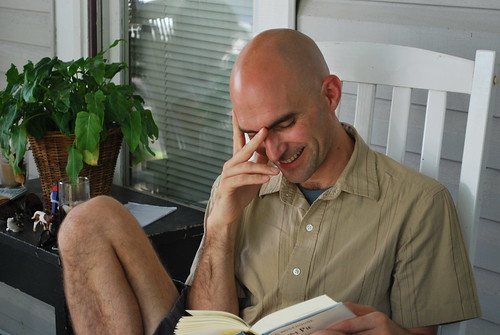
{Photo by rocketlass. I'm actually laughing at Wodehouse, not Nicholson Baker, in this photo, but it serves.}
As it's Friday night and I'm in the mood to sit at the piano, I had intended to do little tonight in this space other than share a couple of passages from the essays in Nicholson' Baker's new collection, The Way the World Works. Like this one, from "String," about the street he lived on as child:
Some parts of the Strathallan sidewalk were made of pieces of slate that sloped up and down over the questing roots of elm trees (one had a mortal wound in its trunk out of which flowed, like blood, black sawdust and hundreds of curled-up larvae), and some parts of the sidewalk were made of aged concrete, with seams cut into them so that they would crack neatly whenever a growing tree required it of them. These seams made me think of the molded line running down the middle of a piece of Bazooka bubble gum, which you could buy in a tiny candy store in the basement of an apartment building near where we lived: the silent man there charged a penny for each piece of gum, machine-wrapped in waxed paper with triangular corner folds. It had a comic on an inner sheet that we read with great interest but never laughed at.The close grain of the memories, the associative leaps, the care in description matched with a deliberate inventiveness of word choice--that is what I love about Nicholson Baker, the sense that everything in the world deserves our attention, especially those parts of it, both physical and verbal, that we barely even bother to notice anymore.
By the time I was a kid, nearly twenty years after Baker, Bazooka was offered in two sizes, a 3-cent or a 5-cent, and also in grape. Grape, though tempting, always led to regret, in strict defiance of a later friend's oft-repeated certainty--known in my circle as Pete's Axiom--that "Whatever can be made grape should be made grape." What hadn't changed in the intervening years was the relationship to the comic wrapped around the gum: slipshod as it was in every respect, from concept to printing, it received our rapt attention nonetheless. Young, we knew little of the world and its infinity of things, so how were we to judge what merited our scrutiny?
The guy who sold us Bazooka was named Earl, and he ran the Bunnyhop Cafe in the New Hope Hotel, a rundown terra-cotta oddity behind our middle school. He was far from silent. Old and round-nosed and laughing, rather, always wearing a floppy fisherman's hat and frequently seen tooling about town in his '54 Plymouth.
And I'd planned to share this one, from the same essay:
Sometimes my mother let me take the spool off the sewing machine and thread the whole living room with it, starting with a small anchor knot on a drawer handle and unreeling it around end tables and doorknobs and lamp bases and rocking-chair arms until everything was interconnected. The only way to get out of the room, after I'd finished its web, was to duck below the thread layer and crawl out.Such kindly parental indulgence, so well-attuned to the desires of the child, reminds me of Ray Bradbury's stories of his Aunt Neva, who built with him a model of the 1933 Century of Progress Exhibition in the backyard, dressed him (and herself) in costumes, and generally encouraged him to keep imagination's door always propped open.
And I was going to share some bits from my favorite essay in the book, "One Summer," which consists of short, separate paragraphs all starting with the two words of the title. I was going to share only those I read aloud, with giggling joy, to a simultaneously amused and bemused rocketlass last night. Like this one:
One summer my daughter learned how to read the word misunderstanding.And this one:
One summer I went to Italy with my girlfriend and her family. My girlfriend's uncle brought a set of dissolvable capsules containing foam circus animals. Every night at cocktail hour we dropped one capsule into a glass of water. As each foam leg emerged, we would say, "There's another leg!"Or this one, which I had trouble reading because laughter--mine--kept interjecting itself:
One summer I was on the verge of making a baloney sandwich. I had the tomato in my hand and I'd opened the door of the refrigerator and I was looking down at the jar of mayonnaise on the bottom shelf, and then I thought, No, no baloney right now. And I closed the refrigerator door. I was able to resist that baloney and put it out of my mind.And, finally, this one:
One summer a raisin stuck to a page I was writing on, so I drew an outline of it and wrote, "A Raisin Stuck Here--Sunmaid."And that was to be it. Post posted. Piano beckoning.
But then I read Michiko Kakutani's review of the book from Monday's New York Times. Oops.
She didn't get it. I suspect there's no way she ever could have--Baker simply seems not to be her kind of writer, his book not her kind of book. Kakutani is serious; Baker is (mostly) silly. Kakutani writes (mostly) about novels; Baker writes novels that read like nonfiction, and nonfiction that reads like no one else's. Kakutani is looking for the point; for Baker, looking frequently is the point.
All of which might still not been enough to prompt me to even mention the review, had it not been for this passage:
The individual essays not only carom around the world in subject matter, they also vary greatly in quality. Some showcase his eye for detail and his ability to nail down those details in velvety, Updikean prose. Some read like parodies of self-absorption that highlight Mr. Baker’s apparent need — shared with his idol, John Updike — to capture even the most trivial of his jottings between the covers of a book. “One Summer,” a list of things the author did over various summers, actually contains this paragraph: “One summer a raisin stuck to a page I was writing on, so I drew an outline of it and wrote ‘A Raisin Stuck here — Sunmaid.’ ” And later on, this sentence: “One summer I was on the verge of making a baloney sandwich.”"Those bits you liked, Levi, enough to read aloud, I disliked." If there is a Platonic form of the ideal Baker reader, Kakutani may well be the necessarily-existing-in-a-dizzying-undergraduate-seminar-way Platonic form of its opposite.
Tastes vary, of course--the Venn Diagram of mine and rocketlass's overlaps but little, yet the gap diminishes our passion for our favorites not a whit. Baker, admittedly, is not to all tastes, and his fans won't be swayed away by a review that pulls quotes for opprobrium that they'd pull for appreciation.
But the failure to connect, my certainty that Kakutani's wrong, burns despite. Baker writes elsewhere in the book, in "The Nod," an appreciation of Updike delivered at a memorial, of reading Updike's story "The City" to his thirteen-year-old daughter:
And as I was reading it to my daughter, I came to the moment in the story that I remembered from when I first read it. The man is lying in his hospital room in the middle of the night and he hears people moaning on either side of him and then there's a sound of "tidy retching," and then comes the sentence: "Carson was comforted by these evidences that at least he had penetrated into a circle of acknowledged ruin." The word ruin there was so amazingly good and well-placed--"acknowledged ruin." And maybe it was that I gave it a special inflection as I read it aloud, but I don't think so. My daughter said, "Oh, that's good." Right at that moment. She liked and she was excited by the very same phrase in the story that I'd been excited by. It seemed so reassuring to know that there is sometimes an absolute moment in a story that many people will independently discover and remember, even across generations, and that this may have been one of those moments.Products of a century of mass-production and mass-marketing, iconoclasm may be our aspiration, but nevertheless we ache for others to like what we like; the harmony thus generated can be so abundantly joyful.
Wednesday, August 10, 2011
[CENSORED]
I accidentally left my shoulder bag at the Asian grocery across the street when I was buying tofu tonight, and I didn't realize it and go retrieve the bag for a couple of hours . . . which was enough to convince me that I can't really blog about Nicholson Baker's new novel House of Holes: A Book of Raunch, because as I was jaywalking my way back to my bag, what was running through my head was, "Please don't let them have looked in it. Please don't let them have looked in it. Please don't let them have looked in it." Because House of Holes was one of the books I'd been carrying today.
As others have already alerted you, if you're one to attend to book news, House of Holes is unapologetically a book of porn. Sam Anderson calls it "a porny Alice in Wonderland." Charles McGrath calls it "a blue-flaring plume of smut-talk." (Apparently the Times style guide calls for "smut-talk" to be hyphenated. Now we know.) And while this blog is unabashedly a fan of, and occasional home to, swearing of nearly all sorts (look closely at this post if you don't believe me), it does not generally take notice of the bluer reachers of our literasphere.
Then there's the fact that, frankly, I don't know what to make of it. I love Baker--love his prose, love his goofy mind, love his utter shamelessness. And Baker's written porn before, in Vox and its better successor, The Fermata. But in those books--particularly the sometimes disturbing latter--the pornographic sequences were part of a larger narrative centered in characters, ideas, and ways of thinking about human (and gender) relations in our era. Here . . . they're just, well, porn.
But that's not fair. The'yre not just porn. Baker's too good a writer of sentences and too humane and intelligent a person for that. The charge against porn is that it's reductive and degrading; Baker's porn is reductive and . . . celebratory? Innocent? Loving? At its best, House of Holes is simultaneously hot, ridiculous, charming, silly, elegant, and inventive. As Baker piles on the ideas--Masturboats, the Porndecahedron, and more inventions whose names I refuse to type--at times his wildly creative prurience offers shades of the lighter Calvino, of a mind choosing carefully among finite permutations and making of them something new.
And House of Holes also has value, for fans of slang, as a poorly organized glossary of creative names for actions and organs. A brief, highly edited list, sans definitions, in deference my online prudishness:
As others have already alerted you, if you're one to attend to book news, House of Holes is unapologetically a book of porn. Sam Anderson calls it "a porny Alice in Wonderland." Charles McGrath calls it "a blue-flaring plume of smut-talk." (Apparently the Times style guide calls for "smut-talk" to be hyphenated. Now we know.) And while this blog is unabashedly a fan of, and occasional home to, swearing of nearly all sorts (look closely at this post if you don't believe me), it does not generally take notice of the bluer reachers of our literasphere.
Then there's the fact that, frankly, I don't know what to make of it. I love Baker--love his prose, love his goofy mind, love his utter shamelessness. And Baker's written porn before, in Vox and its better successor, The Fermata. But in those books--particularly the sometimes disturbing latter--the pornographic sequences were part of a larger narrative centered in characters, ideas, and ways of thinking about human (and gender) relations in our era. Here . . . they're just, well, porn.
But that's not fair. The'yre not just porn. Baker's too good a writer of sentences and too humane and intelligent a person for that. The charge against porn is that it's reductive and degrading; Baker's porn is reductive and . . . celebratory? Innocent? Loving? At its best, House of Holes is simultaneously hot, ridiculous, charming, silly, elegant, and inventive. As Baker piles on the ideas--Masturboats, the Porndecahedron, and more inventions whose names I refuse to type--at times his wildly creative prurience offers shades of the lighter Calvino, of a mind choosing carefully among finite permutations and making of them something new.
And House of Holes also has value, for fans of slang, as a poorly organized glossary of creative names for actions and organs. A brief, highly edited list, sans definitions, in deference my online prudishness:
wonderloavesI'll stop there. You get the idea.
scants
prune elevator
toad-in-the-hole
ladyboys
pornsludge
manhandling
ensemble
But where does that leave us? Honestly, I have very little idea at this point. If you've never read Baker, don't read this one; go get The Mezzanine, his unqualified masterpiece. If you love Baker, you're going to give this a try anyway, despite the fact that it's far from his best book. It's those who find themselves squishing around in the middle ground who are in question . . . and oh, I don't know what to tell you folks. Maybe see what you think the next time you pop up, wide awake, at midnight?
Friday, June 03, 2011
Nicholson Baker works blue once again
I feel I should begin this post with an apology, and perhaps a warning: as they say in the comedy business, I am, however temporarily, working blue here.
It's because of Nicholson Baker. Late this summer, Baker will publish a new novel, which would be a reason for joy no matter its content; Baker's novels, each sui generis, yet each affording what feels convincingly like communion with Baker's odd, hyperspace mind, are a sheer joy.
But this time, the anticipation is even greater, because of the book's title. Are you ready? (Have you made sure your boss isn't looking over your shoulder?) House of Holes: A Book of Raunch. Ahem.
Anyone who's read The Fermata, that magically ridiculous piece of porn masquerading as literature, knows that Baker can definitely work blue--and that he can do it without surrendering the Nabokovian sheen of his prose. The new book apparently offers more evidence of that skill: a couple of weeks ago Sam Anderson, on his Times blog The 6th Floor, selected two sentences from House of Holes among his five favorite sentences of that week . . . and then redacted them, calling them "too scatological for the 6th Floor blog."
Which brings me to another of Baker's best qualities: his utter shamelessness--and even more, the evident glee he takes in being shameless. There is no topic that is beneath him, no indignity to which he will not admit if it furthers the argument he's making or the story he's telling. Most of us, were we to come up with the idea of a man who's able to temporarily stop time, would quickly bury it once some of the more sordid possibilities began to emerge; Baker dove in and wrote a whole novel. Most of us, if we thought our psoriasis was an indicator of some essential affinity with John Updike, would pretend even to ourselves that we didn't actually believe it. Baker not only writes about it at length in U and I, he takes it one ridiculous, unnecessary step further:
1. Eewww.
2. Really? Iris Murdoch? "Sex comes to most of us with a twist," indeed.
3. That "succesfully" in there. That's the brilliant bit, a little landmine of glee masquerading as straightforward explanation. If you wanted to shoot Baker's genius into space on the tiniest of rockets in order to give alien civilizations something a bit more down to earth to chew on than the high-culture bombast carried by Viking II, that one little word might almost suffice.
All of which makes me await House of Holes with bated breath. Which is better, I suppose, than heavy breathing.
It's because of Nicholson Baker. Late this summer, Baker will publish a new novel, which would be a reason for joy no matter its content; Baker's novels, each sui generis, yet each affording what feels convincingly like communion with Baker's odd, hyperspace mind, are a sheer joy.
But this time, the anticipation is even greater, because of the book's title. Are you ready? (Have you made sure your boss isn't looking over your shoulder?) House of Holes: A Book of Raunch. Ahem.
Anyone who's read The Fermata, that magically ridiculous piece of porn masquerading as literature, knows that Baker can definitely work blue--and that he can do it without surrendering the Nabokovian sheen of his prose. The new book apparently offers more evidence of that skill: a couple of weeks ago Sam Anderson, on his Times blog The 6th Floor, selected two sentences from House of Holes among his five favorite sentences of that week . . . and then redacted them, calling them "too scatological for the 6th Floor blog."
Which brings me to another of Baker's best qualities: his utter shamelessness--and even more, the evident glee he takes in being shameless. There is no topic that is beneath him, no indignity to which he will not admit if it furthers the argument he's making or the story he's telling. Most of us, were we to come up with the idea of a man who's able to temporarily stop time, would quickly bury it once some of the more sordid possibilities began to emerge; Baker dove in and wrote a whole novel. Most of us, if we thought our psoriasis was an indicator of some essential affinity with John Updike, would pretend even to ourselves that we didn't actually believe it. Baker not only writes about it at length in U and I, he takes it one ridiculous, unnecessary step further:
When my psoriasis began to get bad, on the other hand, I welcomed its spread at first--I'd been worried that because the disease had shown up late in me (phase I involved only the scalp and penis) . . .And, surprised anew, we laugh. Elsewhere in U and I is what is, to me at least, a much more startling confession:
I myself have never successfully masturbated to Updike's writing, though I have to certain remembered scenes in Iris Murdoch.To which my response--and, I'm willing to proclaim, any sane response--is:
1. Eewww.
2. Really? Iris Murdoch? "Sex comes to most of us with a twist," indeed.
3. That "succesfully" in there. That's the brilliant bit, a little landmine of glee masquerading as straightforward explanation. If you wanted to shoot Baker's genius into space on the tiniest of rockets in order to give alien civilizations something a bit more down to earth to chew on than the high-culture bombast carried by Viking II, that one little word might almost suffice.
All of which makes me await House of Holes with bated breath. Which is better, I suppose, than heavy breathing.
Monday, April 25, 2011
Nicholson Baker on influences
One of the books I carried with me on vacation last week, and very much enjoyed, was U and I (1991), Nicholson Baker's attempt to plumb the extent of John Updike's influence on his reading, writing, and life.
Like so much of Baker's writing, U and I is eminently quotable--and bloggable, and discussable. There are sentences on nearly every page that you can't help but want to read to a friend and talk over, even if, like me, you've read barely a word of Updike: Baker's questions about influence and career and style, even as they're firmly rooted in his own neuroses, are broadly applicable.
Tonight I'll focus on the section in which Baker, after confessing to some anxiety about not having read Harold Bloom's The Anxiety of Influence before embarking on this project, sets out a distinction between contingent and chronic influences:
But with our very favorite writers, the ones whose words have molded ours beyond what we can even tell anymore, that separation remains hard to make--and in that last sentence, Baker comes close to justifying us in our failure to fully break free. It's true: it's not just that the flaw in the beloved makes the beauty stand out, but that the disagreement, worried over and maintained, forces us to look closely at the ground we're holding in opposition, and shore it up against all manner of assault that wouldn't have even threatened us had we not so much at stake.
Like so much of Baker's writing, U and I is eminently quotable--and bloggable, and discussable. There are sentences on nearly every page that you can't help but want to read to a friend and talk over, even if, like me, you've read barely a word of Updike: Baker's questions about influence and career and style, even as they're firmly rooted in his own neuroses, are broadly applicable.
Tonight I'll focus on the section in which Baker, after confessing to some anxiety about not having read Harold Bloom's The Anxiety of Influence before embarking on this project, sets out a distinction between contingent and chronic influences:
A contingent influence springs to mind as you try to solve the problems suggested by a chosen subject and then it goes away.He then notes the many contingent influences weighing on him as he works on this project, which include Bloom, Henry James's "A Figure in the Carpet," Frederick Exley's A Fan's Notes, Cyril Connolly's Enemies of Promise, and more. (Had Geoff Dyer's Out of Sheer Rage existed in 1991, it would surely have made the list.) This, he writes,
is the arrangement of bayonets and blowguns whose hostage I currently am and whose exact middle point, as far from any single peril of encroachment as possible, is what I'm trying to find as I write; and yet when I'm done, the particular threats will tiptoe off as quickly as they came and I will be surprised to remember,w hen I see the shape my essay finally take,s how uncomfortable and beset they all made me feel.Chronic influences, on the other hand, stay with you:
Unlike contingent influences, who (or which) you are always hoping will turn out to be more different from you than you felt them to be at the time they made themselves known, permanent influences like Updike (and, to a lesser extent, Nabokov), make you very unhappy when they threaten to be more unlike you as human beings than you had thought. . . . Because you are matching yourself constantly against a permanent influence, any divergence between you and him assumes the proportions of a small crisis, any convergence is an occasion to nod as if it were all in the cards. . . . Normally if I read something I think is wrong, I forget it two days later . . . but with Updike, when I disagree with him, there is an element of pain, of emotional rupture, that makes me remember my difference, and as a result I keep returning unhappily to it over the years and checking to see whether the disaccord remains in effect--and because each time I check it I have to find grounds that will satisfy me for my continued refusal to be convinced by what he's said, I am able to refine my opinions in a way I could never do if I did find him universally agreeable.On the one hand, Baker is expressing a view that I think even he, self-deprecating to the bone, would agree is essentially childish: we want to feel that we know our heroes, that they are like us, and, when young, we have a lot of trouble separating the doer from the deed, the creator from the creation. In adult life, we're supposed to be beyond that.
But with our very favorite writers, the ones whose words have molded ours beyond what we can even tell anymore, that separation remains hard to make--and in that last sentence, Baker comes close to justifying us in our failure to fully break free. It's true: it's not just that the flaw in the beloved makes the beauty stand out, but that the disagreement, worried over and maintained, forces us to look closely at the ground we're holding in opposition, and shore it up against all manner of assault that wouldn't have even threatened us had we not so much at stake.
Wednesday, February 02, 2011
"It takes an effort of the imagination to conjure up a rose," or, In the bleak midwinter
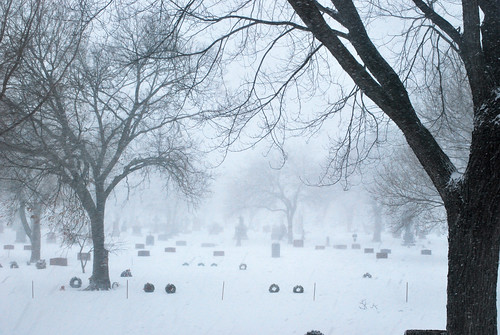
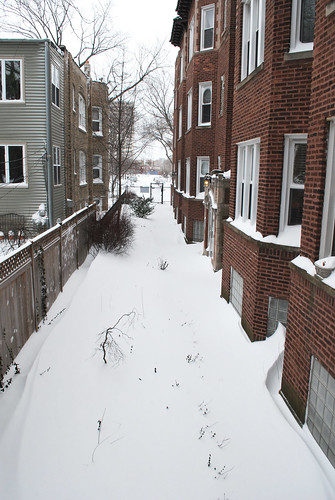
{Photos by rocketlass.}
Pleasantly housebound by the third-largest snowfall in Chicago history, I turn for today's post to some old favorites, all reliably sound on the subject of snow.
First, there's E. B. White, whose thoughts on snow have already graced my Tumblr and Twitter feeds today. A pleasantly rambling New Yorker essay from 1971, "The Winter of the Great Snows," offers plenty of thoughts on the stuff, so much a part of White's Maine winters. "When snow accumulates," writes White,
week after week, month after month, it works curious miracles. Familiar objects simply disappear, like my pig house and the welltop near the barn door, and one tends to forget that they are there. Our cedar hedge (about five feet high) disappeared months ago, along with the pink snow fences that are set to hold the drifts. My two small guard dogs, Jones and Susy, enjoy the change in elevation and the excitement of patrol duty along the crusted top of the hedge, where they had never been before. They have lookout posts made of snow that the plow has thrown high in the air, giving them a chance to take the long view of things.A chance, at least when considered metaphorically, that I doubt they took--unless perhaps the secret of dogs' good natured satisfaction is a quiet far-sightedness? No, scratch that thought: the dog I saw romping in front of our building moments ago was unquestionably living only in, for, and of the present moment.
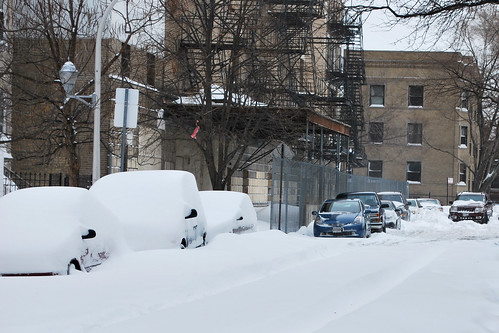
White comments on a phenomenon that rocketlass and I got to see firsthand this afternoon when we finally ventured out: the plight of those in the path of the plow. Writes White:
Every new swipe of the plow hurls a gift of snow into the mouth of a driveway, so that, in effect, the plowmen, often working while we sleep snug in our beds, create a magnificent, smooth, broad highway to which no one can gain access with his automobile until he has passed a private miracle of snow removal. It is tantalizing to see a fine stretch of well-plowed public road just the other side of a six-foot barricade of private snow. My scheme for town plowing would be to have each big plow attended by a small plow, as a big fish is sometimes attended by a small fish. There would be a pause at each driveway while the little plow removes the snow that the big plow has deposited. But I am just a dreamer.The grade-school philosopher in me sees a risk of infinite regression, of ever-smaller plows followed by ever-smaller plows ad infinitum, but I suppose that, come February, a driveway owner in rural Maine would likely be willing to take that chance.
White's essay reminds me of a some moments from Nicholson Baker's wonderfully contemplative little book A Box of Matches (2003), such as this passage, in which his similarities to White are fully on display:
[L]ast month we had that very unusual snowfall that ticked against the window all night. It was an unusual snow, almost like Styrofoam in its consistency in some of the deep places, and when you dug in it, the light that it let through was an interesting sapphire blue--perhaps different prevailing temperatures during snowflake-growth result in a different shape of crystal, which absorbs and allows passage to different wavelengths of light. That Saturday Henry and I dug a tunnel through the snowplow pile. The duck became interested in our project--companionably she climbed to the top, beaking around in it for bits of frozen mud. When both of her feet got cold at the same time she sat down in the snow for a while to warm them. Once or twice she levitated, flapping hard. She didn't much want to walk through the tunnel, and we didn't make her.Baker also reminds me of Thoreau in that passage, his ever-attentive eye trained on minute details of the snow, as his mind ticks away in the background trying to understand their whys and wherefores.
Thoreau himself, not unexpectedly, is good on snow: his Journals offer entry after wintry entry filled with descriptions of and inquiries about snowfall. In honor of today's Chicago, where last night's thundersnow has drifted in places higher than a man's head, I'll choose the entry of January 13, 1852:
Would not snow-drifts be a good study,--their philosophy and poetry? Are they not worthy of a chapter? Are they always built up, or not rather carved out of the heaps of snow by the wind passing through the chinks in the walls? I do not see yet but that they are builded. They are a sort of ripple-marks which the atmospheric sea makes on the snow-covered bottom.Snow has fallen, snow on snow, snow on snow, but from our cozy home here beneath the atmospheric sea the midwinter is far from bleak. Books and cats and tea, and snow as far as the eye can see--how can we complain?
Sunday, June 27, 2010
"A feeling of long-term fondness which is perhaps the most important residual emotion of the experience of literature," or, How I love Nicholson Baker
Months ago, when I was first contemplating writing about David Shields's Reality Hunger, I was struck by something that Nicholson Baker said in the course of a wonderful interview with Chris Lydon for Radio Open Source. Baker was talking about his charming and funny novel The Anthologist, and he said it all started when he was sitting in the side yard one day and began thinking of a new way of understanding poetic meter and rhyme:
And while I'm on the topic of Baker, towards whom I feel inordinately fond, in no small part because of the way that he blurs the line between authorial and fictional voice, it seems right to make sure you've all seen his letter to John Updike that appeared in the June 21 issue of the New York Review of Books. Baker explains in the introduction that he sent the letter to Updike in March of 1985, as he was in the throes of writing his first novel, and that Updike's failure to respond was entirely forgivable, since he didn't include a return address. The letter is worth reading in full--hell, it's worth buying the entire issue for. While I've never been an Updike fan, it seems succinctly to get at many, if not most, of the charms of reading a living writer. If you've read this blog for long, you know how I love Trollope, and the way Baker invokes him will give you a sense of the appreciative tone of the letter:
So when I realized that I had, this to me exciting discovery, I thought, you know, I've got, I've got a novel here, and I rubbed my hands together and then, and I wrote lots of notes, and I didn't have a novel, I had, I had a theory. But it was an extreme enough theory that it seemed to me the right thing for a fictional character to have. This guy has strong opinions, and the great liberating thing about writing it as a novel is that you can just follow out those, those, strong opinions--you can just lay it out, and realize you're being inconsistent with yourself, but you're, you're, you're telling it as truthfully as, as you know how to tell it, that afternoon, out in the side yard. You're doing your best--that's what a novel allows you to do, is do your best at that moment and not worry about the fact that you're not coming up with a codified, perfectly consistent body of theory that you can publish as a, as a new doctrine of rhyme."You're doing your best--that's what a novel allows you to do." The task of defining the novel is impossible, every definition doomed by exceptions, but I'm tempted to adopt Baker's: it's an attempt, the best attempt one can make, to get down what it was like at that moment. Which, unexpectedly, aligns me to some extent with Shields, who loves the idea of the essay as the verb form of the word, a test or attempt, and who lists Baker as one of the hybrid writers he admires--though if one accepts that the novel (and, let us be broad, fiction in general) is fundamentally a hybrid genre, capable of assimilating nearly everything, then the need for a manifesto damning its sins rapidly fades away.
And while I'm on the topic of Baker, towards whom I feel inordinately fond, in no small part because of the way that he blurs the line between authorial and fictional voice, it seems right to make sure you've all seen his letter to John Updike that appeared in the June 21 issue of the New York Review of Books. Baker explains in the introduction that he sent the letter to Updike in March of 1985, as he was in the throes of writing his first novel, and that Updike's failure to respond was entirely forgivable, since he didn't include a return address. The letter is worth reading in full--hell, it's worth buying the entire issue for. While I've never been an Updike fan, it seems succinctly to get at many, if not most, of the charms of reading a living writer. If you've read this blog for long, you know how I love Trollope, and the way Baker invokes him will give you a sense of the appreciative tone of the letter:
I thought what an amazing thing that Mr. Updike has been writing all the years that I have been growing up, and how I have come to depend on the idea that he is writing away as a soothing idea, and then I was reminded of Trollope, and how nice it must have been for writers back then to go about their lives knowing that Mr. Trollope was going to have a new book coming out soon, that it would be good; and they might not read all of the things he wrote, but they would read some, and they would know that what they didn’t read they were missing, but were comforted also that they knew what kind of man he was because they had already read a lot of what he wrote; and the idea they had of the man who gradually had written all these books was a powerful, happy thing in their lives.All too often, we aim for detachment, rational assessment of artworks; once in a while, it's okay to make a space for unabashed love, and the gratitude that should follow.
Subscribe to:
Posts (Atom)