Showing posts with label Laura Miller. Show all posts

Thursday, July 07, 2011

If we were to limit checkouts to a single book . . . which Invisible title would you choose?


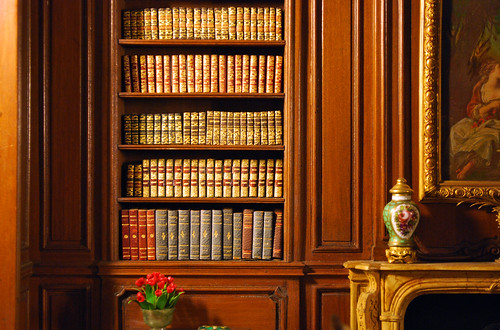
{Photo by rocketlass.}

Earlier this week Laura Miller, author of an excellent book on growing up with (and to some extent growing out of) Narnia, The Magician's Book, and book columnist for Salon, wrote about invisible books--and the Invisible Library that Ed Park and I have been curating, with a certain appropriate vagueness of effort, since 2008. Fans of the Library should go read the whole article, but there are two bits that I think are well worth pointing out here.

First, there's this, which includes a fact that, as a committed Dickens fan, I can't believe I didn't know:
The pseudonymous Dr. Beachcomber would like to expand the Invisible Library to include fake books -- that is, titles that don't even exist in a fictional universe. They appear only on the spines of sham bookshelves used to disguise secret doors in exceptionally interesting houses. Charles Dickens had just such a door installed in his own study in London, with fake titles of his own devising, including "Socrates on Wedlock."
To which I can only reply: of course he did. If you look up "fecund" in the dictionary, alongside stipple pictures of soybeans germinating you'll find an image of Dickens stroking his beard in satisfaction.

In Tearing Haste, the recent volume of letters between Patrick Leigh Fermor and Deborah Mitford included a list of that sort of book--unquestionably not truly Invisible Library titles, despite Dr. Beachcomber's stance--requested by Deborah for a door in her house. To a one they were, as Ed put it when I sent them to him, "horrible"--pun-riddled and silly, though at least acknowledged to be so. (And there was at least one clever and slightly sassy title: Bondage, by Anne Fleming, a play on an apparently poorly kept secret about the sexual proclivities of their friends Ian and Anne.)

Then there's this question, the crux, really, of Miller's article, and not a question that had yet occurred to me:
Which raises an intriguing question: If allowed to choose only one, which volume in the Invisible Library would you most want to read?
If you're the sort to dive into the scrum that is a comments section, what better invitation do you need? Hie thee to Salon and plump for your favorite!

No one who's read this blog for long can be in any doubt about my choice: any one of the novels or memoirs written by Nicholas Jenkins, narrator of A Dance to the Music of Time. Like all fans of Dance, I suspect they'd be much like Anthony Powell's non-Dance novels; like nearly all fans of Dance, that would bring me great, great joy.

{Though if I were to get a second choice . . . who would turn down the chance to read Orbius Tertius?}

Monday, December 28, 2009

Early reading experiences

One aspect of Laura Miller's The Magician's Book which I was pleasantly surprised by was her treatment of childhood reading, of how children experience and understand books. Her account is built largely on memory, like this attempt to reconstruct her first encounter with Narnia:
What remains is a dim recollection of how life was shaped before I knew about Narnia, and a more distinct sense of what it was like afterward. I had found a new world, which at the same time felt like a place I'd always known existed. It wouldn't have occurred to me to be wistful about the fact that I'd never read this perfect book for the first time again. All I wanted was more.
But she also offers other perspectives, including accounts from educators, psychologists, and other authors. Here, for example, is a quick look at the absence of parents from most good children's books:
In the great enterprise of growing up, a child's imagination practices the painless, surgical removal of an attachment that, however essential it may be at the moment, will sooner or later have to be left behind. The same child (myself, for example) who finds imagining her parents' deaths to be heart-freezingly scary will also fantasize about the exciting escapade of being left entirely to her own devices. In her memoir, Welcome to Lizard Motel, the educator Barbara Feinberg describes leading a children's creativity workshop whose participants liked pretending they were orphans, though not, one litle girl clarified, "the sad part of orphans."
Then there's this almost unbearably cute anecdote about the reaction of some friend's children to a picture book she was reading to them:
When I got to the part where a whistling Andy nears a turn in the road and notices just the tip of the runaway lion's tail peeping around the corner, [three-year-old] Desmond scrambled anxiously to the other end of the sofa and hid behind a cushion. Next we read Chris Van Allsburg's The Polar Express, and, at the moment when Santa put his arm around the book's narrator and called for a cheer from the crowd of onlooking children, Desmond sat up straight, radiating pride.
That sort of reflection is sprinkled throughout The Magician's Book, a recurring reminder that we are not the same people--and certainly not the same readers--we were when we first encountered the books of childhood that we recall so fondly.

Almost any serious reader risks slipping into rapturous tones when describing childhood reading. It's one of the rare instances of nostalgia in which there seems little danger of memory playing us false--the experience really was that intense, that all-encompassing.

But when I think of myself as an enthusiastic young reader, I think of an incident that's far more pedestrian: when I was in kindergarten, I read my first Hardy Boys book, The Tower Treasure, and I loved it. Detectives, robberies, mysteries--this was how the world should be! The clues and questions mounted, and just when it seemed that things couldn't get any more dramatic, Frank and Joe discovered who was behind the crimes: a hobo!

Only, the problem was, I thought the word "hobo" meant "ghost." The world of the Hardy Boys was even wilder than I'd imagined--and suddenly I wasn't so sure I wanted to be a detective!

I don't remember how long it took me to figure out I'd made a mistake, but thirty years later I still think of it every time I encounter a difficult passage in a book. I am not the reader I once was, indeed.

Saturday, December 19, 2009

Childhood reading


{Photo by rocketlass.}

As I read Laura Miller's charmingly conversational yet thoughtful The Magician's Book: A Skeptic's Adventures in Narnia (2008), I perked up at this passage about J. R. R. Tolkien:
Tolkien has had many admirers of considerable intellectual stature--Auden was his great champion in the press, and the novelist Iris Murdoch sent him fan mail--but this, too, doesn't go very far in persuading other intelligent people who can't abide his books. Murdoch perhaps chose the wisest course when her husband, the Oxford professor John Bayley, would demand to know how she could be so enthralled by books that were so "fantastically badly written": she'd stare at him in amazement and insist that she didn't know what he was talking about.
Murdoch's response seems just right to me: Bayley is asking a question that doesn't really apply to the Lord of the Rings. Yes, they're badly written, teeth-clackingly awkward at times, but that's not the point. At their best, they immerse the reader in a world that seems inexhaustible, so fully imagined that we begin to suspect there's no question we could ask that Tolkien wouldn't have been able to answer--we feel that we've been invited to enter a supreme work of focused imagination, the vitality of which makes the clunky archaisms of Tolkien's prose entirely beside the point.

That said, neither Tolkien nor his friend C. S. Lewis were real touchstones for me as a young reader, like the latter was for Miller. I read and loved The Hobbit and The Lion, the Witch and the Wardrobe, but I felt none of the same magic from the two men's subsequent books. Looking back, I can see that they represented two important poles of imagination for me: the jumble-sale quality of Lewis's imagination--which, as Miller writes, "lifted figures and motifs in whole cloth from a motley assortment of national traditions, making no effort to integrate them into any coherent mythos"--clashed with my desire for order, while Tolkien's obsessive attention to detail (a quality I would later come to admire) took the books too far in the other direction, bogging them down in hours of elvensong when all I really wanted was for someone to draw sword in anger.

Neither author could match Lloyd Alexander's Chronicles of Prydain or Susan Cooper's Dark Is Risingi sequence (and in particular its first, and least fantastic book, Over Sea, Under Stone, which I read over and over). Looking back, I think that one overarching reason for my preference was that Narnia and Middle-Earth both lacked a quality I prized in fiction even as a boy: a sense of the everyday reality that lies underneath the fantasy and adventure. As Miller points out, neither Tolkien nor Lewis seemed all that interested in the day-to-day life of their worlds: there's no discernible economic activity, no incidental change, and--outside of Sam Gamgee--no characters who reveal long-range plans or aspirations that are disrupted by the events that have swept them up.

Alexander and Cooper, on the other hand, offer plenty of hints of what people in their worlds do when not questing: Taran is an assistant pig-keeper; Coll a full pig-keeper; Fflewddur Fflam a bard; Eilonwy, as a princess, is expected to do nothing--and that limitation drives her nuts. At the end of a battle, Coll laments the crops churned under by the fighting, a loss that will be felt that winter in the surrounding villages. In Over Sea, Under Stone, the Cornish village that the children visit on holiday is entirely ordinary, which makes the irruption of sinister forces and ancient magic all the more astonishing. It is a simple vacation with a somewhat distant relative, a situation we can all recognize--and then suddenly it's much more.

I was a very fortunate child, surrounded by a loving family in a rural freedom that seems more idyllic with every passing year. I didn't want to escape to somewhere: I wanted a world where adventure and dailiness could live side by side, where I could be part of momentous events but not have to give up the home I loved. Alexander and Cooper seemed to understand that in a way that Tolkien and Lewis--whom I now know were themselves in search of full-on escape from a world grown uncongenial--did not.

To circle back to where this post started, I'll turn once again to Iris Murdoch. In a 1962 interview for the Sunday Times, collected in From a Tiny Corner in the House of Fiction: Conversations with Iris Murdoch (2003, edited by Gillian Dooley), Murdoch responds to a question about whether there's a division between fantasy and reality in her own work:
If fantasy and realism are visible and separate aspects in a novel, then the novel is likely to be a failure. In real life the fantastic and the ordinary, the plain and the symbolic, are often indissolubly joined together, and I think the best novels explore and exhibit life without disjoining them.
Though Murdoch wasn't referring here strictly, or even at all, to fantastic literature as represented by Tolkien, Lewis, et al., I think her point nonetheless has some validity. Cooper's and Alexander's books were so powerful for this young reader exactly because they "indissolubly joined" the world of the everyday and the world of the imagination; they offered a new reality I could believe in, and set alongside my own, rather than escape to.

Wednesday, July 08, 2009

Dickens, Thackeray, and a hanging


On the blog that she began as an accompaniment to The Magician's Book (2008), her well-regarded book on C. S. Lewis and the Narnia books, Laura Miller recently wrote about the "petrifying depiction of mob violence" and the "street lynching of a heartless aristo" in A Tale of Two Cities. After quoting Dickens's account--
Once, he went aloft, and the rope broke, and they caught him shrieking; twice, he went aloft, and the rope broke, and they caught him shrieking; then, the rope was merciful, and held him, and his head was soon upon a pike . . .
--Miller writes,
I don't know much about Dickens' background, but this has made me wonder what he'd seen before writing these passages.
Which, you'll not be surprised to learn, sent me to my bookshelves! I had a vague memory of Dickens having witnessed a hanging at Tyburn gallows (which was located where Marble Arch is today), and Peter Ackroyd's giant biography didn't disappoint, revealing that in July 1840 Dickens, essentially on a whim--"Just once, I should like to watch a scene like this, and see the end of the drama"--left a dinner with friends to attend the hanging of Francois Benjamin Courvoisier, a valet who had killed his employer by slitting his throat.

Ackroyd writes,
Dickens said later that there was "nothing but ribaldry, debauchery, levity, drunkenness and flaunting vice in fifty other shapes. I should have deemed it impossible that I could have felt any large assemblage of my fellow creatures so odious." It is like a scene out of Dore; the mob of the poor and the outcast, the ragged clothes, the swearing and the debauchery, the loud cries, the smell, and Dickens himself looking down from the upper room at the spectacle of these, his countrymen, the surging mob living in the shadows cast by his civilisation and inseparable from them.
If Dickens was troubled by the hanging itself, however, Ackroyd doesn't note it, which surprises me given how horrible is his depiction of the hanging in A Tale of Two Cities. Still, it's not hard to believe that he had these grotesque mob scenes in mind the next January when he began writing his long-stalled Barnaby Rudge in earnest.

An odd coincidence about that hanging seems worth noting: across the crowd, Dickens spotted Thackeray, who was in attendance with the aim of writing about the hanging. Thanks to the glories of the Internet, I can share Thackeray's letter offering the piece in advance to Alexander Blackwood (who was, I believe, at the time the head ofthe Blackwoods publishing firm), which is interesting if for no other reason than the way that it lumps the hanging in with other "fun" pieces "of a spicy nature" that Thackeray might write:
I should be glad to do something of like nature if you are disposed to accept my contributions. No politics, as much fun and satire as I can muster, literary talk and criticism of a spicy nature, and general gossip. I belong to a couple of clubs in this village and can get together plenty of rambling stuff. For instance, for next month Courvoisier's hanging (I'll go on purpose), strictures on C. Phillip's speech, the London Library, Tom Carlyle, the Times and account of Willis that may be racy enough.
Despite this pitch, Blackwood's Magazine never ran the piece, but it eventually saw the light of day in Fraser's Magazine later that year. Dickens, meanwhile, wouldn't write about Courvoisier for nearly six years, finally broaching the topic in the second of the Five Letters on Social Questions he published in the Daily News, a new daily political newspaper that he briefly edited at the start of 1846.

And I think that's surely enough time spent down this particular rabbit hole for tonight, no?