Showing posts with label The Guermantes Way. Show all posts

Wednesday, December 19, 2007

Jane and Marcel

Yesterday I mentioned that I was deciding between returning to Proust and starting Claire Tomalin's Jane Austen: A Life (1997). Well, I chose Austen, but I unexpectedly encountered a Proustian moment as well, in a passage from Austen's epistolary novel Lesley Castle (1791), written when she was sixteen and never published. Tomalin quotes the following lines from the book, representing a letter by the sister of a woman who, on her wedding day, has just learned that her bridegroom has been thrown from a horse and is expected to die:
Dear Eloisa (said I) there's no occasion for your crying so much about such a trifle (for I was willing to make light of it in order to comfort her) I beg you would not mind it--You see it does not vex me in the least; though perhaps I may suffer most from it after all; for I shall not only be obliged to eat up all the Victuals I have dressed already, but must if Henry should recover (which is however not very likely) dress as much for you again; or should he die (as I suppose he will) I shall still have to prepare a Dinner for you whenever you marry any one else. So you see that tho' perhaps for the present it may afflict you to think of Henry's sufferings, Yet I dare say he'll die soon, and then his pain will be over and you will be easy, whereas my Trouble will last much longer for work as hard as I may, I am certain that the pantry cannot be cleared in less than a fortnight.
Tomalin says that the woman's self-centered obsession, reaching its comic peak at the casual acknowledgment of, "as I suppose he will," compares favorably to Dickens. I don't think it has the overflowing richness of language of Dickens at his best, but considering that Austen was but a teenager when she wrote Lesley Castle, the fact that the comparison can even be made is astonishing.

Rather than Dickens, though, I found myself reminded of Proust, and specifically the scene at the end of The Guermantes Way (1921) where Swann, exasperated by the intransigence of the Duchesse de Guermantes, reveals to her and the Duc that his doctors have told him that he will be dead in mere months. The astonished response of the Duchesse is perhaps her most unguarded moment in the book, revealing her to be temporarily foundered:
"What on earth are you telling me?" the Duchesse broke out, stopping short for a second on her way to the carriage and raising her handsome, melancholy blue eyes, her gaze now fraught with uncertainty. Poised for the first time in her life between two duties as far removed from each other as getting into her carriage to go to a dinner-party and showing compassion for a man who was about to die, she could find no appropriate precedent to follow in the code of conventions and, not knowing which duty to honour, she felt no choice but to pretend to believe that the second alternative did not need to be raised, thus enabling her to comply with the first, which at that moment required less effort, and thought that the best way of settling the conflict would be to deny that there was one. "You must be joking," she said to Swann.

"It would be a joke in charming taste, replied Swann ironically. "I don't know why I'm telling you this. I've never mentioned my illness to you before. But since you asked me, and since now I may die at any moment . . . But please, that last thing I want to do is to hold you up, and you've got a dinner-party to go to," he added, because he knew that for other people their own social obligations mattered more than the death of a friend, and as a man of considerable politeness he put himself in her place. But the Duchesse's own sense of manners too afforded her a confused glimpse of the fact that for Swann her dinner-party must count for less than his own death.
To her (limited) credit, the Duchesse hesitates, but that very hesitation angers the Duc, who brushes off Swann's revelation with a reminder to his wife that they are in danger of being late--only to abruptly change his mind when he realizes the Duchesse is wearing the wrong shoes. He sends her back to change, then dismisses Swann with a brusque obliviousness that is breathtaking:
"Good-bye, my dear boys, he said, thrusting us gently away, off you go, now, before Oriane comes down. It's not that she doesn't like seeing you both. on the contrary, she's too fond of seeing you. If she finds you still here, she'll start talking again. She's already very tired, and she'll be dead by the time she gets to that dinner. And quite frankly, I have to tell you that I'm dying of hunger."
While the sixteen-year-old Austen plays her scene solely as comedy, Proust is master of a wider range of effects: the startling callousness of the Duc and Duchesse set against the self-effacing frankness and honor of Swann render the scene both pathetically comic and deeply moving. But the resemblance between the scenes is undeniable, revealing an unexpected affinity, both of thought and apprehension of the social self, between Austen and Proust--a pleasant surprise on a day when time's perpetual insufficiency forced me to choose.

Wednesday, September 12, 2007

An overall impression of grandeur

I admit up front that my having read A Dance to the Music of Time more times than I've read In Search of Lost Time is causing me to trace the line of influence in the wrong direction, but doesn't the description below of the Duc de Guermantes read like something right out of Anthony Powell?
Better informed than his wife about the nature of their ancestors, M. de Guermantes had a command of memories which gave his conversation the fine feel of an ancient mansion, lacking in real masterpieces but still full of authentic pictures, of middling interest and imposing, giving an overall impression of grandeur.


In that translation, by Mark Treharne, the sentence even has Powell's rhythm and structure, more so than the Moncrieff-Kilmartin translation, which renders the sentence thus:
Better informed than his wife as to what their ancestors had been, M. de Guermantes had at his command memories which gave to his conversation a fine air of an ancient mansion, lacking in real masterpieces but still full of pictures, authentic, indifferent, and majestic, which taken as a whole has an air of grandeur.
Having no French, I can't comment on the accuracy of either version, but the Powell tone in particular seems to arise from the replacement of the string of descriptive adjectives--"authentic, indifferent, and majestic"--with the descriptive clause, "of middling interest and imposing." The word "middling," meanwhile, seems both more effective than "indifferent" and more Powellian, reminding us as it does that much of the stuff of the world is mediocre--yet so often proves to be of some unexpected interest anyway.

Powell was never shy about acknowledging his debt to Proust. I'm pretty much just playing late-night reading games here, but now I begin to wonder if Treharne is a Powell fan?

And, more important, if we're going to steal Proust's line for Dance, to whom should we attach it? Sir Gavin Walpole-Wilson, maybe?

Monday, September 10, 2007

The Guermantes Way—via Clark and Addison


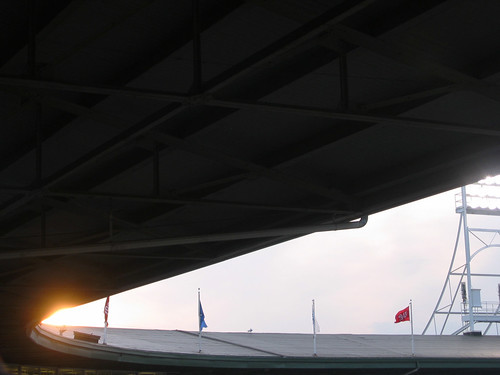
{Photo by rocketlass.}

Unexpectedly staying with the baseball theme from Saturday: if you find yourself at Wrigley Field for a game on a work day--and therefore without your usual seatmates--I recommend taking The Guermantes Way to read between innings. I go to a couple of dozen baseball games every year, and, as great art so often does, today The Guermantes Way helped me to experience the utterly familiar in a new way.

Nearly the whole second half of The Guermantes Way consists of the description of an evening at the salon of Madame de Guermantes, with whom Marcel has been fascinated to the point of obsession since childhood. Having finally, after much covert and overt effort, been granted entree to the hallowed precincts of the Guermantes salon, Marcel is disappointed--even astonished--to find it excruciatingly banal and superficial, a place of forced wit and petty social striving, where art has no value beyond its role as an easy indicator of sophistication.

For more than two hundred pages, Proust relates the conversation of Madame de Guermantes's batch of insecure nobles and society sycophants--a conversation that ought to be stultifying to the point of unreadability. But by presenting the evening from Marcel's perspective, at a remove yet tightly focused and deeply analytic, Proust reveals the pointless back-and-forth as a constant battle for position, almost a sporting event. With their every utterance the interlocutors attempt to stake out territory and establish credentials as thinkers, demonstrate their wit, or simply shore up their position as venerable nobility--all in an effort to worm their way into the good graces of their hostess. Nary a sincere word is uttered, and Marcel provides us with a fascinating and funny running gloss on it all. We end up simultaneously very glad that we're not there and very glad that Proust was.

It's yet another way that Proust wakes us up, makes us more alert to the stuff of life, whether it's the memory locked in a physical sensation, the secret lives led by people we thought we knew, or the usually unnoticed layers--pointless as they ultimately may be--underlying everyday conversation. The problem with reading that half of The Guermantes Way, however, is that for weeks afterwards, you're unable to overhear ordinary conversations in public without subjecting them to Marcel's skeptical analysis.

Wrigley Field proved no exception. By the end of the game, I felt as if I had overheard every tic and type of speech that Marcel discovered in the Guermantes salon. There were the statements designed to demonstrate the speaker's bona fides:
There's not a person alive who knows more about the Cubs of the '90s than I do.

I used to come here every day in the '80s.

There were the patently false statements offhandedly presented as truths:
Fonzie had three homers against the Sox in a game this summer.

Albert Pujols is good, but he's not as good as Ernie Banks.

A sacrifice is as good as a homer here.

That's Scott Rolen.

Diminutive nicknames were handed out with abandon: Fonzie, Rammy, D-Lee, and--least excusably--Rappy, for home plate umpire Ed Rapuano. Feeble attempts at wit were received as brilliant jests:
The Cardinals take it in their Pu-jols!

Go get some more HGH!


There was concern about changes in fashion:
Soriano's the only one out there who's got his socks up. He's the only one who looks like a ballplayer--all the rest of them look like slobs.

Think Carlos will wear his socks up for his next start? It worked last time.


Genealogy and pedigrees even came up for discussion:
You mean you didn't know that Todd Hundley's dad also played for the Cubs?


And, most Guermantes of all, it seemed to me--potential bon mots--
So Taguchi is so bad
--were first floated quietly, almost furtively, then, depending on the reception in the nearest seats, repeated at top volume for the enjoyment of all.

All of which led me to try to imagine Proust as my seatmate. No doubt he'd have been disappointed with the food and drink on offer, uniformly terrible as they were, and both the fashion choices and the pedigrees of the crowd certainly left much to be desired--while the gray and clammy weather would surely have elicited worries about his health. But it's hard to imagine a spectator in the right frame of mind finding the eavesdropping any less than choice.