Showing posts with label Civil War. Show all posts

Tuesday, June 24, 2014

Commander Abraham "Frustrated by McClellan" Lincoln

Travel has once again stolen my blogging time, though that situation should ease up by mid-July, after which point I plan to sit little anywhere other than my porch or my piano bench for the rest of the summer. Which means blogging should be a tad more reliably from that point. I hope.

My travel reading for this trip is the first volume of Shelby Foote's The Civil War. Though a trusted colleague swears by it--going so far as to say he envies my getting to read it for the first time--I had stayed away from it for years because I was worried that Foote might be too much of a Southern apologist for my Northern blood. I'm glad I gave it a try: thus far, though Foote clearly appreciates the South and damns their cause only gently, I'm finding it spectacularly good, full of well-drawn characters and dramatic set pieces. (Oh, and it took but a single quote on Twitter--a line from Sam Houston calling Jefferson Davis "ambitious as Lucifer and cold as a lizard"--to bring someone on Twitter to call me "scum" for insufficiently censuring Foote as a Davis apologist.)

Today I'll share an incident that I must surely have encountered before in reading on the Civil War and Lincoln but had completely forgotten: the President's first and only experience of field command. It came at the point of Lincoln's maximal frustration with General McClellan's self-important dilatory caution: McClellan had finally embarked on his complicated water-borne sweep around the Confederate army protecting Richmond, and Lincoln and Secretary of War Stanton had headed out to Fort Monroe to see what they could see. From here, I'll let Foote tell the story:
Amazed to find that McClellan had made no provision for the capture of Norfolk [across the river inlet], outflanked by the drive up the opposite bank of the James, the President decided to undertake the operation himself, employing the fortress garrison under Major General John E. Wool. . . . The first trouble came with the navy: Goldsborough thought it would be dangerous to ferry men across the Roads with the Merrimac still on the loose. But Lincoln not only overruled him, he and Chase got in separate tugs and reconnoitered the opposite shore for a suitable landing place. When they returned, however, they found that Wool had already chosen one from the chart and was embarking with the troops who were to seize it. Chase went along, but Lincoln and Stanton stayed behind to maintain a command post at the fort and question various colonels and generals who, the President thought, were to follow in support.

"Where is you command?" he asked one, and got the answer: "I am awaiting orders." To another he said, "Why are you here? Why not on the other side?" and was told, "I am ordered to the fort." Experiencing for the first time some of the vexations likely to plague a field commander, Lincoln lost his temper. He took off his tall hat and slammed it on the floor. "Send me someone who can write," he said, exasperated. When the someone came forward--a colonel on Wool's staff--the President dictated an order for the advance to be pushed and supported.
It turned out that "no push or support was needed," as the Confederates had secretly evacuated Norfolk the previous day. Alas, perhaps, for presidential glory, but better, surely, for the fate of America: imagine the chaos of a Lincoln-less Union in late 1862 had he fallen in battle, thrusting the nonentity Hannibal Hamlin (who spent most of the war years in Maine) into command of a fractious nation and tentative army. It's worth a shudder or two.

Tuesday, July 05, 2011

In honor of Independence Day

I may be a few days late, but love of country knoweth no season, abideth by no clock, is reck'd not by the sun nor the moon, surely?

So here, in honor of the 4th of July, which in my neighborhood didn't really end until at least 4 AM on the 5th--at least, that's when I remember hearing the last explosion--a brief passage from Adam Goodheart's wonderful look at the incidentals, interstices, and forgotten elements of the first year of America's Civil War, 1861: The Civil War Awakening:
Like later generations, the men of the 1850s and 1860s expressed their ideals of masculinity through their physical appearance. Most noticeable, and revealing, was the astonishing profusion of facial hair that sprouted forth during those years, including on the previously smooth faces of [James] Garfield and his friends. For a century and a half, American men (and most Europeans) had, nearly without exception, gone clean-shaven: it was a sign of gentility, civility, and restraint. (In the late eighteenth century, one Philadelphia woman considered it a matter of note that she had seen "an elephant and two bearded men" in the street that day.) This changed very suddenly. Most American historians, when they have considered the topic at all, have assumed it had to do with Civil War soldiers avoiding the inconvenience of shaving while in the field.

In fact, the phenomenon predated the war by a number of years--and was the subject of a great deal of contemporary comment and debate. As early as 1844, one physician began inveighing against "woman faced men" with their habit of "emasculating [the] face with a razor," even suggesting that shaving caused diseases of the throat. At the time, this was still an eccentric opinion. By the following decade, however, talk of a "beard movement" was sweeping the nation. In 1857, a conscientious journalist took a stroll through Boston's streets and conducted a statistical survey: of the 543 men he encountered, no fewer than 338 had full, bushy beards, "as God meant to have them," while nearly all the rest sported lesser facial hair of various sorts. Only four were "men of the old school, smooth shaven, with the exception of slight tufted promontories jutting down from either ear, as if designed as a compromise measure between the good old doctrine and modern radicalism."
Good to know that trend stories have been with us nearly as long as newspapers (though this one does seem a bit more grounded than today's "Let's go see what six hipsters in Brooklyn are doing!" variety).

No post on the history of American facial hair would be complete without a photo of Union general Ambrose Burnside, who, though no great shakes as a general, remains a familiar figure to even casual Civil War buffs for the twin redans of his facial hair.


Happy birthday, America!

Monday, May 30, 2011

Memorial Day

From a letter sent by Abraham Lincoln on May 25, 1861, to the parents of Elmer Ellsworth, a friend of Lincoln and the first Union officer killed in the war:
My dear sir and Madam, In the untimely loss of your noble son, our affliction here, is scarcely less than your own. So much of promised usefulness to one’s country, and of bright hopes for one’s self and friends, have rarely been so suddenly dashed, as in his fall. In size, in years, and in youthful appearance, a boy only, his power to command men, was surprisingly great. This power, combined with fine intellect, an indomitable energy, and a taste altogether military, constituted in him, as it seemed to me, the best natural talent, I ever knew.
I found this passage in a post at the LIbrary of America' Reader's Almanac blog that draws on their new volume The Civil War: The First Year Told by Those Who Lived It and Adam Goodheart's acclaimed new book 1861: The Civil War Awakening to tell the story of Ellsworth, a man who found unusual fame even before he became a symbol of the sacrifices that the war would call for, The post is well worth clicking over to and reading, as, I suspect, are both books.

Ellsworth was but the first of those to give, as Lincoln would later put it, "the last full measure of devotion" to their country. The death toll of the Civil War is staggering even when considered against the current population of America; when considered as part of the much smaller nation of the time, it's almost incomprehensible. On this Memorial Day, 150 years later, I'm grateful that, for all our continuing follies as humans, we are no long quite so blithe about sending soldiers to certain death by the tens of thousands. True civilization, by its nature, may forever elude us, always demanding some further refinement of our nature, but in this respect at least we are a bit farther down the road.

Friday, April 08, 2011

The methodical mind of Lincoln


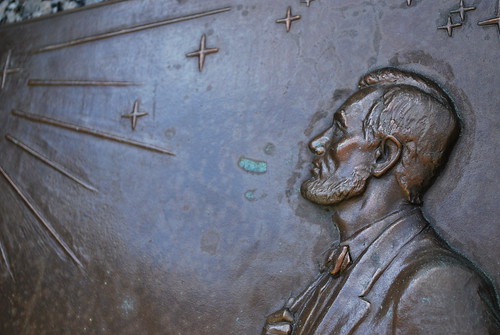
{Photo by rocketlass.}

The sesquicentennial of the Civil War, which begins next week with the anniversary of the firing on Fort Sumter, has sent me back once again to that inexhaustibly fascinating conflict. This time, I'm reading Bruce Catton's three-volume history that was published on the war's centennial, which I'd recommend to any general reader. James M. McPherson's one-volume Battle Cry of Freedom may be a better introduction to the subject--his descriptions and explanations of battles are as good as any I've encountered, offering just as much detail and assistance as a nonspecialist needs--but Catton bests him in prose style and, more important, in analysis of character.

This passage, from near the end of the second volume, Terrible Swift Sword (1963), just after Lincoln has made the Emancipation Proclamation public, combines both qualities:
[T]he President had committed himself to an idea rather than to a specific program. The war would be a revolution from now on, and if revolutionary means were needed to win it they would be used. This, to be sure, had been inherent in the situation from the beginning. The overshadowing fact now was that when he issued his proclamation Mr. Lincoln did in his field exactly what General Lee did in his when he struck the Army of the Potomac at Mechanicsville: he took the initiative, and he would never give it up. All of the Americans who followed this hard road of war would sooner or later have to keep step with him: both those who went with him and those who went against him.
Which is fitting, because, for me at least, it all comes back to Lincoln. I don't think I'll ever tire of trying to fathom his mind, so agile and complicated and, for the most part, admirable.

The months leading up to the above passage from Terrible Swift Sword offer the clearest, most straightforward example I know of just what I find so fascinating about Lincoln as a thinker, politician, and leader. In the summer of 1862, having just written the Emancipation Proclamation he called a meeting of his cabinet and said, in the words of Treasury Secretary Samuel P. Chase, from a postwar letter,
I have considered every thing that has been said to me about the expediency of Emancipation & have made up my mind to issue THIS PROCLAMATION: and I have invited you together to discuss not what is to be done; but to have you hear what I have written & to get your suggestions about form & style. . . . I have thought it all over & have made a promise that this thing shall be done--to myself & to God.
The Cabinet took him at his word, but ultimately they urged him to table the proclamation until the Union Army should win a victory, lest it seem like an act of desperation rather than a call to freedom. Lincoln took their advice, and the proclamation went into a drawer.

A month later, Horace Greeley took to the pages of his New York Tribune to lambaste Lincoln for having neither direction nor resolve in his prosecution of the war or his handling of the issue of slavery. Lincoln replied:
Executive Mansion,
Washington, August 22, 1862.

Hon. Horace Greeley:
Dear Sir.

I have just read yours of the 19th. addressed to myself through the New-York Tribune. If there be in it any statements, or assumptions of fact, which I may know to be erroneous, I do not, now and here, controvert them. If there be in it any inferences which I may believe to be falsely drawn, I do not now and here, argue against them. If there be perceptable in it an impatient and dictatorial tone, I waive it in deference to an old friend, whose heart I have always supposed to be right.

As to the policy I "seem to be pursuing" as you say, I have not meant to leave any one in doubt.

I would save the Union. I would save it the shortest way under the Constitution. The sooner the national authority can be restored; the nearer the Union will be "the Union as it was." If there be those who would not save the Union, unless they could at the same time save slavery, I do not agree with them. If there be those who would not save the Union unless they could at the same time destroy slavery, I do not agree with them. My paramount object in this struggle is to save the Union, and is not either to save or to destroy slavery. If I could save the Union without freeing any slave I would do it, and if I could save it by freeing all the slaves I would do it; and if I could save it by freeing some and leaving others alone I would also do that. What I do about slavery, and the colored race, I do because I believe it helps to save the Union; and what I forbear, I forbear because I do not believe it would help to save the Union. I shall do less whenever I shall believe what I am doing hurts the cause, and I shall do more whenever I shall believe doing more will help the cause. I shall try to correct errors when shown to be errors; and I shall adopt new views so fast as they shall appear to be true views.

I have here stated my purpose according to my view of official duty; and I intend no modification of my oft-expressed personal wish that all men every where could be free.

Yours,
A. Lincoln.
There, displayed, is the mind that I find so fascinating: methodical, even mathematical in its laying out of an argument, fitting every piece into its place while making sure that no permutation of the argument is left to be assumed or ignored. Lincoln, as always seemed to be the case, knew exactly what his foremost goal was--and, unlike many involved in the war, never deluded himself about what it might take to get there. At the same time, even as he's deadly serious, I see a glimmer of his trademark gentle sarcasm there, too, as if the very act of being so elaborately explicit is a way of saying, "Good god, Horace, haven't you listened to a word I've said this past year?"

Looking back, it's hard not to be uncomfortable about Lincoln's willingness to countenance the continuation of slavery should that be necessary. The abolitionists, for all their frequent impracticality, unquestionably had honor (and justice) on their side. But at the same time, Lincoln knew better than anyone the constrictions under which he labored--and the earthshaking change he was about to introduce. Eric Foner, in The Fiery Trial: Abraham Lincoln and American Slavery (2010) argues that we shouldn't read that last line about Lincoln's "personal wish that all men everywhere could be free" as weasely or self-protecting, or even as a statement of his long-standing position that the personal and the official should be distinct. Rather, we should read the whole letter
as a way of preparing Northern public opinion for a change in policy on which he had already decided. Certainly, it suggested that freeing all the slaves was now a real option, something that had not been the case a year or even six months earlier. But perhaps the most telling comment came from the Springfield Republican. The editors praised Lincoln's position but pointed out that the very notion of "saving" the Union required rethinking: the prewar Union was gone forever.
No one knew that better than Lincoln; even as he methodically protested otherwise, he was leading the way to the new Union--and, as Catton put it, everyone was going to have to keep step.

Saturday, December 29, 2007

Mark Twain and the Civil War


I'm about a third of the way through Ron Powers's Mark Twain (2005), which has given me my first real acquaintance with Samuel Clemens's early years. Previously, all I'd known of his life was his riveting account of his brief career as a river pilot in Life on the Mississippi (1883) and bits and pieces of his later years, when he was famous and palling around with people like William Dean Howells and Ulysses S. Grant. It's been fun to get to know Clemens as an ambitious young man, fired with the joy that comes from transforming the heterogeneous stuff of the world into words.

What has struck me most forcefully so far, however, has been learning that Clemens pretty much sat out the Civil War. I assume that's commonly known, but I somehow hadn't realized it before. Clemens was twenty-five when the war began, and, despite (or perhaps because of?) growing up in Missouri, an area of sharply divided loyalties and great strategic importance, he seems not just to have avoided service, but to have as much as possible avoided even taking a position on the conflict.

To the extent that his loyalties can be reconstructed, they seem to have lain with the South, which I suppose makes some sense: though Lincoln was able through a combination of deft management and brute force to keep Missouri in the Union, it was a slave state that was culturally more Southern than Northern. It's also easy to imagine the high-toned moralizing of the abolitionist movement causing someone with Clemens's temperament to get his back up a bit; add in the casual racism that shows up in his youthful writings (and which he would spend a lifetime attempting to outgrow and overcome), and Clemens as a Confederate sympathizer is fairly easy to picture.

His only military service in the war was brief and essentially comic. Here's Powers's description of the homegrown, anti-Union militia that Clemens volunteered for in 1861:
The Green Berets, they were not. No two dressed alike. Weapons ranged from hunting knives to shotguns to squirrel rifles. . . . [Clemens's friend Absalom] Grimes recalls that Sam showed up for war on a four-foot-high yellow mule, clutching a valise, a homemade quilt, a frying pan, a squirrel rifle, twenty yards of seagrass rope, and an umbrella. . . . The outfit called itself the Ralls County Rangers. Sam was elected second lieutenant, and gave a speech standing on a log. Then they all went haring around the country, cadging meals at farmhouses, sleeping in the rain, and laughing at nay passing officer who dared give them an order.
The closest the unit came to combat was a late-night scare sparked by imaginary Union pickets and another false alarm that led to one of the men accidentally shooting his own horse. Clemens quickly fled the unit, and the war entirely, decamping to the Nevada territory, where he began writing the Western sketches that would first make his name. Even out there, though he got into a few arguments over the question, his occasional pro-secession remarks appear to have been at least as much the product of a needling contrarianism as of deeply held beliefs.

To be honest, I'm not entirely sure what I would have had him do differently. While I'd obviously rather he had seen the evils of slavery and the rightness of the Union cause, given his background that's difficult to imagine. And after all, it's not as if even all northerners were jumping at the chance to serve; the draft riots and the practice of paying for substitutes testify otherwise. Similarly, I'm not willing to take him to task for perceived cowardice: five minutes of reading about the carnage at Cold Harbor or the Battle of the Wilderness is enough to make anyone understand why a person would hope to avoid serving. Clemens wasn't yet a public figure, so it's not as if he had even an implied responsibility to be or do something larger than himself. Would I have been on the right side of the issue had I been in his shoes? I'd sure as hell like to think so, but it's impossible to know.

I guess I'm just surprised that when it came to the defining question of his age--an age for which he himself would end up as a defining figure--it appears that Clemens didn't even give it much thought. In a time when the fate of the nation was at stake in a war that with each passing year was being more clearly defined as an essential moral struggle, Clemens blithely stayed away. Am I wrong to expect more? Does it even matter? It doesn't seem to have mattered to his public as he rocketed to fame in the postwar years. (One wonders whether, like John Wayne, who also became a symbol of his nation despite avoiding service, Clemens in later years ever found himself in fights with those who had served. Did the question occur, for example, to Grant?)

But given that Clemens the writer still matters these days largely because of his ability to perceive and convey, however fitfully, the humanity of an escaping slave named Jim, his absence on the larger question of the fate of Jim and his brethren in the years before Huckleberry Finn does seem important. It's yet another inescapable complicating factor in our attempts to understand the man, his work, and his times.

Wednesday, May 23, 2007

On why, having read only 59 pages of Gore Vidal's Lincoln, I returned it to my local library

On the scale of Abraham Lincoln fandom, my interest in the man wouldn't even register. A search on "Abraham Lincoln" at Amazon, for example, returns 44,402 results, of which I've read maybe four. But I am a native Illinoisan, and Lincoln is an endlessly compelling subject: despite those 44,000 volumes, his interior life remains almost completely obscure, and his achievements as a leader are so profound as to almost demand that we keep attempting to plumb that obscurity. What made him the man he was?

That sense of Lincoln's of essential mystery was what drove me to Gore Vidal's Lincoln (1983). How better to get into Lincoln's head than to be freed from strict accountability to history? Good historical novels, after all, can succeed as both history and fiction, illuminating and giving character to the bare facts of history; the fictional depictions of the Battle of Borodino in War and Peace and the Gordon Riots in Barnaby Rudge, for example, have a human weight and immediacy that few historical accounts can match.

But after slogging through 59 pages of Vidal's Lincoln, I closed the book with a sigh and returned it to the library, defeated. I could no longer stomach clunky chunks of exposition-rich, history-laden dialogue like this one:
"But you ain't Union, Mr. Thompson. You're from Virginia, like us."

"What I may be in my heart of hearts, Davie"--Mr. Thompson was now solemn--"I keep to my self, and I suggest you do the same because of our numerous distinguished customers."

"Mr. Davis was one of your customers?"

"One of my best customers, poor man. I've never known anyone to suffer so much from that eye condition of his. He'll be blind by the summer, I said to Dr. Hardinge, if you don't change the prescription. But you can't tell Dr. Hardinge anything. On my own, I gave Mr. Davis belladonna to stop the pain--"

"So then he is your President."

"If I were in business in Montgomery, Alabama, yes, he would be. But I am here--with my loved ones--in a shop at Fifteenth and Pennsylvania Avenue, and I am the official unofficial pharmacist for the presidents of the United States and as I looked after Mr. Buchanan and Miss Lane--she'll never make old bones, I fear--I intend to look after the Lincoln family, a large one, for a change, and sickly, I should think, wonderfully sickly, from the glimpse I had of them yesterday."

Though a friend tells me that Vidal's Burr is actually very good, I think Lincoln has probably turned me off Vidal's fiction for the foreseeable future. If you're looking to get your Lincoln fix, I recommend Adam Gopnik's article in this week's New Yorker instead. Nothing new there for true Lincoln afficionados, I'm sure, but for us casual fans it's a nice, brief look at recent scholarship on Lincoln's language. As for me, if I'm still in a Lincoln mood come the family vacation this summer, I may finally tackle Doris Kearns Goodwin's Team of Rivals (2005).

But on such a pleasant summer evening, it seems wrong to only criticize in this post, leaving you with nothing but another item for your unrecommended list. So instead, because I believe you can never remind people too many times or too loudly that, yes, the Civil War really was about slavery (and that those who try to say otherwise are usually pushing an unpleasant agenda)--and because I was inspired by the hilarious article on lolcats on Slate yesterday, I present to you an LOL Lincoln . . . the Lincloln:


(Original photo by chadh, used under Creative Commons license; Lincloln created by rocketlass.)