Showing posts with label The Long Ships. Show all posts

Monday, January 10, 2011

The past is a foreign country. They had far, far less to do there.

When I hear people lamenting the proliferation of entertainments--TV, video games, text messages, the Internet, etc.--that abound in our relentlessly modern world, distracting us from ye olde contemplative life, I often find myself shaking my head. Really? Would you really want to go back to the days when, outside big cities, almost all your entertainment options involved hitting someone with a stick? (See, for example, the two games--jingling and backswording--described in these posts about Tom Brown's Schooldays.)

I know that I'm oversimplifying the case nearly as much as the knee-jerk nostalgists are, but my reading over the weekend added a couple more entertaining arrows to my quiver. First, from Frans G. Bengtsson's The Long Ships (1954), I learned--to no surprise--that when it comes to brutal games, Tom Brown's classmates had nothing on the Vikings. When the warriors engage in a celebratory session of tests of strength, such as "finger-tug, wrestling, and flat-buttock lifting," as well as "the difficult sport known as knot-lifting," a translator's note explains that the last of these is:
A sort of invitation to break one's neck, played by strong, drunken men after a feast. One (the weaker) sits on the ground, while the other (the stronger) kneels on his hands and knees. The latter is the man who risks his neck. The weaker man sits with his knees drawn up and wide apart, puts his arms outside his thighs and locks his hands under his knees. The strong man then puts his head forward between the other man's knees and into his locked hands, and tries to rise to a standing position, while the victim does his worst by pressing his knees and his locked hands round the strong man's neck. It was (says the author, in a letter to the translator) "a frightful game, only played by drunken men."
Fun stuff!

At least the Vikings had the excuse of being drunk. The participants in the other game I came across this weekend didn't even have that. Here's a note to the Oxford World's Classics edition of George and Weedon Grossmith's Diary of a Nobody explaining a parlor game, "Cutlets":
Patrick Beaver, in Victorian Party Games, describes this as a variant of "Quakers' Meeting," which he explains thus: "The company arrange themselves on the floor in a straight line, all kneeling on the right knee while on the other nee they rest their hands and twiddle their thumbs. It is forbidden to smile--any player detected doing so having to pay a forfeit. The following conversation is then carried on, each line of which must be repeated in turn by every player before the next line is said.

Well friend, and how art thou?

Hast thou heard of Brother Obadiah's death?

No, how did he die?

With one finger up (As each player repeats this line he stops twisting his thumbs and holds up his right forefinger),

With one eye shut (Each closes his right eye),

And shoulder all awry (Each does this).

How did he die?

In this way.

At this point the player at the top of the row give his neighbour a mighty shove and the whole company goes over like a pack of cards."
Oh, those wacky Victorians!

Now, if you'll excuse me, I'm going to go . . . do any of a vast number of activities that are right at my fingertips--and that don't involve shoving, breaking necks, or hitting with sticks.

Friday, January 07, 2011

Tips to file away for next year's holiday parties


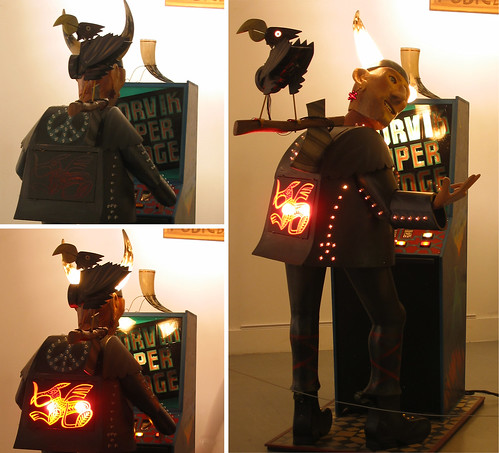
{Photo by rocketlass.}

I wish I had read Frans G. Bengtsson's odd and endlessly entertaining novel The Long Ships (1954) before the holidays. I'm fortunate enough to be part of a more or less strife-free family, but for those of you who aren't, I think I could have drawn on Bengtsson's account of tenth-century Viking adventures to offer some familiar scenes, or even some guidance, as you embarked on the holiday gauntlet.

You may, for example, recognize a particularly acute example of the resentful guest:
Great men from all over the north came to Jellinge to celebrate Yule with King Harald. . . . The principal guest was King Harald's son, King Sven Forkbread, who had arrived from Hedeby with a large following. Like all King Harald's sons, he was the child of one of his father's concubines; and there was little love lost between him and his father, so that in general they avoided each other as much as possible. Every Yule, though, King Sven made the journey to Jellinge, and everybody knew why. For it often happened at Yule, when the food was richer and the drink stronger than at any other time in the year, that old men suddenly died, either in bed or on the drinking-bench. This had been the case with old King Gorm, who had lain unconscious for two days after a surfeit of Yuletide pork and had then died; and King Sven wanted to be near the royal coffers when his father passed over. For many Yules now he had made the journey in vain, and each year his impatience increased.
And, as those from disputatious families can surely attest, when you've got guests who insist on taking a heaping helping of insult as a part of their entree, it's best to have explicit ground rules:
When everyone was in his place, the groom of the bedchamber announced in a gigantic voice that the peace of Christ and of King Harald reigned in the hall, and that no edged implements might be used except for the purpose of cutting up food; any cut, thrust, or open wound caused by weapon, ale-tankard, meat-bone, wooden platter, ladle, or clenched fist would be reckoned as plain murder, and would be regarded as sacrilege against Christ and as an unpardonable crime, and the miscreant would have a stone tied round his neck and be drowned in deep water.
However, ven the best planning, and the most selfless forbearance, cannot always avail you:
In the evening a man from Halland told them about a great wedding that he had been present at in Finnveden, among the wild people of Smaland. During the celebrations a dispute had broken out concerning a horse deal, and knives had quickly appeared; whereupon the bride and her attendant maidens had encouraged the disputants to settle the matter there and then. However, when the bride, who belonged to a well-known local family, saw her uncle's eye gouged out by one of the bridegroom's kinsmen, she had seized a torch from the wall and hit her bridegroom over the head with it, so that his hair caught fire. One of the bridesmaids, with great presence of mind, had forced her petticoat over his head and twisted it tight, thereby saving his life, though he screamed fearfully and his head, when it appeared again, was burned black and raw. Meanwhile the first had caught the straw on the floor, and eleven drunken or wounded men lying in it had been burned to death; so that this wedding was generally agreed to have been one of the best they had had for years in Finnveden, and one that would be long remembered.
In other words, the one true lesson of The Long Ships? Don't invite Vikings to your holiday parties.