Showing posts with label Ecclesiastes. Show all posts

Monday, July 23, 2007

A recipe for restless sleep


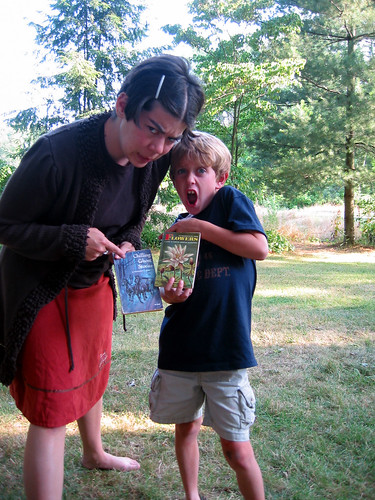
{Stacey: Let's read Chilling Ghost Stories!
Carson: How about we read Flowers instead?}

This is a new version of a longtime family favorite, guaranteed to produce a frothy mix of vaguely frustrating and disturbing dreams, full of shadowy characters, betrayals, and the low hum of constant danger.


Restless Sleep

{Ingredients}

1 spy novel, all but the last hundred pages read
1 breathlessly anticipated seventh volume of an unprecedentedly popular children's series
1 dry gin martini, up, with olive

{Preparation}

Begin reading the remaining pages of SPY NOVEL in time to be finished by 9:30. Set aside and let rest for fifteen minutes (It can later be lent to one's father.). Prepare and drink MARTINI. When clock reads 10:00, settle into comfortable reading position and begin reading BREATHLESSLY ANTICIPATED CHILDREN'S BOOK. Read one hundred pages, or until clock says 11:00. Set book aside (Remainder can be enjoyed as leftovers for up to three days.). Sleep; dreams should follow apace.


As an adaptation of a family staple, this recipe is fairly forgiving--quantities and times need not be exact for you to achieve the desired result. In a pinch, substitutions can be allowed--I find that Luc Sante's Low Life, Mark Smith's The Death of the Detective, Patricia Highsmith's Ripley novels, or Ecclesiastes work well in place of the spy novel, while the role of the children's book can be reasonably approximated by Philip Pullman's His Dark Materials trilogy, the collected works of Charles Schulz, or, oddly enough, any of the novels of Haruki Murakami. There is no substitute for the martini.

Thursday, February 16, 2006

Accounts receivable, or thoughts of life and death

Andrew Delbanco, Herman Melville: His World and Work
In one of [Melville’s books], Isaac Disraeli’s The Literary Character, [Melville’s widow] Lizzie marked the following passage by Disraeli’s widow: “My ideas of my husband . . . are so much associated with his books, that to part with them would be as it were breaking some of the last ties which still connect me with so beloved an object. The being in the midst of books he has been accustomed to read, and which contain his marks and notes, will still give him a sort of existence with me.”

On Herman’s desk she placed the precious bread box containing his unpublished manuscripts, from which she would extract a poem or two, or a few pages of [the then unpublished] Billy Budd, to show to some interested guest.

Ecclesiasticus 41:1-3
O death, how bitter is the remembrance of thee to a man that liveth at rest in his possessions, unto the man that hath nothing to vex him, and that hath prosperity in all things: yea, unto him that is yet able to receive meat!

O death, acceptable is thy sentence unto the needy, and unto him whose strength faileth, that is now in the last age, and is vexed with all things, and to him that despaireth, and hath lost patience!

Fear not the sentence of death, remember them that have been before thee, and that come after; for this is the sentence of the Lord over all flesh.

Verlyn Klinkenborg, Timothy, or Notes of an Abject Reptile

Is death so fearsome that it must be undone? Is this life so poor a thing? Is not eternity somewhat too long?
Theirs is a niggardly faith, withal. Parishioners believe only as much as will save the humans among them. Never mind the rest of creation. Unwilling to distinguish the dead from the living. But eager to set apart the rest of creation.

He rises to the pulpit. God’s family, he says, is numberless. “comprehending the whole race of mankind.” And only the race of mankind. Thereby cutting off most of creation.

But numberless is not the race of mankind. Numberless is the race of beetles. Numberless are “the most insignificant insects and reptiles.” Flying ants that swarm by millions in this garden. Armies of aphids falling in showers over the village. Palmer-worms hanging by threads from the oaks. Shoals of shell-snails. the earthworms. Mighty, Mr. Gilbert White avers, in their effect on the economy of nature. Yet excluded from the family of god.

William Hazlitt, "The Fight" (1822), collected in On the Pleasure of Hating
Even a highwayman, in the way of trade, may blow out your brains, but if he uses foul language at the same time, I should say he was not a gentleman.

Don't worry, folks. These selections aren't signs of a creeping morbidity or melancholy. I just happened to come across all of them yesterday and thought I'd group them.