Showing posts with label The Oxford Book of Death. Show all posts

Wednesday, October 06, 2010

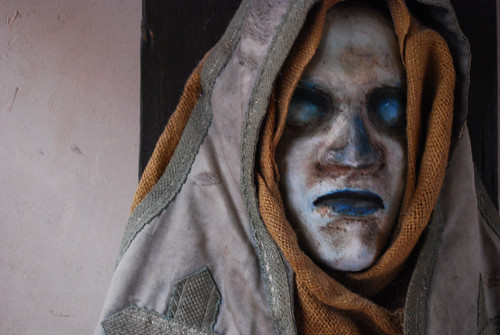
What the ghosts want


{Photo by rocketlass.}

From Expiration Date (2010), by Duane Swierczynski:
”What exactly do you think I am?”

“You’re a dead man.”

“But I’m not.”

“Right. Sure. You’re not dead. Maybe I’m dead. Maybe I’m a dead woman floating around a sea of living people, only I don’t know it yet. Maybe I’ve been dead since I was a kid.”

“I want to ask you about DeMeo.”

“He’s good to me.”

“What does he do up there? What kind of experiments?”

“You mean you don’t know? I thought dead people knew everything. That’s why you come back. To taunt the living. To show us how smart you are, and how dumb the rest of us are.”
In fairness, I should acknowledge that the man isn’t a ghost. The only ghosts found in Expiration Date are, like those in all good noir, those generated by the secrets of our pasts, come back to haunt us.

But I couldn’t resist sharing that pessimist’s view of what ghosts want from us, especially because it serves as such a good lead-in to this passage from Thomas Browne’s Urn Burial:
The dead seem all alive in the humane Hades of Homer, yet cannot well speak, prophesie, or know the living, except they drink bloud, wherein is the life of man. And therefore the souls of Penelope's Paramours conducted by Mercury chirped like bats, and those which followed Hercules made a noise but like a flock of birds.

The departed spirits know things past and to come,yet are ignorant of things present. Agamemnon foretels what should happen unto Ulysses, yet ignorantly enquires what is become of his own Son.
Which leads me to this, from Thomas Mann’s The Magic Mountain, picked out by D. J. Enright for his indispensable Oxford Book of Death:
But the calling back of the dead, or the desirability of calling them back, was a ticklish matter, after all. At bottom, and boldly confessed, the desire does not exist; it is a misapprehension precisely as impossible as the thing itself, as we should soon see if nature once let it happen. What we call mourning for our dead is perhaps not so much grief at not being able to call them back as its grief at not being able to want to do so.
If there's a month to call the dead, October is it--but do you know what would you say? Do you know what you would hear?

Wednesday, October 14, 2009

"Our bones in consecrated ground never lie quiet."


{Photo by rocketlass.}

In Willa Cather's pleasantly creepy little story "Consequences" (1915), a couple of characters--one of them haunted by an invasive, Walter Huston-esque apparition--get to discussing suicide. The unhaunted man describes the self-imposed end of a gentleman he knew:
Well, one afternoon when the tea was brought, he took prussic acid instead. He didn't leave any letters, either; people of any taste don't. They wouldn't leave any material reminder if they could help it.
Good breeding, in other words, demands as little muss, mess, and fuss from our ends as possible--which would surely make leaving any sort of ghostly residue unspeakably gauche.

That desire for complete dissolution returned to my mind a few days later, as I read the chapter on "Fame and the Afterlife" in Keith Thomas's fascinating new book The Ends of Life: Roads to Fulfilment in Early Modern England (2009). In the course of charting the varieties and degrees of belief in various aspects of the afterlife in England in the years after the Reformation, Thomas notes,
[S]cepticism, implicit or explicity, about the literal reality of a future life, whether in heaven or in hell, was more widely dispersed than the clergy would have liked. The resurrection of the body had never been an easy doctrine to justify to an agricultural population who knew only too well waht happened to corpses, whether of men or animals.
At the same time, the more one reads about the period, the more one understands the power of the desire to be reunited with lost loved ones, the
increasing tendency to hold out to breaved families the prospect of being reunited in the next world.
A person fortunate enough to live to adulthood in those years would have been positively surrounded by the memories of dead siblings, parents, friends, and spouses; the idea of a place where all would be reunited--in, as Catherine Talbot put it, "a permanent state of felicity"--would have been undeniably attractive.

Thomas goes on to detail changes in funerary and memorial practices in the period, and in doing so he points out yet another reason why an early modern Englishman might have had doubts about the efficacy--or certainly the attractiveness--of actual physical resurrection: the "remarkably casual" attitude towards remains that prevailed. Writes Thomas, in his inimitably quote-driven style,
After a few years, the graves might be cleared, the gravestones sold, and the brasses reused to commemorate someone else. . . . Overcrowded graveyards were periodically cleared, the stones removed, and the graves reused. The Northampton physician James Hart noticed that graves were often dug for new guests before the bodies of the previous occupants had decayed. Even the bones of the dead, which in medieval times were customarily lifted and preserved in charnel houses, ceased to be the object of specific attention. "Gravestones tell truth scarce forty years," thought Sir Thomas Browne. "Our bones in consecrated ground never lie quiet," agreed John Aubrey, "and in London once in ten years (or thereabout) the earth is carried to the dung-wharf."
All of which led me back to an old favorite, D. J. Enright's Oxford Book of Death (1983), which offers this wry take on the problem from Christina Rossetti's Time Flies (1897):
I well remember how one no longer present with us, but to whom I cease not to look up, shrank from entering the Mummy Room at the British Museum under a vivid realization of how the general resurrection might occur even as one stood among those solemn corpses turned into a sight for sightseers.

And at that great and awful day, what will be thought of suppositious heads and members?
Clearly, for those at both ends of the soul's spectrum--the ones with consciences clear enough to leave them confident of resurrection, and those who've left such marks as to be liable to ghostly expiation--cremation is the best, safest option.

Tuesday, September 01, 2009

"Some suggestion . . . that things could have been even better."

As I mentioned last week, I came to my current re-reading of Anthony Powell's A Dance to the Music of Time straight from Proust, so I was particularly open to narrator Nick Jenkins's many references to In Search of Lost Time as he's reading it during The Military Philosophers, the last of the war volumes. The following one, which comes at the end of a trip through Cauberg--Proust's Balbec--with a group of foreign military attaches, is worth particular attention:
At the same time, a faint sense of disappointment superimposed on an otherwise absorbing inner experience was in its way suitably Proustian too: a reminder of the eternal failure of human life to respond a hundred per cent; to rise to the greatest heights without allowing at the same time some suggestion, however slight, to take shape in indication that things could have been even better.
Jenkins's--and thus Powell's--take on that disappointment hews closer to my experience than does Proust's, however much I might enjoy it. Being not, by nature, an idealist or a dreamer--I'm essentially a pragmatist, and (were it not for the unavoidable hint of self-congratulation contained in the description) might even call myself a realist--I find neither the ideal so high nor the actual so low as does Proust. Nick's more middling, muddling route--and the melancholy pleasure to be found therein--is closer to my style.

That relative calm also comes through in Jenkins's tendency to meditation, or reverie, a characteristic of the novel that is really standing out in this, my fourth or fifth time through Dance: a scene or a person or an exchange will remind Nick of a book or a painting, perhaps an old memory, and he will pause for a moment to suss out the similarities and differences, and what those might teach him about the current moment. What's struck me this time through is the inherent calm required for that approach, a fundamental wholeness of or confidence in himself that allows him to simultaneously operate on two timescales, that of the moment and the much longer, more lasting one of literature, friendship, and personal history.

It's a deeply appealing characteristic, one that allows Powell to perpetually remind us of the reason we read books, the insight that only they can offer. Acknowledgment of the fact that such insight is unavailable to large swaths of our fellow humans is something else that sets Powell apart from most novelists; I've quoted this passage from The Valley of Bones before, but it remains the most succinct statement of that fact that I know, and thus bears repeating:
I was impressed for the ten thousandth time by the fact that literature illuminates life only for those to whom books are a necessity. Books are unconvertible assets, to be passed on only to those who possess them already.
That thought arises from the fact that, in the Army, Jenkins encounters a situation that will be familiar to anyone who has worked a job that mixes classes: being identified, usually skeptically, as a reader. Jenkins eventually surrenders to being pegged as such:
I no longer attempted to conceal the habit, with all its undesirable implications. At least admitting to it put one into a recognisably odd category of persons from whom less need be expected than the normal run.
I'll close out my Powellian musings for the week by noting another aspect of Nick's character--and thus Powell's understanding--that I appreciate: the simple fact that anecdotes that will stun some friends will fall entirely flat with others, and that one of the greatest--if simplest--joys of friendship is the eager anticipation of a chance to tell certain friends certain stories that you know will leave them gobsmacked. Those of you who haven't read Dance but might should skip this next passage, which reveals more than you ought to know in advance, but which illustrates my point:
I had not set eyes on Widmerpool myself since the day Farebrother had recoiled from saluting him in Whitehall. Although, as an archetypal figure, one of those fabulous monsters that haunt the recesses of the individual imagination, he held an immutable place in my own private mythology, with the passing of Stringham and Templer I no longer knew anyone to whom he might present quite the same absorbing spectacle, accordingly with whom the present conjuncture could be at all adequately discussed.
E-mail, cell phones, and other electronic communication aids have brought those crucial friends closer to us, made the stories that are the stuff of friendship easier than ever to share, but of course nothing will ever bridge that final gap, which puts me in mind of two passages I first discovered in D. J. Enright's marvelous anthology The Oxford Book of Death (1983). The first, from "Tam Cari Capitas," by Powell's contemporary Louis MacNeice, reminds us that "When a friend dies out on us and is not there," we miss him most "not at floodlit moments," but
. . . in killing
Time where he could have livened it, such as the drop-by-drop
Of games like darts or chess, turning the faucet
On full at a threat to the queen or double top.
Then there's this from the ever-helpful Samuel Johnson, as recounted by Hester Lynch:
The truth is, nobody suffered more from pungent sorrow at a friend's death than Johnson, though he would suffer no one else to complain of their losses in the same way; "for (says he) we must either outlive our friends you know, or our friends must outlive us; and I see no man that would hesitate about the choice."
A sentiment which I believe neither Nick Jenkins nor the long-lived Anthony Powell would dispute.
Friday, May 25, 2007

The hour is late, and night draws in on silent feet


(Photo by Rocketlass)

Though Chicago is nowhere near as mysterious as Venice, this is the best time of year for sitting late on the back steps and watch the city night steal in over the dark cemetery behind our house, its silent occupants waiting patiently for their hours to come. The sodium vapor lights in the alley slowly expand their dominion, the day sounds--of cars and talk and alley basketball--turn to night sounds--of sirens and breaking bottles and the distant music of party chatter. The evenings unfold slowly, and the mosquitoes have yet to renew their annual war on all warm-blooded creatures, so with books and a martini I remain outside until darkness forbids further reading.

From After Dark (2004, English translation 2007), by Haruki Murakami
Through the eyes of a high-flying night bird, we take in the scene from midair. In our broad sweep, the city looks like a single gigantic creature--or more like a single collective entity created by many intertwining organisms. Countless arteries stretch to the ends of its elusive body, circulating a continuous supply of fresh blood cells, sending out new data and collecting the old, sending out new consumables and collecting the old. To the rhythm of its pulsing, all parts of the body flicker and flare up and squirm. Midnight is approaching, and while the peak of activity has passed, the basal metabolism that maintains life continues undiminished, producing the basso continuo of the city's moan, a monotonous sound that neither rises nor falls but is pregnant with foreboding.


From Lois the Witch (1856), by Elizabeth Gaskell
Evening was coming on, and the wood fire was more cheerful than any of the human beings surrounding it; the monotonous whirr of the smaller spinning-wheels had been going on all day, and the store of flax downstairs was nearly exhausted, when Grace Hickson bade Lois fetch down some more from the storeroom, before the light so entirely waned away that it could not be found without a candle, and a candle it would be dangerous to carry into that apartment full of combustible materials, especially at this time of hard frost when every drop of water was locked up and bound in icy hardness. So Lois went, half shrinking from the long passage that led to the stairs leading up into the storeroom, for it was in this passage that the strange night-sounds were heard, which everyone had begun to notice and speak about in lowered tones.


From At Day' Close: Night in Times Past (2005), by A. Roger Ekirch
"He that does ill hates the light," affirmed a Scottish proverb. Numerous folk, besides burglars, robbers, and other hardened rogues, exploited the evening darkness, often for illicit purposes. Petty criminals were far more numerous, if less feared. For poor families, social and legal constraints of all sorts eased. Indigent households buried their dead at night to escape paying parish dues, which had the added benefit of protecting gravesites from thieves, often needy themselves. Where grave robbers at night stole clothing and caskets, "resurrection men" unearthed entire bodies, freshly interred in churchyards, to sell for medical dissection. . . . The best time for treasure hunting fell after midnight, with some evenings preferred to otehrs depending on the moon's phase. Silence was critical. As a defense against demons, it was customary to draw one or more circles at the supposed spot. More alarming to authorities, malevolent spirits might be invoked to assist in unearthing the treasure. An English statute in 1542 threatened hunters with the death penalty for "invocacions and conjurations of sprites" to "get knowledge for their own lucre in what place treasure of golde and silver shulde or mought be found."


From Peter Haining's introduction to The Ghost-Feeler: Stories of Terror and the Supernatural, by Edith Wharton
It is a strange fact that for the first twenty-seven years of her life, a woman who is today regarded by several authorities on ghost fiction as one of the foremost writers of supernatural stories of her time, was quite unable to sleep in any room that contained so much as a single book of such tales. So unnerved was Edith Wharton by supernatural fiction that she later admitted to destroying any that she came across in the home.


From Blitz: The Night of December 29, 1940 (2005), by Margaret Gaskin
On his brief fact-finding mission from New York, PM editor Ralph Ingersoll had found the most striking aspects of Blitz life were "the normalcy of life by day and the dramatic suddenness with which that life stops at sundown." Though he had adjusted to it, he just "couldn't get over" it at first: in London, "The two worlds, the world of peace and the world of war, exist side by side, separated by only a few minutes of twilight.


From Religio Medici (1643), by Sir Thomas Browne (encountered in The Oxford Book of Death (1983), edited by D. J. Enright
I believe . . . that those apparitions and ghosts of departed persons are not the wandring souls of men, but the unquiet walks of Devils, prompting and suggesting us unto mischief, blood, and villainy; instilling and stealing into our hearts that the blessed Spirits are not at rest in their graves, but wander solicitous of the affairs of the World. But that those phantasms appear often, and do frequent Cemeteries, Charnel-houses, and Churches, it is because those are the dormitories of the dead, where the Devil, like an insolent Champion, beholds with pride the spoils and Trophies of his Victory over Adam.


From The Year of the Death of Ricardo Reis (1984, English translation 1991), by Jose Saramago
The evidence of death is the veil with which death masks itself. Ricardo Reis has gone past the tomb he was looking for. No voice called out, Hello, it's here, yet there are still those who insist that the dead can speak. What would become of the dead if there were no means of identifying them, no name engraved on a tombstone, no number as on the doors of the living.


One's only recourse, clearly, is to stay awake, keeping company with the owls and the nightjars, opossums and rats. If it means closing one's book when it's too dark to read, well, at least night also belongs to the hoboes and raconteurs, who can surely keep us entertained until dawn.