Showing posts with label J. M. Barrie. Show all posts

Wednesday, November 11, 2009

"And I thought, Suppose one of them had an omniscient valet?", or, P. G. Wodehouse on Jeeves

The two highlights for me of the new fourth volume of The Paris Review Interviews--reason enough on their own for me to buy the book--are the interview with Haruki Murakami, which I drew on yesterday, and the one from 1975 with P. G. Wodehouse.

Wodehouse comes across as amiable and a bit goofy, but at the same time every bit the master craftsman and hard worker his fans know him to have been. The interview is sprinkled with wonderful moments--like when Wodehouse says, "I'm bad at remembering things, like when flying really became fashionable," or "It's a shame when things like spats go out"--but what has inspired today's post is one of the standard questions that Wodehouse must have fielded hundreds of times, but to which this time he gave an interesting answer:
INTERVIEWER
Did you ever have a butler like Jeeves?

WODEHOUSE
No, never like Jeeves. My butlers were different, though I believe J. M. Barrie had one just like Jeeves.
Really? Now this calls for a trip to the bookshelves, where from Lisa Chaney's Hide-and-Seek with Angels: A Life of J. M. Barrie (2005), we learn about Barrie's manservant Frank Thurston, who entered Barrie's service in the 1920s and does seem to have been remarkable:
Thurston's ability to enter and leave a room with absolute silence was a reflection of his enigmatic and, some thought, slightly sinister personality. To compound the mystery he had somehow familiarised himself not only with Spanish and French, but also with Latin and Greek. In addition to admirably fulfilling his role as skilled and urbane butler, it soon became clear that Thurston was a man of startling learning. Cynthia [Asquith] wrote of him:
Dictionaries and various learned tomes soon cluttered up the pantry, where I would constantly find him reading Latin or Greek while he polished the silver.
Thurston had an astonishing memory for other things besides living and dead languages. He could supply any forgotten date or quotation. One day Barrie remarked that the only line in an Oxford quotation that survived was "A rose red city half as old as Time." Though we all knew this line, no one of us could remember the name of the poet.
When Cynthia's husband, Beb, confessed that he couldn't remember the name of the "rose red city" and no one else at the table could either, Thurston, passing around the meat, finally said, "Was it not Petra, Sir?"
In light of Thurston's surprising erudition, Chaney tells us, Barrie took to warning his guests that
if they were thinking of reading a thriller in bed they would be advised "to hide it between a Pliny and the latest theory of Ethics."
While Robert McCrum's recent biography of Wodehouse barely mentions Barrie, and Thurston not at all, it does appear
(if Google Book Search's frustratingly limited preview isn't leading me astray) that N. T. P. Murphy at least touched on the question of Thurston as an inspiration for Jeeves in his In Search of Blandings: An Investigation into the Sources That Inspired P. G. Wodehouse (1986), writing that, through the accounts of Wodehouse's friend Denis Mackail, Thurston "played a part in the 'growth' of Jeeves in the early part of the 1920s."*

All of which makes me wonder how Thurston would have handled an odd incident involving Barrie that I've related before, but which seems worth sharing once again. It's from Penelope Fitzgerald's loving, perceptive group biography of her uncles, The Knox Brothers (1977), and, appropriately or not, it's the first thing that comes to my mind when Barrie is brought up:
Desmond MacCarthy, the most genial of Irish critics, had been at King's, and wanted to help [Fitzgerald's uncle Edmund Knox], as he wanted to help everybody he met. He also knew everybody. Eddie must come to him and ask advice from James Barrie, who was at the height of his fame, though he could sometimes be a little disconcerting, unless the side of him which spoke to adults, and which he called "McConachie," happened to be foremost. Buoyed up by MacCarthy's confidence, the two of them called at 133 Gloucester Terrace, where they found the room empty, except for a large dog, with which Barrie used to play hide-and-seek in the Park. While they waited, Eddie in sheer nervousness hit his hand on the marble mantelpiece. It began to bleed profusely. MacCarthy was aghast. Barrie could not bear the sight of blood. They tried to staunch it with handkerchiefs, and with the cuffs of MacCarthy's soft shirt, which became deeply stained. Barrie appeared at the doorway, took one look at them, and withdrew. Kind-hearted though he was, he was obliged to send down a message that he could not see them.
For that matter, how would Jeeves himself have handled it? Bertie's scrapes, though plentiful and harrowing, were rarely the sort to draw blood. Most likely, I suppose, is that no such incident would have occurred, Jeeves having quietly sanded all the corners of the mantelpiece at some point in the past in anticipation of just this sort of danger.

Tuesday, June 23, 2009

"This quietest figure in literature," or, Back under Hardy's spell


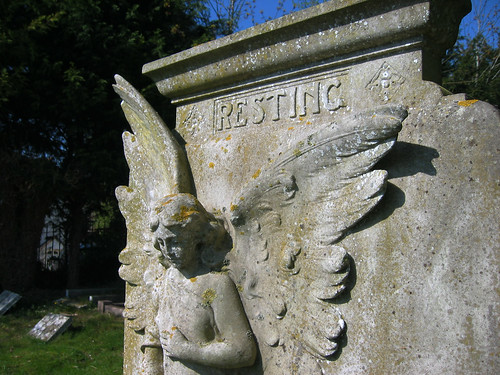
{Photo of a grave in Dorset by rocketlass.}

The problem with happening across a reference to Thomas Hardy, like the one that inspired my previous post, is that no sooner have I consulted my favorite sources on Hardy's life than I find myself weltered by their countless worthy anecdotes--and in a blink, a week of planned posts go by the wayside. Interested in learning more about the delicious Penguin Book of Gaslight Crime? Charles Ardai's fun new swashbuckling adventure series starring Gabriel Hunt? The jeweled viciousness of Randall Jarrell's Pictures from an Institution? Sorry, but you'll have to wait while I give Hardy his due.

For this first anecdote, at least, I can claim the excuse of continuity, as it does feature characters who figured in the previous post: not just Hardy, but also J. M. Barrie and Cynthia Asquith, the daughter-in-law of H. H. Asquith, the prime minister whose threat to ennoble Hardy and Barrie (alongside 498 others) so frightened the House of Lords in 1911. And surely not even the most hardened anti-Hardyite could begrudge me the sharing of a tale like this, from a 1956 article in the Listener by Cynthia Asquith, who at the time of this 1921 visit was Barrie's secretary:
I have such a vivid visual memory of Thomas Hardy. I see him on the threshold of the cottage in which he had been born. He is anxiously watching his friend, J. M. Barrie, climb a rickety ladder to get in through a window and open the locked door of the cottage from the inside, when Barrie was sixty-one years old.
Shades of Peter Pan there, no?

After a few dismissive comments about the architecture of Max Gate, typical of educated visitors to that odd abode that Hardy had designed for himself, Asquith remarks on Hardy's
resigned eyes, unforgettable. They looked as if nothing could ever surprise them again. They were sad eyes--very sad--but unflinching, as though, after long sorrow, a certain serenity had been arrived at.
The best part, though, comes with the appearance of Hardy's dog, Wessex:
The moment we arrived I was formally introduced to the most despotic dog guests had ever suffered under. This notorious dog, who was called "Wessex," had, I am sure, the longest biting list of any domestic pet. His proud master lost no time in telling us that the postman, who had been bitten three times, now refused to deliver any more letters at the door. The thick tousle of Wessex's unbrushed coat made it impossible to guess to which, if any, breed he was supposed to belong, and I did not think it would be civil to ask. Wessex was specially uninhibited at dinner time, most of which he spent not under, but on, the table, walking about unchecked, and contesting every single forkful of food on its way from my plate to my mouth.
Or perhaps (maybe for those of you who harbor unruly dogs of your own?) the most memorable--and undeniably the most telling--part of the article is Asquith's account of one of Hardy's morbidly self-obsessed quirks that Barrie had shared with her:
[H]e often smiled over Hardy's preoccupation with his plans for his own burial--plans which were perpetually being changed. "One day," said Barrie," Hardy took me to see the place where he wants most to be buried, and the next day he took me to see the place where he would like next best to be buried. Usually he says he is to be buried exactly in between his two wives, but sometimes he is to be so many inches hnearer to the first; sometimes so many inches nearer to the second."
If you suspect a little friendly exaggeration in Barrie's account, you're not alone: that was Asquith's response, too, until
the present Mrs Hardy, a little wearily, if unresentfully, told me that her husband had one day made her walk six miles to show her the bench on which he used to sit while he was courting her predecessor. I wondered, but did not like to ask, whether he kept her up to date with his changing arrangements for her burial.
Longtime readers will already have guessed that I found this article in Thomas Hardy Remembered (2007), a compilation of contemporary accounts of Hardy so full of pleasures that I can't imagine a Hardy fan's bookshelves being complete without it, despite its libraries-only price of £57.00. If you're not yet convinced, just wait: as threatened, I'll share more from it in the coming days.

{And after all this talk of Wessex and burial, I must direct you to this photo by Flickr user Grueneman--which, its rights being sadly reserved, I can't reproduce here--of Wessex's grave in Hardy's pet cemetery. He truly was an honored friend, for all his incorrigibility.}

Monday, July 09, 2007

But when I became a man I put away childish things

Oh, how wrong you are, I Corinthians! After all, the final volume of Harry Potter is on its way . . .

That, along with thinking about Lloyd Alexander, has me in the mood for a few notes on children's books.

1 In the comments on my Lloyd Alexander post, Idalia wrote:
That *is* an awesome first sentence, I had forgotten that one. However I have yet to see a children's book first sentence that can go up against Charlotte's Web's "Where's Papa going with that ax?"
Just as she had forgotten the opening of The Book of Three, I had forgotten the opening of Charlotte's Web. What strikes me now, reading that line, is how perfectly in keeping it is with the tone of E. B. White's letters, a collection of which I've been reading off an on for the past few months.

Here, for example, is his reply to a batch of letters from a fifth-grade class, in which he was asked about animals on his farm:
I have raised a good many young pigs, lambs, chicks, and goslings in my barn. I will tell you something that happened to the young geese last winter. There is a small pond down in the pasture and the geese use it for a swimming pool. They start from the barnyard, walking slowly; then as they get nearer the water, they break into a run; and then they spread their wings, take to the air, and land on the pond with a splash. But one night, early last winter, the pond froze during the night. The young geese had never seen ice, and knew nothing about it. They started for the pond, sailed into the air, and when they came down for a landing their feet struck the ice and they skidded the whole length of the pond and crashed into the opposite bank. That's how they learned about ice.


White's prose, whether in a letter or in a more polished piece of writing, has a kindness and matter-of-factness that rescues it from the ever-present danger of archness. What ultimately comes across is the sense of an observant man who enjoys sharing what he's seen, particularly glimpses of the livees of animals or unusual people. The bounce and balance of his sentences ends up seeming effortless, only natural to his storytelling style, as in this letter to James Thurber:
I made the drive in an open car with a turkey in the back seat and a retriever in the front. Stopped off at the Coatses' and we ate the bird and freshened up the dog.


Even when, as so often, he's being thoroughly ironic, as in this 1943 letter to Gustave Lobrano, his charm wins out:
Hospitals are fun now because all the competent people have gone off to the fighting fronts, leaving the place in charge of a wonderfully high-spirited group of schoolgirls to whom sickness is the greatest lark of the century.


All of which leads me to wonder if maybe it's time to reread Charlotte's Web? Or maybe The Trumpet of the Swan, which I remember liking more when I was young?

2 Thinking yesterday of waiting for books to be sent to me through the regional library system also reminded me of the annual trips my parents would take to Chicago for the Farm Bureau convention. I had never been to Chicago, which was 300 miles away from our town, but I imagined it as a paradise, because it had Kroch's and Brentano's, a multi-story downtown bookstore that, it seemed, stocked nearly every book. Before each trip, my parents would ask me for a list of books I was looking for, and invariably they would bring back the majority of them.

The very idea of such a big bookstore was fantastic to me in those pre-superstore days; the fact that in a city you could walk out of a bookstore with not only The Rescuers but Miss Bianca and Miss Bianca in the Salt Mines as well--to say nothing of Mrs. Frisby and the Rats of NIMH--was, I think, the first seed of my desire to transform from a a country mouse to a city mouse.

It was the right choice: Kroch's is long gone, and books of all sorts are far more readily available to rural residents, adults and children alike, but the lure of the city remains powerful, the rich variety emerging from density no less compelling.

3 I've also had J. M. Barrie on the brain lately, perhaps a lingering reaction to once again seeing the Peter Pan statue in Kensington Gardens this spring--or possibly because of a surfeit of Thomas Hardy, of whom Barrie was a champion. Explains Lisa Chaney, in Hide and Seek with Angels: A Life of J. M. Barrie:
Amongst living writers it was Hardy and Meredith whom Barrie admired the most. . . . Barrie's capacity for hero worship might at time have made the diffident Hardy feel a little uneasy, but where Barrie worshiped he also protected, supported, even nurtured. He was capable of immense loyalty, and throughout his life was prepared to expend gargantuan efforts on behalf of his friends.
That loyalty could unquestionably be smothering for its objects, as Barrie was a strange and difficult man, never quite comfortable with adults but at the same time unable to achieve that relatively easy (some might say too easy) understanding with children that Lewis Carroll seems to have had. After his wife left him for a younger man, Barrie successively insinuated himself uncomfortably into two different families--Anthony Powell describes him in this stage as "Dracula-like"--in the unpleasantly overlapping roles of father figure/friend of children/third wheel to a marriage. Though his adopted families were often glad of his company, attention, and, it must be said, money, the situation, it seems, never quite escaped awkwardness, if not outright discomfort.

The following story of Penelope Fitzgerald's father, longtime Punch editor E. V. Knox, meeting Barrie for the first time, which she relates in The Knox Brothers, seems typical of Barrie's uncomfortable nature:
Desmond MacCarthy, the most genial of Irish critics, had been at King's, and wanted to help [Edmund], as he wanted to help everybody he met. He also knew everybody. Eddie must come to him and ask advice from James Barrie, who was at the height of his fame, though he could sometimes be a little disconcerting, unless the side of him which spoke to adults, and which he called "McConachie," happened to be foremost. Buoyed up by MacCarthy's confidence, the two of them called at 133 Gloucester Terrace, where they found the room empty, except for a large dog, with which Barrie used to play hide-and-seek in the Park. While they waited, Eddie in sheer nervousness hit his hand on the marble mantelpiece. It began to bleed profusely. MacCarthy was aghast. Barrie could not bear the sight of blood. They tried to staunch it with handkerchiefs, and with the cuffs of MacCarthy's soft shirt, which became deeply stained. Barrie appeared at the doorway, took one look at them, and withdrew. Kind-hearted though he was, he was obliged to send down a message that he could not see them.

Overall, Barrie's was an odd, sad life, with far more than its share of sorrow and loss to leaven his success. Powell, in a review of Janet Dunbar's J. M. Barrie: The Man Behind the Image (1970) writes:
In the end one feels that only Dostoevsky could do justice to Barrie's life, the passionate sexless love affairs, the money, the rows, the reiterated tragedies. It is all Dostoevsky's meat.


4 All this has lead me to wonder whether some children's or young adult books should accompany me on my upcoming vacation. On my shelf, unread, is The Brilliance of the Moon (2004), the third volume of Lian Hearn's samurai adventure series, Tales of the Otori. Should it be packed? And, having hauled down the Prydain Chronicles to write about Lloyd Alexander--and then finding myself wanting to argue that they're better than Susan Cooper's sequence, The Dark Is Rising--I wonder if I should bring those along?

That would help solve my problem of bringing too many books on trips: if I get tired of hauling these around, I can always send them home with my nephew, further cementing Stacey's and my reputation as that aunt and uncle who always give books. I guess there are worse types of aunt and uncle to be.