Showing posts with label Joseph Mitchell. Show all posts

Monday, May 11, 2015

Cheer

When this post appears, if all is going well, I'll be in the air on my way to a week of publicity calls in New York, having just spent the weekend muttering to myself on my couch in an attempt to hammer the outlines of presentations for 50 or so books into my head.

Accompanying me on the flight will be Thomas Kunkel's new biography of Joseph Mitchell, A Man in Profile. Starting a trip with a book you can count on is essential, and I have it on good authority--that of the book's manuscript editor, Benjamin Dreyer--that this one is excellent.

Knowing I could read it on the plane kept me from doing more than dip into it last week, but I did happen across one bit that I'll share. It's from a letter Mitchell sent a fan in 1993 who wrote him to praise Up in the Old Hotel:
Your letter is one of the first I am really answering because it has meant so much to me. If you remember, in your letter you said you had thought of writing to me about missing my stories in The New Yorker but had decided not to do so until you read in the Author’s Note of my book that graveyard humor exemplified the cast of my mind—"so," you continued in your letter, "you will appreciate this: I thought you were dead." Well, Mrs. Edwards, I don’t know why, but that delighted me. It filled me with cheerfulness. I keep the letter in the tray drawer of my desk and anytime one of those strange, sudden attacks of depression that many of us have hits me, I get it out and reread it, and it never fails to cheer me up.
A good way to start the week, I think. And a good way to start pining for a Joseph Mitchell letters collection . . .

(Oh, and never you worry: yes, I did pack a volume of A Dance to the Music of Time as well. Best to be doubly prepared.)



Monday, July 23, 2012

In the blaze of midsummer, autumn beckons

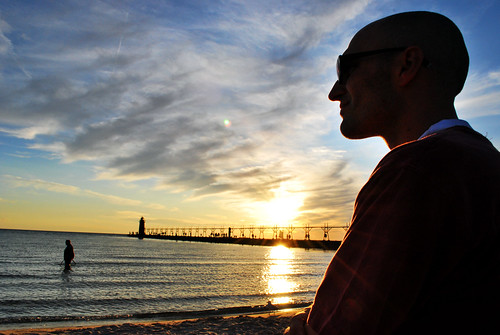
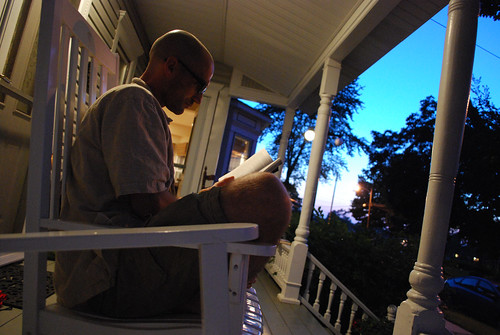
{Photos by rocketlass.}

I have a gift for contentment. The moments are relatively rare when I'm looking ahead or behind, willing myself not to be where I am and doing what I'm doing. The grass is almost never greener. There is always the risk that such a tendency will turn pathological, inertia metastasizing, but on on a day-to-day basis it's far from a bad platform on which to build a life.

--

I don't use "gift" casually. I know that my ability to find contentment is in large part a compound of upbringing, habit, and deliberate choice, but it usually feels like more than that, like something given. I've had the wherewithal to take advantage of it, but I didn't earn it in the first place. I've never had even the slightest leanings toward religious belief, but one teaching from Chrsitianity that I have always found useful is the concept of grace--favor not earned but freely given. That's how I feel about my contentment, and I'm grateful.

--

I do, however, have a habit of looking ahead to the next season. Autumn is the favorite, but as it starts to bite I wonder about winter and its snows; winter, lingering, prompts hopes of spring, and spring--along with baseball--brings thoughts of summer nights. Summer, well, until Stahl family vacation in July, it holds its own.


--

My year includes six major holidays: Opening Day, the first day of the playoffs, the first day of the World Series, Thanksgiving, Christmas, and the seven days of the annual Stahl family vacation. Christmas, the chief in this pantheon when I was young, is always on the verge these days of being relegated to the minors, its consumer mania only just balanced by the way it gathers the family and the pleasures offered by its music. If it weren't for Charles Schulz and Vince Guaraldi, it would likely have been stricken long ago.

--

In the introduction to the career-spanning collection of his work Up in the Old Hotel, Joseph Mitchell writes,
I am sure that most of the influences responsible for one's cast of mind are too remote and mysterious to be known, but I happen to know a few of the influences responsible for mine. . . . Aunt Annie would lead us to the cemetery, and there she would pause at a grave and tell us about the man or woman down below. At some of the graves my mother and my Aunt Mary would chime in, but Aunt Annie did most of the talking. "This man buried here," she would say, "was a cousin of ours, and he was so mean I don't know how his family stood him. And this man here," she would continue, moving along a few steps, "was so good I don't know how his family stood him." And then she would become more specific. Some of the things she told us were horrifying and some were horrifyingly funny.
--

Up in the Old Hotel, it astonishes me to realize, was published twenty years ago next month. Joseph Mitchell, though he hadn't published a word for nearly thirty years, was still with us then.

--

Last week was the eleventh year of the annual Stahl family vacation. We always traveled in the summer when my sister and brother and I were kids--sometimes my father would come home one day and say that he and his father had finished their work on the farm and thus the next two weeks looked clear, and we'd be away the next day. As we grew up and, serially, went to college, the vacation fell away, victim to the scheduling problems that plague all family endeavors. But soon after she had her first child, my sister--wanting, I think, for her son and his siblings and cousins (all then merely prospective) to know his aunts and uncles and cousins better than we'd known ours--convinced us to give a new, different family vacation a try. Ever since, we've been renting a house for a week in July every year.

--

A few years ago in June I had a dream in which I woke up to discover that it was Thursday of Stahl family vacation week and that I'd somehow piddled away the majority of the week, not in the comfortable, companionable way that is the essence of vacation--which, without effort or plan, draws you closer to family--but in the frenzied, forgettable, workplace-like way of the Wordsworthian admonition:
The world is too much with us; late and soon,
Getting and spending, we lay waste our powers.
The intensity of my relief on realizing it was a mere dream is hard to describe.

--


With spouses and children, there are twelve of us now, and six years ago we settled, I think for good, on South Haven, Michigan. South Haven is a resort town in a very Midwestern style--there are no fancy restaurants and few places that I trust to pour a martini. Oh, there are shops, but they're selling nothing you need, aside from the used bookstore (where this year I picked up an Anchor paperback of Joseph Conrad's Chance with an Edward Gorey cover). What the South Haven house has to offer is a porch, proximity to the beach, and quiet, and what more could you possibly need?

--


The first few days of vacation found me reading what I think of as the Inexhaustibles: enjoying another of the hundred-plus volumes on the Donald Westlake bookshelf and two of Rex Stout's seventy-three Nero Wolfes. Consumed at a comfortable pace, the works of these authors--to whose ranks could be added P. G. Wodehouse--will see a reader through decades of lazy vacations. Their comforts feel endless.

--

One of the Stouts I read, Over My Dead Body (1940), introduces Nero Wolfe's daughter, which is a shock if for no other reason than that Wolfe has assembled such a complete proxy family in his brownstone on 35th Street. And an actual daughter introduces the troubling concepts of time and age, both banished from Stout's universe--a not insubstantial part of the pleasure of Wolfe, Archie, Fritz, Saul, et al. is that their selves and relationships are fixed, subject to none of the cruelties of change, age, and loss. Time will not, to twist William Maxwell's phrase, darken them.

--

The week was hot, unusually so, and in a twelve-person house the air conditioning is necessarily regulated by the most sensitive of the group. But Wednesday night rocketlass decided to open our bedroom window, affording entry to an illicit breath of outside air . . . and soon after midnight her incorrigibility was rewarded by the unmediated power of a thunderclap, followed by a hard rain, the first this parched shore had seen in months. It poured, satisfyingly, all night.

--

In any gathering, I'm always the first up in the morning. As Norman Maclean puts it, "I get up early to observe the commandment observed by only some of us--to arise early to see as much of the Lord's daylight as is given to us." The morning after the thunderstorm, I woke to a gentle, drumming afterthought of a rain and took my coffee to the porch a good hour before even the two-year-old would be likely to wake. With me I carried W. G. Sebald's The Emigrants (1992). The newly cool, moist air rippled on the skin the way it does in the earliest days of autumn.

--

I'd read Sebald before and not been convinced. It was in 2000, and I was newly entered into a job that has become a career, newly moved to a condo that has become a home, and about to begin a marriage that has become life itself. Sebald's melancholy was not what I was looking for or needed, and I didn't respond to it. But that Thursday morning last week, half of vacation behind me, an unexpectedly autumnal feel in the air, Sebald's words met me at the right time and place, and I sank into his stories of loss and doomed attempts to recover what is forever gone.

--

"When I think back to those days," one of Sebald's characters writes, "I see shades of blue everywhere -- a single empty space, stretching out into the twilight of late afternoon, crisscrossed by the tracks of ice-skaters long vanished."

--


Autumn is for re-reading, and in particular for re-reading books about loss and regret. So I turn again to Norman Maclean's A River Runs through It and Sarah Orne Jewett's The Country of the Pointed Firs, V. S. Naipaul's The Enigma of Arrival, and William Maxwell, all of William Maxwell. I doubt I'll ever stop re-reading those books.

--

Jewett writes, "There was a silence in the schoolhouse, but we could hear the noise of the water on a beach below. It sounded like the strange warning wave that gives notice of the turn of the tide." Mary Poppins, remember, promises to stay until the wind changes. Seasons, however we spot them or define them, are important.

--

I am regularly surprised, returning to A River Runs through It, by how conversational and wry it is, the way that Maclean's narrator--Maclean, in other words--cocoons the wound at the book's center in casual observation, self-deprecating wit, and ironic folksiness, the better to enable it to emerge, beautiful as it is painful, when the time comes to turn our gaze full upon it. Away from the book, we remember its pain and the beautifully rendered prose of its emotional swells; back with it again we are reminded that it's more like life itself than that memory would have us think, prosaic and silly and funny and even a bit vulgar.

--

In A River Runs through It, Maclean's narrator talks with his wife after he's returned her ne'er-do-well brother, sunburned and hungover, from an ill-fated fishing trip, and the subtext of the conversation is his own troubled brother:
"I am trying to help someone," she said. "Someone in my family. Don't you understand?"

I said, "I should understand."

"I am not able to help," she said.

"I should understand that, too," I said.
Grace is a shade of fortune, and when I think of it--unearned in the face of the world's misery--I feel even more grateful. We've not thus far needed, in our family, the help that Maclean's brother needed and couldn't find a way to accept, so our vacations together are peaceful and comfortable and happy. These are the people I am easiest with in all the world.

--

I read Sebald Thursday and Friday, and Saturday came and we packed up amid happy tears. The calendar turns, and we look ahead to next year. It's not unreasonable to think that we have decades of these vacations ahead of us, and I hold to that thought.

--

It was 93 degrees today in Chicago, but the days are drawing in and, Stahl vacation behind, autumn beckons.

--


"Eventually, all things merge into one, and a river runs through it."

Wednesday, July 02, 2008

And the hearts of the world's Joseph Mitchell fans go pitter-pat . . .

MacDonald Harris's novel Mortal Leap (1964) is about Larry Backus, a sailor in the merchant marine who, having had his identity stripped away by a torpedo during World War II, finds himself claimed by a wealthy woman as her husband, a naval lieutenant on the ship amidst whose wreckage Backus, burned beyond recognition, was recovered. I'll have more to say about the book in coming days, especially about how the story of this autodidact is steeped in books to a degree beyond that of most novels, even those featuring proper intellectuals--but today I just want to quickly share a moment that made me break out into a broad smile.

Backus, still adjusting to life among the cultured and moneyed, has just caused a minor stir by putting catsup on his filet mignon. His father-in-law unexpectedly disrupts the awkward silence that ensues, revealing in the process that he, too, has had to earn his familiarity with money:
After a while Leo remarked, "Joe Gould when he was living in the Village always used to pour catsup out on his plate and eat it with a spoon. He didn't like the stuff but he said it was the only thing in a Village diner that was free."

"Who was Joe Gould?" I demanded, still a little truculent.

"A philosopher," was all he would say. A philosopher who ate catsup? That night after the other had gone to bed I locked myself in the study and looked him up in Baldwin's Dictionary of Philosophy, but he wasn't there.
If only the Internet had existed in 1964, perhaps the Wikipedia might have been able to come to the rescue!

Thursday, December 14, 2006

It's a helluva town.

I'm in New York this week for work, so my reading is on the subway instead of the L. Some New York notes:

1) I started my trip, on the plane, with the least New York book I had handy, Wendell Berry's new novella, Andy Catlett (2006). Berry is a man of the country and the farm, unimpressed by cities, though he has lived in them at times, and Andy Catlett is in part a lament of everything that I can hear right now through my hotel window, the sounds of post-War America--fueled by petroleum, always on the go, mind always split between here and there, now and the future. It's an elegiac book, despite being written about a nine-year-old boy, and in picking it to bring, I guessed right: its slow cadences put me in the right mood for entering the city.

2) But once I got to my hotel, the Hudson, I had no choice but to leap with both feet into the future that to Berry is of such uncertain value, for the Hudson resembles nothing so much as a vision of tomorrow dreamed up by Wong Kar Wei and Haruki Murakami, with the addition of at least a dollop of Eurotrash. So back to Murakami I went, this time to Norwegian Wood (1987, translated into English in 2000).

And I was pleasantly surprised to discover that Norwegian Wood is haunted by a similar sense of loss to that which pervades Andy Catlett. A thirty-seven-year-old man looks back, from 1987, on a love of his 1960s youth:
Each time [that memory] appears, it delivers a kick to some part of my mind. "Wake up," it says. "I'm still here. Wake up and think about it. Think about why I'm still here." The kicking never hurts me. There's no pain at all. Just a hollow sound that echoes with each kick. . . . Which is why I am writing this book. To think. To understand. It just happens to be the way I'm made. I have to write things down to feel I fully comprehend them.
For all that Murakami's books get discussed as weird pageants of contemporary life, icons of postmodernism, the ones I've read have all featured narrators driven by loss, alienated from their past or from the world by people they can't have back, decisions they can't unmake, times they can't recapture. There is a similarity in tone between Murakami and Berry, or Murakami and Anthony Powell, or Proust, that I never expected when I first opened his novels.

3) For weeks, I've been trying to remember the name of a contemporary British author, whose multi-volume family saga has been reviewed favorably, and whose prose style seemed like one I would appreciate. Take this exchange, for example:
"Imagine wanting to talk to someone on the phone," said Eleanor. "I dread it."

"Youth," said Nicholas tolerantly.

"I dreaded it even more in my youth, if that's possible."
Wanting to read this unknown author's collected novels, and knowing what its spine looked like, I'd even gone so far as to quickly look over all the fiction shelves at 57th Street Books in an attempt to circumvent my faulty memory, but to no avail. Then last night, while waiting to meet some friends, I wandered into Three Lives and Company on 10th Street and there it was, stacked high on the front table of staff favorites: Edward St. Aubyn's Some Hope (2003).

When fate gives you such clear instructions to buy a book, you are required to do so, fidelity to your local bookstore and lack of space in your luggage be damned.

4) As a longtime Joseph Mitchell fan, I talked the aforementioned friends into visiting McSorley's Old Ale House last night, and I was pleased that it was all I could have hoped for, abjuring modernity while somehow avoiding the deadly taints of kitsch or irony. The urinals alone--deep, tall, and majestic--made me feel young and insignificant, part of a lesser, fallen generation. We can't even pee like they used to pee.

Then we proceeded to irk our waiter with our frequent indecision in the face of his queries. It was hard to fault him: after all, one's only choices are light or dark, have another round or don't. And again I felt a failure. Joseph Mitchell would have had no trouble deciding. William Maxwell would have had no trouble deciding. Hell, had they allowed women back then, Dorothy Parker would have had no trouble deciding.

A couple of times, our waiter simply decided for us, always in the affirmative, always for the dark, and he was right, of course. We drank what was put in front of us and talked, of, among other topics, baseball, on which subject we were not the only patrons dwelling on this mid-December night. Imagining people talking of Ruth and DiMaggio in their day, just as we talked of Pettite and Giambi, made me feel a bit better about our efforts as patrons.

But my confidence received its largest boost when, as we made our thanks and headed for the door, the waiter chucked me on the elbow and said, "That's a nice suit."

Had I had my proper hat, I would have tipped it to Joseph Mitchell as I left.