Showing posts with label Nero Wolfe. Show all posts

Wednesday, September 10, 2014

A cop in search of a partner

In her Dublin Murder squad series, Tana French has featured a new protagonist in each book, taken, cleverly, from the many minor characters in earlier books. This time around, for The Secret Place, she's chosen Stephen Moran, whom we met back in Faithful Place when he was a beat cop. He's since worked his way up to Cold Cases--in part because of the scratch of the protagonist of that earlier novel, a well-placed cop who was grateful for his help. This book opens with Moran seeing his chance at latching onto the murder squad, as a case drops into his lap.

As with all of French's novels, the prose and sensibility in this book are distinctive: you always know when you're reading a Tana French novel. While the plots can sometimes let you down--and this, in its relatively limited complexity, isn't one of her best--her broader interests in contemporary Irish society, and, in particular, in the deleterious effects of the rapidly receding boom, rendered in richly detailed prose, make her books something I look forward to every time. Hell, they'd almost be worth it for the Irish slang alone. I'd happily read about things being "banjaxed" in many more novels.

What brings me here tonight, however, isn't the book itself--who hasn't covered this novel already? It's a single passage of reflective wistfulness early on:
Your dream partner grows in the back of your mind, secret, like your dream girl. Mine grew up with violin lessons, floor-to-high-ceiling books, red setters, a confidence he took for granted and a dry sense of humor no one but me would get.
It's not the perfect fit, but it does sound as if in some ways he may be pining for our old friend Saul Panzer. Here's Archie Goodwin's description of Saul's apartment, from "Fourth of July":
Saul Panzer, below average in size but miles above it in savvy, lived alone on the top floor--living room, bedroom, kitchenette, and bath--of a remodeled house on Thirty-eighth Street between Lexington and Third. The living room was big, lighted with two floor lamps and two table lamps, even at seven o'clock of a July evening, because the blinds were drawn. One wall had windows, another was solid with books, and the other two had pictures and shelves that were cluttered with everything from chunks of minerals to walrus tusks. In the far corner was a grand piano.
What other detective is more casually, unostentatiously cultured as Saul Panzer? Alas, Saul's neither Irish nor contemporary--nor, let's be clear, likely to be amenable to working with an organization like the Dublin Police Department. It would pay poorly, work inefficiently, and tolerate incompetence and corruption on a scale no operative whose favored employer is Nero Wolfe would ever tolerate. The dream partner remains but a dream. 'Tis a fallen world we live in, after all.

Tuesday, May 28, 2013

Tracking and trailing and other useful skills

In Rex Stout's The Doorbell Rang (1965), Archie Goodwin offers the following practical advice:
If you think you have a tail on a subway train and want to spot him you keep moving while the train is under way, and at each station you stand close enough to a door so that you might get off.
Simple, no? And potentially useful, should I find myself picking up a tail when I'm in New York for work again this week.

It also reminds me that a couple of favorite books when I was a kid were essentially how-to manuals for this sort of work, pitched at kid level. The first one I encountered was my father's copy of The Hardy Boys Detective Handbook (1959). He would have had the first edition--which, as the brief but informative Wikipedia entry for the book tells us, had to be replaced in 1966 when Dominic A. Spina, the retired NYPD detective who served as the book's voice of authority, was indicted on corruption charges. Spina was eventually acquitted, but not before he'd lost his role as advisor to the Hardy Boys (and, one assumes, a more thankless advisor to Chet Morton).

The Detective Handbook, however, never grabbed me like its straightforwardly enchanting title led me to hope it would. It was too dry, and, even to a kid's eye both its techniques and tone seemed a bit dated by the time I was reading it in the early 1980s. What I wanted was to be a brilliant private detective; what it taught was how to be a cop.

So imagine how excited I was when our local library got copies of two books in a UK series of spycraft manuals aimed at kids, The Good Spy Guide to Tracking and Trailing and The Good Spy Guide to Secret Messages. Both were written, the Internet tells me, by Judy Hindley, and the series, from Usborne Books, also included a volume on fakes and forgeries which ten-year-old me would also have enjoyed.

What made the Usborne books was their illustrations, which were in cartoon style but at the same time extremely effective at conveying the point at issue. I still distinctly remember the image of the bad spy using a shop window to look over his shoulder at his quarry--not realizing that if you can see someone in a window or mirror, you know they can see you. For a budding pre-teen spy/detective, that was hot stuff.

Even better was the books' tone: they offered tips and tricks in simplified form but with full seriousness, at least to my memory. These were honest-to-goodness spy tricks, and the author didn't scoff at your reasons for wanting to know them: it was taken as a given that a life well lived might at any moment throw up a situation requiring some hunting or evasion, or a secret communicated by some carefully placed rocks or sticks--even if the reader lived with his parents in the middle of nowhere and had never seen a shady character.

I checked those books out of the library over and over and over again. And thinking about them now makes me glad that I didn't encounter the Nero Wolfe books at that age. I suspect that they would have entertained me greatly, like Agatha Christie's did, even as I missed a lot (their humor, for one thing). But the lure of Wolfe and Archie's perfect little world would have been too much--it would have represented everything I was hoping for out of life. Hell, it's hard to resist even now: as Donald Westlake wrote in his introduction to The Father Hunt,
One doesn't drop in at the house on Thirty-fifth Street for the plot line but for the house itself and its denizens--lovingly described, familiar, comfortable, though with Nero Wolfe in charge and Archie as Virgil never so comfortable as to bore.
Ten-year-old me was content to learn spycraft and detective skills assuming I'd one day have a use for them, and aching for the chance; having had the house on Thirty-Fifth Street to aspire to would only have made the waiting more unbearable.

Wednesday, May 15, 2013

In the beginning

One reason I appreciate blogging is that it mostly relieves you of the stress of writing an opening. While each post is an individual piece of writing, it also has a place in an ongoing conversation; a blogger is allowed to presume that he and his readers are already friends, having been chatting about books for years now, with today's post just another byway in an endlessly digressive, destinationless journey. The problem of openings is thus solved.

Novelists, on the other hand--well, I feel comfortable assuming that it's hard for them not to obsess about that first paragraph. It's the handshake and greeting of someone new at a party--but unlike a meeting in real life, if your new acquaintance doesn't instantly find you engaging, he can just turn his back on you without apology or risk of censure, and you may never get a chance to convince him he got the wrong impression.

In just the past few days, I've read three great openings. Each one is different in tone and substance from the others, but they all succeeded: they made me want to keep going.

The first is from Dan Kennedy's caustic, uncomfortable--but very good--dark comedy American Spirit:
Ten years ago when someone asked Matthew the question, "Where do you see yourself in ten years?" he remained silent and tried to look like he had an answer and was only considering how to phrase it. Inside the head, however, the only answer he could hear was, Those days will eat me alive, and Matthew knew that probably wasn't what you were supposed to say. It's ten years later and if he can swing this storm of time that's standing still in front of him, fortune will smile like it never has. But it is hard to find a hint of promise in a calendar found suddenly blank; Monday through Friday wiped clean against one's own wishes or plans, a wide-open grid of Valium-and-Heineken-kissed dead end days with a horizon way past the weeks on the page. Maybe thirty-five now, maybe forty, close enough anyway--in America these days, one's forties seem to start at twenty-five.
What a combination of ominous content and tightly rhythmic prose! The implied whisper I always hear in italic speech--Those days will eat me alive--makes that unvoiced thought shiver with actual fear. And there's no way I wouldn't want to keep reading a writer who can manage the knocking of consonants (and consonance) in "It's ten years later and if he can swing this storm of time that's standing still in front of him, fortune will smile like it never has," with its hint of a corporate lingo persisting with bloody-nosed bravado amid failure. Kennedy's book is kin to other recent novels of male failure and degeneration--there are echoes here of Sam Lipsyte and Benjamin Anastas--but Kennedy's attention to his prose, and the compelling way he conveys his protagonist's internal narration, with its mix of startling truth and mediated (and medicated) self-deception, makes it stand out.

The second comes from one of my old standbys, Rex Stout. The problem of opening for a genre novelist, especially one writing about a series character, is on the one hand less acute (because his readers already know his work) but on the other more difficult (because he's written about these characters and similar situations over and over and over again already). In Death of a Doxy (1966), Stout solves the problem by simply throwing readers right in:
I stood and sent my eyes around. It's just routine, when leaving a place where you aren't supposed to be, to consider if and where you have touched things, but that time it went beyond mere routine. I made certain. There were plenty of things in the room--fancy chairs, a marble fireplace without a fire, a de luxe television console, a coffee table in front of a big couch with a collection of magazines, and so forth. Deciding I had touched nothing, I turned and stepped back into the bedroom. Nearly everything there was too soft to take a fingerprint--the wall-to-wall carpet, the pink coverlet on the king-size bed, the upholstered chairs, the pink satin fronts on the three pieces of furniture. I crossed for another look at the body of a woman on the floor a couple of feet from the bed, on its back, with the legs spread out and one arm bent. I hadn't had to touch it to check that it was just a body or to see the big dent in the skull, but was there one chance in a million that I had put fingers on the heavy marble ashtray lying there? The butts and ashes that had been in it were scattered around and it was a good bet that it had made the dent in the skull. I shook my head; I couldn't possibly have been such an ape.
Longtime readers of Nero Wolfe stories will, I think, recognize immediately that there's something off here: we've seen Archie Goodwin at plenty of crime scenes, and in plenty of places where he shouldn't be--but this time the worry feels different, more deep-rooted. So we read on, and we soon learn why . .  .

I'll close with the opening of Alice Thomas Ellis's The Clothes in the Wardrobe (1987):
I remembered her all my life. For years the image of her had hung in my mind like a portrait in a high room, seldom observed but unchanging. Sometimes, unawares, I would see her again suddenly revealed in the vaulting halls of my head. She was sitting on a grassy bank, leaning forward a little, a cigarette between her fingers, and she was speaking. I could not remember what she was saying, nor even if I had understood her, but I knew that what she was saying must be, in some sense, significant. She wore a cream-coloured cotton frock with large puffed sleeves, sprigged with tiny brown flowers; he stockings were cream-coloured too and on her feet were white, barred shoes. Her hair grew in dry red curls, dark red like rust or winter bracken. She was not at all beautiful, but even with her likeness before me I had always assumed that she must be, since she carried such conviction in her forgotten words and her enduring appearance. Her name was Lili.
This one, I'll admit, comes close to cliche: even a beginning writing student could see the way to create suspense and intrigue with an opening like this. What saves it for me is the imagery ("the vaulting halls of my head," "dark red like rust or winter bracken"), and the fact that the words--the content of the woman, in some sense--have been lost, and what remains is simply the deep understanding of her significance. Ellis's novel is now, thankfully, back in print, available as part of The Summer House Trilogy from Paul Dry Books. I've raved about her quite a bit before, and my enthusiasm is undimmed.

Sunday, April 28, 2013

What Nero Wolfe was disliking on TV in 1966

As I've noted before, one of the great pleasures of Rex Stout's Nero Wolfe books is their essential timelessness. Like Wodehouse, Stout found his world--essentially 1930s New York--and stayed there. Both authors make passing acknowledgments of change, but they don't allow external changes to affect their characters or settings in any substantial way.

Which is one reason that I always notice when Archie mentions that Wolfe once in a while watches TV. Wolfe gets a TV pretty early--a real Stout fanatic would have the date at his fingertips, but I'll just say I vaguely remember him having one in a novel from the very early 1950s (and having a remote for it!). But Death of a Doxy (1966) is the first time I've encountered any specifics about what Wolfe actually watches. Archie, having been out all day on a Sunday, thinks it likely that while he was gone Wolfe engaged in
his weekly battle with television. That may occur almost any evening, when he has got disgusted with a book, but usually it's a Sunday afternoon, because that's when TV is supposed to be dressed for company. He turns on one channel after another, getting grimmer and grimmer, until he's completely assured that it is getting worse instead of better, and quits.
What Wolfe fan doesn't immediately want to know what Wolfe was watching on that Sunday in January or February of 1966?

I turned to my old friend Jim Ellwanger, whose knowledge of TV is encyclopedic. Within hours, he'd replied in great, fascinating (to this fan of Wolfe and TV history) detail:
My first thought is that my father turned 17 in February 1966, and being in New Jersey, he got the same TV channels Nero Wolfe did in Manhattan -- and probably had the same opinion about them.

Anyway, I actually have a TV Guide from the time period in question, the January 29, 1966, issue.


It's not the New York City edition, it's the Western New York State edition. Still, I can tell you exactly what network shows aired (and it's a pretty safe bet that they all aired on the owned-and-operated stations in New York):

12:30 (CBS) Face the Nation: "Scheduled: Secretary of the Treasury Henry H. Fowler is interviewed in Washington by CBS News correspondents Martin Agronsky and David Schoumacher; and Edwin L. Dale, Washington Bureau, New York Times. (Live)"

1:00 (NBC) Meet the Press: "(COLOR)" [unfortunately, no further details in this TV Guide]

1:30 (ABC) Issues and Answers: "Former Vice President Richard M. Nixon is interviewed in New York City by White House correspondent William H. Lawrence." [This is the predecessor to what's now "This Week."]

2:00 (ABC) NBA Basketball: "The Cincinnati Royals meet the Hawks at Kiel Auditorium, St. Louis. Chris Schenkel and Bob Cousy report. (Live)"

2:30 (CBS) CBS Sports Spectacular: "Scheduled: hunting and bowling. The finals of the $100,000 National Individual Match Game Bowling Championships are telecast live from Lansing, Mich. Also: Hunting authority Lee Wulff narrates films of turkey and quail shooting in Georgia. (Live and tape; 90 min.)"

4:00 (NBC) NBC Sports in Action: "Scheduled: lumberjacking and the Wengen International Ski Races. The ski races started Jan. 11 near Wengen, Switzerland. The World Lumberjack Championships were held last fall at Hayward, Wis. (60 min.)"

4:00 (ABC) The American Sportsman: "(COLOR) Actor Fess Parker joins guide Fred Bear to track down a Canadian grizzly in Northwestern British Columbia. Off Islamorada, Fla., fishing expert Joe Brooks goes after tarpon. Also: a comic underwater look at an Australian grouper (sea bass) that can't decide whether to swallow an attractive but somewhat suspicious piece of bait. (60 min.)"

4:30 (CBS) Ages of Man: "(SPECIAL) Sir John Gielgud reads from the works of Shakespeare in the conclusion of this adaptation of his one-man Broadway show. (60 min.) 'Mister Ed' is pre-empted." [In this, its final season, the regular time slot for "Mister Ed" was Sundays at 5:00 -- its last first-run episode aired 2/6/66.]

5:00 (NBC) Mutual of Omaha's Wild Kingdom: "(COLOR) 'Chacma Country,' second of a two-part study of the chacma baboon. In Southern Africa's Victoria Falls region, host Marlin Perkins and Jim Fowler follow the baboons on a search for water and food."

5:30 (NBC) G.E. College Bowl: "(COLOR) The University of Tulsa (Okla.) vs. Newcomb College, New Orleans. Moderator: Robert Earle. (Live)"

5:30 (CBS) Ted Mack's Original Amateur Hour: "Ted Mack introduces tenor Victor LaTorre; the Dukes, vocal-instrumental group; Elyse's Twirlettes, baton twirlers; singer Ronald Henry; tap dancer LaVerne Huselton; the Fraine Brothers, vocal group; ventriloquist Cassie Booker; and singer Linda Powell."


In addition to Nero Wolfe's network stations (2/WCBS, 4/WNBC, and 7/WABC), he also had three independent stations (5/WNEW, 9/WOR, and 11/WPIX) and an educational station (13/WNDT), and, if he could get UHF, he also had a second educational/public-interest station (31/WNYC). The latter two may not have been on the air for all of Sunday afternoon; the one educational station in Western New York, 17/WNED in Buffalo, didn't sign on until 4:00 P.M., and its programming looked like this:

4:00 Antiques: "George Michael shows a collection of antique bottles, and describes their origins and uses."

4:30 French Chef: "Julia Child shows how to prepare Reine de Saba (Queen of Sheba) cake."

5:00 Open Mind: "'What Kind of Preschool Education for Your Child?' A discussion of the relative merits of the progressive, public and Montessori methods of early education. (60 min.)"

As for the programming that aired on the independent stations, as well as on the network stations in between network programming, there were a couple of syndicated series and specials that were on multiple stations in Western New York:

The Flying Fisherman: "(COLOR) Gadabout fishes for bass at Reelfoot Lake in Tennessee."

Ski Championships: "(SPECIAL) In the first of three televised meets sponsored by the newly formed National Professional Ski League, skiers compete individually and as members of three-man teams. Entrants in today's races, taped Jan. 26-27 at Stratton, Vt., are Olympic gold medalists Stein Eriksen (Norway), Pepi Gramshammer (Austria), Christian Pravda (Switzerland), and Hias Leitner (Germany). (60 min.)"

Other than that were the movies. Some of the titles that aired in Western New York on this particular Sunday:

The Ghost Goes West (1936)
Elephant Boy (1937)
Ma and Pa Kettle (1949)
The Son of Hercules in the Land of Darkness (1964)
Reap the Wild Wind (1942)
Drum Beat (1954)
Damn Yankees (1958)
As they say: education isn't so much about knowing the answer to a question, as knowing where to get the answer. Jim, that's where.

Wednesday, March 27, 2013

A rule for used book shopping


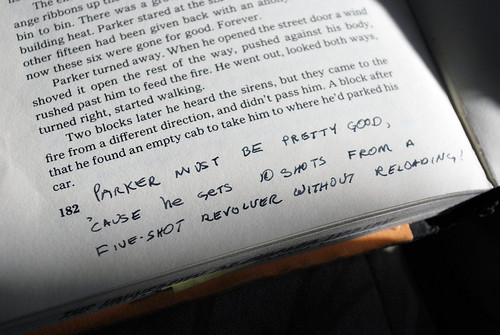
{Photo by rocketlass of marginal commentary in the University of Chicago Library's copy of Richard Stark's Plunder Squad.}

The paperback editions of the Nero Wolfe novels that Bantam published in their Nero Wolfe Library in the 1990s all carry introductions by contemporary crime writers. For the most part, those introductions, while well-meaning, do little but remind us of the vast number of relatively cozy crime writers working at that time--almost none to my taste, but not out of place introducing Wolfe. Nearly all the introductions explain how the writer first came to the Wolfe stories, then, as I've done here many a time, point out some of the reasons they endure. Wholly inoffensive, but far from essential, in other words.

Robert Crais's introduction to Before Midnight, however, deserves to be preserved. That's not because of any particular insight he offers into Rex Stout, and not even because he mentions Donald Westlake and Richard Stark. No, it's because his story of first encountering Wolfe is great fun. As a young man living in Baton Rouge, Crais haunted a used bookstore,
a grungy, dirty, seedy kind of place, but I discovered Chandler there, as well as Ted Mark and Donald Westlake and Don Westlake writing as Richard Stark. A paperback cost nineteen cents. If it had no cover, it cost a dime. I had gone through the Chandlers and was working on the Hammetts and I walked into the little store that day very much wanting a copy of Red Harvest. The stacks were divided by category (western, mystery, science fiction, etc.) but were rarely alphabetized, so if you wanted a particular author, you had to look through all the mysteries, ofttimes a tedious process. There was only a single copy of Red Harvest, and some yo-yo had written BITE ME across the cover in green ink, so that ended that. I won't buy a book with BITE ME on the cover. Not even for half price.
A good rule, and one that led him to pick up the next book that looked of interest, which happened to be by Rex Stout. Sorry, Hammett. If only you'd attracted a better class of reader . . . (and if people are writing BITE ME on Hammett, good god, what must they be writing on Jim Thompson? Or--shudder--Mickey Spillane?)

Monday, March 25, 2013

Mr. Wolfe prefers not to.

One of the things Rex Stout does best--and most entertainingly--in his Nero Wolfe novels is to portray the imperious presumption of executives . . . and then show what happens when it comes up against the 300 pounds of immovable object that is Nero Wolfe.

Before Midnight (1955), the Wolfe novel I read this weekend, offers some particularly fine examples, among them Wolfe turning down a $50,000 check to preserve his dignity ("Dignities are like faces," he says in explaining his opposition, "No two are the same."), tearing up a retainer check, and hiring, firing, and briefly re-hiring a lawyer.

The best moment, however, features Archie Goodwin as Wolfe's immovable proxy. Goodwin meets perfume exec Talbot Heery while on a mission to retrieve from a safe-deposit box some poetry, related to an advertising contest for Heery's company--a contest that became of interest to Wolfe when it led to murder. Archie introduces Heery by saying,
I could merely report that I kept my two-thirty appointment and got the verses and the answers, and let it go at that, but I think it's about time you had the pleasure of meeting Mr. Talbott Heery.
Heery doesn't make much impression until Archie takes him up on an offer to share a cab and get dropped off at Wolfe's on Heery's way downtown:
As we stopped for a red light at Fifth Avenue, headed west on Forty-seventh Street, Heery said, "I have some spare time and I think I'll stop in for a talk with Nero Wolfe."

"Not right now," I told him. "He's tied up."

"But now is when I have the time."

"Too bad, but it'll have to be later--in fact, much later. He has appointments that run right through until late this evening, to ten-thirty or eleven."

"I want to see him now."

"Sorry. I'll tell him, and he'll be sorry, too. If you want to give me your number I'll ring you and tell you when."

He got a wallet from his pocket, fingered in it, and came up with a crisp new twenty. "Here," he said. "I won't need long. Probably ten minutes will do it."

I felt flattered. A finiff would have been at the market, and a sawbuck would have been lavish. "I deeply appreciate it," I said with feeling, "but I"m not the doorman or receptionist. Mr. Wolfe has different men for different functions, and mine is to collect poetry out of safe deposit boxes. That's all I do."

Returning the bill neatly to the wallet, he stated, with no change whatever in tone or manner, "At a better time and place I'll knock your goddam block off." You'll see why I wanted you to meet him.
The scene could serve as an exemplar of a key aspect of Stout's genius, and the pleasures his books afford: it's the feeling of returning again and again to the familiar--familiar settings, characters, situations--while each time seeing a new set of changes rung. We've seen many an exec try to browbeat Archie, and plenty try to bribe him. Rare is the exec who tries both--and Heery, stand six foot though he may, is the only one bold enough to offer to knock Archie's block off.

Which, you'll not be surprised to learn, he doesn't get to do. We live in a fallen world, and not everyone gets everything he wants all the time--even executives.

Wednesday, March 13, 2013

"In a movie theater at least you can hold hands."

One of the many commonalities between Rex Stout and P. G. Wodehouse* is that their characters are essentially stuck in time. For Wodehouse, that era was gone by the time he really established himself as an author: it's early Edwardian. As Orwell explained in "In Defence of P. G. Wodehouse,"
The kind of life that Wodehouse writes about by preference, the life of the "clubman" or "man about town," the elegant young man who lounges all the morning in Piccadilly with a cane under his arm and a carnation in his buttonhole, barely survived into the nineteen-twenties. It is significant that Wodehouse could publish in 1936 a book entitled Young Men in Spats. For who was wearing spats at that date? They had gone out of fashion quite ten years earlier. But the traditional "knut," the "Piccadilly Johnny," ought to wear spats.
Stout's characters, meanwhile, are forever of the 1930s, the period of his first success. Though the Depression barely makes an appearance--the Wolfe stories are more akin to the Busby Berkeley musicals than, say the realist movie that John L. Sullivan wants to make in Sullivan's Travels--but the characters, from the thugs and Inspector Cramer to, more importantly, Archie and (sigh) Lily Rowan, are the familiar fast-talking slang-shooters of period's brilliant screwball comedy.

Such stasis is no small part of the comfort these books afford--a comfort matched by few, if any, other writers. Yet both writers continued working regularly until the 1970s, and both, in familiar series tradition, let their characters float in a vaguely defined eternal present rather than having them age or specifying that their new adventures are taking place in the past.** And thus it becomes interesting to note where the present (now well past) creeps in. Christopher Hitchens, for example, once pointed out the ghastly strangeness of Bertie Wooster--allied to no cause aside from aunt-baiting--running into an anti-war demonstration in the 1974 novel Aunts Aren't Gentlemen. With Stout, the dislocations are never jarring, merely interesting.

Such a moment appears in In the Best Families (1950), one of the most clever and satisfying Wolfe stories. Archie has been dispatched to a country house under slim cover, pretending to investigate a mere dog poisoning (shades of the Philo Vance Kennel Murder Case?) while really looking into murder, and after dinner he's stuck in the living room with all the suspects as they watch television:
Nintey minutes of video got us to half-past ten, and got us nothing else, especially me. . . . Television is raising hell with the detective business. It use to be that a social evening at someone's house or apartment was a fine opportunity for picking up lines and angles, moving around, watching and talking and listening; but with a television you might as well be home in bed. You can't see faces, and if someone does make a remark you can't hear it unless it's a scream, and you can't even start a private inquiry, such as finding out where a young widow stands now on skepticism. In a movie theater at least you can hold hands.
I'm no detective, but I sympathize. As March crawls past, insisting on its pretense of being winter with all the wheezy grotesquerie of a past his prime ladies' man bathed in cologne, the Baseball Machine at the Rocketship maintains its winter dormancy. If Archie wants to bring some suspects by, I'll be happy to help him catch a murderer while the cathode rays sleep.

Wednesday, November 28, 2012

Perhaps there's a reason Wolfe stays in his brownstone after all

From Rex Stout's The Black Mountain (1954):
"I thought you was a private eye."

"I don't like the way you say it, but I am. Also I am an accountant, an amanuensis, and a cocklebur. Eight to five you never heard the word amanuensis and you never saw a cocklebur."
If you've encountered Nero Wolfe before, I don't need to tell you that that's his right hand man, Archie Goodwin, mouthing off there. It's perfect Archie: quick, cocky, and a bit goofy.

Sadly, that's one of the few bits of prime Archie in The Black Mountain--which is the main reason it's the first disappointing Wolfe story I've read. The book starts promisingly, with the murder of one of Wolfe's few real friends, chef and restaurateur Marko Vukcic, a crime so shocking and close to Wolfe's heart as to compel him to leave the brownstone and travel all the way back to his boyhood home of Yugoslavia in search of Vukcic's killer. That ought to make for a fascinating story, showing us Wolfe well outside his carefully controlled environment, but it never quite works, in large part because the language barrier reduces poor Archie to a pair of uncomprehending ears and a gun hand. He relates Wolfe's various foreign-language conversations (which, he explains, Wolfe translated for him later) in real time, but while that enables the story to clip along, it doesn't enable Archie to play his usual wisecracking, hunch-following role. And the unmoored, unusually mobile Wolfe is less jarring, and less interesting, than expected: we too quickly become used to the idea of Wolfe hiking the mountains of Montenegro, and neither the spectacle nor the insight into character that we might have hoped for ever quite comes off.

It's a mark of Stout's achievement in this series that I was completely surprised to find my self not enjoying The Black Mountain, as no one could reasonably expect that an 87-book series wouldn't include at least one fizzle. More important, it would be churlish to complain of that fact--I'll still gladly take up the next invitation I get to the doings at West 35th Street.

Monday, July 23, 2012

In the blaze of midsummer, autumn beckons

{Photos by rocketlass.}

I have a gift for contentment. The moments are relatively rare when I'm looking ahead or behind, willing myself not to be where I am and doing what I'm doing. The grass is almost never greener. There is always the risk that such a tendency will turn pathological, inertia metastasizing, but on on a day-to-day basis it's far from a bad platform on which to build a life.

--

I don't use "gift" casually. I know that my ability to find contentment is in large part a compound of upbringing, habit, and deliberate choice, but it usually feels like more than that, like something given. I've had the wherewithal to take advantage of it, but I didn't earn it in the first place. I've never had even the slightest leanings toward religious belief, but one teaching from Chrsitianity that I have always found useful is the concept of grace--favor not earned but freely given. That's how I feel about my contentment, and I'm grateful.

--

I do, however, have a habit of looking ahead to the next season. Autumn is the favorite, but as it starts to bite I wonder about winter and its snows; winter, lingering, prompts hopes of spring, and spring--along with baseball--brings thoughts of summer nights. Summer, well, until Stahl family vacation in July, it holds its own.


--

My year includes six major holidays: Opening Day, the first day of the playoffs, the first day of the World Series, Thanksgiving, Christmas, and the seven days of the annual Stahl family vacation. Christmas, the chief in this pantheon when I was young, is always on the verge these days of being relegated to the minors, its consumer mania only just balanced by the way it gathers the family and the pleasures offered by its music. If it weren't for Charles Schulz and Vince Guaraldi, it would likely have been stricken long ago.

--

In the introduction to the career-spanning collection of his work Up in the Old Hotel, Joseph Mitchell writes,
I am sure that most of the influences responsible for one's cast of mind are too remote and mysterious to be known, but I happen to know a few of the influences responsible for mine. . . . Aunt Annie would lead us to the cemetery, and there she would pause at a grave and tell us about the man or woman down below. At some of the graves my mother and my Aunt Mary would chime in, but Aunt Annie did most of the talking. "This man buried here," she would say, "was a cousin of ours, and he was so mean I don't know how his family stood him. And this man here," she would continue, moving along a few steps, "was so good I don't know how his family stood him." And then she would become more specific. Some of the things she told us were horrifying and some were horrifyingly funny.
--

Up in the Old Hotel, it astonishes me to realize, was published twenty years ago next month. Joseph Mitchell, though he hadn't published a word for nearly thirty years, was still with us then.

--

Last week was the eleventh year of the annual Stahl family vacation. We always traveled in the summer when my sister and brother and I were kids--sometimes my father would come home one day and say that he and his father had finished their work on the farm and thus the next two weeks looked clear, and we'd be away the next day. As we grew up and, serially, went to college, the vacation fell away, victim to the scheduling problems that plague all family endeavors. But soon after she had her first child, my sister--wanting, I think, for her son and his siblings and cousins (all then merely prospective) to know his aunts and uncles and cousins better than we'd known ours--convinced us to give a new, different family vacation a try. Ever since, we've been renting a house for a week in July every year.

--

A few years ago in June I had a dream in which I woke up to discover that it was Thursday of Stahl family vacation week and that I'd somehow piddled away the majority of the week, not in the comfortable, companionable way that is the essence of vacation--which, without effort or plan, draws you closer to family--but in the frenzied, forgettable, workplace-like way of the Wordsworthian admonition:
The world is too much with us; late and soon,
Getting and spending, we lay waste our powers.
The intensity of my relief on realizing it was a mere dream is hard to describe.

--


With spouses and children, there are twelve of us now, and six years ago we settled, I think for good, on South Haven, Michigan. South Haven is a resort town in a very Midwestern style--there are no fancy restaurants and few places that I trust to pour a martini. Oh, there are shops, but they're selling nothing you need, aside from the used bookstore (where this year I picked up an Anchor paperback of Joseph Conrad's Chance with an Edward Gorey cover). What the South Haven house has to offer is a porch, proximity to the beach, and quiet, and what more could you possibly need?

--


The first few days of vacation found me reading what I think of as the Inexhaustibles: enjoying another of the hundred-plus volumes on the Donald Westlake bookshelf and two of Rex Stout's seventy-three Nero Wolfes. Consumed at a comfortable pace, the works of these authors--to whose ranks could be added P. G. Wodehouse--will see a reader through decades of lazy vacations. Their comforts feel endless.

--

One of the Stouts I read, Over My Dead Body (1940), introduces Nero Wolfe's daughter, which is a shock if for no other reason than that Wolfe has assembled such a complete proxy family in his brownstone on 35th Street. And an actual daughter introduces the troubling concepts of time and age, both banished from Stout's universe--a not insubstantial part of the pleasure of Wolfe, Archie, Fritz, Saul, et al. is that their selves and relationships are fixed, subject to none of the cruelties of change, age, and loss. Time will not, to twist William Maxwell's phrase, darken them.

--

The week was hot, unusually so, and in a twelve-person house the air conditioning is necessarily regulated by the most sensitive of the group. But Wednesday night rocketlass decided to open our bedroom window, affording entry to an illicit breath of outside air . . . and soon after midnight her incorrigibility was rewarded by the unmediated power of a thunderclap, followed by a hard rain, the first this parched shore had seen in months. It poured, satisfyingly, all night.

--

In any gathering, I'm always the first up in the morning. As Norman Maclean puts it, "I get up early to observe the commandment observed by only some of us--to arise early to see as much of the Lord's daylight as is given to us." The morning after the thunderstorm, I woke to a gentle, drumming afterthought of a rain and took my coffee to the porch a good hour before even the two-year-old would be likely to wake. With me I carried W. G. Sebald's The Emigrants (1992). The newly cool, moist air rippled on the skin the way it does in the earliest days of autumn.

--

I'd read Sebald before and not been convinced. It was in 2000, and I was newly entered into a job that has become a career, newly moved to a condo that has become a home, and about to begin a marriage that has become life itself. Sebald's melancholy was not what I was looking for or needed, and I didn't respond to it. But that Thursday morning last week, half of vacation behind me, an unexpectedly autumnal feel in the air, Sebald's words met me at the right time and place, and I sank into his stories of loss and doomed attempts to recover what is forever gone.

--

"When I think back to those days," one of Sebald's characters writes, "I see shades of blue everywhere -- a single empty space, stretching out into the twilight of late afternoon, crisscrossed by the tracks of ice-skaters long vanished."

--


Autumn is for re-reading, and in particular for re-reading books about loss and regret. So I turn again to Norman Maclean's A River Runs through It and Sarah Orne Jewett's The Country of the Pointed Firs, V. S. Naipaul's The Enigma of Arrival, and William Maxwell, all of William Maxwell. I doubt I'll ever stop re-reading those books.

--

Jewett writes, "There was a silence in the schoolhouse, but we could hear the noise of the water on a beach below. It sounded like the strange warning wave that gives notice of the turn of the tide." Mary Poppins, remember, promises to stay until the wind changes. Seasons, however we spot them or define them, are important.

--

I am regularly surprised, returning to A River Runs through It, by how conversational and wry it is, the way that Maclean's narrator--Maclean, in other words--cocoons the wound at the book's center in casual observation, self-deprecating wit, and ironic folksiness, the better to enable it to emerge, beautiful as it is painful, when the time comes to turn our gaze full upon it. Away from the book, we remember its pain and the beautifully rendered prose of its emotional swells; back with it again we are reminded that it's more like life itself than that memory would have us think, prosaic and silly and funny and even a bit vulgar.

--

In A River Runs through It, Maclean's narrator talks with his wife after he's returned her ne'er-do-well brother, sunburned and hungover, from an ill-fated fishing trip, and the subtext of the conversation is his own troubled brother:
"I am trying to help someone," she said. "Someone in my family. Don't you understand?"

I said, "I should understand."

"I am not able to help," she said.

"I should understand that, too," I said.
Grace is a shade of fortune, and when I think of it--unearned in the face of the world's misery--I feel even more grateful. We've not thus far needed, in our family, the help that Maclean's brother needed and couldn't find a way to accept, so our vacations together are peaceful and comfortable and happy. These are the people I am easiest with in all the world.

--

I read Sebald Thursday and Friday, and Saturday came and we packed up amid happy tears. The calendar turns, and we look ahead to next year. It's not unreasonable to think that we have decades of these vacations ahead of us, and I hold to that thought.

--

It was 93 degrees today in Chicago, but the days are drawing in and, Stahl vacation behind, autumn beckons.

--


"Eventually, all things merge into one, and a river runs through it."

Wednesday, March 14, 2012

Silence is golden, or at least smiled upon by the law

Lately, any time I find myself between novels on a weekend--Saturday suddenly stretching before me without an any endings beckoning--I open up the The Third Rumpole Omnibus (1997) and continuing my slow journey through the complete career of John Mortimer's perpetually amused barrister. Rumpole definitely isn't for everyone: leaving aside the fact that, were he to actually be one's colleague, the irritation would be endless, there's the problem that Mortimer's stories about him all hew to a simple formula wherein Rumpole takes on a case whose themes end up resonating in his interactions with his colleagues, wife, and acquaintances. It's all very schematic and repetitive, with Rumpole making the same sort of jokes and observations about the same sort of human failings story after story. In their reliance on the tried and true, the Rumpole books are close kin to Rex Stout's Nero Wolfe stories, but it's a comparison by which they suffer greatly: Stout created two truly unforgettable characters and a host of lesser ones, and his stories ripple with linguistic verve in a way that Mortimer's never do.

Yet, in this world of imperfection, the Rumpole stories are plenty good enough. Rumpole may be no Nero Wolfe, but who is? He's funny, smart, convincing, and never less than good company. Even the weakest Rumpole stories are entertaining, and in aggregate they're an achievement of which John Mortimer could justly be quite proud, and in which readers can take real joy.

Last Sunday morning found me reading a story that quickly became one of my favorites in Rumpole's whole ouevre, "Rumpole and the Right to Silence." It's a well-assemble, well-thought-out, smart, funny story, and it would be a solid place to start with Rumpole if you've not tried him.

Today, though, I'm simply going to share the opening, which, as is common with Rumpole, establishes the current cultural, political, and legal scene (in this case, circa 1990):
What distresses me most about our times is the cheerful manner in which we seem prepared to chuck away those blessed freedoms we have fought for, bled for and got banged up in chokey for down the centuries. We went to all that trouble with King John to get trial by our peers, and now a lot of lawyers with the minds of business consultants want to abolish juries. We struggled to get the presumption of innocence, that golden thread that runs through British justice, and no one seems to give a toss for it any more. What must we do, I wonder. Go back to Rumnymede every so often to get another Magna Carta and cut off King Charles's head at regular intervals to ensure our constitutional rights? Speaking entirely for myself, and at my time of life, I really don't feel like going through all that again.
Rumpole goes on, explicitly stating the theme of his story, to note that the right most under attack at that moment is the right to silence.

Which leads me to my other between-books weekend reading: the aforementioned Nero Wolfe. I followed "Rumpole and the Right to Silence" on Sunday with "Method Three for Murder," from Three at Wolfe's Door (1960). In that story, Archie lays out for a client (his own client, unusually enough, as the story opens with him angrily leaving Wolfe's employ and . . . well, it's complicated, and it ends with Wolfe technically working for Archie, which is fun to watch) her options when she's taken up for questioning:
"There are only three methods that are good in the long run. You have strong fingers."

"I'm sorry." Her grip relaxed a little, but she held on. "What are the three methods?"

"One. Button your lip. Answer nothing whatever. Two. Tell the truth straight through. The works. Three. Tell a simple basic lie with no trimmings, and stick to it. If you try a fancy lie, or a mixture of truth and lies, or part of the truth but try to save some, you're sunk. Of course I'm just talking to pass the time. In the present situation, as far as I know, there is no reason why you shouldn't just tell the truth."
And if you believe that last, well, Archie'd like you to see if you can get Inspector Cramer's job.

Friday, January 27, 2012

Nero Wolfe stoops to ask

Let's stick with Rex Stout one more day. After all, the weekend is upon us, and while Nero Wolfe, from all I can tell, doesn't let that interfere with his usual schedule, for the rest of us that means shedding the routine, loosening up a bit, and enjoying good company--like that of Nero, Archie, and the gang.

Speaking of the gang, check out Archie's description of the apartment of Saul Panzer, ace operative for hire, in "Fourth of July Picnic" (1958):
Saul Panzer, below average in size but miles above it in savvy, lived alone on the top floor--living room, bedroom, kitchenette, and bath--of a remodeled house on Thirty-eighth Street between Lexington and Third. The living room was big, lighted with two floor lamps and two table lamps, even at seven o'clock of a July evening, because the blinds were drawn. One wall had windows, another was solid with books, and the other two had pictures and shelves that were cluttered with everything from chunks of minerals to walrus tusks. In the far corner was a grand piano.
Let's pause for a moment to raise a glass to 1958. Oh, I know that many things were worse then, and I harbor no substantial illusions about wishing I could go back to that time. But to think of the days when an detective op for hire, even one who, as Archie would point out, is the best in the business, would have 1) a wall "solid with books" and 2) a grand piano in 3) his spacious Manhattan apartment! It's hard not to let just wee bit of those-were-the-days creep in, no?

Thinking of Saul brings me to another moment found in the same book, And Four to Go, which collects four holiday-themed Wolfe stories. In Wednesday's post I quoted an exchange from the first page of the story "Easter Parade" in which Archie was refusing Wolfe's request that he try to snatch a rare orchid of which Wolfe is envious from the coat of a woman in an Easter Parade. Nero asks whether Ollie Cather, another of their regular operatives, might be willing to do it instead.
"I doubt it. Not just for the two C's, but he might as a personal favor to you."

Wolfe made a face. "I won't solicit a favor."
Instead, Archie agrees to find a man of looser morals and lighter pocketbook whom he can convince to do the deed. Wolfe, however, would also like Archie to be there with a camera as a backup. The problem is that it's Sunday, and Sundays are Archie's day off, sacrosanct when there's no big case on. "It's no go," says Archie,
"because as you say, my Sundays are mine, and I would only do it as a personal favor for you, and you won't solicit a favor. Too bad."

"I should have qualified that. There are only four people of whom I would ask a favor, and Orrie is not one of them. You are."

"Then go ahead and ask. Call me Mr. Goodwin."

His lips tightened. "Mr. Goodwin," he said coldly, "I solicit a favor."

It's amazing what lengths a man will go to for envy.
All of which leads to an obvious question: who are the four people? Archie is one, but who else? Saul, perhaps? He definitely ranks above Orrie, or Fred Durkin, the other operatives, in Wolfe's esteem. Fritz Brenner, the cook? Theodore Horstmann, the orchid specialist who lives in the brownstone so as to be close to Wolfe's orchids? Other ideas? The Wikipedia offers a nicely fleshed-out list of supporting characters, if you need a refresher. I'm open for suggestions.

Wednesday, January 25, 2012

Time, change, and the comfort of some illusions of permanence

The January 13 issue of the Times Literary Supplement included a really nice, brief piece by Will Eaves about his new job teaching English and creative writing at Warwick University and the memories it's called up of his own undergraduate days. These lines in particular caught my eye:
I want to have settled into my new life the way I wanted to be grown up. That's the trouble with second chances and new lives: they are usually only mildly variant copies of first chances and old lives, and it's the mildness of the variation that induces vertigo, the small change heading for the large consequence.
I was struck by this passage not so much because of its actual content, but because of the way it harmonized with thoughts I've had recently about time and change. If I were somehow to encounter my seventeen-year-old self, I think what would surprise him most (aside perhaps from my disdain for the mullet he wore with such pride) is that adulthood doesn't entail some sort of final arrival, a reaching of a point beyond change. I would never have formulated my conception of adulthood that way back then, but looking back it's obvious that's what I thought: you work through high school, and you work through college, then you find something to do and you do it. And on and on.

Which, in a lot of ways, I have. My life is for the most part ridiculously stable: I've had the same employer for thirteen years, the same home for twelve, the same wife for eleven. That stability is what I want and what I like, and I'm extremely fortunate to have it. But--and this is what would have surprised my teenage self--that still leaves a lot of scope for continual challenge and change, at work and in the rest of life. You may be good at your job, but every day presents a new set of problems to be handled if you want to keep the ball rolling smoothly along; the same for marriage, or friendships, or even hobbies or habits. There is a sense in which every day we must make our world anew, coping with the small or large changes that go on in the background--and affect the texture--of even the most stable life. I've encountered religious believers who say that we should give thanks that every day god deigns to continue creating the world; to some extent, adult life feels like that to me--that if we want our lives to keep going and keep being the way we hope they'll be, every day we're challenged to address them as if they're new and need our full, focused attention.

All of which is a roundabout way of saying thank god for Rex Stout and Nero Wolfe. When I was picking books to read over Christmas--the holiday when, in the midst of my family, I most clearly can see and be grateful for the unchanging foundations of my life--I chose some of Stout's many stories of Wolfe and Archie and the gang at West 35th Street. At Christmas you want comfort food, you want to support yourself in that illusion that this happiness will never change, this group of people will never not be around you in the glow of the tree.

Thus Nero Wolfe is perfect, for his world is beautifully static. Oh, there are alterations--by 1958, for example, Wolfe has a TV (with a remote, no less!)--but they are extremely minor. In a larger sense, nothing at all changes: Archie neither ages nor worries about it; Wolfe never mellows; the staff of Wolfe's brownstone never turns over; even the police who curse his interference and meekly accept his collars neither get promoted nor retire. Stout offers the pleasures of permanence and reliability. The fretting and stress in Stout is about cases and criminals and Wolfe's mood, never about planning for the future or coping with the fact that nothing lasts forever.

"Nothing doing," says Archie, on the first page of "Easter Parade."
"If you wanted me to hook something really worth while, like a Mogok ruby, I might consider it. For what you pay me I do your mail, I make myself obnoxious to people, I tail them when necessary, I shoot when I have to and get shot at, I stick around and take every mood you've got, I give you and Theodore a hand in the plant rooms when required, I lie to Inspector Cramer and Sergeant Stebbins whether required or not, I even help Fritz in the kitchen in emergencies, I answer the phone. I could go on and on. But I will not grab an orchid from a female bosom in the Easter parade. There is--"

"I haven't asked you to," Wolfe snapped. He wiggled a finger at me. "You assumed I was headed for that, but you were wrong. I only said I wanted to hire someone for such an errand--someone adroit, discreet, resolute, and reliable."

"Me, then," I insisted.
We wouldn't want it any other way.

Other writers can be similarly comforting in their fashion--ones as different as Barbara Pym and Ross Macdonald come to mind--but no one else other than P. G. Wodehouse (another favorite Christmas author) offers such a complete world, almost medieval in its unchanging perfection and assurance that everything has and always will have its place. It's a comforting illusion for these darkest days of winter.

Tuesday, February 02, 2010

Archie and Bertie, Wolfe and Jeeves

I'm far from the first person to point out that Archie Goodwin, Nero Wolfe's right-hand-and-legman, bear similarities to Bertie Wooster--if, that is, you can imagine a Bertie Wooster who is capable, tough, and smart. Which, admittedly, is a difficult proposition. Really, the similarities usually begin and end at the two men's use of language: Archie is the best source of outdated slang I know of outside Wodehouse's world, able to work himself up to a dizzying pitch of idle--or, more frequently, needling--banter.

But every once in a while Rex Stout extends Wodehuose a nod that's a bit more overt, as in this passage from one of my favorite Nero Wolfe novels, The Silent Speaker (1946):
What Wolfe tells me and what he doesn't tell me, never depends, as far as I can make out, on the relevant circumstances. It depends on what he had to eat at the last meal, the kind of shirt and tie I am wearing, how well my shoes are shined, and so forth. He does not like purple shirts Once Lily Rowan gave me a dozen Sulka shirts, with stripes of assorted colors and shades. I happened to put on the purple one the day we started on the Chesterton-Best case, the guy that burgled his own house and shot a week-end guest in the belly. Wolfe took one look at the shirt and clammed up on me. Just for spite I wore the shirt a week, and I never did know what was going on, or who was which, until Wolfe had it all wrapped up, and even then I had to get most of the details from the newspapers and Dora Chesterton, with whom I had struck up an acquaintance. Dora had a way of--no, I'll save that for my autobiography.
Would Jeeves have done any less?

Which can't help but lead a reader to imagine the possibilities: what if Jeeves and Wolfe had met at some point, and teamed up? There's no question that they would have been a formidable duo, but would they have gotten along? Or would Jeeves merely have frustrated Wolfe, his silent efficiency eliminating any need for the drama and flourish that Wolfe loved so much?

Archie and Bertie, on the other hand. . . . Bertie would take one look at Archie and quail, seeing the inner tough guy beneath the dapper exterior, while Archie would instantly cross Bertie off any and all lists of both suspects and rivals, and thus would take barely any notice of him at all, methinks.

Monday, November 02, 2009

Notes! On Agatha Christie and Nero Wolfe!

Too much time spent watching baseball and attempting to learn to play "Linus and Lucy" on the piano without driving rocketlass totally insane leads to . . . a Notes column! Newspapers may die, but the Notes column is eternal!

1 Recently, an article by John Curran in the Guardian in honor of Agatha Christie's 120th birthday sent me to The ABC Murders (1935). Like the last time I read Christie (prompted by Pierre Bayard's gamesmanship), I was pleasantly surprised at her light touch, which didn't register during my long-ago middle-school Poirot binge. Sure, the characters rarely rise above type and the dialogue is wooden, but the sense of fun that pervades the novel--even as its ostensible focus is brutal murder--is infectious. It even extends--unexpectedly--to Christie poking a little fun at herself and her formula, in this conversation between Poirot and his trusty friend Hastings:
"If you could order a crime as one orders a dinner, what would you choose?"

I fell in with his humour.

"Let me see now. Let's review the menu. Robbert? Forgery? No, I think not. Rather too vegetarian. It must be murder--red-blooded murder--with trimmings, of course."

"Naturally. The hors d'oeuvres."

"Who shall the victim be--man or woman? Man, I think. Some bigwig. American millionaire. Prime Minister. Newspaper proprietor. Scene of the crime--well, what's wrong with the good old library? Nothing like it for atmosphere. As for the weapon--well, it might be a curiously twisted dagger--or some blunt instrument--a carved stone idol--"

Poirot sighed.

"Or, of course, I said, there's poison--but that's always so technical. Or a revolver shot echoing in the night. Then there must be a beautiful girl or two--"

"With auburn hair," murmured my friend.

"Your same old joke. One of the beautiful girls, of course, must be unjustly suspected--and there's some misunderstanding between her and the young man. And then, of course, there must be some other suspects--an older woman--dark, dangerous type--and some friend or rival of the dead man's--and a quiet secretary--dark horse--and a hearty man with a bluff manner--and a couple of discharged servants or gamekeepers or something--and a damn fool of a detective rather like Japp--and well--that's about all."

"That is your idea of the cream, eh?"

"I gather you don't agree."

Poirot looked at me sadly.

"You have made there a very pretty resume of nearly all the detective stories that have ever been written."

2 Christie also offers a quick little joke at the expense of Sherlock Holmes:
"The crime," said Poirot, "was committed by a man of medium height with red hair and a cast in the left eye. He limps slightly on the right foot and has a mole just below the shoulder-blade."

"Poirot?" I cried.

For a moment I was completely taken in. Then the twinkle in my friend's eye undeceived me.

"Poroit!" I said again, this time in reproach.

"Mon ami, what will you? You fix upon me a look of doglike devotion and demand of me a pronouncement a la Sherlock Holmes!"
The ABC Murders appeared in 1935, a mere five years after Conan Doyle's death, and only eight years after the publication of the last Sherlock Holmes story, which makes me wonder when the first parody of Holmes appeared. How quickly did wags begin to treat Holmes's infallible perceptiveness as an object of humor? Somehow I doubt Christie was the first--and if Google Books had more than a limited preview of The Alternative Sherlock Homes (2003), I might be able to say for sure. Looks like this may require a trip to the library . . .

3 Then there's this exchange, which smacks more of the relationship between Nero Wolfe and Archie Goodwin than what usually prevails between Poirot and Hastings:
"Is that a way to fold a coat? And regard what you have done to my pyjamas. If the hairwash breaks what will befall them?"

"Good heaveans, Poirot," I cried, "this is a matter of life and death. What does it matter what happens to our clothes?"

"You have no sense of proportion, Hastings. We cannot catch a train earlier than the time that it leaves, and to ruin one's clothes will not be the least helpful in preventing a murder."
Unlike Archie, however, Hastings simply cannot be counted on for a wry rejoinder. I could imagine a Hastings who is more of an English Archie--think Bertie Wooster with a sidearm--but I don't picture him lasting long with Poirot, who seems to need less a goad than a foil.

4 Speaking of Nero Wolfe, it was his fault that the premise of The ABC Murders, described by John Curran as "beautifully simple," didn't surprise me this time around. The murders mounted, and I began to think I could see the motive behind them . . . but it took me a while to remember that I'd come across the same diabolical plan recently in "The Slaughtered Santas," an episode of the early 1950s "The Adventures of Nero Wolfe" radio show. {Spoilers here, for those who want them.}

5 The Nero Wolfe radio show, sadly, isn't as good as fans of the novels would have a right to hope; it arrived too late in the radio era to get the quality of writing Rex Stouts novels deserve. Still, there's undeniable pleasure in hearing the glorious Sydney Greenstreet in the title role--imagine him delivering this line, from Too Many Cooks (1935):
I have only so long to live--so many books to read, so many ironies to contemplate, so many meals to eat.
A list that's sad, but true, and to which I'd have to add that one only gets so many World Series, so in an effort to postpone winter's chill at least one more night, it's time to watch some baseball.

Saturday, March 28, 2009

A Saturday miscellany


{Photos by rocketlass.}

Some reading notes for your Saturday, held together, as you'll see, by the slimmest of threads:

1 As longtime readers of this blog know, I'm fascinated by the topic of dreams. So I've been paying particular attention to Shelley's dreams as I've been reading Richard Holmes's biography of the poet this past week. Shelley was a troubled sleeper from childhood, prone to sleepwalking and vivid dreams--and quite possibly, depending which of his friends you believe, waking visions--that fueled his poetic embrace of the ghostly and the macabre. At one point in the biography, Holmes quotes a passage from an account by Shelley's cousin Tom Medwin that reads like a cross between Borges and the Arabian Nights:
At this time Shelley was ever in a dreamy state, and he told me he was in the habit of noting down his dreams. The first day he said, they amounted to a page, the next to two, the third to several, till at last they constituted the greater part of his existence.
While the thought of the writing of a dream journal consuming one's life is scary enough, after that the account moves into the positively uncanny:
One morning he told me he was satisfied of the existence of two sorts of dreams, the Phrenic and the Psychic; and that he had witnessed a singular phenomenon, proving that the mind and soul were separate and different entities--that it had more than once happened to him to have a dream, which the mind was pleasantly and actively developing; in the midst of which, it was broken off by a dream within a dream--a dream of the soul, to which the mind was not privy; but that from the effect it produced--the start of horror with which he waked--must have been terrific.
2 Which leads me to a dream I had last week: I was in a boat, possibly a police launch, cruising purposefully up the East River on a chilly night. We were looking for a body . . . and Nero Wolfe was with us. I think that's how I realized that it was a dream: no force on earth, I told myself, could get Nero Wolfe to leave his townhouse and board a boat for a wintry nighttime cruise up the East River. That said, I bet he would have found what we were looking for had I only stayed asleep a little longer.

3 Speaking of Nero Wolfe, he tosses off a line in Some Buried Caesar that's been lingering in my mind since I read the novel a couple of weeks ago. Dismissing some complaints about a ruse he'd employed, he says,
Victor Hugo wrote a whole book to prove that a lie could be sublime.
I'm far from a Hugo expert, and a tiny bit of research didn't turn up any obvious answers, so I put the question to the audience: what book is Wolfe talking about?

4 Though I've only lost about half a dozen books in my life, strangely enough two of them were Victor Hugo novels: back in high school, I had mass market paperbacks of Les Miserables and The Hunchback of Notre Dame, and both of them disappeared when I was partway through them. Perhaps one of my classmates was a secret Hugo fan?

I've thus never finished either one, though I'll admit that my enjoyment of ridiculously long books has led me to eye Les Miserables at the bookstore on occasion--I'm willing to listen to arguments on its behalf if anyone has any to offer.

5 Finally, on the topic of books I've never finished: nearly four years ago I read about four hundred pages of The Count of Monte Cristo while on a weekend road trip. I was surprised to find that nearly everything I knew about the novel--the frame-up, the imprisonment, the escape--happened in the first three hundred or so of those pages, which were great fun, on par with the best parts of The Three Musketeers. But the next hundred pages proved a bit of a slog: where I was expecting the Count to instantly and implacably begin wreaking vengeance, instead he embarked on a series of improbable picaresque adventures. So I put the book away, unsure that I had the patience for another nine hundred pages of such swashbuckling.

So, I ask any Monte Cristo fans out there: was I wrong? Should I take up the Count's story once more?

6 Now that I think about it, this list comes distressingly close to being a perfect example of how my mind works: I may not be a social butterfly, but I plead guilty to being a mental one.

Thursday, March 12, 2009

"I was reflecting that of all Wolfe's thousand techniques for making himself obnoxious the worst was when he thought he was being funny."

After reading a novel about Nazis, however, well-written it might be, a retreat to novelistic comfort food seems essential. And what better comfort than that offered by Rex Stout, who, following my recent discovery of the pleasures afforded by his Nero Wolfe novels, offers me a near-Wodehousian quantity of books to enjoy?

The mention of Wodehouse is anything but accidental, as Stout's novels in their tight plots and attention to slanguage resemble nothing so much as what one would imagine Wodehouse himself might have turned out had he devoted himself to mysteries rather than the troubles of privileged kittenheads. Not that Stout's language reaches the brilliance of Wodehouse--to be honest, it's hard to think of anyone who matches Wodehouse when he's at his best. But Stout at least earns the comparison, both for the off-the-cuff beauty of Archie Goodwin's vocabulary and for the Blandings Castle-like sense that, much as the trappings of life may change, in essence Archie and Wolfe remain forever in Depression-era New York, their townhouse a fiercely held redoubt against modern existence.

So I turned to a recently published two-fer, which comprises Some Buried Caesar (1938) and The Golden Spiders (1953), and I was far from disappointed. Both offer circumstances that are unusual for Wolfe: he spends the entirety of the former not only outside his beloved 35th Street townhouse, but, god forbid, in rural New York, while the latter sees the case at its heart opened by, of all things, a child. Yet (and this is one of the keys to the appeal of the Wolfe novels) Wolfe himself is essentially the same no matter the circumstances: certain and secretive, imperial and imperious, finicky and forbidding. His unchanging, self-involved nature offers many of the same pleasures as his model, Sherlock Holmes--but, crucially, Wolfe, for all his peculiarities and sensitivities, suggests nothing of the strange neediness or even hard-fought weakness that occasionally flicker around the edges of Holmes's personality. Wolfe will never need us or our mysteries--but if we need him, we can rely on Nero Wolfe completely. If, that is, we can put up with him.

To aid us in that mission, we have, as ever, Archie Goodwin, whose Bertie Woosterian vocabulary serves as an excellent distraction from his Jeevesian competence. If Archie can tolerate Wolfe, then surely so can we. He serves as our eyes and our sounding board, testing theories and attempting to interpret Wolfe's monumental self-confidence. Without Archie, these books could easily have been little but puzzle mysteries, chances to test our wits against Wolfe's complicated plans and cryptic pronouncements; Archie's constant attention to character and motive are a large part of what enlarges them so that they become something more, a sort of compromise among Conan Doyle, S. S. Van Dine, and the noir masters whom Stout's work is, by design, too light to openly acknowledge.

And then there's Archie's language, which is a treat in and of itself. Whether he's describing how out of place a dandyish thug looks on a country ranch--
[T]he proper environment for that type is bounded by 42nd and 96th Streets on the south and north, and Lexington Avenue and Broadway on the east and west. In their habitat they don't look bad, in fact they help a lot in maintaining the tone, but out in the country like that, still wearing a Crawnley town suit including vest and a custom-made shirt and a Monteith tie, they jar.
--or being pleasantly surprised by the secretary at a highbrow magazine--
Having on Sunday bought a copy of the magazine that Vincent Lipscomb edited, and looked through it before passing it to Wolfe, I had supposed that any female employed by it would have all her points of interest, if any, inside her skull; but a curvy little number with dancing eyes, seated at a switchboard, gave me one bright glance and then welcomed me with a smile which indicated that the only reason she had taken the job was that she thought I would show up someday.
--or dismissing an unctuous PR flack--
In size he had been shortchanged, the top of his head being about level with the tip of my nose. With his thin brown mustache trimmed so it wasn't quite parallel with the thick lips of his wide mouth, I wouldn't have called him well designed to make the sort of impression desirable for a handler of public relations, but I admit I'm prejudiced about a mustache trying to pass as a plucked eyebrow.
--or just describing his own movements--
The basement floor was concrete. I navigated it, now as silently as silence.
--Goodwin's running monologue is idiosyncratic, worldly, goofily self-regarding, and, most important, great fun. He's wonderful company.

Now to read the remaining sixty-nine Nero Wolfe novels. After all, if I don't do that, how will I know whether Stout ever came up with a better closing line that the one that ends The Golden Spiders? It's damn hard to top "What the hell," you've gotta admit.

Saturday, December 20, 2008

Too much liquid, even for two such large men


{Photos by rocketlass.}

This post began with the return of my grisly obsession with the horrors of medicinal bloodletting, prompted by this passage from Peter Martin's Samuel Johnson: A Life (2008):
[Johnson's] imagination was playing tricks on him, and he feared the worst for his lungs. "My physician bled me yesterday and the day before, first almost against his will, but the next day without any contest. I had been bled once before, so that I have lost in all 54 ounces." It was the third time he was bled that winter. Like many of his contemporaries, he was already well into phlebotomy, the surgical opening or puncture of a vein to draw out blood, a lifelong madness that he inflicted on his ailing body with more assiduity than most. Rather than wait on a physician, he often impatiently bled himself with grisly deliberateness for all manner of ailments: coughs and colds, flatulence, an "inflamed" eye, and especially breathing difficulties and shortness of breath. Fifty-four ounces is a great quantity of blood, though to the end of his life he believed that the practice was effective only if it were done in copious amounts.
I think Martin is understating the case: the entire human body only contains about 190 ounces. Blood donors often feel faint after giving a mere pint; I would describe a medicinal bloodletting that drained more than three times that amount as wildly insane, even by the standards of Johnson's day.

The memory of Johnson's copious bloodletting came to mind instantly Thursday when I encountered the following exchange between Archie Goodwin and Nero Wolfe in Rex Stout's Fer-de-Lance (1934):
"[W]e're licked as sure as you're full of beer."

[Wolfe's] eyes opened. "I'm going to cut down to five quarts a day. Twelve bottles. A bottle doesn't hold a pint."


Even for a man of Nero Wolfe's bulk (think Sydney Greenstreet, who, perhaps inevitably, was cast as Wolfe on the fun, but short-lived radio adaptation) five quarts per day of beer would seem to be a bit much. And that's the diet ration! A doctor hired to bleed Wolfe might be well-advised to get acquire a liquor license beforehand: then he could hang a neon sign and start pouring frothy pints straight from Wolfe's arm!

Thursday, December 18, 2008

Archie Goodwin on Shysters, Shysterball on Archie Goodwin


From Rex Stout's Fer-de-Lance (1934)
"Oh no." I shook my head. "That's not the way us geniuses work, you can't shake us empty like a bag of peanuts."
A couple of days ago, at the suggestion of Terry Teachout, I picked up a Rex Stout two-fer, containing the first two Nero Wolfe mysteries, Fer-de-Lance (1934) and The League of Frightened Men (1935). Back in high school, I read the couple of Wolfe mysteries that my local library carried, but they didn't make much of an impression. This time around, spending time with Nero Wolfe has been a sheer joy.

When I read Stout all those years ago, I was interested almost exclusively in crime novels of a hard-boiled bent--having just progressed from Robert B. Parker to Lawrence Block. Wolfe, however, is decidedly soft-boiled, a willfully eccentric Sherlock Holmes who wholly eschews the physical component of the detective's art, in part because of his hippopotamean bulk. "You must pardon me," he tells a client, "for engineering reasons I arise only for emergencies."

All investigative activities that cannot be performed from the comfort of Wolfe's West 35th Street townhouse he leaves to his operative Archie Goodwin, who narrates the adventures in a voice that is somewhere between Huck Finn and Bertie Wooster, spinning a vibrant, slang-filled running monologue that offers a splendid contrast to Wolfe's lofty certainties. Here he is crossing off a suspect in Fer-de-Lance:
One look at Dr. Bradford was enough to show me that I had been wasting a lot of pleasant suspicions which might have been avoided if I had happened to catch sight of him somewhere. He was tall and grave and correct, the distinguished old gentleman type, and he had whiskers! There may have been a historical period when it was possible for a guy with whiskers to pull a knife and plunge it into somebody's back, but that was a long time ago. Nowadays it couldn't be done.
That's probably enough to give you a sense both of Archie Goodwin's mind and his voice--and also of the larger reason why I wasn't impressed with the Wolfe books back in high school: I simply wasn't attuned to the fun Stout was having with language and character. Revisit Agatha Christie's novels as an adult, and you find them almost murdered by their flat, even awkward prose and cardboard characters; revisit Stout's as an an adult and you find them offering pleasure after pleasure that simply didn't register when you were younger.

And now to explain this post's headline: in Fer-de-Lance, Archie describes the feeling of awe that always overtakes him when he enters the presence of Wolfe's enormous collection of orchids:
It was like other things I've noticed, for instance no matter how often you may have seen Snyder leap in the air and one-handed spear a hot liner like one streak of lightning stopping another one, when you see it again your heart stops.
Loving that image, I began to wonder what ballplayer Goodwin was talking about; when Baseball Reference turned up no appropriate Snyders, I appealed to Craig Calcaterra, proprietor of the wonderful baseball blog Shysterball. Craig was kind enough to put the question to his readers today, and you can read his post, along with his readers' thoughtful guesses, here.

In thanks, it's only right to share the following passage. Craig, as his blog's name indicates, is a lawyer, and it turns out that Archie Goodwin has a decided impression of lawyers:
When I consider the different kinds I've seen it seems silly to say it, but somehow to me all lawyers look alike. It's a sort of mixture of a scared look and a satisfied look, as if they were crossing a traffic-filled street where they expect to get run over any minute but they know exactly the kind of paper to hand the driver if they get killed and they've got one right in their pocket. This Derwin looked like that; otherwise he seemed very respectable.
I assume Craig has such a paper in his pocket at all times--unless, like Nero Wolfe, he's so powerful that he doesn't even need to leave the house?