Showing posts with label New Directions. Show all posts

Tuesday, May 04, 2010

The Glamorous World of Publishing, Revealed!

The press of work--which, for all its pleasures, Jules Renard was apt in describing as
a little like a prison: how many pleasant, passing things it keeps us from seeing!
--is rendering blogging difficult this week. So what better to do than, in honor of my employer's semi-annual sales conference, hew, however briefly, to a theme of publishing!

First, from David Mitchell's Cloud Atlas (2004), I offer you an awkward encounter between a vanity publisher and one of his authors, an unreconstructed British gangster who is upset that his book isn't being sufficiently promoted or appreciated:
I explained to him for the hundredth time how an author-partnership set-up like Cavendish Publishing simply cannot fritter away money on fancy catalogues and team-building go-karting weekends for sales forces. I explained, yet again, that my authors derived fulfilment from presenting their handsomely bound volumes to friends,to family, to posterity. I explained, yet again, that the gangster-chic market was saturated; and that even Moby-Dick bombed in Melville's lifetime, though I did not deploy that particular verb.
Being a gangster, the author quickly salvages the situation with a spot of spectacular violence, the resulting publicity from which sells out print run after print run.

Which leads nicely into this jotting from the notebooks of New Directions founder James Laughlin, published in his odd little posthumous semi-memoir The Way It Wasn't (2006), about an author who found a much more humane way to boost sagging sales:
WOW! Guess who won the Pulitzer Prize for Poetry! Our little old George Oppen. Totally a surprise, but nice . . . His sales on the book which won were negative for 1968, i.e.--more returns than sales. Salesmen begged me last year--"No more Oppen, please"--we just can't sell him. Waiting to see their Rosy Visages this Thursday at Sales Meeting in Phila.
And Oppen, a few of whose books are currently in a box in my basement while we wait (and wait and wait) to sell our condominium, leads me to a dream I had a week or two ago:
I woke to find Ruk, the tall, menacing android from the Star Trek episode "What Are Little Girls Made Of?"*, looming over my bed. "Come," he said, and then he led me into our second bedroom. Pointing to the bookcase--the one lonely bookcase, of twelve, that we've retained in our newly spare, depersonalized condo--Ruk shook his head and said, "Not one bookcase. One bookshelf."


Fortunately I woke for real before I had to begin the agonizing process of further winnowing, and Ruk hasn't paid any subsequent visits to check my compliance.

Sunday, August 02, 2009

Like a visit from an old, strange, slightly creepy friend.

My regular wander through 57th Street Books yielded a very pleasant surprise on Thursday: The Skating Rink (1993), the newest volume in New Directions's ongoing Robert Bolaño translation project, which I'd not been expecting to arrive for at least a month.
I heard his deep, velvety voice, the one thing that hasn't changed over the years. He said: This is just the night for Jack. He was referring to Jack the Ripper, but his voice seemed to be conjuring lawless territories, where anything was possible. We were adolescents, all of us, but seasoned already, and poets, so we laughed.
Forty pages in, and it's already intriguing, vague, a bit ominous, and multivocal; everything I've been missing in the year or so since I last read Bolaño.
The campground was called Stella Maris (a name reminiscent of rooming houses) and it was a place where there weren't too many rules, or too many fights and robberies. It was frequented by working-class families from Barcelona and young people of modest means from France, Holland, Italy and Germany. The combination was sometimes explosive and would have blown up in my face for sure if I hadn't immediately adopted El Carajillo's golden rule, which consisted basically of letting them kill each other. His harsh way of putting it, which struck me as funny at first, then disturbing, didn't reflect a contemptuous attitude to the clients; on the contrary, it sprang from a profound respect for their right of self-determination.
Ah, it's good to be back in the Bolañoverse.

Tuesday, April 21, 2009

"Ten cups, and still we are not drunk," or, Looking at nature from the bottom of a glass


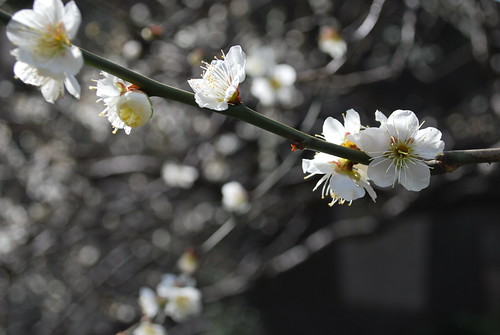
{Photos by rocketlass.}

As the visit of an out-of-town friend rightly takes precedence over blogging tonight, today's post will be short--and since later on I'm sure to be raising a glass with my friend, it seems only right to continue with a theme touched on in Sunday's post, that of tipsy nature poetry!

I cited one example on Sunday from New Directions's new anthologies of Chinese and Japanese poetry translated by Kenneth Rexroth; today I have another to share, from twelfth-century Chinese poet Lu Yu {also known as Lu You}:
Evening in the Village

Here in the mountain village
Evening falls peacefully.
Half tipsy, I lounge in the
Doorway. The moon shines in the
Twilit sky. The breeze is so
Gentle the water is hardly
Ruffled. I have escaped from
Lies and trouble. I no longer
Have any importance. I
Do not miss my horses and
Chariots. Here at home I
Have plenty of pigs and chickens.
I suppose it's possible that the speaker's assertions are here less than straightforward; one could read this poem as an attempt by the speaker, who has come down in the world, to convince, not just us, but himself as well, of his satisfaction in the simple pleasures that he now has no choice but to accept as his lot.

I prefer, however, to read it as honest, an evocation of a quiet evening that has followed pleasantly on a quiet day, the transition smoothed by the pleasure of a drink or two. It makes me pine for warm summer breezes and long twilights, for back-steps weather and condensation collecting on my martini glass.


In his "Rain on the River," also collected in Songs of Love, Moon, and Wind: Poems from the Chinese, Lu Yu acknowledges that such lubricated appreciation of nature can carry a cost, drunken insomnia--though even that can offer pleasures to the attentive :
At midnight I am awake,
Heavy with wine. The smoky
Lamp is still burning. The rain
Is still sighing in the bamboo
Thatch of the cabin of the boat.
All of which makes me wonder whether there any good American tipsy nature poets? Off the top of my head . . . Walt Whitman's exuberance carries with it some of the happy drunk's cup-runneth-over joy, but that's no good: Whitman was abstemious, and even wrote a temperance novel. Wendell Berry's eye for nature is wonderful, and in his fiction he is very good at depicting the social pleasures of drinking, but Berry the nature poet and Berry the raconteur don't really intermingle.

Surely there's someone obvious I'm missing? The floor is open for nominations . . .

Sunday, April 19, 2009

The gift of poetry


{Photos by rocketlass.}

In my brief tenure as a bookseller in London, I had enough dealings with tiny gift books to send me to the poetry section for a quick flip through the Inferno, on the assumption that somewhere therein Dante had contrived an appropriately creative and hideous punishment for whoever invented the form. Tiny gift books are a horror in every way: they don't stack well; they can't really be shelved, because they disappear when placed spine-out; and they're easily shoplifted. Perhaps worst of all, they tend to represent the gift of last resort: confronted with the task of buying a gift for a nephew he barely knows, the shopper wanders the store for a desultory hour before reluctantly plumping for the harmless and charmless Beyond D'oh! The Wit and Wisdom of Your Favorite Cartoon Characters. They're the airport tchotchkes of book retail, simultaneously loathsome and disposable.

Now New Directions has come out with a couple of books that have forced me to dial back the vitriol: Written on the Sky: Poems from the Japanese and Songs of Love, Moon, and Wind: Poems from the Chinese, both translated by Kenneth Rexroth. They've plucked these slim, well-regarded volumes from their backlist and designed them to be pocket-sized, pretty, and undaunting--and in doing so have, I think, given the books a real chance of breaking out of their natural market and finding new readers. (It couldn't hurt that they've also managed to land at least some of them in non-traditional retail outlets: I recently saw another volume in the series, by Neruda, in Anthropologie, of all places.)

Seeing these books succeed would go a long way towards vitiating my hatred of gift books; New Directions publishes so many of my favorite authors that anything that adds to their bottom line is almost de facto good for literature. But beyond that, these books are simply wonderful on their own merits, and I'm happy to hope that by packaging Rexroth's translations this way New Directions can lead people to unexpectedly discover classical Japanese and Chinese poetry.


Both volumes draw on dozens of authors from throughout each centuries-long tradition and mix forms and styles, the poems in the Chinese volume more varied in approach than those of the Japanese collection, which consists of a mix of haiku and tanka. Murasaki Shikibu turns up three times in the Japanese volume, with this poem in particular seeming a suitable account of the life of quiet observation that is the lot of the novelist:
I feel of others' affairs
as thought they were
the water birds I watch
floating idly on the water.
My idleness comes
only from sorrow.
My favorite poem from that book thus far is this one, by an anonymous poet (and, frustratingly, undated):
Everybody knows
How much I love you.
All your
Mannerisms
Have Become my
Mannerisms.
I'm impressed by the suppleness of the shift in perspective in those lines: the love is seen by everyone, but in a way that is perhaps not obvious to the beloved until, gesturing, the poet points it out; you can almost feel the amused flutter of recognition coursing through the beloved.

From the Chinese volume, I'm particularly struck by this poem, by Ou-Yang Hsiu, who wrote in the eleventh century:
East Wind

The burgeoning trees are thick with leaves
The birds are singing on all the hills.
The East Wind blows softly.
The birds sing, the flowers dance.
This minor magistrate is drunk.
Tomorrow when he wakes up,
Spring will no longer be new.
Japanese and Chinese poets of the classical tradition write so well, and so simply, about nature that it's easy to slip into an exoticizing awe, stripping them of their context and viewing them as an admirable class of nature savant--like reading the Romantics without remembering that their work was in part written against the growth of industry. "East Wind" serves as an amusing corrective. After a traditionally descriptive opening, it casually deflates the beautifully seductive scene it's established: the magistrate is minor, he's drunk, and though his appreciation of this quiet scene is real, its hyper-lyrical qualities just might owe as much to liquor as to spring itself. Haven't we all at times felt that ovewhelming warm love for the world and all its creatures, just before we toddle off for an inevitably sobering sleep?


On a morning when yet again yesterday's promise of spring has been stolen away by gray skies and chilly rain, it seems appropriate to end the post with these lines from "Spring Joy," by Chu Shu-Chen, who wrote in the twelfth century:
Drafty winds and fine rain
Make a chilly Spring.
I drink wine, remembering bygone happiness,
Under the pear blossoms,
Weeping with misery.
I don't expect to do any weeping today, but if I have to put up with another month of this non-spring nonsense, I can't make any guarantees about my fortitude. Those of you in warmer, more reliable climes, enjoy the outdoors for me today.