Showing posts with label Leonard Woolf. Show all posts

Thursday, May 20, 2010

Leonard, Lev, and the servants

After Tuesday's post about Lev Grossman's Believer article about Leonard Woolf, fantasy, and modernism, Ed Park (who was Grossman's editor for the piece) sent me to a post on Grossman's new blog where he offers some background to the article. It's worth reading the whole post, in which, among other things, Grossman reveals that the article's origin lies in a conversation with his mother from nearly twenty years ago. But what stood out for me was this admission:
I’m pretty tired of writing these truncated little 650-word nuglets for Time. It felt good to type knowing that I didn’t have to stop when I came to the end of the little box.
I've always wondered about that, about how someone as talented and well-read as Grossman adapts to hammering out the briefest of summaries week after week.There's an art to it, unquestionably; writing short and on deadline can in its way be as difficult as writing long. But I'm not surprised to find that it can also be frustrating, especially as more and more online options emerge, with their--theoretically--unlimited word counts.

Grossman's adept use of the material of Leonard Woolf's volumes of memoir having tempted me to seek them out, I returned to my bookshelves to see what I could learn about them. Anthony Powell, no friend of Bloomsbury, wrote of the first volume, Sowing, for the Daily Telegraph in 1966 (when, almost unbelievably, Woolf was still alive), that
The narrative of the early years which culminated in Cambridge is extraordinarily well done. . . . Woolf writes in an incisive, rigorous rose, suited to his own uncompromising view of life. He gives the reader a clear idea of his own upbringing and what he was like as a boy. . . . At the same time one has the feeling that the author's at times almost brutal directness conceals a good deal of sensitiveness that has suffered in the past some hard blows.
From there he moves to analysis of Bloomsbury that seems indisputable even for a reader who, like me, is more inclined to appreciate the circle:
Accordingly, like others of the group, he found, in what was perhaps a certain basic lack of self-confidence, support in becoming a member of Bloomsbury; that community which had about it something of a small religious sect in the attitude of its adherents towards each other and to the outside world.
All of which, in the disjointed way that blogs are, with the reader's forbearance, on occasion allowed to be, leads me to share a moment from Alison Light's book Mrs. Woolf and the Servants (2008). The whole book is fascinating--I can't recommend it too highly--but the moment that most stood out for me came in this account of the summer of 1929, when the Woolfs had just purchased a rural cottage:
With Nellie away, Annie came in the mornings and made lunch, often leaving a pie for Virginia to cook for dinner. By three o'clock the Woolfs were alone--a complete and utter novelty. It is worth emphasizing. They had never been alone before in their own home. Thus the life of the British modern couple was inaugurated.
They had been married for seventeen years at that point.

As I washed the dishes tonight after a long day at the office, I'll admit to having temporarily dreamed of a life with servants, but Light reminds me that such a life is far, far from the right one for me.

Tuesday, May 18, 2010

"We think of fantasy and modernism as worlds apart, but somehow they always end up in the same place," or, Lev Grossman and Leonard Woolf


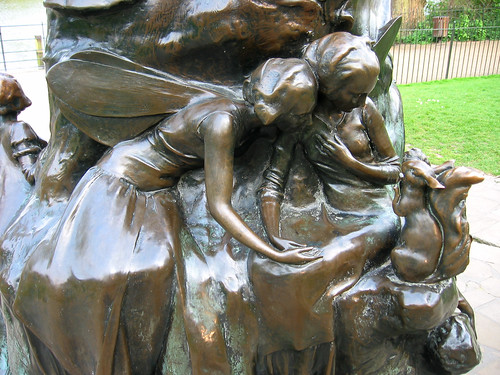
{Photo by rocketlass.}

Fresh off Sunday's post about Virginia Woolf, today I'll direct you to Lev Grossman's article about Leonard Woolf, "The Death of a Civil Servant," in the May issue of the Believer.

The essay is built around Woolf's time as a young civil servant in Ceylon, and this description of what he found when he arrived will give you a good idea of how well Grossman makes use of interesting details from Woolf's autobiographical writings:
Ceylon was a giant step forward into adulthood and independence for Woolf, but it was also a great leap backward--backward in time. Ceylon had yet to enter the twentieth century, at least as it was known in the Western world. "Before the days of the motor-car," Woolf wrote, "Colombo was a real Eastern city, swarming with human beings and flies, the streets full of flitting rickshas and creaking bullock carts, hot and heavy with the complicated smells of men and beasts and dung and oil and food and fruit and spice." The alien heat and gargantuan insects appalled Woolf. The day after he arrived he was reunited with [his terrier] Charles at the docks. Charles promptly peed on a passerby, who seemed not at all troubled by this, then threw up from the emotion and the sun. Crows flew down to eat the vomit. Welcome to Ceylon.
Grossman tells of Woolf's awkward friendship with another colonial official, a policeman and would-be poet and intellectual, B. J. Dutton, and he uses that friendship--and Woolf's near-horror at Dutton's fairy-and-fantasy-filled poems--as the ground from which to argue a convincing, fascinating case for modernism and fantasy as dark twins, born of the same moment and reacting to the same changes in society. As Grossman puts it,
Fantasy is a prelude to the apocalypse. Modernism is the epilogue.
That Grossman has a deep knowledge of and interest in fantasy won't surprise any readers of his novel from last year, The Magicians, in which a young man who has long dreamed of escaping into a fantasy world gets his chance--only to discover that the problems and weaknesses and disappointments and betrayals of ordinary life are not, after all, particularly amenable to magic. As Grossman puts it in his Believer piece,
Much of fantasy literature arises from this essential truth: that magic is not the end of all your problems, it's the beginning. Travel deeper into the realms of gold--farther up and farther in, as Aslan says--and you leave reality behind, but only to re-encounter it in transfigured form.
Given Grossman's nuanced understanding of fantasy, what's odd about The Magicians is that the occasional frustrations in this otherwise very satisfying novel seem to come from Grossman's rejection of one of the now-standard characteristics of fantasy literature: the carefully balanced, multi-book story arc. It's as if, because there can be no truly heroic quest in The Magicians, because the world--even, or perhaps especially, the magic world--simply isn't like that, then the story itself can't be made to fit the same the heroic shape we're used to. The result is that portions of the novel feel compressed, bits of its impressively imaginative world-building more suggested than fully worked out: the relationship, for example, between the magic school of Brakebills Academy and the larger world; or the mostly alluded-to post-graduate careers of its alumni; or the faculty, who are so intriguing a group that you wish they were allotted more space. A sequel apparently is in the works, and perhaps Grossman will flesh out some of these aspects in its pages, but within The Magicians itself I felt the lack.

All of which is not to take away from Grossman's achievement: The Magicians is completely captivating, and it's absolutely crammed with creative, surprising ideas and inventions, nearly all of which cohere impressively. A magical ordeal that involves a transformation from human into animal is wonderfully rendered, convincing in its depiction of the physical and mental alterations alike. The admission exam taken by potential students is simultaneously jaw-dropping and totally believable in its context--it's hard to imagine anyone who remembers being a talented student not smiling at its challenges (and sort of wishing they could take a crack at it). And a scene where an evil creature unexpectedly emerges in a classroom is one of the most intense and frightening scenes I've ever read. I read the book soon after it was published last spring, and it's stayed with me; now I'm impatient for the sequel.

{While you're waiting, you could do worse than to pick up the May Believer--the Grossman piece alone is worth the price of admission!}