Showing posts with label Lev Grossman. Show all posts

Thursday, August 14, 2014

A visit to the library

When I started work on The Getaway Car, I hadn't been a student for nearly twenty years. So the first step was re-learning how to do research--which also involved learning just how much could be done from my couch. With the help of the University of Chicago Library, I was able to discover and order nearly fifty books and articles, and have a surprising number of them delivered to me directly, within minutes, right on my laptop. It was a spectacular lesson in the enlarged, place-less library of the present-and-future.

Ah, but there's still plenty to be said for actually hitting the stacks, as a visit this week to the Regenstein Library on campus reminded me. I went in search of Roy Fuller's The Second Curtain, an English crime novel from 1953 that had been recommended to me by Will Schofield (proprietor of the wonderful Fifty Watts). I located it, admired its first line "("Fox was rather like a fox."), and was about to move on . . .

Then another name caught my eye. Firbank. Ah, Ronald Firbank! The writer whom Anthony Powell led back into print when he worked at Duckworth, of whom Harold Nicolson wrote, "It would be impossible, I think, to actually be as decadent as [Firbank] looked." It has been a while since I've looked into his baroque weirdness. [Flip, flip, flip]

Oh, yes, this browsing was worth it. It turned up this, from the unfinished  Tragedy in Green:
It was one of Lady Georgia's habits to find equivalents for all her worser feelings in the Bible.
That line was offered as a gloss on a bit of dialogue:
"I am a work of art," she sighed, "and this evening I feel nearly as wicked as Herodias."
Few writers ever mastered the sigh like Firbank.

The same volume also yielded this bit, from another incomplete work:
Her week-ends were a noted success. She arranged a circle of chairs under the lime trees on her lawn, and everyone slept. It was so restful, her friends said, and then when one could not sleep one could always talk scandal to one's neighbor.
Firbank's complete works aren't extensive, which meant it didn't take long for my eyes to light on another irresistible volume: Ronald Firbank: Memoirs and Critiques (1977), an example of one of my favorite genres: a collection of accounts of a writer by those who knew him. With a character as memorable as Firbank, such a book can't but be riddled with gems. Here's one, from Ifan Kyrle Fletcher:
In 1905 he published a slim volume containing this story ["Odette d'Antravernes"] and another sketch called "A Study in Temperament." Some of the copies were bound in pink wrappers and some in blue. The pallor of these colors offended his eye, now quick in aesthetic sensibility. He expressed his detestation in a letter to his publishers which foreshadowed his later ironical work. From the point of view of the public, he need not have been concerned. His book was ignored.
Fletcher also supplies a wonderfully concise description. After quoting another person to the point that Firbank was "full of contradictions," "naturally artificial and sincerely paradoxical," Fletcher writes::
It is this twisting of qualities which today makes him appear so remote, like a figure from a Restoration comedy. And it was this twisting of qualities which, in his life-time, made him so vitally baorque. His life seemed all grotesque ornamentation. His love of beauty was skilfully disguised. But it was always apparent in his hatred of pretensiousness. He suspected his own expressions of admiration as strongly as he questioned the sincerity of all rodomontade. Growing out of this was his refusal to talk seriously about art and life, even to kindred spirits. he feared that serious talk would become sober tosh.
Then there's this unforgettable account from Augustus John:
If I terrified Ronald Firbank, as he used to say I did, he often quite unnerved me with his way of emitting a long, hollow laugh about nothing in particular, a laugh like a clock suddenly "running down," accompanied by a fluttering of the hands (not the clock's), hand which he would then proceed to wash with the furtive precipitation of a murderer evading pursuit.
Osbert Sitwell, meanwhile, retails an anecdote that is appropriate for this month's Great War centennial (even if it smacks of being far too good to be true):
He told us . . . that when, after a dozen or so examinations, the War Office finally rejected him as totally unfit for service (which anyone else could have told at a glance), and then, in their usual muddled way, at once called him up again, he replied to them through his lawyer with the threat of a libel action. The War Office, at a time when it governed the world, was so taken aback at this simple piece of individual initiative that it at once sent back to him a humble apology.
Evelyn Waugh, meanwhile, contributes a critical essay in which the following effectively analytic paragraph stands out (once you get past the "inscrutable wit of the Chinese," that is):
But by its nature Firbank's humour defies quotation. Perhaps it is a shade nearer to the abiding and inscrutable with of the Chinese. It is there to be njoyed by those who have a taste for it, but it is too individual and intangible to become a literary influence. The importance of Firbank, which justifies the writing of a critical essay about him, lies in his literary method. He is the first quite modern writer to solve for himself, quite unobtrusively and probably more or less unconsciously, the aesthetic problem of representation in fiction; to achieve, that is to say, a new, balanced interrelation of subject and form. Nineteenth-century novelists achieved a balance only by complete submission to the idea of the succession of events in an arbitrarily limited period of time. Just as in painting until the last generation the aesthetically significant activity of the artist had always to be occasioned by anecdote and representation, so the novelist was fettered by the chain of cause and effect,. Almost all the important novels of this century have been experiments in making an art form out of this raw material of narration. It is a problem capable of many solutions, of which Firbank discovered one that was peculiarly appropriate and delicate.

His later novels are almost wholly devoid of any attributions of cause to effect.

Still reeling from the strangeness of Firbank, I let my eyes slide over a shelf, where they found the safest of harbors: John Galsworthy. A volume of his letters, flipped open, yielded this passage, which seems a suitable way to tiptoe back towards ordinary life from the Firbankian shadows:
I am conscious of never having been of any set in my life. To be "in" and "of" are not the same. It seems queer to look back on those times; queer and not too reassuring--yet sometimes there comes over one now the feeling that in pure physical health and pleasures lies the true existence, and that in all the nerve devouring and heart searching analysis of our present years lies discontent and fag. How comparatively vegetably happy are not one or two of my friends of those days who have been content to pass their lives keeping packs of hounds. No doubts and queries about them! Jolly red faces, and solid muscles. Ah! well, everything that is, is right.
Equilibrium restored to at least its usual tentative state, I ambled from the library, remembering as I left a passage from late in the new, final volume of Lev Grossman's Magicians trilogy, The Magician's Land. Grossman's characters are wandering a magical library located between worlds, and they glance into a side room, set aside by the librarian for "problem formats":
It was the weirdest bibliographical menagerie she'd ever seen. Books so tall and yet so narrow that they looked like yardsticks; she supposed they must be illustrated guides to snakes, or arrows, or maybe yardsticks. One book was kept in a glass terrarium--a librarium?--the better to contain the words that kept crawling out of it like ants. One lay slightly open on a table, but only slightly, so you could see that its pages emitted an intolerably bright radiance; a welding mask lay next to it. One book appeared to be all spine along all of its edges. It was unopenable, its pages sealed inside it.
Another room contains all the novels people have meant to write but not gotten around to. I imagine browsing in that room would be a tad less productive than the hour I spent in PR6011 through PR6013.

Enjoy your weekend, folks. May your browsing lead you to good places!

Monday, August 15, 2011

The Magician King

Last year I wrote, of Lev Grossman's novel The Magicians, which tells of a young man who discovers that magic is real and he's good at it, but that it doesn't make him a hero or make the world any more amenable to heroic quests:
The occasional frustrations in this otherwise very satisfying novel seem to come from Grossman's rejection of one of the now-standard characteristics of fantasy literature: the carefully balanced, multi-book story arc. It's as if, because there can be no truly heroic quest in The Magicians, because the world--even, or perhaps especially, the magic world--simply isn't like that, then the story itself can't be made to fit the same the heroic shape we're used to. The result is that portions of the novel feel compressed, bits of its impressively imaginative world-building more suggested than fully worked out. . . . A sequel apparently is in the works, and perhaps Grossman will flesh out some of these aspects in its pages, but within The Magicians itself I felt the lack.
That sequel, The Magician King, has arrived, and while it's quite good, it, too, feels as if it would have benefited from being expanded: some of the major characters from the first book, including Eliot and Janet, barely register in this one, making little impression even when they're present on the page; Brakebills, so important to Quentin and his friends in the first book, is given only a token appearance; and some key elements of the plot and the world Grossman's created (like the role of the Order in protecting the Neitherlands) are dispatched far too quickly.

In nearly all other respects, however, The Magician King is impressive, and a better book than The Magicians: more dramatic, more inventive, and similarly clear about its characters' failings of character while feeling less deliberate about foregrounding them. Its central quest is modeled on The Voyage of the Dawn Treader, but interwoven with the story of that sea journey is the story of Julia, a high school friend of Quentin, Grossman's protagonist. In The Magicians, Julia fails the Brakebills entrance exam, but the spell that routinely wipes the memories of failed applicants doesn't work, and the realization that magic exists--and she's been shut out of it--drives Julia to learn it on her own. By the end of that novel, she has reappeared as a "hedge witch" (Grossman's brilliant coinage for a self-taught magician [CORRECTION: As Biblibio points out in the comments, this is a common term, not Grossman's invention.]); in this book, we learn how she did it--and what she had to sacrifice along the way. It's a brutal, harrowing tale, and it shows Grossman at his best: watching Julia move through the subculture of samizdat magic is fascinating, and Grossman absolutely nails the combination of self-regard, self-satisfaction, power games, and pathologies that subcultures so often breed. The network of self-taught magicians is so well-conceived and fully realized that it seems almost plausible.

Julia's journey ends with a scene of violent destruction as surprising as it is frightening; as in the first book, Grossman is extremely good at conveying terror and unbridgeable imbalances of power. All books dealing with magic, it seems, ought to have a scene wherein mortals find themselves in over their heads, sparring with powers whose extent they've woefully, oh-too-humanly underestimated. If there is hidden power in the universe, there surely are also hidden Powers, and a fantasy that can convincingly depict them can be deliciously frightening.

I want to end with a brief note about the Brakebills exam itself. The test was one of the real highlights of The Magicians: Quentin, Julia, and a host of strangers are essentially plucked off the streets of ordinary life, magically shuttled to Brakebills, and told they are to stand an examination. As they're smart teens, that's far less odd than it seems--think back to your math nerd years and how often you were taken to some other school to match wits with strangers for vaguely spelled-out prizes. And Grossman's account of the test brings back the feeling of being a smart teen like nothing else I can remember reading: even when he's not sure of the point, Quentin takes each complicated math and language problem as a personal challenge, getting wholly wrapped up in them with the near-autistic intensity that, for me at least, is now only a memory. And what nerd wouldn't, with questions like this:
[T]he test gave him a passage from The Tempest, then asked him to make up a fake language, and then translate the Shakespeare into the made-up language. He was then asked questions about the grammar and orthography of his made-up language, and then--honestly, what was the point?--questions about the geography and culture and society of the made-up country where his made-up language was so fluently spoken. Then he had to translate the original passage from the fake language back into English, paying particular attention to any resulting distortions in grammar, word choice, and meaning. Seriously.
But why, then, did Julia fail? She's clearly intelligent, and she's gifted enough in magic to eventually make her way without instruction, so why did she not pass the test? In The Magician King we get the explanation. Whereas Quentin took the events of that day as much in his stride as would be humanly possible, because he'd always been expecting his drab life to suddenly change for the better,
Julia had been blindsided. She had never expected anything special to just happen to her. Her plan for life was to get out there and make special things happen, which was a much more sensible plan from a probability point of view, given how unlikely it was that anything as exciting as Brakebills would ever just fall into your lap. So when she got there she had the presence of mind to step back and make a full appraisal of exactly how weird it all was. She could have handled the math, God knew. She'd been in math classes with Quentin since they were ten years old, and anything he could do she could do just as well, backward and in high heels if necessary.

But she spent too much time looking around, trying to work it through, the implications of it. She didn't take it at face value the way Quentin did. The uppermost thought in her mind was, why are you all sitting here doing differential geometry and generally jumping through hoops when fundamental laws of thermodynamics and Newtonian physics are being broken left and right all around you? This shit was major. The test was the last of her priorities. It was the least interesting thing in the room.
Magic aside, that, too, is familiar, a risk I recall lurking at the verge of consciousness at every one of those teenage tests, from math contest to the SAT: if you let your glance slide to the bigger picture, you were sunk. It's one of the difficulties of teenage life that's hardest to recover as an adult. We tend to say that we want young people to think of the bigger picture (college, jobs), but we fail to realize that a successful teenage life, even strictly on the academic side, requires a fairly fundamental myopia, an ability to attend blindly to this task, that moment without lifting one's eyes to the horizon. Because if you do, those concerns, those requirements, even those achievements, will almost inevitably look small, partial, or even inconsequential . . . even as the years between you and adulthood remain just as substantial as ever.

Friday, May 28, 2010

Two bookish bits for your holiday weekend


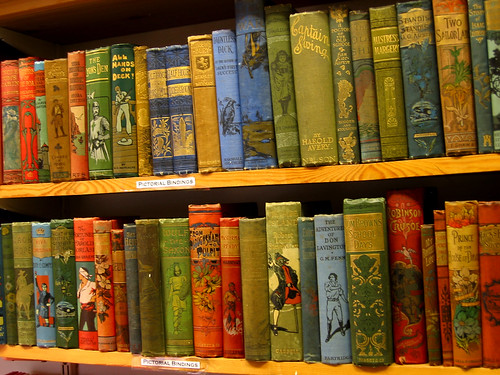
{Photo by rocketlass.}

To send you into the weekend, I'll share a couple of passages of bookish appreciation that I've come across in my reading this week. First, from Lev Grossman's Codex (2004), a moment when the protagonist, charged with the task of cataloging a vast library of rare books, reflects for a moment on the volumes around him:
He went back for another stack of books: a three-volume English legal treatise; a travel guide to Tuscany from the '20s crammed with faded Italian wildflowers that fluttered out from between the pages like moths; a French edition of Turgeniev so decayed that it came apart in his hands; a register of London society from 1863. In a way it was idiotic. He was treating these books like they were holy relics. It wasn't like he would ever actually read them. But there was something magnetic about them, something that compelled respect, even the silly ones, like the Enlightenment treatise about how lightning was caused by bees. They were information, data, but not in the form he was used to dealing with it. They were non-digital, nonelectrical chunks of memory, not stamped out of silicon but laboriously crafted out of wood pulp and ink, leather and glue. Somebody had cared enough to write these things; somebody else had cared enough to buy them, possibly even read them, at the very least keep them safe for 150 years, sometimes longer, when they could have vanished at the touch of a spark. That made them worth something, didn't it, just by itself? Though most of them would have bored him rigid the second he cracked them open, which there wasn't much chance of. Maybe that was what he found so appealing: the sight of so many books that he'd never have to read, so much work he'd never have to do.
As someone who hasn't thought of reading as a duty, well, ever, and who just yesterday used the excuse of the Seminary Co-op's annual member sale to bring yet more books into the house, I think of the stacks of unread volumes differently: I'll get to all of these someday, and oh, the pleasures that await!

Which leads nicely into this passage from Gene Wolfe's "The Island of Doctor Death and Other Stories" (1970):
The drugstore is as big as a supermarket, with long, bright aisles of glassware and notions and paper goods. Jason buys fluid for his lighter at the cigarette counter, and you bring him a book from the revolving wire rack. "Please, Jason?"

He takes it from you and replaces it in the rack, then when you are in the car again takes it from under his jacket and gives it to you.

It is a wonderful book, thick and heavy, with the edges of the pages tinted yellow. The covers are glossy stiff cardboard, and on the front is a picture of a man in rags fighting a thing that is partly like an ape and partly like a man, but much worse than either. The picture is in color, and there is real blood on the ape-thing; the man is muscular and handsome, with tawny hair lighter than Jason's and no beard.
Be it pulp or something pleasantly snootier, enjoy your reading this weekend. I'll be back here as normal on Tuesday.

Thursday, May 20, 2010

Leonard, Lev, and the servants

After Tuesday's post about Lev Grossman's Believer article about Leonard Woolf, fantasy, and modernism, Ed Park (who was Grossman's editor for the piece) sent me to a post on Grossman's new blog where he offers some background to the article. It's worth reading the whole post, in which, among other things, Grossman reveals that the article's origin lies in a conversation with his mother from nearly twenty years ago. But what stood out for me was this admission:
I’m pretty tired of writing these truncated little 650-word nuglets for Time. It felt good to type knowing that I didn’t have to stop when I came to the end of the little box.
I've always wondered about that, about how someone as talented and well-read as Grossman adapts to hammering out the briefest of summaries week after week.There's an art to it, unquestionably; writing short and on deadline can in its way be as difficult as writing long. But I'm not surprised to find that it can also be frustrating, especially as more and more online options emerge, with their--theoretically--unlimited word counts.

Grossman's adept use of the material of Leonard Woolf's volumes of memoir having tempted me to seek them out, I returned to my bookshelves to see what I could learn about them. Anthony Powell, no friend of Bloomsbury, wrote of the first volume, Sowing, for the Daily Telegraph in 1966 (when, almost unbelievably, Woolf was still alive), that
The narrative of the early years which culminated in Cambridge is extraordinarily well done. . . . Woolf writes in an incisive, rigorous rose, suited to his own uncompromising view of life. He gives the reader a clear idea of his own upbringing and what he was like as a boy. . . . At the same time one has the feeling that the author's at times almost brutal directness conceals a good deal of sensitiveness that has suffered in the past some hard blows.
From there he moves to analysis of Bloomsbury that seems indisputable even for a reader who, like me, is more inclined to appreciate the circle:
Accordingly, like others of the group, he found, in what was perhaps a certain basic lack of self-confidence, support in becoming a member of Bloomsbury; that community which had about it something of a small religious sect in the attitude of its adherents towards each other and to the outside world.
All of which, in the disjointed way that blogs are, with the reader's forbearance, on occasion allowed to be, leads me to share a moment from Alison Light's book Mrs. Woolf and the Servants (2008). The whole book is fascinating--I can't recommend it too highly--but the moment that most stood out for me came in this account of the summer of 1929, when the Woolfs had just purchased a rural cottage:
With Nellie away, Annie came in the mornings and made lunch, often leaving a pie for Virginia to cook for dinner. By three o'clock the Woolfs were alone--a complete and utter novelty. It is worth emphasizing. They had never been alone before in their own home. Thus the life of the British modern couple was inaugurated.
They had been married for seventeen years at that point.

As I washed the dishes tonight after a long day at the office, I'll admit to having temporarily dreamed of a life with servants, but Light reminds me that such a life is far, far from the right one for me.

Tuesday, May 18, 2010

"We think of fantasy and modernism as worlds apart, but somehow they always end up in the same place," or, Lev Grossman and Leonard Woolf


{Photo by rocketlass.}

Fresh off Sunday's post about Virginia Woolf, today I'll direct you to Lev Grossman's article about Leonard Woolf, "The Death of a Civil Servant," in the May issue of the Believer.

The essay is built around Woolf's time as a young civil servant in Ceylon, and this description of what he found when he arrived will give you a good idea of how well Grossman makes use of interesting details from Woolf's autobiographical writings:
Ceylon was a giant step forward into adulthood and independence for Woolf, but it was also a great leap backward--backward in time. Ceylon had yet to enter the twentieth century, at least as it was known in the Western world. "Before the days of the motor-car," Woolf wrote, "Colombo was a real Eastern city, swarming with human beings and flies, the streets full of flitting rickshas and creaking bullock carts, hot and heavy with the complicated smells of men and beasts and dung and oil and food and fruit and spice." The alien heat and gargantuan insects appalled Woolf. The day after he arrived he was reunited with [his terrier] Charles at the docks. Charles promptly peed on a passerby, who seemed not at all troubled by this, then threw up from the emotion and the sun. Crows flew down to eat the vomit. Welcome to Ceylon.
Grossman tells of Woolf's awkward friendship with another colonial official, a policeman and would-be poet and intellectual, B. J. Dutton, and he uses that friendship--and Woolf's near-horror at Dutton's fairy-and-fantasy-filled poems--as the ground from which to argue a convincing, fascinating case for modernism and fantasy as dark twins, born of the same moment and reacting to the same changes in society. As Grossman puts it,
Fantasy is a prelude to the apocalypse. Modernism is the epilogue.
That Grossman has a deep knowledge of and interest in fantasy won't surprise any readers of his novel from last year, The Magicians, in which a young man who has long dreamed of escaping into a fantasy world gets his chance--only to discover that the problems and weaknesses and disappointments and betrayals of ordinary life are not, after all, particularly amenable to magic. As Grossman puts it in his Believer piece,
Much of fantasy literature arises from this essential truth: that magic is not the end of all your problems, it's the beginning. Travel deeper into the realms of gold--farther up and farther in, as Aslan says--and you leave reality behind, but only to re-encounter it in transfigured form.
Given Grossman's nuanced understanding of fantasy, what's odd about The Magicians is that the occasional frustrations in this otherwise very satisfying novel seem to come from Grossman's rejection of one of the now-standard characteristics of fantasy literature: the carefully balanced, multi-book story arc. It's as if, because there can be no truly heroic quest in The Magicians, because the world--even, or perhaps especially, the magic world--simply isn't like that, then the story itself can't be made to fit the same the heroic shape we're used to. The result is that portions of the novel feel compressed, bits of its impressively imaginative world-building more suggested than fully worked out: the relationship, for example, between the magic school of Brakebills Academy and the larger world; or the mostly alluded-to post-graduate careers of its alumni; or the faculty, who are so intriguing a group that you wish they were allotted more space. A sequel apparently is in the works, and perhaps Grossman will flesh out some of these aspects in its pages, but within The Magicians itself I felt the lack.

All of which is not to take away from Grossman's achievement: The Magicians is completely captivating, and it's absolutely crammed with creative, surprising ideas and inventions, nearly all of which cohere impressively. A magical ordeal that involves a transformation from human into animal is wonderfully rendered, convincing in its depiction of the physical and mental alterations alike. The admission exam taken by potential students is simultaneously jaw-dropping and totally believable in its context--it's hard to imagine anyone who remembers being a talented student not smiling at its challenges (and sort of wishing they could take a crack at it). And a scene where an evil creature unexpectedly emerges in a classroom is one of the most intense and frightening scenes I've ever read. I read the book soon after it was published last spring, and it's stayed with me; now I'm impatient for the sequel.

{While you're waiting, you could do worse than to pick up the May Believer--the Grossman piece alone is worth the price of admission!}