Showing posts with label Henry Fielding. Show all posts

Friday, February 22, 2013

Henry Fielding on Vanity

Henry Fielding's Joseph Andrews (1742), while not nearly as entertaining as Tom Jones--an unfair bar to ask a book to clear--is nonetheless great fun, a rambling goof on hypocrisy, vanity, and desire that in its paper-thin organizational scheme is one step up from the picaresque.

It's amusing throughout--what led rocketlass to pick it off the table at Daunt Books when we were in London was a scene of fisticuffs that had her laughing out loud--but my favorite moment is this vertiginous encomium to/damnation of vanity:
O Vanity! How little is thy Force acknowledged, or thy Operations discerned? How wantonly dost thou deceive Mankind under different Disguises? Sometimes thou does wear the Face of Pity, sometimes of Generosity: nay, thou has the Assurance even to put on those glorious Ornaments which belong only to heroic Virtue. Thou Odious, deformed Monster! whom Priests have railed at, Philosophers despised, and Poets ridiculed: Is there a Wretch so abandoned as to own thee for an Acquaintance in public? yet, how few will refuse to enjoy thee in private? Nay, thou are the Pursuit of most Men through their Lives. The greatest Villainies are daily practised to please thee: nor is the meanest Thief below, or the greatest Hero above, thy notice. Thy embraces are often the sole Aim and sole Reward of the private Robbery, and the plundered province. It is, to pamper up thee, thou Harlot, that we attempt to withdraw from others what we do not want, or to withhold from them what they do. All our Passions are they Slaves. Avarice itself is often no more than thy Hand-maid, and even Lust thy Pimp. The Bully Fear, like a Coward, flies before thee, and Joy and Grief hide their Heads in thy Presence.

I know thou wilt think, that whilst I abuse thee, I court thee; and that thy Love hath inspired me to write this sarcastical Panegyrick on thee: but thou are deceived, I value thee not of a farthing; nor will it give me any Pain, if thou should'st prevail on the Reader to censure this Digression as errant Nonsense: for know to thy Confusion, that I have introduced thee for no other Purpose than to lengthen out a short Chapter; and so I return to my History.
That's right: Fielding tricked Vanity into helping him fill out a chapter . . . by appealing to Vanity's vanity. Well played, sir.

Wednesday, February 20, 2013

Mark Twain leads by example, or, Out, d---n'd swears!

Longtime readers know that while I try not to work blue here, I am an unabashed fan of swears. I hold with Mark Twain, who argued that we all swear--sinning in our hearts, if not in our mouths:
For it is not the word that is the sin, it is the spirit back of the sin. When an irritated lady says, "oh!" the spirit back of it is "damn!" and that is the way it is going to be recorded against her. It always makes me so sorry when I hear a lady swear like that. But if she says "damn" and says it in an amiable, nice way, it isn't going to be recorded at all.
I depart from Twain (as, based on his more considered writings on the subject, he seems to have parted with himself) when it comes to the image of a goodly recording angel, but it's hard to disagree with the sentiment. He continues with his argument:
The idea that no gentleman ever swears is all wrong. He can swear and still be a gentleman if he does it in a nice and benevolent way.
Or, I would add, a creative way. Creativity in swearing, it's important to note, is not a risk-free endeavor: while the well-timed, unexpected combination of vulgarity, punch, and descriptive force can be an unmitigated joy, if you get too creative you risk having your auditors, angelic or otherwise, suspect you of idling away the day imagining swears, which is not a situation in which one wants to be pictured after reaching, say, fifteen. Life, it's been said, is a goddam struggle.

Twain was a wonderful man for giving advice, less a one for following it, even when it was his own. Edgar Lee Masters records an incident of less than nice swearing as an aged Twain wrestled with a balky faucet in a DC hotel room in 1906:
God damn the Goddamned son of a bitch that invented that faucet. I hope he'll roast in hell a million years.
I think describing those swears as benevolent would also constitute a stretch. Masters uses the tale as an example of Twain's decline. Calling him an "irritable, foolish old man" on the verge of "spiritual collapse," he points out the faucet's true inventor:
It was God, you see, who created the fool who invented the faucet. And at that Twain may merely have failed to operate the faucet properly.
In schoolyard parlance, Twain here would be rubber, Masters glue. When he's done outwitting Twain, I've got a stack of Stephen King books out from the library in which Masters can white out all the F-words.

Speaking of F-words, what started me off on this path tonight was an elided swear word in Henry Fielding's Joseph Andrews. A connoisseur such as myself ought not to be tripped up by the em-dash–filled shells of words too shocking for eighteenth-century eyes, and for the most part I've not been: "B---" and D--n'd" present no problems. This one, however, from the foul mouth of an innkeeper's wife whose attentions Joseph Andrews spurned, stumped me:
"My dear," said [her husband], "common Charity won't suffer you to do that." "Common Charity, a F--t!"says she.
All day this bedeviled me . . . but, in an instance that would lend support to the arguments of those who urge us to work through puzzles and problems by writing about them, the mystery has been solved. As I was typing, rocketlass asked what I was working on, and I pointed out the expurgated expletive. "It's 'fart,'" she instantly said. "Did my annoying coworkers put you up to this?"

Thursday, March 19, 2009

Pickwick and Plum and Fielding, oh my!


{Photo of my hat at risk by rocketlass.}

I've always thought that the primary influences on P. G. Wodehouse's gloriously funny work are fairly easy to spot: Shakespeare and the Bible provide most of his references and many of his cadences, while musical theatre, particularly Gilbert and Sullivan, inspire the energetic joking and intricate plotting. Reading The Pickwick Papers makes me realize, with some surprise, that hitherto I've missed a quite obvious one: Dickens.

Take this scene, which finds Mr. Pickwick chasing his hat, which has blown off his head and is "gambolling playfully away in perspective":
There are very few moments in a man's existence, when he experiences so much ludicrous distress, or meets with so little charitable commiseration, as when he is in pursuit of his own hat. A vast deal of coolness, and a peculiar degree of judgment, are requisite in catching a hat. A man must not be precipitate, or he runs over it: he must not rush into the opposite extreme, or he loses it altogether. The best way is, to keep gently up with the object of pursuit, to be wary and autious, to watch your opportunity well, get gradually before it, then make a rapid dive, seize it by the crown, and stick it firmly on your head: smiling pleasantly all the time, as if you thought it as good a joke as anybody else.

There was a fine gentle wind, and Mr Pickwick's hat rolled sportively before it. The wind puffed, and Mr Pickwick puffed, and the hat rolled over and over as merrily as a lively porpoise in a strong tide.
A narrator pausing the action to deliver a brief analysis, followed by seriously given instructions for an utterly unserious action--can you get more Wodehousian? Dickens's humor is so through-and-through lighthearted in Pickwick that its place as an ancestor to Wodehouse's work is much more clear than in the later novels, with their surrounding darkness.

In fact, to draw out the chain by one more link, the same is true for Dickens's own debt to the narrative verve and mock-seriousness of Henry Fielding--it's much more obvious in the playfulness of Pickwick than in the seriousness, of, say, Dombey and Son. Not that Dickens's admiration for Fielding is any sort of secret: he did, after all, name his eighth child Henry Fielding Dickens.

Thursday, December 04, 2008

Fielding, Richardson, and Dr. Johnson, or, This one's for Maggie

Last Christmas I gave my friend Maggie a gift that was at least as much a challenge as a true present: Samuel Richardson's 1,536-page epistolary novel Clarissa (1748). Her letter to me in response--for Maggie is not one to back down from a dare--is nicely summed up in her line, "I would not say I didn't enjoy the book, but there is so, so much of it."

I thus couldn't help but think of her tonight when, flipping through The New Oxford Book of Literary Anecdotes (2006), I came across this deliciously nasty account of Richardson's self-regard, from Isaac D'Israeli's Curiosities of Literature (1791-1823):
The extreme delight which he felt on a review [revision] of his own works, the works themselves witness. Each is an evidence of what some will deem a violent literary vanity. To Pamela is prefixed a letter from the editor (whom we know to be the author) consisting of one of the most minutely laboured panegyrics of the work itself, that ever the blindest idlolator of some ancient classic paid to the object of his frenetic imagination. To the author's own edition of his Clarissa is appended an alphabetical arrangement of the sentiments dispersed throughout the work; and such was the fondness that dictated this voluminous arrangement, that such trivial aphorisms as "habits are not easily changed," "men are known by their companions," etc. seem alike to be the object of their author's admiration. And in Sir Charles Grandison, is not only prefixed a complete index, with as much exactness as if it were a History of England, but there is also appended a list of the similes and allusions in the volume.

Literary history does not record a more singular example of that self-delight which an author has felt on a revision of his works. It was this intense pleasure which produced his voluminous labours.
Even the staunchest partisan of Richardson have to admit that D'Israeli's vitriol has a certain fierce glory, no? It makes me think a trip to the library in search of that volume may be in order . . . what other authors suffered under his withering gaze?

In the interests of Richardson fans, such as Laura of Popscratch and Jenny Davidson of Light Reading, I feel that I ought to at least allow a defense of Richardson; since I'm not qualified, having not read him, I'll allow Samuel Johnson to enter the lists as his champion. In James Boswell's Life of Johnson we find this vigorous praise, wrapped up in a blast of denigration heaped on the wonderful Henry Fielding (with the role of Johnson's friend Erskine played, admirably, by Maggie):
Fielding being mentioned, Johnson exclaimed, "he was a blockhead;" and upon my expressing my astonishment as so strange an assertion, he said, "What I mean by his being a blockhead is that he was a barren racal." BOSWELL. "Will you not allow, Sir, that he draws very natural pictures of human life?" JOHNSON. "Why, Sir, it is of very low life. Richardson used to say, that had he not known who Fielding was, he should have believed he was an ostler. Sir, there is more knowledge of the heart in one letter of Richardson's, than in all Tom Jones. I, indeed, never read Joseph Andrews." ERSKINE. "Surely, Sir, Richardson is very tedious." JOHNSON. "Why, Sir, if you were to read Richardson for the story, your impatience would be so much fretted that you would hang yourself. But you must read him for the sentiment, and consider the story as only giving occasion to the sentiment."
Elsewhere in the Life, Johnson says of the pair,
[T]here was as great a difference between them as between a man who knew how a watch was made, and a man who could tell the hour by looking on the dial-plate.
Boswell, characteristically, prefers the livelier Fielding. Though in conversation with his hero Johnson he seems to have only tepidly argued the point, in the Life he offers a defense that I think truly touches the heart of the charm underlying Fielding's comedy:
Johnson used to quote with approbation a saying of Richardson's, "that the virtues of Fielding's heroes were the vices of a truly good man," I will venture to add, that the moral tendency of Fielding's writings, though it does not encourage a strained and rarely possible virtue, is ever favourable to honour and honesty, and cherishes the benevolent and generous affections. He who is as good as Fielding would make him, is an amiable member of society, and may be led on by more regulated instructors, to a higher state of ethical perfection.
Clarissa is of course doomed to die for sensibility; for my part, long live Tom Jones.

Monday, April 28, 2008

On the science of bleeding, or, And people wonder why I don't particularly like doctors!


{Photos by rocketlass.}

Near the conclusion of Henry Fielding's black comedy of rascality The Life of Mr Jonathan Wild the Great (1743), Thomas Heartfree, a good man falsely condemned for a variety of frauds actually perpetrated by the amoral Jonathan Wild, learns of his reprieve mere moments before ascending the gallows. Fielding writes,
It would be impertinent to offer at a description of the joy this occasioned to the two friends, or to Mrs Heartfree, who was now again recovered. A surgeon, who was happily present, was employed to bleed them all.
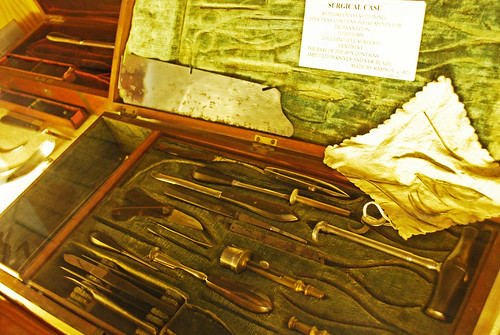
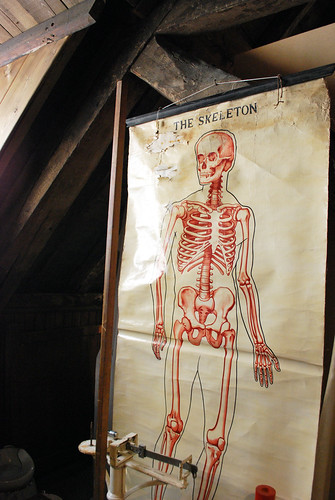
I read that passage on the way home from London, a few days after a visit to the old operating theater in the garret of St. Thomas's church, where multi-bladed bleeding implements were nestled in display cases alongside other terrifying tools of early modern medicine. Being confronted with the reality of that most cringe-making of outdated medical practices reminded me of my first encounter with therapeutic bleeding, which I imagine I share with many a bookish kid. It came at the hands of Robert Louis Stevenson, in those glorious opening scenes of Treasure Island (1883), where an ordinary boyhood is disrupted by the arrival of mysterious strangers--one of whom has a stroke:
"The man has had a stroke, as I warned him. Now, Mrs. Hawkins, you just run up-stairs to your husband, and, tell him, if possible, nothing about it. I must do my best to save this fellow's trebly worthless life, and Jim here will get me a basin."

When I got back with the basin, the doctor had already ripped up the captain's sleeve and exposed his great sinewy arm. It was tattooed in several places. "Here's luck," "A fair wind" and "Billy Bones his fancy," were very neatly and clearly executed on the forearm; and up near the shoulder there was a sketch of a gallows and a man hanging from it--done, as I thought, with great spirit. "Prophetic," said the doctor, touching this picture with his finger. "And now, Master Billy Bones, if that be your name, we ll have a look at the colour of your blood. Jim," he said, "are you afraid of blood?"

"No, sir," said I.

"Well, then," said he, "you hold the basin;" and with that he took his lancet and opened a vein.

A great deal of blood was taken before the captain opened his eyes and looked mistily about him. First he recognised the doctor with an unmistakable frown; then his glance fell upon me, and he looked relieved But suddenly his colour changed and he tried to raise himself crying:--

"Where's Black Dog?"

"There is no Black Dog here," said the doctor, "except what you have on your own back. You have been drinking rum, you have had a stroke, precisely as I told you, and I have just, very much against my own will, dragged you headforemost out of the grave."
I remember being both horrified and fascinated when I first read that, feeling instantly that I was in a world markedly different from my own--almost certainly my first experience of literature's enlivening of the past.

The operating theater, which was placed in the garret of St. Thomas's church in the mid-19th century when the adjacent St. Thomas's Hospital was desperate for space, was sealed up around the turn of the century and forgotten for more than fifty years. Now it is a fun little museum, alternating displays of herbs (with signs explaining their real and supposed medicinal powers, such as coral's powers over "Monsters, Incubii, Succubii, Phantasmata and all Evil Spirits") with cases of medical implements that were once state-of-the-gruesome-art. The operating theater itself encapsulates the horrors of Victorian medicine: as a placard explains, it rests on a false floor above three inches of sawdust, so that blood spilled by the doctors--who wore frock coats "stiff and stinking with pus"--wouldn't seep through into the sanctuary below.


Of most interest to the literary tourist, however, is the fact that John Keats studied at St. Thomas's, and presumably attended lectures in the operating theater. But Keats soon realized that he was not suited for a medical career: according to Lord Houghton,
When he had once entered upon the practical part of his business, he found his mind so oppressed with an over-wrought apprehension of doing harm that he determined on abandoning the course of life to which he had devoted a considerable portion of his small fortune.
A letter Keats sent to a friend in 1817 pinpoints the decision in a moment of distraction while bleeding a patient:
My last operation was the opening of a man's temporal artery. I did it with the utmost nicety, but reflecting on what passed through my mind at the time, my dexterity seemed a miracle, and I never took up the lancet again.
At least Keats realized his shortcomings; a contemporaneous account of his medical mentor, Mr. Morgan, related in the operating theater museum, is postively chilling:
A tall, ungainly, awkward man, with stooping shoulders and a shuffling walk, as deaf as a post, not overburdened with brains, but very good-natured, and liked by everyone. His surgical acquirements were very small,his operations very badly performed, and accompanied with much bungling, if not worse.
It seems that Keats probably made the right decision in choosing the relatively developed art of poetry over the still-blind gropings of Regency medicine. Remind me not to visit the past unless I'm sure my time machine is prepared to yank me back at the first sign of sickness.

Saturday, December 29, 2007

On the lameness of me and the greatness of detail-oriented scholarship


Since I mentioned earlier in the week that I probably ought to get out more, I can't help but pose the question, before I even begin writing this post: could there possibly be anything more lame than spending the late hours of a Friday night writing about a note to a Penguin Classic? No, no, no, no way. There's just not. This is the lamest.

Does it help if I avow that Rocketlass and I did go out tonight? That we spent the evening with friends? No? Okay, what if I try to justify tonight's post by reference to my longstanding appreciation of the drudge work that goes into editing, establishing, and writing the notes for authoritative texts? It's work that I, by long ago deciding against graduate school, eschewed, but that I appreciate nonetheless, and that therefore I feel should occasionally get its share of attention.

The note I'm interested in tonight is one I picked up on several weeks ago when I was reading the Penguin Classics edition of Tom Jones. Late in the novel, in the midst of some pleasantly rambling remarks introducing a chapter, Henry Fielding describes the untrustworthiness of Tom's sugar mama Lady Bellaston in the following manner:
Tho' the Reader may have long since concluded Lady Bellaston to be a Member (and no inconsiderable one) of the Great World, she was in reality a very considerable Member of the Little World; by which Appellation was distinguished a very worthy and honourable Society which not long since flourished in this Kingdom.

Among other good Principles upon which this Society was founded, there was one very remarkable: For as it was a Rule of an honourable Club of Heroes, who assembled at the close of the late War, that all the Members should every Day fight once at least; so 'twas in this, that every Member should, within the twenty-four Hours, tell at least one merry Fib, which was to be propagated by all Brethren and Sisterhood.
Editors Thomas Keymer and Alice Wakely grace readers of that paragraph with the following information:
Although the War of the Austrian Succession, formally concluded in October 1748, was the most recent war to have ended, Battestin plausibly finds an allusion here to a coterie of officeers, the so-called "Derby Captains," who devoted themselves to provoking duels following the Treaty of Utrecht (1713), which ended the War of the Spanish Succession. Battestin also cites John Arbuthnot's prospectus for a mock-treatise entitled "The Art of Political Lying" (1727), a chapter of which would outline "a Project for uniting the several smaller Corporations of Lyars into one Society."
Could a note be more suggestive or fascinating? Don't both those societies sound like something right out of Robert Louis Stevenson, or perhaps G. K. Chesterton? Dumas, too, would surely have had fun with these folks. Or, at a further remove, can't you imagine Borges delivering a detailed account of a secret society dedicating to lying and dueling--which, despite its being fully annotated and crammed with references to the appropriate historical documents, you would naturally assume to be a complete fabrication?

Thank you, edition-editing, note-writing scholars. You've kept me up far too late and brought me real pleasure.

Thursday, December 06, 2007

"He speaks all his Words distinctly, half as loud again as the others."


{David Garrick as Hamlet}

In the weeks leading up to Hallowe'en, when I was writing daily about ghosts and spirits, I spent a few days on Shakespearean ghosts, including that of Hamlet's father. If only I'd read Tom Jones a couple of months earlier, I could have adduced a scene from it as evidence of just how scary Hamlet's father's ghost can be--for said ghost makes a memorable appearance in one of Tom Jones's most entertaining digressions, a trip to the theatre by Tom and his well-meaning buffoon of a servant, Partridge; that the scene also gives us a glimpse of David Garrick--whom Partridge refers to as "that little Man "--in action as Hamlet is an extra bonus:
As soon as the Play, which was Hamlet Prince of Denmark, began, Partridge was all Attention, nor did he break Silence till the Entrance of the Ghost; upon which he asked Jones, "What man that was in the strange Dress; something," said he," like what I have seen in a Picture. Sure it is not Armour, is it?" Jones answered, "That is the Ghost." To which Partridge replied, "Persuade me to that, Sir, if you can. Though I can't say I ever actually saw a Ghost in my life, yet I am certain I should know one, if I saw him, better than that comes to. No, no, Sir, Ghosts don't appear in such Dresses as that, neither."
Enter Garrick, and Partridge's doubts take wing, replaced by assailing fears that lead to knocking knees and trembling limbs:
"O la! Sir," said he, "I perceive now it is what you told me. I am not afraid of any Thing; for I know it is but a Play. And if it was really a Ghost, it could do one no Harm at such Distance, and in so much Company; any yet if I was frightened, I am not the only Person." "Why, who," cries Jones, "dost thou take to be such a Coward here besides thyself?" "Nay, you may call me Coward if you will; but if that little Man there upon the Stage is not frightned, I never saw any Man frightned in my Life. Ay, ay; go along with you!
Later, Partridge graces us with a close--if naive--analysis of Garrick's technique:
[D]id you not yourself observe afterwards, when he found out it was his own Father's Spirit, and how he was murdered in the Garden, how his Fear forsook him by Degrees, and he was struck dumb with Sorrow, as it were, just as I should have been, had it been my own Case.
Yet for all this, at the end of the play, when asked for his favorite player, Partridge forsakes Garrick, choosing instead the actor who had played Claudius, for which he is reproached by one of his companions:
"Indeed, Mr. Partridge," says Mrs. Miller, "you are not of the same Opinion with the Town, for they are all agreed, that Hamlet is acted by the best player who ever was on the Stage." "He the best Player!" cries Partridge, with a contemptuous Sneer. "Why I could act as well as he myself. I am sure if I had seen a Ghost, I should have looked in the very same Manner, and done just as he did. And then, to be sure, in that Scene, as you called it, between him and his Mother, where you told me he acted so fine, why, Lord help me, any Man, that is, any good Man, that had such a Mother, would have done exactly the same. I know you are only joking with me; but indeed, Madam, though I was never at a Play in London, yet I have seen acting before in the Country; and the King for my Money; he speaks all his Words distinctly, half as loud again as the others.--Any Body may see he is an actor."
Gulled by Garrick's naturalism, the yokel prefers the overwrought. Though Partridge doesn't know that he is expected to prefer Garrick, the scene nevertheless reminds me distantly of Marcel's disappointment at first seeing La Berma on stage in In Search of Lost Time: expecting the spectacular, he fails to notice nuance.

If Samuel Johnson's account of Garrick's acting is accurate, Partridge would probably not have been the only novice theatre-goer to have been fuddled by Garrick's technique. In The Life of Johnson James Boswell reports Johnson saying:
Garrick . . . was no declaimer; there was not one of his own scene-shifters who could not have spoken To be, or not to be, better than he did; yet he was the only actor I ever saw whom I could call a master both in tragedy and comedy; though I liked him best in comedy. A true conception of character, and natural expression of it, were his distinguishing excellencies.


{Garrick as Richard III}

But there are limits to naturalism for Johnson, even in the case of Garrick:
Johnson, indeed, had thought more upon the subject of acting than might be generally supposed. Talking of it one day to Mr. Kemble, he said, "Are you, sir, one of those enthusiasts who believe yourself transformed into the very character you represent?" Upon Mr. Kemble's asnwering that he had never felt so strong a persuasion himself; "To be sure not, Sir, (said Johnson;) the thing is impossible. And if Garrick really believed himself to be that monster, Richard the Third, he deserved to be hanged every time he performed it.

With which sentiments I believe Dr. Johnson would have found Partridge in strong agreement.

Tuesday, December 04, 2007

Some laughs, or, "A dark, even-handed misanthropy"

To leaven yesterday's tales of robbery, killing, and general amorality, today let's have some humor!

I've really just got a few funny items for you, but I think that can be excused when this first one is, I venture, the funniest thing I've ever read. It is, not unexpectedly, by P. G. Wodehouse, and it opens the story "Buried Treasure," a tale of the Angler's Rest club that is collected in Lord Emsworth and Others (1937). The only additional introduction you need is the knowledge that in Angler's Rest stories Wodehouse identifies each speaker by the name of his drink. And now, to the joke:
The situation in Germany had come up for discussion in the bar parlour of the Angler's Rest, and it was generally agreed that Hitler was standing at the crossroads and would soon be compelled to do something definite. His present policy, said a Whisky and Splash, was mere shilly-shallying.

"He'll have to let it grow or shave it off," said the Whisky and Splash. "He can't go on sitting on the fence like this. Either a man has a moustache or he has not. There can be no middle course."
Wodehouse's most impressive achievement in those paragraphs is to maintain complete surprise: even though you know a joke's coming, his opening lines get your thoughts running so completely in one particular track that the sudden jump to another, previously unconsidered track is hilarious.

Now let's shift from the verbal to the visual, and from the twentieth century to the eighteenth, where I've been spending so much of my reading time lately. One of the books that's been holding me in that period is Tom Jones (1749), and the designer of the Penguin Classics edition deserves plaudits for choosing the perfect cover image, James Gillray's print Fashionable Contrasts;--or--The Duchess's Little Shoe Yielding to the Magnitude of the Duke's Feet (1792).


Created to celebrate and satirize the marriage of the Duke and Duchess of York, the print's simplicity is stunning, especially when contrasted with the other works of Gillray and his contemporaries, which tended to be overloaded with characters and symbols. And what a title!

Gillray, whose work I've noted before, was a contemporary of Blake, Rowlandson and Isaac Cruikshank, an artistic descendant of Hogarth, and an influence on Goya. As Vic Gatrell tells us in his spectacularly entertaining City of Laughter: Sex and Satire in Eighteenth-Century London (2006),
Gillray was an enigmatic fellow, and we're not going to like him. In appearance he seems to have been rather daunting, so it comes as no surprise to learn that, with his "slouching gait and careless habits," he was too taciturn to have intimate friends. As the artist-journalist W. H. Pyne remembered, he was "meanly mischievous" to other people and as lazy in his personal relationships as in his art, and "a stranger to the feelings of friendship." But although he was "a careless sort of cynic, one who neither loved, nor hated society," "his aberrations were more the results of low habits and the want of self-esteem, than from malignity, envy, or meanness."
And though, as Gatrell points out,
Artistic London was a small world, and he grew into his trade alongside significant others. . . . [and in] their tavern lives, these men mingled with literary and theatrical hacks as well as each other, acting out the fashionable cult of dissolute genius with growing conviction,
Gillray seems never quite to have been fully a member of that fraternity of artists, standing decidedly aloof.
Except for a few depictions of St James's characters from life, his works lack warmth or affection. . . . Many are moved by a dark, even-handed misanthropy--by something approaching hatred, mixed with sadism.
That certainly seems the case when you look at some of Gillray's other works, such as this celebration of Nelson's victory on the Nile, Destruction of the French Collossus, which could with some adjustments have been slipped into the pages of an EC comic of the 1950s:


Given the horrors clearly available to Gillray's imagination, it may not surprise you to learn that he went insane in his later years. In his last days he thought George Cruikshank (later to be celebrated for his illustrations of Dickens) was Sir Joshua Reynolds and he himself was Rubens, while a suicide attempt in 1811 inadvertently recreated some of the grotesquely comic air of his prints:
He once tried to throw himself out of [his patron] Hannah Humphrey's upper window, and was saved because he jammed his head and was spotted from White's club across the street.

But now I've allowed my interest in Gillray to derail me from my initial intention to leaven your day with humor--can anything be further from the comedic than suicidal insanity? I'll try to make up for it with, first, another Gillray, this one with none of the elegance of Fashionable Contrasts--for as any Swift fan could tell you, when all else fails, one can always opt for scatology, which Gillray did in his 1793 take on the possibility of a French invasion, The French Invasion;--or--John Bull, Bombarding the Bum-Boats:


Gross, yes, but hard not to smile at, and presumably effective politically. The French, it seems, may find themselves needing the services of the Poopsmith.

Having descended into the gutter, I'll stay there and close with this pleasantly scurillous anecdote that Henry Fielding tosses off in Tom Jones regarding actress Nell Gwyn, mistress of Charles II and good friend of I've Been Reading Lately favorite Lord Rochester:
On this subject, reader, I must stop a moment, to tell thee a story. "The famous Nell Gwynn, stepping one day, from a house where she had made a short visit, into her coach, saw a great mob assembled, and her footman all bloody and dirty; the fellow, being asked by his mistress the reason of his being in that condition, answered, `I have been fighting, madam, with an impudent rascal who called your ladyship a wh--re.' `You blockhead,' replied Mrs Gwynn, `at this rate you must fight every day of your life; why, you fool, all the world knows it.'

`Do they?' cries the fellow, in a muttering voice, after he had shut the coach-door, `they shan't call me a whore's footman for all that.'"
Finally, since it's a day of visuals, and I've already violated all bounds of good taste, I may as well add some nudity. Here's a 1672 engraving by Richard Thomson of a painting by Peter Cross depicting Nell Gwyn as Cupid:


Gwyn's sly smile and, um . . . perkiness . . . may be NSFW these days, but they must have been just fine in Samuel Pepys's day, for he reportedly kept a copy hanging over his desk at the Admiralty.

Monday, November 19, 2007

Consigned to the Flames I: Emperor Shi Huang Ti

Under my belt for the long weekend trip to my grandparents from which I've just returned:
1,618 miles, 276 pages of Adam Sisman's Boswell's Presumptuous Task, 222 pages of Ken Bruen and Jason Starr's Slide, 215 pages of Mickey Spillane's Dead Street, 140 pages of Tom Jones, and much pleasant time with my grandparents, parents, aunts, uncle, cousins, great-aunt, and great-uncle.
Thus I have no time for a proper post tonight.

Instead, I'll inaugurate a New Feature! (Oh, for blinking, scrolling, multi-colored, music-playing text there! Oh, World Wide Web of the early aughts, how I miss thee! Oh, Henry Fielding, how you infect and deform my prose!)

This feature will recur every time I come across an account of an author burning any sort of written work: unfinished novels, letters, diaries, notebooks, etc. Though other forms of destruction--particularly, say, by tiger--may be in themselves interesting, I will only include destructive acts that involved fire. If a form of destruction is unspecified, I will assume fire to have been employed, fire being, the evidence of paper-rock-scissors aside, the natural enemy of paper.

Because the Internets are by their nature totalizing, I will set no other boundaries and anticipate no other limits to this series: I will instead pretend that the series will one day encompass every instance of authorial immolation. Limits can therefore be set only by authors themselves deciding to disregard their fears of a potentially prurient posterity and eschew the temptations of the torch.

I'll begin by already stretching the minimal boundaries I've just now set out; you'll please simply disregard those for today. Think of this as an establishing shot. Zippos to the ready.


From "The Wall and the Books," by Jorge Luis Borges, collected in Selected Non-fictions (1999), Eliot Weinberger, editor:
I read, a few days ago, that the man who ordered the building of the almost infinite Chinese Wall was that first Emperor, Shi Huang Ti, who also decreed the burning of all the books that had been written before his time. That these two vast undertakings--the five or six hundred leagues of stone against the barbarians, and the rigorous abolition of history, that is, of the past--were the work of the same person and were, in a sense, his attributes, inexplicably satisfied and, at the same time, disturbed me. . . . Perhaps hi Huang Ti walled his empire because he knew that it was fragile, and destroyed the books because he knew that they were sacred books, books that teach what the whole universe teaches or the conscience of every man. Perhaps the burning of the libraries and the building of the wall are acts that in some secret way erase each other.