Showing posts with label Anna Karenina. Show all posts

Wednesday, January 12, 2011

Openings

Elif Batuman wrote an entertaining blog post over the weekend about Republican National Committee chairman Michael Steele inadvertently mixing up his Tolstoy and his Dickens: after citing War and Peace as his favorite book, apparently he started in on, "It was the best of times, it was the worst of times." Batuman points out, sympathetically, that War and Peace doesn't really open memorably; its first words are in French, for one thing, and they're dialogue, for another. Rather than announce that The Book is Beginning, Tolstoy merely draws back the curtain and invites the reader inside.

That got me thinking about opening lines. Unlike War and Peace, Anna Karenina does open memorably, with the famous aphorism:
All happy families are alike; each unhappy family is unhappy in its own way.
Unforgettable, certainly . . . but tell me, does it ring true to you? It's so familiar that I've always taken it as a commonplace, but the more I actually attend to it, the more I doubt. It strikes me as more a flourish than a thought, an overly writerly phrase rather than a genuine observation about human character. It's the sort of phrase that a writer lays down in the fervid inspiration that accompanies the beginning of work on a novel . . . and then should be sure to go back and cut.

It simply doesn't fit, either with what immediately follows or with the long rest of the novel. If Tolstoy hadn't already had such a strong epigraph--"Vengeance is mine. I shall repay."--he would have been better off relegating his opening to that status and beginning the book with the second paragraph instead:
All was confusion in the Oblonskys' house. The wife had found out that the husband was having an affair with their former French governess, and had announced to the husband that she could not live in the same house with him. This situation had continued for three days now, and was painfully felt by the couple themselves, as well as by all the members of the family and household.
Wouldn't it be better to be plunged directly into that irony and bustle, rather than being given Tolstoy's solemn pronouncement first? Isn't that paragraph far more true to the feeling of Tolstoy's world, in all its particularity?

Not that Tolstoy's alone in falling for his own beauties. Take L. P. Hartley, whose similarly well-known lines that open The Go-Between I adapted for the title to Monday's post:
The past is a foreign country. They do things differently there.
Those lines work better than Tolstoy's with what's to come: in the immediate moment, the discovery by an adult of a journal he kept as a boy; in the course of the novel, his realization that his youthful self was missing, or misunderstanding, key elements of a drama in which he had played an unwitting part. But even so, those lines stand out as too chiseled, too separate; they'd do much better as an epigraph--that's the proper place for such an overarching, guiding observation.

And what about Dickens, and his (apparently Tolstoyan, per Michael Steele) "best of times, worst of times"? Those lines, bombastic as they may be, at least are tied to the book's theme of duality (overplayed though it may be in this weakest of Dickens novels)--and, because the passage is rarely quoted in full, it's easy to forget that Dickens intentionally deflates the tone by the end, a reminder that his true genius lay in his eye for the comic and self-important:
It was the best of times, it was the worst of times, it was the age of wisdom, it was the age of foolishness, it was the epoch of belief, it was the epoch of incredulity, it was the season of Light, it was the season of Darkness, it was the spring of hope, it was the winter of despair, we had everything before us, we had nothing before us, we were all going direct to Heaven, we were all going direct the other way--in short, the period was so far like the present period, that some of its noisiest authorities insisted on its being received, for good or for evil, in the superlative degree of comparison only.
Steele, it's only fair to say, is far from the first politician to fail to read far enough into a quotation to reach the sting in its tail. Methinks Dickens would have put him solidly into that category of "noisiest authorities."

For my money, however, Dickens's best opening lines come from the book of his that has been most effaced, as a piece of writing, by its many adaptations--A Christmas Carol:
Marley was dead: to begin with. There is no doubt whatever about that. The register of his burial was signed by the clergyman, the clerk, the undertaker, and the chief mourner. Scrooge signed it: and Scrooge's name was good upon 'Change, for anything he chose to put his hand to. Old Marley was as dead as a door-nail.
Is there a better way to open a story that's to begin with the visit of a ghost?

In fact, as far as setting a tone and giving the reader a sense of what's to come, I can only think of one line that beats it:
When the phone rang, Parker was in the garage, killing a man.
That's from Richard Stark's Firebreak. What more do you need to know, other than how much time you've got left for reading before you have to drag yourself away to bed?

Saturday, January 23, 2010

Tolstoy the animist


{Photos by rocketlass.}

When I'm trying to describe Tolstoy's seemingly inexhaustible, uncontrollable, overflowing, enthusiastic empathy (which, frankly, I find myself doing strangely often, an indicator, I suppose of both my personality and the circles in which I tend to run), I tend to tell people about the moment in Anna Karenina when, in the middle of a hunt, he unexpectedly delves into the consciousness of a dog. When Levin orders the dog, Laska, to flush a quail, she thinks,
"But I can't flush anything. . . . Where will I flush it from? I can sense them from here, but if I move forward, I won't be able to tell where they are or what they are." Yet here he was nudging her with his knee and saying in an excited whisper, "Flush it, Lasochka, flush it!"

"Well, if that's what he wants, I'll do it, but I can't answer for myself any more," she thought and tore forward at full speed between the hummocks. She no longer smelled anything, but only saw and heard, without understanding anything
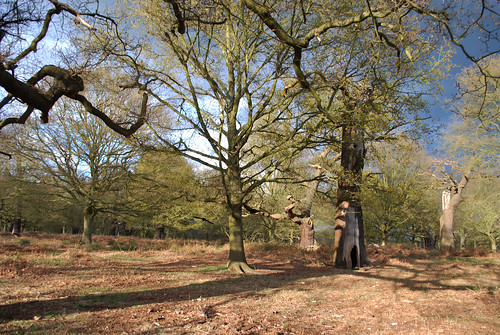
But this time around with War and Peace, I noticed a passage that may trump that one. It comes at a point when, between the wars, Prince Andrei is spending most of his time managing his estates. One day, as he is riding in a carriage through one of them, he sees a tree:
At the side of the road stood an oak Probably ten times older than the birches of the woods, it was ten times as thick and twice as tall as any birch. It was an enormous oak, twice the span of a man's arms in girth, with some limbs broken off long ago, and broken bark covered with old scars. With its huge, gnarled, ungainly, unsymmetrically spread arms and fingers, it stood, old, angry, scornful, and ugly, amidst the smiling birches. It alone did not want to submit to the charm of spring and did not want to see either the springtime or the sun.

"Spring, and love, and happiness!" the oak seemed to say. "And how is it you're not bored with the same stupid, senseless deception! Always the same, and always a deception! There is no spring, no sun, no happiness. Look, there sit those smothered, dead fir trees, always the same; look at me spreading my broken, flayed fingers wherever they grow--from my back, from my sides. As they've grown, so I stand, and I don't believe in your hopes and deceptions."
A tree! A centuries-year-old tree! And Tolstoy makes its haughty voice reasonably convincing!


Andrei, at least, is convinced:
"Yes, it's right, a thousand times right, this oak," thought Prince Andrei. "Let others, the young ones, succumb afresh to this deception, but we know life--our life is over!"
Oh, but Andrei, it could always be worse: you could, after all, be deeply mired in yet another Chicago January, where even the false promises of spring would seem like a gift from the gods!

Sunday, March 30, 2008

"And I must finish the novel that has become such a nuisance to me."


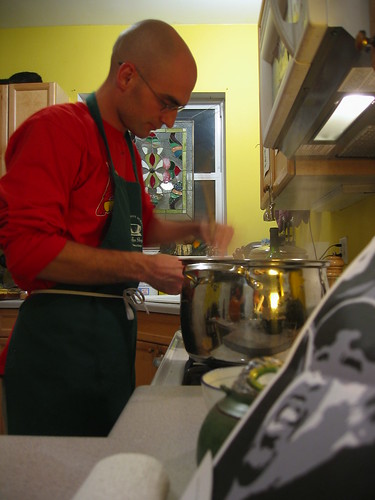
Between a weekend of proofreading and making giant pots of chili to feed to guests in honor of the incipient baseball season, I find myself again without time to write. So, as I've had Anna Karenina on my mind this past week, today I'll give you only a couple of bits from letters Tolstoy sent to his longtime friend Nikolay Strakhov during the four-year period in which Tolstoy was struggling with Anna Karenina, which are featured in one of the chapters of Viktor Shklovsky's Energy of Delusion (1981). This first letter, from March 25, 1873, gives a glimpse into the novel's moment of conception; it also offers an optimism about the ease of its inevitable composition that quickly dissipates:
I'm going to tell you about myself, but please, keep it a secret, because it may be that nothing will come of what I'm going to tell you . . . After work, I happened to pick up . . . a book by Pushkin and as always (for the seventh time, I think), reread it all, unable to tear myself away from it, as though reading it for the first time. And what's more, it seems as if it resolved all my doubts . . . And there is a line, "The guests were getting ready to leave for the country house." Involuntarily and quite unintentionally, without knowing why and how, I began thinking up people and events, went on doing so, then, of course, changed the, and suddenly everything tied in so beautifully and unexpectedly, that the result was a novel, which is almost finished in draft form. A very lively, passionate and complete novel with which I am pleased; it will be ready, if God grants me good health, in two weeks. . . . Please do not scold me for such an incoherent letter--I have been working happily all morning. I'm excited that it's finished, and now, in the evening, I have an hangover.
Perhaps Tolstoy decided the letter really was too incoherent, for he never sent it. Regardless, that short paragraph gives us so much of the man--especially his unstoppable imagination, determined to imbue with full life even the slightest thought about the things and people of the world, and his confident enthusiasm when things are going well.

As with anything to which Tolstoy turned his attention, however, Anna Karenina, as its complexity and difficulty became apparent, began to seem an insurmountable challenge, driving him nearly to despair; by November 9th, 1875, he was writing to Strakhov:
My God, if only someone could finish Anna Karenina for me! It's unbearable.
His mood continued to swing, however, with each day's writing, and within two months he was writing to a pair of friends, A. M. and T. A. Kuzminsky,
Farewell, good-by. Sonya will describe everything, and I have written it all in Anna Karenina, and nothing is left
--while telling Strakhov days later,
Anna Karenina is making progress.
I'll leave you with an image that I found particularly striking, Tolstoy's account, in a letter to Strakhov of February 13, 1874, of his working method:
You are right to assume that I'm very busy and have been working a lot. I'm glad that I didn't start publishing anything, as I wrote in one of the previous letters. I don't know how else to draw a circle but to close it first and then begin correcting the original flaws. And now I have just come to the closure, and the corrections are endless.
And now to the kitchen. Baseball season beckons.


{Photo of me making baseball chili by rocketlass.}

Thursday, July 12, 2007

Some passing thoughts on a passing state, that of ecstatic joy


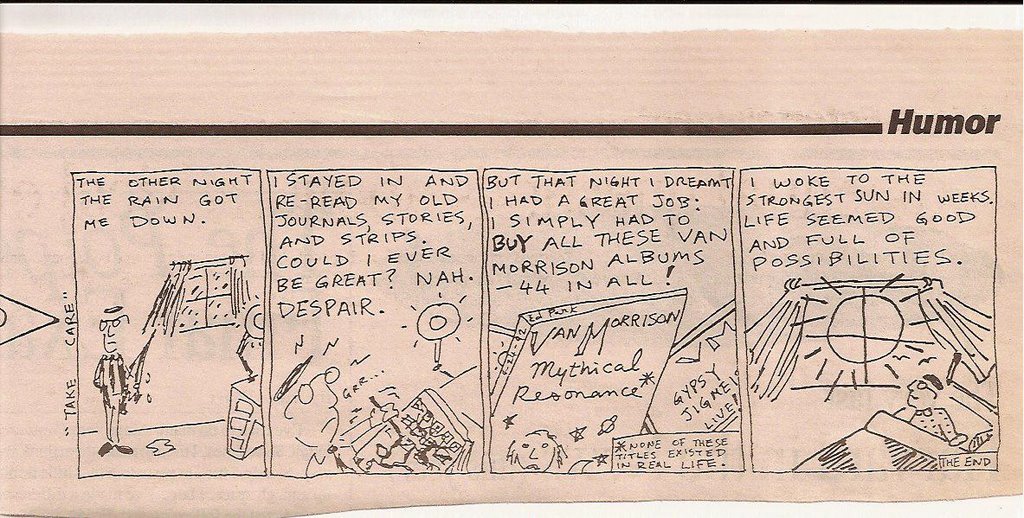
I've had Van Morrison on the brain lately, because I've spent the past few weeks listening to him a lot and because earlier this week Ed at the Dizzies pointed out a blog where Van fan Patrick Maginty is writing about Van's 36 albums, from his least- to his most-favorite. Ed also sent me to this cartoon (which is now my second-favorite music cartoon--my favorite is here), which relates cartoonist Mr. Saturnhead's dream that his great new job was to buy 44 Van Morrison albums--none of which exist in reality. The titles of the few that he displays in the comic are hilarious dead ringers for actual Van titles. Now I'm kind of surprised that I never tried imagining unmade Van albums in my days of being a superfan--when the password for my first e-mail account was G.Ivan1945. Trying to hit just the right note of lyricism verging on pretentiousness would have been a fun exercise.

As I waited for the train this morning, I was listening to Van's "So Quiet in Here". A gorgeous, unexpectedly cool summer day was just getting underway, and I started thinking about how good Van is at writing about sheer joy; he's the only person I know who would write a song called "Days Like This" that is about good days. To my mind he's rivaled in pop music only by maybe Prince and Stevie Wonder (oh, and I suppose Little Richard) in writing happy songs--which is harder than it would seem. The opening of Anna Karenina may have become a cliche, but at the base of Tolstoy's statement about happy families is a real truth. Joy so often occurs in the absence of conflict, while art thrives on the creation, depiction, and resolution of conflict. To write about the ecstatic state outside the confines of mystical religion is difficult, and Van Morrison, over forty years, has frequently made it look easy.

My commuting companion the past few days has been Tolstoy's short early novel, The Cossacks (1863), and as I settled back into it this morning, it occurred to me that Tolstoy, too, is one of the great depictors of surpassing joy in art. The thought came to me as I read the following scene, in which Olenin, a young Russian nobleman who has traded his dissipated Moscow life for service in the Caucasus, achieves a near mystical state of joy on a hunting trip deep in the forest:
This cloud of insects went so well with this wild, insanely lavish vegetation, with the forest's countless animals and birds, the dark verdure, the hot, aromatic air, the rivulets of murky water seeping out of the Terek and gurgling somewhere beneath overhanging leaves, that Olenin found pleasant what he had previously found unbearable. He walked around the place where they had seen the stag the day before and, not finding anything, decided to rest a little. The sun stood high above the forest, and whenever he came upon a path or clearing, it relentlessly cast its harsh rays on his head and back. The seven pheasants hanging from his belt weighed him down painfully. He looked for the track the stag had left the day before, crawled beneath the bush into the thicket where its lair was, and lay down. He looked at the dark foliage around him, at the damp spot where the animal had lain, at yesterday's dung, the stag's knee marks, the torn-up clump of black earth, and at his own footprints from the day before. He felt cool and comfortable. He thought of nothing, desired nothing. Suddenly he was gripped by such a strange feeling of groundless joy and love for everything that, in a habit he had from childhood, he began crossing himself and expressing his thankfulness.

Often in Tolstoy, the happiest states are triggered by physical conditions--think of Levin in Anna Karenina bursting with joy despite aching in every muscle after a day of reaping with his kulaks. But whereas Van Morrison is writing pop songs, which at their best create and sustain a single mood for their duration, Tolstoy's writing novels, so he almost always takes the next step. These states, he reminds us--though as they happen may feel as if they are, in their essence, eternal--are often followed closely by states of lost purpose, self-reproach, or despair. Levin believes he's found his way forward in life, but the reader knows that his joy is temporary, that the life of a kulak will not satisfy him. Or, in a different vein, there's Stepan Arkadyevitch Oblonsky, whose exuberant, overflowing love of life (and its representatives, other people) is almost impossible to dampen--yet dampened it is, time and again, when Stepan Arkadyevitch is made aware of the deeply felt pain he's caused others, primarily his wife, Dolly, through his ceaseless carousing. He may not ever quite understand why his actions have that effect--and he's sure to thoughtlessly, accidentally inflict the same pain sometime in the future--but when the undeniable reality of a crying Dolly is before his eyes, even he plunges, at least for a while, into a sort of despair.

That understanding of the continuum--or would pendulum be better?--between joy and despair is crucial to Tolstoy's art, and it also helps explain, I think, the brutal asceticism of his later life.

The sense one gets from reading about Tolstoy the man, with his works serving as a backdrop, is that he didn't trust (or maybe even feared) strong emotion; a religiously based asceticism forces a tamping down of the emotions while simultaneously allowing one to attribute a religious or mystical cause to the emotions one does feel. That Tolstoy's asceticism was cruel to his family, that it further damaged an already fractious marriage, that it was on its face absurd in the context of his wealth--none of that mattered when set against the sense of control and purpose it delivered.

Van Morrison, I think, though of course the lesser artist (who isn't a lesser artist than Tolstoy?), has the better solution--I can't imagine anyone suggesting that the chubby lover of late-night wine and craic has any ascetic tendencies. Instead, he leavens his ecstasies with a near-Buddhist argument against the self, an effort to feel oneself to be, at one's heights, a connected, minuscule part of a larger, significant whole. Instead of a closing of the self, as Tolstoy chose, it's viewed as the ultimate opening of the self, an embrace of the universe that, at base, is little different from what Tolstoy ascribes to Olenin in the forest. Tolstoy could write about those states, but he couldn't live within them; maybe Van Morrison can't, either--most likely none of us can--but that's at least where he's aiming. I don't know Van, so I can't say for sure that he's happy--but I'd be willing to wager that he has been happier than Tolstoy.