Showing posts with label Oblomov. Show all posts

Thursday, May 22, 2008

On not doing.

For a character who is best known for spending nearly all his time in bed, the titular protagonist of Ivan Goncharov's Oblomov (1859) doesn't actually spend that much time in bed. Oh, he's probably in or around bed for nearly half the book--but that still leaves more than two hundred pages wherein he (admittedly under pressure from an energetic German friend) attends dinners, reads the daily papers, visits friends, and even falls in love with a woman who nearly pulls him out of his lethargy for good.

Nonetheless, the heart of the book is Oblomov's apathy, his Bartleby-style refusal to cope with any of the complexities of the world--a trait that Goncharov convincingly portrays as a sort of bone-deep innocence and harmlessness. Oblomov himself names his tendency to subside into reverie oblomovschina, a capacious term that encompasses a hereditary laziness, a fundamental lack of concern for any aspect of one's well-being beyond immediate peace, and a preference for wispy dreams over active plans. The world is the way it is, unlikely to be changed by one's efforts, so why should one not lie in one's tattered dressing gown and contemplate the ceiling cracks until sleep descends?

Oblomov's is a worldview that I can't endorse outside of fiction; hell, I'm not even good at sleeping in. (Example: today, home from work with an ugly head cold, I was up by 7:20.) So long as I'm in Goncharov's grip, however I teeter, understanding both the frustration of Oblomov's friends and the siren call of restful oblivion. Oblomov is so utterly blameless in his lethargy that it's hard not to take his side in the many arguments he has about activity; his friends' positions, though eminently sensible, all come burdened with the crash and rush and potential calamity of positive action. If one acts, one will eventually meet failure. Inaction, on the other hand, is attractive precisely because it guarantees a sort of success: a lazy surrender to the fates makes their judgments feel less like judgments and more like agreed-upon outcomes.

One of the best examples of the seductive nature of Oblomov's point of view comes early in the book, when he is attempting to write to his landlord, who is threatening to evict him. Having dislodged a spider from the inkwell and dug a pen from under a cushion, Oblomov starts writing . . . but he quickly encounters difficulties that will be familiar to any writer:
He thought for a while and began to write.

"The apartment on the second floor, which I rent and in which you are proposing to undertake some renovation is entirely suitable to my style of life and the routine I have developed over the many years I have lived here. On learning from my man, Zakhar Trofimov, that you had required him to convey to me that the apartment I rent . . " Oblomov stopped writing and read what he had written.

"It reads awkwardly," he said. "I've written 'that' twice in a row and I've put 'which' twice too."

Whispering to himself, he tried rearranging the words, but it was no good because the first 'which' went with 'the floor,' and not 'the apartment,' it still did not hang together. He tried to improve it and racked his brains in an effort to avoid the doubling of 'that.' He tried crossing out one word and replacing it with another.

He put 'that' in three different places and only succeeded in either making nonsense of the sentence or ending up with the three 'thats' too close together again.

"Just can't get rid of this damned second 'that,'" he said in exasperation. "Well to hell with it--and the damned letter too--breaking my head over such niggling details! I've lost the knack of writing business letters-and it's almost three o'clock!"

"Are you satisfied now, Zakhar?" He tore the letter in four and flung the pieces on the floor.
What writer could blame Oblomov for returning to bed after that fiasco? Yet here I am, writing and editing and rewriting this piece, rather than just hitting Post and being done with it.

Post.

Tuesday, May 20, 2008

Criss-cross!

In what I think will be the last post linking Ed Park's Personal Days to Ivan Goncharov's Oblomov, we turn to the place of unusual appearance in business dealings.

First Ed tells us about the office's tarty bombshell, Maxine, whose faith in the powers of an outfit that can be described only with the aid of italics is, unexpectedly, proved to be misplaced:
Maxine's new outfit was completely inappropriate for winter, in fact for any season or situation. It had two kinds of pink going on, and ornate beaded strappy things, and a fairly explicit bondage motif. There were parallelograms of exposed flesh that were illegal in most states, a bow in the back that looked like a winding key. One area involved fur. Her hair had a fresh-from-salon bounce that clashed with the rest of the getup, but this being Maxine, everything kind of went together in the end. . . . Pru and Lizzie instinctively flinched. They might as well have been rolling on the ground like bowling pins, with xs for eyes.

With her female competition out of the way, Maxine leveled her extremely hot gaze right at Grime, who stood his ground. He swayed in place, gently rocking on one heel. Maxine was saying something about Wednesday, but it wasn't clear whether she meant tomorrow or last Wednesday.

Grime's not-flinching was making Maxine flinch. It looked like a nod but it was actually a flinch. Lizzie and Pru saw it all unfold. They're filing away the subtleties for Jack II and his blog. Maxine lost the thread of what she was saying, eyes gleaming in panic. She could have been talking about the general concept of Wednesday, its status as a hump day, its complicated spelling. No one had seen her quiver like this before. It was like she'd been set in italics.

There was a historical vibe to the scene.
Then there's Goncharov's account of Oblomov's landlord, who is, perhaps intentionally, awkward and a bit grotesque:
The brother tip-toed into the room and responded to Oblomov's greeting with a triple bow. His tunic was tightly buttoned from top to bottom so that it was impossible to tell whether he was wearing any linen underneath. His tie was knotted with a single knot and the ends were tucked inside the tunic. He was about forty with a tuft of hair sticking straight up from his brown and with two identical tufts sprouting, wild and untended, from each temple, resembling nothing so much as the ears of an average-sized dog. His gray eyes never settled on their target directly, but only after some stealthy reconnoitering in its vicinity.

It seemed as if he were ashamed of his hands and whenever he spoke to someone he did his best to keeping them out of sight, either placing both hands behind his back or keeping one tucked inside his coat and holding the other behind his back. When handing a document requiring some explanation to a supervisor he would keep one hand behind his back and, with the middle finger of his other hand, making sure to keep the nail pointing downwards, he would point to the line or word in question. Then, at the earliest possible moment he would tuck the hand out of sight, maybe because his fingers were on the thick side, reddish and trembling slightly, and he felt, not unreasonably, that it was somehow too indelicate to expose them too frequently to public scrutiny.
Despite that seeming insecurity, the landlord manages to successfully dun the relatively hapless Oblomov for 1,354 roubles and twenty-eight kopecks for a two-week rental.

Were we able to jumble these scenes, I think that Oblomov might successfully deploy his congenital mix of apathy and vagueness to hold out against Grime's unflappability, whereas I have no question that Maxine's wardrobe (mal)function would cut the landlord's bill at least in half.

As Patricia Highsmith might have put it, criss-cross! Inter-novelistic loans, that's what we need!

Monday, May 19, 2008

Reading the signs

Reading Ivan Goncharov's Oblomov (1859) and Ed Park's Personal Days (2008) at the same time continues to offer unexpected (and unexpectedly rewarding) affinities. Take, for example, this bit of contemporary folklore offered up by one of Ed's charactes:
Jack II says that when you feel a tingling in your fingers, it means someone's Googling you. We take to this bit of instant folklore immediately.
I wonder whether a Yahoo search triggers the same response? Or an Alta Vista search?

If Goncharov were alive today, he'd surely know the answer, if the following conversation between Oblomov's parents is any indication:
Suddenly Ilya Ivanovich stopped in the middle of the room, and, with a look of alarm, touched the tip of his nose. "Oh, no, this is terrible," he said, "look, the tip of my nose is itching, there's going to be a death."

"There you go again!" his wife exclaimed, clasping her hands, "it's not the tip of your nose itching that means there's going to be a death, it's the bridge of your nose! Really, what a scatterbrain you are! What if you were to say something like that when we were visiting people or when we had guests--it would be so embarrassing!"

"Well, what does it mean then when the tip of your nose itches?" said Ilya Ivanovich, discountenanced.

"A death! Really, what can you be thinking of?"

"I'm always mixing things up," said Ilya Ivanovich. "How can a personal be expected to know what it means when you itch in all these different places, the side of your nose, the tip, the eyebrows. . . ?"

Pelegaya Ivanovna was quick to supply the information. "The side means news, between the eyebrows means tears, the forehead means meeting someone, on the right a man, on the left a woman, the ears means rain, the lips, kissing, the whiskers, eating sweets, the elbow, sleeping in a new place, the soles of the feet, a journey."

"Well done, Pelageya Ivanovna!" said Ilya Ivanovich.
For maximum enjoyment, I recommend reading Pelegaya Ivanovna's litany out loud at top speed.

Saturday, May 17, 2008

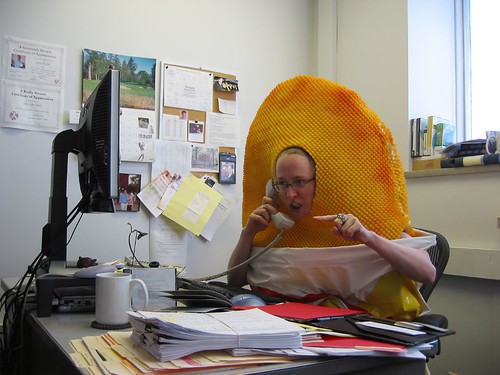
"Consequently, the initial prospect of spending the major part of his life going to work was painfully depressing."


{Photo by rocketlass.}

Those of you who've served time in an office will surely recognize this guy:
At work he has no clearly defined tasks because his colleagues and supervisors have never been able to detect in him any particular skills or competence. Whatever task he is given he performs in such a way that his supervisor is always hard put to it to say whether he has performed it well or badly. No matter how closely he looks or how carefully he reads, the best he can come up with is: "Leave it for now, I'll take a look at it later . . yes, well it seems more or less alright."
Apparently some aspects of office life never change: the above is not from Ed Park's brand-new, critically acclaimed novel of office life, Personal Days, but from Ivan Goncharov's Oblomov, which was published in 1859. As I was traveling when Ed's book was published this week and therefore couldn't pick up the copy I'd pre-ordered at 57th Street Books, I was pleasantly surprised to discover some office comedy in Oblomov.

The titular gentleman of the novel is primarily known for spending most of his life in bed, alternately daydreaming and dozing--but as a young man he worked in Russia's senselessly bureaucratic civil service. Like many a person entering on his first job, Ilya Ilyich Oblomov brought some misconceptions to the workplace:
He imagined that office colleagues were just one close, happy family constantly putting themselves out for each other's comfort and pleasure and that attendance at the office could not possibly be a kind of compulsory custom that you simply had to observe every single day and that slush, heat, or mere disinclination would be adequate and legitimate grounds for non-attendance.

Imagine his dismay on realizing that nothing short of an earthquake could excuse a healthy civil servant's absence from his place of work and that, in any case, St. Petersburg never had the good fortune to have earthquakes. No doubt a flood would also be acceptable grounds, but floods hardly ever happened there either.
Worse was his misunderstanding of the role of the boss:
At home, he had heard that a boss or a supervisor was a father to his subordinates and had formed an image of such a personage, an image as beaming and benign and indulgent as a member of his own family. He saw him as a kind of second father who lived and breathed only to reward his subordinates and to cater, unceasingly and unremittingly, regardless of their merits, not only to their needs but even to their pleasures. Ilya Ilyich thought that a superior was so intimately bound up in the welfare of his subordinates that he would inquire anxiously whether he had had a good night's sleep, why his eyes were a little cloudy and whether he might not have a little headache.

His first day on the job was thus a rude awakening. The moment the supervisor appeared, everyone started hustling and bustling and bumping into each other from sheer agitation, some even nervously fingering their clothing in case he might deem them not sufficiently presentable. The reason for this, as Oblomov subsequently became aware, was that in the person of a subordinate scared out of his wits and rushing to pay his respects, a certain type of boss saw not only proper respect for his person, but a mark of zealousness and indeed at times even of competence.
And all that frantic kowtowing occurs despite Oblomov's department having a relatively good supervisor:
He was never heard to utter a harsh word or even to raise his voice; he never demanded but always asked. If he wanted you to do something, he asked; if he invited you to his house, he asked; if he had you arrested, he asked.
Between the rush of duties ("It doesn't leave a moment for living!" Oblomov laments) and his fear of his supervisor ("[T]he moment the boss addressed him, he would find that his natural voice had been replaced by something nauseatingly insipid."), poor Oblomov quickly becomes a wreck . . . so he forges a doctor's note diagnosing himself with hepatitis and an enlarged heart, both blamed on the office, which he then forsakes forever in favor of his bed.

Those of us without substantial private incomes from large country estates, however, will inevitably be back on the train Monday--but with Personal Days under one arm, Oblomov under the other, we'll have an extra spring in our step and a glint in our eye, our quiet laughter a sufficient defense against our fellow commuters' confused contempt.