Showing posts with label Geoff Dyer. Show all posts

Wednesday, August 31, 2011

Geoff Dyer on the Great War


{Photo by Flickr user Dunechaser. Used under a Creative Commons license, which reserves some rights.}

Geoff Dyer's The Missing of the Somme (1994) has just been published in the States for the first time, the lag probably an indication less of Dyer's formerly low profile over here than of the relatively small place of World War I in American memory. I suspect that if, rather than World War I, we called it the Second Franco-Prussian War--thus stripping it of its not inaccurate position as a prelude to World War II, which remains a constant topic of self-congratulatory (and, again, not wholly inaccurate) American reflection--it would occupy a position more like the French and Indian War or the War of 1812, covered in grade school, then all but forgotten by anyone who's not a history buff.

 For our participation in that war was late and limited, our losses negligible. And by 1914, we were just settling into what would become a century and a half (so far) of reflection on our own horrible, romantic, inescapable, endlessly compelling war, the Civil War. Its battlefields were America's Somme, its convulsions and aftermath our rending of the veil of heroic illusion. That we, driven by Southern apologists, spent much of the twentieth century attempting to sugarcoat it, strip it of its meaning, and accord both sides equal honor despite the fact that one side was fighting to keep humans in bondage seems fundamentally American, a core sample of our national character.

 No, for us the impact of World War I was relatively limited at the time, attenuated nearly to nothingness by now. Its greatest effect was to continue and amplify the consolidation of federal power, regularization of daily life, and knitting together of the many disparate and rural pockets of the far-flung nation that was set into motion by the vast apparatus of the Civil War and that reached its apogee during World War II. (One example: in his wonderful, data-based Daily Life in the United States, 1920–1940, David E. Kyvig notes that nearly one-third of American draftees for World War I were rejected as physically unfit, leading to significant pushes by the federal government to educate the population about proper nutrition, exercise, and hygiene.) The emotional valence of the war has never come close to what it carries for European nations.

 And therein lies the fascination for me, and the reason that Dyer's book seems nearly perfect. It is an account, not of the war, but of how Europeans (and the English in particular) have remembered it--beginning with poems, news accounts, and memorials created as it was happening and carrying through to the moments when Dyer and friends, sometimes a bit drunk, trek from battlefield to battlefield in 1990s France. It owes an acknowledged debt to John Berger; its closest other kin is probably Paul Fussell's magnificent The Great War and Modern Memory, on which it draws--though Dyer writes much more personally and is much more open to the idea, and its accompanying frustration, that certain questions, certain feelings, certain, to steal from Berger, ways of seeing, have been closed to us by time. Its closest Stateside kin, which I hope Dyer knows, is Lee Sandlin's Losing the War, published in the Chicago Reader in 1997. All three are less concerned with facts--though they don't disdain them--than with impressions, reactions than actions.

In a book full of interesting ideas and observations, the sort that lead a reader down new paths of thought and inquiry, this passage stood out:
"Before the Great War there was no war poetry as we now conceive the term," writes Peter Parker in The Old Lie; "instead there was martial verse." So pervasive were the conventions of feeling produced by this tradition that in 1914 the eleven-year-old Eric Blair could write a heartfelt poem--"Awake, young men of England"--relying entirely on received sentiments. In exactly the same way, an eleven-year-old writing fifty years on could, in similar circumstances, come up with a heartfelt poem expressing the horror of war--while also relying solely on received sentiment. In some ways, then, we talk of the horror of war as instinctively and enthusiastically as Rupert Brooke and his contemporaries jumped at the chance of war "like swimmers into cleanness leaping." This is not just a linguistic quibble. Off-the-peg formulae free you from thinking for yourself about what is being said. Whenever words are bandied about automatically and easily, their meaning is in the process of leaking away or evaporating. The ease with which Rupert Brooke coined his "think only this of me" heroics by embracing a ready-made formula of feeling should alert us to--and make us sceptical of--the ease with which these sentiments havebeen overruled by another.
Dyer's skepticism, here and throughout, is bracing, in a way that goes far beyond the question of World War I and its meaning. We should always keep in mind the seductive danger of received opinion; when everyone is agreeing with us we should pause a moment to disagree with ourselves and see how that sits. Dyer reminds us that even the writing of participants in the war traffic in tropes that were common enough to be limiting thought and expression, closing off rather than opening out questions, as the war was just getting underway. He doesn't dismiss the war poems and memoirs, but he reminds us that even though those who experienced the war had to wrestle it into shape somehow, and--to no discredit--they often chose the shapes that were, culturally speaking, lying around.

 In some sense, though he doesn't mention him by name, Dyer seems to endorse Ford Madox Ford's take on the war: Ford's masterpiece, the four-volume Parade's End, is almost entirely concerned with the war and its damage; by the third volume, description has largely given way to ellipses, elision indicating that which, if described, would killingly concretize into cliche.

Yet at the same time Dyer's account can't help but send us back to that generation in general and its literary output. If we try to escape the frame of "horror," and focus instead--as I find myself doing--on the slightly narrower question of what must that all have been like (which ranges from what must it have been like to winter in the trenches; to what must it have been like to live, a woman, in a village from which all the men had left; to what it must have been like to live in a nation in which one in ten males has been violently killed), we have to return to Graves and Sassoon and Owen (and even, in a refracted way, Lord Dunsanay, whose Tales of War (1918), recently republished by Whisky Priest Books, offers a simultaneously more literary and more vigorously angry perspective). They remain our strongest link to those irrecoverable times and emotions, and as the centennial of the tragedy approaches, they have lost little of their power. I suspect our descendants will still be wrestling with them at the bicentennial.

Wednesday, April 20, 2011

Fitzgerald's beautiful and damned. In both senses of that apostrophe.


{Photo by rocketlass.}

An essay on F Scott Fitzgerald's The Beautiful and Damned in Geoff Dyer's new collection, Otherwise Known as the Human Condition (and, let's be honest, the quiet persistence of the Fuck Yeah Fitzgerald tumblr) led me to that novel last week. I tend to think of myself as someone who is regularly reading Fitzgerald, but the encounter with this novel made me realize that I usually engage with only a small portion of his work: The Great Gatsby, perpetually re-read and never exhausted; and his lingering mess, The Crack-Up and the notebooks. Each is in its own way perfection: the only flaw in Gatsby is a slight overheatedness, for which the jeweled sentences and the gentle complicity of Nick Carraway more than make up, while the minor matters in The Crack-Up and the notebooks are perfect in their small compass of imperfection, full of striking fragments and unforgettable lines unmoored from unfinished stories.

To read The Beautiful and Damned is to re-encounter the imperfect Fitzgerald, the Fitzgerald who was learning his craft, his generation, and his own self all at the same time. Dyer puts it well:
For more than a hundred pages, The Beautiful and Damned does not represent any kind of advance on This Side of Paradise. Isolated moments of insight cannot disguise its stylistic and structural flimsiness. The reader's heart sinks when, after less than twenty pages, Fitzgerald abandons novelistic prose and inserts one of the little playlets that should have been edited out of his first novel.* . . . Unleashed as soon as Gloria sets foot in the book, Fitzgerald's tendency to effulgence is, at first, ironically refracted through Anthony's consciousness: "Surely the freshness of her cheeks was a gossamer projection from a land of delicate and undiscovered shades; her hand gleaming on the stained table-cloth was a shell from some far and wildly virginal sea." Shortly afterward it takes on the tone of Fitzgerald's own lyrical yearning. A cab "moved off like a boat on a labyrinthine ocean"; Gloria "turned up her face to him, pale under the wisps and patches of light that trailed in like moonshine through a foliage." Fitzgerald never entirely grew out of this kind of thing--he would have been a lesser writer if he had--but he did learn to control it, to ground the lushest imagery in the actual and immediate.
There's so much more purple prose from the early going that Dyer could have cited. Want more gossamer? Here:
There were silences as murmurous as sound. There were pauses that seemed about to shatter and were only to be snatched back to oblivion by the tightening of his arms about her and the sense that she was resting there as a caught, gossamer feather, drifted in out of the dark.
Yet even as those sentences set the eyes rolling, others show signs of Fitgerald's mature lyricisim--and, as Dyer writes, a grounding in the immediate. Take this, from the page following the gossamer feather:
The stark and unexpected miracle of a night fades out with lingering death of the last stars and the premature birth of the first newsboys. The flame retreats to some remote and platonic fire; the white heat has gone from the iron and the glow from the coal.
Just when the prose starts to feel too puffed up, Fitzgerald brings on the newsboys to deflate it; then, almost unnoticed, he inverts our notions of night and day, dark and light, hot and cold, giving the power and the glory, fading out, to the night and leaving the day the hangover-wracked imposition that his characters feel it to be.

The novel does, as Dyer notes, pick up considerably a ways in, and its tale of the disintegration of, respectively, Anthony, Gloria, and their marriage, has all the brutality, but none of the didacticism, of a temperance tract like The Tenant of Wildfell Hall. Light party scenes--of the recognizably 1920s sort that Waugh and Powell treated comically and Fitzgerald's friend Edmund Wilson treated seriously, ending up with a sort of Fitzgerald-lite--give way to scene after scene of unalloyed disssipation. The overriding impression is of people who have been entirely unfitted, by education, upbringing, and culture, for the daily round of life, and of the powerful lure of failure--and, as Dyer puts it, "the capacity of failure to generate some kind of hideous enlightenment." By the end of the novel, its imperfections are forgotten, and all that's left is the coppery taste of destruction, pain, and emptiness portrayed with brutal precision.

Thursday, August 23, 2007

The past is another country; they do things differently there.

Thanks to Geoff Dyer, today I kept vaguely turning over the idea of someday rereading D. H. Lawrence, despite being fairly confident that the specifics of his personal philosophy--on which the whole of his work is hung--are likely to seem, on being re-encountered in adulthood, rather unconvincing. Then, while I was reading David Kynaston's Austerity Britain: 1945-1951 (2007) on the train, I came across the following description of one of the Labour Party's most prominent thinkers of the war years, Evan Durbin:
[Durbin] once remarked that his three greatest pleasures were "food, sleep and sex" but accused D. H. Lawrence of "shallow abstractions" in relation to "freedom in sexual relations."

That is more or less how I remember Lawrence's position, too: a vague positing of sex itself as a primary liberating experience, a crucial step towards a truly free life. Heady stuff at the time, presumably, but quickly sounding silly these days unless taken in small doses.

Ultimately, the problem with Lawrence's novels, from what I remember, is the problem that plagues any writer who knows the way people ought to live: the novel--which as a form thrives on growth, discovery, and above all openness--is warped by the character (or narrative voice) who doesn't need to change, doesn't need to learn, because he already sees through the illusions that bind those around him. Speech and incident become didactic demonstration, drama becomes melodrama, and despite some very powerful passages, the whole is rendered false. In his journal for 1987, Anthony Powell (who, incidentally, agrees with Dyer that Lawrence's letters are great reading) puts it more succinctly:
The reader [is] always, so to speak, tripping over the Lawrence self-image, which at once reduces conviction, much of novel being in any case ludicrously melodramatic.


Powell, who had recently re-read Women in Love, also notes,
Red-hot emotions as usual much overdone, tho' I suppose could be argued people to some extent behave like that nowadays, breaking up marriages because sexual relations not for the moment absolutely ideal. That would, in fact, have greatly disturbed Lawrence himself.
Powell's letting his grouchy conservative side show, but Lawrence isn't the only person who would have been disturbed--and here I return to where I started this post, Austerity Britain, from which learned today that even in 1948, two decades after Lawrence's death, a Gallup poll revealed that only 27 percent of British citizens thought that divorce by simple mutual consent should be allowed. To broaden the picture, Kynaston, as he does throughout the book, turns straight to the actual words of the people, revealing a batch of their responses to related survey question, "How do you feel about divorce?"
It depends on the people. If either is to blame they should have a divorce.

Well, I mean to say, it's a good thing if the couple are unhappy.

No. A man takes a wife for better or worse, doesn't he?

I wouldn't grant divorce. They should get on with it.

I feel very sorry for the kiddies. It's very hard on them but if Mother and Father can't agree it only makes the children suffer worse--they suffer inwardly.

I think it's an awful thing to happen to anyone--everyone turns away from a divorced woman.

Better to divorce than live unhappily.

I don't like the idea of a divorce--all the publicity and scandal.

In some cases, yes. Marriage is a gamble anyway.
Austerity Britain is rich with moments like that, phrases that give such direct, authentic access to the past that they pull you up short. A gamble . . . scandal . . . everyone turns away. Even though at points 1947 can feel very familiar, it was a very different time; a well-crafted work of history, like Kynaston's, works to make sure we never forget that.

And though Powell's probably right that Lawrence would have disapproved of free-and-easy divorce, he surely would have approved of the context in which public opinion was changed and the stigma lost--a gradual but dramatic expansion of an individual's right to freely make decisions about his or her life. That's the side Lawrence was fighting for, after all, and despite his occasional silliness, like everyone who plays a part in shifting the terms of the debate, he deserves to be remembered well for it.

So maybe I will reread The Rainbow someday after all.

Wednesday, August 22, 2007

I can't go on, I'll go on

It's entirely appropriate that, while I meant to write about Geoff Dyer's Out of Sheer Rage: Wrestling with D. H. Lawrence (1997) yesterday, I got distracted and ended up putting it off. For that's what the gloriously titled Out of Sheer Rage is all about: Geoff Dyer putting off writing a "sober, academic study" of D. H. Lawrence.

He's been meaning to write the book--he's told his agent he's going to write it--but he's also thinking about writing a novel, and he can't quite figure out how to get started, and, well, the result is a 230-page tour through Dyer's psyche that at various points takes the form of autobiography, rant, and, despite his worst intentions, even a study of D. H. Lawrence.

Dyer is a betwixt-and-betweener, a hither-and-yonner, constitutionally unable to seize contentment wherever he is and deciding instead that he needs to be somewhere else--where, upon arrival, he instantly begins cataloging all that was good and irreplaceable about the location he just left. Here he is early in the book, having just signed a year-long lease for the apartment he's been occupying in Paris:
I was ecstatic. For about five minutes. Then I realised I had taken on an awesome, not to say crippling responsibility. And far from solving the problem of where to live I had actually put a lid on it so that now my uncertainty was boiling away under pressure, threatening to blow me apart. The one thing I could be sure of was that I had to leave this apartment, where I had never known a moment's peace of mind, as soon as possible. If I stayed here, I now say, I would fail to write both my novel and my study of Lawrence. That much was obvious. The trouble, the rub, was that I had to give three month's notice and therefore had to predict how I would be feeling three months hence which was very difficult. It was all very well deciding today that I wanted to leave but what counted was how I was going to be feeling three months from now. You could be perfectly happy today, I would say to myself, and three months from now you could be suicidal, precisely because you will see the enormity of the mistake you made by not renouncing the lease three months earlier.
And so on. Perpetually dithering and uncertain, Dyer travels from Paris to Rome to Sardinia to Oxford to Taos, accompanied by his surprisingly tolerant and sane girlfriend, simultaneously following Lawrence and bowing to the whims of his neuroses, whining all the way. Sometimes, for example, he has to eat seafood, which he hates:
[S]ea-food is vile filth which I will eat under no circumstances. My favourite foods are all variants of bread, food you can chow down with no effort, without even a knife and fork, food that requires virtually no preparation and little expenditure of money or energy. At the other extreme there is food that you have to fiddle around with, food that comes in shells that you have to prise open, food that you have to prepare for hours and pick the bones out of and pay for through the nose: sea-food, in short, and here we were in a sea-food restaurant. The first course arrived: not any old sea-food (i.e. not simply inedible) but the ultimate sea-food (i.e. there was actually nothing to eat): sea urchins, blackened conker shells with a tiny strip of (presumably) slimy, salty, orange gristle in the middle.


Take that passage and expand it to book-length, and you'll get a sense of Out of Sheer Rage: cranky, unapologetic, utterly self-involved--yet hilarious and impossible to put down. The small difficulties of life wind Dyer up to such a pitch of worry, frustration, and anger that it's hard not to sympathize, even as you're laughing and groaning and realizing that, if you were his long-suffering girlfriend, you'd have to stab him through the eye. Every morning. Instead, she notes his inadequacies in her journal: "G. had a fit, as usual."

Somehow, in the midst of obsessively recounting his travails, Dyer also tells us a lot about Lawrence, delivering a lively and interesting larger critique that one could imagine, after mummification, comprising the sober study he's so utterly failed to write. He's particularly good when writing about photos of writers, and here he is on another topic that fascinates me, the draw of a writer's unfinished or unpublished work:
As time goes by we drift away from the great texts, the finished works on which an author's reputation is built, towards the journals, diaries, letters, manuscripts, jottings. This is not simply because, as an author's stature grows posthumously, the fund of published texts becomes exhausted and we have to make do not only with previously unpublished or unfinished material but, increasingly, with matter that was never intended for publication. It is also because we want to get nearer to the man or woman who wrote these books, to his or her being. We crave an increasingly intimate relationship with the author, unmediated, in so far as possible, by the contrivances of art. A curious reversal takes place. The finished works serve as a prologue to the jottings; the published book becomes a stage to be passed through--a draft--en route to the definitive pleasure of the notes, the fleeting impressions, the sketches, in which it had its origin.
Dyer is intentionally overstating the case, but he's essentially right about the draw of a writer's extraneous material: the thrill of peeking into a favorite writer's letters or diaries is of a different character from that provided by their work, but it can vie with that work in power. And through his consideration of interesting portions of Lawrence's letters, notebooks, and journals, Dyer managed to renew my interest in Lawrence, a writer whom I'd half-consciously decided I was unlikely to enjoy as much as an adult as I did when I was twenty. Maybe he'll even get me to re-read The Rainbow--which he himself regrets re-reading. Of course.

Ultimately Dyer's life on tenterhooks is for me like a dispatch from an alien race: I can't even imagine living in such a welter of dread and regret. I'm lucky enough to be as near the opposite as possible: contentment seems to be my natural state. The grass is never greener, and even if it might temporarily appear that way, I know deep down that thoughtful analysis will prove it to be at best a light brown, relatively.

That easy satisfaction can become a fault, of course--and the same contentment that keeps me from deciding to move to New York or hop from job to job also keeps me from having much ambition at all beyond reading through the perpetually renewing stack of books. So to come up against someone like Dyer who is constantly wrestling with his desires and regrets--and who can turn that struggle into a funny, insightful, compelling narrative--is a treat, a powerful reminder of the glories of difference, of the near-infinite ways one can choose to approach this life.

By the end of the book I'd developed real sympathy for Dyer--even admiration. For even though he knows that he is going to regret and second-guess any decision he makes, any effort he puts forth, he doesn't let that stop him. He keeps moving:
[S]ince the only way to avoid giving into depression and despair is to do something, even something you hate, anything in fact, I force myself to keep bashing away at something, anything. . . . It is a simple choice: work or succumb to melancholia, depression, and despair. Like it or not you have to try to do something with your life, you have to keep plugging away.
The horizon and its certainty are always going to be far away; we might as well keep walking. Dyer, knowing that, makes himself good company for the journey.

Some advice, or a field report from the War on Rest


{Photos by rocketlass.}

If you ever find yourself, after dinner, intending quickly to write about Geoff Dyer's Out of Sheer Rage, which you've just finished, and soon after to get to bed at a reasonable hour, then I recommend that you do not pick up the copy of Sputnik Sweetheart that a friend has just returned, no matter how innocuous it looks lying there on the kitchen counter.

Nor, if you do find yourself going so far as to pick it up, do I recommend thinking to yourself, "I've not read any Murakami for a while," then opening the book and a beer at the same time.

For if you do, I can now tell you from experience, a few hours later you'll read this passage:
I glanced at the full-length mirror as I passed by, at my face reflected in it. A strange expression was on my face. That was my face, all right, but where did that look come from? I didn't feel like retracing my steps and investigating further.

Sumire stood at the entrance to her new place to see me off. She waved goodbye, something she rarely did.

In the end, like so many beautiful promises in our lives, that dinner date never came to be.

Then a few hours after that, when the darkness has driven you from your perch on the back steps and the cicadas have claimed the cemetery next door as their sovereign domain once again until dawn, you'll come to this passage:
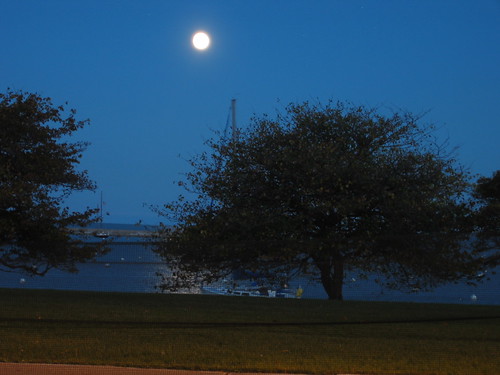
In the sky above the summit, the coarse-looking moon loomed awfully near. A hard ball of stone, its skin eaten away by the merciless passage of time. Ominous shadows on its surface were blind cancer cells stretching out feelers toward the warmth of life. The moonlight warped every sound, washed away all meaning, threw every mind into chaos.


Finally, when you close the book, pointedly not looking at the clock, all hope for a reasonable amount of sleep will have long since slunk away, defeated.


In the war on rest, the novel remains a fierce, indefatigable partisan.