Showing posts with label Dodie Smith. Show all posts

Saturday, January 23, 2016

Dodie Smith's novels

Among the piles of books I return with from my London trips are almost always a couple of paperbacks of novels that are out of print in the States. Most often they're relatively domestic novels by women from the early to mid-twentieth century, doomed to US obscurity through some combination of sexism and a sense that they're too English in their focus and outlook. In recent years, I've completed my Barbara Pym collection, added to my Alice Thomas Ellis, and introduced myself to Barbara Comyns in that way. This time, it was Dodie Smith's novel The Town in Bloom (1965) that drew me in.

I first encountered Smith the way most folks do these days: not through the book that was the most successful in her lifetime, The 101 Dalmations (which her biographer, Valerie Grove, says she wrote "out of sheer irritation at Enid Blyton's success"), but via her charming, funny, beautiful, moving first novel, I Capture the Castle (1949). Often classed as a young adult novel, it tells of a girl coming of age amid genteel (but very real) poverty and English eccentricity. I wrote about it way back in 2007:
Without disrupting the verisimilitude of her young narrator's perspective, Dodie Smith's perceptiveness and intelligent attention shine through, and though I Capture the Castle is a gentle book at heart, with little of the darkness of the world, there's at the same time a palpable sense of reality to it. Its gentleness and humor are not created through avoiding or denying life's dangers but through enthusiastically embracing the world as it is--imperfect, yet still able to take your breath away with its shimmering beauty. Smith is not talking down to anyone, and she's not limiting the insights her story can generate: she's simply showing us a young woman learning about herself, her family, and the differences that make us who we are.
While I've not read all of Smith's books, it's hard to imagine another one topping I Capture the Castle: it has that feeling that great first books often carry of a lifetime of energy and perception finally finding a release, brilliantly.

The first volume of her memoirs, Look Back with Love (1974), however, does come close. It, too, is concerned with English eccentrics, primarily Smith's three bachelor uncles, all of whom worked at the Exchange by day, but gave their hearts to amateur theatre at night. Groves, in her foreword to the Slightly Foxed edition of Look Back with Love, praises Smith for being able to convey vividly "the feeling of enjoyment from the distant past," and she's right: the book brims with innocent pleasure and distinctive, appreciative character sketches. Here's an account of Smith's Aunt Bertha, for example:
She had a most original personality, in fact it bordered on eccentricity. She could not, for instance, tell her right hand from her left unless she hopped; and she insisted that if she was left alone for more than three hours her teeth went soft. But she was a shrewdly intelligent woman. She was also a very humble one and never ceased to be surprised when people liked her, as they invariably did. She had come out even worse than my mother over education and would look terrified if any historical character was mentioned--both she and my mother seemed to think that not to know history was the lowest depths of degradation. And though Auntie Bertha wrote excellent letters, her fear that the spelling and punctuation might be faulty always caused her to add a postscript saying--"Burn this."
It's a wonderful book, through and through, one I'd recommend to any Anglophile.

The fact that those two books are so good has left me a bit at sixes and sevens about the two other Smith novels I've read, The Town in Bloom and the one that followed it, It Ends with Revelations (1967). They're . . . fine? Smith never writes less than well, and there's unquestionable pleasure to be had simply sinking into her prose: her conversational sentences never step wrong, and the female narrative voice in The Town in Bloom is satisfyingly self-confident and congenial. Yet both feel a bit slight rather than minor--a fine distinction, I'll acknowledge, but one that I think exists: rather than setting a limited compass and ambition and making it work, they seem to be lacking some crucial element that would make them come to life. Though both have relatively small casts, few characters are distinctive; there's little of the quick grasp of personality Smith offers us in her memoir. And the plots--extravagant to the border of melodrama in Revelations (secret homosexuality; blackmail; an affair), slight to the point of nothingness in Town (young woman begins to make her way in theatrical London)--aren't convincing or compelling enough to offer much compensation.

And yet . . . I wouldn't say they're bad books, and would even recommend Town to the right reader. If you can reconcile yourself to the fact that Smith is interested in her heroine almost to the exclusion of all other characters, then the introspection and self-questioning and pondering over major life decisions that they both undertake can become quite interesting. What choices, at mid-century, did an educated woman who needed an income have? How was she best served in work and in love? What does it mean to look back on past choices with regret, but also to know that you wouldn't do differently even if it were possible? Here's a sample, from late in Town:
Was there in me a frozen immaturity? Bits and pieces were all I could look back on, bits of love, bits of talent for acting, writing, even music. (I had been taught music as a child, and very well taught, but for years I had only played by ear--how like me.) And now the boot of the car houses a collection of oil paints! A nonsense was all my life would ever add up to, the nonsense life of a nonsense woman. Eve's life of devotion amounted to something far more worth while than my ragbag of experience.

She had once said I suffered from an excess of individualism and I had always thought of this as a compliment. But if the individualism remained that of a precocious child, what then?
What I ultimately appreciate in these novels--and, again, much more so in Town--is that presence of thought. One of the qualities I most admire in a Dance to the Music of Time is Anthony Powell's willingness to allow Nick Jenkins space for reflection: he's not afraid to let Nick's thoughts on and reactions to an event break up and delay the actual account of it; what we care about in that book isn't so much what happens as what Nick draws from what happens. What will stay with me from Smith's novels, and what keeps me from saying they're unsuccessful, is exactly that, the sense she conveys of a character mulling it all over, just as we, the readers, are always doing as a book unfolds itself before us.

Friday, July 27, 2007

I Capture the Castle

The past fortnight of Pottermania has made me extra-sensitive to questions of genre. Genre can be of great use as an aid to description and understanding of a book, but instead it often becomes prescriptive, limiting expectations for both a book's artistry and its potential audience. Most of the tut-tutting about how Harry Potter's popularity with adults is a sign of the apocalypse is tied to its being a children's series, and while that strain of criticism seems less prevalent this time around, with previous volumes a lot of commentators allowed that aspect of the series to obscure the undeniably cheering fact that the books' great popularity has led 8.5 million people--many of whom do not spend a lot of time talking or thinking about writing--into discussions of the elements of creative art, such as narrative structure and strategies, artistic intentions, and representation of character. (Michael Berube has a fascinating article in the most recent issue of the Common Review about his son, who has Down Syndrome, learning about how stories work through reading Harry Potter.)

I wouldn't argue that the Harry Potter books aren't children's literature. Rowling is specifically writing for children (or young adults), and her structure, concerns, and approach, however creative and well executed, fit too neatly within the tradition for me to say otherwise--but I also don't care, because a genre classification has no power to limit the books' audience at this point. There's joy and excitement for readers of any age there, along with a singular (and fun) feeling of community that books, by their very nature as solitary objects of contemplation, generally don't provide.

Dodie Smith's I Capture the Castle (1948), on the other hand, I would argue could use the boost of not being regarded as a children's book--or at least not regarded solely as such. Marketing it that way makes sense: Dodie Smith is best-known for The One Hundred and One Dalmations, the book is told in the form of the journal of a seventeen-year-old girl who lives in a decaying castle in rural 1930s England, and the publishers make extravagant use of praise for the book from J. K. Rowling. But at the same time that it is a novel in every way suitable for a smart teen or pre-teen reader, there is nothing about it that ought to limit it to that audience. Without disrupting the verisimilitude of her young narrator's perspective, Dodie Smith's perceptiveness and intelligent attention shine through, and though I Capture the Castle is a gentle book at heart, with little of the darkness of the world, there's at the same time a palpable sense of reality to it. Its gentleness and humor are not created through avoiding or denying life's dangers but through enthusiastically embracing the world as it is--imperfect, yet still able to take your breath away with its shimmering beauty. Smith is not talking down to anyone, and she's not limiting the insights her story can generate: she's simply showing us a young woman learning about herself, her family, and the differences that make us who we are.

The narrator, Cassandra, lives in genteel but actual poverty with her family in the ruined castle, which they rent from a family of landed gentry. Her volatile father is a writer who published a critically hailed avant-garde book (which comes across as a mix of Cyril Connolly's The Unquiet Grave, the more fragmented portions of "The Waste Land," and, say, Finnegans Wake) when Cassandra was a toddler, but hasn't published a thing--or earned a shilling--since. The rest of her eccentric family consists of the teenage son of an old family servant, her younger brother, and her beloved older sister, as well as her stepmother, Topaz, a former model and artistic bohemian who is by turns silly, self-involved, dedicated, and kind. Topaz is the sort of character Anthony Powell or Evelyn Waugh might include in a party scene, though Smith presents her as a far more complicated figure than those two's passing mentions would allow. In a near-perfect isolation, sometimes glorious, sometimes constricting, the family ekes out a unique, cobbled-together existence, the roles of parent and child indistinct, the children without even a clear idea of how other people live. Like Iris Murdoch would later do in a couple of novels, Smith shows how the such unusual places can develop their own odd atmospheres, affecting and infecting the people living there; though the bonds such isolation forces can be glorious at times, the possibility that they will curdle and become malign is ever present.

As the novel opens, Cassandra's sister has reached her late teens and is beginning to despair of ever escaping the family's insularity and establishing a life of her own; life has established a pattern, and it seems unlikely ever to change. But suddenly change bursts upon the family in the form of the new heirs to the manor house, a pair of attractive young men who stumble into the castle one night while searching for their grand new home. (Another similarity, now that I think about it, to Murdoch: her novels are full of figures who enter established groups and disrupt them--though Smith's young men are essentially benign, while Murdoch's are almost always at least chaotic, if not demonic. I could certainly imagine Murdoch knowing and liking this book.) Like Austen heroines, the sisters spin dreams around the men, and those dreams begin the inevitable process of forever changing their seemingly changeless family life.

Through some luminously described scenes--a paired swim on a cool spring night around the six-hundred-year-old moat, an illicit late-night dance in the candlelit manor, a solstice bonfire--the girls fall in and out of love, the family's life is turned upside down, and Cassandra grows up. Like her sister, she welcomes the idea of escaping their poverty, but that escape inevitably brings a loosening of the family bonds as well. The book ultimately reminds us of the inevitability of change and the importance of accepting it--we can and should try to hold on to what is good, but there often comes a point when such efforts become false, and a healthy heart must learn the art of gracefully moving on. It's a hard lesson for anyone, let alone a teenager, and Smith presents Cassandra's acceptance of it with great subtlety and care.

Dodie Smith invests the Cassie and her language, as well as the other characters, with such evident warm love and empathy that I will confess to assuming that she had drawn them from her own childhood, though her Wikipedia entry gives no hint of a connection. I think that obvious love is another reason that I Capture the Castle gets pigeonholed as a children's book: a lot of people do read it when they're young, and that warmth resonates strongly, inspiring a deep devotion that we don't often develop for books we read as adults. So if you have smart, bookish children, by all means give them a copy--but be sure to find the time to read it yourself. You won't regret it.

Saturday, July 21, 2007

"You sound as if all we had to look forward to was being gobbled up."


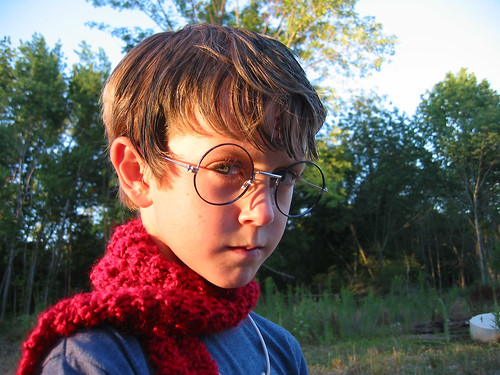
{My nephew as Harry Potter. Photo by rocketlass}

As my annual family vacation followed a week that I began with two posts about children's books, and as Stacey and I were looking forward to capping the vacation with a midnight Harry Potter party in the company of our eight-year-old nephew, it probably comes as no surprise that I read some children's books during the trip.

No, I haven't read Harry Potter and the Deathly Hallows yet; from the moment just after midnight when we were handed it at the very pleasant Treehouse Books in Holland, Michigan, until 4:15 this morning, Stacey was buried in it. She says she stopped reading at 4:15 because
I started thinking about how very weird it is that we look at this set of little marks on a page, and they make words, and then those words make a story. That got very distracting, so I decided that meant it was time for bed.
Meanwhile, my mother, waking up at 3:00 and going to check that we'd all made it back from the bookstore, saw her and said,
A-ha. I thought so.


{Stacey as Nymphadora Tonks. Photo by rocketlass}

The children's books I read instead were older, and accompanied by considerably less hooplah. In the comments at The Dizzies last week, I weighed in on the side of Lloyd Alexander regarding the question of whether his Chronicles of Prydain are better than Susan Cooper's Dark Is Rising sequence--but I realized that my confidence was somewhat inappropriate, as I'd not read the Prydain books since childhood. So in the car on the way to the house we were renting for the week, I blazed through the first of the series, The Book of Three (1964).

I was surprised at how little of the plot I remembered, especially as so many of the characters remained so vivid. The more mysterious characters must have resonated with me most strongly as a boy, for they're the ones I remember most clearly. When Taran and Lord Gwydion were captured by the evil sorceress Achren, her terrifying seductiveness rushed back whole into my mind, as if I'd tapped a cobwebbed keg containing my actual memories of reading the book as a boy; her mix of femininity, ruthlessness, and power must have mightily addled my adolescent brains. Gurgi's appearance had a similar, if less powerful, effect, reminding me of how much I was entertained by him when I first read the books--though it has to be admitted that he's a character who wears better on pre-teens than on adults. He remains fun, but I now understand a bit better why the adults in the book get frustrated with his wheedling and yammering.

The one character whom I'd almost totally forgotten was the young princess, Eilonwy (Yet I remembered Taran clearly--evidence, should any have been needed, that I was not a preteen girl when I first read the book?). Not that I had forgotten her existence, or her role in the series--instead, I'd forgotten her essence: she's weird. She shares all her rambling thoughts (including her frank opinions--the headline for this post is from Eilonwy's mouth) and she makes odd leaps of logic and intuition. I don't remember quite how she develops in the following books--except that she retains her bravery while growing nicely into leadership--but in The Book of Three her most entertaining and endearing characteristic is her tendency to invent strange, yet apt metaphors. Here's a batch from throughout the book:
I know it isn't nice to vex people on purpose--it's like handing them a toad.

You can't just sit there like a fly in a jug.

[Petting this fawn] is lovely; it makes you feel all tingly, as if you were touching the wind.

You've been carrying that harp ever since I met you, and you've never once played it. That's like telling somebody you want to talk to them, and when they get ready to listen, you don't say anything.

It's silly to worry because you can't do something you simply can't do. That's worse than trying to make yourself taller by standing on your head.

I can't stand people who say, "I told you so." That's worse than somebody coming up and eating your dinner before you have a chance to sit down.


Other than recovering Eilonwy for me, what this reading has revealed is that The Book of Three, though great fun, isn't even in the same league as Over Sea, Under Stone, the first book of Susan Cooper's sequence. But one book is insufficient evidence by which to judge a whole series--Over Sea, Under Stone is by far Cooper's best book, while I remember the emotional power of the Prydain Chronicles growing along with Taran as he meets new people and spends more time with the ones we've met already. Before I can render a proper judgment, I'll have to reread the rest of the Prydain books, which I'll likely do over the next several months. I'll let you know how it goes.

Tomorrow (or possibly Monday), I'll write about the other children's book I read on vacation, which was a birthday gift from my friend Maggie, giver of impeccably chosen gifts: Dodie Smith's I Capture the Castle (1948).