Showing posts with label Michael Dirda. Show all posts

Monday, January 12, 2015

One last (?) ride in The Getaway Car

It's been a while since I gathered reviews for The Getaway Car, and a big one has just appeared to cap off a long and very gratifying publicity run, so I hope you won't mind indulging me in a bit of linking and smiling. Like I told Gil Roth when he interviewed me for his Virtual Memories podcast recently, the nice thing about editing a book of someone else's work is that you can sing its praises wholeheartedly without feeling fully sheepish: it's their work, after all, not yours.

The biggest review thus far came from the Wall Street Journal, in which William Kristol went a bit farther than even I would be willing to go:
I hope I won’t shock anyone, but will merely expose myself to good-natured ridicule, if I profess myself inclined to the opinion that Donald E. Westlake (1933-2008) was the greatest modern American novelist.
The best thing about that review was that Kristol urged people not just to get The Getaway Car, but to go pick up the Parker books, too--and subsequent sales showed that a lot of folks took his advice.

Perhaps the review that meant the most to me came from the Washington Post, where Michael Dirda--a longtime IBRL favorite--was full of praise:
The Getaway Car may seem an odd title for a nonfiction miscellany, but it derives from a remark by Abby Adams Westlake. Her husband, she said, “no matter where he was headed, always drove like he was behind the wheel of the getaway car.” That suggests something of the rush and exhilaration with which most readers will turn these pages.
Having Michael Dirda say that the book was "expertly edited" really warmed my heart.

In the Daily Beast, longtime Westlake fan Malcolm Jones raved about the book and the oeuvre:
Is a posthumous collection of miscellaneous pieces (even one as smartly edited as this one) a good place to first encounter a writer known for his fiction? Normally I would say no, but in Westlake’s case, there really is no wrong way to approach his work. It is after all his sensibility—funny, fatalistic, humane but never sappy and always a little off kilter—that gives his writing its flavor, and you can find that sensibility in these pages as surely as you can in the novels. Because ultimately Westlake was not this kind of writer, or that kind, not a crime writer, or a satirist, or a comedian. He was just a writer, and as good as they come.
In the Guardian, meanwhile, my online friend P. D. Smith wrote a brief, but very appreciative review--the subhead says it all:
This wonderful collection, edited by Levi Stahl, includes entertaining autobiographical insights from the prolific American crime writer.
And then, to cap it all off, the New York Times Book Review on Sunday featured a brief review by Charles Finch (who earlier in the Chicago Tribune had named The Getaway Car one of the five best books to get a suspense fan this year). Finch wrote:
"This is a book for fans," Stahl insists in his introduction—the sole misstep of his whole enterprise, because in fact this is a book for everyone, anyone who likes mystery novels or good writing or wit and passion and intelligence, regardless of their source. . . . Stahl has assembled these pieces both lovingly and wisely. . . . A collection [that] one hopes will find him new readers.
Don't mind me. I'll just be over here blushing. I knew going into this project that I was going to enjoy the whole process, but the ride has been even more fun than I expected--thanks for going along on it with me.

Thursday, July 24, 2014

Robert Graves

One of the books that carried me through the twenty-one hours, door-to-door, of my return from Slovenia earlier this month was Robert Graves's Goodbye to All That. I've long been an enthusiastic dabbler in Graves--a fan of the delectable I, Claudius, a timid peeper at the labyrinthine obsessions of The White Goddess, and a prurient, if casual, collector of anecdotes about his life.

On that last point, the best stories tend to revolve around the malevolent power of his longtime love Laura Riding. Michael Dirda, in Bound to Please, relates one of the most shocking. After a different lover rejected her, Riding:
sipped some Lysol, tootled, "Goodbye, chaps," and leaped out of a fourth-floor window. Robert immediately rushed down the steps; but realizing that his muse must surely be dead, he stopped on the third floor and jumped out a window after her.
Astonishingly, both survived, though with substantial injuries. Riding would go on to dominate Graves's life for many years; there's an often harrowing account of her power in Once As It Was, Griselda Jackson Ohannessian's memoir of the years she spent as their neighbor in rural Pennsylvania when she was a girl. She tells of how Riding quickly brought all the nearby adults under her spell, and her descriptions of Riding's dominance are convincingly uncanny. As Dirda notes, Graves once remarked, "You have no idea of Laura's holiness"; if Ohanessian is to be believed, her holiness was more that of the pagan deity inexorably demanding sacrifice than of the sort that honors and rewards purity and goodness.

A much more gently amusing Graves anecdote entered my store this winter via Albert Vigoleis Thelen's magnificent, enormous novel The Island of Second Sight. It's a thinly veiled--though beautifully, inventively, and hilariously stylized--account of the years Thelen spent on Mallorca in the run-up to World War II. Among the modest European expatriate community is Graves, who enlists Thelen to translate some of his work into German. The amusing bit, though, is how Thelen tells us Graves introduces himself to everyone he meets: shaking the person's hand vigorously, he says, "Robert Van Ranke Graves, Goodbye to All That." No use courting confusion, I suppose.

Which leads us to the book that made Graves's name, and for which he's still best known, Goodbye to All That. Published in 1929, it was one of a wave of memoirs of the Great War, and, along with Siefried Sassoon's and Edmund Blunden's memoirs, it has remained one of the key documents of the experience of the trenches. So imagine my surprise when I realized how much comedy was in it--this is no All Quiet on the Western Front. Oh, there are horrors aplenty, and much of the humor is of the nihilistic black sort that, it seems likely, has always been part of the soldier's experience. But there is also the occasional bit of pure, if savagely ironic, comedy, as in this passage from Graves's first extended leave, in 1916. Home with his parents, he allows himself to be badgered into attending church in the morning--his mother taking "no active part in the argument, just looking sad"--rather than catching up on months of lost sleep. Church is to be at 9:30, which Graves thought "unusually early for matins," but attributed to "the new wartime principle of getting things over quickly." Then comes a knock at the door:
The proprietor of a neighbouring bath-chair business was waiting with a bath-chair. He explained that, as he had previously told my mother, they could not spare a man to take it to church, being seriously under-staffed because of the war--his sole employee, the only one left, had a job pulling the aged Countess of I-forget-what to the Parish Church, a mile or so in the opposite direction. For the moment I thought that it had been a very generous thought of my mother's on my behalf, but, ill as I felt, I could surely manage to reach the church, about half a mile away, without such a parade of infirmity. I forgot my father's gout, and also forgot that passage in Herodotus about the two dutiful sons who yoked themselves to an ox-cart, pulled their mother, the priestess, to the Temple, and were oddly used by Solon, in a conversation with King Croesus, as a symbol of ultimate human happiness.
Had Solon tried to make the same example of Graves, I expect he would have received some choice words in return. In reality, though, Graves "could only laugh" and take up the "beastly vehicle." The church, as you've surely already assumed, was up a hill.

It got worse from there:
By half-past ten the service did not seem to be getting on as fast it should have, and I grew dreadfully bored, longing to sneak outside for--well, anyhow, I wanted to sneak outside.

I whispered to my mother: "Isn't it nearly over?"

She answered: "My dear, didn't your father tell you that it would be a three-hour service? And, of course, since you couldn't get up to pull him to church for the early service, he'll want to stay for Holy Communion at the end. That will make it a little longer."
Welcome home from the trenches, son! We've missed you terribly!

One question before I wrap this up: Does anyone feel confident about what Graves was planning to sneak out of church to do? Smoke or drink, one would assume, but if that's it, why not just say so explicitly? Any other ideas?

Wednesday, December 14, 2011

Apologies to Trollope

After Friday's post that took issue with Trollope's complaint about Dickens's prose style, a reader wrote to argue that I was being unfair to Trollope. And he's right: Trollope's complaint was specifically about the idea of Dickens's prose as a model for beginning writers--which, even today, when the buzzing, wild genius of Dickens's descriptive energy is more widely recognized, it would be disastrous for a young writer to attempt to mimic. It would lead to pastiche at best; baggy, affected nonsense at worst.

But it was for the closing of my post that I owe Trollope the real apology: after he recommended Thackeray as a better model, I noted that at least he hadn't nominated himself. I was being flip on a Friday night, and Trollope deserves better. By all accounts, Trollope was a man of appropriate self-assessment, neither over- nor under-selling his achievements. He was a working writer who found success, and he was proud of that fact, but he didn't make claim to be a genius. In a piece on Trollope's autobiography, Michael Dirda quotes a couple of assessments from the book:
Above all, he is surprisingly harsh about his own creations. Take those two novels mentioned above, Doctor Thorne and The Bertrams. The first soon ranked among his most popular titles; the other long lay among his most ignored. Yet, says their author, "I myself think that they are of about equal merit, but that neither of them is good." His own favorites among his books are those about the politician Plantagenet Palliser, especially The Prime Minister--which the critics damned. Orley Farm, he observes, possesses his best plot, but "taking it as a whole," The Last Chronicle of Barset is "the best novel I have written."
Dirda also includes a great anecdote that I can't help but pass on:
Once, when he overheard two clergymen complain that the celebrated Mrs. Proudie of the Barsetshire novels had grown tiresome, he went up and told them that she would be dead within the week. And so she was.
Almost anyone involved, even peripherally, in the literary should also appreciate Trollope for being what he was: a writer who lived a life with relatively little drama, worked for the Post Office every day for decades while still finding time to write, and matter-of-factly turned out prose. No sturm und drang here. Dirda uses Trollope's own account to calculate that at Trollope's pace of 3,000 words per day, every day, he would have turned out a novel the length of Gatsby in a month. John Sutherland, in his magnificent new Lives of the Novelists, says that Trollope's reliability and speed ended up working against him:
He had produced too many novels too quickly for the public's appetite. Sales and payments fell--not catastrophically but palpably.
Crime fiction fans will recall that one of the reasons Donald E. Westlake always gave for writing under so many pen names was that he was writing too fast for his publishers' taste; they didn't want to flood the market with Westlake books. Trollope, one assumes, never considered that option--and wouldn't a Trollope novel be recognizable under any name, regardless?

Sutherland claims that the falling sales led to a "gloom [that] found magnificent expression in his mordant satire on the morals of his age an the decay of Englishness, The Way We Live Now." He goes on to point out something else that distinguishes Trollope from the best of his contemporaries:
The title [of The Way We Live Now] points to a salient feature of Trollopian art. Thackeray, Dickens and George Eliot consistently antedated the action of their novels by decades. Trollope invariably writes about "now." Sic vivitur, as his favourite Latin proverb put it--thus we live.
And with that, The Duke's Children goes into my bag for my next trip. That's another point--and not a minor one--in Trollope's favor: he's reliable enough that, if pressed, you can pack nothing but a book by him for a trip and still depart with confidence. He's certainly not going to let you down.

Friday, September 17, 2010

Ronald Firbank

The primary reason that Harold Nicolson's Some People is remembered at all today is because of the barely veiled portrait it features of Ronald Firbank, a writer of campily decadent novels and stories that were popular and influential among aesthetically inclined writerly types in the early part of the century, and have remained favorites of a small, but passionate group of readers ever since.

Anthony Powell, who was a bit too young to have known Firbank--whom he described as a "talented, painfully shy, lonely, tipsy, ailing homosexual" in a review--was a fan, and Firbank's influence, like Hemingway's, can be seen in the clipped dialogue of Powell's early novels. Michael Dirda, whose enthusiasms have been drawing me, from one to the next, all week, has described Firbank's spare style nicely:
He discarded leisurely descriptions, stripped dialogue of its "he saids" and "she saids," subordinated plot to language, and made his characters, those absurd and ingratiating puppets with names like Mrs. Shamefoot and Madame Wetme, into vehicles for social satire and joyful, imaginative extravagance.
Dirda quotes Firbank--echoing Scott Fitzgerald's stated willingness to scrap a whole story for the sake of one good sentence he could use elsewhere--saying, "I think nothing of filing fifty pages down to make a brief, crisp paragraph or even a row of dots."

Nicolson's depiction of Firbank, as the title character of the story "Lambert Orme," is so good that it's easy to understand why it's lasted:
It would be impossible, I think, to actually be as decadent as Lambert looked. I split the infinitive deliberately, being in the first place no non-split die-hard (oh, the admirable Mr. Fowler!), and desiring secondly to emphasise what was in fact the dominant and immediate consideration which Lambert evoked. I have met many men with wobbly walks, but I have never met a walk more wobbly than that of Lambert Orme. It was more than sinuous, it did more than undulate: it rippled. At each step a wave was started which passed upwards through his body, convexing his buttocks, concaving the small of his back, convexing again his slightly rounded shuolders, and working itself out in a backward swaying of the neck and head. This final movement passed off more rapidly than the initial undulations, with the resulting impression of a face upturned generally, but bowing at rhythmic intervals, as if a tired royalty or a camel marching heavily along the road to Isfahan. . . . He dressed simply, wearing an opal pin, and a velours hat tilted angularly. He had a peculiar way of speaking: his sentences came in little splashing pounces; and then from time to time he would hang on to a word as if to steady himself: he would say “Simplytooshattering FOR words,” the phrase being a slither with a wild clutch at the banister of “for.”
Firbank's works are available here in the States from New Directions, but back in the early 1930s it was Powell himself, while he was working at Duckworth, who was responsible for getting them back into print in England. In Messengers of Day, the second volume of his autobiography, he wrote,
I also pressed the claims of Ronald Firbank, whose novels at this period were all out of print. The directors showed no overwhelming enthusiasm for Firbank, but, in consequence of making enquiries as to where the "rights" lay, it was disclosed that Firbank had left a sum of £800 to be devoted to guaranteeing the republication of his books at some future date.
There's a lesson here, authors: attend to your wills!

I've only barely read Firbank: I gave him a half-hearted try several years ago and wasn't quite convinced. But Powell's enthusiasm, Nicolson's amusement, and Dirda's claim that, "In the right mood they are very nearly the most amusing novels in the world," have convinced me to try again.

Wednesday, September 15, 2010

The Fingers of M. Stambuloff


Michael Dirda's recommendation of James Lees-Milne having proved good recently, I decided last week to follow him once more, this time picking up Harold Nicolson’s odd little book of semi-fictionalized tales of friends and acquaintances, Some People (1929). It's a strange book, a bit too deeply involved in the ephemera of interwar upper-class English culture for me to be able to recommend it to too many people, but it had plenty of charms nonetheless.

One passage was so grotesquely entertaining that it's worth sharing despite its being much longer than what I’d usually quote here. It comes in “Miss Plimsoll,” a story about the woman who was Nicolson’s governess when his family lived in Sofia:
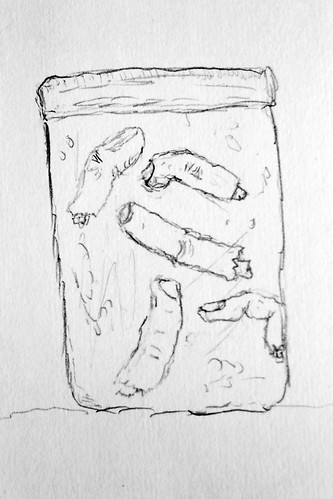
The hostility latent in our feelings towards each other would not, I think, have reached the surface had it not been for M. Stambuloff’s fingers. I am still glad that in this connection I behaved so badly: I suspect also that Miss Plimsoll, when she has a tea-party at Southsea, will to this day recount the incident with gusto. But at the time my action led to serious trouble. M. Stambuloff had been murdered in the street: they had attacked him with yataghans, striking him on the head: he had put his hands up to protect himself, with the result that his fingers were severed and fell upon the pavement. They were picked up by an admirer and given to his wife. After the funeral she put them in a large bottle of methylated spirits and placed the bottle in the window of her dining-room, so that passers-by could see. I was told of this by Zachary, the chasseur of the Legation, and I begged my father to take me to see them. He refused. On the following day I asked Miss Plimsoll to come for a walk. She was pleased at this and we started off briskly, talking about the British Navy. M. Stambuloff’s house was near the Club, and as we approached it we saw a little lot of loiterers gazing in at the dining-room window. I steered Miss Plimsoll in the same direction and we came to anchor in front of the window. It was a very large bottle, and the eight fingers floated dimly in it like little pickled cucumbers. Miss Plimsoll took so long to realise what they were that I was able to enjoy myself thoroughly. When at last she did identify the contents of the bottle she gave a little sharp scream like a shot hare, clutched me by the forearm, and dragged me violently away. She called a cab and drove back to the Legation: she began to sob a little on the way, and when she got home she burst into hysterics. I for my part was sent to bed.

The next morning I received a full-dress scolding. I was scolded by my father. I was even scolded by my mother. Miss Plimsoll called me into her bedroom and told me to sit down. She then explained to me that my action had not only been heartless but also disgusting. Things, she said, could never be quite the same for her again: all her life, she said, she would be haunted, yes haunted by those fingers. Did I realise how cruel I had been? I said I was very sorry, I would never, never do it again.

The guilt with which these upbraidings weighted my soul developed, in the weeks that followed, into panic fear. I also became haunted by the fingers of M. Stambuloff. . . . Night after night the fingers of M. Stambuloff would appear in my dreams, enormous, clustering--not in the least like cucumbers, having circles of bleeding flesh and shattered bone around their base.
Horrible, no? Nicolson's promise "never, never" to do it again is a bit hollow, even if meant: how often does a boy get the chance to introduce such a horror? And ultimately Miss Plimsoll shows herself, as expected, the bigger person: rather than leave the boy to stew, she sits up with him night after night until he can sleep.


Dirda says that Nabokov once claimed that he had been fighting against the influence of Some People all his life, "like a drug," and the grotesquerie of this passage, allied to the balanced, precise, assonant prose of the rest of the book, makes such influence easy to imagine.


{Photo by rocketlass.}

Wednesday, August 18, 2010

Dipping into "the higher gossip," Or, Time to read James Lees-Milne

In the Barnes and Noble Review this week, Michael Dirda writes in praise of English diarist James Lees-Milne, whose many volumes of diaries and one volume of memoir, Another Self (1970), Dirda argues, belong on the short shelf of masterpieces of “the higher gossip”:
Their pages are packed with amusing anecdotes, erotic adventures, moral observations, lyrical evocations of the past, bits of biography, encounters with unusual people, and glorious descriptions of nature, art, places, and society. These are, in short, works that recreate a time and a place, while also plunging us deep into a tattered human heart.
I’ve only ever glanced at Lees-Milne, but the passages that Dirda draws out of his diaries are entertaining enough to guarantee that I’ll give him a more serious read.

It seems a fitting, as a coda to Monday’s post about sex and vulgarity, to highlight some of the spicier bits that Dirda quotes. Like this scene, from Lees-Milnes’s memoir, in which his mother, about to turn him loose at boarding school, realizes that he should probably be told about sex:
'Which reminds me,' she added, in a rather portentous and uncharacteristic tone, 'your father would wish me to give you a little, just a little piece of advice. About life generally.' She paused, and then suddenly corrected herself. 'On the whole, it might be better if you asked the headmaster to explain all about the disgusting side of it.' And then to herself and half aloud, she added 'Not that I myself have ever found it exactly that.'
Or this, from the diaries:
Dined with Charles Fry [a director of the publishing house Batsford's] back from the States. He drank seven whiskies and soda while I was with him between 7:30 and 10:30. He is violently pro-American and anti-English. He said he had been away eleven and a half weeks and slept with forty people during that time.
I find hints of Powellian characterization in that description, reminiscent of some of the lines in Powell’s notebooks--which is perhaps not surprising, as the two were contemporaries and ran in not dissimilar circles of upper-class artists, writers, and hangers-on.

Lees-Milne turns up in Powell’s own journals in a handful of places, a couple of them interesting enough to pass on. First, there is an entry describing a luncheon with Lees-Milne and his wife, Alvilde, on August 20, 1987, before which Powell had just finished re-reading the Diaries, as a counterpoint to the letters of Rupert Hart-Davis and Lord Lyttleton (which Dirda, by the way, also praises). Writes Powell,
He has less of Rupert’s practical grasp of how people react in relation to the arts, books, or journalism, though often acute in the Diaries about individuals’ social behaviour, with which he came in much amusing contact among owners of more-or-less stately homes.
Later, Powell notes that he
quite misjudged Jim’s reaction to my having reread (I think for third time) and enjoyed, all his Diaries. I supposed he would be greatly interested in small points in them I brought up, but he scarcely noticed these, only saying something like, “Oh, how could you wade through all that?”
Which jibes with a telling observation Powell made a couple of years later, in July of 1991, following another lunch:
He is oddly uninterested in his own life, which I noticed when he lunched with us.
If true, that would put him at odds with other masters of “the higher gossip” from Dirda’s list--such as my longtime favorites Casanova and Boswell--but would help explain his apparent attention, appreciated by Powell, to the oddities of others.

Before I hie myself to the library in search of some Lees-Milne, it seems right to leave you with some lines from Powell’s notebooks that I suspect Lees-Milne, with his broad experience of people, would have appreciated. First, a sentiment that surely anyone dealing with the superannuated super-wealthy would agree with:
The actual existence of other people gets on the nerves of some individuals.
Then, to bring things back full circle to the topic of love and sex, a line from Lees-Milne’s assessment of Emily Bronte,
It is unfulfilled love which intensifies passion.
--which, Powell might add, also has the benefit of keeping the lover from ever realizing that:
All love affairs are special cases, and yet at the same time each is the same case.
An argument that, for all his narcissism and self-regard, I think even Casanova would find congenial.

Wednesday, July 29, 2009

"A dilettante and a practical joker, but . . . a wise man all the same," or, Some pleasures from Lord Berners

On a whim recently, I ordered a Faber Finds reprint of Mark Amory's biography of composer, writer, and painter Lord Berners, Lord Berners: The Last Eccentric (1998). Before reading Amory's book, I only knew Lord Berners as the model for the wildly strange Lord Merlin in Nancy Mitford's The Pursuit of Love and for his wonderfully comic yet slightly creepy The Camel, which Michael Dirda calls
the novella equivalent to an Edward Gorey album, at once witty, slightly off-kilter, a bit camp, and perfectly pitched.
Amory's book--which is full of delicious anecdotes that I'll try to share in the coming weeks--sent me to Berners's slim volumes of memoir, which, though not, it seems displaying complete fidelity to the truth, are charming and funny litle books.

Two brief scenes, one gorgeous, one comic, stood out in the early pages of the first volume, First Childhood (1934); both seemed worth passing on. First, a moment of chance beauty Berners experienced in his bedroom one afternoon as a boy:
[O]ne afternoon my day-dreams were interrupted by an extraordinary phenomenon that took place on the ceiling. Everythign that was happening outside the house within a certai nradius appeared upon it, mirrored in vivid shadow-play. As I lay on my bed I could see, reproduced on the ceiling, the moving figures of servants, gardeners, or grooms. A dog trotted across and a cat appearead and sat licking itself. I saw the carriage coming up to the door and my mother going out for a drive. It was a complete cinematographic representation in silhouette. The curtains had been drawn in a certain way which allowed a small shaft of light to penetrate, and the ceiling of the room had been converted into a cinema screen.
Anyone who's ever seen a camera obscura in action can imagine how thrilling such a magical occurrence in one's childhood bedroom would be. Sadly, Berners was never able to recreate the effect.

Then there's an account of Berners's grandmother, Lady Bourchier, whom Berners describes as having been born with "the seeds of a baleful asceticism in her heart," a figure of forbiddingly intolerant religion:
The only subjects Lady Bourchier allowed to be discussed in her presence were the less sensational items of general news and those preferably of a theological nature. It must be confessed she sometimes appeared to take an interest in local scandals. She seemed to derive a certain pleasure from hearing instances of other people's godlessness. It gave her satisfaction, no doubt, to hear of yet another of God's creatures obviously destined for Hell.
That's not to say that Lady Bourchier wasn't of a giving nature:
Lady Bourchier spent a good deal of her time in paying minatory visits to the sick and the poor. She would set out on these charitable raids in a small pony-chaise which she used to drive herself, armed with soup and propaganda. The rest of the day she passed in meditation in her grim little study overlooking the moat. There was always an immense pile of cheap, ill-bound Bibles on the table and these she would give away whenever she got a chance. "Let me see, child, have I given you a Bible?" "Yes, Grandmother," one would hastily reply. But you never managed to get out of the room without having one of them thrust into your hand. Disposing of a Bible was no easy matter. It would, of course, be sacreligious to burn it. If deliberately left behind or lost it would invariably be returned because she always took the precaution of writing one's name and address on the title-page. I remember once when I dropped one of them into the moat being horrified to find that it refused to sink and continued to bob up and down on the surface like a life-buoy. Even this contingency, I felt, must have been foreseen by my grandmother and in consequence she had had it lined with cork.
The bobbing Bible is like a foundational nightmare of childhood paranoia, our relatives finding us out in our every little misdeed; it's no wonder Berners never took to religion.

Thursday, March 20, 2008

Nine Notes on Dorothy L. Sayers and The Nine Tailors


1 I came to Dorothy L. Sayers last week as a reaction to the intellectual drama of Robert Musil: I was in search of something straightforward and cozy, a world where questions had answers and everything would ultimately find its place. I first seized on Gaudy Night (1936) because in Michael Dirda's appreciation of Agatha Christie in Classics for Pleasure (2007) he notes in passing, "I bow to no one in my admiration for Gaudy Night." I opened it with much anticipation.

The early pages were excellent. I enjoyed the company of the protagonist, Miss Harriet Vane, as she attended a reunion of her Oxford class, an occasion that allowed Sayers to offer some splendid observations of the early days of women's education there--including a complaint from a staff member that the young ladies had the previous spring taken to sunbathing in their underwear rather than the more concealing bathing costumes of the day. The observations at the heart of this bit of dialogue, too, were memorable:
"Yes," Miss de Vine smiled oddly. "If you were to listen at those windows, you would find it was the middle-aged ones who were making the noise. The old have gone to bed, wondering whether they have worn as badly as their contemporaries. They have suffered some shocks, and their feet hurt them. And the younger ones are chattering soberly about life and its responsibilities. But the women of forty are pretending they are undergraduates again, and find it it rather an effort. Miss Vane--I admired you for speaking as you did tonight. Detachment is a rare virtue, and very few people find it lovable, either in themselves or in others. If you ever find a person who likes you in spite of it--still more, because of it--that liking has very great value, because it is perfectly sincere, and because, with that person, you will never need to be anything but sincere yourself."
Page after page went by, however, and the only mystery to arise was the rather dreary question of which member of the college had been sending some poison pen letters. Instead, the focus of the book seemed to be rapidly settling on the question of whether Harriet would accept Lord Peter Wimsey's proposal of marriage. In the face of such a desultory mystery, that choice seemed far from unreasonably--but as I didn't know Lord Peter as anything other than a famed detective and was only just getting to know Harriet, the fact that their romance was dominating what was purportedly a detective novel began to chafe. With nearly four hundred pages still ahead, I decided to chuck it.

2 When I explained my plight to my friend Sarah, she pressed a different Sayers novel, The Nine Tailors (1934) into my hands, arguing that it was more typical of Sayers--and probably closer to what I'd been looking for. The title was familiar, but it wasn't until I got home that I realized that this novel had served as Exhibit A in Edmund Wilson's amused evisceration of the genre, "Who Cares Who Killed Roger Ackroyd?" (1945):
Well, I set out to read The Nine Tailors in the hope of tasting some novel excitement, and I declare that it seems to me one of the dullest books I have ever encountered in any field. The first part of it is all about bell-ringing as it is practised in English churches and contains a lot of information of the kind that you might expect to find in an encyclopedia article on campanology. I skipped a good deal of that, and found myself skipping, also, a large section of the conversations between conventional English village characters. . . . There was also a dreadful stock English nobleman of the casual and debonair kind, with the embarrassing name of Lord Peter Wimsey, and, although he was the focal character of the novel, being Miss Dorothy Sayers's version of the inevitable Sherlock Holmes detective, I had to skip a good deal of him, too.
This did not bode well.

3 Having now read The Nine Tailors, I can say that Wilson was right about everything but the dullness . . . yet it doesn't really matter. Yes, the bits of campanology are too much. The bell-ringers' jargon is almost entirely unintelligible to the layman, and the interest of the passages is slight--they have nothing of the thematic force of the similar insertions of encyclopedic materials in Moby-Dick, to take a brutally unfair example. And, yes, the rustic dialogue is perhaps too cute at points, and Lord Peter is for much of the book a more blithe and amusing figure than is perhaps believable. Yet it works: the campanology fleshes out and roots the characters Lord Peter encounters; the rustic dialogue provides Dickensian verbal tics and some moments of genuine humor, and Lord Peter's breeziness in the early part of the novel serves to lend his harrowing experience at the novel's real power. To argue, as Wilson does, that the clever solution to the case is appropriate to the sort of story that Sherlock Holmes could have dispensed with in thirty pages is to utterly miss the point: Wimsey likes these people and their odd rural interests--and so do we, so neither of us is in a hurry to be shed of them. His having a mystery to solve gives us both an excuse to stick around for a while.

4 And now on to the fun bits. Sayers's Foreword begins:
From time to time complaints are made about the ringing of church bells. It seems strange that a generation which tolerates the uproar of the internal combustion engine and the wailing of the jazz band should be so sensitive to the one loud noise that is made to the glory of God.
Though anyone who has spent a quiet Sunday morning in the deserted streets of the City of London, with no accompaniment but the occasional church bells, can appreciate Sayers's point, she severely weakens her case by opening the novel with a scene of a rural vicar organizing a series of peals to be rung on New Year's Day for nine hours--from midnight until nine in the morning! Enduring such an ordeal while I was trying to sleep would be more than sufficient to shift me to the side of the bell-haters.

5 I've written before about a certain strain in English writing, both fiction and nonfiction, of casualness about ghosts and apparitions. Such an attitude appears in The Nine Tailors in a throwaway line by an uneducated housewife, a friend of whose daughter has been scared by a ghostly light (which turns out to be entirely explicable in earthly terms) in the graveyard at night. Lord Peter questions the woman:
"Did she tell her mother and father?"

"Not then, she didn't. She didn't like to, and I remember well, as a child I was just the same, only with me it was a funny sort of thing that used to groan in the wash-house, which I took to be bears--but as to telling anybody, I'd ha' died first."
My knowledge of the natural history of England is far from perfect, but I don't think bears have been groaning in wash-houses there since at least the days of Elizabeth I. Clearly it was a ghost.

6 I also enjoyed the following exchange between Lord Wimsey and his manservant, Bunting:
[Wimsey] put aside the vest and pants, filled a pipe and wandered down the garden, pursued by Mrs. Venables with an ancient and rook-proof linen hat, belonging to the Rector. The hat was considerably too small for him, and the fact that he immediately put it on, with expressions of gratitude, may attest the kind hear which, despite the poet, is frequently found in close alliance with coronets; though the shock to Bunter's system was severe when his master suddenly appeared before him, wearing this grotesque headgear, and told him to get the car out and accompany him on a short journey.

"Very good, my lord," said Bunter. "Ahem! there is a fresh breeze, my lord."

"All the better."

"Certainly, my lord! If I may venture to say so, the tweed cap or the grey felt would possibly be better suited to the climatic conditions."

"Eh? Oh! Possibly you are right, Bunter."
Surely Bunter later shared a quiet laugh about that moment with his friend Jeeves over brandy at the Junior Ganymede Club?

7 For Wimsey's appreciation of rustic pleasures, you can't do better than the somewhat ironic enthusiasm he expresses to a waiter in a rural restaurant about the festivities anticipated for the opening of a new drainage system for the fens. The waiter explains that it is hoped that the Duke of Denver--who, unbeknownst to him, is Wimsey's brother--will come to kick off the party:
"I'll make a point of jogging old Denver up to his duty. We'll all come. Great fun. Denver shall present gold cups to all the winners and I will present silver rabbits to the losers, and with luck somebody will fall into the river."

"That," said the waiter, seriously, "will be very gratifying."
Come the event itself, the pleasure is more than trebled:
The weather was perfect, the Duke of Denver made a speech with was a model of the obvious, and the Regatta was immensely successful. Three people fell into the river, four men and an old woman were had up for being drunk and disorderly, a motor-car became entangled with a tradesman's cart and young Gotobed won First Prize in the Decorated Motor-Cycle section of the sports.

8 Late in the book, Sayers offers up a string of headline phrases that would, I think, amuse any fan of the newspaper honor box:
The public memory is a short one. The affair of the Corpse in Country Churchyard was succeeded, as the weeks rolled on, by so many Bodies in Blazing Garages, Man-Hunts for Missing Murderers, Tragedies in West-End Flats, Suicide Pacts in Lonely Woods, Nude Corpses in Caves and Midnight Shots in Fashionable Road-Houses, that nobody gave it another thought.
If only we could get copies of Sayers's lurid imaginary newspapers into the hands of Michael Lesy or Felix Feneon!

9 Potty Peake, a man who could uncharitably be described as the village idiot, is described by one of Sayers's characters as a "natural." I'd never encountered that meaning of the word, but sure enough, Merriam-Webster's offers as the first definition of the noun form of natural, dating from 1533:
One born without the usual powers of reasoning and understanding.
--while the Shorter Oxford English Dictionary offers, as sense four,
A person mentally handicapped from birth.

Coda

Now that I've settled into the Sayers sensibility, any fans out there want to offer an opinion on whether I should once again attempt Gaudy Night?

Tuesday, February 19, 2008

Roger Ackroyd is dead. At least we can agree on that, right?


When I was in middle school, I went through a period where I read little but Agatha Christie novels. (For those of you keeping score at home, that period followed the one wherein I read little but Doc Savage novels and preceded the one wherein I read little but Star Trek novels.) They offered exactly what I was looking for in a mystery: a setting vaguely exotic, both in its Englishness and its era; minimal violence, occurring offscreen and with virtually no gore; and, most important, a battle of wits--one which, because Christie always played straight with her readers, I was invited to join. I blazed through book after book, preferring Poirot to Marple but ultimately willing to read whatever my local library held.

For nearly twenty years after that, however, I didn't read a single Christie novel. I had moved on: I preferred straight novels, in general, and when I did read mysteries, I was much more interested in the brooding and violence of noir than Christie's decorum. But then a couple of months ago circumstances, like criminals, began to conspire . . .

First, Spinster Aunt supplied a very convincing post about reading Murder on the Orient Express, in the midst of which she pointed out that "You can read Christie's books, drunk, in a day," and that, "They're very good around Christmas time, when [one does] virtually everything in a pleasant alcoholic haze." Marketers take note: those are undeniable selling points!

Then Michael Dirda weighed in. In his Classics for Pleasure (2007), after acknowledging that Christie is not a good writer "if we look to her for the more obvious literary qualities [such as] distinctive prose style, rich characterization, a picture of society and contemporary life," he succinctly explained--thus making me remember--just what is so much fun about her:
Where Christie excels is in her plotting, that most essential of the elements of fiction. (As E. M. Forster emphatically insisted, "Oh yes, the novel tells a story.") Like a poet who writes only sonnets or a composer working out a set of variations, Christie accepts the conventions of the mystery and then seeks to surprise us with her originality. A creative-writing student could usefully study her novels just to learn the art of narrative construction.
In that sense, Christie stands as the anti-Chandler: her characterizations and atmosphere are nil, but her plots are fiendishly clever, her red herrings sprinkled with well-camouflaged abandon, and her mastery of manipulation and misdirection are second to none. No less a mind than Edmund Wilson wrote, after reading Death Comes at the End, that
I confess that I have been had by Mrs. Christie. I did not guess who the murderer was, I was incited to keep on and find out, and when I did finally find out, I was surprised.
--though fairness dictates that I point out that he continued by writing, "I did not care for Agatha Christie, and I hope never to read another of her books."

When I discovered that, despite Christie's reputation as a seamless plotter, Pierre Bayard had, in his book Who Killed Roger Ackroyd? The Mystery Behind the Agatha Christie Mystery (1998), had the gall to argue that Hercule Poirot had gotten the answer to the question posed by his title wrong, it was obvious: the fates (as represented by my Google Reader and my library) were conspiring to tell me that it was time to give Dame Agatha another try.

Fortunately, I'd somehow never read The Murder of Roger Ackroyd (1926), despite its having been the book that made Christie's name, so I was in the fortunate position of being able to read it and Bayard's refutation back to back. And it turns out that . . . everyone was right! Spinster Aunt's recommendation of a drink or two to ease the reading was much appreciated, Dirda's assessment of Christie's characters--
[S]he uses the same stock company in book after book--the retired colonel, the village gossip, the local doctor, the independent young woman, the shrewd governess. They, and the victim, are no more real to us than the characters in a game of Clue.
--was dead on, and Christie's plot was ingenious--yet at the same time Bayard homed in on so many surprisingly weak points as to make a reader wonder if she, too, might have been in on the deception. Reading the two books back to back is a treat I'd recommend to any mystery fan.

Bayard's book consists of two roughly even parts: a section of general reflections on the conditions and rules of the mystery genre, and a section specifically deconstructing Christie's explanation of Roger Ackroyd's untimely demise. Much of the fun of the book rests on Bayard's utter seriousness: though he doesn't make the Sherlockian move of pretending that The Murder of Roger Ackroyd is anything more than a novel, within the context of the novel itself he treats every fact presented as a true description of the characters and events of the book--and he insists on devising an alternate solution that fits those facts. "Our first concern, then, is with rigor," he writes early in the book, and he does not waver; I think not even Christie herself could argue for long against his solution. It is, like Christie's, ingenious and satisfying--the more so because it teases out a possibility that, before Bayard's work, the novel itself had foreclosed. The very act of reopening the question serves to animate and enliven The Murder of Roger Ackroyd in a way that surely hasn't obtained since soon after its first publication.

I can't be the only person who, on reading Bayard's book, wished Borges had been alive to enjoy it, can I? Who Killed Roger Ackroyd? is almost like a bizarre refraction of a story like Pierre Menard, an enactment of the idea that every text is perpetually alive and available for rewriting, for injecting with a new meaning. Bayard has, in a sense, modernized this eighty-year-old story, by giving us that most post-modern of things: a choice. We now have two answers, two interpretations, each with its own strengths and weaknesses, which give rise, between them, to a third choice: we can decide for ourselves which of the proposed murderers killed Roger Ackroyd--or we can decide to revel in ambiguity itself, enjoying the pleasures of close reading and the stimulation of uncertainty.

And if that's what we choose, we can wholeheartedly look forward to Bayard's next book, on . . . get ready for it . . . The Hound of the Baskervilles.

Wednesday, December 19, 2007

"I think we should go on living," or, From Compton-Burnett to Conan Doyle


I'm returning briefly to Ivy Compton-Burnett's Manservant and Maidservant (1937) tonight both because I feel it would be wrong to give up before I've convinced each of you to slip one of her novels into the stocking of your favorite witty cynic and because I can't resist sharing the following scene. Set in the schoolroom of the novel's isolated rural family, it tells of the arrival of the long-suffering children's first tutor, Gideon. In the children's grilling of him, Compton-Burnett's dialogue hews closer to realism than usual--perhaps because children tend more towards cruel bluntness than adults do--but it's no less funny or cutting for that.
"You are rather old for a tutor," said Marcus, "I thought they were generally young."

"Some young men begin by being tutors, and pass on to something else."

"Then you are a failure?" said Tamasin.

"I think I should be called one. I paid too much attention to my studies when I was young, and that does lead to people's being tutors."

"How old are you?" said Marcus

"I am forty-one."

"Oh, quite a young man," said Tamasin.

"Does your wife think you are a failure?" said Marcus.

"I am not married. I live with my mother and sister. If they think so, they do not betray it. Women are so loyal."

"What do you do with the money you earn?" said Jasper. "If you have no wife, you can't have children, and you don't seem as if you spend very much on yourself."

"Part of it I subscribe to the family expenses, and part to a fund that is to give me an income when I am old."

"Your hair is gray now," said Marcus.

"Yes, but that is premature. It merely gives me a personality."
The scene is also unusual in that it develops along more typically comedic lines than most of Compton-Burnett's scenes: there are no surprise interruptions from a character who's not even been announced as entering the room, no unexpectedly murderous asides, not even a sense that the participants are scrapping for points. Given the freedom that comes from the natural inquisitiveness of children confronted with a new tutor, Compton-Burnett runs with it.

One technique that does tie Compton-Burnett to other English satire is her employment of negative constructions as a way of both softening and improving a joke. Born, presumably, of a real usage reflecting British reticence, the negative construction--"not entirely unexpected," "not particularly," "not without its charms," and the like--works as a way of tiptoeing up to a barb; it focuses the attention, and, in the case of a skilled satirist, reveals unexpected degrees of denial and diffidence. It is the stiff upper lip incarnate. Anthony Powell was a master of negative constructions, as was Evelyn Waugh, who employs it simply but to good effect in this line about the dictatorship of Neutralia in "Scott-King's Modern Europe":
"[They were] led to the reception hall which with its pews and thrones had somewhat the air of a court of law and was in fact not infrequently used for condemning aspiring politicians to exile on one or the other of the inhospitable islands that lay off the coast of the country.
But I've yet to encounter a writer whose employment of negative constructions is more effective than Compton-Burnett's. The following lines describing the role of a village shopkeeper, Miss Buchanan, as a receiving station for clandestine letters capture the understated effectiveness of the technique:
On this secondary traffic Miss Buchanan turned an equivocal eye, that did not add to the ease, already not complete, of those who availed themselves of it.
At its best, the negative construction works sort of like a hand brought to the mouth to hide the scurrilous details we're being told; its pretense to authorial reluctance make the bulk of the satire, expressed in positive, straightforward terms, seem even more viciously pointed.

And viciousness is unavoidable in Compton-Burnett; life in her novels is richly red in tooth and claw. Late in Manservant and Maidservant, two of the boys, on seeing their father headed for a bridge they know to be dangerously faulty, willfully neglect to issue a warning to him. After he passes, they reflect on their failing:
"We are worse than we have ever been. We are not meant to kill people, whatever the reason. We might meet him in a future state, and know that he knew about it. It would be what is called poetic justice."

"That would not be for a long time."

"It might be soon. Some people would die of remorse."

"I think we should go on living," said Jasper.
That scene came to mind the other day when I was reading Michael Dirda's appreciation of Sir Arthur Conan Doyle and Sherlock Holmes in his Classics for Pleasure (2007). Dirda describes a feeling I've written about before, the sense of returning home that one gets every time one slips into the familiar world of a Holmes story:
[W]e discover a quiet refuge from our crowded lives as we glance again around the familiar flat with its chemical retorts, blazing fire, the bullet holes in the wall forming the initials V. R. Outside the fog rolls in and the rain beats down, but Mrs. Hudson is even now bringing up a cheering supper. Soon, there will be a knock on the door and a distressed gentlewoman will enter, or a puzzled policeman or a disguised nobleman, and the next grand adventure will begin. As Vincent Starrett observed: "they still live for all that love them well: in a romantic chamber of the heart, in a nostalgic country of the mind, where it is always 1895."
In Compton-Burnett's novels, it is always the early Edwardian era, a few years into the new century at best, and as I read Dirda's description, I began to picture Compton-Burnett's country houses, and the spite and viciousness they contain, as the flip side of Holmes's rationality: these are the locations, the people, the crimes, the competing hatreds and passions, that Holmes is called on to put to rights.

Conan Doyle provides us with answers and comforts us; Compton-Burnett provides us with unruly darkness and distaste. Perhaps an appreciation of both is a sign of emotional health?

Monday, June 18, 2007

Memories of malevolence


(Photo by rocketlass)

Saturday night, Stacey and I had Marc, our old friend from my bookselling days (whom long ago became a minister in the Universal Life Church via the Internet so that he could perform our wedding ceremony), over for dinner to belatedly celebrate his and my birthdays.

As always, it was a great night full all sorts of talk--but always circling back to books. Late in the evening, I asked Marc if he'd ever read Laura Riding:

Marc Only her short stories. They're intense--incredibly oppressive. She could describe a tea party and you'd feel like she was in the teapot. In her way, she's as intense as Dickens.

Me But whereas Dickens is standing over your shoulder manically pointing things out because he thinks they're fascinating and he really wants to make sure you aren't going to miss them, she's directing your attention because she wants to make sure you're looking where she wants you to?

Marc Exactly. Those stories are scary. They'll set your chest hair on fire.

I asked Marc about Riding because all I really know of her is through her longtime association with Robert Graves, which I've mentioned in passing before. As Michael Dirda explains:
[Riding was] a hauntingly strange writer--the young Auden called her the "only living philosophical poet" and acknowledged her influence. . . . Graves admired her poems and started a correspondence that eventually led to Riding's being offered a job as his secretary. As anyone might guess, this was a bad idea. Before long, the two poets were lovers, though [Gates's wife] Nancy didn't seem to mind much. A rocky marriage slowly turned into a steady menage a trois.

From all accounts Riding possessed a charismatic, forceful personality, a superb mind, and a psychological acumen that permitted her to bend almost anyone to her will. . . . Robert once remarked, "You have no idea of Laura's holiness."
Having found what he perhaps had needed all his life, Graves really did seem to essentially worship Riding, but that didn't make their lives together any easier. There followed dual suicide attempts, a move to Mallorca, and, on Riding's part, a temporary (but lengthy) renunciation of sex. Later, the couple spent an extremely stormy, destructive, and mysterious summer in an old stone farmhouse in rural Pennsylvania. As Dirda explains, "No one likes to talk about the weeks that followed."

But someone eventually did. Those weeks form the malefic heart of Once As It Was (2002), a memoir by former New Directions president Griselda Jackson Ohannessian, who with her parents lived down the hill from the Graves-Riding farmhouse. Though the first two-thirds of the book are a remarkably charming, affectless, even naive account of a Depression childhood--one that calls to mind Flora Thompson's Lark Rise to Candleford--the story darkens with the arrival of Graves and Riding in 1939, the summer of Griselda's twelfth year. Of Riding, she says:
I thought Miss Riding a curious sight. She was wearing clothes that seemed to me more like a costume than everyday wear. Maria remembers a sort of elaborate hunting jacket, bright red. She was wearing dangling jewelry and I think she was carrying a parasol or fan. She noticeably had on makeup; one could see the layer of powder on her face. Her looks were intriguing. One didn't usually see ordinary people wearing ankle-length skirts or putting on makeup in the daytime back then. One minute she would seem almost ugly; another, she would look like a regal personage, maybe Egyptian, from long ago. She had very blue deep-set eyes and brown, bushy, wiry hair held back with a headband or a ribbon. Her voice seemed rather odd. She had a bit of a nasal twang and behind her English accent lurked a more plebeian American-city one.
(Graves, meanwhile, "was large and burly and looked as if he had bad breath, as indeed he did.")

Graves and Riding become fixtures at Griselda's parents' house, and it's not long before she begins to notice her parents and their friends falling meekly into line behind Riding:
I did not like the way the other grownups treated her. "Yes, Laura." "Of course, Laura." "You're right, Laura." I did not like Laura's acceptance of their deference. I wasn't comfortable in the heavy atmosphere--all the hustle and bustle, all the talk. Once, when crossing the front lawn, I passed them all sitting in a circle, no one speaking. Then Robert said something and Laura snapped at him. "Be quiet." And he was. I did not like the way either of them had behaved--he subservient, she dictatorial.
The tension builds in the family as Riding extends her control--though she's never able to extend that power to Griselda, which openly angers her. In the manner of Henry James or Richard Hughes, Ohannessian presents the scene through the surprising perceptiveness native to children: though the adults seem to be forcing themselves to deny it, Griselda clearly sees that the situation, suffused with secrecy and malevolence, is becoming untenable. Then one night at dinner Griselda's mother makes her stand:
The meal was almost over. It had not been a pleasant one. Suddenly Ma stood up and announced,
"I am taking the children for a walk."

"Robert will go with you," Laura said.

"No he will not," Ma replied.

"Not now, Katharine," Laura commanded.

"They are my children," Ma replied, "and if I want to take them on a walk, I will do so."

Did Laura say "You will not"? It was at the very least implied. Ma pushed back her chair, got up, and turned toward the door. I had a feeling that I had to stand up to Laura. I stood up, my troops stood too, and we followed Ma.
In the gathering dusk, they walk--and on the way Griselda's mother has an absolutely bloodcurdling breakdown, followed soon after by the first in what would become a decades-long series of institutionalizations.

Griselda, meanwhile, is left with her father and Graves, both completely in thrall to Laura; her confrontation with Riding a few nights later reads like something out of the creepiest of psychological horror novels:
I was stopped in my tracks by a great wave of fear. I was dizzy, there was a buzzing in my ears, I could hardly breathe, I was losing myself, I was going off my rocker. . . . Then I heard the click-clack--Laura's footsteps were always resounding. I knew without a trace of doubt that she was coming and she was coming quickly and I, having moved my bed catty-corner to the door, was trapped. There was no place to hide, no exit. I was cornered and she was coming and I knew she knew the condition I was in. She was going to push me over an edge--that's what I believed and still do.
At the last second, Riding is stopped in her tracks through the inexplicable intervention of what Griselda at the time--and, apparently, for the rest of her life--took to be some sort of higher power. Laura's uncanny power--at least where Griselda is concerned--is broken. At Bookexpo, I mentioned the creepiness of that scene to a woman working in the New Directions booth, and she assured me that Griselda retained that belief in the invisible but palpable workings of good and evil in the world to this day.

Years ago, I remember arguing with a girlfriend about the value of biography as an element of how we understand and judge writers. Back then, young and certain, I took a purist's position, scoffing at the notion that biography could provide any insight into a stand-alone work of art. Now, as evidenced by my love of Javier Marias's Written Lives, I find myself interested in writers' lives not only for what they might teach me about their work, but also, I'm not ashamed to say, on a much baser, near-prurient level as well. The Graves-Riding story is so complicated and fascinating, so shocking, that at this distance, the principals long dead, it has become a sort of work itself--odd and unpleasant, but damned hard to turn away from.

All of which is a roundabout way of saying, anyone read Riding? Is Marc right? Will her stories set my chest hair on fire? And, knowing all this, how can I not give her a try?

Wednesday, March 28, 2007

The Other Side of You, part three

Part one is here and part two is here.

This was all thrown into sharp relief the next morning, as, in reading Anthony Trollope's Can You Forgive Her? (1865), I came across the following passionate discussion, which runs along similar lines to some of Thomas and Elizabeth's conversations. George Vavasor talks here with his cousin, Alice, to whom he had once been engaged and whom he had treated badly, about her impending marriage to a quiet country farmer:
"Between you and me there can be no necessity for falsehood. We have grown beyond our sugar-toothed ages, and are now men and women. I perfectly understood your breaking away from me. I understood you, and in spite of my sorrow knew that you were right. I am not going to accuse or to defend myself; but I knew that you were right."

"Then let there be no more about it."

"Yes; there must be more about it. I did not understand you when you accepted Mr Grey. Against him I have not a whisper to make. He may be perfect for aught I know. But, knowing you as I thought I did, I could not understand your loving such a man as him. It was as though one who had lived on brandy should take himself suddenly to a milk diet,--and enjoy the change! A milk diet is no doubt the best. But men who have lived on brandy can't make those changes very suddenly. They perish in the attempt."

"Not always, George."

"It may be done with months of agony;--but there was no such agony with you."

"Who can tell?"

"But you will tell me the cure was made. I thought so, and therefore thought that I should find you changed. I thought that you, who had been all fire, would now have turned yourself into soft-flowing milk and honey, and have become fit for the life in store for you. With such a one I might have travelled from Moscow to Malta without danger. The woman fit to be John Grey's wife would certainly do me no harm,--could not touch my happiness. I might have loved her once,--might still love the memory of what she had been; but her, in her new form, after her new birth,--such a one as that, Alice, could be nothing to me. Don't mistake me. I have enough of wisdom in me to know how much better, ay, and happier a woman she might be. It was not that I thought you had descended in the scale; but I gave you credit for virtues which you have not acquired. Alice, that wholesome diet of which I spoke is not your diet. You would starve on it, and perish."
Though I'm only about a third of the way through Can You Forgive Her?, and I suspect that George may not ultimately be entirely trustworthy, I do think that here his speech is sincere. Whereas Thomas's pleadings to Elizabeth all seem rooted in his desire to further his own aims, George's to Alice, though they may have that effect, seem just as strongly rooted in a real desire for truth and an understanding of his cousin. Am I mistaken? Michael Dirda's not the only person, after all, who praised The Other Side of You--could this just be a very personal reaction to a couple of particular characteristics that Vickers has assigned to her character? From what I've provided here, do you see any difference in tone between the men as presented by Vickers and Trollope?

I'll close this too-long post with one last point against those who celebrate their own rudeness as having some inherent, iconoclastic value. I think Stephen Miller was dead-on in his Conversation: A History of a Declining Art (2006) when he wrote:
In popular culture rude people are celebrated as authentic, and those skilled at the art of conversation are often depicted a superficial or effeminate or dishonest (or all three).

The Other Side of You, part one

I picked up Salley Vickers's The Other Side of You (2006) because Michael Dirda said that fans of Marilynne Robinson, James Salter, and Penelope Fitzgerald would like it. He wrote,
All these authors reflect, with grace and gravity, on life's moments of sorrowful epiphany, so achingly summarized by the Elizabethan playwright Thomas Heywood:

O God! O God! That it were possible

To undo things done; to call back yesterday. . . .

That was enough for me. But for the second straight time, the usually reliable Dirda has steered me wrong.

In The Other Side of You, a psychiatrist relates the story of a woman named Elizabeth Cruikshank, whom he counseled after a suicide attempt. He tells of their increasingly intimate sessions, of his own fear and uncertainty, and of the ways that the sessions become as much about his own emotional growth as about her coming to terms with the business of living. Slowly she reveals that her suicide attempt was driven by the loss of a great love. Not believing she could be truly loved, she pulled away, and she blamed that faithlessness, in part, for her loss. As Vickers puts it,
It is a hallmark of the damaged that when it comes to their own desire instinctively, ruinously, they tend to court the opposite.


The book is peppered with that sort of aphoristic lines about human nature, some of them almost as sharp as those found in George Eliot. For example, the psychologist, confronted with a pathologically lonely student, thinks,
I'm not sure why there is something shaming about having no one to confide in, but in my view a good deal of aberrant behaviour stems from unbearable isolation and the socially unacceptable sense of being quite alone
Of Eliabeth's attempts at assuaging the loss of her love, Vickers notes,
She was to learn why the commonly advised remedy of "pulling oneself together" is one which is recommended only by those who have been spared the doomed attempts to apply it.
And of his patients, the doctor states,
The people we were treating were not so much looking for a remedy for anxiety or depression, they were looking for a reason to be alive.


From all this, it's clear that Vickers has an interesting mind and is serious in her thinking about emotion, desire, and pain. The problem comes when she has Elizabeth begin describing her lover, Thomas, a free-spirited art historian.

More tomorrow.