Showing posts with label Roger Clarke. Show all posts

Wednesday, October 08, 2014

Just popping in for a look, or, Daytime ghosts

One of many fun digressions in Roger Clarke's A Natural History of Ghosts comes when he reminds us that while in our age, midnight is the proper ghostly hour,
traditionally, ghosts are summoned by the extreme transitional stages of the clock. You are as likely to see a ghost before lunch as you are after going to bed. In later years, this tradition died out, since it seemed ghosts were inalienably connected to the night. Indeed, the whole nature of the ghostly at this period [the early eighteenth century] was linked to the vapours exhaled by the earth when the world turned dark.
Clarke goes on to share stories of several daytime ghosts from that period, including one of a soldier recorded in John Aubrey's ever-bountiful Miscellanies.

Any ghosts in earshot should definitely not take this as a challenge . . . but it is hard to picture ghosts being nearly so terrifying under bright skies. As A. Roger Ekirch writes in At Day's Close: A History of Night in Times Past, there's a reason night scares us, beyond its actual dangers:
Night dramatically transformed the communal landscape, investing innocuous landmarks with sinister portent. In a Yorkshire valley, for example, the decayed ruins of a small chapel were a "perfect paradise for boys" by day, but "not to be approached for the world by night, being haunted by a variety of strange ghosts."
Darkness invites imagination to fill it, and those we conjure as its denizens are more frightening, by far, than any spirits we could imagine encountering under full sun.

a So, tradition aside, midnight it is. Ekirch tells of laborers afraid to leave for work too long before the arrival of dawn, with its powers to chase demons:
According to the Newcastle antiquary Henry Bourne, . . "Hence it is, that in country places, where the way of life requires more early labour, they always go chearfully to work at that time; whereas if they are called abroad sooner, they are apt to imagine everything they see or hear, to be a wandring ghost."
Late eighteenth-century folklorist Francis Grose, meanwhile, writes Ekirch,
estimated that the typical churchyard contained nearly as many ghosts at night as the village had parishioners. "To pass them at night was an achievement not to be attempted by any one in the parish, the sextons excepted."
Elsewhere in his book, Ekirch notes that some communities were plagued by recurrent visits from the same ghost, including "Wiltshire's Wilton's Dog." Frustratingly, Ekirch doesn't elaborate, but the introduction of a ghostly animal does enable me to bring this post full circle, back to daytime ghosts--and the story of the only possible ghost I remember seeing. When I was a young boy, aged probably three or four, we had an black, white, and orange cat named Angel, who lived with us for probably a year, then wandered away. Much later--in my memory, it's at least three years--I was playing in our front yard one day when I looked up and saw Angel walking up the end of the driveway. I watched as she walked halfway up the drive and sat down. More confused than pleased to see her, I looked away briefly, and when I looked back, she was gone.

Oh, fine--there probably is a reasonable explanation for it. Be rational, if you must, about the lifespans and habits of wandering cats. But it's October, and the memory is powerful and clear all these decades later, so tonight I'll amuse myself by thinking that Angel, like the ghost of the dying soldier chronicled by Aubrey, who visits his mistress merely to "come to her bedside, draw the curtain, look upon her and go away," simply wanted one last spectral look at her old home.

Monday, October 06, 2014

"Things were, alas! worse than I had feared," or, With M. R. James as our guide, we enter October country


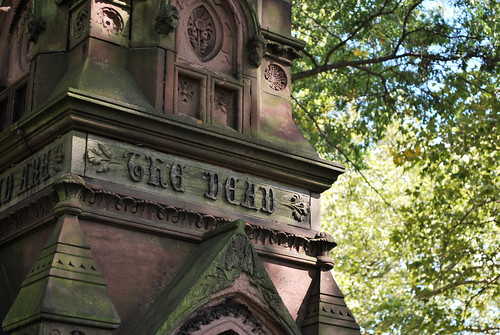
{Photo by rocketlass.}

Roger Clarke's A Natural History of Ghosts: 500 Years of Hunting for Proof (2012) isn't quite the book its title would suggest: though the book opens with some accounts (suitably hair-raising) of ghost-hunting, Clarke quickly dives into the past, nimbly running through accounts of famous historical ghosts and hauntings, some quite familiar, others a bit faded by time. That's not a fault, mind you: it's almost exactly what I want in a book about purportedly true hauntings: stories of poltergeists that seem almost certainly to have been the work of mischievous children or ill-treated servants; nine-days' wonders that find that the last few of those nine days require a ghost's activities to be amped up a bit; and wonderfully credulous contemporary accounts, breathlessly related.

Clarke also finds space to discuss antiquarian and ghost story master M. R. James, a subject of which we never tire at I've Been Reading Lately. James's telling of ghost stories on Christmas Eve at Kings College is familiar to any fan, but it's nonetheless a pleasure to find a firsthand description of the atmosphere, like this one from Oliffe Richmond:
We sat and waited in the candlelight, perhaps someone played a few bars at the piano, and desisted, for good reason. . . . Monty emerged from the bedroom, manuscript in hand at last, and blew out all the candles but one. He then began to read, with more confidence than anyone else could have mustered, his well-nigh illegible script in the dim light.
Was James's delay in entering a tactic for building suspense, or was he writing to and past deadline? I don't remember it coming up in Michael Cox's biography of James, but a New Statesman article from last winter suggests it was the latter. Properly donnish, even when at play.

Clarke follows that scene with an account from James himself of a seemingly supernatural experience in his own childhood that was triggered by reading a story by Sheridan Le Fanu, who would become the most obvious influence on James's own stories:
The words were quite enough to set my own fancy on a bleak track. inevitably I looked and with apprehension, to the Plantation Gate. As was but right it was shut, and nobody was on the path that led to it or from it . . . there was in it a square hole giving access to the fastening; and through that hole I could see--and it struck me like a blow on the diaphragm--something white or partly white. Now this I could not bear, and with an access of something like courage--only it was more like desperation, like determining that I must know the worst--I did steal down and, quite uselessly, of course, taking cover behind bushes as I went, I made progress until I was within range of the gate and hole. things were, alas! worse than I had feared. Through that hole a face was looking my way. It was not monstrous, not pale, fleshless, spectral. Malevolent I thought and think it was; at any rate the eyes were large and open and fixed. it was pink and, I thought, hot, and just above the eyes the border of a white linen drapery hung down from the brows. . . . Do not press me with questions at to how I bore myself when it became necessary to see my family again.
Like all good ghost stories, it leaves you wanting to know more. How did he tear himself away? Did the thing see him as he saw it?

The leaves are turning. Night is drawing in. Time for ghosts.

Thursday, October 31, 2013

Haunting monks and Pepys


{Photos by rocketlass.}

Earlier this month, I drew on the tales of the unnamed monk of Byland Abbey, who collected ghost stories from the surrounding countryside. I imagined the monk, alone in his cell on the quiet, wintry moors, spooking himself as he took pen in hand--so I was pleased to gather some more context for my imaginings last week from Carl Watkins's The Undiscovered Country: Journeys Among the Dead (2013):
The open country of the Vale of York lies to the south of this place but the moors rise steeply above it to the north. Although modest in height, they attract early winter snows, which make them a world unto themselves when the valley below is green. To medieval eyes this landscape was not beautiful but terrifying. Long before the abbey was built, the Venerable Bede thought these "steep and remote hills" more suitable for "dens of robbers and haunts of wild beasts than for men." Generations later, Bede's successors agreed. The monks who colonised the moors in the twelfth century entered "a place of horror and vast solitude," but they did so by choice, alighting on the place precisely because this was wild country, where minds could be bent to God free from distraction.
The exposure and isolation proved too much even for monks, however, and the abbey was eventually moved from the moor to the slightly more sheltered and accessible vale. But my imaginings of the spooky confines of an isolated abbey seem to have been on the mark nonetheless, at least by the fifteenth century, when the nameless monk began to collect his stories:
The heyday of the monasteries was in the past then. Outbreaks of plague and other epidemic disease had whittled away numbers at Byland and fewer recruits came forward to take their places. By 1400, a dozen or so monks were rattling around the cloisters. It was a good place to tell ghost stories and, as the abbey emptied of monks, the land round about was full of spirits.
And the monk had good reason to write down the stories he heard from the people of the surrounding country:
Stories about apparitions could not lightly be set aside and, since the chronicle of Byland warned that things not written down "slip away and wither as the sin of forgetfulness triumphs," there was reason to commit them to writing.
So the monk wrote, and so we know of a tailor named Mr. Snowball who fought a ghostly raven; and of James Tankerlay, a bad priest who walked after death and "blew out the eye" of his mistress; and of the fact that, as Watkins writes,
A soul detained [in Purgatory] suffered for its sins but could and should be helped through prayer and masses undertaken in its name. To write it off, to forget it, was a terrible thing. It was a sin. It was to rob the soul of the prayers that were its right. When a ghost walked, the living must harken to it. They must conjure it, let it speak, discover what it wanted, for it was likely to be suffering and in need of aid and deserved the benefit of the doubt.
Ghosts, however, change as we change, which makes the thumbnail history offered by Roger Clarke in his A Natural History of Ghosts: 500 Years of Hunting for Proof (2012) particularly useful:
Medieval ghosts were reanimated corpses or holy apparitions; Jacobean ghosts, demons pretending to be human.

Post-Restoration ghosts returned to correct injustices, right wrongs and supply information about lost documents and valuables. Regency ghosts were gothic. In Victorian times, ghosts were to be questioned in seances, and ghost-seeing became far more associated with women. Late Victorians embraced paranormality, seeing the ghostly as a manifestation of as yet understood laws of nature. The 1930s found the poltergeist.
And today? Perhaps unsurprisingly, it's more vague:
In one study in 1999, a group of Manchester women thought that hauntings were more to do with malign presences--in other words, a bad feeling--rather than the soul of someone who is dead making themself known.

Ghosts are no longer souls. Ghosts are now an emotion field.
As for me--still a skeptical enthusiast despite having, I'm told, seen a ghost when I was a boy--well, I think it right to end the month with Pepys. The diarist, Watkins tells us, was
an affirmed sceptic about wandering spirits. But he still relished a good story about them. And his scepticism, under the right conditions, might be a fragile thing. Several times he whiled away a dark evening talking with friends about ghosts.
Watkins goes on to mention a time that Pepys stayed in a reputedly haunted house and managed to spook himself. A bit of digging locates the incident on April 8 and 9, 1661. In his diary entry for the 8th, Pepys tells of traveling to the Hill House at Chatham, where:
Here we supped very merry, and late to bed; Sir William telling me that old Edgeborrow, his predecessor, did die and walk in my chamber, did make me some what afeard, but not so much as for mirth’s sake I did seem. So to bed in the treasurer’s chamber.
Mirthful exaggeration or not, his sleep was not untroubled, as he reveals in the next day's entry:
And lay and slept well till 3 in the morning, and then waking, and by the light of the moon I saw my pillow (which overnight I flung from me) stand upright, but not bethinking myself what it might be, I was a little afeard.
Nonetheless, Pepys, that most earthbound, most familiar, most untroubled of men, is not bothered for long, as "sleep overcame all."

As October closes, howling wind and spitting rain and swirls of blowing leaves and all, would that we all could lay our ghosts so easily.