Showing posts with label New York. Show all posts

Monday, May 23, 2011

"They are simply dull, solid, one-hundred percent Americans, who have never been in a night club in their lives," or, New York and "the Real America"

As preparation for a trip this week to New York, I decided to read a Robert Benchley piece from 1928, "The Typical New Yorker," collected in The Benchley Report. Benchley opens with a bit of throat-clearing that perhaps shouldn't have been surprising, but was:
One of the most persistent convictions reported by foreign commentators on the United States (a group which evidently embraces all unoccupied literates of England and the more meditative sections of the Continent) is that the real America is represented by the Middle West. Aside from the not entirely adventitious question of who is to decide what "the real America" is, there arises a fascinating speculation for breeders and students of climatic influence as to why a man living in Muncie, Indiana, should partake of a more essential integrity in being what he is than a man living in New York City. Why is the Middle Westerner the real American, and the New Yorker the product of some complicated inbreeding which renders him a sport (in the biological sense) and a man without a country?
There are two points of interest in that paragraph. First, the obvious one: as Ecclesiastes told us ever so long ago, there is nothing new under the sun, and it's probably safe to assume that urbanites have been being drummed out of the "real American" category since the Articles of Confederation. The second interesting bit is the reference to Muncie: Benchley's article was published (in the Yale Review) in 1928, a year before Robert and Helen Lynd's Middletown: A Study in Contemporary American Culture pinned Muncie down as the heart of the heart of the country; apparently it already had that reputation.

Benchley goes on to question the pervasive notion that country life is superior to city life:
I remember once a mother whose three children were being brought up in the country (and very disagreeable and dishonest children they were, too) saying, with infinite pity of the children of a city acquaintance, "Just think, those kiddies have probably never seen a cow!" Just what sanctity or earnest of nobility was supposed to attach itself to the presence of a cow in a child's life I never could figure out, but there was an answer which might have been made that her own kiddies had never seen the Woolworth Building or the East River bridges at night. Among the major inquiries that will one day have to be made is one into the foundation for this belief that intimacy with cows, horses, and hens or the contemplation, day in and day out, of great stretches of crops exerts a purifying influence on the souls of those lucky enough to be subjected to it. Perhaps when the answer is found, it may help solve another of the pressing social problems of the day--that of Rural Delinquency.
As a refugee from the rural, I heartily agree!

Benchley's actual point is to draw a distinction between the experience of the ordinary New Yorker, going from home to office back home on the same treadmill walked by everyone, even those vaunted Middle Westerners (who surely "have to attend to some sort of office work during the day aside from contemplating Nature in its more magnificent aspects"), and that of the visitor, for whom
New York is the Shrine of the Good Time. This is only natural, for outsiders come to New York for the sole purpose of having a good time, and it is for their New York hosts to provide it. The visiting Englishman, or the visiting Californian, is convinced that New York City is made up of millions of gay pixies, flitting about constantly in a sophisticated manner in search of a new thrill. "I don't see how you stand it," they often say to the native New Yorker who has been sitting up past his bedtime for a week in an attempt to tire his guest out. "It's all right for a week or so, but give me the little old home town when it comes to living." And under his breath, the New Yorker endorses the transfer and wonders himself how he stands it.
I'll be in town for work, so perhaps I can manage to occupy some middle ground--a mix of the treadmill and the ginmill, tiring my friends just enough that they won't object to seeing me when next I land?

Monday, May 26, 2008

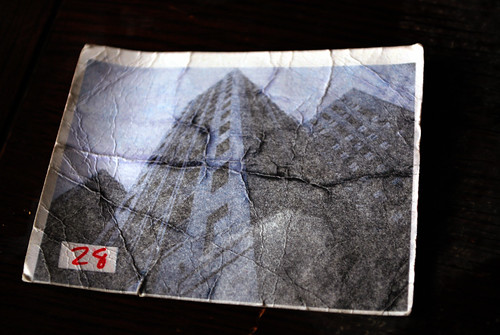
Left item #28


On returning from my recent trip to New York, I found the above claim check in the pocket of my coat. Clearly, I'd forgotten to redeem something I'd left with the management of some establishment. But what could the item have been? My fedora, my coat, and my shoulder bag all made the return trip with me. For a while I thought I'd lost a tie, and I enjoyed imagining a forgotten moment in some bar when, having been deemed overdressed, I was forced to strip it from my neck with a flourish and hand it to the coat check girl in the ripped Metallica t-shirt. But alas, even the tie eventually turned up.

Then there's the question of where I checked said mysterious object. The ticket bears no writing aside from that red "28," and gives no clue to its origins. I suppose the next time I'm in New York I could retrace my steps, presenting this claim check at every bar and restaurant I visited this time around, enduring blank stare after blank stare until, finally, someone takes the ticket with a brisk nod, spins on a heel and disappears into the back room to return moments later with . . . what?

Or I could turn to an old favorite, Ludovico Ariosto's Orlando Furioso (1516) and employ the method used by the English knight Astolfo, friend of the love-maddened Orlando, when he wishes to seek out poor Orlando's lost wits. Astride a hippogriff, he flies to the moon, and here, in Barbara Reynolds's translation, is what he finds there:
Between two mountains of prodigious height
The travellers to a deep valley went.
What by our fault, or Time's relentless flight,
Or Fortune's chances, or by accident
(Whatever be the cause) we lose down here,
Miraculously is assembled there.

Not only wealth and kingdoms, which the wheel
Of Fortune whirls at random among men,
But what she has no power to give or steal,
Such as the following, I also mean:
Tatters of fame are there, on which a meal
Is made (the tooth of Time is sharp and keen);
Prayers to God and penitential vows
Which sinners make with humbled knees and brows,

The tears of lovers and their endless sighs,
The moments lost in empty games of chance,
Vain projects none could ever realize,
The fruitless idleness of ignorance,
And unfulfilled desire--which occupies
More room than all the rest and more expanse:
In short, whatever has been lost on earth
Is found upon the moon, for what it's worth.
The question, I suppose, is how quickly left objects become the moon's responsibility? Is it after a set amount of time, or does it happen the moment the person holding the claim check has forgotten what it redeems? It would be extremely frustrating to arrive at the moon only to learn that Death & Co. still held my . . . whatever it is.

A trip to the moon's repository also offers risk of embarrassment, as Astolfo discovered when he entered the chamber containing various vials of lost wits:
A liquid, thin and clear, Astolfo sees,
Distilled in many vases, large and small,
Which must (so volatile the fluid is)
Be tightly corked; the largest of them all
Contains the greatest of those essences:
The mind of mad Anglante, of whose fall
You are aware and of his frenzied fits.
And on it the duke read: "Orlando's wits."

On other bottles too the names are shown
To whom the wits belong. To his surprise,
Astolfo finds a great part of his own.
A New York trek is sounding like the better idea all the time. I only hope whatever I checked wasn't perishable.

Friday, May 16, 2008

"They had met only a few hours before."

I came to New York on Tuesday with five books, which was too many.

I'm leaving with ten.

The silliest part is that four of them were bought when I was in full command of myself, during visits to St. Mark's, Book Culture (the former Labyrinth), and McNally Robinson, at times when, despite knowing that I had a book (or several) in my bag to read, I found things on the shelf I'd been thinking about . . . and now my luggage is that much heavier.

But perhaps at least tonight's book can be excused? I'll set the scene: I spent much of this rainy, rainy evening at the extremely welcoming cocktail bar Death & Co., having three drinks (two of which were not martinis, which should give anyone who knows me a sense of how convincing the bartender's skills were), with only my marathon-honed willpower steeling me against the desire for a fourth. As I drank, I read Oblomov, which led the aforementioned bartender to recommend Maxim Gorky, whom I've not read. So on my wander back to the subway I stopped in St. Mark's. They didn't have Gorky, but in the place where Gorky might otherwise have been was a very slim volume in Northwestern University Press's Writings from an Unbound Europe series, And Other Stories (2007) by Georgi Gospodinov. As someone who will remain forever grateful to that series for introducing me to Mesa Selimovic, I'm perhaps extra-susceptible to its charms . . . so I walked out with the book.

I work in publishing, so I know the considerations that go into the pricing of a book. The cost of production comes into play, but the overriding consideration is what the market will bear: how are other books of this ilk, aimed at this audience, priced? Can we get a price near that and still make money? But as a reader, there are times when the price I pay seems to bear absolutely no relationship to what I get from a book--what price Anna Karenina, after all? Or Labyrinths? In Search of Lost Time?

I of course wouldn't claim, on the basis of the one story from And Other Stories that I read twice in succession on the subway tonight, that this volume is on a level with those works. But there's no question that that lone story, "Peonies and Forget-Me-Nots," was all by itself more than worth the $14.95 I spent. Extremely brief--less than 1,500 words--it relates an airport encounter in Bulgaria between strangers: a man, who has a package, perhaps illicit, that is to be delivered to America, and the woman who is to carry it for him. As Gospodinov explains, "It was a five-minute job," but the two hit it off, and they talk and talk as the time until her flight leaves winds down:
And the silence was becoming unseemly. The small table in front of them was piled with empty plastic cups that had acquired most unexpected shapes after being fumbled at for hours. The coffee stirrers had long been broken into the smallest possible pieces, the empty sugar bags turned into tiny cornets and little boats.

It occurred to him that he could turn this table into a ready-made object, an installation, so to speak, that he could title An Apologia for Embarrassment (plastic coffee cups, stirrers, empty sugar bags, a white table.)
Inexplicably--and certainly unexpectedly--they've found something, someone.
"Let's talk," she said, as if they hadn't been talking nonstop for two hours.

The remaining hour was too little time to be wasted in beating around the bush and making boats. But since he wouldn't start talking, she said simply, "We have to accept it that sometimes people just miss each other."

"The whole irony of it is that they realize it the moment they meet," he said.

"Maybe we've met before. We've lived in the same city for so long. It's not possible that we haven't passed each other at some traffic light or other."

"I'd have noticed you," he said.

"Do you love her?" she asked.

"Do you love him?" he asked.
It's a formulaic conceit, unequestionably, and that, along with the sheer unlikeliness--these things don't, after all, happen, right?--should sink the story. But Gospodinov's spare language and emotional restraint affords the scene a melancholy, almost chilling power. The crux of the story comes just after the midpoint--after the pair have acknowledged their mutual attraction--when Gospodinov unexpectedly propels us into an already dimmed future:
Later he couldn't even remember who was the one who had come up with the life-saving (or so he thought then) idea of inventing shared memories, to make up a whole life together before and after their meeting.
That very concept ought to be laughably cliched, reeking of low-level fiction-writing classes--but the blunt parenthetical, "(or so he thought then)," throws the whole story into heartbreaking relief, making us believe--and care about--the pair's futile efforts to pretend their lives have been different. The rest of the story serves as a coda to that moment, agonizingly recounting their sincere, doomed efforts to cement their unexpected connection.

It's a hell of a story, and a good way to end a week in a city I've come to love but don't live in. See you next time, NYC.

Tuesday, May 13, 2008

Readers of a feather


{Spring Night, Greenwich Village, 1930, by Martin Lewis.}

On an overnight visit to Lichfield, Staffordshire, during our recent vacation to London, we visited a charming little museum devoted to Erasmus Darwin, a doctor, poet, and botanist who was the grandfather of Charles and a member of the learned society the Lunar Society, whose numbers included Josiah Wedgwood, James Watt, and Joseph Wright of Derby. From a placard at the museum, I unexpectedly learned that Erasmus Darwin and I are spiritual kin: a young woman wrote that when Dr. Darwin would set out to call on patients he would have
a pile of books reaching from the floor to nearly the ceiling of the carriage.
That was for a journey of a mere forty miles. I'm traveling much farther this week, and I'm proud to say that I've brought only five books.

Should I be pleased that I'm finally getting smart enough to heed the warning cries of my sore shoulders? Or should I feel silly that I brought even that many to a city that is lousy with books? But what if I were to run out . . . and so did New York's bookstores? Disasters do happen in publishing, after all--like the supply-chain mishaps that, according to biographer Ron Powers, nearly brought down Mark Twain's publishing company:
Then bad luck struck the business, in the form of fires and contagious horse diseases that slowed down book shipment.
Perhaps I should stop by St. Mark's tonight, just in case of horse disease.

Saturday, January 12, 2008

A New York Saturday morning


Looking out my hotel room window this Saturday morning on the deserted office building across the street, I am reminded of another passage from E. B. White's "Here Is New York":
On weekends in summer the town empties. I visit my office on a Saturday afternoon. No phone rings, no one feeds the hungry IN-baskets, no one disturbs the papers; it is a building of the dead, a time of awesome suspension. The whole city is honeycombed with abandoned cells--a jail that has been effectively broken. Occasionally from somewhere in the building a night bell rings, summoning the elevator--a special fire-alarm ring. This is the pit of loneliness, in an offices on a summer Saturday. I stand at the window and look down at the batteries and batteries of offices across the way, recalling how the thing looks in winter twilight when everything is going full blast, every cell lighted, and how you can see in pantomime the puppets fumbling with their slips of paper (but you don't hear the rustle), see them pick up their phone (but you don't hear the ring), see the noiseless, ceaseless moving about of so many passers of pieces of paper: New York, the capital of memoranda, in touch with Calcutta, in touch with Reykjavik, aways fooling with something.
I love the way White uses parentheses to modulate the sound of that last sentence, separating the sights (seen) from the sounds (unheard): the parentheses effectively muffle the sounds you aren't hearing, creating the silent distance he describes.

White, along with William Strunk Jr. wrote the book on prose style, so he is known for his careful, clear, and memorable writing, but it's a treat to encounter anew every time nonetheless. Like the prescriptions of The Elements of Style itself, White's prose wouldn't be well suited for every type of writing--a noir novel, for example, would be difficult to lift out of parody under White's guidance (though it would sure be fun to watch him try!). But a man who can write a sentence as balanced, assonant, and whimsical as this one--
Doormen grow rich blowing their whistles for cabs, and some doormen belong to no door at all--merely wander about through the streets, opening cabs for people as they happen to find them.
--need never apologize for what he can't do.

Thursday, January 10, 2008

Old New Yorks

In his 1948 essay "Here Is New York" E. B. White wrote that "To a New Yorker the city is both changeless and changing." What a visitor like me sees is countless New Yorks of the past living on in everything from the thrilling shine of the Chrysler Building--triumphantly shouting, "Progress!"--to the accidental decoupage archaeology of rock show handbills in the Village--derisively sneering, "Throw it all away." And New York seems to be always, aggressively, doing both.

As I've wandered the city this week, I've also wandered earlier New Yorks in books, traces of which remain visible in the streets around me. I've already written briefly about one of those, Edith Wharton's New York of carriages, balls, and finely delineated social strata. But I've also lost myself in E. B. White's exuberant postwar Manhattan and Lawrence Block's beat-era Greenwich Village.


{52nd Street, 1948, from the Library of Congress's American Memory project.}

White's essay needs no introduction; it's generally regarded as an essential portrait of the city. White writes not so much about specific places as about certain moods and typical scenes: the wrestle for a cab, Bowery winos bedding down, the casual attention of the crowd at an outdoor performance in Central Park. This is the city as gliding complexity and atmosphere:
It is seven o'clock and I reexamine an ex-speakeasy in East Fifty-third Street, with dinner in mind. A thin crowd, a summer-night buzz of fans interrupted by an occasional drink being shaken at the small bar. It is dark in here (the proprietor sees no reason for boosting his light bill just because liquor laws have changed.) . . . The owner himself mixes. The fans intone the prayer for cool salvation.
The prominence of the whispering fans in that scene is a reminder of how much of what White writes about is now lost: "Here Is New York" is a summer essay, written in the days before air-conditioning was widespread, and there is much in it of the street life and overheard intimacy generated by open windows and inescapable heat. The arrival of air conditioning is a seeming small thing relative to the scale of a city, yet it leads the windows, transoms, and back doors to be closed, people to be sealed off just a tiny bit more from one another and from the city they make together.


If White is writing about the city as one big agglomeration of individuals, Lawrence Block, in A Diet of Treacle (1961) is writing about how those individuals try to define themselves in opposition to that mass. It follows a trio of young people through beat-era Greenwich Village: Joe, who returned from Korea with emotional damage that expresses itself as a vague inability to do; Anita, a Hunter College student who visits the Village to escape the square life she can already see stretching before her; and Shank, the sociopathic pot dealer who will quickly get them in over their heads.

A Diet of Treacle was probably fairly provocative at the time it was published: it's full of scenes of pot-smoking and sex, and the characters show increasingly little regard for social conventions. But now it's more an interesting artifact, even a work of reportage, an account of the lingo and poses of late-1950s hipness, full of "cats" and "squares" and "bread." The portrayal of pot as a phenomenally powerful, life-changing drug is particularly quaint at this distance, but pot is an important part of what defines these kids: knowing it and using it marks them as different.

In his novel Lucky at Cards, Block portrayed the tug-of-war between the allure of the criminal life and the reliability of the straight side. In A Diet of Treacle, he shifts the terms a bit: though he demonstrates with the luridness of a school filmstrip the dangers of a life consumed by, for want of a better term, criminal hipness, he doesn't pretend that the straight life holds any real appeal for these kids, either. As Block portrays them, they really are stuck, their only safe choice being to sink back into the stultifying conformity of 1950s America.

Wandering Greenwich Village today you still see kids trying to make that choice--or, even more, trying to simply frame it, to decide what's conforming and what's not, what's hip and what's not, what's selling out and what's staying true. I find it almost painful to watch, but maybe I shouldn't. Should I instead take heart in the way that generation succeeds generation down there--and that despite (as the great blog Pinakothek lamented a few weeks ago) the ever-greater ease of buying a hip identity, every generation sees some of those kids slip through, shed poses, and find what truly matters to them? Should I take heart that, so far, Greenwich Village, despite changing and changing and changing, is still in some essential way there for them?

Meanwhile, I continue to wander today's city that will be different tomorrow, dressed as usual like an anachronism in my old suit, overcoat, and fedora, which I discovered yesterday must make me stand out from all the other oddities that comprise a New York street scene--enough at least to draw the attention of a contemporary iteration of one of Block's hipsters: as I walked down 25th Street just past Madison Square Park, a baggily-dressed long-haired teen, lost in the music of his headphones, raised his head just enough to see me, cocked a finger, and said, with an air of approval, "Fedora." Then he bopped on, going about his business, and disappeared into the crowd.

Tuesday, January 08, 2008

The streets of once and future New York?


I'm in Manhattan, where it's a balmy sixty-something degrees and people are walking around with the pleased but fretful look of kids sneaking candy--they're sure they're going to get their hands smacked for it, but it's so good while it lasts. I half-expect to see palm trees and giant mosquitoes, or maybe a diplodocus breaching the lagoon.

For a while this afternoon, however, the subway insulated from the lovely weather, and Edith Wharton plunged me right back into winter--and the turn of the twentieth century--with the descriptive passages that open her story "A Cup of Cold Water." Everyone knows Wharton as a keen chronicler of society and the psychological chafing of the individual within it; what I'm learning is that she is just as attentive to the physical world.

I'm going to quote a bit more than I usually would, because I think you need all three paragraphs to get a sense of how Wharton renders the cityscape with precision and invests it with the soberly pessimistic perspective of its observer:
It was three o'clock in the morning, and the cotillion was at its height, when Woburn left the over-heated splendor of the Gildermere ballroom, and after a delay caused by the determination of the drowsy footman to give him a ready-made overcoat with an imitation astrachan collar in place of his own unimpeachable Poole garment, found himself breasting the icy solitude of the Fifth Avenue. He was still smiling, as he emerged from the awning, at his insistence in claiming his own overcoat: it illustrated, humorously enough, the invincible force of habit. As he faced the wind, however, he discerned a providence in his persistency, for his coat was fur-lined, and he had a cold voyage before him on the morrow.

It had rained hard during the earlier part of the night, and the carriages waiting in triple line before the Gildermeres' door were still domed by shining umbrellas, while the electric lamps extending down the avenue blinked Narcissus-like at their watery images in the hollows of the sidewalk. A dry blast had come out of the north, with pledge of frost before daylight, and to Woburn's shivering fancy the pools in the pavement seemed already stiffening into ice. He turned up his coat-collar and stepped out rapidly, his hands deep in his coat-pockets. As he walked he glanced curiously up at the ladder-like door-steps which may well suggest to the future archaeologist that all the streets of New York were once canals; at the spectral tracery of the trees about St. Luke's, the fretted mass of the Cathedral, and the mean vista of the long side-streets. The knowledge that he was perhaps looking at it all for the last time caused every detail to start out like a challenge to memory, and lit the brown-stone house-fronts with the glamour of sword-barred Edens.

It was an odd impulse that had led him that night to the Gildermere ball; but the same change in his condition which made him stare wonderingly at the houses in the Fifth Avenue gave the thrill of an exploit to the tame business of ball-going. Who would have imagined, Woburn mused, that such a situation as his would possess the priceless quality of sharpening the blunt edge of habit?
I absolutely love the image of the streets of New York being mistaken for ancient dry canals; it's the sort of vision that can change your whole way of looking at a street--especially, I suppose, on a day like today that, however lovely, in its aberrant mildness seems to be screaming, "GLOBAL WARMING! GLOBAL WARMING! LOOK OUT! FLOODS AND PLAGUES TO COME!!!"

But enough with the gloom and doom. I'm going to go find someplace where I can drink a martini . . . outside . . . in January!

Monday, January 07, 2008

"You cannot accomplish anything in the way of business, you cannot even pay a friendly call, without devoting a whole day to it."


{The Black Maria--prisoners leaving the van at the foot of Twenty-sixth Street, New York City, to embark for Blackwell's Island, 1867. Found at NYC Snapshot.}

From a letter Mark Twain sent from New York as correspondent for the Alta California newspaper February 2, 1867, published March 28, 1867
If you live below Twenty-fifth street, you are "down town;" and if you live anywhere between that and Seven Hundred and Seventy-fifth street (I don't know how far they run--have quit trying to find out), you will never get down town with out walking the legs off yourself. You cannot ride. I mean you cannot ride unless you are willing to go in a packed omnibus that labors, and plunges, and struggles along at the rate of three miles in four hours and a half, always getting left behind by fast walkers, and always apparently hopelessly tangled up with vehicles that are trying to get to some place or other and can't. Or, if you can stomach it, you can ride in a horse-car and stand up for three-quarters of an hour, in the midst of a file of men that extends from front to rear (seats all crammed, of course,)--or you can take one of the platforms, if you please, but they are so crowded you will have to hang on by your eye-lashes and your toe-nails.

I'm off to New York for a few days. I'm taking along the The New York Stories of Edith Wharton and the new Lawrence Block novel from Hard Case Crime, and am dithering on some Dawn Powell--all to go along with Proust or a Byron bio, between which I cannot decide today. Any other New York books I should be sure to carry?

Tuesday, September 18, 2007

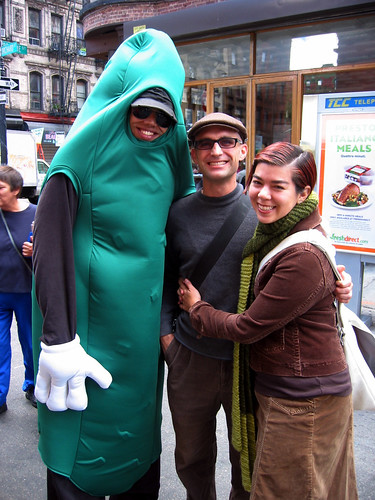
Two of the people in this photo are celebrating their wedding anniversary.


If you surprise your wife on a Friday morning by announcing that you've spent four months secretly planning a trip to New York to celebrate your seventh wedding anniversary, and that you're leaving that night, it's even more fun, when she asks what you're going to be doing in New York, to be able to tell her, "We'll be going to International Pickle Day!"

We ate a lot of regular pickles, some pickled beans and radishes, some kimchi, some more pickles. And here, I suppose, is this post's tenuous connection to this blog's ostensible purpose: in reading the International Pickle Day materials, I learned two new terms for cucumbers: curvey describes a type of cucumber that is destined for pickling (56% of the nearly 3 billion grown annually in the United States), while slicer refers to a cucumber that is to be shipped to groceries and sold as is. I also learned the Dutch phrase in de pickel zitten, which means "to sit in the pickle"--the rough equivalent of our "to be in a pickle."

It was a great trip. We saw friends, had good food and drink, talked about books and music, heard stories of bad workplaces. Which leads me to think, once again, that there really isn't enough fiction about office life, relative to the amount of time and emotion we spend there. Though maybe Bartleby the Scrivener is enough?

Bartleby reminds me that there were of course books on the trip, too. We met our friend Bernice at the Brooklyn Book Festival, where I couldn't resist picking up some of the beautifully designed novellas published by Melville House. And my current Prince fixation led me to pick up a book on his album Sign 'o' the Times by my friend Maura's sometimes co-blogger Michaelangelo Matos, who won me over with this line:
The only music from 1987 to match it for sheer libido isn't an R&B record-it's Guns 'n' Roses' Appetite for Destruction, cock-rock metal with a disco rhythm section.
At the Book Festival, we also saw a panel featuring Ed from the Dizzies, along with Rob Sheffield and Chuck Klosterman--the last of whom came out with an unforgettable (if possible untrue?) line:
Even with something you absolutely love, if you think about it long enough, you can make it seem horrible.


Oh, and we wandered the Strand, where I picked up Mary Ann Caws's impressionistic, digressive volume on Proust in the Overlook Illustrated Lives series, from which I gleaned this anecdote:
At the moment when [Proust's brother] Robert was about to marry Marthe in the nearby church of St. Augustin, Proust, panicked as usual over the notion that he might be cold, stuffed his tuxedo with a great mass of thermal wadding, placed several mufflers around his neck, and three overcoats over the tux, and so attired, was too massive to get down the aisle and had to stand aside. "To each row in turn he announced in a loud voice that he had been ill for months, that he would be still more ill that evening, that it was not his fault."
Proust as Monty Python character--now that's a side of the man I would never have expected to see.

All in all, a lovely whirlwind trip. Now back home, and back to regularly scheduled blogging. And, you know, work and all that stuff, too.

Friday, September 14, 2007

"New York had all the iridescence of the beginning of the world."


From F. Scott Fitzgerald's "My Lost City," collected in The Crack-Up (1945)
"What news from New York?"
"Stocks go up. A baby murdered a gangster."
"Nothing more?"
"Nothing. Radios blare in the street."


No blogging for a few days, as we're off to New York for the weekend.

Thursday, December 14, 2006

It's a helluva town.

I'm in New York this week for work, so my reading is on the subway instead of the L. Some New York notes:

1) I started my trip, on the plane, with the least New York book I had handy, Wendell Berry's new novella, Andy Catlett (2006). Berry is a man of the country and the farm, unimpressed by cities, though he has lived in them at times, and Andy Catlett is in part a lament of everything that I can hear right now through my hotel window, the sounds of post-War America--fueled by petroleum, always on the go, mind always split between here and there, now and the future. It's an elegiac book, despite being written about a nine-year-old boy, and in picking it to bring, I guessed right: its slow cadences put me in the right mood for entering the city.

2) But once I got to my hotel, the Hudson, I had no choice but to leap with both feet into the future that to Berry is of such uncertain value, for the Hudson resembles nothing so much as a vision of tomorrow dreamed up by Wong Kar Wei and Haruki Murakami, with the addition of at least a dollop of Eurotrash. So back to Murakami I went, this time to Norwegian Wood (1987, translated into English in 2000).

And I was pleasantly surprised to discover that Norwegian Wood is haunted by a similar sense of loss to that which pervades Andy Catlett. A thirty-seven-year-old man looks back, from 1987, on a love of his 1960s youth:
Each time [that memory] appears, it delivers a kick to some part of my mind. "Wake up," it says. "I'm still here. Wake up and think about it. Think about why I'm still here." The kicking never hurts me. There's no pain at all. Just a hollow sound that echoes with each kick. . . . Which is why I am writing this book. To think. To understand. It just happens to be the way I'm made. I have to write things down to feel I fully comprehend them.
For all that Murakami's books get discussed as weird pageants of contemporary life, icons of postmodernism, the ones I've read have all featured narrators driven by loss, alienated from their past or from the world by people they can't have back, decisions they can't unmake, times they can't recapture. There is a similarity in tone between Murakami and Berry, or Murakami and Anthony Powell, or Proust, that I never expected when I first opened his novels.

3) For weeks, I've been trying to remember the name of a contemporary British author, whose multi-volume family saga has been reviewed favorably, and whose prose style seemed like one I would appreciate. Take this exchange, for example:
"Imagine wanting to talk to someone on the phone," said Eleanor. "I dread it."

"Youth," said Nicholas tolerantly.

"I dreaded it even more in my youth, if that's possible."
Wanting to read this unknown author's collected novels, and knowing what its spine looked like, I'd even gone so far as to quickly look over all the fiction shelves at 57th Street Books in an attempt to circumvent my faulty memory, but to no avail. Then last night, while waiting to meet some friends, I wandered into Three Lives and Company on 10th Street and there it was, stacked high on the front table of staff favorites: Edward St. Aubyn's Some Hope (2003).

When fate gives you such clear instructions to buy a book, you are required to do so, fidelity to your local bookstore and lack of space in your luggage be damned.

4) As a longtime Joseph Mitchell fan, I talked the aforementioned friends into visiting McSorley's Old Ale House last night, and I was pleased that it was all I could have hoped for, abjuring modernity while somehow avoiding the deadly taints of kitsch or irony. The urinals alone--deep, tall, and majestic--made me feel young and insignificant, part of a lesser, fallen generation. We can't even pee like they used to pee.

Then we proceeded to irk our waiter with our frequent indecision in the face of his queries. It was hard to fault him: after all, one's only choices are light or dark, have another round or don't. And again I felt a failure. Joseph Mitchell would have had no trouble deciding. William Maxwell would have had no trouble deciding. Hell, had they allowed women back then, Dorothy Parker would have had no trouble deciding.

A couple of times, our waiter simply decided for us, always in the affirmative, always for the dark, and he was right, of course. We drank what was put in front of us and talked, of, among other topics, baseball, on which subject we were not the only patrons dwelling on this mid-December night. Imagining people talking of Ruth and DiMaggio in their day, just as we talked of Pettite and Giambi, made me feel a bit better about our efforts as patrons.

But my confidence received its largest boost when, as we made our thanks and headed for the door, the waiter chucked me on the elbow and said, "That's a nice suit."

Had I had my proper hat, I would have tipped it to Joseph Mitchell as I left.