Showing posts with label Sputnik Sweetheart. Show all posts

Wednesday, September 05, 2007

Murakami and Laika, part two

Part one is here.

Appropriately enough for the novel that followed the tales-within-tales of Murakami's grandly ambitious The Wind-Up Bird Chronicle, the uncanny enters Sputnik Sweetheart through a story, told by a woman with whom Sumire has fallen in love. It's a stunningly creepy account of a late-night experience at a carnival that turned her hair white and, she says, essentially broke her--and her life--irrevocably into two pieces. From there, the strangeness builds, and the Greek island begins to resemble a de Chirico painting, shadowy and depopulated, but with hints of threatening life around every corner; following more than a hundred pages of straightforward realism, the eruption of the fantastic--and chilling--is all the more believable and compelling. From the start we knew that the novel would end with loss, and the strange events surrounding that loss, never clearly explained, serve both to deepen its impact and make it seem sadly inevitable.

My friend Kristi calls Murakami a pessimist, while I've argued before on this blog that he strikes me as at worst a grudging optimist. After I read Norwegian Wood, I wrote that Murakami's vision, without denying life's traumas, seems to honor the simple effort of daily living:
Norwegian Wood is crowded with suicides, nearly all by teenagers. . . . . Some of the kids have fairly clear reasons, while others are essentially inexplicable, but the overall sense is that, faced with the quotidian difficulties of life, they decided they were unable to continue. In the face of so much death, there is a real sense of hard-won victory, of tangible achievement in the simple fact that the narrator is still alive twenty years later, able to vividly recall and tell us this story of his youth. His life has included great loss, disappointment, and sorrow, but he has kept going.
We don't know for sure that the narrator of Sputnik Sweetheart will make that choice, but the book closes on a note of quiet determination.

Which brings me back to Laika. What is Murakami trying to say by linking his story to that one? Is Kristi right about Murakami's pessimism? That doesn't seem so far-fetched: after all, Laika's story is one of sheer hopelessness--there was never a way out for her, just as it seems that there was no way Murakami's narrator in could have kept his love.

I recently told a friend that an essential part of writing a blog like this is a willingness to make decisions about works of art and seem reasonably confident about them--despite knowing that somewhere down the road I might change my mind, or be convinced that I was wrong. In interpreting Laika's story I will admit to being less confident than usual; Murakami's stories are richly multivalent, and I fear that I may be seeing what I want to see. As I continue reading my way through Murakami's oeuvre, I realize that I may reach a different position.

But for now I prefer to read the story as support for my view of Murakami the grudging optimist. We are all like Laika to some extent, set in motion by forces we don't know and can't understand, heading to a destination we can't even conceive clearly. Of course, most of us are much luckier than Laika, our fates nowhere near as horrid--but at the same time, like her we are constantly watching people and things we love and cherish fall away beneath us, loss perhaps the only constant in our long lives.

Yet our space capsule keeps moving, ultimately out of our control, and we have to keep moving with it--so we might as well look out the window and continue thinking about what we see. Faced with the inevitability of loss, we must find a way to give that loss meaning while simultaneously attempting to retain what we can't afford to lose, our very self. So we tell stories, and we pass them on, and meanwhile we pay attention to the things of the world--the art, yes, but also the ephemera and the junk, the very stuff that hedges us about and helps, whether we like it or not, to define who we are.

We can't possibly come through life whole, but if we shore up enough of that everyday stuff, after a terrible loss we just might be able use it as a sort of mold, a place in which to re-form the shattered self. The first step, Murakami seems to remind us again and again, is simply to keep taking the first step.

Murakami and Laika, part one

Every time I write about Haruki Murakami's novels, I find myself moving past a simple evaluation or recommendation (That part is easy: they're deeply rewarding and you should read them.) to consider instead just what Murakami is trying to say, what his larger intentions might be. His meanings are never quite clear; he surrounds them with an organic strangeness, an obscurantism that seems not so much willful--let alone ill-intentioned--as inherent and essential.

To open Sputnik Sweetheart (1999), however, Murakami employs a tool that writers have long used as a way to draw readers' attention to their underlying themes and intentions: an epigraph. Taken from The Complete Chronicle of World History, it reads:
On October 4, 1957, the Soviet Union launched the world's first man-made satellite, Sputnik I, from the Baikanor Space Center in the Republic of Kazakhstan. Sputnik was 58 centimeters in diameter, weighed 83.6 kilograms, and orbited the earth in 96 minutes and 12 seconds.

On November 3 of the same year, Sputnik II was successfully launched, with the dog Laika on board. Laika became the first living being to leave the earth's atmosphere, but the satellite was never recovered, and Laika ended up sacrificed for the sake of biological research in space.


Seemingly ever since the launch, people have found Laika's story powerfully moving, and artists and writers have drawn on it in various forms. (Jeanette Winterson recently turned Laika into a central component of her retelling of the myth of Atlas, Weight.) Why, in the face of the many indisputably worse acts perpetrated by humans in recent decades, does this one story resonate so strongly? In large part, unquestionably, it's simply because Laika was a dog, and many people are irrationally sensitive to the welfare of dogs in a way that they are not about other animals, including humans. But I think it's also--maybe even primarily--because the horrific circumstances make it unusually easy for us to put ourselves in Laika's place and imagine what she felt: from everything you can tell, you're doing what you should do, behaving how you're supposed to behave, when suddenly everything you've known is gone and you've been utterly abandoned. It's an image of deep loss and despair, mixed with a cruel, incomprehensible fate--and that's the pall that Murakami's epigraph casts over Sputnik Sweetheart.

Opening the book in that mood, I was reminded of Murakami's Norwegian Wood, which shares that air of inevitable loss. And sure enough, from the elegaic first paragraph on, Sputnik Sweetheart reads like a stranger, more sinister cousin of Norwegian Wood. They tell stories that are similar in their rough outline, of doomed love affairs, but while Norwegian Wood is narrated by a middle-aged man looking back on his college years, Sputnik Sweetheart is related by a twenty-four-year-old who has only recently experienced--and not by any means yet come to grips with--the events he describes. Both men love a young woman who cannot, for various reasons, return that love; the men turn instead to other women who are attractive, interesting, and sympathetic but who will never be able to displace the unavailable lover. In both novels, the desired women remove themselves to remote locations while the men are left alone, biding their time, yearning. Murakami's treatment of that yearning is deeply poignant in both books, though it takes noticeably different forms in the prose of the two novels--more wistful in the case of Norwegian Wood's older narrator, affectless to the point of naivete in the case of Sputnik Sweetheart, a reminder that Murakami's straightforward style, despite its seeming transparency, is the product of skill and care.

For half of its length, Sputnik Sweetheart also seems to share the commitment to realism that makes Norwegian Wood stand out among Murakami's novels. None of his trademark fantastical strangeness, or, really, even his quirkiness, is to be found--until suddenly the narrator receives a late-night phone call from the Greek island where the young woman, Sumire, has been staying, and the uncanny breaks into his reality.

This is getting very long, so I'll save the rest for tomorrow.

Wednesday, August 22, 2007

Some advice, or a field report from the War on Rest


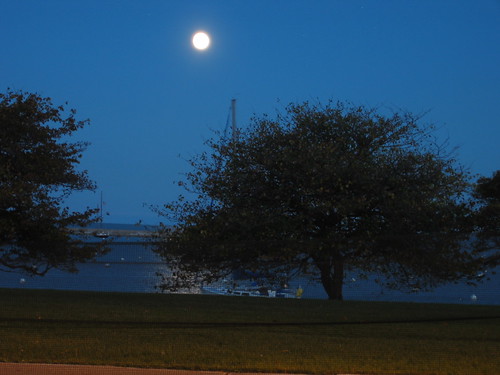
{Photos by rocketlass.}

If you ever find yourself, after dinner, intending quickly to write about Geoff Dyer's Out of Sheer Rage, which you've just finished, and soon after to get to bed at a reasonable hour, then I recommend that you do not pick up the copy of Sputnik Sweetheart that a friend has just returned, no matter how innocuous it looks lying there on the kitchen counter.

Nor, if you do find yourself going so far as to pick it up, do I recommend thinking to yourself, "I've not read any Murakami for a while," then opening the book and a beer at the same time.

For if you do, I can now tell you from experience, a few hours later you'll read this passage:
I glanced at the full-length mirror as I passed by, at my face reflected in it. A strange expression was on my face. That was my face, all right, but where did that look come from? I didn't feel like retracing my steps and investigating further.

Sumire stood at the entrance to her new place to see me off. She waved goodbye, something she rarely did.

In the end, like so many beautiful promises in our lives, that dinner date never came to be.

Then a few hours after that, when the darkness has driven you from your perch on the back steps and the cicadas have claimed the cemetery next door as their sovereign domain once again until dawn, you'll come to this passage:
In the sky above the summit, the coarse-looking moon loomed awfully near. A hard ball of stone, its skin eaten away by the merciless passage of time. Ominous shadows on its surface were blind cancer cells stretching out feelers toward the warmth of life. The moonlight warped every sound, washed away all meaning, threw every mind into chaos.


Finally, when you close the book, pointedly not looking at the clock, all hope for a reasonable amount of sleep will have long since slunk away, defeated.


In the war on rest, the novel remains a fierce, indefatigable partisan.