So . . . back on Monday I promised that, come today, proper blogging would resume. You know, the usual: some aptly chosen passages, maybe some wry commentary mixed with earnest enthusiasm and bone-deep nerdy love of books?
Well, it turns out that I lied: I'm here once again only to point you elsewhere. But rest assured that the link is far from tenuous; rather, I'm pointing you to yet more of my writing about Isaac D'Israeli and his glorious Curiosities of Literature. This time, I'm writing about the book in honor of the first anniversary of the online literary magazine the Second Pass, as part of a group of people gathered to rave about their favorite out-of-print books. The whole piece is well worth checking out . . . and if any of you happen to be chummy with the editors of the NYRB Classics line, I hope you'll give Mr. D'Israeli a good word on my behalf.
Surely the Germans have come up with a word for lying about your plans to blog? Well, if so, they won't have to use it on Friday: I double super-promise to be back Friday with a post about butlers. Butlers! What more could you want?
Showing posts with label The Second Pass. Show all posts
Showing posts with label The Second Pass. Show all posts
Wednesday, March 10, 2010


Thursday, December 17, 2009
Looking ahead . . . to 2110!
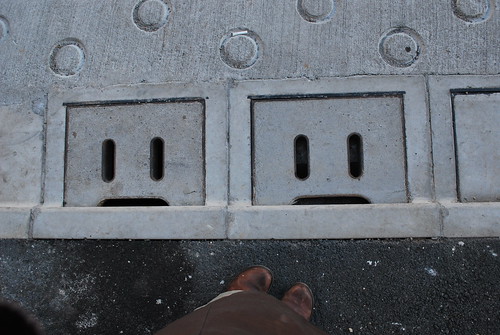
{Photo by rocketlass.}
One of the most fun pieces of criticism I read all year was the Second Pass's "Fired from the Canon" article from mid-summer, in which a handful of anonymous reviewers gleefully slagged books by such eminent writers as Dickens, Faulkner, Garcia Marquez, DeLillo, and more. Find yourself the right bar--one with a literary clientele and free wifi--and you just might have enough fodder argument fodder there to enable you to break John Steinbeck's twenty-seven-martini record.
The holidays, however, are a more generous time, and in that spirit the Second Pass today published a complementary article, "The 2110 Club," in which they invited contributors to make a pitch for one book, relatively little-known or poorly understood now, that they could imagine holding up for a century.
The resulting list of books includes a couple of old favorites--and that's before you get to my own contribution, which I describe as "a novel so grim—and so relevant—that it’s almost painful to read." If that doesn't whet your appetite enough to make you postpone wrapping presents for a few minutes, what will?
Friday, July 10, 2009
Fightin' words
Over at the Second Pass, the editors have assembled a post calling out canonical novels that they can't stand. The contributors issue merciless beatdowns to ten novels, from Victorian classics (A Tale of Two Cities) to recent sensations (The Corrections).
As should be the case in a fight-picking post such as that one, the writing is at its best when it hits a novel you instinctively want to defend, but suddenly, cringingly, find you can't. Like D. H. Lawrence's The Rainbow, about which I have many fond memories, but about which the anonymous contributor writes,
I was, after all, merely nineteen years old when I read it: some people, at that age, fall for Bukowski; others of us, nerdier, fall for Lawrence. {And, in the spirit of the Second Pass's post, I can't help but point out that at least us Lawrentians get over him eventually . . . }
Go check out the list, then register your complaints and/or approbation in their comments section.
As should be the case in a fight-picking post such as that one, the writing is at its best when it hits a novel you instinctively want to defend, but suddenly, cringingly, find you can't. Like D. H. Lawrence's The Rainbow, about which I have many fond memories, but about which the anonymous contributor writes,
The book was yanked [from circulation] for ostensibly racy sex, but you won’t find much of that here. Instead, much of what it contains — redundant, stultifyingly interior, almost eventless — is reminiscent of nothing so much as the things an English prof endures on the way to getting into a sensitive student’s pants: the gushing, the journal reading, the unedited first drafts. Viz:But . . . but . . . I sputter--then I find myself wondering whether the one novel that I had believed good enough to transcend the humorless self-importance that suffuses Lawrence's every word may actually be just as purple and melodramatic as the rest.She could be very happy. And she wanted to be happy. She resented it when he made her unhappy. Then she could kill him, cast him out. Many days, she waited for the hour when he would be gone to work. Then the flow of her life, which he seemed to dam up, was let loose, and she was free. She was free, she was full of delight. Everything delighted her.
I was, after all, merely nineteen years old when I read it: some people, at that age, fall for Bukowski; others of us, nerdier, fall for Lawrence. {And, in the spirit of the Second Pass's post, I can't help but point out that at least us Lawrentians get over him eventually . . . }
Go check out the list, then register your complaints and/or approbation in their comments section.
Thursday, July 02, 2009
John Crowley and the Second Pass
Just in time for the holiday, I'm up at the Second Pass with a review of John Crowley's new novel, Four Freedoms, one of the most quietly, thoughtfully patriotic novels I've ever come across.
As I've done before, I figure I might as well use this space to share a passage that I marked in my notes, but wasn't able to find a place for in the review; I initially flagged it for the lovely little slang term Crowley throws in at the end, but the elegant beauty of its closing sentence is worth noting, too, a reminder of Crowley's skill with descriptive prose. The scene finds the book's protagonist, Prosper Olander, deep into a night of drinking with a young woman he's recently met:
As I've done before, I figure I might as well use this space to share a passage that I marked in my notes, but wasn't able to find a place for in the review; I initially flagged it for the lovely little slang term Crowley throws in at the end, but the elegant beauty of its closing sentence is worth noting, too, a reminder of Crowley's skill with descriptive prose. The scene finds the book's protagonist, Prosper Olander, deep into a night of drinking with a young woman he's recently met:
"Well if you want to take a walk, maybe we can get a car."Happy Fourth of July, everyone. Raise a glass to our forefathers (and mothers), and I'll see you again Monday.
"Swell," she said. "One more drink."
"Really?"
"Oh Prosper," she said rising. "Don't be a better-notter."
The band was playing a waltz as Prosper and Diane went out, and the three women were singing mournfully about love and loss, and Pancho and his friend were turning to each other with regal care.
Thursday, March 26, 2009
"Leviathan is not the biggest fish;--I have heard of Krakens," or, To the boats!
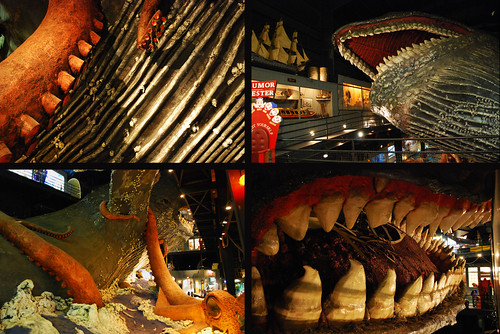
{Photos by rocketlass.}
From Moby-Dick, by Herman Melville
What is the great globe itself but a Loose-Fish? And what are you, reader, but a Loose-Fish and a Fast-Fish, too?A press of obligations has me feeling much more like a fast-fish than a loose-fish today, but I feel I should at least take the time to point you to my guest post on the blog of the recently launched online book site the Second Pass. Follow that link and you'll find me raving about an old favorite, Moby-Dick, and a new favorite, Dan Beachy-Quick's A Whaler's Dictionary; dig around the site some more and you'll find plenty of good stuff (including an excellent appreciation of Russell Hoban's doomsday novel, Riddley Walker).
But first, back to Melville. I hope that if I've established anything with this blog, it's the fact that one book always leads to another: my love of Moby-Dick led me to pick up A Whaler's Dictionary when I spotted it in St. Mark's back in January; reading it led me both back to Moby-Dick and, thanks to a recommendation from reader ctorre, forward to Paul Metcalf's unclassifiable novelish book Genoa: A Telling of Wonders (1965), which takes much of its material and inspiration from Melville.

You enter one book, but you may find that the only exit from that book opens right into another one; as Metcalf writes,
[S]inking in one ocean, I have risen to the surface of another--in a different hemisphere, or on the other side of the equator. The heart beats, the blood flows, the lungs inhale and discharge air--but all are radically altered.I've been dipping into all three volumes here and there for months; the melting away of the lake ice and the halting approach of spring makes me think it's the right time to banish all other books from my shoulder bag and read only the tales of the whale for a while.
So I'll plunge in, and who knows what I might find at the confluence of the three books' waters? Perhaps I'll discover what Beachy-Quick describes in his entry for "Line":
Every book, unlike every whale hunt, ends in silence. The line runs out and becomes blank.
Subscribe to:
Posts (Atom)