Showing posts with label John O'Hara. Show all posts

Friday, July 20, 2012

The Johns Steinbeck and O'Hara

Since John Steinbeck's name popped up here not long ago (in a passage from a letter by George Lyttelton slagging one of his lesser efforts, The Wayward Bus), I'll close this recent run of quotes from John Sutherland's Lives of the Novelists with a look at his entry for Steinbeck. Sutherland's biographical sketch is fairly dismissive, essentially agreeing with Fitzgerald's characterization of Steinbeck as a "rather cagey cribber." In his middle period he cribbed from Hemingway, whom he met one time, in the early 1940s:
John Hersey, who set it up, records that the occasion was a "disaster." Steinbeck had given fellow novelist John O'Hara a blackthorn stick. Hemingway grabbed the stick from O'Hara and broke it over his own head and threw the pieces on the ground, claiming it was a "fake of some kind." Drink was probably behind his actions, but one is tempted to allegorise the episode as Hemingway protesting Steinbeck's appropriation of "his" style. That is how Steinbeck read the event, at least. According to Hersey, "Steinbeck never liked Hemingway after that--not as a man."
With O'Hara and Hemingway involved in an altercation, I think it's safe to say that, yes, drink played a part.

I'm inclined to give Steinbeck a tad more credit than Sutherland. Of Mice and Men is simple but moving, and East of Eden, while stagey in places and a tad overblown throughout, is nevertheless powerful. The Red Pony and The Pearl, on the other hand, those staples of middle-school curricula, are horrid and have probably done as much to destroy a love of reading as handheld video games.

Sutherland does at least let Steinbeck off more easily than the aforementioned John O'Hara. O'Hara gets more credit for his best work--Sutherland praises Appointment in Samarra, though he neglects to mention the great novellas of the early 1960s--but as a man he comes in for harsh judgment. In contrast with John Hersey, whose bio precedes O'Hara's, Sutherland writes,
Stylish decency was never the calling card of John O'Hara. Words like "oaf," "lout," and "brute" attach themselves to him, particularly in his drinking days. "A strange, unpleasant man," one critic calls him. Paul Douglas, the Hollywood star, once grabbed O'Hara by his necktie and made a good attempt at throttling him, after an especially obnoxious piece of drunkenness. Many wished Douglas had succeeded.
And that's all with Sutherland leaving out my favorite O'Hara story, of the time he greeted a friend for lunch while wearing no pants . . . which wasn't even his worst offense of the day. But the point is made: O'Hara was a writer better encountered on the page than over a drink.

Monday, August 23, 2010

“The quantity is naturally indefinite,” Or, Prohibition and its discontents


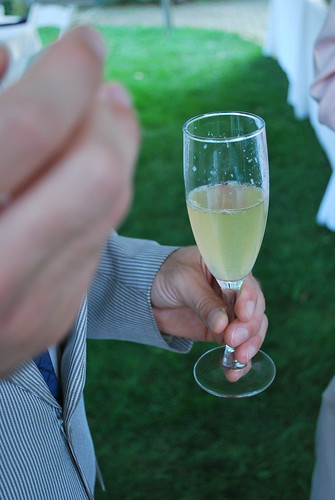
{Photos by rocketlass.}

Earlier this summer I read, all in a rush, Daniel Okrent’s wonderful history of Prohibition, Last Call, and ever since, I’ve been taking note of mentions of the ban in the books I read.

First, there’s John O’Hara, in The Girl on the Baggage Truck (1960), looking back on that period:
All this was thirty years ago, as remote-seeming to many people today as the Gay Nineties had seemed to me. New York now is as different from New York then as New York then was from London. The one pervasive factor in all our lives was Prohibition, which made lawbreakers of us all and gave a subtly conspiratorial, arcane touch to the simple act of dining out. Even that was phony, for there were only a few speakeasies which you could not talk your way into, where you had to be known.
Apparently it wasn’t so easy in upstate New York--at least if this scene from Edmund Wilson’s gin-soaked novel of bohemian life in 1920s New York, I Thought of Daisy (1929), is accurate:
“I’m sorry that I can’t offer you a drink--but the only things we can get around here are apple and alcohol, and both of them are vile. We’ve finally come to the conclusion that it’s really more considerate to the guests not to offer them anything at all!”--“We hoped you might bring something with you,” said Daisy, looking up with her sweet candid smile. She was dealing out white plates around a table in the middle of the room. I apologized for not having thought of it. “We never think of it ourselves--if you can believe me,” Pete insisted. “It’s almost impossible to get any kind of decent liquor--in New York or anywhere else--and the kind of drinks that you can get just don’t interest me!” I agreed with him heartily and added that the trouble with New York was that everybody there drank far too much bad liquor. “That’s why we came to the country,” said Daisy. “We decided that it was that or the drunkard’s home!”
The British never quite understood the very American experiment that was Prohibition, and who better to flaut the law than Winston Churchill? William Manchester, in his biography of Churchill, The Last Lion (1983), quotes a diary entry from Winston’s son, Randolph, from a trip to America with his father in 1929:
We are now in the ship bound to Seattle, American soil and Prohibition. But we are well-equipped. My big flask is full of whisky and the little one contains brandy. I have reserves of both in medicine bottles. It is almost certain that we shall have no trouble. Still if we do, Papa pays the fine and I get the publicity.” Papa would have been hit by both; he had a case of brandy in stone hot-water bottles.
On a later trip, in 1932, an auto accident--Churchill was hit by a car as he crossed 79th Street at the edge of Central Park--provided the perfect pretext for his doctor to, as Manchester puts it, rescue him
from the hardship of Prohibition with a note on his stationery: “This is to certify that the post-accident convalescence of the Hon. Winston S. Churchill necessitates the use of alcoholic spirits, especially at meal times. The quantity is naturally indefinite but the minimum requirements would be 250 cubic centimeters [slightly over eight ounces].”
That white lie, and its malign effects, was the sort that John O’Hara had in mind when he launched into a fire sermon on the period in his novella Imagine Kissing Pete (1960):
We had come to our maturity and our knowledgeability during the long decade of cynicism that was usually dismissed as “a cynical disregard of the law of the land,” but that was something else, something deeper. The law had been passed with a “noble” but nevertheless cynical disregard of men’s right to drink. It was a law that had been imposed on some who took pleasure in drinking by some who did not. And when the law was an instant failure, it was not admitted to be a failure by those who had imposed it. They fought to retain the law in spite of its immediate failure and its proliferating corruption, and they fought as hard as they would have for a law that had been an immediate success. They gained no recruits to their own way; they had only deserters, who were not brave deserters but furtive ones; there was no honest mutiny but only grumbling and small disobediences. And we grew up listening to the grumbling, watching the small disobediences; laughing along when the grumbling was intentionally funny, imitating the small disobediences in other ways beside the customs of drinking. It was not only a cynical disregard for a law of the land; the law was eventually changed. Prohibition, the zealots’ attempt to force total abstinence on a temperate nation, made liars of a hundred million men and cheats of their children; the West Point cadets who cheated in examinations, the basketball players who connived with gamblers, the thousands of uncaught cheats in the high schools and colleges. We had grown up and away from our earlier esteem of God and country and valor, and had matured at a moment when riches were vanishing for reasons that we could not understand. We were the losing, not the lost, generation. . . . We knew everything, but we were incapable of recognizing the meaning of our complacency.
Given such an anomie--to say nothing of the booze that underlies it--it’s no surprise that O’Hara can be relied on in the matter of hangovers. In Appointment in Samarra (1935), he presents a memorable account:
He had felt physically worse many times, but this was a pretty good hangover. It is a pretty good hangover when you look at yourself in the mirror and can see nothing above the bridge of your nose. You do not see your eyes, nor the condition of your hair. You see your beard, almost hair by hair; and the hair on your chest and the bones that stick up at the base of your neck. You see your pajamas and the lines in your neck, and the stuff on your lower lip that looks as though it might be blood but never is. You first brush your teeth, which is an improvement but leaves something to be desired. Then you try Lavoris and then an Eno’s. By the time you get out of the bathroom you are ready for another cigarette and in urgent need of coffee or a drink, and you wish to God you could afford a valet to tie your shoes. You have a hard time getting your feet in your trousers, but you finally make it, having taken just any pair of trousers, the first your hands touched in the closet. But you consider a long, long time before selecting a tie. You stare at the ties; stare and stare at them, and you look down at your thighs to see what color suit you are going to be wearing. Dark gray. Practically any tie will go with a dark gray suit.
And with that, it’s time to toss back a chaser of water, with a toast to Aristotle, who I believe liked to say, as cocktail hour approached in ancient Athens, “All things in moderation, my friends--including all things in moderation.”

Monday, August 16, 2010

Keep your pants on!, Or, Mr. O'Hara regrets to inform you that he'll be late for lunch.

I fear that Friday’s post on swearing may have dragged my mind temporarily to the gutter, for, on reading the following passage in Geoffrey Wolff’s biography of John O’Hara, The Art of Burning Bridges, my first thought was that I had to share it with you folks:
Eventually [John] McClain was shocked by his roommate, when he returned home from the Sun with a young woman to pick up O’Hara for a lunch date. Having forgotten the engagement, O’Hara greeted the couple wearing his underpants, instructed them to wait while he concluded an ongoing chore, and, without closing the door to his bedroom, wrapped up a performance--theatrically strident--of lovemaking. He had partners aplenty, and each was destined to learn from O’Hara the names and preferences of the others. Such narratives, even more than the knowledge of his promiscuity and his frequent contagions of the clap, tempered the devotion of the women he pursued during the McClain period.
Now, to each his own, but if you were to show up for a lunch date to find such a performance underway, would you not count it as a de facto cancellation of the date? And therefore not wait it out? How excruciatingly uncomfortable those minutes must have been . . .

Which reminds me of a line from the oral biography of George Plimpton, George, Being George. In the middle of a batch of accounts of Plimpton’s--and, apparently, everyone’s--freewheeling sex life in the early 1970s, his friend Fayette Hickock says,
When I think about George going to orgies,, I think of him not as leering with his tongue dangling out, but just as George as George. Like, okay, wow, let’s see where this is going to take us.
Elsewhere in the book, Gay Talese describes 1970s America as “the most sexually permissive place in the history of the world,” which, by what feels like an almost medieval association of opposites, makes me think of Adam Thirlwell’s discussion in The Delighted States of an anthology of Laurence Sterne’s writing called The Beauties of Sterne that was published in 1782, after Sterne’s death:
The writer of the “Preface” to The Beauties of Sterne expressed sadness that the “chaste lovers of literature” had been “deprived” of the possible “pleasure and instruction” to be derived from the works of Laurence Sterne--since they could not risk encountering the “obscenity which taints the writing of Sterne”: “his Sentimental Journey, in some degree, escaped the general censure, though that is not entirely free of the fault complained of.” The purpose of The Beauties of Sterne was therefore to give the reader an expurgated version of the works of Laurence Sterne. But this is not an easy task, to expurgate the work of Laurence Sterne--because it is not easy, turning an unserious novel into a serious extract.
That said, much of what offended in Sterne in 1782, while still entertaining, looks relatively mild these days--and what is more fun in Sterne, anyway, is his more subtly sexual matter, much of which, Thirlwell points out, escaped the censor:
Sterne was exploiting the fact that sexual vocabulary does not quite exist; it mimes the ordinary vocabulary of sexuality. A person can talk about sex while pretending to talk about niceness. A person can talk about sex without ever mentioning sex: the point of flirting is its utilitarian benefit, is that it allows for deniability.
Much, much more fun than O’Hara’s boorishness, no? The martini as opposed to the Jager Bomb, in a sense.

To close, a poem from a man who would not have stinted at Jager Bombs--so long as there was quantity--any more than he balked at public lewdness: Lord Rochester. Here, however, he drops his vulgarities in favor of a flirtatious subtlety, as he attempts to put over a not-particularly-convincing denial of unfaithfulness:
Love and Life

All my past life is mine no more;
The flying hours are gone,
Lie transitory dreams given o’er,
Whose images are kept in store
By memory alone.

The time that is to come is not;
How can it then be mine?
The present moment’s all my lot;
And that, as far as it is got,
Phillis, is only thine.

Then talk not of inconstancy,
False hearts, and broken vows;
If I by miracle can be
This live-long minute true to thee,
‘Tis all that Heaven allows.
In other words, as Shaggy once said, “It wasn’t me.”

Wednesday, August 04, 2010

Pour yourself a bit more of John O'Hara's soda-water. It'll be good for what ails you.

On Monday I quoted the opening paragraphs of one of the three novellas that make up Sermons and Soda-Water (1960), which, when I happened across it last week while on vacation, almost instantly made me a John O’Hara fan. Given how strong an impression the openings of the three novellas made on me, it seems right to also share the first paragraphs of the other two in the set.

Here’s the opening of the novella that leads the set, The Girl on the Baggage Truck:
When I was first starting out in New York I wrote quite a few obituaries of men who were presumably in good health, but who were no longer young. It was the custom on the paper where I worked that a reporter who had no other assignment was given this task, which most reporters found a chore but that I rather enjoyed. The assistant day city editor would tell you to prepare an obit on some reasonably prominent citizen, you would go to the office library and get out the folder of the citizen’s clippings, and for the remainder of the afternoon you would read the clippings and appropriate reference books, and reconstruct a life from the available facts, keeping it down to forty lines or whatever length the subject’s prominence had earned. One time I had to look up Jack Smedley, one of the richest oil men in the United States, and I discovered that his folder was so slim that you could have mailed it for the price of a two-cent stamp; while a Bronx politician of almost the same name had six bulging folders that cluttered up my desk. Later, when the two men died, the rich man was a Page One story all over the world, and the Bronx politician got thirty lines halfway down the column on the obituary page. You got what in more recent times was called a sense of values.
It’s not as richly descriptive or evocative as the section from We’re All Friends Now that I quoted Monday, but even in this more modest form the tone and the prose work together to present a distinct voice: straightforward, experienced, knowledgeable, unsentimental, and wry. You want to trust this voice.

Then there’s the opening paragraph of Imagine Kissing Pete, which quickly and clearly introduces the web of relationships, commitments, gossip, and betrayals that are at the heart of O’Hara’s picture of the upper class at midcentury:
To those who knew the bride and groom, the marriage of Bobbie Hammersmith and Pete McCrea was the surprise of the year. As late as April of ‘29 Bobbie was still engaged to a fellow who lived in Greenwich, Connecticut, and she had told friends that the wedding would take place in September. But the engagement was broken and in a matter of weeks the invitations went out for her June wedding to Pete. One of the most frequently uttered comments was that Bobbie was not giving herself much opportunity to change her mind again. The comment was doubly cruel, since it carried the implication that if she gave herself time to think, Pete McCrea would not be her ideal choice. It was not only that she was marrying Pete on the rebound; she seemed to be going out of her way to find someone who was so unlike her other beaus that the contrast was unavoidable.
All three novellas are written from the perspective of a man in his mid-fifties who, driven by various events in his present life, is thinking back on his late twenties, and they are pervaded by the melancholy and loss natural to such reflections. That feeling finds its clearest expression in this passage from Imagine Kissing Pete, which follows the suicide of an acquaintance, Julian English, a few weeks after the narrator, then in his youth, had seen him at a party:
I was shocked and saddened by the English suicide; he was an attractive man whose shortcomings seemed out of proportion to the magnitude of killing himself. He had not been a friend of mine, only an acquaintance with whom I had had many drinks and played some golf; but friends of mine, my closest friends in the world, boys-now-men like myself, were at the beginning of the same kind of life and doing the same kind of thing that for Julian English ended in a sealed-up garage with a motor running. I hated what I thought those next few days and weeks. There is nothing young about killing oneself, no matter when it happens, and I hated this being deprived of the sweetness of youth. And that was what it was, that was what was happening to us. I, and I think the others, had looked upon our squabbles as unpleasant incidents but belonging to our youth. Now they were plainly recognizable as symptoms of life without youth, without youth’s excuses or youth’s recoverability. I wanted to love someone, and during the next year or two I confused the desperate need for love with love itself. I had put a hopeless love out of my life; but that is not part of this story, except to state it and thus to show that I knew what I was looking for.
Longtime readers will instantly see why I was drawn to this passage: it’s driven by the same concerns that animate so much of Anthony Powell’s writing, the question of how one moves through time, what markers and labels and acknowledgments one allots its various stages, how one fights or accommodates its demands. An inevitable byproduct, I suspect, of even the most pleasant vacation with one’s parents, wife, siblings and their spouses, and nieces and nephews, is a growing awareness of time and its cruelly diminishing elasticity, and to happen across such a reflection on those matters in the midst of such inescapable thoughts was, in some ways, a reminder of why we read at all: for all of Plato’s insecure chiding, these shadows on the cave wall do instruct by their example, do enlighten even as we know they are art rather than life. Our lives and our world are not the ones O’Hara or Powell depict, and yet, looked at in just the right way . . .

Monday, August 02, 2010

"Let us have wine and women, mirth and laughter / Sermons and soda water the day after."


{Photos by rocketlass.}

I made an wonderful, unexpected discovery while I was on vacation last week. As I was browsing in a pleasant used bookstore, Black River Books, a set of three lovely little matched hardcovers caught my eye--and mere days later, I think I may now be a John O’Hara fan.

I’ve never been strong on midcentury American authors--the Anglophile in me tends to win out when it comes to that part of the century--and O’Hara is someone I might simply never have gotten around to. But all it took was reading the first page or two of the three individually bound novellas that make up Sermons and Soda-Water (1960), and I was hooked. Try the opening of the third one, We’re Friends Again:
I know of no quiet quite like that of a men’s club at about half past nine on a summer Sunday evening. The stillness is a denial of the meaning and purpose of a club, and as you go from empty room to empty room and hear nothing but the ticking of clocks and your own heel taps on the rugless floor, you think of the membership present and past; the charming, dull, distinguished, vulgar, jolly, bibulous men who have selected this place and its company as a refuge from all other places and all other company. For that is what a club is, and to be alone in it is wrong. And at half past nine on a summer Sunday evening you are quite likely to be alone. The old men who live there have retired for the night, sure that if they die before morning they will be discovered by a chambermaid, and that if they survive this night they will have another day in which their loneliness will be broken by the lunch crowd, the cocktail crowd, and the presence of a few men in the diningroom in the evening. But on a summer Sunday evening the old men are better off in their rooms, with their personal possessions, their framed photographs and trophies of accomplishment and favorite books. The lounge, the library, the billiard and card room have a deathly emptiness on summer Sunday evenings, and the old men need no additional reminder of emptiness and death.


There’s a clarity and confidence to O’Hara’s prose here that I find remarkably bracing, the sure first-person voice conveying the desolation of the empty club so clearly that this long-gone bastion of midcentury manhood and privilege rises around you, smelling of leather and hair tonic and stale tobacco.

That lean clarity is maintained throughout the three novellas, and its straightforwardness and seeming simplicity are incredibly seductive, to the point where I could imagine them being dangerously influential for a writer of fiction. O’Hara’s sentences make me want to write like that, all adornment stripped away or skillfully hidden within an overtly utilitarian syntax. In his introduction to the three novellas, O’Hara wrote that his increasing age convinced him to leave these stories short, rather than try to spin them out into full-length novels. “I want to get it all down on paper while I can,” he wrote, and that urgency, that need to remember and commemorate and explain and understand, comes through in every sentence. It makes you ache for the simple fact that the past is lost forever, and it makes you admire those who try to save it for us despite.