Showing posts with label Tess of the D'Urbervilles. Show all posts

Monday, December 13, 2010

It's White Fang or Nothing!

One of the great pleasures of Deborah Mitford's charming and funny new memoir, Wait for Me!, is its portrait of David Mitford, Baron Redesdale, whom Mitford fans long ago came to know in the guise of Uncle Matthew in Nancy's The Pursuit of Love. Deborah acknowledges that in many ways her father really was like Matthew, but she paints him in a much gentler light:
Nancy made him sound terrifying but there was nearly, though not always, a comic undercurrent not apparent to outsiders. I adored him. He was an original, with a total disregard of the banal or boring.
In other words, exactly the sort of character best met in the pages of a novel or memoir--and for all Deborah's attempts to show her father's lighter side, it's hard not to come to the conclusion that, yes, he was essentially terrifying. If he was more bluster than anything, well, that's still an awfully large quantity of bluster to live with on a daily basis.

But in a memoir? Oh, there he's vastly entertaining. As when he went to the dentist in his mid-thirties,
and asked him to take out all his teeth. The dentist refused, saying it was dangerous. "All right then," said Farve impatiently. "I'll go to someone who will." An hour or so later there was not a tooth left in his head. Thereafter "my good dentures" chewed up Muv's excellent food.
Or his inordinate "horror of anything sticky":
I once asked him what his idea of hell was. "Honey on my bowler hat," was the answer.
Or this exchange about his brother-in-law, Denis Farrer, the Old Dean:
Fare was once talking to an acquaintance about the Farrers and said, "The only trouble with the Old Dean is that he married a ghastly woman." "Oh?" said the acquaintance. "I thought she was your sister?" "Yes, she is. A poisonous creature."
Or his brutal manners when Nancy brought home friends:
[M]y father waited for a pause in the conversation and said loudly to my mother at the other end of the table, "Have these people no homes of their own?"
The anecdote that made me laugh the loudest, however, also happens to be the most suitable for this blog: it's about books, and, specifically, about one of my old favorites, Thomas Hardy. According to Deborah, her father read only one book in his life, White Fang, "which he enjoyed so much he vowed never to read another." Learning this soon after their marriage shocked Mrs. Mitford, and she came up with a plan:
She persuaded him to listen to her reading aloud some classics, starting with Thomas Hardy. She chose Tess of the d'Urbervilles with its descriptions of farm and heath land, which she thought he would enjoy. When she got to the sad part, my father started crying. "Oh, darling, don't cry, it's only a story." "WHAT," said my father, his sorrow turning to rage, "do you mean to say the damn feller made it up?"
Which makes one wonder: Is it possible that David had misunderstood the nature of White Fang?

I suspect that Hardy--who was alive and well at that time--of all people would have enjoyed knowing that Tess was selected because of its depiction of the humble activities of rural life. The dismissal of it all as made-up, and thus pointless, however? I expect he would have replied with the self-righteous asperity of this passage from his explanatory note to the first edition of Jude the Obscure:
I would ask that any too genteel reader, who cannot endure to have said what everybody nowadays thinks and feels, to remember a well-worn sentence of St Jerome's: If an offence come out of the truth, better is it that the offence come than that the truth be concealed.

Tuesday, October 21, 2008

"We inherited from him early his abounding sense of the possibilities of the countryside."

In response to my post last week about the shared desire of Thomas Hardy and Wendell Berry to preserve rapidly disappearing rural ways of life, Frank Wilson of Books, Inq. commented,
The idealization of country life seems to be about as old as literature. But it is the work of writers, who have a tendency to airbrush out the grinding poverty and back-breaking labor that went with pastoral scenes. Which is not to say that I do not find myself susceptible to such idealization.
It's a sensible response to a post in which I confessed to finding Berry's and Hardy's visions of rural life seductive, but fairness to both authors dictates that I make clear that they actually spend a lot of time chronicling the hard work necessitated by such a life. In fact, they're two of the best writers about work, period, that I know.

At the same time, however, neither man denies the pleasure to be had in good company while you're working with your hands. It's a feeling I know from the work I did as a boy on farms, and as a young man in food service and the retail trade: when you're performing straightforward manual tasks, your mind--and your conversation--can roam free in a way that even the best office life can't replicate.

Tess offers some great examples of both aspects of manual labor. While Tess find little but happiness--despite the early hours and tiring work--at the dairy where she begins her working life, at the farm where she labors later she finds toil at its most draining. The following scene is a good example: Tess and her fellow laborers are working with the itinerant owner of a rudimentary steam-powered threshing machine hired by the farmer. Because the machine's time is precious, the farmer forces them to take advantage of the full moon and keep working through the night until the hayrick has been completely threshed. Night wears on:
By degrees the freshest among them began to grow cadaverous and saucer-eyed. Whenever Tess lifted her head she beheld always the great upgrown straw-stack, with the men in shirt-sleeves upon it, against the gray north sky; in front of it the long red elevator like a Jacob's ladder, on which a perpetual stream of threshed straw ascended, a yellow river running up-hill, and spouting out on the top of the rick.
The threshing concludes in a scene that can only be horrifying to our modern eyes, but was simply an accepted part of the job in nineteenth-century Dorset: the hubbub that ensues when the work reveals the layer of live rats at the bottom of the hayrick.
The time for the rat-catching arrived at last, and the hunt began. The creatures had crept downwards with the subsidence of the rick till they were all together at the bottom, and being now uncovered from their last refuge they ran across the open ground in all directions, a loud shriek from the by-this-time half-tipsy Marian informing her companions that one of the rats had invaded her person--a terror which the rest of the womeon had guarded against by various schemes of skirt-tucking and self-elevation. The rat was at last dislodged, and, amid the barking of dogs, masculine shouts, feminine screams, oaths, stampings, and confusion as of Pandemonium, Tess untied her last sheaf; the drum slowed, the whizzing ceased, and she stepped from the machine to the ground.
Writing about farm life as lived nearly a century later, Wendell Berry, too, conveys both its responsibilities and rewards. The former is summed up nicely in this paragraph from the funny and moving story "Never Send a Boy to Do a Man's Work":
Carter Keith was a good father. He kept Athey with him as much as his work and, later, Athey's schooling would alow. The Keith place was always asire with work in those days. Everybody on the place would be up and the men and boys at the barns while the stars still shone, and at work by first light. Carter Keith followed the rules that he handed on to his son: He made use of all the daylight he had and would ask no man to do anythign that he would not do himself. His tenants and hands knew this and so respected him, and they worked hard.
While these passages from "Where Did They Go?" offer a small glimpse of the pleasures of manual labor in a crew:
Though talking put Leaf to extreme effort, tightening the cords of his neck, when he sang his voice came sweet and free. To hear him stop talking, which he seldom did, and start to sing "The Wabash Cannonball or "Footprints in the Snow" always seemed a sort of miracle to me, as if a groundhog had suddenly soared into the air like a swallow. . . . It was pretty work when you had time to think about it, and weren't too tired to care. We drew the white-stemmed, green-leafed plants out of the moist ground of the beds, and laid them neatly in bushel baskets and old washtubs. R. T. hauled them to the patch where the setter crew spaced them out in the long rows. They would wilt in the heat that day, but by the next morning or the next, they would be stickign up again, pert and green and orderly, in the dew-darkened ground. Each night when we quit, Jake would say to me, fairly singing: "We're getting it done, Andy boy! We're leaving it behind!"
And that "leaving it behind," I can tell you from walking beans as a teenager, is one of the best feelings in the world.

Friday, October 17, 2008

Thomas Hardy and Wendell Berry


{Photos of Dorsetshire by rocketlass.}

When I went to shelve Tess of the D'Urbervilles tonight I realized that I first needed to add one more post to the string inspired by my recent re-reading of this most heartfelt of Thomas Hardy's novels.

I wrote a bit already about Hardy's tinkering with the text between the novel's first appearance in 1891 in the Graphic and its inclusion in the Wessex edition of his works in 1912. The most obvious and important changes Hardy introduced were to the relationship between Tess and Alec, but another set of alterations seems worth noting, particularly for a reader coming to the book more than a century later. As David Skilton, editor of the 1978 Penguin Classics edition, explains,
On the whole there is an increase in dialect and colloquialism in the dialogue between the 1891 and 1912. . . . The spoken language is generally rather neater, more economical, and less "literary" in the later version.
The increased employment of dialect, alongside the occasional added reference to some old country practice--such as Angel Clare's wearing of a cabbage leaf under his hat to keep cool, which only appears in the 1912 edition--suggests that Hardy revised with an eye towards preserving details of a way of life that, in the decades since Tess's first publication, had almost entirely disappeared.

Even at the time of writing, Hardy was aware that the old country ways, having held from time immemorial, were slipping away, obsolescent in the face of the machine age. Late in the novel Hardy writes of the increasing hubbub of Old Lady-Day, when farm laborers who want to change situations moved to their new homes:
These annual migrations from farm to farm were on the increase here. When Tess's mother was a child the majority of the field-folk around Marlott had remained all their lives on one farm, which had been the home also of their fathers and grandfathers; but latterly the desire for yearly removal had risen to a high pitch.
At the same time, Hardy explains, the villages were also being depopulated, their non-farm residents--carpenters, smiths, and other skilled workers--were being forced out; when their leaseholds expired, which often happened on the death of the head of the family, their cottages were torn down, the land beneath them going under the plow. As Hardy explains,
These families, who had formed the backbone of village life in the past, who were the depositaries of the village traditions, had to seek refuge in the large centres; the process, humorously designated by statisticians as "the tendency of the rural population towards the large towns," being really the tendency of water to flow uphill when forced by machinery.


That passage, written in close to a pure editorial voice, reminds me of Wendell Berry, who takes on the same mission of preservation in his novels. Berry draws on more than a century of unbroken chains of story and memory to recall rural life as it was lived in the years just before and after World War II, when the largely self-contained, pre-petroleum economy still held sway in the more remote hill farms of Kentucky. Berry's belief in that mostly lost way of life as more sustainable, human, and fulfilling than our contemporary industrial culture is implicit in all his fiction, echoed in the relationships of characters to one another and to the land, and in his emphasis on the importance of stewardship in all our interactions.

Berry makes those points explicit in his non-fiction, as in this passage from his essay "People, Land, and Community," collectd in The Art of the Commonplace:
People are joined to the land by work. Land, work, people, and community are all comprehended in the idea of culture. These connections cannot be understood or described by information--so many resources to be transformed by so many workers into so many products for so many consumers--because they are not quantitative. We can understand them only after we acknowledge that they should be harmonious--that a culture must either be shapely and saving or shapleless and destructive. To presume to describe land, work, people, and community by information, by quantitites, seems invariably to throw them into competition with one another. Work is then understood to exploit its people. And then instead of land, work, people, and community, we have the industrial categories of resources, labor, management, consumers, and government. We have exchanged harmony for an interminable fuss, and the work of culture for the timed and harried labor of an industrial economy.
It was only when I read Wendell Berry, more than a decade after I left my rural birthplace for Chicago, that I understood how my hometown, like the smaller farming communities around it, had entered upon the decline that, by the time I left, had trimmed its population and largely shuttered its downtown. Berry's accounts, in fiction and nonfiction, showed me what those towns had been as recently as a generation ago, and it made me ache for their loss in a way I never had when I lived there.

The city is my home, and I love it far too much to ever want to leave it, but through Berry's eyes I finally saw what a small town could be even now, if propelled by a dynamic, decidedly local economy. It's a seductive vision, and one that I think Thomas Hardy would recognize and approve.

Sunday, October 05, 2008

Annotations, or, What's a gam'ster?

The edition of Tess of the D'Urbervilles that I'm currently reading is the 1978 Penguin Classics edition, edited and with notes by David Skilton. I usually find that the editors of Penguin Classics append a bit too much annotation, to the point that the superscripts become distracting, whereas for most of the past week I've been frustrated at how scanty Skilton's notes are: while he flags every biblical reference (which I mostly don't need, since I'm reasonably strong on the Bible), he does nothing to clarify the many wonderful Dorset slang terms with which Hardy lards his characters' speech. Some terms--such as "skillentons," meaning skeletons, or "hobble," meaning a spot of trouble--are easy enough to figure out from context. But what on earth is a pummy? Or a gam'ster? Or a rozum?

Just now, however, as I was stupidly attempting to simultaneously read and stir the beginnings of bread dough, I dropped the book . . . and it fell open to a glossary. Oops. Pummy, it turns out, is the name for "crushed apples used in cider-making"; and a gam'ster is "a cudgel player, etc.; hence a plucky animal"; while a rozum is "a quaint saying or nonsense," and by extension a person with strange ideas. And, ooh, one more: a market-nitch is "the amount drunk after market. A 'nitch' is 'a burden; as much as one can carry of wood, hay, or straw, and sometimes of drink,'" drawn from William Barnes's A Grammar and Glossary of the Dorset Dialect (1863). Sometimes of drink!

The Penguin edition also marks all the changes Hardy introduced between the first publication of the novel, in the Graphic, in the fall of 1891, and the collected Wessex edition of his novels that was published in 1912. Some of the changes are bound to be of great interest to Hardy fans, as they show Hardy continuing to tinker in relatively serious ways with the details of Tess's relationship with Alec D'Urberville--long after he'd pointedly sworn off novel-writing.

One utterly minor emendation seems worth sharing, as it's hard not to enjoy despite Alec's horridness: on Alec's first appearance in the Wessex edition of the novel, he is described as having
an almost swarthy complexion, with full lips, badly moulded, though red and smooth, above which was a well-groomed black moustache with curled points, though his age could not be more than three- or four-and-twenty.
At the time of the Grapic edition, however, his moustache had been less impressive:
a sooty fur represented for the present the dense black moustache that was to be.

All this reminds me of a letter from Tolstoy to his publisher, M. N. Katkov, that I read recently. Sent from Yasnaya Polyana on January 3, 1865, it accompanied the manuscript of the first part of War and Peace, which Tolstoy encouraged Katkov to publish, preferably in one part, and soon:
But of course you have your own considerations, and if you find it better to divide the first part, it can't be helped. But in that case, write and tell me whether you wish to have the 2nd part this year, i.e. this winter. It woudl be a nuisance for me to leave it until next autumn, since I can't hold on to waht I have written without correcting and revising it endlessly. . . . The manuscript is full of crossings out, and I do apologise, but as long as it's in my hands I revise it so much that it can't look any different.
As I've said before: thank you, tireless textual scholars. Your loving drudgery is appreciated.

Wednesday, October 01, 2008

"But I miss you most of all / My darling / When autumn leaves / Start to fall"


{Photo by rocketlass.}

In Tuesday's post, I mentioned in passing that in my current re-reading of Tess of the D'Urbervilles, I have found myself paying attention to aspects of the novel that would never have held my attention the first time I read it, at age twenty. In particular, I find myself sinking pleasantly into Hardy's lush, detailed descriptions of the natural life of the countryside, just as I find myself these days far more attentive than I was at that age to the wildlife that shares my city, from the peregrine falcons who nest across the street, to the juncos who visit in the spring and fall, to the humble sparrows who are my year-round window companions.

This account of the mid-summer mornings of the milking crew, which because of the long English days of that season begin dreadfully early, offers a good example of Hardy's ability to focus his--and therefore our--attention on quiet moments of interaction with nature:
At these non-human hours they could get quite close to the waterfowl. Herons came, with a great bold noise as of opening doors and shutters, out of the boughs of a plantation which they frequented at the side of the mead; or, if already on the spot, hardily maintained their standing in the water as the pair walked by, watching them by moving their heads round in a slow, horizontal, passionless wheel, like the turn of puppets or clockwork.

They could then see the faint summer fogs in layers, woolly, level, and apparently no thicker than counterpanes, spread about the meadows in detached remnants of small extent. On the gray moisture of the grass were marks where the cows had lain through the night--dark-green islands of dry herbage the size of their carcasses, in the general sea of dew. From each island proceeded a serpentine trail, by which the cow had rambled away to feed after getting up, at the end of which trail they found her: the snoring puff from her nostrils, when she recognized them, making an intenser little fog of her own amid the prevailing one.
The precision of Hardy's language, married to what can only be termed love for the humble, easily missed details of his scene--the cow's puff of recognition; the dry islands in the sea of dew--is what makes this scene come to life. The wheeling of the herons is "passionless," the fog is "woolly," the cows "ramble," their trail is "serpentine." It's language born of a belief that these aspects of Tess's existence are important enough to get exactly right, that they contribute to the self she is trying to establish and the temporary pleasure and comfort she feels in these surroundings. It works: like Tess, we are almost lulled into believing that the past can be left behind.

On this first day of October, one which the cool weather and the start of baseball playoffs agree signals the true start of autumn, it seems right close this appreciation with Hardy's account of Tess's autumnal wanderings with her beau, Angel Clare:
Thus, during this October month of wonderful afternoons they roved along the meads by creeping paths which followed the brinks of trickling tributary brooks, hopping across by little wooden bridges to the other side, and back again. They were never out of the sound of some purling weir, whose buzz accompanied their own murmuring, while the beams of the sun, almost as horizontal as the mead itself, formed a pollen of radiance over the landscape. They saw tiny blue fogs in the shadows of trees and hedges, all the time that there was bright sunshine elsewhere. The sun was so near the ground, and the sward so flat, that the shadows of Clare and Tess would stretch a quarter of a mile ahead of them, like two long fingers pointing afar to where the green alluvial reaches abutted against the sloping sides of the vale.
This afternoon in Philadelphia, the shadow of the grandstand will creep across home plate, making pitches dart elusively between darkness and light; as it grows dark tonight at Wrigley Field, the chill we remember from Opening Day back in April will settle in alongside the hopes we harbored then, and are lucky enough to still maintain.

It's the best time of the year, time for chili and beer and magic jack-o-lanterns. Time to play ball.


{Ozzie-o-lantern, and photo, by rocketlass.}

Tuesday, September 30, 2008

Sure, you should put it in your tea . . . but seriously, folks--let's trust W. C. Fields and stop there.


{Photo by rocketlass.}

Nearly a year ago, with the help of Tobias Smollett and Peter Ackroyd, I warned about the perils of drinking milk, which range from dreadful sobriety to painful gout.

Had I recalled it at the time, I could also have drawn on the experienced opinion of Dairyman Crick, who gives Tess Durbeyfield employment as a milker:
She drank a little milk as temporary refreshment--to the surprise--indeed, slight contempt--of Dairyman Crick, to whose mind it had apparently never occurred that milk was good as a beverage.

"Oh, if ye can swaller that, be it so," he said indifferently, while one held up the pail that she spped from. " 'Tis what I hain't touched for years--not I. Rot the stuff; it would lie in my innerds like lead."
That exchange is followed by a scene of the milking crew in action together. It's rich with details of Victorian country life that I would have passed over inattentively on my first reading of Tess when I was in college, but that I now prize as an example of one of my favorite characteristics of novels--their tendecy to incidentally preserve the living details of lost ways of life. Here the dairyman and his crew run through some folk wisdom:
"To my thinking," said the dairyman, rising suddenly from a cow he had just finished off, snatching up his three-legged stool in one hand and the pail in the other, and moving on to the next hard-yielder in his vicinity; "to my thinking, the cows don't gie down their milk to-day as usual. Upon my life, if Winker do begin keeping back like this, she'll not be worth going under by midsummer."

" 'Tis because there's a new hand come among us," said Jonathan Kail. "I've noticed such things afore."

"To be sure. It may be so. I didn't think o't."

"I've ben told that it goes up into their horns at such times," said a dairymaid.

"Well, as to going up into their horns," replied Dairyman Crick dubiously, as though even witchcraft might be limited by anatomical possibilities, "I couldn't say; I certainly could not. But as nott cow will keep it back as well as the horned one. I don't quite agree to it."
Ultimately the crew decides to "life up a stave or two" to coax the recalcitrant cows, a practice that remained at least until 1951, when Alan Lomax took his Nagra out to collect folk songs in Scotland and had a milker assure him that her singing "Makes the cow more content, and she gives more milk when she hears me singing."

For their part, the cows in Tess seem unbothered by the fact that the song chosen is about "a murderer who was afraid to go to bed in the dark because he saw certain brimstone flames around him." The reader can easily imagine a young Thomas Hardy witnessing such a song and carefully storing it away . . . for the edification of us readers, supermarket milk-buyers all, more than a century later.

But good god, that doesn't mean we should drink the stuff! Why do you think gin was invented?!

Sunday, September 28, 2008

On re-reading Tess


{Photo by rocketlass.}

In her biography of Thomas Hardy, Claire Tomalin writes, "[Hardy] could . . . use his sense of the world's random cruelty to make a masterpiece." I have just begun reading Tess of the d'Urbervilles (1891) for the first time since the spring of 1994, when I was turning twenty. Last year's visit to Hardy's native Dorset, where rocketlass (whom I'd not met when last I read the novel) and I traced the young Hardy's steps through the heath from Higher Bockhampton to the market town of Dorchester, has given me exactly the sort of additional context that can make re-reading so powerful; fourteen years of living have done their part as well.

Mere pages in, I am captivated. Memories of the whole rush in upon me with sufficient force that I can already agree with Tomalin:
To read Tess is an emotional experience; to write it must have been an overwhelming one. . . . [Hardy] was exact when he said a novel is not an argument but an impression, and this novel lives through its impressions of Tess and the landscapes through which she moves.
And here are the first of those impressions:
A young member of the band turned her head at the exclamation. She was a fine and handsome girl--not handsomer than some others, possibly--but her mobile peony mouth and large innocent eyes added eloquence to colour and shape. She wore a red ribbon in her hair, and was the only one of the white company who could boast of such a pronounced adornment. . . . Tess Durbeyfield at this time of her life was a mere vessel of emotion untinctured by experience. The dialect was on her tongue to some extent, despite the village school. . . . Phases of her childhood lurked in her aspect still. As she walked along to-day, for all her bouncing handsome womanliness, you could sometimes see her twelfth year in her cheeks, or her ninth sparkling from her eyes; and even her fifth would flit over the curves of her mouth now and then.

Yet few knew, and still fewer considered this. A small minority, mainly strangers, would look long at her in casually passing by, and grow momentarily fascinated by her freshness, and wonder if they would ever see her again: but to almost everybody she was a fine and picturesque country girl, and no more.
T. S. Eliot wrote of Hardy,
What again and again introduces a note of falsity into Hardy's novels is that he will leave nothing to nature, but will always be giving one last turn of the screw himself, and of his motives for so doing I have the gravest suspicion.
That's true of Jude the Obscure (1895), which eventually turns so grimly gothic as to be laughable, but in Tess we feel the workings of true, implacable fate, abetted (or even goaded) by the inherent cruelties of society. Hardy himself provocatively wrote in his explanatory note to the first edition,
I would ask that any too genteel reader, who cannot endure to have said what everybody nowadays thinks and feels, to remember a well-worn sentence of St Jerome's: If an offence come out of the truth, better is it that the offence come than that the truth be concealed.
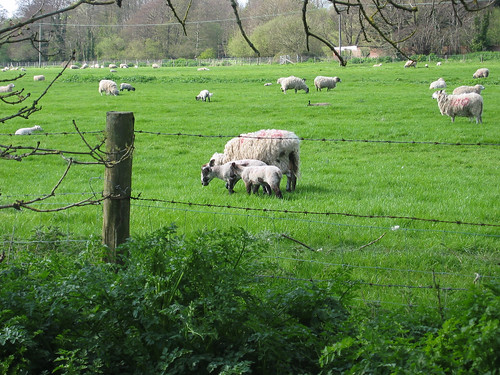
Saturday, September 27, 2008

"I repair the omission now," or, a pleasant coincidence


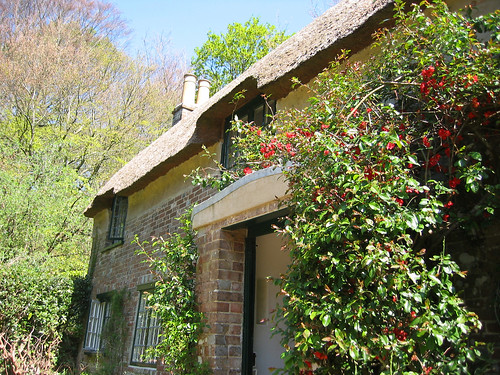
{Photo of Thomas Hardy's boyhood home by rocketlass.}

I learned today from Paul Collins's blog, Weekend Stubble, that the Times of London has begun a new blog that draws from their archives--and, in a coincidence that allows for a pleasant follow-up to yesterday's post about Thomas Hardy and Tess of the d'Urbervilles (1891), one of their first posts features a letter of thanks that Hardy sent the paper following a strongly positive review of Tess:
Max Gate
Dorchester
13.1.92

My dear Sir,

I cannot let your notice of my novel in to-day’s Times pass by without sending you a line to express my thanks and also my sense of the generous insight which recognizes the spirit and aim of a writer when his achievement is only too faulty.

Yours very faithfully
Thomas Hardy
It's well worth clicking through to the post itself, for it also features a second letter, this one thanking the Times for a review of Life's Little Ironies (1894), as well as images of the letters themselves, now held in the paper's archive.

Yet another blog to add to my Google reader . . .

Friday, September 26, 2008

"Mr. Hardy was of medium height and figure . . . his expression placid rather than sad."


{Photo of Thomas Hardy's boyhood home by rocketlass.}

Earlier this week I raved about the many pleasures to be found in The New Oxford Book of Literary Anecdotes (2007), offering a couple of examples from the entry for Lord Byron, whose life spun off enough rich anecdotes to fill a personal Decameron.

It would seem wrong, however, to close discussion of the book without also turning to another of this blog's favorite preoccupations, Thomas Hardy; fortunately, the volume doesn't disappoint when it comes to Dorchester's greatest export. First, we learn that Hardy had something unexpected in common with Vladimir Nabokov: both were synesthetes, as Elliot Felkin's "Days with Thomas Hardy" (published in Encounter in 1962) reveals:
He went on to talk about days of the week and colours and associations. Monday was colourless, and Tuesday a little less colourless, and Wednesday was blue--"this sort of blue" pointing to an imitation Sevres plate--and Thursday is darker blue, and Friday is dark blue, and Saturday is yellow, and Sunday is always red.
And Tess fans can't help but marvel at this story, told by Hardy's second wife, Florence, in her The Later Years of Thomas Hardy (1930), of a hospital visit to Hardy's friend Lord Pembroke:
He [Pembroke] was now ill at a nursing home in London, and an amusing incident occurred while his visitor was sitting by his bedside one afternoon, thinking what havoc of good material it was that such a fine and handsome man should be prostrated. He whispered to Hardy that there was a "Tess" in the establishment, who always came if he rang at that time of day, and that he would do so then that Hardy might see her. He accordingly rang, whereupon Tess's chronicler was much disappointed at the result; but endeavoured to discern beauty in the very indifferent figure who responded, and at last persuaded himself that he could do so. When she had gone the patient apologized, saying that for the first time since he had lain there a stranger had attended to his summons.
The New Oxford Book of Literary Anecdotes includes a handful of additional Hardy stories, all good--but really nothing can touch the trove that is Thomas Hardy Remembered (2007), edited by Martin Ray. A compilation of firsthand accounts of Hardy by both the well- and the little-known, it offers page after fascinating page of sheer pleasure for the Hardy fan. Sure, it costs £55 (which, until John McCain unsuspends the suspension of the suspension of his campaign and flat-out superheros this economic crisis, is something like $1,000,000,000.34), but where else are you going to find such a collection of Hardy anecdotes?

Hell, I would argue that this one from Augustus John's Chiaroscuro: Fragments of Autobiography (1952) is worth nearly £55 on its own, if for no other reason than the vehemence of Hardy's protest:
Thomas Hardy had good reason to view with anxiety the demonstrations of some of his admirers. One of these, hailing from the USA, on the strength of a few minutes interview, produced a book entitled Thomas Hardy's Universe [Ernest Brennecke, 1952--ed.], in which the poet was described as soliloquizing before the fire, while smoking a succession of cigarettes. "But," said Hardy, with a gesture of despair, "I have never smoked a cigarette in my life!"
Or this nuanced appraisal from Edmund Gosse's obituary of Hardy in the Sunday Times of January 15, 1928:
[Hardy] needed all the natural magic of his genius to prevent his work, interpenetrated as it was by this resigned and hopeless melancholy, from becoming sterile, but joy streamed into it from other sources--the joy of observation, of sympathy, of humour. Yet, after all, the core of Hardy's genius was austere and tragical, and this has to be taken into consideration, and weighed in every estimation of his writings. It was a curious fact, and difficult to explain, that this obvious aspect of his temperament was the one which he firmly refused to contemplate. The author of Tess of the d'Urbervilles conceived himself to be an optimist.
Or, returning to Tess, this account of authorial travails from Frank A. Hedgcock's "Reminiscences of Thomas Hardy" (published in the National and English Review of October 1951):
He thought that public opinion was probably right in regarding it as his best novel; but he had put too much feeling into it to recall it with pleasure.
However, my favorite of Hardy's references to Tess (aside, that is, from this one) comes from Desmond MacCarthy's "Thomas Hardy: The Writer" (published in the BBC magazine The Listener on June 6, 1940). For its sheer disingenuousness, this anecdote alone is definitely worth £55, exchange rates be damned:
Once when we were passing some spot in Tess he said to me, "If I had thought that story was going to be such a success, I'd have made it a really good book."
Methinks a re-read of Tess may be on my autumn calendar.


{Photo by rocketlass.}

Wednesday, September 19, 2007

The Last Novel

No time for real posting today, so I'll stick to a simple question: how does any blogger who reads David Markson's The Last Novel (2007) resist posting the whole damned thing?

Early in the novel, Markson defines it succinctly as
A novel of intellectual reference and allusion, so to speak minus much of the novel.
--though that does nothing to answer inescapable questions about whether it really is a novel, because it consists almost entirely of page after page of two- or three-line notes from the lives of writers and artists, their syntax given a convoluted arrangement reminiscent of index entries.

But that larger question will have to wait until I have more time and thought available. For now, I'll just share some of the irresistible biographical nuggets that Markson provides, seemingly the fruit of a lifetime of magpie work in biography and literary history. The range of subjects is wide enough that any dedicated reader will learn something about his favorites, and several regular subjects of this blog make appearances. Thomas Hardy, for example:
Andrew Lang's indignation over a mild blasphemy in Tess of the D'Urbervilles.
A gentleman who turned Christian for half an hour, Hardy dismissed him as.

Then there's this guy:
So difficult and opaque it is, I am not certain what it is I print.
Said John Donne's very publisher about the first edition of his verse.

But I need to wrap this up and head off to the office, so I'll close with this one, which seems like a good thought with which to start one's day:
Literature is the art of writing something that will be read twice.
Said Cyril Connolly.

Friday, August 03, 2007

Stepping stones

Earlier in the week, I mentioned John Aubrey in a post, and, thinking of him as I flipped between a biography of John Donne and a book of memories of Thomas Hardy, I began to wonder if I could get from Donne to Hardy through a game of literary stepping stones. The answer, I'm sure, is yes--but the real question is whether we can do so with a lazy game of stepping stones, on a Friday night, with just the resources at hand?

Well, no. But who knows what we might learn along the way? If you're willing to give it a try, to the bookshelves, and may we stay dry!

We start with Donne, who died in 1630 while the Dean of St. Paul's, where he is memorialized with a statue of himself in his shroud that he had carved late in life; Anthony Powell says the older Donne "looks a trifle like Lord Olivier as Lear." John Aubrey, only four years old when Donne died, doesn't profile him in Brief Lives, but the book is full of his contemporaries, and Donne turns up several times. One of those contemporaries is Donne's friend John Hoskyns, a lawyer and poet in his own right. According to Aubrey:
His verses on the fart in the Parliament house are printed in some of the Drolleries. He had a booke of Poemes, neatly written by one of his Clerkes, bigger then Dr. Donne's Poemes, which his sonn Benet lent to he knowes not who, about 1653, and could never heare of it since.
Of Hoskyns we also learn that he
Was wont to say that all those that came to London were either Carrion or Crowes.

Hoskyns doesn't really move us forward, though. I only included him because, well, how could I not share the story of his wastrel son and the misplaced book? Instead, in the nature of stepping stones, we drop back a step, as Aubrey leads us to Isaak Walton, Donne's first biographer, who used to feed Aubrey anecdotes about Ben Jonson. I suppose we could have reached Walton directly from Donne--but isn't any path that travels through Brief Lives more fun than the direct route?

With Walton, because of my relatively limited acquaintance with writers of the late-sixteenth and early seventeenth centuries, we ought to have our first splash between stones--but just before we fall, I change the rules! No longer do we need to rely on personal acquaintance--and thus here is James Boswell reaching out a hand to help us over the gap!

In his Life of Johnson Boswell records the following conversation:
He talked of Isaac Walton's Lives, which was one of his most favorite books. Dr. Donne's Life, he said, was the most perfect of them. He observed, that 'it was wonderful that Walton, who was in a very low situation in life, should have been familiarly received by so many great men, and that at a time when the ranks of society were kept more separate than they are now." . . . BOSWELL. "No quality will get a man more friends than a disposition to admire the qualities of others. I do not mean flattery, but a sincere admiration." JOHNSON. "Nay, Sir, flattery pleases very generally."
Surely Boswell, one of literature's great flatterers, took those words to heart.

Boswell was of course much more than a flatterer; his skills as a biographer allow us to make another big jump, now to the nineteenth century, to Thomas Babington Macaulay, who called him "the first of biographers. He has no second." Macaulay leads us to Trollope, who wrote in a letter to G. S. Rusden in 1879 that
An historian is bound to be true. Who can say otherwise? But amongst historians who is so often read as Macaulay,--who is inaccurate, but whose style is charming? What so readable as Herodotus, who tells us tales? What so unreadable as Allison who tells us facts? Men now very seldom are laborious readers. You must charm or you have no chance.
To be fair, we really ought to splash down again here, as the only link I find between Trollope and Hardy is the slimmest of threads, a line in a letter from a young Hardy to his sister Mary, that Barchester Towers "is considered the best of Trollope's." And if I'm going to allow as tenuous a connection as that, I might as well cut right back to Donne directly, as Claire Tomalin notes in her biography of Hardy that his friend Edmund Gosse sent him an edition of Donne's poems, for which Hardy offered "1000 thanks."

Oh, but I've shown so little regard for the rules so far that I'm no longer sure even gravity applies, and we float through the air, dry as can be, to the point I wanted to reach all along, safe on shore in Dorset, where we meet Hardy at his home. He's entertaining Princeton professor Henry Van Dyke in 1909, and as recounted by Van Dyke (and collected in the absolutely fascinating new book, Thomas Hardy Remembered), Hardy tells Van Dyke that Tess was his favorite character:
"Yes," he said gravely, "I love her best of all."

"Why, then, did you kill her? Was there no other way to end the book"

"There was no other way," he replied, still more gravely. "I did not kill her. It was fated."
That does sound like Hardy, doesn't it? If there's one active force you can feel behind all of his novels, it's an inexorable and dangerous fate.

Hardy at least would have understood how we made it over all those yawning gaps and got from Donne to him: clearly, it was fated.

Thursday, March 08, 2007

Books in the suitcase

"Weeks before any journey, I begin to worry about what books I'll bring."

Sound like any blogger you know? Though it could have been written by me, it's actually the opening sentence to a nice piece by Jay Parini in the Chronicle of Higher Education about picking books with which to travel. I've written before about how difficult it is to choose books for a trip, about the complex formulae involved in determining which and how many books to bring for a trip of x duration. First of all, you need to be sure you have enough books for the trip, but you also need to have an extra (or two) in case you find yourself not in the mood for one of the ones you brought--and you need at least one book in which you repose complete confidence so you know your attention will be totally diverted during the flight.

Parini's solution is a bit simpler than mine: he carefully arranges to be three-quarters of the way through a gripping novel when he sits down on the plane. But that seems wasteful to me, because you know from the start you'll be carting around a novel you've finished. I prefer to preview several novels, just to make sure they're not godawful, then bring a couple. Maybe when I'm older, my shoulders less willing to bear a multi-book burden, I'll take Parini's advice, but for now I'll keep carrying two or three too many books on every trip.

My friend and former coworker Jim sent me the link to Parini's story because we were discussing this topic over the weekend. With a vacation in prospect, Jim is starting to plan out his reading, simultaneously making sure that he'll not be in the middle of anything when the time comes to leave and starting to eye the books he might want to take along. At the time, I expressed sympathy . . . and then the other day Stacey and I decided to fly to London next month. So now I'm in the same spot: what to take along? I'm tempted to take Tess, since I've been thinking and writing about Hardy so much lately. Maybe we'll even go visit his home in Dorset. Or some Trollope? And no matter how many times I've read him, I always consider taking Anthony Powell to London; other than Dickens, there are few better books to read on the tube.

Anyone want to make other suggestions?

Thursday, March 01, 2007

Some thoughts on Tess and truth, to close a week of Hardy

I thought I was finished with Thomas Hardy, but a conversation at the office today about him led me back to Claire Tomalin's biography where I dug out the following letter from Robert Louis Stevenson to Henry James, deploring Tess of the D'Urbervilles (1891):
Tess is one of the worst, weakest, leas sane, most voulu [Wanted? French speakers--anyone clear this up for me?] books I have yet read . . . no earthly connexion with human life or human nature; and to be merely the unconscious portrait of a weakish man under a vow to appear clever, or a rickety schoolchild setting up to be naughty and not knowing how . . . Not alive, not true was my continual comment as I read, and at last--not even honest! was the verdict with which I spewed it from my mouth.

Stevenson's criticism is close in tone to Tomalin's statement about the darkest, most self-pitying portions of Jude the Obscure:
"This is not a true account of life. Hardy is not only coercing his plot, he is generalizing falsely."
Similarly, Nick Hornby (to whose column on Pete_Dexter I find myself referring for the second time this week), tells of Martin Amis recalling his father saying
that he found Virginia Woolf's fictional world 'wholly contrived: when reading her he found that he kept interpolating hostile negatives, murmuring, "Oh no she didn't" or "Oh no he hadn't" or "Oh no it wasn't" after each and every authorial proposition.


Though I disagree Amis about Woolf (for whom it is hard to imagine a reader less likely to be congenial or receptive), I appreciate the sentiment. When I judge a novel a failure, it is most often because it has failed the test of reality; the author has intentionally misrepresented, bent, or damaged human nature--and the world itself--for some other purpose, and thus the novel's every word has become suspect. Once you begin to doubt an author, there's little reason to continue except to argue with the book (which, like Kingsley, I will admit I do quite a bit of).

If I were forced to boil my aesthetic as a reader of fiction down to one phrase, it would be that I am looking in fiction for the manifold answers to the question of "What is one to do?" Such an aesthetic should not be mistaken for a belief in a truly pedagogical role for literature; rather, I formulate it that way to emphasize the openness I hope to bring to any piece of writing: I want to learn about characters on their terms, as their situations and the decisions they entail strike them. But for that question to matter at all, the people and the world being presented absolutely must ring true--one false note can ruin a whole work.

That said, I find it's an aesthetic that is incredibly malleable, one that does not by its nature foreclose any type or genre of literature, for any form, well practiced, can accommodate true observations about people and their interactions. As I don't by nature tend towards the doctrinaire, I can sometimes enjoy novels, from crime to sci-fi to comedy, that do suborn a true representation of life to other goals--but the best authors (such as Patricia Highsmith and Graham Greene, Stanislaw Lem and Phillip K. Dick, J. F. Powers and Kingsley himself) find ways to present a real understanding of people without sacrificing their other aims. And while someone who has a way with a sentence will always have an advantage over someone whose prose is pedestrian, ultimately it all comes back to the question behind Stevenson's complaint: is this author paying real attention to the world, has this creation fully come to life, is it true enough to be real?

Which brings us back to Tess, about which I--and Claire Tomalin--think Stevenson is dead wrong. Picking almost at random, I find the following passage, wherein Tess, well beyond down on her luck, finds herself, at the end of a tremendously long walk across the Dorset countryside, needing to seek succor from her father-in-law:
She nerved herself by an effort, entered the swing-gate, and rang the door-bell. The thing was done; there could be no retreat. No: the thing was not done. Nobody answered to her ringing. The effort had to be risen to and made again. She rang a second time, and the agitation of the act, coupled with her weariness after the fifteen-miles' walk, led her to support herself while she waited by resting her hand on her hip, and her elbow against the wall of the porch. The wind was so nipping that the ivy-leaves had become wizened and gray, each tapping incessantly upon its neighbour with a disquieting stir of her nerves. A piece of blood-stained paper, beat up and down the road without the gate; too flimsy to rest, too heavy to fly away; and a few straws kept it company.

Tess remains so powerful more than a hundred years after its publication precisely because it feels so true to life. Tess herself is achingly real, her sufferings all the more painful because her ultimately insufficient strength is so deeply rooted in a life, and a person, in whom we fully believe. Hardy, for all his failures in gender relations within the confines of his marriage, clearly understood and appreciated women with a perspicacity unexpected in a late Victorian man; it may be unfair to conjecture thus, but I wonder if Tess was simply too much for Stevenson, a woman beyond his imagining?