Showing posts with label Leo Tolstoy. Show all posts

Monday, September 12, 2011

"As long as there is a Tolstoy in literature it is simple and gratifying to be a literary figure," or, More on Tolstoy and Chekhov

After Friday's post that set Tolstoy and Chekhov in opposition, it seems only fair to allow Chekhov to rebalance the scales a little--for Chekhov admired Tolstoy, both as a writer and as a man, like few other people. Here, in a letter to Mikhail Menshikov of January 28, 1900, he frets about reports of ill health:
Most likely Tolstoy is in good health (apart from the stones) and will live another twenty years or so. His illness frightened me and kept me in a state of tension. I dread Tolstoy's death. His death would create a vacuum in my life. To begin with, I have never loved anyone as much as him; I am an unbeliever, but of all the faiths I consider his the nearest to my heart and most suited to me. Then again, as long as there is a Tolstoy in literature it is simple and gratifying to be a literary figure; even the awareness of not having accomplished anything and not expecting to accomplish anything in the future is not so terrible because Tolstoy makes up for all of us. His career is justification for all the hopes and expectations reposed in literature. In the third place, Tolstoy stands solid as a rock, with his immense authority, and as long as he remains alive bad taste in literature, all vulgarity, be it insolent or tearful, all coarse, irascible vanities will be held at a distance, deep in the shadows. HIs moral authority alone is capable of keeping so-called literary moods and trends at a certain high level. Without him the literary world would be a flock without a shepherd or a hopeless mess.
It seems cruel that it was Chekhov who was to die first, without ever getting to read Tolstoy's late masterpiece, Hadji Murat, the posthumously published novella (worked on in secret even as he disavowed fiction) that in some sense brought him back full circle to the world of his early novel The Cossacks.

Sofia Tolstoy--whose suffering (complicated, I acknowledge, by her own complicity and problematic character) might have lessened Chekhov's devotion had he been able, as we are, to read her diaries--in general seems to have appreciated, even admired Chekhov's work. But on April 16, 1911, six months after her husband's death, when she was, it seems, still wrestling with a toxic combination of anger and loss, she wrote in her diary,
I read some Chekhov--very clever, but he sneers a lot and I don't like that.
Sneering isn't a stance I associate with Chekhov; he has too much fundamental sympathy for that. What seems more likely is that Sofia was still too wrought up by her loss to accept the sort of empathy that Chekhov extends to his characters; the rest of that day's entry, even when adjusted for Sofia's (Russian?) tendency to melodrama, is painful to read:
A fine morning, then a thunderstorm and a short, fierce shower. I haven't been crying recently--I've grown cold, my life is a matter of endurance. "To live is to submit!" according to Fet.
Which sends me to Viktor Shklovsky, epigrammatic genius of Russian critics, who in his Energy of Delusion wrote on Chekhov's short, struggling life:
It's as though in the history of literature you won't come across a story that's more moving or decent as Chekhov carrying his large family on his back.

Someone so free in his judgments, who loved Tolstoy, who strangely never noticed Dostoevsky, and who freed literature from the slavery of old forms.

That was Chekhov.
And on Karenina and Vronsky:
Were they unhappy? Was Tolstoy happy? I don't know.

I don't know what happiness means to birds, but when a flock of geese or quails fly over the ocean to their dear old nests, the nests on each side are probably identical.

They are each just as precious.

Is the goose happy after his flight from Egypt to the Arctic Sea? He is probably made for such a flight, and his stroking wing coincides with the movement of the air that carries the flock.

While searching for a path of life through the life of his novels, Tolstoy was perhaps occasionally happy.

But it's impossible to create a complete novel and sometimes it's impossible to finish even a song.
Friday, I learned today, was Tolstoy's birthday. He was born 183 years ago, and we continue to read and re-read and discuss and ponder and fret about him.

Friday, September 09, 2011

A post suitable to the Friday of what has been a very long week, with too much work and not enough piano playing, but at least the right number of martinis

I originally intended to build tonight's post around a passage from the wonderfully cracked, cascading, brilliant lunacy of Marguerite Young's Miss Mackintosh, My Darling (1965), the subject of the World's Least Popular Book Club (New Members Welcome!). A passage like this, for example:
He could not be easily persuaded, he believed, even by the intoxicating, contagious madness of an angelic, lawless woman he had always compassionately, profoundly loved, one for whom he would have sacrificed his life, his own best interests, having loved her just as much as his dead brother had hated her, scorning impatiently her love, not returning it, even making light of it in a most high-handed manner, even saying she had only pretended to be insane. Perhaps Mr. Spitzter loved her even more than his brother had hated her. His brother had been insolent, a gambler, a spender of borrowed money, a quick suicide, a four-flusher with a quick come-back, a ready apology or the banal dismissal of the need for apology, very different from cautious Mr. Spitzer, who claimed never to have placed a bet on even that which he had been most certain of. His brother had been worldly, but Mr. Spitzer had always been, if he might sometimes say so, unworldly and abstruse.

Though she tormented Mr. Spitzer endlessly, sometimes implying that he did not exist, it was perhaps because, after all, in spite of the fact that she could be committed to no one, her imagination floating through unknown amplitudes, she had become grudgingly fond of him, this one faithful caller, he at least providing her a rare amusement.
The suggested searches in this 1,000-page novel at Amazon? "Suffrage captain," "great shiek," opium lady," "black king," "little shadow boxer," and "ghost buggy." (Did I mention that the book club is accepting new members? We'll waive the initiation fee!)

But then, on the bus heading home from work, a soft autumn rain plickering the windows as the gray of Lake Michigan roiled in the distance, I read this passage, from Chekhov's The Duel (1891):
"And last night, for instance, I comforted myself by thinking repeatedly: Oh, how right Tolstoy is, how unmercifully right! And this made me feel better. In point of fact, brother, he truly is a great writer! Regardless of what anyone says."

Samoylenko, having never read Tolstoy but spent each day preparing to read him, felt embarrassed and said:

"Yes, all writers write from the imagination, but he's straight from nature . . ."
Which brings to mind this passage from Chekhov's letters, sent to A. S. Suvorin on May 4, 1889:
Nature is an excellent sedative. It pacifies--that is, it makes one indifferent. And it is essential in this world to be indifferent. Only those who are indifferent are able to see things clearly, to be just and to work. Of course, I am only speaking of intelligent people of fine natures; the empty and selfish are indifferent enough any way.
Chekhov, even when he's being intentionally provocative, as seems likely here, always comes across as fundamentally decent, an opinion which has thus far been borne out by everything I've read about him. Lilian Hellman, in an introduction to a collection of Chekhov's letters, wrote,
Chekhov was a pleasant man, witty and wise and tolerant and kind, with nothing wishywashy in his kindness nor self-righteous in his tolerance, and his wit was not ill-humored. He would have seen through you, of course, as he did through everybody, but being seen through doesn't hurt too much if it's done with affection.
Tolstoy, on the other hand, was, as is well known, nearly as horrible, at least to his family, as he was brilliant. Berryman's assessment of Rilke would suit: Tolstoy was a shit. As a husband, he calls to mind the end of Flannery O'Connor's "A Good Man Is Hard to Find": Tolstoy would have been a good husband, "if it had been somebody there to shoot [him] every minute of [his] life."

So for Friday, my love to Tolstoy's work, my admiration to Marguerite Young's ambition and singularity, but a seat at my bar for Chekhov, who need do nothing more than sit quietly, listening to the piano and nodding, perhaps pausing once in a while to wipe the foam from his mustache.

 Enjoy the weekend, folks.

Wednesday, January 12, 2011

Openings

Elif Batuman wrote an entertaining blog post over the weekend about Republican National Committee chairman Michael Steele inadvertently mixing up his Tolstoy and his Dickens: after citing War and Peace as his favorite book, apparently he started in on, "It was the best of times, it was the worst of times." Batuman points out, sympathetically, that War and Peace doesn't really open memorably; its first words are in French, for one thing, and they're dialogue, for another. Rather than announce that The Book is Beginning, Tolstoy merely draws back the curtain and invites the reader inside.

That got me thinking about opening lines. Unlike War and Peace, Anna Karenina does open memorably, with the famous aphorism:
All happy families are alike; each unhappy family is unhappy in its own way.
Unforgettable, certainly . . . but tell me, does it ring true to you? It's so familiar that I've always taken it as a commonplace, but the more I actually attend to it, the more I doubt. It strikes me as more a flourish than a thought, an overly writerly phrase rather than a genuine observation about human character. It's the sort of phrase that a writer lays down in the fervid inspiration that accompanies the beginning of work on a novel . . . and then should be sure to go back and cut.

It simply doesn't fit, either with what immediately follows or with the long rest of the novel. If Tolstoy hadn't already had such a strong epigraph--"Vengeance is mine. I shall repay."--he would have been better off relegating his opening to that status and beginning the book with the second paragraph instead:
All was confusion in the Oblonskys' house. The wife had found out that the husband was having an affair with their former French governess, and had announced to the husband that she could not live in the same house with him. This situation had continued for three days now, and was painfully felt by the couple themselves, as well as by all the members of the family and household.
Wouldn't it be better to be plunged directly into that irony and bustle, rather than being given Tolstoy's solemn pronouncement first? Isn't that paragraph far more true to the feeling of Tolstoy's world, in all its particularity?

Not that Tolstoy's alone in falling for his own beauties. Take L. P. Hartley, whose similarly well-known lines that open The Go-Between I adapted for the title to Monday's post:
The past is a foreign country. They do things differently there.
Those lines work better than Tolstoy's with what's to come: in the immediate moment, the discovery by an adult of a journal he kept as a boy; in the course of the novel, his realization that his youthful self was missing, or misunderstanding, key elements of a drama in which he had played an unwitting part. But even so, those lines stand out as too chiseled, too separate; they'd do much better as an epigraph--that's the proper place for such an overarching, guiding observation.

And what about Dickens, and his (apparently Tolstoyan, per Michael Steele) "best of times, worst of times"? Those lines, bombastic as they may be, at least are tied to the book's theme of duality (overplayed though it may be in this weakest of Dickens novels)--and, because the passage is rarely quoted in full, it's easy to forget that Dickens intentionally deflates the tone by the end, a reminder that his true genius lay in his eye for the comic and self-important:
It was the best of times, it was the worst of times, it was the age of wisdom, it was the age of foolishness, it was the epoch of belief, it was the epoch of incredulity, it was the season of Light, it was the season of Darkness, it was the spring of hope, it was the winter of despair, we had everything before us, we had nothing before us, we were all going direct to Heaven, we were all going direct the other way--in short, the period was so far like the present period, that some of its noisiest authorities insisted on its being received, for good or for evil, in the superlative degree of comparison only.
Steele, it's only fair to say, is far from the first politician to fail to read far enough into a quotation to reach the sting in its tail. Methinks Dickens would have put him solidly into that category of "noisiest authorities."

For my money, however, Dickens's best opening lines come from the book of his that has been most effaced, as a piece of writing, by its many adaptations--A Christmas Carol:
Marley was dead: to begin with. There is no doubt whatever about that. The register of his burial was signed by the clergyman, the clerk, the undertaker, and the chief mourner. Scrooge signed it: and Scrooge's name was good upon 'Change, for anything he chose to put his hand to. Old Marley was as dead as a door-nail.
Is there a better way to open a story that's to begin with the visit of a ghost?

In fact, as far as setting a tone and giving the reader a sense of what's to come, I can only think of one line that beats it:
When the phone rang, Parker was in the garage, killing a man.
That's from Richard Stark's Firebreak. What more do you need to know, other than how much time you've got left for reading before you have to drag yourself away to bed?

Friday, September 24, 2010

The long war of the Tolstoys

The new volume of Sofia Tolstoy's diaries that I wrote about back in the summer has just been published here in the States, and the very first entry I saw when I opened the book at random gives a perfect sense of just how crazy the Tolstoys' lives were by the end. Here's the entry for August 31, 1909--which, I should warn you, is pretty horrible:
This morning we had a visit from a 30-year-old Romanian who had castrated himself at the age of 18 after reading The Kreutzer Sonata. He then took to working on his land--just 19 acres--and was terribly disillusioned today to see that Tolstoy writes one thing but lives in luxury. He questioned everyone, seeking an explanation of this contradiction. He was obviously very hurt, and said he wanted to cry, and kept repeating, "My God, my God! How can this be? What shall I tell them at home?" Then a rich deaf mute arrived from Kiev with his friend, a barber, especially to make Tolstoy's acquaintance. Goldenweiser came and played chess with L.N.
The Kreutzer Sonata, with its violent condemnation of marriage and conjugal love, was, as you might expect, a sore point with Sofia. She was embarrassed by the all-too-easily drawn conclusion that life with her had led Tolstoy to that renunciation--a conclusion that, while not inaccurate, certainly doesn't do justice to Tolstoy's own eager part in the long war of mutual cruelty that was their marriage.

And in her diaries, Sofia was writing at least as much for Lev, whom she knew would read them, as for herself, so it's no surprise to find her emphasizing the disillusion of the poor young Romanian. Yet even taking that into account, I'm astonished by how matter-of-fact she is about the man's self-mutilation. My god, he castrated himself because of something her husband had written--and her only real response is a sort of unsurprised snort at his disillusion? And then she just trucks along to an account of the next couple of visitors they had that day?

Here is where--as James Meek pointed out in his fascinating article about the diaries for the London Review of Books this summer--what you want is facing-page dual (and dueling) diaries. We see here what Sofia wanted us to see of this event, and, to some extent, how it affected her. But what about Lev? What is it like to have someone take a fairly unhinged rant of yours so brutally seriously? Surely even Lev, so self-confident and--when it helped him to be--so self-delusional, was shaken by that?

Wednesday, July 21, 2010

"Yet I love him when he is kind and normal and full of human weakness," or, The Terrible Tolstoys

If you haven't seen it, you should check out the great article by James Meek in the July 22nd issue of the London Review of Books about the Tolstoy marriage and its end. Prompted by a handful of new books, including a new edition of Sofia Tolstoy's diaries that will be published here in the fall, the piece offers all the jaw-dropping craziness and mutual torment that we're used to encountering any time we look into that endlessly fascinating (and troubling) marriage:
There was happiness and love between the couple, particularly in the early years; despite his increasingly Talibanic public stance about even conjugal sex, they kept making love into old age. But from the beginning their marriage was punctuated by mutual jealousy, by fights by a sense that they were suffocating each other, by Sofya Andreyevna's fear that he was withholding both his mind and his heart from her, and that, if she withheld her mind and heart from him, he wouldn't care.

"If I could kill him and create a new person exactly the same as he is now, I would do so happily," she wrote a few months after they were married.
I'm not actually sure what Sofia means by that statement--unless that the act of murdering her husband would be pleasing if it could be undone--but its impossibility, following as it does here Meeks's succinct account of the basic, intractable problem of their marriage, seems emblematic.

And then there's the fundamental sadness--and crazy, curdled idealism--of the couples' mutually shared diaries:
Sofia Andreyevna’s voice as she writes about the Kreutzer episode indicates the evolution of her idea of her audience; that she might be addressing posterity, or her husband’s audience, as well as herself and her descendants. From the beginning, she was addressing Tolstoy. As a prelude to their marriage, Tolstoy asked if she kept a diary and, when she said she had kept one since she was 11, asked if he could read it. She refused, and let him read a short story she had written instead. In the week between his proposal and their wedding, he gave her his diaries to read. She read of his drinking, gambling and sexual adventures and of the child he’d fathered with a peasant woman. She was, she wrote later, ‘shattered’ by his ‘excess of honesty’.

So the idea was set in motion of the mutual reading of supposedly personal diaries, and at times the entries in the diaries of husband and wife reflect the fact that they are speaking to each other while pretending to have secret thoughts. As relations between the couple became stale and formal, Sofia Andreyevna valued free, exclusive and continuous access to Tolstoy’s diaries as a surrogate for the great man’s love and friendship.
Any ground would do for the site of a battle between the two, so I suppose had they not shared their diaries, they'd likely have found another way to score all the points and mount all the defenses contained therein. But what must it do to a relationship--to a self--to have to actively reconstruct and shape it retrospectively, day by day, as part of a never-ending offensive? To pretend to openness yet know, even as you deny it to yourself, that you're mounting an argument at least as much as you're recounting events?

Oh, 'tis a good thing the Tolstoys aren't with us in the age of the blog. Now that would get ugly, fast.

Thursday, February 04, 2010

"A march is clean business," or, Yet another reason to love your local bookstore!

A couple of weeks ago, I wrote a post about a catchphrase repeated by a character in War and Peace, and the different ways I have seen it translated. Not knowing the underlying Russian, I could only guess at the reason the translations varied . . . but last night Jeff Waxman, Joyland author and bookseller at my favorite bookstore, 57th Street Books, put the question to a Russian-speaking friend, Olga Romadin, and she offered a detailed and interesting answer:
My first language is Russian, but English is my primary language, and when I read Russian I always find myself struggling to translate some of the most interesting parts of the text. It's frustrating because there are many instances when a phrase or paragraph I want to share with my English-speaking friends just cannot be said with the same effect in another language.

Now, having said that, the case of the uncle with the verbal tic unfortunately happens to be one of those things that is untranslatable in any way that would make sense. Literally, it means "A clean business march." (Or "A march is clean business.")

I think it's correct to compare these idioms to a Dickens character because Tolstoy's characters, I noticed (I am currently reading Anna Karenina), as well as other gentry speaking in this era of Russian literature have these phrases that are essentially along the lines of British quips such as "I do say so" and cannot be understood by literal translation except as just decorational additions to their conversations. The author would never write a phrase like that except in dialogue, unless he/she was understood to be in a dialogue with the reader directly (like Dostoevsky does in many of his novellas, although I've never noticed him using these conversational "enhancers").

Also, I'd like to point out that the Russian word for "uncle" does not necessarily mean that the man referred to is even related to the person calling him that. It's a term of endearment for close friends of the family, mostly used by children. The same goes for aunts.

While I haven't read War and Peace completely and cannot verify the relation of the man in question to the Rostovs, I believe that it might be Dunnigan's reason for using the word in quotations, though I personally would have tried to squeeze in a footnote or mentioned in in a preface.
Many thanks to Olga, who managed to fill what I had thought were surely vain hopes for answers, and to Jeff, too, for putting her on the case. In a week when the debate about online versus independent bookselling has unexpectedly flared up once more, what better demonstration could there be of the importance of the local?

Sunday, January 31, 2010

Bees and sailors, or, Tolstoy's metaphors

As a descriptive writer, Tolstoy is rich in metaphor; readers quickly get used having characters compared to animals compared to plants compared to ideas themselves. But his metaphors are at their best when they are extended, when he draws out a comparison to the point that what he's really doing is not simply describing something, then mentioning something else to which it's similar, but rather drawing two completely different, fully detailed scenes, joined only by his purpose of showing us how they illuminate one another.

My favorite example from War and Peace is his comparison of Moscow, abandoned by almost all its inhabitants in the face of the French advance, to a beehive that has lost its queen. It's far too long to cite here, but you can find it in Volume Three, Part Three, Chapter XX (page 874 in the Pevear and Volokhonsky translation); his description is creepy and convincing on both fronts, depicting a sort of living death exemplified by pointless, habitual activity.

Another example that's short enough to share comes much earlier, when the Russian troops are marching to the doomed battle of Austerlitz:
A soldier in movement is as heed in, limited, and borne along by his regiment as a sailor by his ship. However far he may go, whatever strange, unknown, and dangerous latitudes he gets into, around him--as for the sailor always and everywhere there are the same docks, masts, and rigging of his ship--always and everywhere there are the same comrades, the same ranks, the same sergeant major Ivan Mitrich, the same company dog Zhuchka, the same superiors. A soldier rarely wishes to know what latitudes his whole ship has gotten to; but on the day of battle, God knows how and from where, a stern note is heard in the moral world of the troops, the same for everyone, which sounds the approach of something decisive and solemn and arouses in them an unaccustomed curiosity. On days of battle, soldiers excitedly try to get beyond the interests of their regiment, listen intently, look about, and greedily inquire into what is going on around them.
That passage is also a good example of the constant richness of detail, of attention to the world--and the petty, even risible interests through which we attempt to understand it in our daily lives--that fills and animates the novel, giving it a constant liveliness and spirit that, until you've experienced it, is hard to believe can be sustained for 1,200 pages.

Friday, January 29, 2010

"Fair field, clear course!" or, Hunting for good translations

One minor hope I had for the recent Pevear and Volokhonsky translation of War and Peace was that it would remove a source of silly, but real, irritation in the first translation I read, Ann Dunnigan's 1968 translation for Signet Classics. When the Rostovs lead a hunt at their country house, they're joined by a distant relative whom they address as uncle, and in Dunnigan's translation he is always referred to as "Uncle," with the quotation marks around the name to remind us that he's not really their uncle. As you can imagine, the repetition of those quotation marks is incredibly grating--almost fingernails-on-a-chalkboard painful--by the end of that scene.

Fortunately, Pevear and Volokhonsky dispense with the quotation marks, but they make another change to that scene that is frustrating in its own way. Uncle is an enthusiastic hunter, and, like an incidental character in Dickens, he is distinguished almost exclusively by a verbal tic, a constantly repeated favorite exclamation of delight--which, in Dunnigan's translation, was rendered as "Fair field, clear course!"

Pevear and Volokhonsky render Uncle's favorite phrase much more simply, as "Right you are!"--which offers some of the same tone, but none of the individuality or memorability of "Fair field, clear course!" Constance Garnett (who also dispenses with the quotation marks around Uncle), I find, translated it as, "All's well and quick march," which seems somewhere in between the two approaches. I don't have Anthony Briggs's 2005 translation at hand to consult, but I recall it being criticized for making the Russian soldiers sound too British, which makes me suspect his version probably falls closer to "Fair field" than "Right you are."

Not knowing Russian, I don't have any real idea which of these versions is closest to what Tolstoy intended, and their sheer range suggests a certain untranslatability at the core of the phrase. But I'll happily admit to still being partial to "Fair field, clear course!" There's an unquestionable tinge of the English countryside in that phrase, but it's memorable and effective nonetheless--when I idly think of War and Peace, as often as not I find myself thinking, "Fair field, clear course!"--and it succinctly conjures up a picture of a hearty, bluff, hail-fellow-well-met sort of character in a way that I imagine Tolstoy, a fan of Dickens, must have intended.

Any readers of Russian want to weigh in with their own translation?

Wednesday, January 27, 2010

Tolstoy's zoo


{Photo by rocketlass.}

At one point in War and Peace, Natasha--her surfeit of energy having temporarily trapped her in that odd state common to teens of being simultaneously listless and frenetic--orders her maid, almost inexplicably, to bring her a rooster. By the time the rooster has been located, Natasha has already considered and discarded several other thoughts and activities, and has as little interest in the rooster as would a person brought one out of the blue:
During this conversation, a maid stuck her head in at the back door of the sitting room.

"They've brought the rooster, miss," the girl said in a whisper.

"Never mind, Polya, tell them to take it away," said Natasha.
But the rooster did serve a purpose: it got me thinking about the animals of War and Peace. My notes make it:
A bear
Horses
Hunting dogs
A wolf and her cubs
A hare
The bear, of course, is the greatest of these, costarring with Pierre and Dolokhov in one of the novel's--and Tolstoy's--finest scenes, the debauched night that begins with the bear dancing and ends with it tied to the back of a policeman, floating in the Moika.

I can't bear--sorry--to refer to that scene without quoting Pierre's rationalization for being there in the first place after promising his good friend Prince Andrei mere hours before that he wouldn't go near the party:
"It would be nice to go to Kuragin's," he thought. But at once he remembered the word of honor he had given Prince Andrei not to visit Kuragin.

But at once, as happens with so-called characterless people, he desired so passionately to experience again that dissolute life so familiar to him, that he decided to go. And at once the thought occurred to him that the word he had given meant nothing, because before giving his word to Prince Andrei, he had also given Prince Anatole his word that he would be there; finally he thought that all these words of honor were mere conventions, with no definite meaning, especially if you considered that you might die the next day, or something so extraordinary might happen to you that there would no longer be honor or dishonor. That sort of reasoning often came to Pierre, destroying all his decisions and suppositions. He went to Kuragin's.
Quite. As someone who does not generally give in to impulse when it contradicts earlier plans*, I find myself loving Pierre more at that moment than at any other in all 1,200 pages of War and Peace.

The bear, meanwhile, brings to mind another, later bear, this one in Penelope Fitzgerald's strange, beautifully written novel of Russia, The Beginning of Spring (1988). I turned to the scene with the bear in that novel tonight and was immediately impressed by how Tolstoyan the bear's backstory feels:
Frank . . . asked her, out of civility, what Mitya's present was. It was a tame bear-cub, or perhaps not tamed, sent dow from the North. The prices of ordinary brown bear fur, for rugs and coats, had gone down terribly since they had put proper heating into the Trans-Siberian railway. Still, this one's mother had been shot for sport by one of Arkady's business contacts and generously he had ordered them to box up the cub and put it on the train for Moscow.
Still, I was surprised when later on that same page Fitzgerald made her reference to Tolstoy overt:
Frank had never been much amused by the dancing bear [he recalled from his childhood], nor, as far as he could see, was anyone else. This was only a cub, though. When he got back to Reidka's he told Selwyn what he had arranged, largely for the relief of repeating it aloud. At least he can't make it have anything to do with Tolstoy, he thought. But it turned out that at the New Year Lev Nicolaevich had himself taken the part of the performing bear, wearing a skin which had been lined with canvas. According to Selwyn, this enabled him to give a more spiritual turn to the whole occasion.
After reading that I found myself imagining Tolstoy as the author of Bambi . . . oh, what drama he would bring to the forest fire!

Monday, January 25, 2010

"His books move; they show mankind's way of thinking in those times," or, Some reflections on Tolstoy


{Photo by rocketlass.}

I'm deep into War and Peace now, making a concerted press to get through the last twenty percent--but I took a break tonight to turn to some of my favorite writings on Tolstoy, and I found a couple of pieces well worth sharing as a follow-up to last week's post on General Kutuzov.

First, from Isaiah Berlin's The Hedgehog and the Fox: An Essay on Tolstoy's View of History (1953), an account of his role and his evolution as a character through Tolstoy's innumerable drafts:
Such heroes as Pierre Bezukhov or Karataev are at least imaginary, and Tolstoy had an undisputed right to endow them with all the attributes he admired--humility, freedom from bureaucratic or scientific or other rationalistic kinds of blindness. But Kutuzov was a real person, and it is all the more instructive to observe the steps by which he transforms him from the sly, elderly, feeble, voluptuary, the corrupt and somewhat sycophantic courtier of the early drafts of War and Peace, which were based on authentic sources, into the unforgettable symbol of the Russian people in all its simplicity and intuitive wisdom. By the time we reach the celebrated passage--one of the most moving in literature--in which Tolstoy describes the moment when the old man is woken in his camp at Fili to be told that the French army is retreating, we have left the facts behind us, and are in an imaginary realm, a historical and emotional atmosphere for which the evidence is flimsy, but which is artistically indispensable to Tolstoy's design. The final apotheosis of Kutuzov is totally unhistorical, for all Tolstoy's repeated professions of his undeviating devotion to the sacred cause of truth.

In War and Peace Tolstoy treats facts cavalierly when it suits him, because he is above all obsessed by his thesis--the contrast between the universal and all-important but delusive experience of free will, the feeling of responsibility, the values of private life generally, on the one hand; and on the other the reality of inexorable historical determinism, not, indeed, experienced directly, but known to be true on irrefutable theoretical grounds.
Which leads nicely into this complementary passage on Tolstoy's method of revision, from Viktor Shklovsky's Energy of Delusion: A Book on Plot (1981), a collection of oblique, pithy, idiosyncratic, piercingly acute observations that should always be close at hand for anyone who is reading Tolstoy:
I'll repeat what's important for me: Lev Nikolaevich Tolstoy said that he didn't know how to draw a circle; he had to close the line and then correct it.

He knew how to think by juxtaposing words, by awakening them, in a way.

When he wrote his major novels, he would begin with something plotted, i.e., something that was happening or had already happened, and sought the relationship between the incidental and the inevitable.

He studied the thoughts of a child and how cunning emerged at its first stages.

The so-called draft version is not an adaptation of a text to the norms, not sorting through gems, like jewelers do when making necklaces and crowns.

Drafts weigh the essence of events. The scenarios, which the hero of the work goes through, they should be called "hypothetical circumstances."

This is the analysis of how man was created, i.e. his sensation of the world, and how through the movements of scenarios, experimented and tested hundreds of times in fiction, the truth becomes clearer.

This work is like that of a captain who navigates by the stars and moon, using his chronometer to verify and make sure of their hypothetical place in the sky. The captain is testing the ship's course.

The book I'm writing is still moving in front of me, swaying on the waves. I'm cutting away at my subject with words--the way a stonecutter or sculptor works. I'm searching for meaning.

The purpose of my search is art.

The world moved in front of Tolstoy. He was near-sighted and never wore glasses, so as not to introduce yet another convention into his vision. His books move; they show mankind's way of thinking in those times.
Tolstoy's drafts are like parallel universes whose tiny initial differences lead to wildly different outcomes; I like to imagine a different, parallel Tolstoy in each of those universes who was satisfied with, and published, each of those variations. For decades after Kutuzov's death, we lived in a universe in which he was a sycophantic voluptuary--until Tolstoy, to suit his vision, shifted us into a different, one where Kutuzov's resignation in the face of fate was the mark of a hero.

Saturday, January 23, 2010

Tolstoy the animist


{Photos by rocketlass.}

When I'm trying to describe Tolstoy's seemingly inexhaustible, uncontrollable, overflowing, enthusiastic empathy (which, frankly, I find myself doing strangely often, an indicator, I suppose of both my personality and the circles in which I tend to run), I tend to tell people about the moment in Anna Karenina when, in the middle of a hunt, he unexpectedly delves into the consciousness of a dog. When Levin orders the dog, Laska, to flush a quail, she thinks,
"But I can't flush anything. . . . Where will I flush it from? I can sense them from here, but if I move forward, I won't be able to tell where they are or what they are." Yet here he was nudging her with his knee and saying in an excited whisper, "Flush it, Lasochka, flush it!"

"Well, if that's what he wants, I'll do it, but I can't answer for myself any more," she thought and tore forward at full speed between the hummocks. She no longer smelled anything, but only saw and heard, without understanding anything
But this time around with War and Peace, I noticed a passage that may trump that one. It comes at a point when, between the wars, Prince Andrei is spending most of his time managing his estates. One day, as he is riding in a carriage through one of them, he sees a tree:
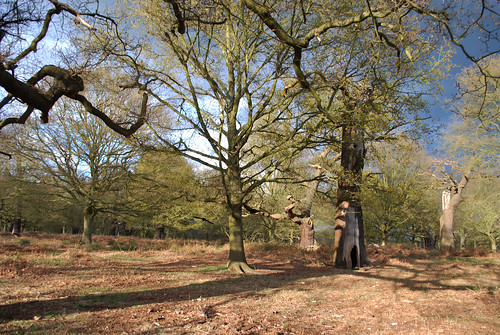
At the side of the road stood an oak Probably ten times older than the birches of the woods, it was ten times as thick and twice as tall as any birch. It was an enormous oak, twice the span of a man's arms in girth, with some limbs broken off long ago, and broken bark covered with old scars. With its huge, gnarled, ungainly, unsymmetrically spread arms and fingers, it stood, old, angry, scornful, and ugly, amidst the smiling birches. It alone did not want to submit to the charm of spring and did not want to see either the springtime or the sun.

"Spring, and love, and happiness!" the oak seemed to say. "And how is it you're not bored with the same stupid, senseless deception! Always the same, and always a deception! There is no spring, no sun, no happiness. Look, there sit those smothered, dead fir trees, always the same; look at me spreading my broken, flayed fingers wherever they grow--from my back, from my sides. As they've grown, so I stand, and I don't believe in your hopes and deceptions."
A tree! A centuries-year-old tree! And Tolstoy makes its haughty voice reasonably convincing!


Andrei, at least, is convinced:
"Yes, it's right, a thousand times right, this oak," thought Prince Andrei. "Let others, the young ones, succumb afresh to this deception, but we know life--our life is over!"
Oh, but Andrei, it could always be worse: you could, after all, be deeply mired in yet another Chicago January, where even the false promises of spring would seem like a gift from the gods!

Thursday, January 21, 2010

Tolstoy's general

In his introduction to the translation of War and Peace that he made with his wife, Larissa Volokhonsky, Richard Pevear, in the course of pointing out a paradox that is obvious to readers of the novel--that
the most real and even, in Tolstoy's sense, historical figures in War and Peace turn out to be the fictional ones; and the most unreal, the most insubstantial and futile, the historical ones.
--notes that the one important exception to that rule is the supreme commander of the Russian forces, Field Marshall Kutuzov, "who for Tolstoy is 'historical' in both senses of the word and thus becomes a touchstone figure in the book."

Kutuzov--old, half-blind, tired of both the trappings and the reality of war--is a character who has stood out in each of my readings of the novel. His weariness, if not his lack of resolve, is familiar from photos and accounts of Ulysses Grant,the reluctant destroyer. Before the battle of Austerlitz, Kutuzov sleeps through a high-level council of generals, knowing its pointlessness; only at the end of the meeting,after various impossible alternative battle plans have been proposed, more for the glory of their designers than for any hope of their actual implementation, does he rouse himself:
Kutuzov woke up, cleared his throat loudly, and glanced around at the generals.

"Gentlemen, the disposition for tomorrow, for today even (because it's already past twelve), cannot be changed," he said. "You have heard it, and we will all do our duty. And there's nothing more important before a battle . . . " (he paused) "than a good night's sleep."
General Grant comes to mind again when Prince Andrei reflects on a meeting with Kutuzov in the early days of Napoleon's invasion in 1812:
How and why it happened, Prince Andrei could in no way have explained, but after this meeting with Kutuzov, he went back to his regiment relieved with regard to the general course of things and with regard to the man to whom it had been entrusted The more he saw the absence of anything personal in the old man, in whom there seemed to remain only the habit of passions, and, instead of intelligence (which groups events and draws conclusions), only the ability to calmly contemplate the course of events, the more calmed he felt over everything being as it had to be. "He won't have anything of his own," thought Prince Andrei, "but he'll listen to everything, remember everything, put everything in its place, won't hinder anything useful or allow anything harmful. He understands that there is something stronger and more significant than his will--the inevitable course of events--and he's able to see them, able to understand their significance, and, in view of their significance, is able to renounce participating in those events, renounce his personal will and direct it elsewhere."
But the moment when Kutuzov most fully comes to life as a character is in a quiet moment with Prince Andrei earlier that day. The general, "flabby and swollen with fat," tired from a day in the saddle, dismounts:
He straightened up, looked around with his narrowed gaze and, glancing at Prince Andrei, obviously without recognizing him, strode towards the porch with his dipping gait.

"Phew . . . phew . .. phew," he whistled and again glanced around at Prince Andrei. Only after several seconds did the impression of Prince Andrei's face (as often happens with old men) connect with the remembrance of his person.

"Ah, greetings, Prince, greetings, dear boy, come along . . ." he said wearily, looking around, and went heavily up the steps, which creaked under his weight. He unbuttoned his jacket and sat down on a bench that stood on the porch.

"Well, how's your father?"

"Yesterday I received news of his passing away," Prince Andrei said shortly.

Kutuzov looked at Prince Andrei with wide-open, startled eyes, then took off his cap and crossed himself: "God rest his soul! His will be done with us all!" He sighed deeply, with his whole chest, and fell silent. "I loved and respected him, and I sympathize with you wholeheartedly." He embraced Prince Andrei, pressed him to his fat chest, and did not let go of him for a long time. When he did, Prince Andrei saw that Kutuzov's swollen lips were trembling and there were tears in his eyes. He sighed and took hold of the bench with both hands in order to stand up.
The mix of sincere emotion and ritual performance, the sense one gets of Kutuzov calling up and deploying reserves of genuine sadness generated by other, more important losses--it all serves to make Kutuzov believable and memorable in a way that Tsar Alexander and Napoleon simply can't ever be.

Tuesday, January 19, 2010

"A Russian is self-assured precisely because he does not know anything and does not want to know anything."


{Photo by rocketlass of me saying, "Have you read War and Peace? I think you'd really like it."}

I first read War and Peace at age twenty-two, in a white heat that saw me do nothing for ten days but go to work and read. It was my first encounter with Tolstoy, and I was most impressed by his more philosophical passages, the reflections on history in which his narrative voice takes on the confidence and timbre of a god's. The second time I read it, not even five years later, was prompted by my first reading of Anna Karenina, and, still under the spell of that book, I found myself responding to those parts of War and Peace that were most like it--the quotidian social fussing and emotional turmoil that Tolstoy depicts so well--while finding Tolstoy's disquisitions on history almost intolerable.

Now, at thirty-five, I'm reading it again--brought back to it by Adam Zamoyski's wonderful book on the Congress of Vienna, Rites of Peace--and, somewhere in the middle of the book, I find myself . . . somewhere in the middle. While I'm still most drawn to the Tolstoy of the small detail--Bilibin's deep wrinkles, which "always looked as neatly and thoroughly washed as one's fingertips after a bath"; the old woman knocked down while trying to catch a biscuit from Tsar Alexander's hand who "did not consider herself defeated, though she was lying on the ground"; the way that Andrei, reunited with Pierre,
spoke eagerly and quickly, like a man who has not spoken for a long time. His gaze became the more animated, the more hopeless his opinions were.
But I also find that my patience for Tolstoy's big-picture narrative voice has increased. Oh, I still find those passages a bit tiresome, their irony too often of the heavy-handed, "Ha! See!" variety, their certainty about our uncertainty reminiscent of all the contradictions and stubbornness that seem to have made Tolstoy such an impossible person to deal with. Yet this time around I no longer see them as a rupture, a distraction from the story, at least when they're at their best: for the first time, I think I'm seeing War and Peace whole, finally see Tolstoy's vision of the quotidian and the epic truly intertwined, indistinguishable, both simultaneously out of our control yet impossible not to obsess over. I have long thought of Tolstoy's approach to his characters being god-like in its empathy; the philosophical passages, in a sense, remind us of just how a god, knowing better, might try in vain to talk himself out of once again being sucked into actively caring about the petty foibles and aspirations of his creation.

That lack of frustration, that willingness to accept Tolstoy's inclusive, syncretic, capaciousness, has freed me to enjoy the combination of assurance and irony in a passage like this one, which last time through would have driven me up the wall:
Pfuel was one of those hopelessly, permanently, painfully self-assured men as only Germans can be, and precisely because only Germans can be self-assured on the basis of an abstract idea--science, that is, an imaginary knowledge of the perfect truth. A Frenchman is self-assured because he considers himself personally, in mind as well as body, irresistibly enchanting for men as well as women. An Englishman is self-assured on the grounds that he is a citizen of the best-organized state in the world, and therefore, as an Englishman, he always knows what he must do, and knows that everything he does as an Englishman is unquestionably good. An Italian is self-assured because he is excitable and easily forgets himself and others. A Russian is self-assured precisely because he does not know anything and does not want to know anything, because he does not believe it possible to know anything fully. A German is self-assured worst of all, and most firmly of all, and most disgustingly of all, because he imagines that he knows the truth, science, which he has invented himself, but which for him is the absolute truth.
Which also makes me wish Tolstoy had lived long enough to grapple with Americans--what would he have said about our self-assurance? An American is self-assured because he knows that everyone else has had the same chance he's had, and if he's come out on top it's through his own hard work and skill? Oh, to hear Tolstoy's thoughts on Melville!

Monday, January 04, 2010

Metternich's alarm clock

One of the most arresting moments in Adam Zamoyski's Rites of Peace: The Fall of Napoleon and the Congress of Vienna (2007) comes in the early morning hours of March 7, 1815. Metternich, Austria's foreign minister, is woken "at the ungodly hour of 6 o'clock" by his valet, who has brought him a despatch marked "urgent." Metternich, tired equally by diplomacy and amours, chose to let it lie until 7:30, when he felt more like waking, at which point he opened it to find:
The English commissioner Campbell has just sailed into the harbour to enquire whether there has been any sighting of Napoleon, given that he has disappeared from the Island of Elba. The answer being negative, the English frigate put to sea without delay.
Though the note came from the Consulate General in Genoa, I can't help but hear a certain British faux-casualness in it, something like, "Say, old chap, have you seen that fellow Napoleon? No, no--no reason to worry: we've just lost track of him for a bit, that's all. I expect he's just popped round the corner for a spot of tea--I'm sure he'll turn up any minute now."* In one sense, such a momentous event seems to cry out for such downplaying, but I'm astonished nonetheless: this was the event that all Europe had feared, and the dread Napoleon soon proved those fears justified, parlaying his mere 1,000-man force into control of all of France.

Thoughts of Napoleon leading, as they inevitably do, to War and Peace, soon after finishing Zamoysky's book I turned to Tolstoy's letters, where I found this striking response to an inquiry about Napoleon from novelist Alexander Ivanovich Ertel, sent on January 15, 1890:
I can't tell you anything about Napoleon. No, I haven't changed my opinion, and I would even say I value it very much. You won't find any bright sides; it's impossible to find them until all the dark and terrible sides this person presents have been exhausted. The most valuable material is Memorial de Sainte-Helene. And his doctor's memoirs about him. However much they exaggerate his greatness, this pathetic fat figure with a paunch and a hat, loafing around an island and living only on the memories of his former quasi-greatness, is pathetic and nasty. I was always terribly agitated reading about this, and I very much regret that I didn't have to touch on this period of his life. The last years of his life when he plays at greatness and sees himself that it's no good--the period when he is shown to be a complete moral bankrupt, and his death--all this should be a very big and important part of his biography.
That letter offers an additional, unexpected pleasure: that defining phrase, "terribly agitated." It's how I always think of Tolstoy the man: fingers tightly gripping a book as he shakes it in anger and frustration, his lips atremble, his mind racing in counterattack. It could hardly have made him a comfortable spouse or father or even friend, but good god am I glad for it nonetheless.

Sunday, October 05, 2008

Annotations, or, What's a gam'ster?

The edition of Tess of the D'Urbervilles that I'm currently reading is the 1978 Penguin Classics edition, edited and with notes by David Skilton. I usually find that the editors of Penguin Classics append a bit too much annotation, to the point that the superscripts become distracting, whereas for most of the past week I've been frustrated at how scanty Skilton's notes are: while he flags every biblical reference (which I mostly don't need, since I'm reasonably strong on the Bible), he does nothing to clarify the many wonderful Dorset slang terms with which Hardy lards his characters' speech. Some terms--such as "skillentons," meaning skeletons, or "hobble," meaning a spot of trouble--are easy enough to figure out from context. But what on earth is a pummy? Or a gam'ster? Or a rozum?

Just now, however, as I was stupidly attempting to simultaneously read and stir the beginnings of bread dough, I dropped the book . . . and it fell open to a glossary. Oops. Pummy, it turns out, is the name for "crushed apples used in cider-making"; and a gam'ster is "a cudgel player, etc.; hence a plucky animal"; while a rozum is "a quaint saying or nonsense," and by extension a person with strange ideas. And, ooh, one more: a market-nitch is "the amount drunk after market. A 'nitch' is 'a burden; as much as one can carry of wood, hay, or straw, and sometimes of drink,'" drawn from William Barnes's A Grammar and Glossary of the Dorset Dialect (1863). Sometimes of drink!

The Penguin edition also marks all the changes Hardy introduced between the first publication of the novel, in the Graphic, in the fall of 1891, and the collected Wessex edition of his novels that was published in 1912. Some of the changes are bound to be of great interest to Hardy fans, as they show Hardy continuing to tinker in relatively serious ways with the details of Tess's relationship with Alec D'Urberville--long after he'd pointedly sworn off novel-writing.

One utterly minor emendation seems worth sharing, as it's hard not to enjoy despite Alec's horridness: on Alec's first appearance in the Wessex edition of the novel, he is described as having
an almost swarthy complexion, with full lips, badly moulded, though red and smooth, above which was a well-groomed black moustache with curled points, though his age could not be more than three- or four-and-twenty.
At the time of the Grapic edition, however, his moustache had been less impressive:
a sooty fur represented for the present the dense black moustache that was to be.

All this reminds me of a letter from Tolstoy to his publisher, M. N. Katkov, that I read recently. Sent from Yasnaya Polyana on January 3, 1865, it accompanied the manuscript of the first part of War and Peace, which Tolstoy encouraged Katkov to publish, preferably in one part, and soon:
But of course you have your own considerations, and if you find it better to divide the first part, it can't be helped. But in that case, write and tell me whether you wish to have the 2nd part this year, i.e. this winter. It woudl be a nuisance for me to leave it until next autumn, since I can't hold on to waht I have written without correcting and revising it endlessly. . . . The manuscript is full of crossings out, and I do apologise, but as long as it's in my hands I revise it so much that it can't look any different.
As I've said before: thank you, tireless textual scholars. Your loving drudgery is appreciated.

Saturday, September 13, 2008

David Foster Wallace, R.I.P.

Tolstoy, perhaps predictably, simultaneously offers acceptance and prescription in this letter from 1898:
The question "Has a man in general the right to kill himself?" is incorrectly put. There can be no question of "right". If he is able to do it, then he has the right. I think that the possibility of killing oneself is a safety-valve. Having it, man has no right (here the expression "right" is appropriate) to say that life is unbearable.

If it were impossible to live, then one would kill oneself; and consequently one cannot speak of life as being unbearable. The possibility of killing himself has been given to man, and therefore he may (he has the right to) kill himself, and he continually uses this right - when he kills himself in duels, in war, by dissipation, wine, tobacco, opium, etc.

The question can only be as to whether it is reasonable and moral (the reasonable and moral always coincide) to kill oneself. No, it is unreasonable; as unreasonable as to cut off the shoots of a plant which one wishes to destroy; it will not die, but will merely grow irregularly..

Life is indestructible; it is beyond time and space, therefore death can only change its form, arrest its manifestation in this world. But having arrested it in this world, I, first, do not know whether its manifestation in another world will be more pleasant to me; and, secondly, I deprive myself of the possibility of experiencing and acquiring by my ego all that could be acquired in this world.

Besides this, and above all, it is unreasonable because by arresting my life owing to its apparent unpleasantness, I hereby show that I have a perverted idea of the object of my life, assuming that its object is my pleasure - whereas its objects, on the other hand, personal perfection, and on the other, the service of that work which is being accomplished by the whole life of the Universe.

It is for the same reason that suicide is also immoral. Life in its entirety, and the possibility of living until natural death, have been given to man only on the condition that he serve the life of the Universe. But, having profited by life so long as it was pleasant, he refuses to serve the Universe as soon as life becomes unpleasant: whereas, in all probability, his service commenced precisely when life began to appear unpleasant. All work appears at first unpleasant.

In the Optin Monastery, for more than thirty years, there lay on the floor a monk smitten with paralysis, who had the use of his left hand only. The doctors said that he was sure to suffer much, but not only did he refrain from complaining of his position, but incessantly making the sign of the cross, and looking at the ikons, he smilingly expressed his gratitude to God and joy in that spark of life which flickered in him. Tens of thousands of visitors came to see him, and it is difficult to imagine all the good which flowed into the world through this man, though deprived of the possibility of any activity. Certainly he did more good than thousands and thousands of healthy people who imagine that in various institutions they are serving the world.

While there is life in man, he can perfect himself and serve the Universe. But he can serve the Universe only be perfecting himself, and perfect himself only by serving the Universe.
Tolstoy's view--essentially insufferable--is of course predicated on a belief that the Universe is purposive and that therefore one's own insignificant life has a purpose as well, a view that many of us living more than a century later have a hard time countenancing.

Chekhov--remaining, like Tolstoy, largely in character--offers a different spin, focusing on the inability of our art to grasp the dimensions of self-destruction:
The suicide of a seventeen-year-old boy is a very promising and tempting theme, but a frightening one to undertake. An issue so painful to us all calls for a painfully forceful response, and do we young writers have the inner resources for it? No. When you guarantee the success of this theme, you are judging by your own standards. But then, in addition to talent, the men of your generation had erudition, schooling, iron and phosphorus, while contemporary talents have nothing of the sort. Frankly speaking, there is reason to rejoice that they keep away from serious problems. Let them have a go at your seventeen-year-old, and I am certain that X, completely unaware of what he is doing, will slander him and pile lie upon blasphemy with the purest of intentions; Y will give him a shot of pallid and petty tendentiousness; while Z will explain away the suicide as a psychosis. Your boy is of a good, pure nature. He seeks after God. He is loving, sensitive and deeply hurt. To handle a figure like that, an author has to be capable of suffering, while all our contemporary authors can do is whine and snivel.
The sections of Infinite Jest dealing with Kate Gompert's suicidal depression are among the most memorable and powerful in the book; like Tolstoy in Anna Karenina, David Foster Wallace wrote about depression and the suicidal impulse with the clarity and force of someone who had experienced them. Yet I almost off-handedly assumed that a person who found the very stuff of the world as fascinating as he obviously did would have a handle, a power, an ability to overcome the darkness that has claimed so many. Intellectually, I knew that depression doesn't work that way, but the joy I am fortunate enough to take in the dailiness of life has always made it extremely difficult for me to imagine its obverse.

I find myself thinking about Malcolm Lowry--who, if he didn't explicitly kill himself, at least registered, again and again, his dissatisfaction and discomfort with the state of being alive. In a letter to his wife's family, he wrote that the theme of his novel of extended suicide, Under the Volcano, was that "only against death does man cry out in vain."

Rest in peace, David Foster Wallace. Our thoughts are with your family and friends.

Monday, August 04, 2008

Dear I've Been Reading Lately,

A discussion this week with Jenny Davidson about the publication of So I Have Thought of You, a collection of letters from the splendid Penelope Fitzgerald (a copy of which is winging its way to me across the ocean as we speak) has convinced me that this week ought to be, despite not a whit of planning on my part, a Letters Week! I do, after all, love letters.

Fortunately for this theme, I happened to begin the week with a bit from Kafka's letters. As I've also recently been reading Tolstoy's letters, it seems right to continue by quoting a letter from him that, unusually, could serve as the opening--or perhaps even the whole--of a story by Kafka. Sent to his English translator Aylmer Maude on November 3, 1910, at the end of his ill-starred final flight from the (somewhat self-induced) marital hell of Yasnaya Polyana, it was written in English in response to a letter Maude had sent inquiring about his health. Tolstoy's letter in full reads:
On my way to the place where I wished to be alone I was taken ill . . .
Four days later he was dead.

Tolstoy's letters, like his biography, serve as a reminder, should we need one, that acute perceptiveness and talent needn't necessarily bring with them true understanding of oneself, one's relations to others, or--perhaps most troubling--of how one ought to live in the world. A passage from a letter to Turgenev, sent from Moscow in May of 1882, illustrates this poignantly:
I'm quite calm, but sad--often because of the exultant, self-assured madness of the life of the people around me. I often don't understand why it has been granted to me to see their madness so clearly, and they are completely incapable of understanding their own madness and their own errors; and we just stand opposite each other without understanding each other, being astonished, and condemning each other. Only they are legion, and I am one. They seem to be happy and I seem to be sad.
He was right about his understanding, insufferable because of it, and never quite capable of reconciling what he knew of other people and what he knew of himself. Therein lies the tragic sadness of Tolstoy's life.

Saturday, July 26, 2008

"Tolstoy's truest prayer was the manuscript of Hadji Murad"


One of my tiny goals in writing this blog is to make it one of the first places people land following searches for information about Tolstoy's last fiction, the posthumously published novella Hadji Murat (1912). I've raved about the book before: though one of the least well-known of Tolstoy's works, it's the perfect introduction to his genius, offering in a mere hundred-plus pages glimpses of both his unmatched eye for telling detail and the seemingly endless wells of sympathy that underlie his characterizations. At the same time, when set next to his early novel The Cossacks, which is set in the same region, Hadji Murat serves as a clear demonstration of the growth of his skill and perception. Despite the fact that the The Cossacks was based largely on Tolstoy's own experiences as a young man, while Hadji Murat was created through research, it is the earlier novel that at times feels imagined or constructed, while the later novel never feels less than fully lived.

In Tolstoy and the Novel (1966), John Bayley writes that "some portraits in the story are as life-giving and complete as those in War and Peace," while Viktor Shklovsky, in Energy of Delusion (1981), not only makes the grand claim of this post's headline, but also writes, "Among his great works, Tolstoy has one that's the best. It's Hadji Murad." The tale's place at the end of Tolstoy's ouevre is given a further poignancy by the fact that even as he wrote it, Tolstoy was actively denying to himself that literature had value. As A. N. Wilson explains in Tolstoy: A Biography (1988)
While he was writing it between 1896 and 1904, so little did its subject matter accord with mainstream Tolstoyan pacifism that he felt obliged to work on it "on the quiet" and, by the time he had completed the Shakespeare essay and persuaded himself that literature was evil or a waste of time, Hadji Murat was laid aside.
Wilson explains that though Tolstoy denigrated his achievement, his wife, even as their long-running marital wars were reaching fever pitch, treasured the book, writing in her diary,
I have done nothing but copy out Hadji Murat. It's so good! I simply couldn't tear myself away from it.
What brings me back to Hadji Murat today is a letter I came across in the second volume of R. F. Christian's two-volume collection of Tolstoy's letters. Written from Yasnaya Polyana in January of 1903 to Anna Avessalomovna Korganova, the widow of the army officer who had guarded Hadji Murat after he had crossed over to the Russian side in the perpetual war in the Caucasus, it reveals Tolstoy even at that late date searching for specific details to give his portrait of the charismatic rebel leader the force of reality.
Dear Anna Avessalomovna,

Your son, Ivan Iosifovich, having learned that I am writing about Hadji Murat, was kind enough to tell me many details about him and, moreover, permitted me to turn to you with a request for more detailed information about the naib Shamil who lived with you at Nukha. Although Ivan Iosifovich's information is very interesting, many things might have been unknown to him or wrongly understood by him, since he was only a ten-year-old boy at the time. I am venturing therefore to turn to you, Anna Avessolomovna, with the request to answer certain questions of mine and to tell me all you remember about this man and about his escape and tragic end.

Any detail about his life during his stay with you, his appearance and his relations with your family and other people, any apparently insignificant detail which has stuck in your memory, will be very interesting and valuable to me.

My questions are as follows:

1. Did he speak even a little Russian?
2. Whose were the horses on which he tried to escape--his own, or ones given to him? And were they good horses, and what colour were they?
3. Did he limp noticeably?
4. Did the house where you lived upstairs, and he downstairs, have a garden?
5. Was he strict in observing Mohammedan rituals, the five daily prayers etc.

Forgive me, Anna Avessalomovna, for troubling you with such trifles, and accept my sincere gratitude for everything you do to carry out my request.

I remain, with the utmost respect, at your service,
Lev Tolstoy

P.S. Another question (6) What were the murids like who were with Hadji Murat and escaped with him, and how did they differ from him?

And yet another question (7) Did they have rifles on them when they escaped?
It's the hurried questions in the postscript that really bring Tolstoy to life in this letter; like a good friend lingering at a dinner party because there's still so much more to talk about, he can't help but want to know more, more, more. I love question six in particular, the way its request for what are essentially brief character studies rests on an implicit confidence that the discernment and descriptive powers of a master novelist--what Shklovsky calls "Tolstoy's strength and ability to construct the temple of the human soul"--are available to any stranger to call on when asked.

The letter seems to support what Shklovsky, in his typically fervid fashion, notes about Tolstoy's work on this novel in his last years:
[E]ven when he was sick and close to death, Tolstoy was still doing research for this novel. He demanded books, checking the details in them. . . . When Tolstoy finished Hadji Murad, he lifted himself up on the arms of his chair and said: that's how it should be, yes, that's how it should be.

And there he was, a mountaineer, heading straight toward the bullets.

He was singing a song.
As I've urged before: read Hadji Murat. You won't regret it.

Sunday, March 30, 2008

"And I must finish the novel that has become such a nuisance to me."


Between a weekend of proofreading and making giant pots of chili to feed to guests in honor of the incipient baseball season, I find myself again without time to write. So, as I've had Anna Karenina on my mind this past week, today I'll give you only a couple of bits from letters Tolstoy sent to his longtime friend Nikolay Strakhov during the four-year period in which Tolstoy was struggling with Anna Karenina, which are featured in one of the chapters of Viktor Shklovsky's Energy of Delusion (1981). This first letter, from March 25, 1873, gives a glimpse into the novel's moment of conception; it also offers an optimism about the ease of its inevitable composition that quickly dissipates:
I'm going to tell you about myself, but please, keep it a secret, because it may be that nothing will come of what I'm going to tell you . . . After work, I happened to pick up . . . a book by Pushkin and as always (for the seventh time, I think), reread it all, unable to tear myself away from it, as though reading it for the first time. And what's more, it seems as if it resolved all my doubts . . . And there is a line, "The guests were getting ready to leave for the country house." Involuntarily and quite unintentionally, without knowing why and how, I began thinking up people and events, went on doing so, then, of course, changed the, and suddenly everything tied in so beautifully and unexpectedly, that the result was a novel, which is almost finished in draft form. A very lively, passionate and complete novel with which I am pleased; it will be ready, if God grants me good health, in two weeks. . . . Please do not scold me for such an incoherent letter--I have been working happily all morning. I'm excited that it's finished, and now, in the evening, I have an hangover.
Perhaps Tolstoy decided the letter really was too incoherent, for he never sent it. Regardless, that short paragraph gives us so much of the man--especially his unstoppable imagination, determined to imbue with full life even the slightest thought about the things and people of the world, and his confident enthusiasm when things are going well.

As with anything to which Tolstoy turned his attention, however, Anna Karenina, as its complexity and difficulty became apparent, began to seem an insurmountable challenge, driving him nearly to despair; by November 9th, 1875, he was writing to Strakhov:
My God, if only someone could finish Anna Karenina for me! It's unbearable.
His mood continued to swing, however, with each day's writing, and within two months he was writing to a pair of friends, A. M. and T. A. Kuzminsky,
Farewell, good-by. Sonya will describe everything, and I have written it all in Anna Karenina, and nothing is left
--while telling Strakhov days later,
Anna Karenina is making progress.
I'll leave you with an image that I found particularly striking, Tolstoy's account, in a letter to Strakhov of February 13, 1874, of his working method:
You are right to assume that I'm very busy and have been working a lot. I'm glad that I didn't start publishing anything, as I wrote in one of the previous letters. I don't know how else to draw a circle but to close it first and then begin correcting the original flaws. And now I have just come to the closure, and the corrections are endless.
And now to the kitchen. Baseball season beckons.


{Photo of me making baseball chili by rocketlass.}

Tuesday, March 25, 2008

"The more one sees of life the more one is aware how hopeless it is without art to give it meaning."


{Vivien Leigh in Anna Karenina, 1948}

From Viktor Shklovsky's "Another Note on Beginnings and Endings," from Energy of Delusion: A Book on Plot (1981)
If a talented person tried to lie, Tolstoy said, his talent wouldn't allow him to.
It's an inordinately busy week, so I've only got time to share a couple of quick bits tonight.

The Shklovsky I present in honor of a renewal, last night with my friend Bob--who is spending this week getting drunk on Tolstoy--of the eternal, inexhaustible conversation about Anna Karenina. A bit more from the same essay:
Sometimes happy endings are dressed with irony. As in one of Charlie Chaplin's pictures his friend, the millionaire, recognizes him only when he is drunk, but when he is sober, Chaplin is a stranger to him.

At the beginning of the novel, Karenina is reading an English novel about a baronet. She reads it through to the traditional ending, when the baronet gains his happiness.

Suddenly she is filled with shame.

She has already seen Vronsky.

This is the first hint of adultery.

It's not going to end like the novel about the baronet.
Which seems like a good enough lead-in to a pair of entries from Cyril Connolly, who provides this post's title. I'm drawing today from a piece in The Condemned Playground (1945), "England Not My England," which consists of selections from a journal kept by the twenty-three-year-old Connolly, chosen by him to highlight his whiplashing dis- and re-enchantment with his native England. The first strikes an unusual note of forthright satisfaction:
2nd to 4th August 1927

I ought in fairness to announce that these two days by the sea I have been distinctly happy.
But true to form, Connolly is soon right down in it again:
8th September 1927

My thoughts run to depression as a child to its mother. Not to be born is best, or, being born, to live at Cadiz.
Even at his most self-pitying, Connolly remains detached enough to derive a level of amusement--even pleasure--from his condition; Robert Burton would, I think, have approved.