It was past three in the morning and I was staring into the green murk of Madame Beetle's tank. The plants are all shrouded in long green webs of algae, there are white and ghostly bits of old meat hanging about blooming with mould, the sides of the tank are very dim. It's like the setting for a tiny horror film but Madame Beetle doesn't seem to mind. I can't think now how it could have occurred to me that I might write a story about her. Who am I to use the mystery of her that way? Her swimming is better than my writing and she doesn't expect to get paid for it. If someone were to buy me, have me shipped in a tin with air-holes, what would I be a specimen of?I don't know the answer to that, but I do know that, as her eventual partner in well-meaning crime, William G., points out, she would be the source of Neara soup.
Friday, June 14, 2013
From turtles to water-beetles
While I'm busy collecting turtle stories--go leave yours in the comments to Wednesday's post!--I'll share another passage from Russell Hoban's Turtle Diary. This one is from Neara's diary, written after a session of watching her pet water-beetle:


Wednesday, June 12, 2013
You can never have too many turtles, but maybe you can have too many Turtle Diaries? Or, a contest!
For several years now, Ed Park has been urging me to read Russell Hoban's Turtle Diary. So it's fitting that in his introduction to the new NYRB Classics edition what he does is, essentially, urge you--and you, and you over there--to read it. "I'm going to make you need this story," he writes, and elsewhere,
He's right about Turtle Diary, too. Told through dual (not quite dueling) diaries, it comes to life through the voices of its twin narrators, William G. and Neera, and the wild (and often hilarious) peregrinations of their strange, solitary thoughts. On the first page alone, William dreams of an octopus, then looks up a picture of one in the bookstore where he works:
(My favorite of those? This one, which I have found myself thinking about pretty much every day in the month since I first read it:
The voices, and the underlying sensibility, are what draw you in, but Hoban doesn't rely solely on that--he instead sets his two seemingly inertia-ridden characters in motion and works them through a plot, and even a romance. If the plot is a bit fractured, if, as Ed puts it, "the dramatic mainstays of love and death . . . are not necessarily in the places you expect," well, that's what happens when you set out with oddballs. The book starts off funny, and, while never losing its charm, winds up being moving, earning its place as "one of the great novels of middle age," as Ed puts it:
I'll start. A few years back, I was walking out of Central Park up the 77th Street ramp, when a young man on a bicycle came barreling down the ramp, swept around the curve, and headed north, towards Belvedere Castle and Turtle Pond. How did I know that's where he was headed? In his right hand, held out away from his body, was a turtle, legs swimming in air. As he flew past, the man was saying to the turtle, "Don't fret! Don't fret!"
And your turtle story?
My own shelves are crammed with books I mean to get around to sometime. Yours probably are, too. What if I told you that this novel, of two loners on a mission to liberate the sea turtles from the London Zoo, is like a lot of things you already like, while being so much its own stupendous thing that it's become one of my literary yardsticks?And what if I told you that my shelves, too, are crammed, with books Ed has convinced me to read (while his, I suspect, groan under a similar weight in return), and that those I've followed through on (Charles Portis! Charles Portis! Charles Portis!) have taken their place among my favorites? When Ed Park tells you to read something, trust him.
He's right about Turtle Diary, too. Told through dual (not quite dueling) diaries, it comes to life through the voices of its twin narrators, William G. and Neera, and the wild (and often hilarious) peregrinations of their strange, solitary thoughts. On the first page alone, William dreams of an octopus, then looks up a picture of one in the bookstore where he works:
Their eyes are dreadful to look at. I shouldn't like to be looked at by an octopus no matter how small and harmless it might be. To be stared at by those eyes would be altogether too much for me, would leave me nothing whatever to be.From that unexpectedly bleak thought, within sentences he's on to this:
They're related to the chambered nautilus which I'd always thought of only as a shell with nothing in it. But there it was in the book full of tentacles and swimming inscrutably."Swimming inscrutably." Perfect, and perfectly strange. A later entry opens:
Briefcases. Businessmen, barristers carry briefs. When I was in advertising we always talked about what our brief was. Brief means letter in German. Brief is short. Life is a brief case. Brief candle, out, out. In the tube there was a very small, very poor-looking man in a threadbare suit and a not very clean shirt, spectacles. He made a roll-up, lit it, then took from his briefcase a great glossy brochure with glorious colour photographs of motorcycles. Many unshaven men carry briefcases. I've seen briefcases carried by men who looked as if they slept rough. Women tramps usually have carrier bags, plastic ones often. I carry one of those expanding files with a flap. Paper in it for taking notes, a book sometimes, sandwich and an apple for lunch. The apple bulges, can't be helped.Lately I've been admiring Alice Thomas Ellis's ear for the quiet, often punishing asides we deliver, sotto voce or even silently, in the interstices of difficult conversations--and her ability to render their often unsettlingly oblique quality. Hoban has a similar skill with what we say truly to ourselves, the altogether more benign jokes and tangents that pepper our thoughts throughout the day, and that in quantity and importance often outweigh the words we speak aloud.
(My favorite of those? This one, which I have found myself thinking about pretty much every day in the month since I first read it:
Two of the turtles at the Aquarium are green turtles, a large one and a small one. The sign said: "The Green Turtle, Chelonia mydas, is the source of turtle soup . . . " I am the source of William G. soup if it comes to that. Everyone is the source of his or her kind of soup. In a town as big as London that's a lot of soup walking about.How can you resist that?)
The voices, and the underlying sensibility, are what draw you in, but Hoban doesn't rely solely on that--he instead sets his two seemingly inertia-ridden characters in motion and works them through a plot, and even a romance. If the plot is a bit fractured, if, as Ed puts it, "the dramatic mainstays of love and death . . . are not necessarily in the places you expect," well, that's what happens when you set out with oddballs. The book starts off funny, and, while never losing its charm, winds up being moving, earning its place as "one of the great novels of middle age," as Ed puts it:
It's a book that can help you, even if you don't think you need help. (If you've read this far, you do.) It offers solace to anyone who has ever looked at her situation in life and wondered, as one of Hoban's characters does, "Am I doomed?" (Answer: No.)Now that I've filled your mind with turtle thoughts ("Funny, two minds full of turtle thoughts"; "Now here we are, both of us alone and thinking turtle thoughts."), let's put them to good use! I've ended up with an extra copy of Turtle Diary, and rather than let it moulder on my shelf, I thought I'd give it to someone: I'll send the book to the person who leaves the best turtle story in the comments by June 20.
I'll start. A few years back, I was walking out of Central Park up the 77th Street ramp, when a young man on a bicycle came barreling down the ramp, swept around the curve, and headed north, towards Belvedere Castle and Turtle Pond. How did I know that's where he was headed? In his right hand, held out away from his body, was a turtle, legs swimming in air. As he flew past, the man was saying to the turtle, "Don't fret! Don't fret!"
And your turtle story?
Monday, June 10, 2013
Penelope Fitzgerald on Barbara Pym
Before I leave Barbara Pym for a while, here's one last, quick post in honor of her centennial. In a review of Pym's A Few Green Leaves, Penelope Fitzgerald--who, though nearly Pym's contemporary, didn't truly get established in her writing career until much later, and who clearly felt Pym's influence--offers a description of the mostly hidden stakes that quietly underlie conversations in Pym's works:
In her nine novels Barbara Pym stuck serenely to the [world] she knew best: quiet suburbs, obscure office departments, villages where the neighbours could be observed through the curtains, and, above all, Anglican parishes. . . . This meant that the necessary confrontations must take place at cold Sunday suppers, little gatherings, visits, funerals, and so on, which Barbara Pym, supremely observant in her own territory, was able to convert into a battleground. Here, even without intending it, a given character is either advancing or retreating: you have, for instance, an unfair advantage if your mother is dead, "just a silver-framed photograph," over someone whose mother lives in Putney. And in the course of the struggle strange fragments of conversation float to the surface, lyrical moments dear to Barbara Pym.Pym's conversational battles, like her humor, are so subtle that an inattentive or unsympathetic reader could easily miss them entirely. Unlike Ivy Compton-Burnett, whose characters fight with words like naked blades and in not a few cases are ready to back up their thrusts with actual violence, Pym's characters leave the social surface unruffled; in fact, a fear of troubling the waters is at the root of many a silent retreat. Pym's dialogue, and what it represents, is part of a lineage that stretches back to Austen--but surely Penelope Fitzgerald was not its last practitioner? Anyone have nominations for the Pym of today, in that regard?"An anthropologist," declared Miss Doggett in an authoritative tone. "He does some kind of scientific work, I believe."Or:
"I thought it meant a cannibal--someone who ate human flesh," said Jane in wonder.
"Well, science has made such strides," said Miss Doggett doubtfully."Well, he is a Roman Catholic priest, and it is not usual for them to marry, is it?"In such exchanges the victory is doubtful: indeed, Miss Doggett and Miss Foresight are, in their way, invincible.
"No, of course they are forbidden to," Miss Foresight agreed.
"Still, Miss Lydgate is much taller than he is," she added.
Wednesday, June 05, 2013
Falling in love (with a writer--specifically Barbara Pym)
Is there any moment more important to us when we're young--more obsessed-over, more fraught--than that of falling in love? The energy and emotion that we, at sixteen or eighteen or twenty, bring to bear on trying to pinpoint the instant when appreciation and amusement and desire and friendship and intrigue crystallize into love . . . well, if it does nothing else it reminds us, ineluctably, that we're ultimately all the centers of our own Copernican scheme.
But when does it happen with a writer? There's no question that sometimes it's instant. For me, that's Borges, or Steven Millhauser: reading both the first time felt uncannily like welcoming old friends into the house--there was surprise and mystery there, certainly, but also a comfort, as if Borges's Library of Babel had already alerted me to the existence of these brilliant permutations of letters. Other times, it's gradual. I didn't really fall for Anthony Powell until well into the second volume of A Dance to the Music of Time, and I didn't--to stay with and extend the metaphor--marry him until my second time through the sequence.
It's probably no surprise, given the ups and downs of her reputation over the decades, that the process was gradual with Barbara Pym. Penelope Fitzgerald's praise led me to Less Than Angels, and I was impressed with her delicacy and humor, but it took time for head and heels to swap. I read another, then another. Then I read the diaries and letters, and used a whole pad of post-it flags. Then I found myself spotting Barbara Pym characters and situations in everyday life. I was caught.
There really is no one quite like her. Oh, Jane Austen is her model, and Ivy Compton-Burnett, Penelope Fitzgerald, and Anthony Powell impinge on her Venn diagram, but no one else provides her exact cocktail of insight, aphoristic asperity, wit, perceptiveness, and at times painful honesty--mixed, crucially, with love and comfort. Her centennial has sent me back to her books, as it should, and that has only confirmed my love.
I'll close with an anecdote that makes me smile, shared by Pym's sister, Hilary Pym Walton, which opens her brief foreword to "All This Reading": The Literary World of Barbara Pym (2003):
But when does it happen with a writer? There's no question that sometimes it's instant. For me, that's Borges, or Steven Millhauser: reading both the first time felt uncannily like welcoming old friends into the house--there was surprise and mystery there, certainly, but also a comfort, as if Borges's Library of Babel had already alerted me to the existence of these brilliant permutations of letters. Other times, it's gradual. I didn't really fall for Anthony Powell until well into the second volume of A Dance to the Music of Time, and I didn't--to stay with and extend the metaphor--marry him until my second time through the sequence.
It's probably no surprise, given the ups and downs of her reputation over the decades, that the process was gradual with Barbara Pym. Penelope Fitzgerald's praise led me to Less Than Angels, and I was impressed with her delicacy and humor, but it took time for head and heels to swap. I read another, then another. Then I read the diaries and letters, and used a whole pad of post-it flags. Then I found myself spotting Barbara Pym characters and situations in everyday life. I was caught.
There really is no one quite like her. Oh, Jane Austen is her model, and Ivy Compton-Burnett, Penelope Fitzgerald, and Anthony Powell impinge on her Venn diagram, but no one else provides her exact cocktail of insight, aphoristic asperity, wit, perceptiveness, and at times painful honesty--mixed, crucially, with love and comfort. Her centennial has sent me back to her books, as it should, and that has only confirmed my love.
I'll close with an anecdote that makes me smile, shared by Pym's sister, Hilary Pym Walton, which opens her brief foreword to "All This Reading": The Literary World of Barbara Pym (2003):
I am reminded of an incident from the distant past when someone, on meeting Barbara and me with our mother, asked, "And which is the clever one?" I am afraid that she was referring to me, as I had drawn a picture of a horse at an early age and had received some sort of certificate.Which leads me back to Pym's inexhaustible diaries, to an entry from July 10, 1943, when she was in an army training camp:
I went with Peggy Wall, a quiet dark girl who seems to be about the best of our lot--she used to be secretary to a literary agent. She said as soon as she saw me she thought--I bet she's going to write a novel about it. Well--who knows.If you share my tastes at all--there's nearly eight years of blog posts here to help you determine that--and you've not read Pym, do. It will make your summer.
Monday, June 03, 2013
Good birthday wishes for Thomas Hardy and Barbara Pym!
In a diary entry for May 20, 1977, Barbara Pym noted,
If she knew they shared a birthday, she didn't mention it. Yesterday, June 2, would have been Pym's hundredth birthday, Hardy's 173rd. They overlapped for fifteen years, long enough for us to imagine a young Pym, having fallen for Tess, saddened at hearing of Hardy's death. They're not similar writers at all, but in a talk written for the BBC in the spring of 1978, "Finding a Voice," Pym did reveal some passages from Hardy's notebooks that, while she doesn't explicitly make this point, feel like part of the Pym universe:
Which leads to the unanswerable question: Would Hardy have liked Pym's work? It seems wildly unlikely, doesn't it? Hardy bridges the Victorian and Edwardian eras, but for all their ventures into psychology his novels remain nearly as full of incident as their predecessors, whereas Barbara Pym's books turn on such modest changes of heart and fortune that a reader more accustomed to the violence and passion of Hardy could miss them entirely. In fact, the developments in Pym's plots so often don't exist, involving as they do the raising and surrendering of unexpressed dreams--whereas dreams in Hardy are rarely (if ever?) repressed, finding life in wild, dramatic action.
The humor, too, would be a problem. Hardy's novels are almost entirely humorless, at least when it comes to their central characters and concerns, as Anthony Powell noted in a 1971 review for the Telegraph:
No, much as Pym loved Hardy, the reverse seems unlikely. But birthday mates they are despite. This year, Pym, rightfully, is getting the lion's share of attention: her centennial has sparked a wonderfully astute appreciation by Carrie Frye for the Awl, while bloggers at My Porch and Fig and Thistle are hosting a Barbara Pym reading week. From My Porch's gallery of Pym covers I learned that the New York Times once called her "the novelist most touted by one's most literary friends," while Shirley Hazzard simply noted that "her books will last." Indeed. It's unlikely we'll be around for her bicentennial, but I hold out hopes that her books will.
Seeing a handsome Dorset woman at a petrol pump I thought a Hardy heroine of today might well follow such an occupation. Tess for instance.She mentions reading Hardy a couple of times in her diaries and letters, once accurately describing the right atmosphere for taking comfort from his poetry--
The weather is dull but not unpleasant--rather calming and saddening and I'm glad i have brought Hardy's poems with me.--and later trying (and failing) to imagine him driving.
If she knew they shared a birthday, she didn't mention it. Yesterday, June 2, would have been Pym's hundredth birthday, Hardy's 173rd. They overlapped for fifteen years, long enough for us to imagine a young Pym, having fallen for Tess, saddened at hearing of Hardy's death. They're not similar writers at all, but in a talk written for the BBC in the spring of 1978, "Finding a Voice," Pym did reveal some passages from Hardy's notebooks that, while she doesn't explicitly make this point, feel like part of the Pym universe:
Let me quote this entry for Sunday, February 1st 1874: "To Trinity Church, Dorchester. The rector in his sermon delivered himself of mean images in a sublime voice, and the effect is that of a glowing landscape in which clothes are hung up to dry." Or another entry, for October 25th 1867, more likely to have inspired a poem: "Martha R --, an old maid whose lover died, has his love letters to her bound, and keeps them on the parlour table."The latter has the self-aware wistfulness of Pym's characters, the former a hint of her judgment and humor--though if we encountered it in the context of Hardy's work the judgment would predominate.
Which leads to the unanswerable question: Would Hardy have liked Pym's work? It seems wildly unlikely, doesn't it? Hardy bridges the Victorian and Edwardian eras, but for all their ventures into psychology his novels remain nearly as full of incident as their predecessors, whereas Barbara Pym's books turn on such modest changes of heart and fortune that a reader more accustomed to the violence and passion of Hardy could miss them entirely. In fact, the developments in Pym's plots so often don't exist, involving as they do the raising and surrendering of unexpressed dreams--whereas dreams in Hardy are rarely (if ever?) repressed, finding life in wild, dramatic action.
The humor, too, would be a problem. Hardy's novels are almost entirely humorless, at least when it comes to their central characters and concerns, as Anthony Powell noted in a 1971 review for the Telegraph:
Hardy's failing was a total lack of humour, which, one feels, might have prevented some of the absurdities. He could do knockabout up to a point, or irony, but one has only to think of Balzac, Dickens, Dostoevsky, Proust, or Conrad, to see the missing quality that is possessed by most of the great novelists in one form or another.Hardy's humor is almost always found in the rustics around his protagonists, the characters who see no disjunction between their dreams and their surroundings, who harbor neither hope nor fear of change--they're Shakespearean jesters (though fortunately less irritating). Gentle satire of Pym's sort, even if you could explain its essential reference points of contemporary social intercourse, would I suspect fall entirely flat with Hardy. As Penelope Fitzgerald notes in her perceptive review of Pym's last novel, A Few Green Leaves,
High comedy needs a settled world, ready to resent disturbance.--and Hardy's world is anything but settled. What we get in Hardy is the friction caused by different rates of change, between an old way of life that is inexorably being lost (but slowly enough that the fact can be denied) and a new freedom that is emerging too fitfully (and that ultimately may not wholly compensate for what's been lost). Tess as a gas station attendant in Hardy would involve disgrace and rage in at least equal parts with fierce independence; as a Pym character she would be merely a figure of speculative village gossip.
No, much as Pym loved Hardy, the reverse seems unlikely. But birthday mates they are despite. This year, Pym, rightfully, is getting the lion's share of attention: her centennial has sparked a wonderfully astute appreciation by Carrie Frye for the Awl, while bloggers at My Porch and Fig and Thistle are hosting a Barbara Pym reading week. From My Porch's gallery of Pym covers I learned that the New York Times once called her "the novelist most touted by one's most literary friends," while Shirley Hazzard simply noted that "her books will last." Indeed. It's unlikely we'll be around for her bicentennial, but I hold out hopes that her books will.
Tuesday, May 28, 2013
Tracking and trailing and other useful skills
In Rex Stout's The Doorbell Rang (1965), Archie Goodwin offers the following practical advice:
It also reminds me that a couple of favorite books when I was a kid were essentially how-to manuals for this sort of work, pitched at kid level. The first one I encountered was my father's copy of The Hardy Boys Detective Handbook (1959). He would have had the first edition--which, as the brief but informative Wikipedia entry for the book tells us, had to be replaced in 1966 when Dominic A. Spina, the retired NYPD detective who served as the book's voice of authority, was indicted on corruption charges. Spina was eventually acquitted, but not before he'd lost his role as advisor to the Hardy Boys (and, one assumes, a more thankless advisor to Chet Morton).
The Detective Handbook, however, never grabbed me like its straightforwardly enchanting title led me to hope it would. It was too dry, and, even to a kid's eye both its techniques and tone seemed a bit dated by the time I was reading it in the early 1980s. What I wanted was to be a brilliant private detective; what it taught was how to be a cop.
So imagine how excited I was when our local library got copies of two books in a UK series of spycraft manuals aimed at kids, The Good Spy Guide to Tracking and Trailing and The Good Spy Guide to Secret Messages. Both were written, the Internet tells me, by Judy Hindley, and the series, from Usborne Books, also included a volume on fakes and forgeries which ten-year-old me would also have enjoyed.
What made the Usborne books was their illustrations, which were in cartoon style but at the same time extremely effective at conveying the point at issue. I still distinctly remember the image of the bad spy using a shop window to look over his shoulder at his quarry--not realizing that if you can see someone in a window or mirror, you know they can see you. For a budding pre-teen spy/detective, that was hot stuff.
Even better was the books' tone: they offered tips and tricks in simplified form but with full seriousness, at least to my memory. These were honest-to-goodness spy tricks, and the author didn't scoff at your reasons for wanting to know them: it was taken as a given that a life well lived might at any moment throw up a situation requiring some hunting or evasion, or a secret communicated by some carefully placed rocks or sticks--even if the reader lived with his parents in the middle of nowhere and had never seen a shady character.
I checked those books out of the library over and over and over again. And thinking about them now makes me glad that I didn't encounter the Nero Wolfe books at that age. I suspect that they would have entertained me greatly, like Agatha Christie's did, even as I missed a lot (their humor, for one thing). But the lure of Wolfe and Archie's perfect little world would have been too much--it would have represented everything I was hoping for out of life. Hell, it's hard to resist even now: as Donald Westlake wrote in his introduction to The Father Hunt,
If you think you have a tail on a subway train and want to spot him you keep moving while the train is under way, and at each station you stand close enough to a door so that you might get off.Simple, no? And potentially useful, should I find myself picking up a tail when I'm in New York for work again this week.
It also reminds me that a couple of favorite books when I was a kid were essentially how-to manuals for this sort of work, pitched at kid level. The first one I encountered was my father's copy of The Hardy Boys Detective Handbook (1959). He would have had the first edition--which, as the brief but informative Wikipedia entry for the book tells us, had to be replaced in 1966 when Dominic A. Spina, the retired NYPD detective who served as the book's voice of authority, was indicted on corruption charges. Spina was eventually acquitted, but not before he'd lost his role as advisor to the Hardy Boys (and, one assumes, a more thankless advisor to Chet Morton).
The Detective Handbook, however, never grabbed me like its straightforwardly enchanting title led me to hope it would. It was too dry, and, even to a kid's eye both its techniques and tone seemed a bit dated by the time I was reading it in the early 1980s. What I wanted was to be a brilliant private detective; what it taught was how to be a cop.
So imagine how excited I was when our local library got copies of two books in a UK series of spycraft manuals aimed at kids, The Good Spy Guide to Tracking and Trailing and The Good Spy Guide to Secret Messages. Both were written, the Internet tells me, by Judy Hindley, and the series, from Usborne Books, also included a volume on fakes and forgeries which ten-year-old me would also have enjoyed.
What made the Usborne books was their illustrations, which were in cartoon style but at the same time extremely effective at conveying the point at issue. I still distinctly remember the image of the bad spy using a shop window to look over his shoulder at his quarry--not realizing that if you can see someone in a window or mirror, you know they can see you. For a budding pre-teen spy/detective, that was hot stuff.
Even better was the books' tone: they offered tips and tricks in simplified form but with full seriousness, at least to my memory. These were honest-to-goodness spy tricks, and the author didn't scoff at your reasons for wanting to know them: it was taken as a given that a life well lived might at any moment throw up a situation requiring some hunting or evasion, or a secret communicated by some carefully placed rocks or sticks--even if the reader lived with his parents in the middle of nowhere and had never seen a shady character.
I checked those books out of the library over and over and over again. And thinking about them now makes me glad that I didn't encounter the Nero Wolfe books at that age. I suspect that they would have entertained me greatly, like Agatha Christie's did, even as I missed a lot (their humor, for one thing). But the lure of Wolfe and Archie's perfect little world would have been too much--it would have represented everything I was hoping for out of life. Hell, it's hard to resist even now: as Donald Westlake wrote in his introduction to The Father Hunt,
One doesn't drop in at the house on Thirty-fifth Street for the plot line but for the house itself and its denizens--lovingly described, familiar, comfortable, though with Nero Wolfe in charge and Archie as Virgil never so comfortable as to bore.Ten-year-old me was content to learn spycraft and detective skills assuming I'd one day have a use for them, and aching for the chance; having had the house on Thirty-Fifth Street to aspire to would only have made the waiting more unbearable.
Wednesday, May 22, 2013
Alice Thomas Ellis on secrets
When not beset by the other obligations that have rendered me an unreliable blogger lately, I've been reading Alice Thomas Ellis's The Clothes in the Wardrobe (1987), the first volume in The Summer House Trilogy, which Paul Dry Books has recently done readers the service of returning to print in the States. I've written already of my love of Ellis's fierce, astringent novels, a love that grows with each new one I encounter. Her observations are so acute--and, more distinctly, so uncompromising in their judgment--that The Clothes in the Wardrobe easily kept my Twitter feed busy all week. A sample:
Surely to make a great fool and spectacle of yourself for the sake of another is a form of martyrdom.Tonight, I'll add a scene that probably ought not to be taken straight as advice--in context there's more going on in this conversation than might appear at first read--but is fun to think of as such:
No one can love a person who knows a secret about him that he would prefer not to know himself.
Pride is the subtlest of sins, offering the most morally destitute some comfort.
She couldn't help disapproving of people. It seemed to be essential to her sense of identity.
If it is not possible to be free, perhaps to be hidden is the next best thing.
I told my mother with timid spite, hidden terror, and a certain mad braggadocio.
If she was a wife, she was, by conventional standards, a gloriously bad one.
I wondered as I thought of secrets if I might find some release in telling Lili the thing that festered in my soul, and I asked her if she would listen.And if you don't believe in priests, your only option is the wind and the stars.
She said something I found so odd that my vision of the world faintly changed and my despair lessened. If the world was not as I perceived it then it was possible that I was not damned. I felt no great assurance of comfort, but my conviction of evil grew a little less.
She said, "If you have a secret you don't want the world to know you must never tell it except to an enemy. And if you must tell your dearest friend your secret then you must tell others too, for inevitably the world will get to know and you will blame your dearest friend and lose him. So tell him, if you must, but also tell his brother and the butcher and the baker and the candlestick-maker and then you will never know who has betrayed you and you can, to some degree at least, go on loving your friend. If you tell your enemy, your hatred will be even more satisfactorily justified, but the best thing to do is tell the priest. No one else. He won't tell. The trouble is, sometimes people want to be betrayed. It makes them feel more at home and less lonely."
Friday, May 17, 2013
Medical advice from Bertie Wooster
From the opening of Aunts Aren't Gentlemen (1974):
"Jeeves," I said at the breakfast table, "I've got spots on my chest."There's nothing so comforting after a busy weekend of work than putting oneself in the hands of a competent gentleman's gentleman.
"Indeed, sir?"
"Pink."
"Indeed, sir?"
"I don't like them."
"A very understandable prejudice, sir. Might I enquire if they itch?"
"Sort of."
"I would not advocate scratching them."
"I disagree with you. You have to take a firm line with spots. Remember what the poet said."
"Sir?"
"The poet Ogden Nash. The poem he wrote defending the practice of scratching. Who was Barbara Frietchie, Jeeves?"
"A lady of some prominence in the American war between the states, sir."
"A woman of strong character? One you could rely on?"
"So I have always understood, sir."
"Well, here's what the poet Nash wrote. 'I'm greatly attached to Barbara Frietchie. I'll bet she scratche when she was itchy.' But I shall not be content with scratching. I shall place myself in the hands of a competent doctor."
"A very prudent decision, sir."
Wednesday, May 15, 2013
In the beginning
One reason I appreciate blogging is that it mostly relieves you of the stress of writing an opening. While each post is an individual piece of writing, it also has a place in an ongoing conversation; a blogger is allowed to presume that he and his readers are already friends, having been chatting about books for years now, with today's post just another byway in an endlessly digressive, destinationless journey. The problem of openings is thus solved.
Novelists, on the other hand--well, I feel comfortable assuming that it's hard for them not to obsess about that first paragraph. It's the handshake and greeting of someone new at a party--but unlike a meeting in real life, if your new acquaintance doesn't instantly find you engaging, he can just turn his back on you without apology or risk of censure, and you may never get a chance to convince him he got the wrong impression.
In just the past few days, I've read three great openings. Each one is different in tone and substance from the others, but they all succeeded: they made me want to keep going.
The first is from Dan Kennedy's caustic, uncomfortable--but very good--dark comedy American Spirit:
The second comes from one of my old standbys, Rex Stout. The problem of opening for a genre novelist, especially one writing about a series character, is on the one hand less acute (because his readers already know his work) but on the other more difficult (because he's written about these characters and similar situations over and over and over again already). In Death of a Doxy (1966), Stout solves the problem by simply throwing readers right in:
I'll close with the opening of Alice Thomas Ellis's The Clothes in the Wardrobe (1987):
Novelists, on the other hand--well, I feel comfortable assuming that it's hard for them not to obsess about that first paragraph. It's the handshake and greeting of someone new at a party--but unlike a meeting in real life, if your new acquaintance doesn't instantly find you engaging, he can just turn his back on you without apology or risk of censure, and you may never get a chance to convince him he got the wrong impression.
In just the past few days, I've read three great openings. Each one is different in tone and substance from the others, but they all succeeded: they made me want to keep going.
The first is from Dan Kennedy's caustic, uncomfortable--but very good--dark comedy American Spirit:
Ten years ago when someone asked Matthew the question, "Where do you see yourself in ten years?" he remained silent and tried to look like he had an answer and was only considering how to phrase it. Inside the head, however, the only answer he could hear was, Those days will eat me alive, and Matthew knew that probably wasn't what you were supposed to say. It's ten years later and if he can swing this storm of time that's standing still in front of him, fortune will smile like it never has. But it is hard to find a hint of promise in a calendar found suddenly blank; Monday through Friday wiped clean against one's own wishes or plans, a wide-open grid of Valium-and-Heineken-kissed dead end days with a horizon way past the weeks on the page. Maybe thirty-five now, maybe forty, close enough anyway--in America these days, one's forties seem to start at twenty-five.What a combination of ominous content and tightly rhythmic prose! The implied whisper I always hear in italic speech--Those days will eat me alive--makes that unvoiced thought shiver with actual fear. And there's no way I wouldn't want to keep reading a writer who can manage the knocking of consonants (and consonance) in "It's ten years later and if he can swing this storm of time that's standing still in front of him, fortune will smile like it never has," with its hint of a corporate lingo persisting with bloody-nosed bravado amid failure. Kennedy's book is kin to other recent novels of male failure and degeneration--there are echoes here of Sam Lipsyte and Benjamin Anastas--but Kennedy's attention to his prose, and the compelling way he conveys his protagonist's internal narration, with its mix of startling truth and mediated (and medicated) self-deception, makes it stand out.
The second comes from one of my old standbys, Rex Stout. The problem of opening for a genre novelist, especially one writing about a series character, is on the one hand less acute (because his readers already know his work) but on the other more difficult (because he's written about these characters and similar situations over and over and over again already). In Death of a Doxy (1966), Stout solves the problem by simply throwing readers right in:
I stood and sent my eyes around. It's just routine, when leaving a place where you aren't supposed to be, to consider if and where you have touched things, but that time it went beyond mere routine. I made certain. There were plenty of things in the room--fancy chairs, a marble fireplace without a fire, a de luxe television console, a coffee table in front of a big couch with a collection of magazines, and so forth. Deciding I had touched nothing, I turned and stepped back into the bedroom. Nearly everything there was too soft to take a fingerprint--the wall-to-wall carpet, the pink coverlet on the king-size bed, the upholstered chairs, the pink satin fronts on the three pieces of furniture. I crossed for another look at the body of a woman on the floor a couple of feet from the bed, on its back, with the legs spread out and one arm bent. I hadn't had to touch it to check that it was just a body or to see the big dent in the skull, but was there one chance in a million that I had put fingers on the heavy marble ashtray lying there? The butts and ashes that had been in it were scattered around and it was a good bet that it had made the dent in the skull. I shook my head; I couldn't possibly have been such an ape.Longtime readers of Nero Wolfe stories will, I think, recognize immediately that there's something off here: we've seen Archie Goodwin at plenty of crime scenes, and in plenty of places where he shouldn't be--but this time the worry feels different, more deep-rooted. So we read on, and we soon learn why . . .
I'll close with the opening of Alice Thomas Ellis's The Clothes in the Wardrobe (1987):
I remembered her all my life. For years the image of her had hung in my mind like a portrait in a high room, seldom observed but unchanging. Sometimes, unawares, I would see her again suddenly revealed in the vaulting halls of my head. She was sitting on a grassy bank, leaning forward a little, a cigarette between her fingers, and she was speaking. I could not remember what she was saying, nor even if I had understood her, but I knew that what she was saying must be, in some sense, significant. She wore a cream-coloured cotton frock with large puffed sleeves, sprigged with tiny brown flowers; he stockings were cream-coloured too and on her feet were white, barred shoes. Her hair grew in dry red curls, dark red like rust or winter bracken. She was not at all beautiful, but even with her likeness before me I had always assumed that she must be, since she carried such conviction in her forgotten words and her enduring appearance. Her name was Lili.This one, I'll admit, comes close to cliche: even a beginning writing student could see the way to create suspense and intrigue with an opening like this. What saves it for me is the imagery ("the vaulting halls of my head," "dark red like rust or winter bracken"), and the fact that the words--the content of the woman, in some sense--have been lost, and what remains is simply the deep understanding of her significance. Ellis's novel is now, thankfully, back in print, available as part of The Summer House Trilogy from Paul Dry Books. I've raved about her quite a bit before, and my enthusiasm is undimmed.
Monday, May 13, 2013
Observing May 12, 1937
Wandering my bookshelves on Saturday, I happened to pull down a volume from the Faber Finds series: a publication from the Mass Observation program in England titled May the 12th. Being as the day itself was May the 12th, I opened it up.

For those of you who don't know, Mass Observation was a program aimed at setting down the character of everyday life in Britain, the ephemeral as much as the important. From 1937 until the early 1950s, a combination of volunteer diarists, paid investigators, and mail surveys built up an archive of British daily life that, years later, can astonish you with its evocative detail. David Kynaston's incomparable histories of postwar Britain draw heavily on Mass Observation reports, and the result is that his books convey the texture of daily life, and the immediacy of individual voices, like few histories.
Because I was supposed to be working--prepping for publicity calls or working on my Donald Westlake book, one or the other--I didn't sit down and read May the 12 from cover to cover. But I did flip through it and note some passages worth sharing, in case you were wondering what was going on in England at this time of the year seventy-six years ago, the day that George VI was crowned at Winchester Cathedral.
The first I'll share comes from a twenty-eight-year-old single woman who worked as a children's nurse and identified herself as a Conservative and a member of the Church of England:
I'll quote two passages from the next observer, identified only as a Platonist. (Seriously!) After opening his notes with, "I noticed with malicious pleasure that the weather was not fine," and assuaging his regret at the lack of rain with hope that the situation might change, he starts to go about his day:
I'll close with a passage from a 21-year-old woman from a small village in Essex. After spending the day in the village listening to the broadcast of the service, she helped serve the village's free supper and managed some of the details of the public dance. Then she went off on her own adventures:

For those of you who don't know, Mass Observation was a program aimed at setting down the character of everyday life in Britain, the ephemeral as much as the important. From 1937 until the early 1950s, a combination of volunteer diarists, paid investigators, and mail surveys built up an archive of British daily life that, years later, can astonish you with its evocative detail. David Kynaston's incomparable histories of postwar Britain draw heavily on Mass Observation reports, and the result is that his books convey the texture of daily life, and the immediacy of individual voices, like few histories.
Because I was supposed to be working--prepping for publicity calls or working on my Donald Westlake book, one or the other--I didn't sit down and read May the 12 from cover to cover. But I did flip through it and note some passages worth sharing, in case you were wondering what was going on in England at this time of the year seventy-six years ago, the day that George VI was crowned at Winchester Cathedral.
The first I'll share comes from a twenty-eight-year-old single woman who worked as a children's nurse and identified herself as a Conservative and a member of the Church of England:
One Wednesday, May 12, 1937, I was awakened at 2.10 a.m. by a newsboy yelling Daily Mail. I crawled out of bed and was quite surprised to see that the Hotel opposite and the streets were alive with all types of people. I admit I thought London had gone crazy and felt annoyed with the world in general. I returned to my bed, determined to sleep. It was impossible, the rush of cars and noise of heavy traffic was deafening. I tried counting sheep but to my horror found I was counting human footsteps. I think I must have dozed off when I was suddenly awakened by a man's voice shouting through the keyhole, "Nurse, it's a quarter to five." It was the cook. That seemed to me the last straw. For a moment I wondered if he had taken leave of his senses, but the steady tramp of feet on the pavement outside brought home to me in a flash that the Great Day had dawned. "At least," I said to myself "I hope their Majesties are also getting up at this unearthly hour." I dressed and after the inevitable cup of tea I went to the nursery.I think you could probably separate the world meaningfully into those who view the morning cuppa as a pleasure and those who refer to it as "inevitable."
I'll quote two passages from the next observer, identified only as a Platonist. (Seriously!) After opening his notes with, "I noticed with malicious pleasure that the weather was not fine," and assuaging his regret at the lack of rain with hope that the situation might change, he starts to go about his day:
After breakfast I put some hair oil on my head, as a prophylactic against threatening baldness, noting the resemblance between the King and myself in respect of this action. At this time (10 a.m.), when I was in my bedroom, I was a little startled to see a bird (a sparrow, I fancy) beating its wings for a short time (perhaps three seconds) against the window-pane. For a moment I thought it was perhaps imprisoned between the panes of the open window. On going nearer I concluded that it had seen, and was trying to get out, a daddy long legs or some such creature, which was motionless in an approximately upright position (i.e. head near ceiling) against one of the panes. I thought (i) of "nature red in tooth and claw" (ii) that the bird was observing the source of its sustenance, even as the Coronation crowds would be doing, (iii) that the bird's observation of the daddy long legs ought to be included in mass-observation. I noticed also the terrifyingly fragile and almost beautifully exact structure of the insect. (I wondered whether it was technically an insect, and counted six legs on it.) I thought also that it was too transparent for decency. This last thought arose from my squeamishness.The second passage comes from later in the day:
At about 5:45 an unexpected incident happened to me, to which I recall no parallel in my life. I opened a "printed paper rate" postal communication from the Cambridge Preservation Society. This communication had reached me about three weeks earlier, but, having been extremely busy, and perhaps also not anxious to explore a request for money, I had left it unopened. (The envelope bore the words "Cambridge Preservation Society.") Inside, besides the printed communication from the Cambridge Preservation Society, I found a sealed envelope addressed to a person whom I did not know, and bearing undistributed tamps to the value of 1-1/2d. Rather impulsively, I opened it up, and found inside a document evidently not belonging to the communication from the Preservation Society, and of a suspicious and perhaps illegal nature. In some alarm at my unintentional but still reckless participation in an affair that might possibly lead to legal proceedings, I resolved to send the document to the Secretary of the Cambridge Preservation Society. This, coming at the end of a boring and long-drawn out stretch of work, too me by surprise.But what was in the envelope? What sort of shady dealings? Money, murder, general mayhem? Alas, Mass Observation will never know!
I'll close with a passage from a 21-year-old woman from a small village in Essex. After spending the day in the village listening to the broadcast of the service, she helped serve the village's free supper and managed some of the details of the public dance. Then she went off on her own adventures:
After this I went to a more sophisticated dance at a nearby town where they had a pageant representing the different colonies in the Empire--then home to bed at 4 a.m.--slightly whistled!With which we gain a new word for drunkenness, one that even Edmund Wilson's Lexicon of Prohibition knows not. Work be damned, that seems enough achievement for one weekend, no?
Tuesday, May 07, 2013
John Ford and cultural lenses
Still waylaid by work and such, but I did want to take a moment and share an essay I just read from Film Comment in which Kent Jones takes after Quentin Tarantino for a poorly thought-out slam of John Ford. It's not strictly speaking book-related, but I wanted to share it because 1) I'm a Ford fan and 2) this passage encapsulated a particular problem of contemporary American cultural life better than any writing I've come across before:
The only other time I've encountered thinking this cogent about our lingering Boomer cultural mindset, and its insistence on opposition and outsiderism (which necessarily requires insiders and villains) is in a post from New York magazine music critic Nitsuh Abebe a few years back. The post, titled "You Are All Still Boomers: A Sort of Modest Proposal," highlights the degree to which we're still wedded to that worldview:
I'll close with a (perhaps inevitable?) turn to Mad Men, our culture's most prominent current ongoing engagement with history. Simply put, it is dull when it focuses on the sins of the past--Look, pregnant ladies are smoking! People are homophobic!--and fascinating when it shows us that every life is lived within constraints, and that the individual struggle to escape or come to terms with those limitations is what is interesting. The past may have been less enlightened than the present, but it was no less complicated and multifaceted. As Jones says, it shouldn't be "them" and "us"--it's all us. We'll be the past ourselves soon enough.
It’s curious that American culture and history are still so commonly viewed through a New Left prism, by means of which 1964 or thereabouts has become a Year Zero of political enlightenment; as a consequence, the preferred stance remains that of the outsider looking in, or in this case back, at a supposedly gullible and delusional pre-Sixties America. It’s certainly preferable to right-wing orthodoxy, but that’s hardly a compliment. The New Left is now very old but its rhetoric lives on, many times removed from its original context, and that rhetoric seems to have found a welcome home in film criticism.Jones nails it: despite the fact that we should know better, that we've seen the past products of American culture ourselves and know they're more complicated than that--and that our own era is always more complicated, more two-steps-forward-one-step-back than the surface narrative would suggest, we're still stuck in this very 1960s mode of gawping at history. The past is littered with moral failures; the present is as well. Saying that we've gotten better at recognizing humanity and fighting injustice need not require us to simplify the past nor amplify its flaws.
Can we really afford to keep saying “them” instead of “us?” Is it useful to keep looking back at the past, disowning what we don’t like and attributing it to laughably failed versions of our perfectly enlightened selves?
The only other time I've encountered thinking this cogent about our lingering Boomer cultural mindset, and its insistence on opposition and outsiderism (which necessarily requires insiders and villains) is in a post from New York magazine music critic Nitsuh Abebe a few years back. The post, titled "You Are All Still Boomers: A Sort of Modest Proposal," highlights the degree to which we're still wedded to that worldview:
We often worry about the health of our undergrounds, or worry about the possibility of having one. If we can’t find one, we get sad. People get older and shake their heads about it: where are the vigorous pop-culture insurgencies of yesteryear? It’s just a basic of our rhetoric: if I’m trying to explain to you why one piece of art is better than another, it’s a standard tactic to say, well, this thing represents an underground, a revolution, a next thing. And I don’t want to turn into Thomas Frank here, but this is so rote that it’s long been part of advertising, even, which’ll pitch almost anything as a counterculture alternative. Because advertisers know that’s just how we think.Acknowledging the lens is the first step to actually seeing what it reveals.
And there are loads of perfectly good reasons for this — this whole map/narrative is often a workable and effective way of looking at things. I’m not necessarily arguing with it. The thing I find myself dwelling on lately, though, is that it’s also a pretty old way of looking at things. We could trace it backwards through art far enough into history that I wouldn’t know what I was talking about anymore. Wikipedia tells me the first use of the term “avant-garde” to describe the purpose of the artist came in 1825. And there’s the rise of a western-European bourgeoisie, with the image of the artist as anti-bourgeois. And there’s modernism. And then most of all . . .
Well, if you’re American, here’s the part that might depress you: the map/narrative we’re talking about is basically a Baby Boomer thing, isn’t it? Isn’t the use of this map basically an attempt to relive the narrative Boomers brought forward out of the 1960s? Obviously I’m pretending to be a bit naive here, because I think you probably realize this already: the template and narrative for how modern Americans think about counter-culture and social change is insanely influenced by the Boomer experience.
I'll close with a (perhaps inevitable?) turn to Mad Men, our culture's most prominent current ongoing engagement with history. Simply put, it is dull when it focuses on the sins of the past--Look, pregnant ladies are smoking! People are homophobic!--and fascinating when it shows us that every life is lived within constraints, and that the individual struggle to escape or come to terms with those limitations is what is interesting. The past may have been less enlightened than the present, but it was no less complicated and multifaceted. As Jones says, it shouldn't be "them" and "us"--it's all us. We'll be the past ourselves soon enough.
Thursday, May 02, 2013
A bit of Waugh
As I warned last week, the combination of work and the early stages of assembling The Getaway Car: A Donald E. Westlake Miscellany have stolen away any hope of proper blogging this week. But just now as I was flipping through The Paris Review Interviews, Volume III, I came across a section of their 1963 interview with Evelyn Waugh that seemed worth sharing.
First, when asked if he would like to choose any other historical period to live in, Waugh responds,
The second part is a moment when Waugh reveals his reliable snobbishness and dyspepsia. After having it pointed out that he had never created a sympathetic working-class character, he replies:
The dyspepsia, however, gives way to enthusiasm quickly--and amusingly--with the next question:
WAUGH
Ah, the criminal classes. That's rather different. They have always had a certain fascination.
You can almost see the gleam in his eye as he makes that reply.
First, when asked if he would like to choose any other historical period to live in, Waugh responds,
The seventeenth century. I think it was the time of the greatest drama and romance. I think I might have been happy in the thirteenth century, too.I understand the appeal of the eighteenth century--what lover of words could fail to fall for the Age of Johnson? But the seventeenth, with the Thirty Years' War and the English Civil War and essentially unending strife? And the thirteenth century? Really? One might almost as well opt for caveman days and fervently hope for a good cave and reasonably strong teeth.
The second part is a moment when Waugh reveals his reliable snobbishness and dyspepsia. After having it pointed out that he had never created a sympathetic working-class character, he replies:
I don't know them, and I'm not interested in them. No writer before the middle of the nineteenth century wrote about the working classes other than as grotesques or as pastoral decorations. Then when they were given the vote certain writers started to suck up to them.It's interesting that fifty years later, Waugh's position--that writers address the working class out of self-interest rather than actual interest--can still be found reflected in conservative politics, whose leaders not infrequently reduce any attempts to ameliorate inequality to simple vote buying.
The dyspepsia, however, gives way to enthusiasm quickly--and amusingly--with the next question:
INTERVIEWERWhat about Pistol . . . or much later, Moll Flanders and--
WAUGH
Ah, the criminal classes. That's rather different. They have always had a certain fascination.
You can almost see the gleam in his eye as he makes that reply.
Sunday, April 28, 2013
What Nero Wolfe was disliking on TV in 1966
As I've noted before, one of the great pleasures of Rex Stout's Nero Wolfe books is their essential timelessness. Like Wodehouse, Stout found his world--essentially 1930s New York--and stayed there. Both authors make passing acknowledgments of change, but they don't allow external changes to affect their characters or settings in any substantial way.
Which is one reason that I always notice when Archie mentions that Wolfe once in a while watches TV. Wolfe gets a TV pretty early--a real Stout fanatic would have the date at his fingertips, but I'll just say I vaguely remember him having one in a novel from the very early 1950s (and having a remote for it!). But Death of a Doxy (1966) is the first time I've encountered any specifics about what Wolfe actually watches. Archie, having been out all day on a Sunday, thinks it likely that while he was gone Wolfe engaged in
I turned to my old friend Jim Ellwanger, whose knowledge of TV is encyclopedic. Within hours, he'd replied in great, fascinating (to this fan of Wolfe and TV history) detail:
Which is one reason that I always notice when Archie mentions that Wolfe once in a while watches TV. Wolfe gets a TV pretty early--a real Stout fanatic would have the date at his fingertips, but I'll just say I vaguely remember him having one in a novel from the very early 1950s (and having a remote for it!). But Death of a Doxy (1966) is the first time I've encountered any specifics about what Wolfe actually watches. Archie, having been out all day on a Sunday, thinks it likely that while he was gone Wolfe engaged in
his weekly battle with television. That may occur almost any evening, when he has got disgusted with a book, but usually it's a Sunday afternoon, because that's when TV is supposed to be dressed for company. He turns on one channel after another, getting grimmer and grimmer, until he's completely assured that it is getting worse instead of better, and quits.What Wolfe fan doesn't immediately want to know what Wolfe was watching on that Sunday in January or February of 1966?
I turned to my old friend Jim Ellwanger, whose knowledge of TV is encyclopedic. Within hours, he'd replied in great, fascinating (to this fan of Wolfe and TV history) detail:
My first thought is that my father turned 17 in February 1966, and being in New Jersey, he got the same TV channels Nero Wolfe did in Manhattan -- and probably had the same opinion about them.As they say: education isn't so much about knowing the answer to a question, as knowing where to get the answer. Jim, that's where.
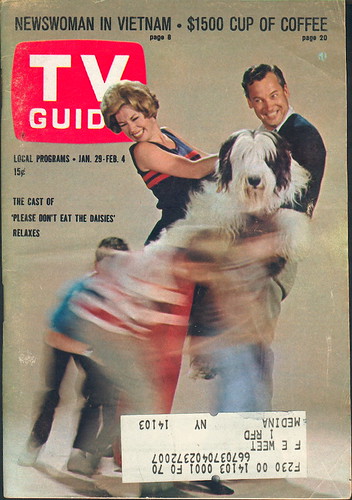
Anyway, I actually have a TV Guide from the time period in question, the January 29, 1966, issue.
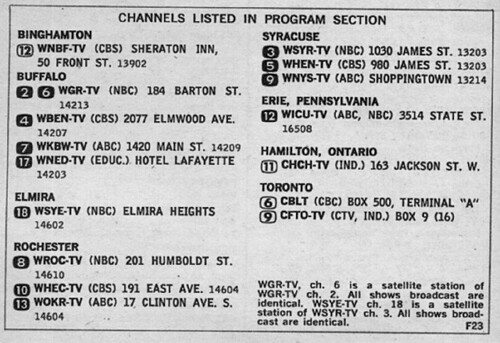
It's not the New York City edition, it's the Western New York State edition. Still, I can tell you exactly what network shows aired (and it's a pretty safe bet that they all aired on the owned-and-operated stations in New York):
12:30 (CBS) Face the Nation: "Scheduled: Secretary of the Treasury Henry H. Fowler is interviewed in Washington by CBS News correspondents Martin Agronsky and David Schoumacher; and Edwin L. Dale, Washington Bureau, New York Times. (Live)"
1:00 (NBC) Meet the Press: "(COLOR)" [unfortunately, no further details in this TV Guide]
1:30 (ABC) Issues and Answers: "Former Vice President Richard M. Nixon is interviewed in New York City by White House correspondent William H. Lawrence." [This is the predecessor to what's now "This Week."]
2:00 (ABC) NBA Basketball: "The Cincinnati Royals meet the Hawks at Kiel Auditorium, St. Louis. Chris Schenkel and Bob Cousy report. (Live)"
2:30 (CBS) CBS Sports Spectacular: "Scheduled: hunting and bowling. The finals of the $100,000 National Individual Match Game Bowling Championships are telecast live from Lansing, Mich. Also: Hunting authority Lee Wulff narrates films of turkey and quail shooting in Georgia. (Live and tape; 90 min.)"
4:00 (NBC) NBC Sports in Action: "Scheduled: lumberjacking and the Wengen International Ski Races. The ski races started Jan. 11 near Wengen, Switzerland. The World Lumberjack Championships were held last fall at Hayward, Wis. (60 min.)"
4:00 (ABC) The American Sportsman: "(COLOR) Actor Fess Parker joins guide Fred Bear to track down a Canadian grizzly in Northwestern British Columbia. Off Islamorada, Fla., fishing expert Joe Brooks goes after tarpon. Also: a comic underwater look at an Australian grouper (sea bass) that can't decide whether to swallow an attractive but somewhat suspicious piece of bait. (60 min.)"
4:30 (CBS) Ages of Man: "(SPECIAL) Sir John Gielgud reads from the works of Shakespeare in the conclusion of this adaptation of his one-man Broadway show. (60 min.) 'Mister Ed' is pre-empted." [In this, its final season, the regular time slot for "Mister Ed" was Sundays at 5:00 -- its last first-run episode aired 2/6/66.]
5:00 (NBC) Mutual of Omaha's Wild Kingdom: "(COLOR) 'Chacma Country,' second of a two-part study of the chacma baboon. In Southern Africa's Victoria Falls region, host Marlin Perkins and Jim Fowler follow the baboons on a search for water and food."
5:30 (NBC) G.E. College Bowl: "(COLOR) The University of Tulsa (Okla.) vs. Newcomb College, New Orleans. Moderator: Robert Earle. (Live)"
5:30 (CBS) Ted Mack's Original Amateur Hour: "Ted Mack introduces tenor Victor LaTorre; the Dukes, vocal-instrumental group; Elyse's Twirlettes, baton twirlers; singer Ronald Henry; tap dancer LaVerne Huselton; the Fraine Brothers, vocal group; ventriloquist Cassie Booker; and singer Linda Powell."
In addition to Nero Wolfe's network stations (2/WCBS, 4/WNBC, and 7/WABC), he also had three independent stations (5/WNEW, 9/WOR, and 11/WPIX) and an educational station (13/WNDT), and, if he could get UHF, he also had a second educational/public-interest station (31/WNYC). The latter two may not have been on the air for all of Sunday afternoon; the one educational station in Western New York, 17/WNED in Buffalo, didn't sign on until 4:00 P.M., and its programming looked like this:
4:00 Antiques: "George Michael shows a collection of antique bottles, and describes their origins and uses."
4:30 French Chef: "Julia Child shows how to prepare Reine de Saba (Queen of Sheba) cake."
5:00 Open Mind: "'What Kind of Preschool Education for Your Child?' A discussion of the relative merits of the progressive, public and Montessori methods of early education. (60 min.)"
As for the programming that aired on the independent stations, as well as on the network stations in between network programming, there were a couple of syndicated series and specials that were on multiple stations in Western New York:
The Flying Fisherman: "(COLOR) Gadabout fishes for bass at Reelfoot Lake in Tennessee."
Ski Championships: "(SPECIAL) In the first of three televised meets sponsored by the newly formed National Professional Ski League, skiers compete individually and as members of three-man teams. Entrants in today's races, taped Jan. 26-27 at Stratton, Vt., are Olympic gold medalists Stein Eriksen (Norway), Pepi Gramshammer (Austria), Christian Pravda (Switzerland), and Hias Leitner (Germany). (60 min.)"
Other than that were the movies. Some of the titles that aired in Western New York on this particular Sunday:
The Ghost Goes West (1936)
Elephant Boy (1937)
Ma and Pa Kettle (1949)
The Son of Hercules in the Land of Darkness (1964)
Reap the Wild Wind (1942)
Drum Beat (1954)
Damn Yankees (1958)
Wednesday, April 24, 2013
The fate of Samuel Holt
In between bouts of research for my forthcoming Donald Westlake nonfiction collection last weekend, I also read one of the forty or so Westlake novels I'd not yet gotten to, Sacred Monster (1989). It's far from his best: a story of a self-involved movie star whose only mode of existence is playing a part, but no Westlake book I've encountered yet is worthless, and this one has its moments.
The bit that amused me most, however, comes in an aside, when the star is recounting his life story and tells of a new house he and his wife moved into, which had until recently been owned by
Despite what we learn in Sacred Monster, however, I'm not at all convinced that Holt actually killed himself. He just didn't seem like that kind of guy: he's not exactly happy-go-lucky, but he's resourceful and determined, and while his show was clearly important to him you don't get the sense from the books that it's a matter of life and death. All these years later, we'll likely never know, but I suspect foul play. Does that loose-lipped publisher have an alibi?
The bit that amused me most, however, comes in an aside, when the star is recounting his life story and tells of a new house he and his wife moved into, which had until recently been owned by
a television star named Holt who'd committed suicide when his series was canceled.That, Westlake fans will quickly realize, is surely Samuel Holt, star of a Magnum, PI-style crime show--and author of four books about his inadvertent real-life adventures solving crimes . . . which were written by Westlake in the early 1980s and published under Holt's name as a Richard Bachman-esque test of the market. In the foreword to the Felony and Mayhem editions of the books, Westlake explains that he'd gotten his publisher to agree not to put his name on the books, and he was ready to see whether he could sell just on the strength of his writing--but then
The first book was published, and in the window of my local bookstore was a sign saying Samuel Holt was me. The publisher had told his sales staff the "secret," and encouraged them to pass the news on to the bookstores.Coming at this from the other end--working in a publisher's marketing department--I have to admit that it would be very hard to grit my teeth and not share the secret.
Despite what we learn in Sacred Monster, however, I'm not at all convinced that Holt actually killed himself. He just didn't seem like that kind of guy: he's not exactly happy-go-lucky, but he's resourceful and determined, and while his show was clearly important to him you don't get the sense from the books that it's a matter of life and death. All these years later, we'll likely never know, but I suspect foul play. Does that loose-lipped publisher have an alibi?
Monday, April 22, 2013
Spring is here?
Saturday morning we woke to snow covering the roofs and the cars. Today, we touched sixty degrees, and the kite-eating tree in the lakefront park was displaying the broken bones of its first victim. Spring is here--and more than six hundred years later, we still follow Chaucer's lead in this season:
So thanks for your patience, and enjoy the spring. If, that is, you're in one of those areas that's bothering to have it. As for Chicago, I'll believe it's here to stay around July.
Whan that Aprille, with hise shoures soote,And that's where I'm headed tomorrow: a pilgrimage to Donald E. Westlake's house, to look through his files with the help of Ethan Iverson, who knows Westlake's work as well as anyone on the planet. Blogging may therefore be a bit spotty in the coming days--and even the coming months, frankly. Editing a book is a new plate to add to my juggling act, and since it comes with a deadline, with all the looming that implies, it has to take priority. Hopefully the occasional dry spells here will be more than made up for down the road by the appearance of the book. I spent most of the weekend using the University of Chicago Library--from my couch!--to dig up more nonfiction pieces by Westlake, and the combination of what I found and what I've got on the way from other libraries has got me very excited about the project!
The droghte of March hath perced to the roote
And bathed every veyne in swich licour,
Of which vertu engendred is the flour;
Whan Zephirus eek with his swete breeth
Inspired hath in every holt and heeth
The tendre croppes, and the yonge sonne
Hath in the Ram his halfe cours yronne,
And smale foweles maken melodye,
That slepen al the nyght with open eye-
So priketh hem Nature in hir corages-
Thanne longen folk to goon on pilgrimages.
So thanks for your patience, and enjoy the spring. If, that is, you're in one of those areas that's bothering to have it. As for Chicago, I'll believe it's here to stay around July.
Friday, April 19, 2013
Things to do with books--other than read them, that is
On a Friday night at the close of a strange and unpleasant week, I'll turn the mic over to Ford Madox Ford, who, on being asked by an American editor to write a few hundred words on the uses of books, replied, in this letter from September 14, 1929:
Books can be useful from so many points of view. In my early days, for example, I used to use the Encylopedia Britannica as a trouser-press and certainly the house that was without it was to be pitied. Books are also very useful for pulping; bibles and other works set over the heart will deflect bullets; works printed on thin india paper are admirable if you happen to run out of cigarette papers. Their use for that purpose is in fact forbidden in France where there is a tobacco monopoly. In fact, if you are ever without a book you are certain to want one in the end. For the matter of that, my grand aunt Eliza Coffin used to say: "Sooner than be idle, I’d take a book and read." According to her the other uses of books were (1) for the concealing of wills (2) for the ditto of proposals of marriage by letter; (3) for pressing flowers; (4) folios piled one on the other will aid you to reach the top row in the linen cupboard; (5) they have been used as missiles, as bedsteads when levelly piled, as wrappings for comestibles; (6) as soporifics, sudorifics, shaving paper etc.Glad we got that last bit cleared up.
I was once accused of using slices of bacon, at breakfast, to mark my place in a book. That is untrue.
Wednesday, April 17, 2013
Brothers Keepers
Donald E. Westlake wrote more than 100 novels. It's a daunting number, but fortunately there are plenty of places where a reader just coming to his work can begin. Like comedy? Try the first Dortmunder novel, The Hot Rock, or the standalone Somebody Owes Me Money, with its brilliant opening line:
One place not to start is with Brothers Keepers (1975). Yet as I was reading it recently, I kept thinking that it serves almost perfectly as a demonstration of the qualities that make a Westlake novel entertaining. It's about a monastery in Manhattan whose residents realize that they're about to be booted so that the property owner can build a soulless office tower. Westlake described the writing process to Ethan Iverson like this:
The light touch of the opening gives a good sense of Westlake's off-kilter sense of humor:
Westlake's plots are airtight--even this crime novel without a crime features a complicated plot--and efficient in their workings. But while he never wastes any time, he also doesn't hesitate to use time, to take advantage of what's offered in a scene to have a little fun, even silly, mostly pointless fun. The best example of that in Brothers Keepers, a scene that had me giggling to myself on the L, is when Dwarfmann, the guy who's going to build the office tower, unexpectedly draws a Bible verse and begins combat:
I bet none of it would have happened if I wasn't so eloquent.Want something more hard-boiled? Try 361, which Westlake himself described as an exercise in writing with absolutely no hint of emotion, or the first Parker novel, The Hunter.
One place not to start is with Brothers Keepers (1975). Yet as I was reading it recently, I kept thinking that it serves almost perfectly as a demonstration of the qualities that make a Westlake novel entertaining. It's about a monastery in Manhattan whose residents realize that they're about to be booted so that the property owner can build a soulless office tower. Westlake described the writing process to Ethan Iverson like this:
I have to tell you a teeny thing about the genesis of Brothers Keepers. It all began with a title; The Felonious Monks. They would commit some sort of robbery to save the monastery. So I started it and introduced them and realized I liked them too much to lead them into a life of crime. So, to begin with, there went the title. "Okay," I said, "let's see what a caper novel looks like without the caper." Turned out to be a love story; who knew.Surprisingly, it works--and what makes it work is the simple fact that shines through even the hardest-boiled of Westlake's novels: this is a man who enjoyed writing. He enjoyed setting difficulties and seeing how he could get out of them. He enjoyed pointless asides, and dumb jokes, and goofy displays of knowledge. All those come into Brothers Keepers at some point, and they're delightful.
The light touch of the opening gives a good sense of Westlake's off-kilter sense of humor:
"Bless me, Father, for I have sinned. It has been four days since my last confession."He goes on to confess stealing an orange Flair pen from one of the other brothers, for which he's given "two Our Fathers and oh, Seven Hail Marys."
"Yes, yes. Go on."
Why does he always sound so impatient? Rush rush rush; that's not the proper attitude. "Well," I said, "let's see." I tried not to be rattled. "I had an impure thought," I said, "on Thursday evening, during a shaving commercial on television."
"A shaving commercial?" Now he sounded exasperated; it was bad enough, apparently, that I bored him, without bewildering him as well.
"It's a commercial," I said, "in which a blonde lady with a Swedish accent applies shaving cream to the face of a young man with a rather prognathous jaw."
"Prognathous?" More bewildered than exasperated this time; I'd caught his attention for fair.
"That means, uh, prominent. A large jaw, that sort of sticks out."
"Does that have anything to do with the sin?"
"No, no. I just thought, uh, I thought you wanted to know, uh . . . "
"This impure thought," he said, chopping off my unfinished sentence. "Did it concern the woman or the man?"
"The woman, of course! What do you think?" I was shocked; you don't expect to hear that sort of thing in confession.
"All right," he said. "Anything else?" His name is Father Banzolini, and he comes here twice a week to hear our confessions. We give him a nice dinner before and a nightcap after, but he's surly all the time, a very surly priest. I imagine he finds us dull, and would rather be hearing confessions over in the theater district or down in Greenwich VIllage. After all, how far can a lamb stray in a monastery?
"Um," I said, trying to think. I'd had all my sins organized in my mind before coming here, but as usual Father Banzolini's asperity had thrown me off course. I'd once thought I might jot down all my sins in advance and simply read them from the paper in the confessional, but somehow that lacked the proper tone for contrition and so on. Also, what if the paper were to fall into the wrong hands?
Westlake's plots are airtight--even this crime novel without a crime features a complicated plot--and efficient in their workings. But while he never wastes any time, he also doesn't hesitate to use time, to take advantage of what's offered in a scene to have a little fun, even silly, mostly pointless fun. The best example of that in Brothers Keepers, a scene that had me giggling to myself on the L, is when Dwarfmann, the guy who's going to build the office tower, unexpectedly draws a Bible verse and begins combat:
"My days," he said, "are swifter than a weaver's shuttle. Let's get back down to business."The duel continues for nearly two pages, and after Dwarfmann leaves, the monks are still a bit stunned:
I'm sure Brother Oliver was as taken aback as I was. The imagery, in Dwarfmann's rattly style of speech, seemed wildly inappropriate. Then Brother Oliver said, in distinct astonishment, "Was that from Job?"
"Chapter seven, verse six," Dwarfmann snapped. "Come, come, if you have something to say to me, say it. Our time is a very shadow that passeth away."
"I don't know the Apocrypha," Brother Oliver said.
Dwarfmann gave him a thin smile. "You know it well enough to recognize it. Wisdom of Solomon, chapter two, verse five."
"Then I can only cite One Thessalonians," Brother Oliver said. "Chapter five, verse fourteen. Be patient toward all men."
"Let us run with patience," Dwarfmann or somebody said, "the race that is set before us."
"I don't believe," Brother Oliver told him, "that was quite the implication of that verse in its original context."
Shaking my head, I said, "The devil can cite Scripture for his purpose."As much as any writer I can think of, Westlake demonstrated that he understood that we aren't coming to these books to improve ourselves, or learn life lessons (though, to be fair, you can learn a hell of a lot of life lessons from the Parker novels), but to have fun. And if he's getting the most possible fun out of the writing, we're likely going to feel the same way in the reading.
Brother Oliver gave me a puzzled look. "Is that New Testament? I don't recognize that."
"Uhh, no," I said. "It's Shakespeare. Merchant of Venice." I cleared my throat. "Sorry," I said.
Monday, April 15, 2013
Turning to Johnson
From W. Jackson Bate's Samuel Johnson: A Biography:
Because he was so susceptible to symbols, his impulse had always been to deny their power over the imagination and to try to put them at arm's length. The dignity of human nature required this if one was to remain a "free agent." Typical was the way he would dismiss the effect on us of the seasons ("imagination operating on luxury"). But now, in many ways, he was changing--not changing in his character but in what he said or admitted.
As November came to Litchfield, which he could reasonably doubt that he would ever see again, he felt the poignance of autumn as never before. One of Horace's odes especially (IV, vii) haunted him--the one in which the large revolving changes of nature, destroying and re-creating, are contrasted with the hopes and destiny of short-lived man. Before Johnson left Litchfield he translated it into English verse. The snows of winter--the ode begins--are melting as spring returns. The fields and woods are again green. But the human being, after entering his own winter, will not return. He will be like those millions of others who have entered the night--"ashes and a shade." The ode, in its clear-eyed existential honesty and mellow acceptance, typifies what Johnson had prized in Horace when he was a boy at Stourbridge--a union of qualities he had associated with Cornelius, who had seemed to the half-blind, half-deaf, awkward youth such a model of grace and classical acceptance of fact. Of the many translations of this famous ode, none catches the spirit of Horace more closely. At moments it is even more condensed than Horace. "Each revolving year," says Horace, "each hour that snatches the day, bids us not to hope for immortal life." Johnson wrote, "The changing year's successive plan / Proclaims mortality to man." Yet this is balanced by a flourish of stoic gaiety that goes beyond Horace. "Who knows whether the gods," asks Horace, "will add tomorrow's time to the sum of today?" In Johnson this becomes: "Who knows if Jove who counts our score / Will toss us in one morning more?"
Friday, April 12, 2013
Dickens and Dostoevsky
The piano is eating up all my time tonight (remind me--why did I agree to be in a recital Sunday?), but I don't think you'll complain when you see what I have for you: a link to a story from the April 10 issue of the Times Literary Supplement wherein Eric Naiman takes last year's very strange kerfuffle over a purported meeting between Dickens and Dostoevsky--noted in Claire Tomalin's biography and others--and starts pulling threads.
If I may engage in some wild, Friday night mixing of metaphors: the unraveling threads send Naiman down rabbit hole after rabbit hole into a world of fake names, fake citations, fake articles, and fake books, and even fake letters to the editor. I found it dizzying and deliciously entertaining, and I suspect that anyone even peripherally connected with academia--and its occasional log-rolling and insularity--will, at minimum, be amused.
If I may engage in some wild, Friday night mixing of metaphors: the unraveling threads send Naiman down rabbit hole after rabbit hole into a world of fake names, fake citations, fake articles, and fake books, and even fake letters to the editor. I found it dizzying and deliciously entertaining, and I suspect that anyone even peripherally connected with academia--and its occasional log-rolling and insularity--will, at minimum, be amused.
Wednesday, April 10, 2013
Spidey's back!
Today I've got three quick things that I failed to work into last week's post about Spider-Man. A warning, though: comics, clearly, are off my usual beat, and we're getting pretty deep into the weeds on this post, so if superhero comics aren't your thing, you might duck out and come back later.
1 I can't believe I failed to note the appeal of Spider-Man's driving idea: With great power comes great responsibility. For an eleven-year-old, it doesn't get much simpler, or profound, than that. Then you add in the fact that Peter Parker is perpetually discontented with being Spider-Man--which is confusing to a kid because who wouldn't want to be a superhero?--and you've got a potent recipe for adding emotional complexity to simple stories, and beginning to introduce a young reader to irony, contradiction and ambiguity. And all with six lines that I'm guessing Stan Lee came up with over lunch one day when he had some pages to fill and no more time to get it done.
2 This will give you an idea of how much time I used to spend with each issue back in 1986: I used to pore over the Post Office–mandated Statement of Ownership, Management and Circulation that Marvel ran in each title once a year. Seriously--the first issue of Amazing Spider-Man I read, #275, included it, and I was fascinated from the start. The USPS required them to list their base subscription price, their ownership down to holders of 1% of the stock, bond-holders, and, most interesting, their "Extent and Nature of Circulation"--numbers that I watched and compared, year after year, like the young nerd I was. They printed 476,932 copies of issue #275, down a bit from the twelve-month average of 498,367. Of those, a stunning 169,577 on average came back as returns from newsagents and stores. The death of the drugstore spinner rack solved that problem for comics companies, but I bet they'd be willing to take it back if they could get those overall circulation numbers back with it. (Oddly, DC never ran that statement; presumably they were set up under a different type of mailing license?)
3 To close, I'll share a discovery I made about fifteen years ago when I was reading through a long run of issues from the late 1970s. That period wasn't one of Spidey's best--it feels stagnant, with Peter Parker is running in place, so that more than at any other time you can feel the drag of having characters who can't really age. And in issue #188, from January of 1979, there's a letter from Kurt Busiek, at the time a reader but later to be an innovative, clever writer of comics for Marvel and other companies. I'm going to quote at length both because I haven't spotted this letter elsewhere online and because Busiek, at eighteen, did a remarkable job of diagnosing what was wrong with Spider-Man at that moment:
Seems to me there's only one proper response to a letter like that: "All right, kid, send us a script. Let's see what you can do."
1 I can't believe I failed to note the appeal of Spider-Man's driving idea: With great power comes great responsibility. For an eleven-year-old, it doesn't get much simpler, or profound, than that. Then you add in the fact that Peter Parker is perpetually discontented with being Spider-Man--which is confusing to a kid because who wouldn't want to be a superhero?--and you've got a potent recipe for adding emotional complexity to simple stories, and beginning to introduce a young reader to irony, contradiction and ambiguity. And all with six lines that I'm guessing Stan Lee came up with over lunch one day when he had some pages to fill and no more time to get it done.
2 This will give you an idea of how much time I used to spend with each issue back in 1986: I used to pore over the Post Office–mandated Statement of Ownership, Management and Circulation that Marvel ran in each title once a year. Seriously--the first issue of Amazing Spider-Man I read, #275, included it, and I was fascinated from the start. The USPS required them to list their base subscription price, their ownership down to holders of 1% of the stock, bond-holders, and, most interesting, their "Extent and Nature of Circulation"--numbers that I watched and compared, year after year, like the young nerd I was. They printed 476,932 copies of issue #275, down a bit from the twelve-month average of 498,367. Of those, a stunning 169,577 on average came back as returns from newsagents and stores. The death of the drugstore spinner rack solved that problem for comics companies, but I bet they'd be willing to take it back if they could get those overall circulation numbers back with it. (Oddly, DC never ran that statement; presumably they were set up under a different type of mailing license?)
3 To close, I'll share a discovery I made about fifteen years ago when I was reading through a long run of issues from the late 1970s. That period wasn't one of Spidey's best--it feels stagnant, with Peter Parker is running in place, so that more than at any other time you can feel the drag of having characters who can't really age. And in issue #188, from January of 1979, there's a letter from Kurt Busiek, at the time a reader but later to be an innovative, clever writer of comics for Marvel and other companies. I'm going to quote at length both because I haven't spotted this letter elsewhere online and because Busiek, at eighteen, did a remarkable job of diagnosing what was wrong with Spider-Man at that moment:
Dear Marvel,The editors' response is very polite, if a tad defensive--but most amazing is that they apologize for not having printed his letter in full! There's more that they cut out!
When Spider-Man first appeared on the comics scene, he was immediately a smash hit because (if we are to believe the hype) he dared to do what had never been done before-to be unpredictable, to have that funky element of real life that you never know what's going to happen next. Spider-Man is stil the same as he was back then. But this is not such a good thing. Spidey is still daring to be different, but different from whwat super-heroes were in 1960. He was unpredictable back then, but he has now established a record of doing "unpredictable" things over and over again. Speculating about what will happen next in Spider-Man is like wondering if the good guys will win on your seventh viewing of Star Wars. Spidey has degenerated into a red-and-blue Mego doll; other than the fact that he's a nice package, he's the same as most of the other super-heroes around. He is no longer in the vanguard.
I was talking with some friends about issue #182 where Parker proposes to Mary Jane. It was fairly obvious that she was gonna say no. I mean, when has Marv Wolfman ever exhibited the urge to change something so it shows? Still, we mused, Spider-Man's concept is that of radical change. Wolfman is the new writer, so maybe he's trying to bring back the old unpredictable Spidey. We were wrong. We were caught on guard.
After so long with Gerry Conway and Len Wein, I thought we might be seeing daylight with Marv. So maybe his Spider-Woman and Nova mags aren't up to par. Dracula certainly is. Maybe we'll see that taut chracterization, those nice conflicts, in a super-hero mag. Maybe not. Blast! The idea of a married Parker, bouncing between a teacher's assistant job, the Bugle, home strife, and the usual plethora of super-villains, really appealed to me. It would open up a new vista of stories, guaranteeing that the writer would do something new. But with MJ's turn-down in #183, it is not to be.
I'm sure that Marv thinks he has gobs of "new, exciting ideas that'll really throw ya for a loop, effendis!" But I doubt it. You can't kill off another supporting character, and I'm sure readers wouldn't want you to. You've done it twice (Capt. Stacy and daughter), it won't be any good again.
But maybe you could clear up some of the long-running plot threads and replace them with new ones we're not expecting. Spider-Man's biggest gimmick is his cavalcade of personal problems. What's wrong with his life that hasn't been done before. A three-year-old could clear up Parker's life. Take his "wanted by the police" schtick. That has not only been over-used in Spider-Man, but in most of Marvel's other books as well, not to mention a few of DC's. Why not clear him?
Is Spidey in the forefront of the field today? When people ask that question Marvel usually points to the sales figures and says, see, see, ain't he great? Well, that red-yellow-and-blue goon at DC has pretty impressive sales figures, too, but in no way is he in the artistic forefront of the industry. Which is where Spidey was back in the Stan Lee days. Spider-Man was once famous for his radical changes. Not raditional comic book "changes" that appear for about eight issues and fade away to be replaced by the standard. I mean lasting changes like Peter's high school graduation, his love life, and the Gwen Stacy affair. Something that will still be important fifty issues later.
This may seem a little emphatic and overemotional, but believe me, this letter has been building for some time. The Mary Jane affair was just the proverbial straw. Thanks for the chance to berate you like this. It may not help, but it makes me feel better.
Seems to me there's only one proper response to a letter like that: "All right, kid, send us a script. Let's see what you can do."
Monday, April 08, 2013
Details, details
Every once in a while as a reader you encounter a detail in a novel that is so perfect, so unusual, and so strictly unnecessary, that you can't help but assume it comes direct from the author's experience--adapted as needed for the fictional situation, but still seeming to carry with it a whiff of reality that extends beyond the page.
My two favorite examples come from Joseph Conrad and Lawrence Block. In The Nigger of the "Narcissus", Conrad tells of a terrible storm:
Lawrence Block's moment comes in the best Matthew Scudder novel, When the Sacred Ginmill Closes. Published in 1986 but set in the '70s, back when Scudder was still a heavy drinker, it portrays the run-down, nigh-lawless New York of that period--the city, like Scudder, still mostly functional but clearly heading downhill fast. At one of the many drinking sessions in the book, a guy is prompted to tell a story of one of the strangest things he's ever seen in New York: leaving his girlfriend's house on West End Avenue in the 80s early one morning, he sees three black men standing in the street, "wearing fatigue jackets, like, and one's got a cap. They look like soldiers." He continues:
All of which leads, with my usual obliqueness, to the book that brought these instances to mind: Kate Atkinson's Life after Life. I've got a lot more tolerance for historical fiction than Jessa Crispin, who recently gave up on the book because she "got about three pages in . . . and suddenly Hitler is there," but as I near the halfway point I'm not yet wholly sure of the book either--despite finding it engaging. That said, leaving Hitler aside Atkinson does wear her research well--the fundamental requirement for a historical novel that's not dreck. Her descriptions of daily life and its accoutrements feel like typical novelistic description rather than gawping at the past or detail delivered for its own sake.
There was, however, one moment that did feel like the fruit of research, a discovery so entertaining that Atkinson surely couldn't help but include it. In that regard, it's like the mirror image of the moments in Block and Conrad, shining more brightly than its surroundings not because it's crafted from lived experience but because it's the sort of thing that only the haphazardly diligent magpie's research of a novelist would likely turn up. See what you think:
Finally, I won't blame you if you begin to suspect that I wrote this whole post for the sole purpose of sharing the following line--which a friend credits to me but I have to believe I stole from someone more clever:
My two favorite examples come from Joseph Conrad and Lawrence Block. In The Nigger of the "Narcissus", Conrad tells of a terrible storm:
On the lee side another man could be seen stretched out as if stunned; only the washboard prevented him from going over the side. It was the steward. We had to sling him up like a bale, for he was paralysed with fright. He had rushed up out of the pantry when he had felt the ship go over, and he had rolled down helplessly, clutching a china mug. It was not broken. With difficulty we tore it away from him, and when he saw it in our hands he was amazed. "Where did you get that thing?" he kept on asking us in a trembling voice.Conrad of course drew on his experience at sea throughout his books, but that one moment--the extraneous detail of the miraculously (and inconsequentially) unbroken china cup feels as straight from life as anything else in his fiction.
Lawrence Block's moment comes in the best Matthew Scudder novel, When the Sacred Ginmill Closes. Published in 1986 but set in the '70s, back when Scudder was still a heavy drinker, it portrays the run-down, nigh-lawless New York of that period--the city, like Scudder, still mostly functional but clearly heading downhill fast. At one of the many drinking sessions in the book, a guy is prompted to tell a story of one of the strangest things he's ever seen in New York: leaving his girlfriend's house on West End Avenue in the 80s early one morning, he sees three black men standing in the street, "wearing fatigue jackets, like, and one's got a cap. They look like soldiers." He continues:
"Well, it's hard to believe I really saw this," he said. He took off his glasses, massaged the bridge of his nose. "They took a look around, and if they saw me they decided I was nothing to worry about--"If Lawrence Block didn't at some point see some dudes firing a mortar into the Hudson--or, at minimum, hear about it from someone else he knew, I'll buy him a steak dinner. Or maybe some beef tongue. (You'll see why in a minute.) The Scudder stories portrat a New York that's always believable, even in--or especially in--its seediest aspects. But that moment? Whump! Just too real.
"Shrewd judges of character," Skip put in.
"--and they set up this mortar, like they've done this drill a thousand times before, and one of them drops a shell in, and they lob a round into the Hudson, nice easy shot, they're on the corner and they can see clear to the river, and we all like check it out, and they still don't pay any attention to me, and they nod to each other and strip the mortar down and pack it up and walk off together."
"Jesus," I said.
"It happened so fast," he said, "and with so little fanfare, I wondered if I imagined it. But it happened."
"Did the round make a lot of noise?"
"No, not a whole lot. There was the sort of whump! sound a mortar makes on firing, and if there was an explosion when the round hit the water, I didn't hear it." "Probably a blank," Skip said. "They were probably, you know, testing the firing mechanism, checking out the trajectory."
"Yeah, but for what?"
"Well, shit," he said. "You never know when you're gonna need a mortar in this town."
All of which leads, with my usual obliqueness, to the book that brought these instances to mind: Kate Atkinson's Life after Life. I've got a lot more tolerance for historical fiction than Jessa Crispin, who recently gave up on the book because she "got about three pages in . . . and suddenly Hitler is there," but as I near the halfway point I'm not yet wholly sure of the book either--despite finding it engaging. That said, leaving Hitler aside Atkinson does wear her research well--the fundamental requirement for a historical novel that's not dreck. Her descriptions of daily life and its accoutrements feel like typical novelistic description rather than gawping at the past or detail delivered for its own sake.
There was, however, one moment that did feel like the fruit of research, a discovery so entertaining that Atkinson surely couldn't help but include it. In that regard, it's like the mirror image of the moments in Block and Conrad, shining more brightly than its surroundings not because it's crafted from lived experience but because it's the sort of thing that only the haphazardly diligent magpie's research of a novelist would likely turn up. See what you think:
Mrs. Glover was more than fully occupied with pressing a calf's tongue, removing the gristle and bone and rolling it up before squeezing it into the tongue press.If I may take a moment to play the squeamish vegetarian: There is such a thing as a tongue press! Good god, I hope it has gone the way of sock garters and collar stays, beef tea and pink shape.
Finally, I won't blame you if you begin to suspect that I wrote this whole post for the sole purpose of sharing the following line--which a friend credits to me but I have to believe I stole from someone more clever:
Tongue--the meat that tastes you back.Good night, folks.
Thursday, April 04, 2013
An announcement and a call for help--Or, When the man sat down at the typewriter . . .

{Donald E. Westlake loses to Brian Garfield at the storied Mysterious Bookshop floating poetry game sometime in the early 1970s. Photographer unknown. For more about that game, see my interview with Garfield on the University of Chicago Press blog.}
Donald E. Westlake opened most of his Parker novels with a sentence that began with the word "when." You can read them all at the Miskatonic University Press site, but the best of them definitely comes from Firebreak: "When the phone rang, Parker was in the garage, killing a man."
In other words, the man didn't mess around. You can't mess around if you're going to make your living with your words for more than half a century. You can't mess around if you're going to write more than 100 books, and end up with dozens of them firmly ensconced in the canon of crime fiction. Like Parker, Westlake was a pro--a working writer who simply went about the work of writing, day after day.
For a lot of writers, that means taking up any job that comes along: book reviews, features, essays, forewords--any old thing that will help an editor fill a hole and bring in a check. Westlake, however, always kept his focus relentlessly on his fiction, so when he did turn to nonfiction, you can be confident he was taking on a subject he cared about.
Which leads me to today's bit of good news: I've just signed a contract with the University of Chicago Press (my employer when I'm wearing my publicist's hat) to edit a volume of Donald Westlake's nonfiction--a celebratory miscellany, sort of like the wonderful Charles Portis volume that was published last year.
The plans are still at a very early stage, but what we're envisioning is a volume that would bring together the best of Westlake's nonfiction, including reviews, essays on favorite writers, magazine pieces, occasional writings, and more. In addition, it would likely include a couple of the most interesting interviews he sat for over the years; a piece or two by prominent fans, friends, and critics about Westlake and his work; and possibly even letters and e-mails. The goal is to give Westlake's large and ever-growing fanbase insight into how his inquisitive, inventive, alert mind worked over questions of genre, form, talent, and more--helping us to see the man behind the books we've all loved for so many years.
I'm already making great use of a small cadre of Parker-fan advisers who have helped me through the years as Chicago has republished that series, but I also could use help from the fan community at large: if you know of any Westlake nonfiction pieces that you even suspect I may not have heard of--anything that's all obscure, or old, or forgotten--I'd love it if you'd drop me a note or leave a comment below. I'll be doing some digging in libraries and archives, so I hope I'll be able to find plenty of good material in addition to what I already have, but I also am well aware that the crime fiction community is incredibly knowledgeable, and I would be grateful for any tips or thoughts folks are willing to share.
I'm sure you'll be hearing more about this from me in the months to come--and I hope you're as excited as I am!
Wednesday, April 03, 2013
Twenty-five thoughts about Spider-Man for his fiftieth birthday

1 The first Spider-Man comic I ever read was issue #275 of The Amazing Spider-Man.
2 I was eleven and a half, an age when that extra half-year retained some vestigial importance. Spider-Man the character was twenty-three. Peter Parker was somewhere in his vague late twenties.
3 It was the first issue of a subscription I'd signed up for using an ad in a G.I. Joe comic. I don't know why I chose Spider-Man over G.I. Joe, but I do remember that it cost $7.50 for sixteen issues. The cover price at the time was $.65, though within months it would rise to $.75.
4 The issue arrived the day of the Challenger explosion, January 28, 1986. I remember lying on my stomach on the floor of the living room reading and re-reading the comic rather than watch the video being replayed and solemnly discussed. I won't pretend I took refuge in thoughts of "If only Spider-Man were real"--I was eleven, and smart enough to know better--but I did appreciate being able to bury myself in this fantasy story rather than watch the reality.
5 That issue was a good place to start: not only did it feature a full-fledged battle with the Hobgoblin, it also included a reprint of Spidey's origin story from Amazing Fantasy #15, the comic in which Spider-man had made his first appearance.
6 Twenty-seven years later, two aspects of that comic, and the experience of reading it, stand out strongly: the sense that there was something real and important at stake in Spider-man's battles and his life--that Peter Parker was an adult facing adult problems--and that by starting to read this comic I was entering into (and possibly, if I was lucky, would become part of) something bigger and longer-lasting than me, a piece of a story that stretched far back into the past.
7 This was issue #275, after all. And the cover proudly proclaimed that 1986 was the twenty-fifth anniversary of the Marvel Universe. Twenty-five years! Add in the annuals (18 at that point for Amazing Spider-Man)--to say nothing of the other two active Spider-Man titles--and you're talking about 6,000 pages of Spider-Man adventures, all happening to the same hero with the same friends in the same city.
8 For an American kid, especially an American boy, it seems like there's never a time when you didn't already know Spider-Man, and Superman, and Batman. You knew he was Peter Parker, and that he was a good guy. But that was about it before the mailman brought the comic that day.
9 Reading that 275th issue, the 6,000th or so page of an ongoing story, felt like being thrown into a deep, fast-moving river--but one that was surprisingly buoyant, so that I quickly realized that I didn't really need to worry about swimming, but could just let it carry me along.
10 What I mean is that many things were instantly clear. The Hobgoblin was Spider-Man's arch-enemy. Peter Parker was grown up now. His old girlfriend, Gwen Stacy, had been killed by the Hobgoblin's predecessor, the Green Goblin. His girlfriend now was Mary Jane Watson--and, surprisingly, she knew he was Spider-Man. He had a sleek new black costume. Peter was working for the Daily Bugle, and he had a number of friends who themselves had problems, but none as big as Peter's: the responsibility of being Spider-Man was wearing him down.
11 All of that came through in just 22 pages. And in addition, there were flashbacks--and editorial notes, too, alerting readers to the earlier issues in which they could find the stories the characters were referring to.
12 The result was a feeling of being invited into an incredibly populous, complicated story that stretched farther back into the past than my eleven-year-old brain could comprehend--and being invited in comfortably. By the time I got to the end of the issue, I was hooked.
13 And there at the end was the letters page, which sank the hook. Letter after letter from fans who clearly lived and breathed this stuff, full of praise, criticism, ideas, and--most important right then--speculation about the identity of the Hobgoblin.
14 When you're that age, some combination of brain plasticity, near-pathological focus, and endless free time combine to make it possible for you to utterly absorb new information in a way that, looking back, seems almost unfathomable. I read and re-read that issue, did the same for each one that came over the next year, and with the help of cross-references, letters pages, and digging for cheap back issues, it didn't take long before I knew Spider-Man and his world. (I would do the same for baseball history a few years later.)
15 I thought then, and I still think now, that I got lucky and entered at a high point. The mid-1980s were a good time to be a fan of superhero comics, especially on the Marvel side. The Marvel universe was riding high, with a huge number of titles that were each selling ten times what issues today sell. They were still widely available in spinner racks in drugstores, groceries, and chain bookstores. And they were cheap, relative to their competition for the youth dollar--just a bit more than a candy bar.
16 Oh, the seeds of the fall had already been sowed, and were even beginning to sprout. The age of the crossover had begun just a few years before, and the collector-frenzy bubble was clearly starting to inflate. But at the time it all felt like a big, cohesive universe just bursting at the seams with stories.
17 I gave up on comics after high school and stayed away for a good while after that, but I've been back for several years, and for the most part it's been enjoyable. It's still fun to open the mailbox and find a comic book there.
18 When I made my first trip to New York as an adult, it was hard not to see it simply as the embodiment of the city I'd seen in Marvel comics for years. Even now, I find myself look at the tops of buildings and imagining what it would be like to see Spider-Man up there.
19 Reading superhero comics as an adult requires accepting some frustrations. The characters, still resonant from childhood, draw you in, but the stories often disappoint. Frequently they're simply not very good, or are too juvenile even to serve as simple entertainment. But more often the problem is the ways the characters and stories are being deformed by external forces.
20 Comics, I think, suffer more than any other form from the demands of money and marketing: characters are regularly being re-conceived, storylines thrown up in the air, whole histories shuffled, in order to meet the needs of a current crossover plan, or align a story with a forthcoming movie, or simply match up to a new marketing strategy.
21 Movies, of course, also suffer from the demands of money. But a movie, even an installment in a series, is wrapped up in one sitting--mistakes and bad decisions, however maddening, are contained in that one unit. With comics, however, what you're buying is a serial narrative, a story that implicitly promises to keep going, month after month, continually adding to the skein that's been being woven for decades. When marketing or sales needs force changes that essentially abrogate that promise, the damage isn't so easily contained.
22 And then there's the different--and almost opposite--problem presented by a serial narrative that now stretches back fifty years: it's impossible. With reasonable suspension of disbelief--such that we're willing to accept that many, many things can happen yet Peter Parker could still be in his late twenties--it seems just possible to have twenty-five years of such a narrative hold together as essentially one story, but much more than that seems completely unworkable. (Try to follow the thread in the Wikipedia entries for, say, Jean Grey, or the Green Goblin, if you need convincing.)
23 But the serial nature of the narrative is what I love about it. Like with baseball, I love the sense that this is a soap opera of sorts that goes on and on and on. If that story becomes too complicated to sustain, and thus has to be repudiated and re-thought at regular intervals, the attraction diminishes. When I was eleven, a fight between Spider-Man and the Hobgoblin was inherently fascinating; now it's only of interest if it's embedded in a creative story that promises to go on and on, drawing on and refracting and building on stories I've already read and a history I already know.
24 Guilty pleasures aren't part of my way of thinking about culture. Pleasure is pleasure, and I'm grateful to any creator who delivers it. There's no question that comics are less important to me than novels--they're essentially a disposable distraction, something I enjoy and then move on from. But once in a while there are series and storylines that achieve something beyond that--Jonathan Hickman's recent multi-year run on the Fantastic Four, for example, or Darwyn Cooke's amazing The New Frontier--and they make me glad the medium still exists, and that I've stuck with it. I still like Spider-Man, and even with all the frustrations I'm still glad to know month after month what he's up to.
25 And behind it all is that comic that arrived in the mail twenty-seven years ago. I wrote this post before I looked at the issue, but I just brought it up from the basement--and page after page, image after image, whole words and phrases, are exactly as I remembered them, crystal clear. They're called formative years for a reason, and you could have far worse figures doing the forming than Spider-Man. Thanks, Stan Lee and Steve Ditko, for what you gave us. Happy birthday, Spidey.
Subscribe to:
Posts (Atom)