Tuesday, October 11, 2011

Forbidden things

{Photo by rocketlass.}

Reading Grace Dane Mazur's Hinges: Meditations on the Portals of the Imagination the other day, I encountered an object well worthy of a ghostly tale or two:
But some mirrors must never be looked at, not ever, at least by humans. This is the case with the sacred regalia mirror, Yata no Kagami, kept at the Ise Shrine in Japan. This is presumed to be an octagonal mirror, ritual in nature, similar to other known octagonal mirrors.

This forbidden mirror is kept in a box within a box within a box, hidden from outsiders in a ritually restricted area of the shrine. The outermost box is made of Japanese cypress wood (Hinoki). The middle box is also of cypress wood. The innermost box, containing the mirror, is made of gold, and thus is incorruptible.

This Shinto sacred mirror is not, in fact, a looking glass, but rather an emblem of imperial nobility in ancient Japan, and, at least in ancient times, possibly a device for reflecting light, thus connected with life and fertility.

No one may look at this mirror, not even the Emperor, though some say the Emperor may have seen it during his pilgrimage to the shrines in 1869; and there is the possibility that Shinto priests may have glimpsed it during a ritual in 1901, when the innermost container was permanently sealed.
I'm enchanted with the idea of a mirror that has never reflected any image that can be aware of its reflection, never had a chance to steal a soul. Surely the story of the Emperor and the priests are but rumors, right? No punishment is spoken of, but it's hard to imagine a forbidden mirror that wouldn't exact a vicious punishment for a transgressive glance. I like to think that, rather than your soul, it would steal your sight, so that as it sat, solitary, in its box of gold in its box of cypress in its box of cypress, it could see, while you, the whole world all before you, are lost in blackest night.

All I know for sure is that, should I ever happen to get to see this mirror, it would be the one mirror in the world into which I would stare while saying, "Bloody Mary Bloody Mary Bloody Mary."

Monday, October 10, 2011

Through gates of horn and ivory, or, Entering the realm of the Oneiroi

{Photos by rocketlass.}

October brings longer nights, and, in the upper Midwest, with its clouds and storms, darker nights. More time for dreaming; more time for nightmares.

In The Terrors of the Night (1594), Thomas Nashe writes of dreams:
There is no man put to any torment, but quaketh & trembleth a great while after the executioner hath withdrawn his hand from him. In the daye time wee torment our thoughts and imaginations with sundry cares and devices; all the night time they quake and tremble after the terror of their late suffering, and still continue thinking of the perplexities they have endured.
I am a light sleeper. When my brother recently mentioned being woken by the ticking of his wife's watch as it lay on a table a floor below, I nodded in recognition. So while I am fortunate enough to dream extravagantly, my dreams tend not to take me over completely, not to disorient me on waking. I don't know the terror expressed in the passage below, which begins Charles Baxter's novel The Feast of Love (2000):
The man--me, this pale being, no one else, it seems--wakes in fright, tangled up in the sheets.

The darkened room, the half-closed doors of the closet and the slender pine-slatted lamp on the bedside table: I don't recognize them. On the opposite side of the room, the streetlight's distant luminance coating the window shade has an eerie unwelcome glow. None of these previously familiar objects have any familiarity now. What's worse, I cannot remember or recognize myself. I sit up in bed--actually, I lurch in mild sleepy terror toward the vertical. There's a demon here, one of the unnamed ones, the demon of erasure and forgetting. I can't manage my way through this feeling because my mind isn't working, and because it, the flesh in which I'm housed, hasn't yet become me.
I was led to the Baxter passage by Grace Dane Mazur's remarkable short book on the concept of the hinge, Hinges: Meditations on the Portals of the Imagination (2010), where she writes, about it and other works:
The openings of some contemporary American masterpieces show the same sort of liminality and entrancement [as Proust] and also an intricate imbalance leading to a sort of structural instability--that state where things are so precarious that something has got to happen. This structural instability can come from being on the edge, or simply being on edge, and is often accompanied by uneasiness, excitement, fear.
In one of the wonderful echoes that reading multiple books at once can generate, I had just that morning been reading Adam Thirlwell's The Delighted States (2007), which links Proust and Kafka in a chapter that begins,
At this point, it is also important to rethink the idea of real life.
Describing an early draft of the opening of The Trial, Thirlwell writes, of the moment after the two officials enter Joseph K.'s room:
Joseph K., however, is quick to set things straight. He establishes friendly terms. "The strange thing is," says Joseph K., chattily, "that when one wakes up in the morning, one generally finds things in the same places they were the previous evening. And yet in sleep and in dreams one finds oneself, at least apparently, in a state fundamentally different from wakefulness*, and upon opening one's eyes an infinite presence of mind is required, or rather quickness of wit, in order to catch everything, so to speak, in the same place on left it the evening before."
But, as Thirlwell explains, Kafka deleted that portion of the scene:
This conversation between Joseph K. and the guardes who have come to take him away, in which K. reports what someone once told him, that waking up is the "riskiest moment," because after all, "if you can manage to get through it without being dragged out of place, you can relax for the rest of the day"--this conversation disappeared.
The omission, Thirlwell argues, is key: what separates Kafka's reflections on the disorientations of sleep from Proust's contemporaneous ones ("How then, searching for one's thoughts, one's personality, as one searches for a lost object, does one recover one's own self rather than any other? . . . One fails to see what dictates the choice, or why, among the millions of human beings one might be, it is on the being one was the day before that unerringly one lays one's hand.") is that Kafka never cues us to look to sleep's dislocations:
Ratehr than speculating on the fact that falling asleep might be ontologically dangerous, Joseph K. now wakes up in a world which is exactly like a dream. Like a dream, it does not feel like a dream at all.
And, as a lived dream in the world, it is, inescapably and inevitably, a nightmare.

In Hinges, Mazur writes,
All these temporal and psyhic perversities combine to put us in an unstable situation in which something, everything, is bound to happen. We, and the characters, have entered into the world of the story, which is clearly a different world from our own.
The same could be said for the world of the dream. Anything could happen--at least up to that moment when, as Paul Bowles put it ins Without Stopping: An Autobiography (1972), "a dream ceases to be a neutral experience and declares itself a nightmare." If we're lucky, at that moment we wake up, or at least begin to receive some intimations that this reality is not reality, and there will be an end to it. A way out.

Which brings me back to the opening, and the sense, on waking, that we have to quickly set the world to rights or risk being permanently unmoored. John Aubrey, in his endlessly diverting and useful Miscellanies Upon Various Subjects (1696), has an entry that suits, under the heading of "Of One's being divided into a Two-fold person":
In dreams it is a sign of death, because out of one are then made two, when the soul is separated from the body.
Sleep is a prefiguring of death,  a dream a hope for countering it, a nightmare a marker of our fears of it. There is a way out, a gate made neither or horn nor of ivory but of bleached bone, through which one day we'll all pass.

Thursday, October 06, 2011

Live, forever!

{Photo by rocketlass.} As I've explained before, October country for me, like for countless other readers, is Ray Bradbury country. Rather than a sci-fi writer, for me Bradbury is much more a writer of small-town ghostliness, of shadows made animate, of the inherent creepiness of quiet isolation. I hope--if I can just tame the beast that is, right now, my day job--to put together a post later this month about how Bradbury at times employs a unique nostalgia for a specific kind of lost, small town terror. But for now I'll just offer the following, from Sam Weller's fascinating book of interviews with Bradbury that was published last year by Stop Smiling and Melville House, Listen to the Echoes:
WELLER: Circuses and carnivals were central to your childhood growing up in Illinois. What are your memories of these traveling shows, and why do you suppose they were so important to your development?

BRADBURY: Again, it's all passion. I was in love with circuses and their mystery. I suppose the most important memory is of Mr. Electrico. On Labor Day weekend, 1932, when I was twelve years old, he came to my hometown with the Dill Brothers Combined Shows--combined out of what, I wondered? He was a performer sitting in an electric chair and a stagehand pulled a switch and he was charged with fifty thousand volts of pure electricity. Lightning flashed in his eyes and his hair stood on end. I sat below, in the front row, and he reached down with a flaming sword full of electricity and he tapped me on both shoulders and then the tip of my nose and he cried, "Live, forever!" And I thought, "God, that's wonderful. How do you do that?"
Anyone who's read Something Wicked This Way Comes--especially anyone who read it as many times as I did in my teens--will perk up at that story. And, believe it or not, it gets wilder from there; the Mr. Electrico story on its own is worth seeking out Listen to the Echoes for.
I knew something important had happened to me that day because of Mr. Electrico. I felt changed. And so I went home and within days I began to write.
As October draws in, it seems worth noting that Bradbury, 91 and counting, is still with us. Live, forever.

Monday, October 03, 2011

{Photos by rocketlass.} It's that time again . . . And where better to start our October journey than with Stephen King, a passage from Pet Sematary (1983):
It's probably wrong to believe there can be any limit to the horror which the human mind can experience. On the contrary, it seems that some exponential effect begins to obtain as deeper and deeper darkness falls--as little as one may like to admit it, human experience tends, in a good many ways, to support the idea that when the nightmare grows black enough, horror spawns horror, until finally blackness seems to cover everything. And the most terrifying question of all may be just how much horror the human mind can stand and still maintain a wakeful, staring, unrelenting sanity That such events have their own Rube Goldberg absurdity goes almost without saying. That may be the point at which sanity begins either to save itself or to buckle and break down; that point at which one's sense of humor begins to reassert itself.
When King is at his best--as he is for large parts of the frequently terrifying Pet Sematary--he is remarkably convincing on that point, putting his characters under more and more pressure, stripping away one by one the defenses of disbelief and rationality, leaving them to confront the horror plain. Like no other writer I can think of except Dorothy Dunnett, he makes us believe in--and understand--just how far a person can keep going, keep pushing, keep fighting despite exhaustion, pain, injury, and loss. As Ambrose Bierce put it in "The Boarded Window,"
There is a point at which terror may turn to madness; and madness incites to action.
When the choice is to surrender to death or to keep fighting the impossible battle, King's characters choose to fight--a reminder that even as his books are about death and destruction and fear, he ultimately believes more in what's in the human than what's in the darkness.

Friday, September 30, 2011

The naming of things

The October 3 New Yorker features an article by John Colapinto about a firm that specializes in coming up with names for new products for corporations. The article is interesting in that way that New Yorker articles about businesspeople tend to be: they tell you things you didn't know, nearly all of which confirm your baseline impression that you're glad you're not working in the world of big business.

This article, however, has one moment of sheer genius. Colapinto tells of a wide-ranging effort by the Ford Motor Company in 1957 to come up with the perfect name for a new mid-price car--and he reveals that Henry Ford wrote to, of all people, Marianne Moore to ask if she had any ideas. And Moore wrote back! Colapinto describes Moore's response perfectly:
Moore responded with a list of names that demonstrated a serene distance from the commercial marketplace: among them were Intelligent Bullet, Utopian Turtletop, Bullet Coisone, Pastelogram, Mongoose Civique, and Andante con Moto.
It's no surprise that Moore chose some animal names; I'd like to see the whole list--maybe there's hedgehog or two on there. Unsurprisingly, Ford didn't take Moore up on any of her suggestions . . . instead they named the car the Edsel.

I would suggest that car companies looking for ideas today turn not to poet's imaginations, but to their actual names. Imagine a stately town car called an Eliot; a beast of a motorcycle named Lord Rochester; a convertible called the Herrick. Detroit, I'm reachable at the e-mail address in the sidebar if you want more.

Wednesday, September 28, 2011

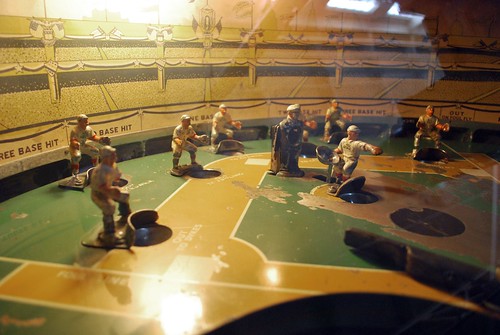
Anticipation, tacit knowledge, and singularity. And baseball.

{Photo by rocketlass.]

In a new novel built around baseball, The Art of Fielding, Chad Harbach describes one of his protagonists, slick-fielding shortstop Henry Skrimshander, as he crouches at his position and gets ready for the pitch:
In one motion he yanked his navy cap with its harpoon-skewered W toward his eyes and dropped into a feline crouch, thighs parallel to the field, glove brushing the dirt. He looked low to the ground, but light on his feet, more afloat than entrenched. The pitch was fouled back, but not before he had taken two full steps to his left, toward the place where he anticipated the ball to be headed. None of the other infielders had moved an inch.
Skrimshander is a defensive prodigy, his instincts easily outstripping those of his peers, but even a poor player knows that jump. Without conscious thought or analysis, years of playing and watching coalesce in some tiny sense, the moment the ball leaves the pitcher's hand and begins to describe its trajectory, of where it will cross the plate--and whether, if met by a bat and sent screaming back at us, it will come to our left or our right. And before we even realize it, we get a half-step head start to the spot in space where we can intercept it. It's a manifestation of the tacit, and on those rare occasions these days when I still get to roam the outfield, it brings me palpable joy, this reminder that there are things I know that I don't, moment to moment, know I know.

Tonight's the last night of the baseball season. After six months of daily engagement--listening to games on the radio, checking box scores, sitting with my usual seatmates at Wrigley Field--the 162-game season has come to down to one last, crucial game for the team I have followed since boyhood, the St. Louis Cardinals. They enter tonight tied with the Atlanta Braves for the Wild Card in the National League, the last open playoff slot. A win would guarantee them at least a shot at a winner-take-all play-off game tomorrow, while a win coupled with a Braves loss would complete a remarkable month that has seen them climb back from 10.5 games out, as they played their best baseball of the year and took advantage of a historic collapse by the Braves.

The greatest pleasure of sports is, of course, that no one knows what will happen in any given game. But greatly enhancing that pleasure is that we know so much else that we bring to this one night. We follow players and careers and teams and stories from year to year and decade to decade, seeing minute variations on countless familiar situations, most melting into the mass but a few standing stark, unforgettable. We know, from nearly 150 years of professional baseball, what's common and uncommon, rare and unprecedented, implausible and impossible. If you'd asked me in August if this Cardinals team could possibly play well enough to have this final game matter, I would have said it was impossible, and, given where they stood then, history would have buttressed my argument. Yet here we are, and no one knows what's next.

Reading Adam Thirlwell's The Delighted States on the train home tonight, I came across a quotation from a character in Chekhov's "A Love" that seemed apt:
What seems to explain one instance doesn't fit a dozen others. It's best to interpret each instance separately, in my view, without trying to generalise. We must isolate each individual case, as doctors say.
Everything in our universe, is singular, different, and while it's impossible to go through our lives every day without letting that knowledge give way to simple sanity's requirement that we categorize, generalize, and gloss over, it's good to be reminded once in a while of the reality. There's never been a Cardinals team like this Cardinals team; this game has never happened before. Let's play ball.

Monday, September 26, 2011

Visiting

On the way back Sunday from a weekend in St. Louis, where we had gone to watch a baseball game--participating, in a way, in an activity from olden days--the sign for the town of Lincoln, Illinois tempted us off Interstate 55. For Lincoln is where William Maxwell was born, and it seems wrong to pass, again and again, a place that figures prominently in the work of a favorite writer without pausing to simultaneously pay homage and see, and imagine with, the remnants of the early twentieth-century town whose streets a young Maxwell walked.

The town looks like any number of Illinois small towns, including the one I grew up in: a courthouse anchoring a town square surrounded by a mix of local businesses and ghostly empty storefronts; quiet, tree-lined streets lined with a mix of large, century old wood-frame mansions and smaller, midcentury houses; a small park, functionless since the end of the days of the local brass band; quiet, deep, fundamental quiet.

Maxwell, in Ancestors (1971), wrote of Lincoln:
At the point at which I began to have a general working knowledge of persons, places, and things--that is to say, about 1912--Lincoln was a modestly flourishing county seat that seemed to have been there forever. It was not even very old, though it did have the air of being deeper in the shadow of the past than many of the towns around it. Nothing of any historical importance had ever happened there, or has to this day.
Forty years later, I suspect that closing statement remains true.

We didn't succeed in finding the Maxwell home, where I have since been told there is a plaque, but we did climb the steps of the lovely Carnegie Library that opened in 1903--clearly architectural kin to the one I grew up patronizing--to which a young Maxwell walked to get books. And on this autumn day, under a stirringly beautiful blue sky dotted with puffy clouds, that, and the quiet, was enough. One of the qualities of Maxwell's novels and stories that keeps me coming back to them again and again is the way they seem to effortlessly bridge that gap between the prewar world--especially the prewar rural world, which was almost incomprehensibly isolated--and our contemporary, connected urban lives. Being in Lincoln, even as the occasional SUV rolled by, drew the connection close.

Elsewhere in Ancestors, Maxwell writes of his father:
In his old age my father enchanted the Rotary Club with a speech which he titled "Memories of Lincoln Way Back When." Being rather proud of this success, he presented me with a carbon copy of the notes he spoke from.

He began by describing the town in his boyhood in the 1880s--the, for the most part, unpaved streets, the original courthouse and the hitching posts all around the courthouse square, the horse fountains, the volunteer fire department, the coal-oil lamps in the houses, and the outside privies. At this time the town of Lincoln was less than forty years old. Up and down the streets of the happy past my father went, locating defunct hotels and dancing academies, banks that had changed their names or failed, dry goods stores, livery stables, boarding houses, barber shops (colored and white), saloons, meat markets, jewelers, gents' furnishings, greenhouses, ice houses, brickyards and coal mines, the collar factory and the shooting gallery.
Nostalgia has always been with us, and when you stand on the streets of Lincoln you can't escape more than a century of it. It's part of Maxwell's genius that nostalgia has little, perhaps no, part in his work; rather, he writes of loss, and time, and the way we work and work and work against their partnership.

Friday, September 23, 2011

The problems of the workplace

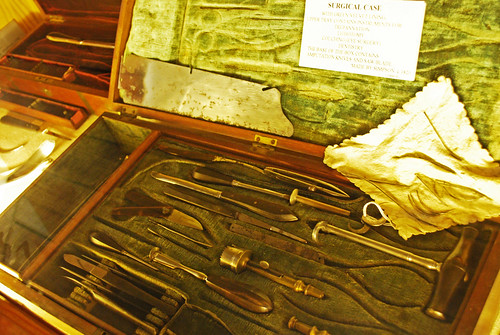
{Photo by rocketlass.}

Candice Millard, author of River of Doubt, one of my favorite books about Teddy Roosevelt (which is saying something), has a new book out on James Garfield, Destiny of the Republic: A Tale of Madness, Medicine, and the Murder of a President. I'm enough of a history dilettante to admit that Garfield was mostly a blank spot for me--had a beard, was an abolitionist, got assassinated by Charles Giteau--until I read Adam Goodheart's 1861 this summer. In Goodheart's hands, Garfield is unforgettable: a passionately idealistic teacher at (and, at 26, president of!) a small Ohio college, essentially drafted into a political career, in which he somehow seems to have remained enthusiastic, serious, and intellectual.

I'm only a few pages into Millard's book, but this passage, describing a presentation at the Centennial Exhibition in Philadelphia, seemed like the right way to close out a long, busy workweek:
Admiring a sturdy saw meant for amputations, one surgeon asked rhetorically, "Who has not experienced the annoyance, in the middle of an operation, of the saw breaking or becoming wedged in the bone so tightly as to be disengaged with difficulty?"
With that, let us all remember to be grateful that we're living now, with all the distractions and irritations and problems of the present, rather than in the, well, sawbones era.

Wednesday, September 21, 2011

Four from the office

As I've noted before, I usually try to keep my life as a blogger and my life as the promotions director of the University of Chicago Press separate. This blog is, after all, something I write on my own time about my life as a reader, and while my reading definitely informs the work I do at the office, they're separate worlds, and, by design, the blog reflects that.

But occasionally they overlap--and this is a very good week for that. So, with apologies for seeming to be shilling for my employers, four notes about Chicago books that I've had a hand in and am thus particularly excited about:

1 The fifth Parker novel, The Score, is the free e-book of the month from Chicago for September--and this time, like with the Anthony Powell giveaway back in December, it's free not just from the Press directly, but also from all the major e-book retailers. I've been writing about Richard Stark ever since I first started reading the Parker novels nearly four years ago; being part of bringing these novels back into print has been one of the things I'm most proud of in a twelve-year career in publishing.

The Score is a great place to start reading Parker: it's one of the most exciting books in the series, but it's also got a lightness of tone that's unusual and welcoming--there's none of the gaspingly brutal violence of, say, Plunder Squad here. I'm confident that the thousands of people who download this freebie won't need much convincing to move from that to one of the other nineteen Parkers that Chicago now has available. If you need more convincing, check out my many posts about Stark in the archives, or visit Ethan Iverson's checklist of Donald Westlake's complete oeuvre.

2 George Pelecanos's new novel, The Cut, features a character who teaches literature to public high school students in DC . . . and one of the books on his syllabus is Stark's The Hunter. After reading aloud the opening page, he asks the students what the description of Parker, all hands and shoulders and implicit violence, makes them feel:
"Way his hands are swinging," said another, "it's like he don't care about nothin."

"He doesn't belong in that suit," said William Rogers, aka Moony.

"Exactly," said Leo. "The suit doesn't fit him, both literally and metaphorically. It's a costume to him. He'd be more comfortable walking naked through a jungle. The Parker books are crime novels, but they're also about a man whose physicality stands in contrast to a working world that, at the time, had become increasingly mechanized and deskbound."

"I don't get what you're sayin, Mr. Lucas."

"Parker is a man of action. He's defined by what he does rather than what he says."
Later, in a touch I suspect Westlake would have appreciated, when the teacher asks the class what they liked about the book, a kid pipes up, "It's short."

3 Another book I had a hand in returning to print has just arrived in bookstores, and it couldn't be more different from Stark's work: Francoise Sagan's A Certain Smile. Sagan's second novel (after the explosively successful Bonjour Tristesse), it is, I think, better than her famous debut: its characters are more convincingly imagined, its prose--full of quotably pithy lines--more stripped-down, its world-weariness feeling a tad more earned. In the Economist, Molly Young called it "a popsicle of a book," and that's not far off, if you can imagine a popsicle leavened with a delectable dash or two of bitters. As autumn draws in, what better way to spend some time than sighing over the prematurely cynical love affairs of a beautiful young French student? Lay in a stock of Gauloises and enjoy!

4 And, fnally, what is perhaps the book I'm most excited about this fall, Dmitry Samarov's Hack: Stories from a Chicago Cab, should be showing up in bookstores everywhere any day now. I've been a fan for a few years now of Dmitry's blog about the people he meets and the strange things he sees while driving a cab, and I'm pleased to have played a part in transforming that blog into a book. If you're fascinated by urban life, and you've always wondered about that slice of it that only cabbies see, this is the book for you: it's full of wonderful (and some horrible) anecdotes and unforgettable images of people with their guard down, revealing things to this stranger behind the wheel that, you sense, they don't even tell their closest friends. It's an amazing book, and it's powered by Dmitry's deep empathy: up against people at their worst day after day, he somehow keeps from being crushed. Indeed, what makes his stories stand out is that even as he marvels at oddity he never loses sight of the fact that it's human oddity, and thus worthy of our forbearance and care.

Dmitry will be appearing at a number of venues in Chicago this fall, including a launch party on October 1 at the Rainbo where I'll be one of the many readers (and certainly the least famous). And if you're on Twitter, definitely follow him: you'll get plenty of late-night stories of unusual fares.

Publishing's a job, like any other. But once in a while, you simply feel lucky to be a part of it. With these books, that's definitely where I stand.

Monday, September 19, 2011

Shelves and shelves and shelves

After a week in which work swamped all else, and my only time for reading was my daily L and bus ride, it was comforting to encounter the following passage in Dorothy Dunnett's Checkmate:
When, presently, Philippa set wide the great double doors of the library, the curator was not in the chamber. The night sky, indigo through the thirteen dormer windows, looked down upon the tiered ranks of fretted shelves, twelve on each side, which held the nine hundred manuscripts lovingly collected by Charles, and the five hundred Greek works left by King Henri's father, along with the others brought him from abroad by his collectors, and looked after him by Bude. Go tell my wife, that curator had said without looking up from his book, when fire broke out and raged through his lodgings. Go tell my wife. I do not concern myself with domestic matters.

It's not the absorption that heartened me, but the numbers: that was the royal library of the King of France in 1557, and it had fewer volumes by far than my own. I am endlessly fortunate, and that reminder leavens the sense--always bubbling up after a week of little reading--that I'm falling behind, failing to get to books I've brought home and very much want to dive into. The surfeit is itself a blessing, and one best met by gratitude and patience.

That thought sent me to Borges's essay on blindness from Seven Nights. He writes of his appointment as director of the Argentine National Library,

I received the nomination at the end of 1955. I was in charge of, I was told, a million books. Later I found out it was nine hundred thousand--a number that's more than enough. (And perhaps nine hundred thousand seems more like a million.)

Little by little I cam to realize the the strange irony of events. I had always imagined Paradise as a kind of library. Others think of a garden or of a palace. There I was, the center, in a way, of nine hundred thousand books in various languages, but I found I could barely make out the title pages and the spines. . . . I remembered a sentence from Rudolf Steiner, in his books on anthroposophy, which was the name he gave to his theosophy. He said that when something ends, we must think that something begins. His advice is salutory, but the execution is difficult, for we only know what we have lost, not what we will gain. We have a very precise image--an image at times shameless--of what we have lost, but we are ignorant of what may follow or replace it.
Borges's philosophical take is helpful. More restorative, perhaps, was a rainy autumn Sunday of sipping cider, sitting by the fire, and reading for hours. It's reminded me that no sensible reader is on a quest for completeness; this is an endless task. In The Library at Night, Alberto Manguel describes it well:
{M]ore than anything else, the LIbrary of Alexandria was a place of memory, of necessarily imperfect memory. . . . Honouring Alexandria's remote purpose, all subsequent libraries, however ambitious, have acknowledged this piecemeal pnemonic function. The existence of any library, even mine, allows readers a sense of what their craft is truly about, a craft that struggles against the stringencies of time by bringing fragments of the past into their present. It grants them a glimpse, however secret or distant, into the minds of other human beings, and allows them a certain knowledge of their own condition through the stories stored here for their perusal. Above all, it tells readers that their craft consists of the power to remember, actively, through the prompt of the page, selected moments of the human experience.
The task is endless, and so are the satisfactions.

Wednesday, September 14, 2011

The Quarterly Conversation turns 25!

Time is short here at I've Been Reading Lately HQ this week--which is particularly frustrating because on Sunday I dove into the last of the Dorothy Dunnett novels I hadn't read, Checkmate, and once you've been sucked into Dunnett's world, there's nothing you want to do but stay there. But fortunately there's the twenty-fifth issue of the Quarterly Conversation for me to send you to. As usual, there's plenty of fascinating material there, including a love letter to Antonio Lobo Antunes by Chad Post (who just may be Antunes's biggest fan); a look at the newest of Cesar Aira's endless supply of novels to be translated into English, by Hugo Browne-Anderson, and a grappling with Robert Duncan's The H. D. Book by George Fragopoulos. That should at least keep you folks busy for a few days until things return to normal around here. Enjoy!

Monday, September 12, 2011

"As long as there is a Tolstoy in literature it is simple and gratifying to be a literary figure," or, More on Tolstoy and Chekhov

After Friday's post that set Tolstoy and Chekhov in opposition, it seems only fair to allow Chekhov to rebalance the scales a little--for Chekhov admired Tolstoy, both as a writer and as a man, like few other people. Here, in a letter to Mikhail Menshikov of January 28, 1900, he frets about reports of ill health:
Most likely Tolstoy is in good health (apart from the stones) and will live another twenty years or so. His illness frightened me and kept me in a state of tension. I dread Tolstoy's death. His death would create a vacuum in my life. To begin with, I have never loved anyone as much as him; I am an unbeliever, but of all the faiths I consider his the nearest to my heart and most suited to me. Then again, as long as there is a Tolstoy in literature it is simple and gratifying to be a literary figure; even the awareness of not having accomplished anything and not expecting to accomplish anything in the future is not so terrible because Tolstoy makes up for all of us. His career is justification for all the hopes and expectations reposed in literature. In the third place, Tolstoy stands solid as a rock, with his immense authority, and as long as he remains alive bad taste in literature, all vulgarity, be it insolent or tearful, all coarse, irascible vanities will be held at a distance, deep in the shadows. HIs moral authority alone is capable of keeping so-called literary moods and trends at a certain high level. Without him the literary world would be a flock without a shepherd or a hopeless mess.
It seems cruel that it was Chekhov who was to die first, without ever getting to read Tolstoy's late masterpiece, Hadji Murat, the posthumously published novella (worked on in secret even as he disavowed fiction) that in some sense brought him back full circle to the world of his early novel The Cossacks.

Sofia Tolstoy--whose suffering (complicated, I acknowledge, by her own complicity and problematic character) might have lessened Chekhov's devotion had he been able, as we are, to read her diaries--in general seems to have appreciated, even admired Chekhov's work. But on April 16, 1911, six months after her husband's death, when she was, it seems, still wrestling with a toxic combination of anger and loss, she wrote in her diary,
I read some Chekhov--very clever, but he sneers a lot and I don't like that.
Sneering isn't a stance I associate with Chekhov; he has too much fundamental sympathy for that. What seems more likely is that Sofia was still too wrought up by her loss to accept the sort of empathy that Chekhov extends to his characters; the rest of that day's entry, even when adjusted for Sofia's (Russian?) tendency to melodrama, is painful to read:
A fine morning, then a thunderstorm and a short, fierce shower. I haven't been crying recently--I've grown cold, my life is a matter of endurance. "To live is to submit!" according to Fet.
Which sends me to Viktor Shklovsky, epigrammatic genius of Russian critics, who in his Energy of Delusion wrote on Chekhov's short, struggling life:
It's as though in the history of literature you won't come across a story that's more moving or decent as Chekhov carrying his large family on his back.

Someone so free in his judgments, who loved Tolstoy, who strangely never noticed Dostoevsky, and who freed literature from the slavery of old forms.

That was Chekhov.
And on Karenina and Vronsky:
Were they unhappy? Was Tolstoy happy? I don't know.

I don't know what happiness means to birds, but when a flock of geese or quails fly over the ocean to their dear old nests, the nests on each side are probably identical.

They are each just as precious.

Is the goose happy after his flight from Egypt to the Arctic Sea? He is probably made for such a flight, and his stroking wing coincides with the movement of the air that carries the flock.

While searching for a path of life through the life of his novels, Tolstoy was perhaps occasionally happy.

But it's impossible to create a complete novel and sometimes it's impossible to finish even a song.
Friday, I learned today, was Tolstoy's birthday. He was born 183 years ago, and we continue to read and re-read and discuss and ponder and fret about him.

Friday, September 09, 2011

A post suitable to the Friday of what has been a very long week, with too much work and not enough piano playing, but at least the right number of martinis

I originally intended to build tonight's post around a passage from the wonderfully cracked, cascading, brilliant lunacy of Marguerite Young's Miss Mackintosh, My Darling (1965), the subject of the World's Least Popular Book Club (New Members Welcome!). A passage like this, for example:
He could not be easily persuaded, he believed, even by the intoxicating, contagious madness of an angelic, lawless woman he had always compassionately, profoundly loved, one for whom he would have sacrificed his life, his own best interests, having loved her just as much as his dead brother had hated her, scorning impatiently her love, not returning it, even making light of it in a most high-handed manner, even saying she had only pretended to be insane. Perhaps Mr. Spitzter loved her even more than his brother had hated her. His brother had been insolent, a gambler, a spender of borrowed money, a quick suicide, a four-flusher with a quick come-back, a ready apology or the banal dismissal of the need for apology, very different from cautious Mr. Spitzer, who claimed never to have placed a bet on even that which he had been most certain of. His brother had been worldly, but Mr. Spitzer had always been, if he might sometimes say so, unworldly and abstruse.

Though she tormented Mr. Spitzer endlessly, sometimes implying that he did not exist, it was perhaps because, after all, in spite of the fact that she could be committed to no one, her imagination floating through unknown amplitudes, she had become grudgingly fond of him, this one faithful caller, he at least providing her a rare amusement.
The suggested searches in this 1,000-page novel at Amazon? "Suffrage captain," "great shiek," opium lady," "black king," "little shadow boxer," and "ghost buggy." (Did I mention that the book club is accepting new members? We'll waive the initiation fee!)

But then, on the bus heading home from work, a soft autumn rain plickering the windows as the gray of Lake Michigan roiled in the distance, I read this passage, from Chekhov's The Duel (1891):
"And last night, for instance, I comforted myself by thinking repeatedly: Oh, how right Tolstoy is, how unmercifully right! And this made me feel better. In point of fact, brother, he truly is a great writer! Regardless of what anyone says."

Samoylenko, having never read Tolstoy but spent each day preparing to read him, felt embarrassed and said:

"Yes, all writers write from the imagination, but he's straight from nature . . ."
Which brings to mind this passage from Chekhov's letters, sent to A. S. Suvorin on May 4, 1889:
Nature is an excellent sedative. It pacifies--that is, it makes one indifferent. And it is essential in this world to be indifferent. Only those who are indifferent are able to see things clearly, to be just and to work. Of course, I am only speaking of intelligent people of fine natures; the empty and selfish are indifferent enough any way.
Chekhov, even when he's being intentionally provocative, as seems likely here, always comes across as fundamentally decent, an opinion which has thus far been borne out by everything I've read about him. Lilian Hellman, in an introduction to a collection of Chekhov's letters, wrote,
Chekhov was a pleasant man, witty and wise and tolerant and kind, with nothing wishywashy in his kindness nor self-righteous in his tolerance, and his wit was not ill-humored. He would have seen through you, of course, as he did through everybody, but being seen through doesn't hurt too much if it's done with affection.
Tolstoy, on the other hand, was, as is well known, nearly as horrible, at least to his family, as he was brilliant. Berryman's assessment of Rilke would suit: Tolstoy was a shit. As a husband, he calls to mind the end of Flannery O'Connor's "A Good Man Is Hard to Find": Tolstoy would have been a good husband, "if it had been somebody there to shoot [him] every minute of [his] life."

So for Friday, my love to Tolstoy's work, my admiration to Marguerite Young's ambition and singularity, but a seat at my bar for Chekhov, who need do nothing more than sit quietly, listening to the piano and nodding, perhaps pausing once in a while to wipe the foam from his mustache.

 Enjoy the weekend, folks.

Wednesday, September 07, 2011

"No doubt this Giacomo Casanova was a most worthless and profligate scoundrel," Or, Casanova's History of My Life, "one of the great cryptograms of literature

I've mentioned a couple of times the nifty marketing gimmick that Melville House books recently used for their Art of the Novella series: on one day, they published five different novellas by five different authors, all titled The Duel. The authors are Joseph Conrad (about whose Duel I wrote a couple of weeks back), Heinrich von Kleist, Chekhov, Aleksandr Kuprin, and Casanova. The ones originally in languages other than English--all but Conrad--are newly translated, and, in a smart move designed to make the $10-12 prices seem more palatable, Melville House has also assembled a collection of bonus materials for each book online. A link in the book sends you to a PDF of what is essentially a course pack of interesting side commentary on the book: related pieces by the author, contemporary reviews, period illustrations, later writings on the author and subject. I've downloaded them all, but the only one I've spent a lot of time with is the companion to The Duel of my old favorite, Casanova, and it's full of interesting material. An 1871 issue of Littell's Living Age, informs us that "It is impossible to recommend any English person to read this book," but that, having read it, he finds that
the cynicism of corruption described as having been universal at Venice seems almost past belief. No doubt this Giacomo Casanova was a most worthless and profligate scoundrel; and it is to be expected that the account given by such a man of any society in which he had lived, would paint it under its worst aspect. Nevertheless, after all reasonable allowance has been made on this score, it is impossible to doubt that, with the exception perhaps of the latter times of the Roman Empire, the world has never seen so grossly corrupt a society as that of Venice at the time spoken of.
What's fun about this is its sense of awe and discovery; it allows us to imagine the time, not that long ago, when Casanova's memoirs were still wholly illicit and difficult to find, its revelations (and their "air of being a truthful story") shocking.
A selection from the Edinburgh Review takes us one step farther, reminding us that for many years the memoirs were
often declared to be spurious and its author set down as a myth.
But slowly the reputation of the book and its author rose, and by the time of that 1914 article,
distinguished antiquaries are engaged in annotating the voluminous pages, endeavouring to verify each statement and identify all the personages described. It is a colossal labour, for Casanova (though gifted with a remarkable memory) wrote his autobiography mainly from recollection when an old man, and consequently made many mistakes; while numbers of the characters described in his narrative are obscure individuals, or their names are disguised under a pseudonym. In this respect his memoirs may be regarded as one of the great cryptograms of literature.
All of this would be of little interest except to historians were it not that Casanova is, almost despite himself, such a compelling, even likable character. In an article for the English Illustrated Magazine in 1896, W. E. Garrett Fisher puts it well:
The rogue over whose memoirs we are willing to spend delightful hours, nor yet account them wasted, must be compact of lighter and more artistic elements. His murders must be disguised under the show of duel or vendetta, and his theft conducted over green tables or on the Great North Road. Furthermore, the fellow’s character must be what is called sympathetic; and I suppose that no one will consider it a very cynical asperity to decline sympathy with Mr. Deeming or Jonathan Wild. The rogue we care for must have the same gaiety of disposition and easiness of morality, the same cheerfulness under adversity and eagerness to make the very most of a passing blink of sunshine, that enlist immortal interest in the son of old Blas of Santillana. It is this lightness of heart and manner that enable Casanova and Cellini, Haji Baba and Gil Blas, to compel a smile by the recital of conduct that would prove no laughing matter if we met with it in real life instead of reading about it in an easy-chair.
We no more want to be with Casanova in real life than we'd actually want to be back in eighteenth-century Europe, with its disease and dirt and war and poverty. But he charms us on the page. Oh, he's horrible through and through, untrustworthy and self-dealing--but at the same time, even as he boasts, he hides so little of himself, of his failings and failures, that we almost can't help but be won over. Fisher briefly runs down some of his reasons he is so compelling:
The restless man had a thirst for information and a taste for celebrities as keen as those of Boswell, with a zest for life equal to that of Cellini and Colley Cibber rolled into one. In the course of his gambling peregrinations he came into contact with Voltaire and Crebillon, the Marquis d’Argens and the Due de Choiseul, Frederick the Great and Louis XV., Cagliostro and the Comte de St. Germain, Haller and Fontenelle. He seems to have been received by all of these on good terms, while he was hail-fellow-well-met with every strolling actor and singer by reason of his parentage. If ever there was a man who fulfilled the Masonic precept of being fellow to a prince and brother to a beggar, it was surely Casanova, as he shows himself; and, to do him justice, it was a matter of the smallest importance to him whether or not the beggar was worthy.
The Duel, which was presented as a fiction starring an unnamed Venetian when it was published in 1780 but was later placed, with little alteration, within the History of My Life, is as good a starting place as any for a Casanova skeptic: it features less than the usual amount of amorous adventure, but Casanova's character comes through clearly even so. If, after seventy pages, you still want the young Venetian, in all his honor, self-confidence, and high-flown sentiment, to win--solely in order that you can spend more time with him, then you should proceed to the History, which finds all those qualities multiplied a thousandfold.

Wednesday, August 31, 2011

Geoff Dyer on the Great War


{Photo by Flickr user Dunechaser. Used under a Creative Commons license, which reserves some rights.}

Geoff Dyer's The Missing of the Somme (1994) has just been published in the States for the first time, the lag probably an indication less of Dyer's formerly low profile over here than of the relatively small place of World War I in American memory. I suspect that if, rather than World War I, we called it the Second Franco-Prussian War--thus stripping it of its not inaccurate position as a prelude to World War II, which remains a constant topic of self-congratulatory (and, again, not wholly inaccurate) American reflection--it would occupy a position more like the French and Indian War or the War of 1812, covered in grade school, then all but forgotten by anyone who's not a history buff.

 For our participation in that war was late and limited, our losses negligible. And by 1914, we were just settling into what would become a century and a half (so far) of reflection on our own horrible, romantic, inescapable, endlessly compelling war, the Civil War. Its battlefields were America's Somme, its convulsions and aftermath our rending of the veil of heroic illusion. That we, driven by Southern apologists, spent much of the twentieth century attempting to sugarcoat it, strip it of its meaning, and accord both sides equal honor despite the fact that one side was fighting to keep humans in bondage seems fundamentally American, a core sample of our national character.

 No, for us the impact of World War I was relatively limited at the time, attenuated nearly to nothingness by now. Its greatest effect was to continue and amplify the consolidation of federal power, regularization of daily life, and knitting together of the many disparate and rural pockets of the far-flung nation that was set into motion by the vast apparatus of the Civil War and that reached its apogee during World War II. (One example: in his wonderful, data-based Daily Life in the United States, 1920–1940, David E. Kyvig notes that nearly one-third of American draftees for World War I were rejected as physically unfit, leading to significant pushes by the federal government to educate the population about proper nutrition, exercise, and hygiene.) The emotional valence of the war has never come close to what it carries for European nations.

 And therein lies the fascination for me, and the reason that Dyer's book seems nearly perfect. It is an account, not of the war, but of how Europeans (and the English in particular) have remembered it--beginning with poems, news accounts, and memorials created as it was happening and carrying through to the moments when Dyer and friends, sometimes a bit drunk, trek from battlefield to battlefield in 1990s France. It owes an acknowledged debt to John Berger; its closest other kin is probably Paul Fussell's magnificent The Great War and Modern Memory, on which it draws--though Dyer writes much more personally and is much more open to the idea, and its accompanying frustration, that certain questions, certain feelings, certain, to steal from Berger, ways of seeing, have been closed to us by time. Its closest Stateside kin, which I hope Dyer knows, is Lee Sandlin's Losing the War, published in the Chicago Reader in 1997. All three are less concerned with facts--though they don't disdain them--than with impressions, reactions than actions.

In a book full of interesting ideas and observations, the sort that lead a reader down new paths of thought and inquiry, this passage stood out:
"Before the Great War there was no war poetry as we now conceive the term," writes Peter Parker in The Old Lie; "instead there was martial verse." So pervasive were the conventions of feeling produced by this tradition that in 1914 the eleven-year-old Eric Blair could write a heartfelt poem--"Awake, young men of England"--relying entirely on received sentiments. In exactly the same way, an eleven-year-old writing fifty years on could, in similar circumstances, come up with a heartfelt poem expressing the horror of war--while also relying solely on received sentiment. In some ways, then, we talk of the horror of war as instinctively and enthusiastically as Rupert Brooke and his contemporaries jumped at the chance of war "like swimmers into cleanness leaping." This is not just a linguistic quibble. Off-the-peg formulae free you from thinking for yourself about what is being said. Whenever words are bandied about automatically and easily, their meaning is in the process of leaking away or evaporating. The ease with which Rupert Brooke coined his "think only this of me" heroics by embracing a ready-made formula of feeling should alert us to--and make us sceptical of--the ease with which these sentiments havebeen overruled by another.
Dyer's skepticism, here and throughout, is bracing, in a way that goes far beyond the question of World War I and its meaning. We should always keep in mind the seductive danger of received opinion; when everyone is agreeing with us we should pause a moment to disagree with ourselves and see how that sits. Dyer reminds us that even the writing of participants in the war traffic in tropes that were common enough to be limiting thought and expression, closing off rather than opening out questions, as the war was just getting underway. He doesn't dismiss the war poems and memoirs, but he reminds us that even though those who experienced the war had to wrestle it into shape somehow, and--to no discredit--they often chose the shapes that were, culturally speaking, lying around.

 In some sense, though he doesn't mention him by name, Dyer seems to endorse Ford Madox Ford's take on the war: Ford's masterpiece, the four-volume Parade's End, is almost entirely concerned with the war and its damage; by the third volume, description has largely given way to ellipses, elision indicating that which, if described, would killingly concretize into cliche.

Yet at the same time Dyer's account can't help but send us back to that generation in general and its literary output. If we try to escape the frame of "horror," and focus instead--as I find myself doing--on the slightly narrower question of what must that all have been like (which ranges from what must it have been like to winter in the trenches; to what must it have been like to live, a woman, in a village from which all the men had left; to what it must have been like to live in a nation in which one in ten males has been violently killed), we have to return to Graves and Sassoon and Owen (and even, in a refracted way, Lord Dunsanay, whose Tales of War (1918), recently republished by Whisky Priest Books, offers a simultaneously more literary and more vigorously angry perspective). They remain our strongest link to those irrecoverable times and emotions, and as the centennial of the tragedy approaches, they have lost little of their power. I suspect our descendants will still be wrestling with them at the bicentennial.

Monday, August 29, 2011

"Our speeches in the day time cause our phantasy to work upon the like in our sleep," or, In dreams


"I had dreams, not nightmares but musical dreams, dreams about transparent questions . . . "--from Amulet, by Roberto Bolano
1 I was reading Neal Stephenson's Baroque Cycle, which I've not read.
"I think dreams have a great many sorts of explanation. Once the Freud virus has, as it were, got into you, you keep on looking at things in that way. But surely there's a lot of pure accident in dreams. One has kinds of obsessions and fears that can't be given a sexual meaning. I think the inventiveness and details of dreams are amazing."--from From a Small Corner in the House of Fiction: Conversations with Iris Murdoch
2 I am playing basketball with the Chicago Bulls. I take a pass and fling up an outside shot, which misses abysmally. I turn around to find Michael Jordan shaming me by wagging a long finger, while Dennis Rodman is doubled over, gripping his knees in helpless laughter.
"The Atlantes, according to my sources, never eat any living thing, and never dream, either."--from The Histories, by Herodotus
3 At my nephew's ninth birthday party I was surprised to notice two guests whose attendance I certainly had not expected: Marcel Proust and Eloise of the Plaza. I got the sense that they'd somehow been invited in error, that it was quite possible that they knew no one at the party aside from each other. That wasn't really a problem, however, as they gave the impression of being the sort of close friends who need little to no outside contact. Huddled together in a corner, they sipped from the tiny teacups of my niece's tea set and quietly shared private, gossipy jokes that caused them now and again to break out in skeins of poorly muffled giggles.
"I knew that in many dreams one must disregard the appearance of people, who may be disguised or may have exchanged faces with one another, like those mutilated saints on the fronts of cathedrals which have been repaired by ignorant archaeologists in a jumble of mismatched heads and bodies, attributes and names. Those we give to characters in our dreams can be misleading. The one we love can be recognized only by the quality of the pain we feel."--from In the Shadow of Young Girls in Flower, by Marcel Proust
4 I am running a marathon in some anonymous but lovely European mountain town. The course, which winds through the narrow, wandering late-medieval streets of the town, is convoluted and difficult to follow, but that difficulty, in the early part of the race, is a help, giving my mind something to focus on aside from the details of my exertion. But around mile twelve I realize quite suddenly that I'm all alone, the body of fellow runners having silently slipped away somewhere along the course. It's clear that I've take a wrong turn and left the course behind. Worried, I look around, hoping to find a guide or a map. All I see is a quaint-looking pastry shop spilling a warm glow of candlelight onto the crooked sidewalk. I enter the pastry shop, conscious of the salty sweat caking my body, and, with apologies for my gross condition, I ask the baker whether he might happen to have a map of the marathon course. Smiling, he reaches into the display case and selects a cookie baked in the shape of an elephant balancing on a ball. He pokes a pudgy finger at the intricate lines that, pressed into the cookie, make up the design. In a voice tinged with a vaguely Germanic accent, he says, "You simply follow these lines." The cookie is a map of the route; the route forms the shape of an elephant balancing on a ball.

With a smile on my face and a cookie in hand, I leave the shop and begin to trot back toward the course.
"It is not much of a dream, considering the vast extent of the domains of dreamland, and their wonderful productions; it is only remarkable for being unusually restless, and unusually real. He dreams of lying there, asleep, and yet counting his companion's footsteps as he walks to and fro. He dreams that the footsteps die away into distance of time and of space, and that something touches him, and that something falls from his hand. Then something clinks and gropes about, and he dreams that he is alone for so long a time, that the lanes of light take new directions as the moon advances in her course. From succeeding unconsciousness he passes into a dream of slow uneasiness from cold; and painfully awakes to a perception of the lanes of light--really changed, much as he had dreamed--and Jasper walking among them, beating his hands and feet."--from The Mystery of Edwin Drood, by Charles Dickens
5 One of the editors at my workplace had arranged for some prominent authors to give lectures on their craft to the entire office. First up were Ernest Hemingway and Joseph Conrad. They took turns speaking, and they actually had fairly interesting things to say about each other’s work. Hemingway was surprisingly self-effacing, and Conrad was exactly as I expected: formal, precise, and thoroughly serious.

It was only after I’d returned to my office following the lecture that I remembered that both Hemingway and Conrad were long dead. “Of course!” I thought. “Those must have been professional impersonators!”

I ran for the front desk, hoping to catch them before they left. Conrad was gone by the time I got there, but Hemingway was just stepping into the elevator. “Wait!” I shouted. “Who do you do when you’re not doing Hemingway?”

Hemingway turned. Then, smiling, he ripped off his mask, held it aloft, and jauntily shouted, "Yourcenar!”
"Against fearful and troublesome dreams, nightmare and such inconveniences, wherewith melancholy men are molested, the best remedy is to eat a light supper, and of such meats as are easy of digestion; no Hare, Venison, Beef, &c. not to lie on his back, not to meditate or think in the day time of any terrible objects, or especially talk of them before he goes to bed. For, as he said in Lucian after such conference, I seem to dream of Hecate, I can think of nothing but Hobgoblins; and, as Tully notes, for the most part our speeches in the day time cause our phantasy to work upon the like in our sleep, which Ennius writes of Homer: as a dog dreams of an hare, so do men dream on such subjects they thought on last."--from The Anatomy of Melancholy, by Robert Burton
6 I was at the zoo, watching a gorilla very close up through the bars of his cage. He gave me a quizzical look, tugged at his earlobe, then pointed at my earlobes while mouthing the word, "Earring?" I stared for a second, then remembered that I was wearing a big, gold pirate-style hoop in each ear.
"There is no great difference, says Proust, between the memory of a dream and the memory of reality. When the sleeper awakes, this emissary of his habit assures him that his 'personality' has not disappeared with his fatigue."--from Proust, by Samuel Beckett
7 I am reading James Boswell's Life of Johnson and find a typo that somehow turns an ordinary sentence into some sort of prognostication about my brother's life. As I read it I am amused but impressed, and I remember that Johnson himself left a cryptic note about dreams and brothers in his diary. The entry for January 23, 1759, the day of his mother's funeral, includes the line, "The dream of my Brother I shall remember." Johnson's brother, Nathanael, had died at only twenty-four, a possible suicide; his sole surviving letter is an indictment of Samuel for his harsh treatment.
"It makes a difference whether your dreams usually come true or not. . . . See then if you can follow my example, and give a happy interpretation to your dream."--from a letter to Suetonius Tranquillus by Pliny the Younger
8 I was at Wrigley Field to watch a Cubs game, and, as game time approached, I got out my scorebook to take down the starting lineup. The public address announcer began to rattle off the Cubs lineup. "Leading off, and playing right field . . . a sesame ball." I wrote it down. "Batting second, and playing second base, a furry kitten." I wrote it down. "Batting third, and playing first base, Stacey Shintani." On hearing my wife's name, I threw down my pencil and exclaimed to my seatmate, "They're trying to throw this game!"
"My earliest memory is of a dream. It was in the house where we lived when I was three or four years of age. I dreamed I was asleep in the house in an upper room.

Then I awoke and came downstairs and stood in the living room. The lights were on in the living room, although it was hushed and empty. The usual dark green sofa and chairs stood along the usual pale green walls. It was the same old living room as ever, I knew it well, nothing was out of place. And yet it was utterly, certainly, different. Inside its usual appearance the living room was as changed as if it had gone mad."--from "Every Exit is an Entrance (A Praise of Sleep)," by Anne Carson
9 I was reading—and greatly enjoying—Anthony Powell's’s biography of Robert Burton, author of The Anatomy of Melancholy. It was only after I woke up that I remembered that Powell never wrote a biography of Burton; that was Nick Jenkins, the narrator of Powell’s A Dance to the Music of Time, who serves as Powell’s stand-in.
"In some ways a narrative is like a dream. You don't analyze a dream--you just pass through it. A dream is sometimes healing and sometimes makes you anxious. A narrative is just the same--you are just in it. A novelist is not an analyst. He just transforms one scene into another. A novelist is one who dreams wide awake. He decides to write and he sits down and dreams away, then wraps it into a package called fiction which allows other people to dream. Fiction warms the hearts and minds of the readers. So I believe that there is something deep and enduring in fiction, and I have learned to trust the power of narrative."--Haruki Murakami, from a lecture in Cambridge, Massachusetts in 2005
10 I dreamed that Van Morrison was at a dinner party I was attending with about a dozen other friends. After dinner, he got up to play a few songs. He ran through a somewhat perfunctory "Moondance," then asked me if I would accompany him on vocals and guitar for a couple of numbers. I don't play guitar, and while I do like to sing, I'm far from a good singer. But, unwilling to refuse Van Morrison, I got up and faked my way through "The Way Young Lovers Do," strumming and singing along. I was sufficiently nervous that I forgot nearly half the lyrics, but Van sang them all beautifully.

Then he launched into Sam Cooke's "That's Where It's At," and suddenly everything was right: I happened across the right chords, was even able to throw in some simple, but convincing finger-picked flourishes, and Van and I sounded stunningly good singing together.
"He was also terrified with manifest warnings, both old and new, arising from dreams, auspices, and omens. He had never been used to dream before the murder of his mother. After that event, he fancied in his sleep that he was steering a ship, and that the rudder was forced from him: that he was dragged by his wife Octavia into a prodigiously dark place; and was at one time covered over with a vast swarm of winged ants, and at another, surrounded by the national images which were set up near Pompey's theatre, and hindered from advancing farther; that a Spanish jennet he was fond of, had his hinder parts so changed, as to resemble those of an ape, and having his head only left unaltered, neighed very harmoniously. The doors of the mausoleum of Augustus flying open of themselves, there issued from it a voice, calling on him by name."--from The Lives of the Twelve Caesars, by Suetonius
11 I was rereading Vladimir Nabokov's Laughter in the Dark, in the pages of which I encountered a book I hadn't noticed on my first reading: Ghost Whim, by Robin Anne Powter.

According to Nabokov's narrator, Ghost Whim is a cultural history of dreaming . . . but before I could learn what would happen if I read a nonexistent cultural history of dreaming inside an actual novel inside a dream, I woke up.
"Night comes when you least expect it. You are making dinner or working late, you look out the window and the sky is already dark. The arrival of night can be elusive, mysterious, and in the city we don't often see it, though we always know when it has fallen. In the country night takes its time. A glorious sunset might flag its approach, yet it seems we can never pinpoint its exact arrival. Nightfall is a subtle process."--from Acquainted with the Night, by Christopher Dewdney


Friday, August 26, 2011

Conrad and Powell

Anthony Powell fans who turn to Joseph Conrad's novella The Duel (one of the five novellas of that title that Melville House, in a clever gimmick, published together last week) will enjoy an amusing echo of Uncle Giles in the whinging of one of the two contestants. Conrad's tale concerns Feraud and D'Hubert, a pair of officers in Napoleon's army who, through the insane readiness of Feraud to take offense, spend more than decade of the Napoleonic Wars in an on-and-off duel. Or, rather, a perpetually on duel, one whose interstices are forced by circumstance: recovery from wounds, lack of proximity, or, in the case that calls Uncle GIles to mind, difference in rank. D'Hubert is promoted to colonel, which leaves Lieutenant Feraud unable to challenge him without rendering both men liable to court martial. Feraud, formerly a casual, even feckless soldier, felt "an urgent desire to get on" spring up in his breast. He
resolved in his mind to seize showy occasions and to court the favourable opinion of his chiefs like a mere worldling.
That in itself is not much like Uncle Giles, who didn't tend to court work or opinion of any sort. But this certainly is:
He began to make bitter allusions to "clever fellows who stick at nothing to get on." The army was full of them, he would say; you had only to look around. . . . Once he confided to an appreciative friend: "You see, I don't know how to fawn on the right sort of people. It isn't in my character."
The minute he gets his promotion, Feraud begins making the arrangements to meet D'Hubert at arms, for,
"I know my bird," he observed grimly. "If I don't look sharp he will take care to get himself promoted over the heads of a dozen men better than himself. He's got the knack for that sort of thing."
Powell was a staunch fan of Conrad, calling him "one of our greatest novelists" in a 1974 article, so it's not unreasonable to think that Feraud's cynical disdain played a part in the creation of Giles.

In a different article on Conrad, published in the Times Literary Supplement in 1947, occasioned by a two new volumes of biography, Powell draws out a couple of succinct distillations of Conrad's stance and concerns as a writer. One is constructed almost entirely from some lines from Razumov, the student from Under Western Eyes who, as Powell puts it, is "forced to play a shabby part through no particular fault of his own . . a favourite theme of Conrad's":
"As if anything could be changed!" thinsk Razumov. "In this world of men nothing can be changed--neither happiness nor misery. They can only be displaced at the cost of corrupted consciences and broken lives--a futile game for arrogant philosophers and sanguinary trifles." This was the lesson Conrad himself had learnt.
Then there's this, which fruitfully compares Conrad to Kipling (an author to whose fundamental literary and imaginative qualities Powell, with his conservative leanings, is probably a better guide than many, able to judge with relative dispassion Kipling's achievements and failures; those of us on the left can then decide where to set the balance regarding other aspects):
Indeed, his informed distrust of pretentious claims to idealism and of pursuit of power masquerading as liberalism sets him apart form the mood of his literary contemporaries. . . . In this divergence he resembles Kipling--an author personally unsympathetic to him--who shares Conrad's respect for a sense of duty, his recognition of the practical difficulties of exercising command, and also, to some degree, his satirical attitude towards officials. Conrad is more sensitive than Kipling in handling the niceties of human character, but he does not possess Kipling's dexterity nor, perhaps, his imaginative powers. On the other hand Kipling--although his dislike for Peter Ivanovitch and his [anti-Tsarist terrorist] circle would in no way have fallen short of Conrad's--could never have achieved the objectivity of Under Western Eyes.
For the best distillation of Conrad's moral sensibility, however, you'll be best off turning to Conrad himself--and if you don't have time to read the whole of Victory, where it's given its most explicit treatment, then this brief passage of scene-setting from The Duel will suffice:
No man succeeds in everything he undertakes. In that sense we are all failures. The great point is not to fail in ordering and sustaining the effort of our life. In this matter vanity is what leads us astray. It hurries us into situations from which we must come out damaged; whereas pride is our safeguard, by the reserve which it imposes on the choice of our endeavour as much as by the virtue of its sustaining power.
I suppose as a key to Conrad, that passage could be faulted for lacking an explicit reference to honor and duty, but it's at least a good start.

Wednesday, August 24, 2011

Joseph Conrad

Now this is how you open a story:
Napoleon I, whose career had the quality of a duel against the whole of Europe, disliked duelling between the officers of his army. The great military emperor was not a swashbuckler, and had little respect for tradition.

Nevertheless, a story of duelling, which became a legend in the army, runs through the epic of imperial wars. To the surprise and admiration of their fellows, two officers, like insane artists trying to gild refined gold or paint the lily, pursued a private contest through the years of universal carnage. They were officers of cavalry, and their connection with the high-spirited but fanciful animal which carries men into battle seems particularly appropriate. It would be difficult to imagine for heroes of this legend two offices of infantry of the line, for example, whose fantasy is tamed by much walking exercise, and whose valour necessarily must be of a more plodding kind. As to gunners or engineers, whose heads are kept cool on a diet of mathematics, it is simply unthinkable.
That's how Joseph Conrad begins his novella The Duel. I know there are those who dislike Conrad's prose--Ha Jin, for example, has written that it "tends to be purple at the expense of immediacy and penetrativeness"--but I find it almost always suited to his aims at a particular moment. What better way to begin a somewhat ridiculous, satirical account of a decade-long running duel than with the gentle irony of these sentences? The opening sentence alone, with its almost immediate interpolation of opinion, instantly reveals a narrative voice at some remove, both temporally and intellectually, from his subject, the perfect location for a Conradian narrative voice. (It's the position in which we find Marlowe at times, Heart of Darkness aside--though his emotional connection to the stories he tells prevents him from ever being as wry as this opening.)

One of the pleasures of Conrad is that he feels almost inexhaustible: there are nearly twenty novels, a handful of memoirs, and countless short stories. A reader can pick up one or two each year, when the hot late summer breeze brings thoughts of distant islands, and not run out for a long time. Such a summer night is this one; I'm glad The Duel is here.

Monday, August 22, 2011

Dueling


{Photo by rocketlass.}

From Le Morte D'Arthur, by Sir Thomas Malory:
So that knight, Sir Pellinore, rode after Sir Tristram and required him of jousts. Then Sir Tristram smote him down and wounded him through the shoulder, and so he passed on his way. And on the next day following Sir Tristram met with pursuivants, and they told him that there was made a great cry of tournament between King Carados of Scotland the King of North Wales, and either should joust against other at the Castle of Maidens; and these pursuivants sought all the country after the good knights. . . . Then Sir Sagramore le Desirous rode after Sir Tristram, and made him to joust with him, and there Sir Tristram smote down Sir Sagramore le Desirous from his horse, and made his way.
As a belated birthday present, some friends took me and rocketlass to Medieval Times this weekend. Braving the Slough of Expressway and venturing into the uncharted Swamps of Suburbia, we hit upon Castle Schaumburg and, once there, enjoyed a throughly pleasant, if fundamentally ridiculous, evening of falconry, horse ballet, stage combat, and, yes, jousting.

I had read a bit of Malory that day in preparation, but I found myself thinking less of his endless catalog of combats than of Dorothy Dunnett. One of the most effective ways--to this untrained history dillettante--that Dunnett unmoors readers a bit from our own era is through her depiction of the deadly sporting contests in which her characters engage. Nearly every novel has one, and they range from the familiar (a fox hunt) to the somewhat familiar but ridiculously dangerous (a proto-polo, a castle-top game of soccer) to the absolutely ridiculous (a footrace across the moving oars of a galley, a drunken chase across city rooftops). In most of the games, at least one contestant dies, and the loss is essentially shrugged off: no one is blamed or held to account. Life, Dunnett convinces us, was cheaper then; people mourned their own as powerfully as we do today, but that sense of loss wasn't extended to strangers.

I also found myself thinking about Robert Massie's Peter the Great, because, along with weaponry, Medieval Times has a collection of medieval instruments. While they're presented (and presumably received by the majority of the patrons) as relatively uncharged artifacts of long-gone days, they're nonetheless horrifying and disturbing, their sick ingenuity a reminder that torture always goes beyond its (perceived) instrumentality and becomes its own end. In Peter the Great's reign, torture was commonplace, the regular response to murmurs of conspiracy, and Peter regularly required nobles to prove their loyalty by taking part in the torture and execution of the accused. Massie makes a fairly convincing case that Peter was by no means unusually cruel by the standards of his day, but that doesn't make even his occasional acts of "mercy" much more palatable: frequently, on seeing a conspirator broken on the wheel, Peter would order his sufferings ended through immediate beheading. That the beheadings were often conducted by inexperienced headsmen and thus became in themselves a form of torture only adds to the train of horrors.

Which brings me back to Malory. When I first read Malory, at age ten or so, having sought him out in our public library, I was amazed by the fact that it's just a litany of knights meeting in the woods, clouting each other a bit, and then traveling on. There's little discernible narrative movement relative to the book's bulk, and very little sense of progress or achievement. As a pre-teen, I was confused and ultimately bored; as an adult, I see it as more interesting, if more wearying: good does not vanquish evil; rather, the two keep knocking each other about, and wherever good wanders, evil is there to challenge it. The cycle continues without end, as long as the knights exist.

And that brings to mind, of all things, the Incredible Hulk. I remember as a teen reading a long run of Hulk comics from, say, the mid-1970s through the mid-'80s, and it seemed as if every issue told this exact story: Bruce Banner wakes up somewhere in torn clothes, without any memory of where he is or how he got there. He staggers about for a bit like a man trying to shake a hangover, and then he runs into some supervillain . . . who makes him angry. He hulks out, stomps the supervillian, and then bounds away to parts unknown, his uncomprehending Hulk brain unable to understand how he got into the fight or what he should do now that it's over. The issue would end, and between issues the Hulk would calm down and return to his Banner form, and the cycle would continue.

I swear, it seemed like that was what happened, month after month after month, unbroken, for approximately a decade. As a kid, I liked the Hulk enough to want to keep reading, but even then I thought it was bizarre: what Marvel Comics had done for the concept of superheroes was to allow them a continuing story and the possibility of change; this was almost a direct refutation of the breakthrough.

Looking back, however, I like those issues. Oh, I won't pretend to believe that they took that form out of some grand design; I suspect laziness and lack of creativity were the reasons for the Hulk's stagnation. But if all superheroes and their battles are in some way metaphorical, I like seeing the Hulk's lost decade as a successful metaphor: Bruce Banner is forever trapped in bad patterns of behavior, reacting in the same way to the same triggers, not knowing how to change for the better; evil and destruction erupt into life again and again, never to be eternally vanquished.

And now that I've brought this post so far from Medieval Times and its jousting, dueling knights: what better to turn to now than Melville House's five new entries in their Art of the Novella series . . . all titled The Duel? I think that's got to be next.

Friday, August 19, 2011

The very existence of this entry, I fear, suggests that I need a hobby (beyond, that is, this blogging thing).


{Photo by Flickr user penreyes, used under a Creative Commons license that reserves some rights.}

At a party a couple of weeks ago, my friend Joseph Clayton Mills and I got onto the topic of Chet Morton, friend of the Hardy Boys; brother of Joe Hardy's girlfriend, Iola; and inveterate hobbyist. I mentioned my favorite of Chet's one-per-book hobbies, taxidermy, and Joseph countered that he was always most impressed by Chet's brief passion for falconry.

"Falconry?" I asked. "Where in Bayport would Chet have encountered falconry, the sport of kings?"

Then, earlier this week, I stumbled upon what I thought might be the answer: perhaps Chet's interest in falconry began with a session of George Plimpton's Video Falconry on Biff Hooper's Colecovision?


This led Joseph to some quick research on the subject of Chet's hobbies. The list on Wikipedia, he reported, is "woefully inadequate," but the entry did deliver this remarkable bit of information:
Chet is one of the most popular characters in The Hardy Boys. In fact, by the mid-sixties, Chet had become so popular that in 1965 the Stratemeyer Syndicate was planning to develop a series about him and his hobbies.

It seems that the Stratemeyer Syndicate did a lot of work on this series (even some complete chapters were written), yet the Syndicate never began to publish it.
And that's not all:
A list of proposed titles in the Chet Morton series were found in the Stratemeyer Archives at the New York Public Library.
1. Chet Morton and the Funny Putty Caper
2. Chet Morton and the Talking Turkey
3. Chet Morton and the Mighty Muscle Builder
4. Chet Morton and the Stolen Flea Circus
5. Chet Morton and his Electronic Exam Passer
6. Chet Morton and his Bird-Brain Blimp
7. Chet Morton and the Monkey’s Uncle
8. Chet Morton and the Flying Fruitcake
9. Chet Morton and the Mystery at Tucks Cove
10 Chet Morton and the Mystery at the Friar Tuck House
11 Chet Morton and the Mystery of Ben's Bat
Those aren't quite Invisible Library titles, but I couldn't resist at least passing them on to my fellow invisible librarian, Ed Park, who replied, "Why do I feel like these could all be euphemisms in House of Holes??"

Surely someone's already working on the Chet Morton fanfiction, right?