Monday, November 05, 2012

Chasers

Two very quick addenda to Friday's post about hangovers and drinking. The first one comes from A Place in Time, Wendell Berry's wonderful new collection of stories about the Port William Membership, whose lives and histories he's beeƄn chronicling for decades now. It's found in "A Burden," which tells of Uncle Peach, a well-meaning ne'er-do-well and drunk:
Oe afternoon Burley Coulter came upon Uncle Peach in front of a roadhouse down by Hargrave. Uncle Peach had been drinking evidently a lot of whiskey and also eating evidently a lot of pickled food from the bar. He had just finished vomiting upon the body of a dead cat, at which he was now gazing in great asotnishment.

"Well, what's the matter, old Peach?"

"Why, Burley," Uncle Peach said. "I remember them pigs' feet and that baloney, but I got no recollection whatsoever of that cat."
That one's gross; the next one's horrible. It comes from Stefan Kiesbye's strange and satisfying little book of horrible stories (think Grimm's Fairy Tales crossed with a more sordid Gashleycrumb Tinies) Your House Is On Fire, Your Children All Gone:
He drank until his sweat turned pink.
And with that, well, the coffee is brewing and Monday's tired of waiting.

Friday, November 02, 2012

On that feeling of overnight having had 95% of the cells in your body secretly replaced by unfathomably pure, lab-grade regret


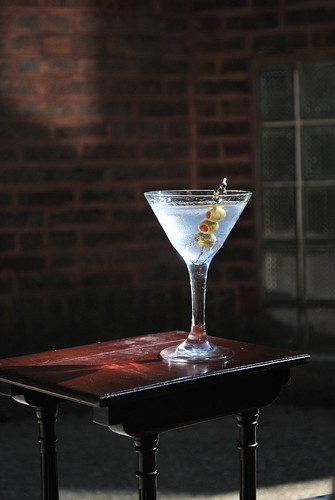
{Photo by rocketlass.}

One of my many sure-to-be-unfulfilled ambitions is to edit an anthology of literature's great hangover scenes. The centerpiece would of course be Lucky Jim, whose recent republication by NYRB Classics is plenty of reason to quote it again:
Dixon was alive again. Consciousness was upon him before he could get out of the way; not for him the slow, gracious wandering from the halls of sleep, but a summary, forcible ejection. He lay sprawled, too wicked to move, spewed up like a broken spider-crab on the tarry shingle of morning. The light did him harm, but not as much as looking at things did; he resolved, having done it once, never to move his eyeballs again. A dusty thudding in his head made the scene before him beat like a pulse. His mouth had been used as a latrine by some small creature of the night, and then as its mausoleum. During the night, too, he'd somehow been on a cross-country run and then been expertly beaten up by secret police. He felt bad.
Good god, that "tarry shingle of morning," the "dusty thudding," the cross-country run. The whole passage trips off the tongue--or would, that is, were the tongue not coated on waking in what seems to be the matted pubic hair of a syphilitic muppet.

Amis also addressed the subject in his book Everyday Drinking:
When that ineffable compound of depression, sadness (these two are not the same), anxiety, self-hatred, sense of failure and fear for the future begins to steal over you, start telling yourself that what you have is a hangover. You are not sickening for anything, you have not suffered a minor brain lesion, you are not all that bad at your job, your family and friends are not leagued in a conspiracy of barely maintained silence about what a shit you are, you have not come at last to see life as it really is, and there is no use crying over spilt milk.
Amis, as you probably know, was something of an expert at both the putting in and the sweating out of the stuff. Cyril Connolly is another who was no stranger to the bottle, and in his sole novel, The Rock Pool, he dealt expertly with its consequences:
Naylor woke late, with a hang-over. It was relatively a new sensation for him, for he was proud of a certain donnish temperance. He would take two whiskies at night and suddenly round on those of his friends who had a third one. Not that he minded, only it seemed rather childish; remember the law of diminishing returns? And why make yourself sick the next day? But strangely enough he was not sick--instead he seemed to be spun up in a kind of voluptuous cocoon. The sun streamed in over the purple bougainvillea. He tottered down to the sea. Lying on his back, the curious sensation was stronger, his stomach seemed made of wool, his throat felt some rich sensual craving, his mind floated among a multitude of sensations, all his senses were slowed up to an unusual delicacy. He masticated a line of Eliot: "The notion of some infinitely tender, infinitely suffering thing." Opening his eyes, the sky and sand were grey as a photograph, his antennae played over the tiny crystals, women's brown legs passed him on the board-walk, but he could not look up. "You see in me a creature in the most refined state of intoxication," he thought, and waves of sensual and lotophagous reminiscence swept over him.
Much as I love the martini, I'll cop to a certain "donnish temperance" myself--one tends to suffice--and I doubt I'm alone in this, our (thank god) more liver-conscious age. In these more temperate times, perhaps it's too much to hope for new entrants to the tippler's TOC?

Fortunately, British novelist Will Wiles has come to the rescue: one of the many great pleasures of his smart, funny, even scabrous new novel Care of Wooden Floors is its splendid rendering of a hangover.

But we'd be doing the memory of Lord Rochester a disservice if we skipped straight to the consequences and neglected the earning of the hangover! First let's get the protagonist--a mostly directionless young Brit who is house-sitting for a particularly particular friend in an eastern European city--drunk. With a friend of said friend who is a musician and (thus?) a committed drinker. Ah, yes, here it comes:
My brain felt thick with scabs, old and new. It was full of wine, it rotated, looked close to spilling.
And that's before they even get to the strip club:
The tide of alcohol was coming back in, dissolving these arguments, mushing them into short-circuiting feedback loops, eating away at ethics, at second thoughts, at broader contexts, at tomorrows and consequences. Amber bumped and ground, and the drink revealed a simple formula on the smeared palimpsest of my mind: seek pleasure. . . . The beer was not helping me as I thought it had been--it had been lying to me. I thought of fermentation, of yeast, of gases, of microbial processes. The wine churned, and came close to spilling.
If only he'd been drinking in Springfield, Homer could have told him that the beer was lying.


And it does spill. Oh, does it spill. But he at least makes it back home, somehow, only to be greeted by the morning:
White noise. Indistinct sound, beneath hearing, the growl and whoosh of blood forcing through tight passages. A two-part beat, the slave-driver's padded drumsticks rising and falling as an exhausted muscle trereme heaves across a treacle ocean. A heart, pumping hot, thick goo in place of blood. Cells striving and dying. The electricity of the brain whining like an insectocutor. A cascade of neural sparks, an ascending, crackling chain reaction, synapses firing. Sensation--the sensation of no sensation. Then, awareness.

A cosmos of pain, discomfort, sickness, and weakness. I was awake. At first, everything seemed to be pain, but this was an illusion brought on by apparent damage to the sensory apparatus. The brain. The brain hurt. It was a sinkhole of pain, dragging all other senses in. Each beat of the drum, each stroke of the oars, simply scooped more sensation towards that pulsing black point of hurt. My heart was going to give up and get sucked into my head, it would explode, and I would die in bed.

In bed. So I was in bed. I realised that this was a good sign.
Or, as Withnail once put it, "I feel like a pig shat in my head." The growing awareness of the extent of his pain continues for three more extravagant pages. "Committees of investigation" are formed to determine that, yes, he is merely hungover. But oh, that merely:
My body was made from wads of soggy material inexpertly lashed together with stringy sinews. The wads composed of the worst stuff possible--bad milk, wine turned to vinegar, chewed gum, earwax, the black crud that accrues on the bottom of computer mice.
The whole scene is the work of a writer having fun with words, and it definitely earns Wiles a place in my chimerical anthology.

And with that, I'll pour the night's lone martini and settle in at the piano to play some Johnny Mercer. Now there was a man who could put it away.

Monday, October 29, 2012

The perpetual past-ness of good ghost stories


{Photo by rocketlass.}

In his introduction to last year's Oxford edition of M. R. James's Collected Ghost Stories, editor Darryl Jones quotes from James's introduction to a 1924 anthology, Ghosts and Marvels, describing it as the "nearest James ever came to a statement of theoretical principles about his chosen form." Wrote James,
Well, then: two ingredients most valuable in the concocting of a ghost story are, to me, the atmosphere and a nicely-managed crescendo.
That's fine so far as it goes, though hardly an advance on Poe. It's the next portion that I find of interest: Jones explains that James thinks
The ghost story also properly belongs in the past--not necessarily the distant past; but it is important that its setting and concerns be at least a generation out of date, in a world which pre-dates technological modernity:
The detective story cannot be too much up-to-date: the motor, the telephone, the aeroplane, the newest slang, are all in place there. For the ghost story a slight haze of distance is desirable. "Thirty years ago," "Not long before the war," are very proper openings.
Writing in 1924, James clearly conceived of his chosen form--conceived of himself--as fundamentally Victorian . . . or at best Edwardian.
I've been thinking about those lines off and on all month. Is James right? Do ghost stories, told best, belong perpetually thirty years ago? Or was that argument specific to his era, the difference between pre-war and postwar, the long sensecence of the old ways versus the birth of the modern?

Well, what's a blog for if not half-baked thoerizing? Though James's position offers nothing like a universal truth--the right writer can scare with almost anything, any time--I suspect it's still a useful way of thinking about scary stories in the near-century since he wrote it. My first inclination was to separate actual ghost stories from what I think of as the larger category of "October stories"--cull the creeps from the skin-crawlies, in essence. For ghosts, broadly defined, rather than any human manifestations of evil, were James's stock in trade. But then I thought of Ray Bradbury's perpetual 1930s--the story "The Whole Town Was Sleeping," for example, from 1950, but which tells of a slasher on the loose in a city where people still walk to the moviehouse, sit on their porches, take in boarders, chat with their neighbors. . . . Or John Collier's delicious little mousetraps, written throughout the first half of the century, but, like the stories of Wodehouse (a clear influence) located in a vague, semi-modern past. Then there are Stephen King's regular returns to a dark but also alluring 1950s. Perhaps James is on to a broader truth about how we want to take our scares?

This ties in, it's reasonable to assume, with two major threads in storytelling: the "once upon a time" compact, wherein we readers agree with the writer that if he'll tell a good story, we'll suspend disbelief, an operation more easily achieved the less we're forced to acknowledge the presence of our daily mundanity in the tale; and the fact that we first encounter stories as children, when we have the fewest intellectual and emotional defenses against them. There's a reason that writers from Tolstoy to King have obsessed over childhood--and it's not because it's some greeting card-style magic unicortopia. It's because we are still forming ourselves, and thus the world, still figuring out not only what is and what isn't, but what can and what can't be, what ought and what ought not. We are susceptible, and as adults the best way to draw us in is to remind us of that susceptibility. Make us children again, however briefly, and we're yours.

All of which leads me to a question: to keep up with James's ever-shifting window, should we now be falling for ghost stories about the early 1980s? Those years seem so plastic, so artificial, that they initially seem inhospitable to spirits.

But then you start to picture it: that party your parents threw that one hot summer night, where you and your sister were pressed into serving drinks--and told how adorable you were by James, or Jimmy, with his twitchy, red-flecked eyes, kissed on the cheek by mom's friend with the smears of glittery eyeliner. Dad's cousin got on all fours and barked like a dog and scratched at the orange shag with his leg; everyone laughed and laughed. Sheila dropped an ashtray on the kitchen floor, where it shattered, sending plumes of gray dust poofing and swirling through the room, and she said a bad word. Your sister plugged into Mom's Walkman and fell asleep early under the side table, headphones over her ears, music so loud you could hear it if you stood over there.

But you stayed awake, increasingly weary as the night drew in, like you could actually feel your bones. The conversations grew louder and more demonstrative, your mom and dad acting strange, funny and wrong at the same time. Then, feeling disoriented by the noise and smoke and music, even a little queasy, you glanced out the front window and saw on the lawn, almost glowing in the midst of the darkness, the guy in the camel-hair jacket, holding the hand of that little boy and staring, staring in at the party. And just looking at the two of them made you so sad it was like something was being taken from you, something you hadn't even known you had but now realized you desperately, tearfully wanted to keep.

Remember? All these years later, surely you remember. You have to remember, because no one else saw them; no one else would even listen when you tugged at their hands and tried to tell them. Even your sister refused to believe you the next day. But how could she? She didn't see them. She didn't have to stand there, transfixed, and read the man's lips.

Friday, October 26, 2012

City life--and afterlife?


{Photo by rocketlass.}

Some atmospheric urban horrors for your Friday night, from a letter H. P. Lovecraft sent to Bernard Austin Dwyer on March 26, 1927:
The key-note of the whole setting--house, neighbourhood, and shop, was that of loathsome and insidious decay, masked just enough by the reliques of former splendour and beauty to add terror and mystery and the fascination of crawling motion to a deadness and dinginess otherwise static and prosaic. I conceived the idea that the great brownstone house was a malignly sentient thing--a dead, vampire creature which sucked something out of those within it and implanted in them the seeds of some horrible and immaterial psychic growth. Every closed door seemed to hide some brooding crime--or blasphemy too deep to form a crime in the crude and superficial calendar of earth.
I love that "fascination of crawling motion"--and the transposition of Lovecraft's twisted rural horrors to the rectilinear city. We urban dwellers house our horrors, too, and find a place for our petrified isolation despite the press of the crowd.

Wednesday, October 24, 2012

"My province is that dim realm where night clutches the worlds," or, Reading Lovecraft's letters

In this too-busy week, I've been finding time to dip into Lovecraft's letters. Dipping is the only sensible approach; spend too much time with Lovecraft and his less palatable side (thoroughgoing racism) starts to show. But a bit at a time, and skimmed for commentary on writers, writing, and horror, they can be quite rewarding.

Today I'll simply share a passage from a letter Lovecraft sent to Frank Belknap Long on May 3, 1922:
To me Poe is the apex of fantastic art--there was in him a vast and cosmic vision which no imitator has been able to parallel. It is no wonder that his work was totally devoid of the sensual, because his dominant excitant lay outside the domain of human relationships altogether. His was the true awe of the atom in the presence of the infinite--the essentially intellectual wonder of one who looks out upon the whirling, grotesque, and unfathomable abysses which engulf the entire world, yet of which the sensually-minded are utterly unconscious.
Later in the letter, Lovecraft hedges--but only a bit:
There may be something rather sophomoric in my intense and unalterable devotion to Poe; a devotion which has lasted for some twenty-five years without diminution; but I do not think it is so far amiss as the average ultra-modern would hasten to pronounce it. Poe was beyond anything this age can produce, and is so far America's sole contribution to the general current of world literature. He is the father of most of the redeeming features of decadent literature, and differs from the actual decadents in that they have failed to comprehend the magnificent and ultra-human point of view on which his unique writings are based.
It does remain fascinating how, after all these years, Poe remains sui generis. What other minds, for good or bad, have we seen like his?

Monday, October 22, 2012

Thirteen thoughts on reading Stephen King's It at thrity-seven, twenty-one years after I first read it

Spoilers, like ghouls, may abound in the too-long post below. Consider this your warning (about the former; as for the latter you're on your own. It's October, after all).

1 If you were a teenager diving into the work of Stephen King in 1990, two books towered over all his others: The Stand and It. There was an obvious reason: they were the biggest, easily, clocking in at 1,200 and 1,100 pages, respectively. But It loomed larger for a more important reason: where The Stand was freaky, mind-bending, and extravagant, It was scary. Everyone you knew who'd read it said it was the scariest book they'd ever read. Including your sister, who knew scary books. So you devoured it. And it was.

2 All these years later, I retain an acknowledged soft spot for King. Oh, all the people who take to book review and op-ed pages, real or virtual, every couple of years to rehash the now-tired complaints about him have plenty of points. In fact, they're usually right about most of the details of their critique. HIs prose can be clunky, even laughably shoddy at times. He is unabashed about going for the gross-out. His dialogue is often terrible. But in at least eight or ten books, that doesn't matter a whit, because they simply work: these are machines designed to frighten you, and, teen or adult, they do.

3 One critique that the genre-guarding op-ed tut-tutters never seem to make is that King isn't funny. But he isn't--and he thinks he is. I bet he's funny (in a goofy uncle sort of way) in person, but on the page his jokes, usually found in dialogue, fall completely flat, barely eliciting a groan. As someone who prizes comedy in novels, I'm surprised again and again by how often King makes what he obviously thinks are jokes . . . and how hard it is to imagine even him actually laughing at them.

4 I remembered It being the scariest book I'd ever read. More than two decades later, it's still scary. The opening--which in the afterword to Cemetery Dance's twenty-fifth-anniversary edition King says he came up with only after figuring out the basic contours of his story--remains incredibly effective. What could be more terrifying than for a boy, having summoned up enough bravery to look into a storm drain--already a source of visceral fear of a non-supernatural sort--to see something alive down there? And to have that something be a clown? A clown who knows his name? We've all known about Pennywise for so long now that it's hard to imagine just how effective that first appearance must have been; even with foreknowledge, the scene remains satisfyingly chilling.

5 That scene--and especially the vicious, animalistic physical violence of Pennywise's attack when it comes--looms over the rest of the book, which, contrary to my memories, never quite reaches that level of fright again. And it's in part because of a relative lack of physicality: Pennywise and It spend most of the book tormenting the characters through visions rather than physical danger. Some of the visions (fortune cookies that spurt blood, for example) are plenty creepy, but for much of the book it's hard to believe the characters are in any physical danger. Whether it's because I'd encountered them before, or because I'm older and less susceptible, the visions simply weren't as frightening as I'd remembered.

6 One aspect of the book, however, is much more interesting when read in adulthood: that it all starts with a bunch of people in their late thirties receiving a phone call telling them it's time to make good on a promise that's now twenty-seven years old--a promise that, until that second, they don't remember at all. Once remembered, however, it has an irresistible power, drawing them inexorably back into the fight they thought they'd finished when they were teens.

That set-up allows King to cut back and forth between the heroes fighting It as eleven-year-olds and their struggles to work up the emotional, intellectual, and physical strength and courage to fight him again as adults. It's an incredibly effective way to dramatize the book's true themes of the difficulties of growing up and the surprising power and resilience that we have, even if we may not realize it, when we're children. It also can't help but draw us in: is there any way of being sure that we didn't make a similar promise at some point in our youth? Any way to know that we won't ever receive such a phone call?

7 In the afterword to the Cemetery Dance edition, King writes explicitly about that theme:
I worked on the book in a dream. I remember very little about the writing of it, except for the idea that I'd gotten hold of something that felt very big to me, and something that talked about more than monsters. To me, It has always been a book about making the terrible transition over the bridge from childhood to adulthood (it's no accident that the final act Bill and his friends perform as child heroes is sexual).

8 The end of that quote alludes to the moment in the book that was, when I first read it, the most shocking: when the teens, in order to seal their bond and be able to defeat it, have sex. Teenage me, you might imagine, didn't really know what to make of that, and it bulked hugely in my memory for more than twenty years. But when I returned to the book as an adult, I found that the scene passes quickly, important but not outsized, in the midst of a number of surprise and struggles. Is it just that I already knew about it this time around, or is it nothing more than a function of being older? (I've also long wondered what that scene is like for a woman to read rather than a man--since King is a man and all but one of the characters is a boy, there is an imbalance that even the teenage me found uncomfortable.) Its inclusion is a strange, gutsy, and, yes, uncomfortable decision, but it doesn't color the whole novel the way it did when I was a teen.

9 That said, the ending overall, which I'd remembered being disappointing, like so many of King's endings, actually worked much better for me this time around. When I was a teen, what I wanted was a clear, complete explanation of who and what Pennywise and It were. (Much like at the same age I wanted an explicit, numbered list of Spenser's rules for living from Robert Parker.) To find that they were essentially ancient, cosmic concepts that are almost incomprehensible was a disappointment. Older, more prepared to accept that some, if not most, things are ultimately inexplicable, I didn't find myself minding it at all.

10 Elsewhere in the afterword to the Cemetery Dance edition, King explains why he decided to make It manifest itself in familiar horror movie forms:
I began thinking about the differences between our childhood fears--monsters, abandonment, monsters, mistreatment, monsters, bullies, monsters--and our more mundane adult fears, like whether or not our job's insurance program covers dental. It seemed to me that we forgot the vividness of those childhood fears as we grew to adults, which might make us uniquely vulnerable to them if they ever came back . . . not as the shadows of tree-limbs on the wall or an imagined movie-poster monster in the closet, but as real things.
The Lovecraftian idea of the mind broken by a horror too great for it to comprehend is a powerful one, and King plays nicely with the different ways that might work with the very different minds of adults and children. One thing I would find hard about parenting, if I had to do it, would be that: the realization that children's fears are as real and powerful as any of our own--more so, perhaps--and that there's only so much we can do to allay them. And, more to King's point, that if we had, as adults, to deal with the uncertainty, powerlessness, and sheer vivid imaginative malleability of our young lives, we just might snap.

11 King has long been obsessed with childhood, as are many imaginative writers, but It is, I think the place where he makes the best use of it (with, perhaps, the exception of "The Body"). What's long puzzled me--and perhaps should be the subject of a standalone post--is the power of his nostalgia. As a child of the late 1970s and early 1980s, I don't have it at all. I have fond memories of family and friends and experiences, but I'm under absolutely no illusions that things were better, or more interesting, then. King, though . . . well, I wonder. He's obsessed with the rock music of that period, for example, seeming to still view it as a liberating force. Then there are bicycles and bullies and rock fights and and muscle cars and exploring and all the other incidentals of childhood, all seen through a relatively rosy haze. And that nostalgia started early--he wasn't even forty when he wrote It. Is this a generational trait or a personal one?

12 Speaking of generational traits: one strange omission in It is Vietnam. King cleverly comes up with the idea of all his heroes being childless--a penalty, they only later intuit, for their first victory over It. But while he sketches out their lives between 1957 and 1984 in some detail, Vietnam doesn't, if I remember correctly, come up at all. Yet they should have lost friends and family members, felt the fear and horror of it themselves. It's an odd omission, and I can't figure out whether it's intentional.

13 King's generation is famously skeptical of authority. That skepticism not infrequently verged into paranoia--a paranoia that, while understandable, makes some cultural products of the late 1960s and early 1970s tough to take nowadays, when we live in a more open, if no less easy, relationship with the darker aspects of our society, our government, and our elders. That paranoia underlies much of It, in the sense that the town itself, through its silence, is complicit in the horrors of its history.

But to me what feels more powerful, and much more frightening, is the sense of the ancient nature of the evil. We are but small people in a vast cosmos, and out there somewhere in that vastness there are powers. We rile them at our risk.

Thursday, October 18, 2012

"The day is broken," or, Interstices

In the midst of the delightful mess of slovenliness, failed stewardship, ennui, and self-lacerating humor that is Will Wiles’s new novel Care of Wooden Floors come this passage:
I put out the cats’ food while the kettle was boiling for my coffee. What did they do during the night? Whatever it was, it gave them an appetite, and they chugged down their chunks of brown flesh with gusto. What did they do in the sleeping city . . fuck and prowl, no doubt, glory in streets without trams and human feet. They were active, most active, in the dark and cold corners of the night.
Two pages later, Wiles writes,
Noon passed. The day was broken, cracked down the middle like a paperback’s spine.
The passages are unrelated, but together they brought to mind something the idea of the hidden places of day and night, of secret background maneuverings, of scene-setting and stage-managing, of a world assembled and performed by powers beyond our ken--but from which the mask can sometimes, especially in these October evenings, slip just enough to unmoor us.

It's an idea that I haven't been able to shake since seeing an absolutely stunning collection of strange photographs taken by Canadian artist Jon Rafman from what he's found in Google Street View. I've drawn a number of them below from a post at Demilked that introduced me to Rafman's work.


If these images give you the same sort of strange chills they do me, it's worth trekking to Rafman's site and wandering around a bit. He's made some truly amazing finds.


When I look at these, I feel as if I'm seeing things I'm not supposed to see--that I'm being given an inadvertent glimpse behind a curtain, a look into the workings of a machine that ordinarily operates so smoothly as to go unnoticed. They feel like elemental interstices, like the concept of the hinge that Grace Dane Mazur explores in her wonderful Hinges: Meditations on the Portals of the Imagination. They call to mind the injunction against looking at the face of God, which is suffused here through all of his works--and reveals him, it's hard not to think, to be sinister, perhaps even evil.


It seems right, too, that so many of these photos should feature animals. Animals, we assume from childhood, have their own secrets, knowledge, understandings, agenda. They care not why the world is the way it is, nor are they surprised by its mutability; they move through it as natives, at home in a way that our self-consciousness will not allow. Out of our sight, who knows what they do and see?


All of which also calls to mind one of my very favorite spooky stories, Robert M. Coates's "The Hour After Westerly." I was introduced to it a few years ago by James Hynes, who, in a round-up of scary stories, wrote that it "is like opening a very familiar door and discovering that it leads someplace entirely new--a feeling that's both mysterious and melancholy."


It's a fairly simple story: a commuter on his way home starts to feel "an odd sense of dullness, or pressure," a fogginess that manifests as a feeling of being late--and that, when it lifts, leaves him with an unrecoverable hour. In its place is nothing but
an image as precise and as unrelated [to his drive home] as something one might see through a sudden parting of a fog--a group of small white houses grouped at an intersection, and a clock (was it on a steeple?) with the clock's hands pointing to ten minutes to six. there was a faint suggestion of a dirt road, too, but even as he tried to consider it, it floated off into nothingness.
It is a story more of mysteries than answers, suggestions than scares, but it's as spookily atmospheric and memorable as any October story I know. While we may scoff, reasonably, at ghosts and ghouls, we all, it suggests, should perhaps fear the unfathomability of time and space--we all just might be at risk of inadvertently, invisibly, slipping between the seams, taking a wrong turning, seeing what we're not supposed to see, being who we're not supposed to be. Ray Bradbury, in his introduction to Timeless Stories for Today and Tomorrow, the collection in which Hynes found the story, writes,
Every man has had alternate lives, there were a million paths we could have followed when young, but we followed that one which now seems inevitable to us, the one that memory says is the only one. . . . We came so very close so many times, to being fools, to being lost, to being dead, that we marvel that we have somehow blundered through to this day and year.
That story, Rafman's Google Street View photos, and the wan October twilight itself haunt me with that mystery, the world's essential unknowableness, the inescapablity of our own finitude in the midst of the undermining infinity of time and space.

Bradbury writes,
For it is not only what life does in the material world that counts, but how each mind sees what is done that makes the fantasy complete. We are two billion worlds on a world here.
Make that seven, make it October, and the reason spooky stories hold us in their sway becomes evident: the world is a haunted mirror, and while our training is strong enough that most of the we look at it slant, we can't help but let our gaze slip to its shadowy corners, and wonder at the slithering we tell ourselves we don't see there.

Monday, October 15, 2012

If only I had the monkey's paw!


{Photo by rocketlass.]

Any fan of ghost stories knows that some of the best come from writers who are known primarily for mainstream fiction, the sort where the only scares are the usual 3 A.M. existential insomnias. Henry James is the most well-known of those writers, having written enough to fill a fat volume, but he shares company, with, among others, Edith Wharton, Muriel Spark, and Rudyard Kipling, who’ve all also written a book’s worth of ghostly tales. And then there are the here-and-there one-offs from Penelope Fitzgerald, F. Scott Fitzgerald, Willa Cather, Joyce Carol Oates, Donald E. Westlake--the list goes on and on.

But like a classic hungry ghost, I can't help but want more. Herewith, my wish list:

1 Herman Melville. Oh, "The Lightning-Rod Man" comes close--but only in that its lush, overripe language calls to mind Ray Bradbury, and its air of menace feels as if it's building to some supernatural revelation. The fact that it doesn't in no way prevents it from being a great story, mind you. But the autumnal extravagance of this story does make me wonder what Melville might have created had he turned his hand to the world beyond the grave. (Over in the Gotham Ghost Gazette Andrea Janes, meanwhile, has speculated, in a different way, on what might have been: a ghost story not by Melville but of Melville.)

2 Joseph Conrad. In response to a question about Conrad and ghosts I put out on Twitter, Mark Kohut pointed out that not only did Conrad not write any ghost stories that he knew of, but that his story "The Black Mate" was an "anti-ghost story, ghost as con job." But imagine what Conrad's ghosts would be like? They'd be called into existence as much by our own needs as hauntees as by the dead's need to haunt, manifestations of our failures of nerve and honor, our unforgettable regrets, the gnawing acid of our mistakes. They'd certainly not be for the faint of heart two whiskeys in.

3 Barbara Pym. She would be on the other end of the spectrum from Conrad: I imagine Pym's ghost stories being gentle, even cozy. The vicarage would be haunted, manifested by spoilt milk and wobbling mint jellies; the ghost would be the source of quiet worry, its relatively benign activities nonetheless way too far beyond the pale to be acknowledged in polite company, especially as it would be at its most active when unrequited crushes begin to rear their unmentionable heads. Decorum would be at risk of disruption, desire, as always, however, ultimately thwarted by reticence. The ghost, like love, would move on.

4 Rex Stout. Wouldn't it be fun to have Nero Wolfe confronted with an actual, honest-to-goodness ghost, one he couldn't banish with a "Bosh!"? Inconceivable, I realize--Stout's world has no truck with nonsense, and Wolfe would, I suspect, continue to deny the supernatural even in the face of the strongest evidence. But what fun it would be to see the battle of wits and clash of stubbornness that could ensue between two such powerful forces!

5 Iris Murdoch. Murdoch's ghosts would, I trust, be like her characters generally: flighty, impressionable, headlong, emotional. They would haunt because of love, be banished by clarity, wreak havoc in between.

These are my five. Yours? (But let's be clear: I get the first crack at wishing for these when that damned monkey's paw turns up! Then you can go. It's not like anything could go wrong, right?)

Thursday, October 11, 2012

An apology for the Hitch in blogging


I've enlisted Alfred Hitchcock--or at least his head, as seen on the endpapers to the 1977 hardcover of his anthology Witch's Brew--to help me apologize for the lack of blogging lately. It's been a bear of a week; I'd blame ghosts if I could, but really the sources of the failure are those more prosaic October regulars baseball and work.

I'll hope to be haunting this space more reliably next week.

Tuesday, October 09, 2012

Can't blog--too busy reading!


829 pages! Can you blame me for being a bit behind? But don't blow out the candle and breathe a sigh of September-tinged relief: the ghosts and I will be with you again shortly!

Friday, October 05, 2012

True-life tales!

Being at best a skeptic who wishes he were an agnostic on the subject of ghosts, I tend to traffic here in actual stories of ghosts in October: created pieces, written to entertain (and frighten), rather than tales that purport to be true. Oh, I mix in the latter once in a while. Part of the fun of reading ghost stories is allowing writers and tellers to blur that line; a lot of the pleasure of M. R. James's stories, I noted yesterday, comes from their faux pedanticism and the air it lends them of veracity. But for the most part what I want from ghost stories is the enjoyment afforded by any story in which plot and atmosphere are paramount, the sensation of a well-constructed machine moving smoothly through its operations.

The past few weeks, however, have brought across my virtual desk a couple of effective stories of real-life ghosts that seem well worth sharing. The first, from the Paris Review blog, is just getting underway: yesterday writer Amie Barrodale opened a tale of a haunted apartment she once rented in Iowa City that promises to continue throughout the coming days. The first post is more tantalizing than substantive--the ghost does little to frighten--but how could anyone resist a true-life ghost story in which two people independently start referring to a closet as "the bad area" within minutes of moving in? I'm looking forward to part two.

More substantial is an article by Australian James Bradley from the new issue of the magazine Meanjin. In the course of discussing, well, "bad areas" and reports of hauntings, Bradley tosses off some really tantalizing references to ghostly experiences among his family and friends ("Another involved my brother, and a little girl he spoke to in a hallway in a hotel who could not have been there." More, please!), does a wonderful job telling a chilling story of a haunting of sorts in the sparsely settled lands of Central Australia, and shares some fascinating information about a scientific theory about the reasons some places might feel haunted. It's all worth checking out, especially the postscript, which adds another layer to Bradley's own experience of hauntings.

This passage in particular will stay with me as I read and think about ghost stories this month:
After all, any story is really two things: the experience it describes and the sense we give to that experience by arranging and shaping it. It would be a mistake to say the first is simply something that happened—no experience is that simple or unconstructed—but as soon as that experience is described or connected to other experiences it becomes something quite different, a thing charged with meaning.

This is particularly true of ghost stories, which draw their energies from the tension between our rational minds and the primitive, unsettling power of the unknown. For as long as that tension can be maintained we are moved out of the world we know and understand, into a state where meaning and the order of things are unsettled, and possibility is given play.

This frisson is both exciting and unnerving, but it can only be maintained for as long as we do not enquire too closely into what is going on.
Suspension of disbelief is a prerequisite for reading all fiction, but for ghost stories that central word, "suspension," takes on a broader meaning: for maximum enjoyment, our disbelief should not be banished entirely, but rather held in suspension, neither here nor there, as we listen and sift and ponder and wonder--and then, while still thinking ourselves in some sense rational, are jolted out of our skin, belief and disbelief alike forgotten and unimportant, overcome by the uncanny.

Wednesday, October 03, 2012

Walking in the woods with M. R. James


{Photo by rocketlass.}

The new Collected Ghost Stories of M. R. James that Oxford published last year is full of the usual James pleasures, but it also includes a number of stories that I'd not previously encountered. My favorite thus far is a very brief, decidedly minor story, "A Vignette," which was the last that James ever wrote. He sent it just before his death in response to a request for from the London Mercury, and he described himself as "ill-satisfied" with it. It's true that the story is far from one of James's best--it's much more a sketch than a fully fleshed out story--but its straightforward, relatively unbaroque relation of some vaguely spooky sightings on the edge of the forest around James's boyhood home is nonetheless effective. Much more than the typical James tale, which generates a pleasant, if unconvincing atmosphere of veracity from its superstructure of references and second-hand accounts, "A Vignette" feels remembered, as if, as Michael Cox writes, in M. R. James: An Informal Portrait, it is
the memory of something that seemed real to him at the time and that shaped his subsequent attitude towards the supernatural.
The ultimate fright in the story I won't quote, since that seems unfair--but I will share these lines, which are nicely chilling in their noting of a common truth and the way they then apply it to a very frightening specific:
To be sure, it is difficult, in anything like a grove, to be quite certain that nobody is making a screen out of a tree and keeping it between you and him as he moves round it and you walk on. All I can say is if such a one was there he was no neighbour or acquaintance of mine, and there was some indication about him of being cloaked or hooded.
The delicacy of James's description here brings to mind that other, more famous James, and a description I've quoted before, from an anecdote told by E. F. Benson, another writer known for his ghost stories:
He described a call he paid at dusk on some neighbours at Rye, how he rang the bell and nothing happened, how he rang again and again waited, how at the end there came steps in the passage and the door was slowly opened, and there appeared in advance on the threshold, "something black, something canine."
Even when he wasn't writing ghost stories, Henry James was writing ghost stories.

It also calls to mind Kenneth Patchen's deliciously frightening "Come now, my child":
Come now, my child, if we were planning to harm you, do you think we'd be lurking here beside the path in the very darkest part of the forest?
That could be the very voice of October.

Monday, October 01, 2012

Walking with William James in the afterlife


{Photo by rocketlass.}

Who better to lead us into October than William James, wishful skeptic?

Late in The Master, Colm Toibin's novel of William's brother Henry, William and his wife are in London to see some specialists in cardiology, as William's heart seems to be weakening rapidly. Tiring of the overly cautious solicitude of his wife and Henry, William tells them that he will "expire on them immediately" should they show one more sign of pity or worry. He goes on to make the most delicious threat of afterlife activity:
And I should warn you both that the hauntings will not be ordinary. No mediums will be required. I will pounce directly.
Threats aside, a William James haunting would I suspect be remarkable less for its horrors than for its persistence: if he failed to get your attention with, for example, table tapping, he would surely turn to furniture moving, then to attic thumping, and so on and so on. It would be merely one more field to which he could turn his indefatigably curious mind.

And as far as that goes, is there anyone you'd rather have at your side in the presence of a ghost than William James?

Friday, September 28, 2012

Conversations with William Maxwell

I've little time tonight, but I do want to share at least a couple of bits from Conversations with William Maxwell (2012), if for on other reason than to try to help spread the word of the book's existence to Maxwell fans who, like me, may have missed it when it was published in the spring.

It's clearly a book that I'll be reading and referring to for a long time; what I have to offer tonight are the merest quick gleanings, a browser's miscellany. Like this exchange with the book's editor (and Maxwell's biographer, Barbara Burkhardt, from 1991, which follows as discussion of the presence of a commenting narrative voice in The Folded Leaf:
Burkhardt: Why did you move away from this type of storyteller in your later works and increasingly use first person?

Maxwell: When I was younger I tried to use the first person and couldn't. The result was inevitably loquacious and without form. I think I learned how not to be loquacious, how to construct a self that would pass with the reader, from reading E. B. White, who is so candid, but so, so disarming. If I had done So Long in the third person I wouldn't have been as close to the painful center of the book, or been able to be a witness as well as an actor.
It shouldn't surprise me, I suppose, that Maxwell drew lessons from White; writers take their models where they find them. And the two do share a commitment to precision, clarity, and sentence-by-sentence quality--but White's lightness of touch, his self-deprecation, the conversational tone of even his most obviously worked over lines nonetheless seem far from Maxwell's seriousness, melancholy, and stateliness.

The best bit I've come across thus far is from an "All Things Considered" interview conducted in 1995, soon after the publication of Maxwell's marvelous All the Days and Nights: Collected Stories. In response to host Linda Wertheimer's statement, "You also write a fair amount about age," Maxwell replies,
I do think being an old man is the most interesting thing that's ever happened to me because of all sorts of strange experiences, the opening up of memory, which I expected, and of the enjoyment of life being progressively greater instead of diminished by age. That was a surprise. And memory is the most remarkable part of all because you live in the past, you live in the present, and you, like everyone, live in the future. Only when you're old, they pass so easily into each other without any effort at all so that the past is quite as real as the present, and the future is, of course, problematical and that's interesting.
Such a satisfying answer, and a heartening one to those of us on our perpetual way, god willing, to being old. That's the goal, isn't it: to hold on to your past while never losing your engagement with the present and your sense of a future.

Maxwell follows that answer with a description of an incident that, for me, raised goose bumps:
I've also had one amazing experience in the night in the dark in bed. I suddenly was able to remember in detail the house I grew up in and left when I was twelve years old. And I went form room to room seeing things that I hadn't remembered for seventy years and more. And being able to look as if I were actually there, as if the house was actually there, I saw that level of the bookcase, I saw pictures, I saw empty rooms, I saw furniture, and could look at it as long as I wanted to. It was as if some shutter had slipped back in my mind and I had absolute, total memory of the past.
Maxwell's description of the experience makes it seem truly uncanny, and it feels as if it ought to carry a hint of dread, of the perils of trespassing, but it doesn't--in fact, his verdict on it is that it was "a marvelous experience," and that it made him believe "that everything is fair, absolutely everything." I suspect that William James might have classed it as a religious experience.

That seems a good way to glide into the haunted precincts of October, with its annual serving of stories of ghosts and ghouls. The coming week may see spotty blogging, but trust me: soon after the spirits will make their presence felt. As the haints put it: have a good weekend--I'll see you on the other side.

Wednesday, September 26, 2012

Another mysterious missive!

Three weeks ago I blogged about receiving an anonymous postcard in the mail. The card had a postmark from Dallas, my address, and a quote from Anthony Powell's A Dance to the Music of Time. Its mystery made my day.

Like some of the early reviewers of A Question of Upbringing, I seem to have erred, taking as a standalone the first part of a series. For in my mailbox yesterday was the card pictured below.


The image is captioned thus:
The Powder Tower, 1650, and the Revolution Museum of the Latvian SSR
In case you can't read it, what it says beside my address and the same Dallas postmark is simply:
All this, and Mopsy Pontner too.
Powell fans will remember Mopsy Pontner as the most minor of characters (despite sporting one of Powell's best names). She first turns up in Temporary Kings, the lovely wife of a dealer in paintings. Moreland is said to have fancied her, in the days before his marriage to Matilda, but kept away because he liked her husband. As Nick explains, "Moreland tended to keep off his friends' wives." (What a large amount of work that one word "tended" does in that sentence!) It's possible in any case that Moreland's reticence would have been matched; Mopsy does have the relatively rare distinction of having turned down Barnby.

Her sole appearance in the sequence is at a recollected dinner party that she attended as part of the sale of an Augustus John drawing to American film magnate Louis Glober, a sale by chance brokered by Nick, who thus also ends up at the party. Moreland, too, is there, "in poorish form, absent in manner, probably weighed down with a current love affair gone wrong." He isn't alone: the dinner's cast never quite clicks, and overall it turns out to be "heavy going." A year or so later, however, having gotten to know Mopsy Pontner a bit better, Nick has this exchange with her about that night:
"Glober did me on the table."

"Among the coffee cups?"

"We broke a couple of liqueur glasses."

"You obviously found him attractive."
But the showstopping revelation--the reason Glober sticks in readers' minds despite being a tad bland in general, is still to come. Mopsy tells Nick:
One rather odd thing about Glober, he insisted on taking a cutting from my bush--said he always did that after having anyone for the first time. He produced a pair of nail-scissors from a small red leather case. He told me he carried them round with him in case the need arose.
Nick, the epitome of English unflappability, drolly replies:
We all have our whims.
At a party years later, the merest mention of that dinner is enough to send an ailing Moreland into paroxysms of nostalgic giddiness--he imagines the headline "Musician Dies of Nostalgia." Then, rambling through all the old memories that the current night's guest list has brought to the fore, he caps it with, "All this, and Mopsy Pontner too." The nostalgia gets so thick and ridiculous that he tells Nick,  only half joking, "You shouldn't have told me about Mopsy Pontner. It wasn't the act of a friend."

Sending mysterious Dance-related postcards, however? Oh, that is unquestionably the act of a friend.

Monday, September 24, 2012

Rebecca West on The Fountain Overflows

At the suggestion of Will Schofield of Fifty Watts, I've recently been dipping into Rebecca West's letters. West was a fierce writer of strong opinions, and the letters are full of unforgettable (and often troubling) scenes from her life, a life vexed by difficult relationships with family and friends. But the letters are also full of great lines and fascinating scenes, like this wonderfully ridiculous account of a drunk Irish playwright at a party, sent to George Bernard Shaw in late 1917:
“To this [party] entered Frank Harris, in a very new dress suit, which one felt was part of an outfit which he had procured from some spinster by fraudulent representations, and delivered a lecture on Style. I admit it was plucky of him, for he was very drunk, His manner was foully offensive: a barking arrogance with oily declensions at the points where he was moved to speak of the necessity of the artist to feel pity and love—awful passages as though the Sermon on the Mount had kittened and there were its progeny. But the thing that really horrified me was that his lecture considered entirely of a criticism of an incident in Madame Bovary which that book does not contain.
I laughed out loud at the "kittening" of the Sermon on the Mount; that's a Wodehouse-level word choice.

What is of most interest to me in the book--and the place I first turned in the index (after Powell, Anthony, an entry that sadly doesn't appear)--is anything she has to say about my favorite of her books, the autobiographical novel The Fountain Overflows. Her most in-depth treatment of the book comes in a letter to TLS editor Arthur Crook of December 24, 1973, in which she took to task for a bad review of the novel. One point in particular that she argued against was Crook'scontention that the mature conversation of the children was unbelievable. West wrote,
As for The Fountain Overflows, you are quite wrong. When my sister Winifred and I were young, we were full of such ideas about childhood, which was a subject constantly discussed, as serfs might discuss serfdom while fond of their masters, and I can assure you that the book understates the musical preoccupations of thehousehold. I don't think a single line of the children's conversation could not have taken place, and many of them did take place.
From the specific familial evidence she proceeds to her larger point:
But nobody else has written about such people. You are penalising me for keeping an unconventional eye. It seems to me now a source for pride that all my books are different. I was looking at something fresh each time. I don't think I should be judged as failing because what I saw was not the same as people without my experience do not recognise as familiar. But again I am not with my age.
Later in the letter she addresses a similar theme from a slightly different angle:
By the way, in your mention of The Fountain Overflows, you accept a modern canon which I think quite inacceptable: that one should not write about exceptionally gifted people. I see no sense in that at all. Scientists do not refrain from investigating the habits of the dolphin because it is the most intelligent of the big-brained sea beasts.
West's example feels weak, but the point is a good one--and one I remember a writing teacher making years ago when I was an undergrad: it's relatively easy to write about people with less knowledge, understanding, and apprehension than ourselves. It can be interesting and useful to do so, but it also can too easily settle reader and writer into an unpleasantly self-congratulatory compact, presenting people and situations where we know oh so much more about what's going on than the characters do. The writer who always comes to mind for me when I think of that is Raymond Carver: it's in some sense an unfair criticism, as he was by all accounts writing about a people and a life that he knew intimately even as he'd transcended it in some ways, but I still find his stories uncomfortable on those grounds. (And never more so than when Robert Altman reshaped them--Short Cuts is on the surface a very good movie, but on longer acquaintance its misanthropy is hard to ignore.) What's harder--and potentially, I think, more interesting--is to write about people who are smarter, quicker, more talented than ourselves. How can we convey the nimbleness and quality of their minds, their dedication, their willpower, in ways that will be comprehensible to us and our readers who have less of all those qualities?

West couldn't chose a more suitable example than The Fountain Overflows to make her case, as the novel is above all convincing. I wrote a brief review of it years ago, on spec, but it was never published--looking it over now, I find I still think it strikes the right note and gets at what's so remarkable about the book:
The Fountain Overflows, Rebecca West’s largely autobiographical novel, set in early twentieth-century London, is narrated by a twelve-year-old girl who, along with her twin sister, is a piano prodigy. It’s a dense, enveloping story of growing up in a financially precarious household headed by a brilliant father whose political pamphlets make Cabinet ministers tremble, but whose undependability and heedlessness are so deeply ingrained as to make every new disaster seem almost intentional. At one particularly difficult point, the girls’ mother--eccentric in her own way and the true heart of both novel and family--mutters, “How can I compete with death and disgrace, which is what he really desires?” Much of the dialogue is that way: thoughtful, considered, tracing and retracing the outlines of ideas, conversation that seems apt for this insular, talented family.

A major theme of the book is the difference between real and false art, the consolations available in the former that cannot be supplied by the latter, and the way such abstract ideas can thread through family life as seen by a perceptive child. The twins have an older sister who plays the violin with polish and emptiness; they and their mother are astonished that she doesn’t herself realize her playing is essentially artless and false. The characters that sweep through the family’s life--including a violin teacher, a cousin, a murderess, and the father’s erstwhile boss--vary in their degrees of understanding of art and people, but the progress of the novel shows that genius does not prevent cruelty, while a lack of understanding does not preclude instinctive kindness.

The circumscribed world of the family is so absorbing, convincing, and hypnotic that even the appearance of poltergeists, invisible bunnies, and imaginary horses comes to seem a natural outgrowth of the several personalities. The novel--and especially the character of the harried, deeply caring mother--is suffused with a rare combination of clear-eyed judgment and inquiring magnanimity, as if the greatest desire of the narrator and her relations is to learn about people, to remind themselves that considered attention to others, even those initially disliked, can lead to the sympathy and caring that are essential to all family--and all human--relations.
We firmly believe in these characters, their thoughts and their lives--to the point that their casual revelations of encounters with the spirit world don't even cause us to raise an eyebrow. This, we feel, is what happens when a family of very smart, very talented people is forced by poverty and failure to be more tightly knit than is probably healthy.

West, in her letter to Crook, sounds more resigned (if combative) than upset about the review. "I was also handicapped because you are right," she writes, "I do care above all for reality. What chance did that give me in a world dominated by Eliot, who did not care for reality, who only cared to give out passes that certified the holder to be respectful to reality." West's desire to present the world and its people as she saw them shines through The Fountain Overflows; a dozen years after I first read it, I still find myself thinking about it all the time.

Friday, September 21, 2012

"Waitress, there's a fly in the ointment that is my drink!", or, The Cocktail Waitress Fatale


It's been a fantastic couple of months for crime fiction fans, from Gillian Flynn's breakout, Gone Girl, to another solid Tana French novel, Broken Harbor, and Megan Abbott's Dare Me, maybe the best of the bunch. But the book I'd most looked forward to didn't arrive until this week, and it turns out to have been worth the wait. James M. Cain's The Cocktail Waitress, which had lain buried, in overlapping drafts, in Cain's papers since his death in 1977, would be a reason for excitement even if all it did was resurrect, however briefly, Cain's distinct storytelling voice--that toxic mix of desire, desperation, and bad choices--but it goes one better: it gives us that voice, but this time it's the voice of the femme fatale herself, new widow Joan Medford.

Hard Case Crime editor Charles Ardai notes in his afterword that
Of course, no femme fatale thinks she is one, or admits it if she does.
And therein lies the chief pleasure of the novel: deciding how much to believe the mostly-innocent-girl-wronged story it tells. After all, how else can a reader respond to an account whose first chapter includes this explicit self-justification:
So what's the fly in the ointment, and why am I taping this? It's in the hope of getting it printed to clear my name of the slanders against me, in connection with the job and the marriage it led to and all that came after--always the same charge, the one Ethel flung at me of being a femme fatale who knew ways of killing a husband so slick they couldn't be proved.
Ardai glosses the passage in his afterword:
It's the inherent contradiction in any work of fiction, the one we all conveniently ignore each time we sit down to enjoy a novel: Can we believe what this narrator is telling us? Well, no, of course not--it's all lies, it's all made up, that's what fiction is. But within the fiction, you say, if we imagine ourselves inhabitants of the characters' world instead of our own, can we believe what we're being told then . . . ? Most of the time you assume the answer is yes: You can trust what Huck Finn tells you; Ishmael isn't lying to you about what went on between Ahab and Moby-Dick. But why do you believe that? How in the world do we know that Ishmael didn't kill all his fellow seamen and then wreck the Pequod himself to cover his tracks?
What's particularly fascinating about Cain's book is that he doesn't play games--there are no half-hidden clues, the sort that you're supposed to see if you read closely and that would fatally undermine the narrator; in their place is nothing but uncertainty, and a vague sense that, as one character says of Joan, "Something about you doesn't quite match up."

What's most interesting about that narrative uncertainty is that, according to Ardai, the first draft of The Cocktail Waitress was written in the third person. Cain was a good enough writer that I wouldn't want to say he couldn't have made it work that way, but there's no question that the point of view is crucial to the book's success now--the plot itself creaks just a tad here and there, and what renders that unimportant is Joan's voice, and the niggling doubt we can't ever quite let it push away.

To raise our uncertainty but refuse to definitively settle the question, even obliquely, and to manage despite to present a couple of quite surprising plot twists is quite an achievement. The Cocktail Waitress may not be up to the level of Cain's best (for my money the odd, nearly picaresque novel of sexual malleability and artistic ambition Serenade), but its resurrection is nonetheless something crime fiction fans should celebrate.

Wednesday, September 19, 2012

Powell on friendship old and young

One thing I've been particularly enjoying this time through Hearing Secret Harmonies is when Nick Jenkins distills the fruit of his years of experience into general pronouncements on life. Like this one about friendship:
In any case the friendships of later life, as contrasted with those negotiated before thirty, are apt to be burdened with reservations, constraints, inhibitions. Probably thirty was placing the watershed too late for the age when both parties more or less begin to know (at least think they know) what the other is talking about, as opposed to those earlier friendships--not unlike love affairs, with all sexual element removed--which can exist with scarcely an interest in common, mutual misunderstanding of character and motive all but absolute.
The overarching point is hard to argue with, but at first glance Powell's explanation seems off: the friends of our youth we misunderstand? Seems wrong, no?

But with more thought, I found myself agreeing with him. When we're young and ill-defined, thinking taste more important than character, we tend to assume that anyone our age who has chosen a broadly similar approach to dress and affect surely shares our outlook on life--and the potent combination of our inexperience, ignorance of the world's multiplicity, and solipsism enables us to rush headlong into friendships that in later life caution would halt at the handshake.

Monday, September 17, 2012

Hearing autumnal harmonies

The streets having, as Zelda Fitzgerald put it, "once more assumed their academic context," I find the recurrent patterns of life, seemingly dormant amid the possibilities of summer, beginning to stand in sharper relief once more, as they do annually when September brings thoughts of school, never, it seems to be banished despite the accumulation of post-graduate years. Which means it's time once again to pick up where last I left off with my perpetual re-reading of A Dance to the Music of Time.

This turn through the Dance, which I believe is my fifth, has brought me to the final volume, Hearing Secret Harmonies. It's regarded by many readers as the least of the series, the moment when Powell's age and success insulated him just enough from changes in the culture (and especially the growth of the counterculture) as to render his observational, ironic manner ineffective. Christopher Hitchens called the final volume an "extreme disappointment," writing,
Here, the shortcomings of the preceding novels appear condensed and intensified. Confronted by what he would doubtless call “the Sixties,” Powell sounds less and less like a stoical and skeptical observer and instead takes on the lineaments of a vaporing old bore. The book supposedly concerns the cult of youth and the traps that this cult will set for the trend-crazed older person who needs or desires to appear contemporary. But it is no longer informed by experience and curiosity, well-recollected and hard-won and wrought over in reflection. Rather, it resembles the plaintive tone of a beached colonial retiree, convinced that all around him is going to the dogs.
Though I wouldn't claim that Hearing Secret Harmonies is the Dance at its best, I've written before of my disagreement with the assessment of it as a failure. Despite a few mis-steps here and there, I think it achieves what Powell aimed for it to achieve: bringing the series to a close without offering closure, asserting the primacy of pattern and repetition and reminding us that the different starting and ending points of all our separate sprints through life mean that the finality offered as a matter of course by most novels is at best a chimera, at worst a lie.

Today, as I started into the book again, I was struck by how much of Powell's style, technique, and concerns make themselves known within just the first few pages. The opening passage gives us his precise, even fussy descriptions and convoluted, even antiquated syntax, festooned with clauses to the point that nearly every assertion feels like a reticent aside:
Ducks, flying in from the south, ignored four or five ponderous explosions over at the quarry. The limestone cliff, dominant oblong foreground structure, lateral storeyed platforms, all coral-pink in the evening sunlight, projected towards the higher ground on misty mornings a fading mirage of Babylonian terraces suspended in haze above the mere; the palace, with its hanging gardens, distantly outlined behind a group of rather woodenly posed young Medes (possibly young Persians) in Mr Deacon's Boyhood of Cyrus, the picture's recession equally nebulous in the shadows of the Walpole-Wilson's hall.
If we were coming new to the books, that passage would suffice to establish narrator Nick Jenkins, and by extension Powell, as a close observer, someone who takes the necessary time to look--and then, having looked, to describe with care what he's seen. It's Jenkins's characteristic role throughout the series: he is more than anything else a watcher, our window to the panoply of lives, hopes, ambitions, and adventures of his generation. His primary mode is meditative, and returning to his narration is a reminder of how dismayingly rare that quality is in fiction.

A few paragraphs on, we get to see how that interest in description and observation can be turned to humor, in an account of a crayfishing expedition:
The single crayfish emerging from under the stones was at once followed by two more. Luck had come at last. The three crayfish, swart miniature lobsters of macabrely knowing demeanour, hung about doubtfully in a basin of mud below the surface. The decision was taken by the crayfish second to enter. He led the way with fussy self-importance, the other two bustling along behind.
Again, it's the precision--bordering on finickiness--that makes the passage work. "Swart"(an archaic version of "swarthy" with an extra valence of malignance), "fussy self-importance," the characterization of the most intrepid crayfish as the second in a duel, setting out to examine the ground for the contest--all this may be pointless, but it's funny, and, moreover, it gives us a sense of the kind of eye we're looking through. A man who troubles to describe crayfish so carefully will not fall down on the job when his fellow humans enter the picture.

The opening paragraph quoted above also introduces another key aspect of Jenkins's approach to life, one that's closely tied to his meditative stance: his constant use of culture to help him understand the lives and events around him. His mention of Mr Deacon's painting is particularly rich because it refers to the imaginary artistic world of the novel itself, but in the opening chapter he also finds room for an apposite Shakespeare quote and draws on knowledge of local archaeology and legend. None of the references seem a stretch; rather, their emergence feels like the organic workings of a mind that is forever remembering, judging, comparing, considering. At the opening of chapter two, Powell writes of the small consolations of getting old:
The other mild advantage endorses a keener perception for the authenticities of mythology, not only of the traditional sort, but--when such are any good--the latterday mythologies of poetry and the novel.
In the face of the typical fourteen-year-old's dismissal of culture as irrelevant ("Why do we have to learn all this old crap?"), I would put forth the workings of Jenkins's mind: because the more we know of what came before, the greater our ability to understand what we see before us now, to detect similarities and patterns, and--perhaps most important--to understand that, while Ezekial's "nada y nada y nada" may have been a tad too gloomy, there certainly isn't a lot new under the sun, and that, rather than something wholly new and different (and, as is usually implied, better), we are but another link in a long chain. One of the great glories of Dance is that it contains such multitudes that it creates the very conditions that Nick so enjoys: its fans find themselves using its memorable characters to help them understand the people they meet in everyday life.

Knowing of Jenkins's tendency to view events through the lens of art also helps us catch a good moment in these first pages with his wife, Isobel. As she explains to her niece and others how to catch crayfish, she says,
The trap must be hauled up gently, or they walk off again. The frustration of the Old Man and the Sea is nothing to it.
Jenkins is remarkably close-mouthed about his marriage--he says at one point, "What can one say about one's marriage?" and mostly sticks to that position. But the glimpses we do get of Isobel's mind--for example, when Nick is able to sneak a weekend pass during the war and she fills his ear, gleefully, with exactly the sort of gossip that he has most been hungering for--enable us to understand the basis of their connection. Her line here is little more than a joke, but it's a good one, one that reveals a fundamental, satisfying affinity.

This, all this, the distinctiveness of Nick Jenkins's voice and worldview, is why returning to the Dance feels like an imperative every fall: there's nothing else quite like it, and it feels like going home. When the consolations of the summer--the sun, the long days, the baseball games on the radio into the night--are being taken away one by one, the familiar is your friend, always there to be leaned on.

Friday, September 14, 2012

Zelda for your autumn evening

The world, as my favorite Wordsworth line would have it, remains too much with me, late and soon, so tonight all I have is a quotation for the autumn and a photo to accompany it.

I've mentioned before that I include snippets from writers' letters in the weekly publicity roundup I create at my office, which gives me an excuse to spend time with my shelves and Google Books every week, looking for bits worth sharing. Today's came when it occurred to me that surely Zelda Fitzgerald had written something suitably autumnal to Scott at some point over the years. I was pleased to discover that in September of 1940 she had:
To-night is the first fall night. The moon is bright and cool and dispassionate and the shadows are remote and impersonally admonitory and the children have started to school; so the streets once more assume their academic context.
What I love about this passage is that its language is beautiful in much the same way that Scott Fitzgerald's language tends to be: its word choices are precise and memorable, its sentences balanced and rhythmic. I don't think I'll be able to navigate an autumn night for the rest of my life without thinking of the leaf-laden shadows as "remote and impersonally admonitory."

Which brings me to the photo, discovered on BoingBoing today:


You've figured out by now that that's Zelda. But did you realize that it's a cake?

Enjoy your reading this weekend, folks.

Wednesday, September 12, 2012

Reading around James

Time has escaped me this week like the right bastard it is, so all I have tonight--byproducts of my continuing happy engagement with The Portrait of a Lady and Michael Gorra's Portrait of a Novel--are a couple of brief passages to share.

The first comes from a book I've drawn on before, Simon Nowell-Smith's collection of Henry James anecdotes, The Legend of the Master, a book whose slimness belies its riches. This scene, related by James's friend Violet Hunt, is more amusing than meaningful, but as I sit here with my cats I find the delivery, along with Hunt's patience in holding back the payoff, makes it satisfying:
Settled in for the afternoon, surrounded by adoring ladies, the recluse of Rye sat complacent, holding my last new Persian kitten between his open palms, talking animatedly to the Beauty [Hunt's niece], who could not talk but looked. He quite forgot the poor beast, which was too polite and too squeezed between the upper and the nether millstone of the great man's hands to remind him of its existence, and I dared not rescue it until the sentence on which Mr. James was engaged was brought to a close--inside of half an hour.
Another book that Gorra's study of Portrait led me to pluck from my shelves is the NYRB Classics edition of the journals of Edmond and Jules de Goncourt. I was surprised to find that no mention of James had made its way into the NYRB's selection; James didn't spend that much time in their circle, but I assumed he would pop up somewhere in their journals nonetheless, and, if so, that editor and translator Robert Baldick would have included it in his selection.

The chief charm of the Goncourt Journals, however, is that it's nearly impossible to turn to any page and not find something that you want to share, James or no James. Like this anecdote told by one of James's literary heroes, Turgenev, from April 9, 1881:
After dinner we talked about love and the strange tastes women have in love. Turgenev told us that in Russia there was a charming woman, a woman with curly hair of the palest blond imaginable and a slightly cafe-au-lait complexion in which the undissolved coffee grains formed a crowd of little beauty spots. This woman had been courted by the most intelligent and most famous of men. One day Turgenev asked her why, out of all her suitors, she had made a perfectly inexplicable choice, and the woman replied: "Perhaps you are right, but then you have never heard the way he says: 'Really? You don't say!'"
I hope Anthony Powell came across that entry at some point; I expect he would have been delighted by it.

Monday, September 10, 2012

Isabel Archer and Caspar Goodwood

Last week, excited about Michael Gorra's new book on Henry James and the writing of The Portrait of a Lady, Portrait of a Novel, I put a question out there via Twitter: should I read Gorra's book, then re-read the novel--last read fifteen years ago, or vice-versa?

Cardinals baseball writer Dan Moore offered a third suggestion, rooted in his ADHD: read both at once. That's not really my style--but it turns out to be exactly the right way to go. Gorra, though offering much, much more in his book than a simple recounting and analysis of the novel, does organize his biographical investigations around developments in the book, and it's easy (and rewarding) to go back and forth, a section or so at a time in each one. The combination enriches both books, and I'd highly recommend it to any James fan.

I'm about halfway through both books now. (Is it possible to spoil the plot of such a well-known novel? If so, I'm about to do some of that, so be warned.) Isabel has just announced, via letter, to her earlier, rejected suitor Caspar Goodwood that she's engaged to Gilbert Osmond. It's also the first we readers have heard of it, and, as Gorra notes, it comes as a shock:
[T]e news fills us with the same sense of surprise and dismay as it does the book's other characters. It makes us feel that Isabel had better explain herself.
Even though we've seen this coming, we've allowed ourselves to be fooled by Isabel's declarations of independence into thinking it might not happen--or at least won't happen soon. Yet there it is, an established fact, presented defiantly. Delivering the news this way is an impressive narrative decision on James's part, and it's incredibly effective at unmooring us, reminding us of the limits of our knowledge, and making us feel that we're experiencing the story as it happens rather than looking back on something already known--or, worse, watching a familiar type of tale round into its expected form.

I want to focus, however, not on the delivery of that information itself, but on the way that Goodwood responds. Isabel's letter has prompted him to rush to Florence to confront her, and when he arrives he is flustered and tired from travel and, while controlled, clearly upset:
His jaw showed the same voluntary cast as in earlier days; but a crisis like the present had in it of course something grim.
After the merest of preliminaries about travel, Isabel introduces the topic of her engagement (of which we at that point still know nothing) with a forced joke, saying, "[Y]ou must have felt as if you were coming to bury me!" She follows it with a forced "smile of encouragement to an easy view of their situation," which leads to this exchange:
"No, I didn't feel that; I couldn't think of you as dead. I wish I could!" he candidly declared.

"I thank you immensely."

"I'd rather think of you as dead than as married to another man."
Goodwood, I should be clear, has to that point shown no inclination to violence. There are no Dickensian clenched fists or simmering brows--he's no Bradley Headstone. But even so, such a bald statement of violent desire is a shock, and should be frightening.

Yet in the context of the novel, it's simply a passing statement of passionate, if deluded, love. Isabel seems barely bothered by it:
"That's very selfish of you!" she returned with the ardour of a real conviction.
Presumably that means that James attaches as little importance to it as well--which, I suspect, is why Gorra, too, mostly lets it pass, addressing it only in the context of the revelation of the engagement itself, writing, "The words are like a slap--a slap not to her but to us."

But I was brought up short, even chilled. It's as good a reminder as any of the way society changes--of, in this case, our growing awareness of and concern about violence against women by those who claim to love them--that what strikes us as horrifying and beyond the pale seems to have been perfectly allowable within the range of passionate expression at the time of the novel. And that fact by itself makes as clear as almost anything else in the book how different Isabel's world and era are from ours, and just what forces she's up against in her attempt to chart her own unfettered fate.

Friday, September 07, 2012

Harry Mathews

If you've not yet checked out the new issue of the Quarterly Conversation, by all means do so. In addition to the usual spate of strong reviews (including one from the always-worthwhile Patrick Kurp), the issue features a symposium on one of the most interesting living American writers, Harry Mathews.

I've written about Mathews and his strange, funny, linguistically and structurally experimental fiction before. If you've not read those posts, you should at least go check out the one that draws on his Paris Review interview and features a perplexed Bennett Cerf saying, about Mathews's novel The Conversions, "Mr. Mathews, I don’t know what the hell you’re up to and I think you owe it to Random House readers to explain!"

In the TQC symposium, Dan Visel takes a crack at explaining the book that baffled Cerf. Jeremy Davies writes about Mathews's most conventional novel, the surprisingly moving Cigarettes, as does A. D. Jameson, who focuses on the novel's complicated plot. Laird Hunt writes about another of my favorite Mathews novels, the dryly funny and playful My Life in CIA, John Beer addresses the poetry, and Daniel Levin Becker writes about Mathews's book of fractured proverbs, Selected Declarations of Dependence. Sadly, no one attends to Matthews's Singular Pleasures, a goofy book of microfictions that are all about masturbation. I guess that one's less appropriate for group analysis than for solo study.

And on top of all that there's my favorite piece, a memoir of discovering Mathews by none other than my fellow Invisible Librarian, Ed Park. After reading a few of these essays, you'll have a pretty good idea, I suspect, whether Mathews is for you--and if so, you'll be incredibly grateful, for he's a truly singular writer, one whose work, despite an often rebarbative surface, stays with you for a long time after reading.

Wednesday, September 05, 2012

The mail brings a greeting, and a mystery

From what I've been given to understand, if you're ever walking down the street and a passerby says to you, "Magic magic ninja what?", the proper response is, "Magic magic ninja what!" That's how you'll both know that you're fellow members of the Juggalo Nation. (If, that is, you are and want to be taken for a member of the Juggalo Nation, which, um, you may not be.)

I thought of that yesterday when I received the postcard pictured below:


The image on the front is of the Transit Synagogue in Toledo, Spain. But that's not the important part. What's important is what's on the back:


"The Essence of the All is the Godhead of the True." Anthony Powell fans will know that there's a proper response to that statement, which is "The Vision of Visions heals the Blindness of Sight." It's the ritual greeting that Dr. Trelawney, a guru and mystic in A Dance to the Music of Time exchanges with adherents and fellow travelers in the occult sciences. Nick Jenkins first learns it at his initial meeting with Trelawney, just days before the outbreak of World War I, when Trelawney, wandering through the country with a band of followers, delivers it "in a low clear voice, almost in accents of one whose very perfect enunciation indicates the English is not his native tongue." To Nick's surprise, his family's old friend General Conyers, with "an almost imperceptible nod," offers the response. It's not the last indication Jenkins will get of Conyers's unexpectedly broad outlook on life, nor is it the last time that Trelawney's appearance will signal the onset of a worldwide conflagration: on the eve of World War II, Nick himself will unexpectedly find occasion to make use of his knowledge of the phrase, to almost magical effect.

This is definitely one of the best postcards I've ever received. The problem I face now is this: I know how to reply, but to whom? Should I send a postcard to General Delivery, Dallas? Or can this post suffice to, in itself, begin healing the blindness of sight?