Monday, September 24, 2012

Rebecca West on The Fountain Overflows

At the suggestion of Will Schofield of Fifty Watts, I've recently been dipping into Rebecca West's letters. West was a fierce writer of strong opinions, and the letters are full of unforgettable (and often troubling) scenes from her life, a life vexed by difficult relationships with family and friends. But the letters are also full of great lines and fascinating scenes, like this wonderfully ridiculous account of a drunk Irish playwright at a party, sent to George Bernard Shaw in late 1917:
“To this [party] entered Frank Harris, in a very new dress suit, which one felt was part of an outfit which he had procured from some spinster by fraudulent representations, and delivered a lecture on Style. I admit it was plucky of him, for he was very drunk, His manner was foully offensive: a barking arrogance with oily declensions at the points where he was moved to speak of the necessity of the artist to feel pity and love—awful passages as though the Sermon on the Mount had kittened and there were its progeny. But the thing that really horrified me was that his lecture considered entirely of a criticism of an incident in Madame Bovary which that book does not contain.
I laughed out loud at the "kittening" of the Sermon on the Mount; that's a Wodehouse-level word choice.

What is of most interest to me in the book--and the place I first turned in the index (after Powell, Anthony, an entry that sadly doesn't appear)--is anything she has to say about my favorite of her books, the autobiographical novel The Fountain Overflows. Her most in-depth treatment of the book comes in a letter to TLS editor Arthur Crook of December 24, 1973, in which she took to task for a bad review of the novel. One point in particular that she argued against was Crook'scontention that the mature conversation of the children was unbelievable. West wrote,
As for The Fountain Overflows, you are quite wrong. When my sister Winifred and I were young, we were full of such ideas about childhood, which was a subject constantly discussed, as serfs might discuss serfdom while fond of their masters, and I can assure you that the book understates the musical preoccupations of thehousehold. I don't think a single line of the children's conversation could not have taken place, and many of them did take place.
From the specific familial evidence she proceeds to her larger point:
But nobody else has written about such people. You are penalising me for keeping an unconventional eye. It seems to me now a source for pride that all my books are different. I was looking at something fresh each time. I don't think I should be judged as failing because what I saw was not the same as people without my experience do not recognise as familiar. But again I am not with my age.
Later in the letter she addresses a similar theme from a slightly different angle:
By the way, in your mention of The Fountain Overflows, you accept a modern canon which I think quite inacceptable: that one should not write about exceptionally gifted people. I see no sense in that at all. Scientists do not refrain from investigating the habits of the dolphin because it is the most intelligent of the big-brained sea beasts.
West's example feels weak, but the point is a good one--and one I remember a writing teacher making years ago when I was an undergrad: it's relatively easy to write about people with less knowledge, understanding, and apprehension than ourselves. It can be interesting and useful to do so, but it also can too easily settle reader and writer into an unpleasantly self-congratulatory compact, presenting people and situations where we know oh so much more about what's going on than the characters do. The writer who always comes to mind for me when I think of that is Raymond Carver: it's in some sense an unfair criticism, as he was by all accounts writing about a people and a life that he knew intimately even as he'd transcended it in some ways, but I still find his stories uncomfortable on those grounds. (And never more so than when Robert Altman reshaped them--Short Cuts is on the surface a very good movie, but on longer acquaintance its misanthropy is hard to ignore.) What's harder--and potentially, I think, more interesting--is to write about people who are smarter, quicker, more talented than ourselves. How can we convey the nimbleness and quality of their minds, their dedication, their willpower, in ways that will be comprehensible to us and our readers who have less of all those qualities?

West couldn't chose a more suitable example than The Fountain Overflows to make her case, as the novel is above all convincing. I wrote a brief review of it years ago, on spec, but it was never published--looking it over now, I find I still think it strikes the right note and gets at what's so remarkable about the book:
The Fountain Overflows, Rebecca West’s largely autobiographical novel, set in early twentieth-century London, is narrated by a twelve-year-old girl who, along with her twin sister, is a piano prodigy. It’s a dense, enveloping story of growing up in a financially precarious household headed by a brilliant father whose political pamphlets make Cabinet ministers tremble, but whose undependability and heedlessness are so deeply ingrained as to make every new disaster seem almost intentional. At one particularly difficult point, the girls’ mother--eccentric in her own way and the true heart of both novel and family--mutters, “How can I compete with death and disgrace, which is what he really desires?” Much of the dialogue is that way: thoughtful, considered, tracing and retracing the outlines of ideas, conversation that seems apt for this insular, talented family.

A major theme of the book is the difference between real and false art, the consolations available in the former that cannot be supplied by the latter, and the way such abstract ideas can thread through family life as seen by a perceptive child. The twins have an older sister who plays the violin with polish and emptiness; they and their mother are astonished that she doesn’t herself realize her playing is essentially artless and false. The characters that sweep through the family’s life--including a violin teacher, a cousin, a murderess, and the father’s erstwhile boss--vary in their degrees of understanding of art and people, but the progress of the novel shows that genius does not prevent cruelty, while a lack of understanding does not preclude instinctive kindness.

The circumscribed world of the family is so absorbing, convincing, and hypnotic that even the appearance of poltergeists, invisible bunnies, and imaginary horses comes to seem a natural outgrowth of the several personalities. The novel--and especially the character of the harried, deeply caring mother--is suffused with a rare combination of clear-eyed judgment and inquiring magnanimity, as if the greatest desire of the narrator and her relations is to learn about people, to remind themselves that considered attention to others, even those initially disliked, can lead to the sympathy and caring that are essential to all family--and all human--relations.
We firmly believe in these characters, their thoughts and their lives--to the point that their casual revelations of encounters with the spirit world don't even cause us to raise an eyebrow. This, we feel, is what happens when a family of very smart, very talented people is forced by poverty and failure to be more tightly knit than is probably healthy.

West, in her letter to Crook, sounds more resigned (if combative) than upset about the review. "I was also handicapped because you are right," she writes, "I do care above all for reality. What chance did that give me in a world dominated by Eliot, who did not care for reality, who only cared to give out passes that certified the holder to be respectful to reality." West's desire to present the world and its people as she saw them shines through The Fountain Overflows; a dozen years after I first read it, I still find myself thinking about it all the time.

Friday, September 21, 2012

"Waitress, there's a fly in the ointment that is my drink!", or, The Cocktail Waitress Fatale


It's been a fantastic couple of months for crime fiction fans, from Gillian Flynn's breakout, Gone Girl, to another solid Tana French novel, Broken Harbor, and Megan Abbott's Dare Me, maybe the best of the bunch. But the book I'd most looked forward to didn't arrive until this week, and it turns out to have been worth the wait. James M. Cain's The Cocktail Waitress, which had lain buried, in overlapping drafts, in Cain's papers since his death in 1977, would be a reason for excitement even if all it did was resurrect, however briefly, Cain's distinct storytelling voice--that toxic mix of desire, desperation, and bad choices--but it goes one better: it gives us that voice, but this time it's the voice of the femme fatale herself, new widow Joan Medford.

Hard Case Crime editor Charles Ardai notes in his afterword that
Of course, no femme fatale thinks she is one, or admits it if she does.
And therein lies the chief pleasure of the novel: deciding how much to believe the mostly-innocent-girl-wronged story it tells. After all, how else can a reader respond to an account whose first chapter includes this explicit self-justification:
So what's the fly in the ointment, and why am I taping this? It's in the hope of getting it printed to clear my name of the slanders against me, in connection with the job and the marriage it led to and all that came after--always the same charge, the one Ethel flung at me of being a femme fatale who knew ways of killing a husband so slick they couldn't be proved.
Ardai glosses the passage in his afterword:
It's the inherent contradiction in any work of fiction, the one we all conveniently ignore each time we sit down to enjoy a novel: Can we believe what this narrator is telling us? Well, no, of course not--it's all lies, it's all made up, that's what fiction is. But within the fiction, you say, if we imagine ourselves inhabitants of the characters' world instead of our own, can we believe what we're being told then . . . ? Most of the time you assume the answer is yes: You can trust what Huck Finn tells you; Ishmael isn't lying to you about what went on between Ahab and Moby-Dick. But why do you believe that? How in the world do we know that Ishmael didn't kill all his fellow seamen and then wreck the Pequod himself to cover his tracks?
What's particularly fascinating about Cain's book is that he doesn't play games--there are no half-hidden clues, the sort that you're supposed to see if you read closely and that would fatally undermine the narrator; in their place is nothing but uncertainty, and a vague sense that, as one character says of Joan, "Something about you doesn't quite match up."

What's most interesting about that narrative uncertainty is that, according to Ardai, the first draft of The Cocktail Waitress was written in the third person. Cain was a good enough writer that I wouldn't want to say he couldn't have made it work that way, but there's no question that the point of view is crucial to the book's success now--the plot itself creaks just a tad here and there, and what renders that unimportant is Joan's voice, and the niggling doubt we can't ever quite let it push away.

To raise our uncertainty but refuse to definitively settle the question, even obliquely, and to manage despite to present a couple of quite surprising plot twists is quite an achievement. The Cocktail Waitress may not be up to the level of Cain's best (for my money the odd, nearly picaresque novel of sexual malleability and artistic ambition Serenade), but its resurrection is nonetheless something crime fiction fans should celebrate.

Wednesday, September 19, 2012

Powell on friendship old and young

One thing I've been particularly enjoying this time through Hearing Secret Harmonies is when Nick Jenkins distills the fruit of his years of experience into general pronouncements on life. Like this one about friendship:
In any case the friendships of later life, as contrasted with those negotiated before thirty, are apt to be burdened with reservations, constraints, inhibitions. Probably thirty was placing the watershed too late for the age when both parties more or less begin to know (at least think they know) what the other is talking about, as opposed to those earlier friendships--not unlike love affairs, with all sexual element removed--which can exist with scarcely an interest in common, mutual misunderstanding of character and motive all but absolute.
The overarching point is hard to argue with, but at first glance Powell's explanation seems off: the friends of our youth we misunderstand? Seems wrong, no?

But with more thought, I found myself agreeing with him. When we're young and ill-defined, thinking taste more important than character, we tend to assume that anyone our age who has chosen a broadly similar approach to dress and affect surely shares our outlook on life--and the potent combination of our inexperience, ignorance of the world's multiplicity, and solipsism enables us to rush headlong into friendships that in later life caution would halt at the handshake.

Monday, September 17, 2012

Hearing autumnal harmonies

The streets having, as Zelda Fitzgerald put it, "once more assumed their academic context," I find the recurrent patterns of life, seemingly dormant amid the possibilities of summer, beginning to stand in sharper relief once more, as they do annually when September brings thoughts of school, never, it seems to be banished despite the accumulation of post-graduate years. Which means it's time once again to pick up where last I left off with my perpetual re-reading of A Dance to the Music of Time.

This turn through the Dance, which I believe is my fifth, has brought me to the final volume, Hearing Secret Harmonies. It's regarded by many readers as the least of the series, the moment when Powell's age and success insulated him just enough from changes in the culture (and especially the growth of the counterculture) as to render his observational, ironic manner ineffective. Christopher Hitchens called the final volume an "extreme disappointment," writing,
Here, the shortcomings of the preceding novels appear condensed and intensified. Confronted by what he would doubtless call “the Sixties,” Powell sounds less and less like a stoical and skeptical observer and instead takes on the lineaments of a vaporing old bore. The book supposedly concerns the cult of youth and the traps that this cult will set for the trend-crazed older person who needs or desires to appear contemporary. But it is no longer informed by experience and curiosity, well-recollected and hard-won and wrought over in reflection. Rather, it resembles the plaintive tone of a beached colonial retiree, convinced that all around him is going to the dogs.
Though I wouldn't claim that Hearing Secret Harmonies is the Dance at its best, I've written before of my disagreement with the assessment of it as a failure. Despite a few mis-steps here and there, I think it achieves what Powell aimed for it to achieve: bringing the series to a close without offering closure, asserting the primacy of pattern and repetition and reminding us that the different starting and ending points of all our separate sprints through life mean that the finality offered as a matter of course by most novels is at best a chimera, at worst a lie.

Today, as I started into the book again, I was struck by how much of Powell's style, technique, and concerns make themselves known within just the first few pages. The opening passage gives us his precise, even fussy descriptions and convoluted, even antiquated syntax, festooned with clauses to the point that nearly every assertion feels like a reticent aside:
Ducks, flying in from the south, ignored four or five ponderous explosions over at the quarry. The limestone cliff, dominant oblong foreground structure, lateral storeyed platforms, all coral-pink in the evening sunlight, projected towards the higher ground on misty mornings a fading mirage of Babylonian terraces suspended in haze above the mere; the palace, with its hanging gardens, distantly outlined behind a group of rather woodenly posed young Medes (possibly young Persians) in Mr Deacon's Boyhood of Cyrus, the picture's recession equally nebulous in the shadows of the Walpole-Wilson's hall.
If we were coming new to the books, that passage would suffice to establish narrator Nick Jenkins, and by extension Powell, as a close observer, someone who takes the necessary time to look--and then, having looked, to describe with care what he's seen. It's Jenkins's characteristic role throughout the series: he is more than anything else a watcher, our window to the panoply of lives, hopes, ambitions, and adventures of his generation. His primary mode is meditative, and returning to his narration is a reminder of how dismayingly rare that quality is in fiction.

A few paragraphs on, we get to see how that interest in description and observation can be turned to humor, in an account of a crayfishing expedition:
The single crayfish emerging from under the stones was at once followed by two more. Luck had come at last. The three crayfish, swart miniature lobsters of macabrely knowing demeanour, hung about doubtfully in a basin of mud below the surface. The decision was taken by the crayfish second to enter. He led the way with fussy self-importance, the other two bustling along behind.
Again, it's the precision--bordering on finickiness--that makes the passage work. "Swart"(an archaic version of "swarthy" with an extra valence of malignance), "fussy self-importance," the characterization of the most intrepid crayfish as the second in a duel, setting out to examine the ground for the contest--all this may be pointless, but it's funny, and, moreover, it gives us a sense of the kind of eye we're looking through. A man who troubles to describe crayfish so carefully will not fall down on the job when his fellow humans enter the picture.

The opening paragraph quoted above also introduces another key aspect of Jenkins's approach to life, one that's closely tied to his meditative stance: his constant use of culture to help him understand the lives and events around him. His mention of Mr Deacon's painting is particularly rich because it refers to the imaginary artistic world of the novel itself, but in the opening chapter he also finds room for an apposite Shakespeare quote and draws on knowledge of local archaeology and legend. None of the references seem a stretch; rather, their emergence feels like the organic workings of a mind that is forever remembering, judging, comparing, considering. At the opening of chapter two, Powell writes of the small consolations of getting old:
The other mild advantage endorses a keener perception for the authenticities of mythology, not only of the traditional sort, but--when such are any good--the latterday mythologies of poetry and the novel.
In the face of the typical fourteen-year-old's dismissal of culture as irrelevant ("Why do we have to learn all this old crap?"), I would put forth the workings of Jenkins's mind: because the more we know of what came before, the greater our ability to understand what we see before us now, to detect similarities and patterns, and--perhaps most important--to understand that, while Ezekial's "nada y nada y nada" may have been a tad too gloomy, there certainly isn't a lot new under the sun, and that, rather than something wholly new and different (and, as is usually implied, better), we are but another link in a long chain. One of the great glories of Dance is that it contains such multitudes that it creates the very conditions that Nick so enjoys: its fans find themselves using its memorable characters to help them understand the people they meet in everyday life.

Knowing of Jenkins's tendency to view events through the lens of art also helps us catch a good moment in these first pages with his wife, Isobel. As she explains to her niece and others how to catch crayfish, she says,
The trap must be hauled up gently, or they walk off again. The frustration of the Old Man and the Sea is nothing to it.
Jenkins is remarkably close-mouthed about his marriage--he says at one point, "What can one say about one's marriage?" and mostly sticks to that position. But the glimpses we do get of Isobel's mind--for example, when Nick is able to sneak a weekend pass during the war and she fills his ear, gleefully, with exactly the sort of gossip that he has most been hungering for--enable us to understand the basis of their connection. Her line here is little more than a joke, but it's a good one, one that reveals a fundamental, satisfying affinity.

This, all this, the distinctiveness of Nick Jenkins's voice and worldview, is why returning to the Dance feels like an imperative every fall: there's nothing else quite like it, and it feels like going home. When the consolations of the summer--the sun, the long days, the baseball games on the radio into the night--are being taken away one by one, the familiar is your friend, always there to be leaned on.

Friday, September 14, 2012

Zelda for your autumn evening

The world, as my favorite Wordsworth line would have it, remains too much with me, late and soon, so tonight all I have is a quotation for the autumn and a photo to accompany it.

I've mentioned before that I include snippets from writers' letters in the weekly publicity roundup I create at my office, which gives me an excuse to spend time with my shelves and Google Books every week, looking for bits worth sharing. Today's came when it occurred to me that surely Zelda Fitzgerald had written something suitably autumnal to Scott at some point over the years. I was pleased to discover that in September of 1940 she had:
To-night is the first fall night. The moon is bright and cool and dispassionate and the shadows are remote and impersonally admonitory and the children have started to school; so the streets once more assume their academic context.
What I love about this passage is that its language is beautiful in much the same way that Scott Fitzgerald's language tends to be: its word choices are precise and memorable, its sentences balanced and rhythmic. I don't think I'll be able to navigate an autumn night for the rest of my life without thinking of the leaf-laden shadows as "remote and impersonally admonitory."

Which brings me to the photo, discovered on BoingBoing today:


You've figured out by now that that's Zelda. But did you realize that it's a cake?

Enjoy your reading this weekend, folks.

Wednesday, September 12, 2012

Reading around James

Time has escaped me this week like the right bastard it is, so all I have tonight--byproducts of my continuing happy engagement with The Portrait of a Lady and Michael Gorra's Portrait of a Novel--are a couple of brief passages to share.

The first comes from a book I've drawn on before, Simon Nowell-Smith's collection of Henry James anecdotes, The Legend of the Master, a book whose slimness belies its riches. This scene, related by James's friend Violet Hunt, is more amusing than meaningful, but as I sit here with my cats I find the delivery, along with Hunt's patience in holding back the payoff, makes it satisfying:
Settled in for the afternoon, surrounded by adoring ladies, the recluse of Rye sat complacent, holding my last new Persian kitten between his open palms, talking animatedly to the Beauty [Hunt's niece], who could not talk but looked. He quite forgot the poor beast, which was too polite and too squeezed between the upper and the nether millstone of the great man's hands to remind him of its existence, and I dared not rescue it until the sentence on which Mr. James was engaged was brought to a close--inside of half an hour.
Another book that Gorra's study of Portrait led me to pluck from my shelves is the NYRB Classics edition of the journals of Edmond and Jules de Goncourt. I was surprised to find that no mention of James had made its way into the NYRB's selection; James didn't spend that much time in their circle, but I assumed he would pop up somewhere in their journals nonetheless, and, if so, that editor and translator Robert Baldick would have included it in his selection.

The chief charm of the Goncourt Journals, however, is that it's nearly impossible to turn to any page and not find something that you want to share, James or no James. Like this anecdote told by one of James's literary heroes, Turgenev, from April 9, 1881:
After dinner we talked about love and the strange tastes women have in love. Turgenev told us that in Russia there was a charming woman, a woman with curly hair of the palest blond imaginable and a slightly cafe-au-lait complexion in which the undissolved coffee grains formed a crowd of little beauty spots. This woman had been courted by the most intelligent and most famous of men. One day Turgenev asked her why, out of all her suitors, she had made a perfectly inexplicable choice, and the woman replied: "Perhaps you are right, but then you have never heard the way he says: 'Really? You don't say!'"
I hope Anthony Powell came across that entry at some point; I expect he would have been delighted by it.

Monday, September 10, 2012

Isabel Archer and Caspar Goodwood

Last week, excited about Michael Gorra's new book on Henry James and the writing of The Portrait of a Lady, Portrait of a Novel, I put a question out there via Twitter: should I read Gorra's book, then re-read the novel--last read fifteen years ago, or vice-versa?

Cardinals baseball writer Dan Moore offered a third suggestion, rooted in his ADHD: read both at once. That's not really my style--but it turns out to be exactly the right way to go. Gorra, though offering much, much more in his book than a simple recounting and analysis of the novel, does organize his biographical investigations around developments in the book, and it's easy (and rewarding) to go back and forth, a section or so at a time in each one. The combination enriches both books, and I'd highly recommend it to any James fan.

I'm about halfway through both books now. (Is it possible to spoil the plot of such a well-known novel? If so, I'm about to do some of that, so be warned.) Isabel has just announced, via letter, to her earlier, rejected suitor Caspar Goodwood that she's engaged to Gilbert Osmond. It's also the first we readers have heard of it, and, as Gorra notes, it comes as a shock:
[T]e news fills us with the same sense of surprise and dismay as it does the book's other characters. It makes us feel that Isabel had better explain herself.
Even though we've seen this coming, we've allowed ourselves to be fooled by Isabel's declarations of independence into thinking it might not happen--or at least won't happen soon. Yet there it is, an established fact, presented defiantly. Delivering the news this way is an impressive narrative decision on James's part, and it's incredibly effective at unmooring us, reminding us of the limits of our knowledge, and making us feel that we're experiencing the story as it happens rather than looking back on something already known--or, worse, watching a familiar type of tale round into its expected form.

I want to focus, however, not on the delivery of that information itself, but on the way that Goodwood responds. Isabel's letter has prompted him to rush to Florence to confront her, and when he arrives he is flustered and tired from travel and, while controlled, clearly upset:
His jaw showed the same voluntary cast as in earlier days; but a crisis like the present had in it of course something grim.
After the merest of preliminaries about travel, Isabel introduces the topic of her engagement (of which we at that point still know nothing) with a forced joke, saying, "[Y]ou must have felt as if you were coming to bury me!" She follows it with a forced "smile of encouragement to an easy view of their situation," which leads to this exchange:
"No, I didn't feel that; I couldn't think of you as dead. I wish I could!" he candidly declared.

"I thank you immensely."

"I'd rather think of you as dead than as married to another man."
Goodwood, I should be clear, has to that point shown no inclination to violence. There are no Dickensian clenched fists or simmering brows--he's no Bradley Headstone. But even so, such a bald statement of violent desire is a shock, and should be frightening.

Yet in the context of the novel, it's simply a passing statement of passionate, if deluded, love. Isabel seems barely bothered by it:
"That's very selfish of you!" she returned with the ardour of a real conviction.
Presumably that means that James attaches as little importance to it as well--which, I suspect, is why Gorra, too, mostly lets it pass, addressing it only in the context of the revelation of the engagement itself, writing, "The words are like a slap--a slap not to her but to us."

But I was brought up short, even chilled. It's as good a reminder as any of the way society changes--of, in this case, our growing awareness of and concern about violence against women by those who claim to love them--that what strikes us as horrifying and beyond the pale seems to have been perfectly allowable within the range of passionate expression at the time of the novel. And that fact by itself makes as clear as almost anything else in the book how different Isabel's world and era are from ours, and just what forces she's up against in her attempt to chart her own unfettered fate.

Friday, September 07, 2012

Harry Mathews

If you've not yet checked out the new issue of the Quarterly Conversation, by all means do so. In addition to the usual spate of strong reviews (including one from the always-worthwhile Patrick Kurp), the issue features a symposium on one of the most interesting living American writers, Harry Mathews.

I've written about Mathews and his strange, funny, linguistically and structurally experimental fiction before. If you've not read those posts, you should at least go check out the one that draws on his Paris Review interview and features a perplexed Bennett Cerf saying, about Mathews's novel The Conversions, "Mr. Mathews, I don’t know what the hell you’re up to and I think you owe it to Random House readers to explain!"

In the TQC symposium, Dan Visel takes a crack at explaining the book that baffled Cerf. Jeremy Davies writes about Mathews's most conventional novel, the surprisingly moving Cigarettes, as does A. D. Jameson, who focuses on the novel's complicated plot. Laird Hunt writes about another of my favorite Mathews novels, the dryly funny and playful My Life in CIA, John Beer addresses the poetry, and Daniel Levin Becker writes about Mathews's book of fractured proverbs, Selected Declarations of Dependence. Sadly, no one attends to Matthews's Singular Pleasures, a goofy book of microfictions that are all about masturbation. I guess that one's less appropriate for group analysis than for solo study.

And on top of all that there's my favorite piece, a memoir of discovering Mathews by none other than my fellow Invisible Librarian, Ed Park. After reading a few of these essays, you'll have a pretty good idea, I suspect, whether Mathews is for you--and if so, you'll be incredibly grateful, for he's a truly singular writer, one whose work, despite an often rebarbative surface, stays with you for a long time after reading.

Wednesday, September 05, 2012

The mail brings a greeting, and a mystery

From what I've been given to understand, if you're ever walking down the street and a passerby says to you, "Magic magic ninja what?", the proper response is, "Magic magic ninja what!" That's how you'll both know that you're fellow members of the Juggalo Nation. (If, that is, you are and want to be taken for a member of the Juggalo Nation, which, um, you may not be.)

I thought of that yesterday when I received the postcard pictured below:


The image on the front is of the Transit Synagogue in Toledo, Spain. But that's not the important part. What's important is what's on the back:


"The Essence of the All is the Godhead of the True." Anthony Powell fans will know that there's a proper response to that statement, which is "The Vision of Visions heals the Blindness of Sight." It's the ritual greeting that Dr. Trelawney, a guru and mystic in A Dance to the Music of Time exchanges with adherents and fellow travelers in the occult sciences. Nick Jenkins first learns it at his initial meeting with Trelawney, just days before the outbreak of World War I, when Trelawney, wandering through the country with a band of followers, delivers it "in a low clear voice, almost in accents of one whose very perfect enunciation indicates the English is not his native tongue." To Nick's surprise, his family's old friend General Conyers, with "an almost imperceptible nod," offers the response. It's not the last indication Jenkins will get of Conyers's unexpectedly broad outlook on life, nor is it the last time that Trelawney's appearance will signal the onset of a worldwide conflagration: on the eve of World War II, Nick himself will unexpectedly find occasion to make use of his knowledge of the phrase, to almost magical effect.

This is definitely one of the best postcards I've ever received. The problem I face now is this: I know how to reply, but to whom? Should I send a postcard to General Delivery, Dallas? Or can this post suffice to, in itself, begin healing the blindness of sight?

Friday, August 31, 2012

Branwell Bronte, the bottle, and a bit of blasphemy

One of the chief aims of Juliet Barker's The Brontes is clearing up longstanding misconceptions about the family in general, and Barker pays particular attention to Branwell Bronte's bad reputation. She is fairly convincing on that point, making a strong case for the potential of his early poetry and a reasonable one for doubting that his dissipation began as early as is often assumed.

At times, however, she seems to push a bit too far against the familiar storyline: again and again she'll quote a passage from one of Branwell's letters to friends in which he details drinking bouts--
I gave some stiffish toasts. . . . till the room spun round and the candles danced in our eyes. . . . I found myself in bed next morning with a bottle of porter, a glass, and a corkscrew beside me.
--only to dismiss it:
No doubt in bragging about his exploits, the twenty-year-old Branwell exaggerated them to suit the older and more worldly John Brown: indeed, the whole account sounds suspiciously like one of the bar-room brawls in the his Angrian tales.
Twenty-year-olds do exaggerate, but they also quite frequently drink to excess, even the ones who don't go on to be alcoholics. It doesn't seem unreasonable to assume that when Branwell told a friend he'd been drinking a lot, he'd probably been drinking a lot.

The above reference to Angria, the imaginary world of Branwell's and Charlotte's extravagant juvenilia, reminds me to share an earlier, fictional account of drinking that Branwell wrote. It tells of a rowdy drinking session among some of the leading men of the fictional nation, one of whom opens this passage by proposing a toast (the poor spelling is Branwell's):
"Its speedy entombement in our stomachs and its ressurection with us in another world!"

The President himself contradicted such a toast swearing that He had enough to do with resurrection of its ghost next morning and Crofton had been vowed that after a full dinner and flowing glass he had too often been troubled with its resurrection the next minute.
Having grown up in the northern reaches of the Bible Belt, among a broadly Baptist-inflected temperance culture, I find Branwell's gentle blasphemy here quite amusing. Given his bad end, like any of his writings on drinking it's tinged with sadness, for we know what's to come. But much like Kingsley Amis's writings on the same subject, it's clever enough that it seems a shame not to share it.

Wednesday, August 29, 2012

The Brontes at home

Juliet Barker's The Brontes is satisfyingly rich in quotations, drawing on letters, diaries, later accounts by friends and neighbors, and, at length, the Bronte children's copious juvenilia. The selection that's pleased me most thus far is a diary entry by Emily and Anne commemorating the utterly ordinary day of November 24, 1834, when Emily was sixteen and Anne was fourteen. Written with Anne's "dreadful handwriting and spelling," which all the siblings seem to have shared, it skips and wanders through the day with the casual confidence of youth:
November the 24 1834 Monday Emily Jane Bronte Anne Bronte I fed Rainbow, Diamond, Snowflake Jasper phesant (alias this morning Branwell went down to Mr Drivers and brought news that Sir Robert peel was going to be invited to stand for Leeds Anne and I have been peeling Apples [for] Charlotte to make an apple pudding. and for Aunts and apple Charlotte said she made puddings perfectly and she was of a quick but lim[i]ted intellect Taby said just now come Anne pillopatate (IE pill a potato Aunt has come into the Kitchen just now and said where are you feet Anne Anne answered on the florr Aunt papa opened the parlour Door and gave Branwell a Letter saying here Branwell read this and show it to your Aunt and Charlotte--The Gondals are discovering the interior of Gaaldine Sally mosley is washing in the bak-KitchinIt is past Twelve o'clock Anne and I have not tid[i]ed ourselves, done our bed work or done our lessons and we want to go out to play We are going to have for Dinner Boiled Beef Turnips potato's and applepudding the Kitchin is in a very untidy state Anne and I have not Done our music excercise which consists of b majer Taby said on my putting a pen in her face Ya pitter pottering there instead of pilling a potate I answered O Dear, O Dear, O Dear I will derictly that I get up, take a Knife and begin pilling.
All misspellings, misgrammarings, mispunctuatings are Emily's own, but the charm comes through, does it not? That feeling, familiar to anyone with siblings, of a closed, but permeable, shared universe? A sense that we're being given the play-by-play of a comfortable evening at home, with the world's cares far from the door? And would I be stretching a point to say that the people who rail against blogs and Twitter and Tumblr and Facebook &c. for being little but the record of our increasing self-obsession might look at this ephemera and, were they to be honest, acknowledge that it was always thus?

A few lines later, the diary entry turns unexpectedly, retrospectively sad:
I say I wonder what we shall be like if all be well and what we shall be and where we shall be if all goes on well in the year 1874--in which year I shall be in my 57th year Anne will be going in her 55th year Branwell will be going in his 58th year And Charlotte in her 59th year hoping we shall all be well at that time.
By 1874, there would be no Brontes in England. Branwell was the first to go, in September of 1848, followed by Emily in December and Anne the following March. Charlotte nearly made it, dying in March of 1855, just before her 39th birthday.

Monday, August 27, 2012

Things I've learned in just the first 200 pages of the new edition of Juliet Barker's The Brontes

1 That biographers are insane. Barker writes in her introduction:
I have made it a point of honour to go back to the original manuscripts of all my material wherever possible, quoting them in preference to printed versions.
And she did that despite the fact that the manuscripts are for the most part "written in the Brontes' minute and cramped hand," which they developed in order to mimic, as closely as possible with a quill pen, the small type they found in printed books.

Biographers are insane, and I'm endlessly grateful for that fact.

2 That February 28, 1810 was named a Day of National Humiliation in England in recognition of the nation's poor efforts against Napoleon and France. Patrick Bronte wrote a 265-line poem in honor of the day, but the day otherwise seems to have been more or less lost to the mists of time--or at least a quick Google search hasn't blown them away and revealed it.

The idea stood out for me if for no other reason than because I had a hard time imagining the United States ever making the same choice. Circumstances, I realize, are different--national humiliation would have a much different sense in a kingdom with an official establishment of religion than for a nation without an official religious (and thus penitential) tradition--but it was still difficult to picture a president or Congress telling the nation to bow its head for even a single day.

Yet my search unexpectedly turned up three American instances: May 11 1775 and May 15, 1776, in the early, dark days of the Revolutionary War, and April 30, 1863, five weeks before Gettysburg. Lincoln's shouldn't, I suppose, surprise us. As we know, he was not averse to casting the Civil War in biblical tones, and the suffering thereof as a judgment, as in the closing paragraphs of his Second Inaugural:
Yet, if God wills that it continue until all the wealth piled by the bondsman's two hundred and fifty years of unrequited toil shall be sunk, and until every drop of blood drawn with the lash shall be paid by another drawn with the sword, as was said three thousand years ago, so still it must be said "the judgments of the Lord are true and righteous altogether."
Still, it's hard to imagine such a day being declared in the present--even leaving aside the religious complications in a secular nation. America is not one to admit its mistakes or submit itself to judgment. Our besetting sin, stronger it seems every year, remains one that would be familiar to literary figures from Melville's Confidence-Man to Lewis's Babbitt: incessant, even frenzied boosterism. We only do good; we only are the best.

3 That Patrick Bronte was almost certainly a much more loving father than he's generally given credit for. Barker makes a convincing case for his involvement and interest in the lives of his children, and his concern for their welfare. Oh, and along the way she clears up the strange old story--told often as a mark of his temper or even mania--about him firing a pistol out the window of the parsonage every day: Haworth was at the time in the midst of a region unsettled by Luddite activity, often violent, and Bronte took to keeping a loaded pistol by his bedside at night. The gun, however, was so primitive that the only way to unload it was to fire it, which he did, apparently, rather than leave a loaded pistol in a house of six children. (But let's not pretend that he also didn't enjoy it--who wouldn't enjoy having the excuse to send a shot ringing harmlessly over the misty moors every morning?)

4 That in 1830, when Patrick, a minister, was sick in bed with a serious lung ailment, the following very strange incident occurred, which fourteen-year-old Charlotte wrote down:
Taby & I were alone in the Kitchen, about half past 9 anti-meridian. suddenly we heard a knock at the door, Taby rose & opened it, an old man appearing standing without, who accosted her thus,

OM does the parson live her?
T yes
OM I wish to see him,
T he is poorly in bed.
OM indeed I have [a] message for him.
T who from?
OM from the LORD.
T who?
OM, the LORD, he desires me to say that the bridegroom is coming & that he must prepare to meet him; that the cords are about to be loosed & the golden Bowl broken, the Pitcher broken at the fountain & the wheel stopped at the cistern.

here he concluded his discourse & abruptly went away. as Taby closed the door I asked her if she knew him, her reply was that she had never seen him before nor any one like him.
The man was surely, as Charlotte herself concluded, merely a religious fanatic--Patrick Bronte's Evangelical brethren were no strangers to apocalyptic talk--but the experience must nonetheless have been quite creepy. It's one I'll remember on Halloweens to come.

Friday, August 24, 2012

Henry James, beset by ladies!

Having spent last weekend reading, with great pleasure, Colm Toibin's astonishingly good novel of Henry James, The Master, and looking forward to getting a copy of Michael Gorra's brand-new book, Portrait of a Novel, about James and the writing of The Portrait of a Lady, tonight I'll simply share one of the countless entertaining anecdotes from Simon Nowell-Smith's 1948 volume of recollections of James, The Legend of the Master. This one comes from Elizabeth Robins and seems to date to the early 1890s:
There was a general impression that Mr. James was much beset by the attention of ladies. One story dates fromt he days when domestic electric lighting was not yet fully under control. The first of the great London establishments to install the new luxury was, if I remember, Grosvenor House. At the subsequent evening party when the scene was at its most brilliant, suddenly the lights went out. As suddenly they came on, to discover--so the story went--thirteen ladies clinging to Mr. James.
Henry, one presumes, was discomfited but polite. William, on the other hand, would surely have been visibly delighted.

Wednesday, August 22, 2012

On falling for Ivy Compton-Burnett

I've spent some time the past few days flipping through Memorable Days, a selection of letters between novelist James Salter and critic Robert Phelps, who became epistolary friends after Phelps wrote Salter an admiring note in 1969. Like all good letters collections, it's full of interesting thoughts, quotable lines, and casually well-put judgments of writers and books.

My favorite example of the last of those components comes when Phelps starts reading Ivy Compton-Burnett. I pulled out the best lines from those letters for my Twitter account a few days ago, but in case you don't follow that along with the blog (I know, I know: it's difficult to imagine, but people have been known to make bad choices with their lives.), I want to reproduce it here. It starts with a letter from Phelps of April 27, 1974:
On the other hand, I seem to have discovered a new (for me, that is) author: Ivy Compton-Burnett, whose father was a homeopath, who described herself as sexually a “neuter,” who died in 1969 at 85 leaving 19 books and 15,000 pounds to keep them in print. I have tried unsuccessfully to read her since about 1951. This week, to my surprise and moderate joy, I am about in the middle of A Family and a Fortune.
Either the £15,000 wasn't invested well or Compton-Burnett's sales were poor enough that the publisher burned through it regardless, for few of her books are in print these days, in the UK or the States. Sadly, I suspect it's the latter, for Burnett is, well, not exactly an acquired taste, but a taste that will appeal to few. She's so incredibly astringent, so venomous, so delicate even as she's portraying violence and betrayal, and so adept at hiding her remarkable wit behind a flat delivery that I fear she'll never appeal to most readers.

Including, I'm sorry to say, James Salter. On May 1, he replied,
I’ve read I. Compton-Burnett; it was so long ago I can’t even remember what it was like. I opened one of her books at Peggy Clifford’s last night to have a little reminder and I promptly toppled into deathlike sleep.
No surprise, really: while I could imagine Salter appreciating Compton-Burnett's spare prose, it's hard to imagine him getting much out of her strange, late-Victorian family quarrels and villainies. Violence, danger, and passion in Salter, even where characters are attempting to subject them to iron-willed control, are more explicitly acknowledged and rendered.

By that fall, however, Phelps was trying again, having fallen so far under Compton-Burnett's spell that he seems to have forgotten that he'd already mentioned her--and that Salter had dismissed her. In a letter of September 6, he calls her "my new literary love," and writes,
At Foyle’s I bought 14 of her 19 books (she shrewdly left her publisher 15,000 pounds to keep them all in print), and I reverently passed her apartment in Cornwall Gardens (now the Dominican Embassy) every day. She requires absolute concentration, but every page is like a brand on the memory. She is ruthlessly unsentimental, fiercely true to egotistical side of human nature, and at the same time, funny. She is exhausting to read, but her mind is unique: like a hypnotized child, she speaks the unspoken, the unspeakable, and it’s a constant, curious shock.
That's as good a description of Compton-Burnett's unsettling novels as any I can imagine, and that evocation of "a brand on the memory" is the reason that I simultaneously think of her as one of my favorite, most admired writers--and am reading my way through her work so slowly that I've only read three of her nineteen novels. Taken too quickly, I suspect she could overwhelm.

Monday, August 20, 2012

Alison Lurie's The War Between the Tates

For a bookseller, the greatest pleasure is surely hand-selling a favorite book. Thirteen years after I worked my last retail shift, I still miss a lot of things about bookselling, but that's the one I miss most: that feeling of bringing a new reader to a book you love.

Robin Romm isn't a bookseller, but she deserves to have that feeling: a short piece by her in the Summer issue of Tin House on Alison Lurie--and specifically on The War Between the Tates, her 1974 novel of infidelity, marital collapse, changing mores, and general bad faith on the campus of Corinth (read: Cornell) University in 1969--has introduced me to a writer who, if this book is indicative, seems likely to be a favorite.

Of Lurie, Romm writes:
She has high expectations of her readers; she writes up to them, never down. But the most arresting thing about her is that she’s so wildly observant. Nothing gets past her--no academic theory, no gesture, no political movement, no outfit or mustache or pigtail. And it’s not empathy with which she sifts through all this flotsam. She has another task in mind: to criticize smartly, to comment on the absurdity of our collective endeavors—empathy be damned. The blurb on The War Between the Tates calls Lurie “a baleful comic artist . . . at her most corrosive.”
A novel of faculty-and-spouse life at the turn of the 1970s could easily be a time capsule of the worst sort, exuding whiffs of used bookstore bargain bins and discarded lifestyle choices. Instead, The War Between the Tates astonishes by its percipience, Lurie's ability to suss out, more or less as it was happening, what the generational rupture meant and--more important--how its unequal knocking off of the shackles of convention affected men and women differently. In an election year that has seen the fundamental facts--which one might reasonably presume to have been settled by now--of women's rights brought bizarrely, crudely to the fore again and again, the struggles of Lurie's women to manage the blind demands of the men in their lives and chart a way forward are unexpectedly potent. (A scene where a woman convinces herself of her rapist's good intentions is particularly chilling read in light of the inadvertent revelation of Senate candidate Todd Akin's cruel and benighted views over the weekend.) All of which risks making Lurie seem like merely a political novelist. She's not: her concerns are personal, interpersonal, and social--but when in our century have those been extricable from the political?

I've shared some lines from the book through my Twitter account, but Lurie's prose is best taken in larger chunks. Here's one that demonstrates her ability, on show throughout the book, to spin an elaborate, effective, wry metaphor. It comes early in the novel, when the parents are merely irritated with each other, mostly because their teenage children have become such unmanageable horrors:
"I don't want strangers taking care of The Children," Brian announced, his tone capitalizing the noun like an honorific or divine title--which it was. Though they considered themselves agnostics, during the course of their marriage the Tates had worshiped several gods, of whom the most prominent were The Children. Like most divinities, they were served only intermittently. At certain moments, to express disrespect for The Children would have been blasphemy. At other times they were treated as ordinary beings called Muffy and Jeffo--and sometimes even (under the names Mouse and Pooch) as household pets.

Mouse, Pooch, Muffy and Jeffo had long ago left the house on Jones Creek Road, to be replaced by two disagreeable adolescents; but The Children remained. Public observance of the faith continued, though they were worshiped less frequently and more formally--mainly at religious holidays such as birthdays and Christmas, and during visits to and from relatives. That Brian should call upon them now seemed to Erica unfair. Still, if he could summon the old gods, so could she.

"Darling, strangers take care of The Children all day," she said in a clear soft reasonable voice. "Their teachers at school are strangers, as far as you're concerned," she added, alluding to the fact that Brian had declined to go to any PTA meetings for the past year.
That "clear soft reasonable" voice, with no commas between its adjectives, alluding--perfect, no? Later in the conversation, Lurie describes Brian's voice as
beginning to get tight, as if a heavy rubber band of the sort which propels toy fighter planes were being wound up in his throat.
Erica knows that "if the topic of conversation didn't change soon, he would take off." But, ginned up for a fight, she can't bear to change it.

Lurie's dissection of Brian's tortuously self-deluding path to adultery is similarly attentive to the vagaries of internal score-keeping and goalpost-moving. It's too long to quote in full, but Brian's conclusion, after months of trying to ignore the attentions of a comely undergrad, will give you a sense of the moral backflips at its heart:
Therefore, Brian argued with himself as the soapy waves of false logic sloshed toward the shore, what he really ought to do was to sleep with Wendy himself, as soon as possible. She would see then that he was only a man like other men; her disease would be cured. He owed it to her to provide this cure, even at the cost of deflating his value in her eyes and ruining his moral record. He didn't want to commit adultery, he told himself, but it was his duty. It was a choice between his vanity, his selfish wish for moral consistency, and Wendy's release from a painful obsession.
That self-deception is reminiscent of the writer who has come to mind most often as I've read this novel: Iris Murdoch. Lurie is simultaneously less silly and less deliberately intellectual than Murdoch, while being much funnier and definitely more interested in the actual goings-on of her time. In Murdoch, eros is the driver, and farce its mode; our failure to get beyond our own sense of self and our own desires is what dooms our relationships. With Lurie, that solipsism, much more than passion, is the problem. All Lurie's characters evince it, seeing others almost exclusively through their own needs--though, as Barbara Pym could have told her, the men are the only ones to unquestioningly assume that vantage as their birthright.

And that blindness to the reality of others brings with it a desire to punish, a cruelty, even, that doesn't appear in Murdoch much outside the characters of her explicitly malevolent enchanters. Love in Lurie is not the playful, transformative, incidentally dangerous force that it is for Murdoch, or her muse, Shakespeare; in Lurie's world, love is barely spoken of, falling into it something that only the less than rational would do. The rational, instead, cut and claw and bite. The only way out of the hole is by climbing over someone else. Time and pain are the only transformative powers here.

Friday, August 17, 2012

Nicholson Baker, Platonic forms, and things I've read aloud lately to rocketlass


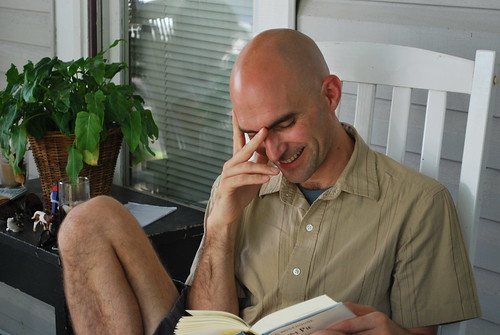
{Photo by rocketlass. I'm actually laughing at Wodehouse, not Nicholson Baker, in this photo, but it serves.}

As it's Friday night and I'm in the mood to sit at the piano, I had intended to do little tonight in this space other than share a couple of passages from the essays in Nicholson' Baker's new collection, The Way the World Works. Like this one, from "String," about the street he lived on as child:
Some parts of the Strathallan sidewalk were made of pieces of slate that sloped up and down over the questing roots of elm trees (one had a mortal wound in its trunk out of which flowed, like blood, black sawdust and hundreds of curled-up larvae), and some parts of the sidewalk were made of aged concrete, with seams cut into them so that they would crack neatly whenever a growing tree required it of them. These seams made me think of the molded line running down the middle of a piece of Bazooka bubble gum, which you could buy in a tiny candy store in the basement of an apartment building near where we lived: the silent man there charged a penny for each piece of gum, machine-wrapped in waxed paper with triangular corner folds. It had a comic on an inner sheet that we read with great interest but never laughed at.
The close grain of the memories, the associative leaps, the care in description matched with a deliberate inventiveness of word choice--that is what I love about Nicholson Baker, the sense that everything in the world deserves our attention, especially those parts of it, both physical and verbal, that we barely even bother to notice anymore.

By the time I was a kid, nearly twenty years after Baker, Bazooka was offered in two sizes, a 3-cent or a 5-cent, and also in grape. Grape, though tempting, always led to regret, in strict defiance of a later friend's oft-repeated certainty--known in my circle as Pete's Axiom--that "Whatever can be made grape should be made grape." What hadn't changed in the intervening years was the relationship to the comic wrapped around the gum: slipshod as it was in every respect, from concept to printing, it received our rapt attention nonetheless. Young, we knew little of the world and its infinity of things, so how were we to judge what merited our scrutiny?

The guy who sold us Bazooka was named Earl, and he ran the Bunnyhop Cafe in the New Hope Hotel, a rundown terra-cotta oddity behind our middle school. He was far from silent. Old and round-nosed and laughing, rather, always wearing a floppy fisherman's hat and frequently seen tooling about town in his '54 Plymouth.

And I'd planned to share this one, from the same essay:
Sometimes my mother let me take the spool off the sewing machine and thread the whole living room with it, starting with a small anchor knot on a drawer handle and unreeling it around end tables and doorknobs and lamp bases and rocking-chair arms until everything was interconnected. The only way to get out of the room, after I'd finished its web, was to duck below the thread layer and crawl out.
Such kindly parental indulgence, so well-attuned to the desires of the child, reminds me of Ray Bradbury's stories of his Aunt Neva, who built with him a model of the 1933 Century of Progress Exhibition in the backyard, dressed him (and herself) in costumes, and generally encouraged him to keep imagination's door always propped open.

And I was going to share some bits from my favorite essay in the book, "One Summer," which consists of short, separate paragraphs all starting with the two words of the title. I was going to share only those I read aloud, with giggling joy, to a simultaneously amused and bemused rocketlass last night. Like this one:
One summer my daughter learned how to read the word misunderstanding.
And this one:
One summer I went to Italy with my girlfriend and her family. My girlfriend's uncle brought a set of dissolvable capsules containing foam circus animals. Every night at cocktail hour we dropped one capsule into a glass of water. As each foam leg emerged, we would say, "There's another leg!"
Or this one, which I had trouble reading because laughter--mine--kept interjecting itself:
One summer I was on the verge of making a baloney sandwich. I had the tomato in my hand and I'd opened the door of the refrigerator and I was looking down at the jar of mayonnaise on the bottom shelf, and then I thought, No, no baloney right now. And I closed the refrigerator door. I was able to resist that baloney and put it out of my mind.
And, finally, this one:
One summer a raisin stuck to a page I was writing on, so I drew an outline of it and wrote, "A Raisin Stuck Here--Sunmaid."
And that was to be it. Post posted. Piano beckoning.

But then I read Michiko Kakutani's review of the book from Monday's New York Times. Oops.

She didn't get it. I suspect there's no way she ever could have--Baker simply seems not to be her kind of writer, his book not her kind of book. Kakutani is serious; Baker is (mostly) silly. Kakutani writes (mostly) about novels; Baker writes novels that read like nonfiction, and nonfiction that reads like no one else's. Kakutani is looking for the point; for Baker, looking frequently is the point.

All of which might still not been enough to prompt me to even mention the review, had it not been for this passage:
The individual essays not only carom around the world in subject matter, they also vary greatly in quality. Some showcase his eye for detail and his ability to nail down those details in velvety, Updikean prose. Some read like parodies of self-absorption that highlight Mr. Baker’s apparent need — shared with his idol, John Updike — to capture even the most trivial of his jottings between the covers of a book. “One Summer,” a list of things the author did over various summers, actually contains this paragraph: “One summer a raisin stuck to a page I was writing on, so I drew an outline of it and wrote ‘A Raisin Stuck here — Sunmaid.’ ” And later on, this sentence: “One summer I was on the verge of making a baloney sandwich.”
"Those bits you liked, Levi, enough to read aloud, I disliked." If there is a Platonic form of the ideal Baker reader, Kakutani may well be the necessarily-existing-in-a-dizzying-undergraduate-seminar-way Platonic form of its opposite.

Tastes vary, of course--the Venn Diagram of mine and rocketlass's overlaps but little, yet the gap diminishes our passion for our favorites not a whit. Baker, admittedly, is not to all tastes, and his fans won't be swayed away by a review that pulls quotes for opprobrium that they'd pull for appreciation.

But the failure to connect, my certainty that Kakutani's wrong, burns despite. Baker writes elsewhere in the book, in "The Nod," an appreciation of Updike delivered at a memorial, of reading Updike's story "The City" to his thirteen-year-old daughter:
And as I was reading it to my daughter, I came to the moment in the story that I remembered from when I first read it. The man is lying in his hospital room in the middle of the night and he hears people moaning on either side of him and then there's a sound of "tidy retching," and then comes the sentence: "Carson was comforted by these evidences that at least he had penetrated into a circle of acknowledged ruin." The word ruin there was so amazingly good and well-placed--"acknowledged ruin." And maybe it was that I gave it a special inflection as I read it aloud, but I don't think so. My daughter said, "Oh, that's good." Right at that moment. She liked and she was excited by the very same phrase in the story that I'd been excited by. It seemed so reassuring to know that there is sometimes an absolute moment in a story that many people will independently discover and remember, even across generations, and that this may have been one of those moments.
Products of a century of mass-production and mass-marketing, iconoclasm may be our aspiration, but nevertheless we ache for others to like what we like; the harmony thus generated can be so abundantly joyful.

Wednesday, August 15, 2012

Craft, sentences, and "banal miracles"

I as I was reading and enjoying Jess Walter's Beautiful Ruins (2012) the past few days, I found myself thinking a lot about craft. When we describe a writer as a craftsman, that's often a way of acknowledging skill or accomplishment while also relegating the author to a lesser plane of achievement--as if the ability and care and determination to put a piece of writing together well were all tools with which to hide the fact that it's not accomplishing anything new or important.

It's unfair, and I suspect it's a legacy of the ascendence of the moderns, who--while unquestionably craftsmen themselves--convinced a large part of the culture that difficulty equals importance and clarity should be questioned. For in some ways that's what we're talking about when we praise craft, as separate from skill, or flash, or talent: prose that's assembled well, and clearly, and put in service of something, usually a somewhat traditional story.

I thought about it as I read the following passage from Beautiful Ruins:
Jet tires chirp, grab the runway, and Shane Wheeler jerks awake and checks his watch. Still good. Yeah, his plane's an hour late, but he's got three hours until his meeting, and he's a mere fourteen miles away now. How long can it take to drive fourteen miles? At the gate he uncoils, deplanes, and makes his way in a dream down the long, tiled airport tunnel, through baggage claim and a revolving door, onto a sunlit curb, jumps a bus to the rental-car center, falls in line with the smiling Disney-bounders (who must've seen the same $24 online rental-car coupon), and when his turn in line comes, slides his license and credit card to the rental clerk. She says his name with such significance ("Shane Wheeler?") that for a deluded moment he imagines he's traveled forward in time and fame, and she's somehow heard of him--but of course she's just happy to find his reservation. We live in a world of banal miracles.
I love the sound and bounce and rhythm of that passage, its consonance and movement, the way that, while conveying the basic information about Shane's progress and always keeping us in his head, it manages to mimic the movement and disorientation of the modern airport experience. The jet tires that "chirp" and "grab," the "deluded" moment, the travel in both "time and fame"--it all works to lift these sentences above their very basic duty of carrying the character from one place to another.

One of the most interesting qualities of the novel as a form is that, most times, nearly everything in one could be thrown out--in theory. All the background details and the descriptions of weather and clothing and houses, all the ancillary characters and scurrying hither and yon are there solely to cocoon the infinitely more compact ideas and people at its heart, to give them a home and make them matter more when revealed to us. At the same time, in reality you can't strip it away and actually be left with anything. The novel, like everyday life, is its details. So when an author lifts his sentences above the functional, when he makes them into living, important things of their own while not rendering them unfit to perform their work, we should appreciate and acknowledge it. "We live in a world of banal miracles." The workings of good sentences in good novels are among them.

And if a well-crafted novel featuring interesting characters (and a convincing portrait of a drunken but not-yet-too-far-gone Richard Burton) turns out to be a tad more romantic than realistic, more hopeful and sweeping than strictly true-to-life--well, when that book begins with a beautiful actress stepping from a boat into a fading Italian fishing village in 1962 under the watchful eyes of a twenty-two-year-old dreamer, what more should we expect?

And, really, what more should we want?

Monday, August 13, 2012

M. R. James, the kindliest of frighteners

Over the weekend, I spent some more time dipping into the second volume of the correspondence of George Lyttelton and Rupert Hart-Davis, and I happened across a couple of brief references to Lyttelton's friend M. R. James, scholar and writer of ghost stories, that seemed worth passing on.

First, from a Lyttelton letter of September 13, 1957 ("Friday!" interjects Lyttleton in his own dateline):
It is time we met again and had a long crack, feet on fender. . . . A monstrous suggestion to make to an overworked publisher--or would be if I didn't know you have that engaging and impressive trait of M. R. James, i. e. however busy he was, he was always ready for a talk.
A trait to aspire to, no?. And one that is particularly irritating not to possess, for the only things preventing us are our solipsism and our well-nurtured sense that the world should accommodate itself to our timetables, other folks be damned. How better to be like James, ready to listen at any time.

That accords with a further sketch of James's personality that Lyttelton presents in a letter from October 9, 1957:
I was particularly pleased to meet Edmund Blunden again. One gets in his company the same--what shall I call it?--easeful satisfaction that one used to get from Monty James. It comes--doesn't it?--when great kindliness of heart accompanies great distinction of mind. I remember M.R.J.'s cordial listening to a story which I knew he knew, and on another occasion to a man making assertions about the history of some cathedral which were so wrong that they had to be corrected, but how gently and beautifully M.R.J. did it.
Interestingly, it seems that many of James's contemporaries, while agreeing about his kindness, wouldn't have said the same about his "distinction of mind." Darryl Jones, in the introduction to the recent Oxford University Press of James's Collected Ghost Stories (1931), writes,
His extraordinary intellectual capacities were matched by a commensurate anti-intellectualism which amounted, at times, to a genuine fear of ideas--a fear which his stories, with their consistent themes of the danger of knowledge, reflect quite clearly.
He offers an amusing example:
His longtime King's colleague Nathaniel Wedd recalled James's admonishing two students who were discussing a philosophical problem: "He rapped sharply on the table with his pipe, and called out: 'No thinking gentlemen, please.'"
James's friend A. C. Benson, who also wrote ghost stories, said of him,
[His] mind is the mind of a nice child--he hates and fears all problems, all speculation, all originality or novelty of view. His spirit is both timid and unadventurous. he is much abler than I am, much better, much more effective--yet I feel that he is a kind of child.
Children of course can be terribly cruel, but a kind child can be a marvel, ready to take the time to talk, and listen, and be patient with others.


{Photo by rocketlass.}

Michael Chabon, in his introduction to a pocket collection of James's stories from OUP, Casting the Runes, tries to figure out the roots of the frightening visions that came from the pen of this writer who "seems, for the entire duration of his life, to have considered himself the happiest of men.":
And what of the childhood fascination with the tortures suffered by Christian martyrs, each date and gruesome detail of beheadings, immolations, and dismemberments lovingly memorized the way some boys memorize batting averages? And the spectral face at the garden gate, pale and wide-eyed, reeking of evil, that one evening peered back at the young James across the lawn as he looked out through the windows of the rectory? And the intimate eleven-year friendship with a man named McBryde, illustrator of some of James's best stories, traveling companion and inseparable confidante, whose rather late marriage in 1903 was followed, scarcely a year later, by his untimely death? And the boys, the tens upon hundreds of thousands of boys of Eton and King's on whom James had lavished his great teacherly gifts, cut down in the battlefields of Belgium and France? And the empty lawns, deserted commons and dining halls, the utter desolation of Cambridge in 1918?
But perhaps we don't need to look that far, or dig that deep, to find the origins of James's horrors. For really, who better to write ghost stories than the timid, who if he looks can find fear in everything? Or, as Chabon concludes:
Violence ,horror, grim retribution, the sudden revulsion of the soul--these things, then, are independent of happiness or suffering. A man who looks closely and carefully at life, whether pitiable as Poe or enviable as the Provost of Eton, cannot fail to see them.
On a drizzly August Monday, hints of autumn are in the air. October, with its darkness and its stories, is just around the corner.

Friday, August 10, 2012

Maqroll the Gaviero and Abdul Bashur, Dreamer of Ships

Over the weekend, I returned yet again to Alvaro Mutis's stories of Maqroll. I've written before about Maqroll, the merchant mariner and weary world traveler, and the fact that he
Maqroll doesn't so much have adventures and love affairs as that they have him; the reverse would require a bit too much active desire, too much engagement with this decrepit dinosaur of a world.
As with many a hero, one of Maqroll's strengths is simple knowledge: he's been everywhere, met everyone, has a memory or story for every occasion. But where James Bond, for example, takes the world as known and thus his, Maqroll takes the world as known and thus no one's, with nothing to offer but memories of what's been lost and anticipations of the losses to come. He's much more Marlow than Indiana Jones, more fatalist than flaneur:
For Maqroll, life has long ceased to have a meaning beyond one's connections to friends and lovers--who, in the face of his best efforts to keep them close, are perpetually being lost to such rivals as distance and death. Yet he continues to plod on nonetheless, driven by inertia and a curiosity, barely acknowledged as such, that continues to seek new experiences and new answers, despite knowing that every time, they will be revealed to be the same as the last, simultaneously dangerous and disappointing.
I've been slowly reading my way through the 700 pages of Maqroll stories and novels that NYRB Classics collected in The Adventures and Misadventures of Maqroll, and this time out, I read Abdul Bashur, Dreamer of Ships, a section that's primarily focused on Bashur, the Gaviero's oldest and closest friend. In a passage early in the volume that Mutis clearly had fun writing, he sets out the differences between the two, and in the process reveals both in loving detail:
I had already heard a good deal about his friendship with Maqroll; when I met Bashur, it was easy enough to understand. It was rooted in an interplay of their ways of behaving, some contrary, others complementary or consonant, but in their totality creating an unbreakable harmony between the two men. Maqroll acted on the conviction that everything was already hopelessly lost. We are born, he would say, with a vocation for defeat. Bashur believed that everything was waiting to be done and that those who lost were the others, the irredeemable fools who undermine the world with sophistry and camouflaged ancestral weakness. From women Maqroll expected friendship without commitment or any trade in guilt, and in the end he always left them. With infallible regularity Bashur fell in love as if for the first time; he accepted, without analysis or judgment and as though it were an inestimable gift of heaven, everything that came from women. Maqroll only rarely confronted his adversaries; he preferred to leave punishment and reprisals to life and its changing fortunes. Abdul reacted immediately and brutally, not calculating the risk. Maqroll forgot offenses and therefore never thought of revenge, but Bashur cultivated vengeance as long as necessary and took it without mercy, as if the offense had just occurred. Maqroll had absolutely no money sense. Abdul was immeasurably generous, but at bottom he kept a running balance of profits and losses. Maqroll called no place on earth home. Abdul, a distant descendant of Bedouins, always yearned for the nomadic encampment where he would be welcomed with familial warmth. Maqroll was a voracious reader, especially of history and the memoirs of illustrious men, liking in this way to confirm his hopeless pessimism regarding the much vaunted human condition, concerning which he held a rather disillusioned and melancholy opinion. Abdul not only never opened a book but did not understand what possible use such a thing could have in his life. He had no faith in humans as a species but always gave each person the opportunity to prove to him that he was wrong.

That is how the two friends traveled the world together, engaging in the most outlandish enterprises, sowing both intimate and legendary memories in their wake.
If that doesn't make you want to read these books, then they're definitely not for you.

Though the pair gets into adventures, these are not books that depend upon their plots, which are often more suggestions of plot than fully worked-out mechanisms. The men embark on a scheme, things go poorly, and in the face of Maqroll's fatalism--"The Gaviero, faithful to his principle of always allowing things to happen regardless of consequences, would not intervene under any circumstances."--the strands of plot eventually just fall away, sinking quietly back into the waves. But as with Alan Furst's novels, which I love more each year as he has less and less actually happen in them, Maqroll's adventures are all the better for their gauziness. They seem to confirm the Gaviero's take on the world: whereas a plot that pops and springs and locks into place suggests a world of cause and effect, of inherent meaning, Mutis's plots remind us that in life, things happen, and then other things happen, and the waves continue to crawl up and down the sands.

Late in Abdul Bashur, when schemes have come to naught and Maqroll is once again looking for a ship, he says, "I can't hold on to anything. It all slips away between my fingers." The only plot, the only fact, is loss. I'm dreading the day I turn the last page of the last Maqroll story.

Wednesday, August 08, 2012

Ethel Wodehouse, spy?

Ben Macintyre's Double Cross: The True Story of the D-Day Spies is, as expected, full of drama, surprise, and interesting tidbits--just seeing Anthony Burgess and Kim Philby pop up as members in good standing of MI5, commenting on reports from double agents, is fascinatingly creepy. What I didn't expect, and something I haven't seen noted in any of the reviews, is that it also goes a ways toward rehabilitating P. G. Wodehouse's wife, Ethel, from the lingering charge of collaboration during the couple's internment.

The last I'd read on the issue was in Robert McCrum's 2004 biography of Wodehouse. McCrum builds a convincing case for what is now, I think, the general assessment of Wodehouse's own level of culpability for his pro-German broadcasts: Wodehouse, McCrum argues, was guilty at most of gullibility and ignorance, rooted in naivete and a desire to please. He should have known better, but he certainly didn't intend worse.

Ethel, however, doesn't come off so well in McCrum's book. Major Cussen, the M15 officer assigned to interrogate the couple after the war, McCrum writes, was strongly critical of Ethel:
"From what I have seen of Mrs Wodehouse," he wrote, " I expect to learn that she conducted herself [in Germany] in a flamboyant manner and that she accepted all the attention which was no doubt paid to her by German officials."
Macintyre, drawing on security service documents, paints a different picture.

The Wodehouses enter Macintyre's account because, while living in France in the pre-war years, they became friends with a German agent, Johnny Jebsen, who was quietly anti-Nazi and eventually became a double agent for Britain. Among his many shady activities, Jebsen ran a minor currency scam, accepting forged British banknotes from Nazi officials to trade for dollars, while skimming a substantial amount--some of which he used to help support the Wodehouses, who knew nothing of Jebsen's secret job or the source of the money.

Macintyre doesn't offer any new information about Wodehouse himself, but Ethel appears very differently in this report from MI6 operative Charles de Salis, written in conjunction with an analysis of Jebsen (whose codename was Artist):
Mrs. Wodehouse is very pro-British and is inclined to be rude to anyone who dares address her in German. She has on occasion said loudly in public places: "If you cannot address me in English don't speak at all. You had better learn it as you will have to speak it after the war anyway." Artist thinks she might be a useful source. . . . Wodehouse himself is entirely childlike and pacifist.
Here's how MaciMntyre glosses the report:
It is not known whether MI6 acted on this suggestion and recruited Ethel Wodehouse, but Jebsen's suggestion casts a new light on their time in Paris. . . . Jebsen's report proves that while Wodehouse himself may have been passively apolitical, his wife was so anti-Nazi that she was considered a potential spy.
Though I realize that security service files, with their purging and blackouts, don't allow for a lot of certainty, it does seem reasonable to assume that if Ethel Wodehouse had actually been recruited that fact would have emerged in the subsequent decades. Regardless, for a Wodehouse fan it's good to see this report--anything that further clears the cloud of collaboration is welcome.

Monday, August 06, 2012

The D-Day spies and their echoes in Lisbon

A lot of the double agents who play leading roles in Ben Macintyre's Double Cross: The True Story of the D-Day Spies (2012) are controlled from Lisbon (on the Nazi side), and reading that book you'd be forgiven for thinking that perhaps every single person in 1940s Lisbon was a spy, probably a double or even triple agent. Take the following account of a dinner party thrown by von Karsthoff, the German control of Dusko Popov, a double agent who was secretly working for the British. The names aren't important; just attend to the cat's cradle of secret connections:
[Von Karsthoff] threw a dinner party in Popov's honor and invited Jebsen, Aloys Schreiber (the new head of counterintelligence), and their secretaries. It was a bizarre occasion. Two of the guests were German intelligence officers, and two others were secretly working for British intelligence; Jebsen was sleeping with Schreiber's secretary, who was spying on her boss; the married von Karsthoff was having an affair with his secretary, Elizabeth Sahrbach, while ripping off the Abwehr. Popov was conducting at least six love affairs. Everyone was involved in the lying and cheating game.
I don't know nearly enough about Portuguese history to be sure of this, but the incidental sense I get of neutral Portugal from MacIntyre's book is of an utterly louche, feckless netherworld, a sort of fascist Monte Carlo of the soul, blithely untroubled by the fears, dangers, shortages, and existential threats faced by the rest of Europe at the time:
An Abwehr office who arrived in Libson shortly before Jebsen was shocked by the behavior of his new colleagues, who "were leading a rather loose and immoral life in Lisbon," with little concern for their duties." Some were sleeping with their secretaries. Others were cocaine abusers. "All had enormous amounts of money, most had their own cars, made frequent pleasure trips throughout Portugal and spent their evenings gambling in the casinos."
It's been at least fifteen years since I read Cees Nooteboom's wonderfully compact little meditation on death, The Following Story (1991, English translation 1994), but its vision of a haunted, hushed, exhausted Lisbon has stayed in my mind--the hangover of neutrality and fascism?
Evening in my memory, evening in Lisbon. The lamps in the city had been lit, my eyes were like a bird flying above the streets. It had grown cool, up there; the voices of the children had gone from the gardens; I saw the dark shadows of lovers, statues locked in embrace, lazily moving double-people.
Nooteboom presents the town as labyrinth, of frustrated plans and forgotten intentions, leading to the only exit: death.

The most striking aspect of the Lisbon component of the XX, or Double Cross, group, however, is the network of fake spies set up by Portuguese double agent Juan Pujol, known by the British as "Garbo." Pujol, who "possessed what his case officer, Tomas Harris, called a 'remarkable talent for duplicity'," not only convinced his Nazi handlers that he was supplying them good information even as he was doing the bidding of his English paymasters, but also had them believing in an entire network that he'd made up out of whole cloth. MacIntyre explains:
By the end of 1942, the Garbo network included an airline employee, the courier who supposedly smuggled Garbo's letters to Lisbon, a wealthy Venezuelan student named Carlos living in Glasgow, his brother in Aberdeen, a Gibraltarian waiter in Chislehurst whose anti-British feelings were said to be exacerbated because "he found the climate in Kent very disagreeable," a senior official in the Spanish section of the Ministry of Information, an anti-Soviet South African, and a Welsh ex-seaman living in Swansea described by Pujol as a "thoroughly undesirable character." The personality, activities, and messages of each spy were carefully imagined, refined, and entered in a logbook. Some of these subagents were supposedly conscious collaborators, while others were unwitting sources of secret information; some were given names, while others remained anonymous. . . . Pujols's subagents were able to correspond with the Germans independently after he was authorized to supply them with secret ink; those agents then began recruiting their own sub-agents. The network began to self-replicate and metastasize, until the work of Pujol and Harris came ot resemble a limitless, multicharacter, ever-expanding novel.
Who else could possibly come to mind than Lisbon native Fernando Pessoa, who, in the words of translator Richard Zenith,
wrote under dozens of names, a practice--or compulsion--that began in his childhood. He called his most important personas "heteronyms," endowing them with their own biographies, physiques, personalities, political views, religious attitudes and literary pursuits. . . . The many . . . alter egos included translators, short-story writers, an English literary critic, an astrologer, a philosopher and an unhappy nobleman who committed suicide. There was even a female persona: the hunchbacked and helplessly lovesick Maria Jose. At the turn of the century, sixty-five years after Pessoa's death, his vast written world had still not been completely charted by researchers, and a significant part of his writings was still waiting to be published.
Or, as Pessoa writes in The Book of Disquiet,
And all this, in my walk to the seashore, was a secret told me by the night and the abyss. How many we are! How many of us fool ourselves! What seas crash in us, in the night when we exist, along the beaches that we feel ourselves to be, inundated by emotion! All that was lost, all that should have been sought, all that was obtained and fulfilled by mistake, all that we loved and lost and then, after losing it and loving it for having lost it, realized that we never loved; all that we believed we were thinking when we were feeling; all the memories we took for emotions; and the entire ocean, noisy and cool, rolling in from the depths of the vast night to ripple over the beach, on my nocturnal walk to the seashore . . .
Ah, though the pleasures of multiplicity might tempt, the intrigues of spies are not for Pessoa:
I've always felt an almost physical loathing for secret things--intrigues, diplomacy, secret societies, occult sciences.
No, for Pessoa, multiplicity was too hermetic to be part of an external scheme. "Every gesture, however simple, violates an inner secret." He could be no spy.

Friday, August 03, 2012

Counting all this money is so tiresome!

'Tis a Friday of virtual hobnobbing with the wealthy and titled . . .

We'll start with the diary entry of Count Harry Kessler for June 20, 1911:
Dinner at Madame Edwards's. D'Annunzio, Boni de Castellane, Rejane, Bakst, Romain Coolus, Tata Golubeff, Sert, the lover of Rejane Nicodemi, and an Argentinian, Quintana, the son of a former president, were present. After dinner came Maupeou, Gloria, Ricciotto Canudo, and the Russian Baryton Kedroff, who sang wonderfully. The apartment of Edwards is one of the most tasteful I have ever seen. Many chinoiseries from the time of Louis XV and Louis XVI, everywhere expensive old laces as curtains and tablecloths and on the walls, like tapestries, decorations by Bonnard. In between a mass of roses, big and small. D'Annunzio had said he would come after dinner but arrived during the fish course. He seemed to enjoy our surprise. Rejane who is a ruin, but still of a refined elegance and very amusing, allowed D'Annunzio to pay court to her. They disappeared together after dinner into a boudoir as Rejane, in leaving the salon, cried out, "When you hear the first cry, you will come . . . no, not the first, but at the third."
Those of us who generally move in less refined circles can take solace from the fact that most of those names mean nothing today, even when annotated--but it's hard to begrudge Kessler his society and name-dropping, as he at least seemed to appreciate it and make good use of it, working with von Hofmannsthal and spending time with Diaghilev, Nijinsky, Nietzsche, Rilke, Verlaine, Richard Strauss, Shaw, and others of impressive accomplishment.

But mightn't we, were we to be suddenly dropped, Quantum Leap–style, amid all that glamor, simply get bored? Ben Macintyre, early in his new book about the D-Days spies, Double Cross, offers an example:
Boredom stalked Elvira Chaudoir like a curse. Her father, a Peruvian diplomat, had made a fortune from guano, the excrement of seabirds, bats, and seals, collected off the coast of Peru and exported as fertilizer. Elvira grew up in Paris, where she was expensively educated and tremendously spoiled. In 1934, at the age of twenty-three, to escape the tedium, she fled into the arms of Jean Chaudoir, a Belgian stock exchange representative for a gold-mining firm. Jean turned out to be a crashing bore, and life in Brussels was "exceedingly dull." After four years of marriage and a number of unsatisfactory love affairs with both men and women, she came to the conclusion that "she had nothing in common with her husband" and ran away to Cannes with her best friend, Romy Gilbey, who was married to a scion of the Gilbey gin dynasty and very rich. Elvira and Mrs. Gilbey were happily losing money made from gin in a casino in Cannes when the Germans invaded France; they fled, in an open-top Renault, to St. Malo before taking a boat for England.

In London, Elvira moved into a flat on Sloane Street, but the tedium of life swiftly descended once more. She spent her evenings shuttling between the bar at the Ritz and the bridge tables, losing money she did not have. She would have borrowed from her parents, but they were stuck in France. She tried to join the Free French forces gathering around the exiled Charles de Gaulle but was told she was unsuitable. She did a little translating for the BBC and found it dreary.
Chaudoir eventually turned to the elixir that has stemmed the ennui of so many of the idle rich over the centuries: spying.

Finally, lest you assume that our jet-powered, ever-connected, new Gilded Age has freed the poor wealthy from the besetting curse of boredom, I'll leave you with the unimpressed glories of the Pierces.


Milton's ending to Paradise Lost--
The world was all before them, where to choose

Their place of rest
--was surely intended to be equivocal, perpetual grace traded for free will--but little did he know those centuries gone that with but the appending of a weary sigh his lines could be adapted to the pitiful plight of the privileged.

Wednesday, August 01, 2012

Continuing to fall for Alice Thomas Ellis

With every book of hers I read--in hideous large-print editions because that's all Chicago Public Library has--it becomes more clear that Alice Thomas Ellis is nearly a perfect writer for me. She's funny, mordant, and impressively dark, much of her whiplash humor coming from the combination of her characters' terseness and their seeming lack of social filters. Ivy Compton-Burnett, her most obvious influence (who knew that a writer as sui generis as Compton-Burnett had a legacy?), shares that trait, but Ellis also brings to mind the social comedy and satire of Barbara Pym and Penelope Fitzgerald, and the clear-eyed believer's often-comic understanding of religion that we find in J. F. Powers.

One writer I'd not linked her to until the most recent book I've read, Pillars of Gold, is P. G. Wodehouse. Yet there are a number of Wodehousian attitudes or turns of phrase in the book. Even as simple a bit as this description of an emotionally disconnected husband listening to his wife--
Scarlet said much more, and while he had not listened closely, he had got the gist.
--smacks of Wodehouse, whose characters, distracted, apprehend the world largely as a gestalt rather than a concatenation of specific details.

Then there's the borderline criminality of so many of Ellis's characters, and the sense that even murder is a problem only to the extent that it will out. Wodehouse's characters would never stoop to murder, of course--blithe violence being much more the territory of Compton-Burnett's family jealousies--but they do fret an awful lot about the depredations of the long arm of the law. Read the following passage from Pillars of Gold and imagine that Constance is a Wodehouseian aunt--in the brash, Aunt Agatha mold:
"It's not your fault," said Constance. "If you was anyone else, I'd say, get divorced, but you did that once and then you went and got married again. You can't help yourself. It's your destiny--all writ up in your stars. You could kill him, I suppose, but you've got to remember this: if you do, what you have to do next is ruffle up your hair and mess up your garments and appear howling and all distressed at your local nick, saying you don't know what came over you. On no account look out your passport and make for the airport because they'll catch you in customs and the judge will be cross and tell you you're a calculating murderess and give you twenty years. If you follow course one, you'll get off with a caution or three month's community work. That's today's Helpful Home Hint."
And to think I've got another ten books to read!