Friday, August 13, 2010

If Saturday night’s all right for fighting, can Friday night be all right for cursing?, or, Oh, no--another &*@#@(! blog post!

Though I’ve never claimed that this is a family blog--you thousands of teenage fans hear that? Time to leave here and go back to Pingu!--I do tend to refrain from swearing most of the time. It’s just not part of my writing voice, so I don’t do much of it in print.

But that doesn’t mean I don’t appreciate some blue language, a bit of salt with my substance, especially when delivered by a master. {Scroll down on that one to the bottom of the post for July 8, 2000. You’ll be glad you did.} And over the past ten days, I’ve encountered a handful of oddities relating to swearing that have led to this batch of not particularly well-connected notes.

1 It started with an entry in Kinsgley Amis’s idiosyncratic, chatty style and usage guide, The King’s English (1997). The entry, “Four-letter words,” included this passage:
I have forgotten when I first said or made a character say fuck in print, but no one seemed to notice or care, any more than they did when my son Martin used the word several dozen times in one page in a novel published in 1978.
The swipe at Martin reminded me of a footnote to a piece Martin wrote about J. G. Ballard back in 1997: he noted that Kingsley would give a writer one bad book before giving up on them. “His son,” Martin wrote, “he gave two.” If, however, Kingsley was counting swear words in 1978--Success, it must have been--then it seems he subjected himself to at least three of Martin’s novels before bagging it.

2 All of which makes me unable to resist sharing an incident from Zachary Leader’s biography of Kingsley that I first noted a couple of years ago: once when Kingsley fell asleep on a beach, his wife wrote on his ample stomach in lipstick,
One Fat Englishman. Will Fuck Anything.
A writer for the Literary Review who reviewed the biography characterized Kingsley’s guiding philosophy in terms that match those in vulgarity and ethos both:
If it moves, fuck it. If it doesn’t, drink it.
It almost makes Martin’s protagonist in The Rachel Papers seem upstanding and honorable.

3 Earlier in the week, profanity played a part in a crucial series between the then first-place Cincinnati Reds and my beloved St. Louis Cardinals, who trailed the Reds by one game as they entered the series. Asked before the first game whether a sore leg might keep him out of the game, Reds second baseman Brandon Philips had this to say:
I'd play against these guys with one leg. We have to beat these guys. I hate the Cardinals. All they do is bitch and moan about everything, all of them, they're little bitches, all of 'em. I really hate the Cardinals. Compared to the Cardinals, I love the Chicago Cubs. Let me make this clear--I hate the Cardinals.
This, as you might have expected, got the Cardinals a bit fired up, which resulted in a bench-clearing brawl in Tuesday’s game--and, more important, a masterful sweep of the series by the Cards.

None of which would merit mention on this blog, had the St. Louis Post-Dispatch’s deputy managing editor not gone to the trouble a few days later of explaining why the paper decided to print the quote as uttered, swear words and all. The explanation is interesting, as is editor Steve Parker’s note that a search of the archives returned hundreds of uses of the word “bitch” in recent decades--which surprised me (and, it seems, him), given how squeamish American newspapers are about swearing.

Newspapers like the Cincinnati Enquirer, for example, which riddled Phillips’s quote with so many evasions that it begins to sound like they’re a kid telling the teacher about somethind bad they heard Brandon say on the playground:
I hate the Cardinals. All they do is (b-word) and moan about everything, all of them, they're little (b-words), all of 'em.
None of which, however, matches up to the bowdlerization once performed on a quote from Cardinals reliever Steve Kline--it’s Item #3 in this post.

Oh, and Brandon Phillips? He went 2 for 14 in the series. Oops.

4 The only suitable way to end this post is by sending you to this Wikipedia entry, which demonstrates yet again, should you still need to be convinced, the useless glory that can result from the combination of free time, obsession, and the Internet.

Have a great fucking weekend.

Wednesday, August 11, 2010

A Westlake by any other name---or make that many other names

After yesterday’s post about Parker, I thought you might an amusing passage I encountered today in A Jade in Aries (1970), the fourth of the five novels about disgraced copy Mitch Tobin that Donald Westlake wrote under the name Tucker Coe. Coe’s bio in this book reads:
A self-made conglomerate, Tucker Coe is a subsidiary of a writer better known to most readers under a different name, perhaps his own. A man who constructs his own walls for his own reasons, Mr. Coe lives with his family in the American Northwest and is currently at work on several projects, including a further expedition by Mitchell Tobin.
But savvy readers, if they hadn’t figured out Coe’s identity already, would surely have realized it after this big hint, which appears late in the novel:
Marty came on the line after a minute, and I said, “Hello. How are you doing?”

“Don!” he cried. “Good to hear from you!”

I said, “This is Mitch. Mitch Tobin.”

“For God’s sake,” he said. “Hiya, Mitch. You sound just like Don Stark. You don’t know him, do you?”

“No, I don’t.”

“I never realized it before,” he said. “It’s incredible.”
Ethan Iverson, in his indispensable annotated checklist of Westlake’s novels, writes that the Coe books, along with the four novels Westlake wrote as Samuel Holt,
are the only conventional private eye murder mysteries in the Westlake canon. It’s not surprising they are under pen names; Westlake was suspicious of the form. . . . The Coes and Holts are probably really only for Westlake completists, but they will make good reading for anyone who likes to try to “beat the detective” and solve the murder mystery before the hero does. The always-honest Westlake leaves the clues in plain sight; rather to my surprise, without trying, I solved a few of them myself.
I’d give the Coe novels, at least, a bit more credit than that: they’re not first-rate Westlake, but anyone who appreciates his lean, clear prose and his sympathetic eye for the odd, surprising, yet rarely inexplicable ways that people choose to live in this world will find plenty to like in them.

Tuesday, August 10, 2010

Parker purloining paperbacks? Preposterous!

My local bookstore, the 57th Street Books branch of the Seminary Co-op, has begun posting the winning stories in their Parker flash fiction contest, for which I served as one of the judges. Congratulations to Ryan Garms, whose "The Rare Book Score" took third place, and to Anders Runestad, who swiped second with "The Bookstore Heist," both of which are now up at the store's Front Table blog.

Keep an eye on the Front Table for the winning story later this week--and if 150-word semi-comic heists aren't enough to sate your need for crime, you can pick up the three newest Richard Stark reissues from my employer, the University of Chicago Press, Deadly Edge, Slayground, and Plunder Squad. In a great new foreword to the books, Hard Case Crime editor Charles Ardai describes them as marking a new plateau in Richard Stark's career to that point. Considering the number of times I gasped out loud while reading them, I can't disagree--along with the upcoming Butcher's Moon, this is as good, and as dark, as Parker gets.

Sunday, August 08, 2010

Lew Archer chats up a receptionist

John O'Hara having set me to thinking about the openings of books last week, I was pleased to find that Ross Macdonald's The Goodbye Look (1969), which I turned to this morning, has a great one.

Macdonald's novels don't mess around in their initial pages: Lew Archer nearly always has a case afoot within moments of the opening lines. But this one is even better than usual, offering a sampler of the qualities that make Archer such a compelling narrative voice--perceptiveness, natural sympathy, humor, and an openness to friendliness despite a lifetime's knowledge of the seamier side of human relationships:
The lawyer, whose name was John Truttwell, kept me waiting in the outer room of his offices. It gave the room a chance to work me over gently. The armchair I was sitting in was covered in soft green leather. Oil paintings of the region, landscapes and seascapes, hung on the alls around me like subtle advertisements.

The young pink-haired receptionist turned from the switchboard. The heavy dark lines accenting her eyes made her look like a prisoner peering out through bars.

"I'm sorry Mr. Truttwell's running so late. It's that daughter of his," the girl said rather obscurely. "He should have let her go ahead and make her own mistakes. The way I have."

"Oh?"

"I'm really a model. I'm just filling in at this job because my second husband ran out on me. Are you really a detective?"

I said I was.

"My husband is a photographer. I'd give a good deal to know who--where he's living."

"Forget it. It wouldn't be worth it."

"You could be right. He's a lousy photographer. Some very good judges told me that his pictures never did me justice."

It was the mercy she needed, I thought.
Later in the novel, Macdonald has Archer directly address his most salient quality: that of being a good listener, someone to whom people feel compelled to talk, more or less honestly and emotionally, to him with very little prompting:
We went down together in the elevator. In its automatic intimacy she said:

"I've spilled all my secrets. How do you make people do it?"

"I don't. People like to talk about what's hurting them. It takes the edge off the pain sometimes."
When people talk, Archer listens. Sometimes he judges, but mostly he listens, and in listening acknowledges that we all are frail and mistake-prone. In that, he's our ideal self, the one we always tell ourselves we want to be, simultaneously reminding us of our constant, vague wish to be better to those around us and of the risk--the emotional costs--of actually doing so.

Friday, August 06, 2010

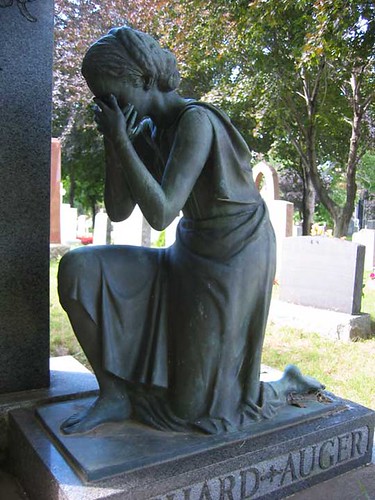
Visiting graves with Neil Gaiman


{Photos by rocketlass.}

I wouldn’t consider myself quite a Neil Gaiman fan: though I have enjoyed a lot of his work, I often feel that it could be just a bit better, that he could push his ideas and his prose alike a bit more and turn what is never less than an interesting, fun story into something more closely approaching genius.

That said, I really enjoyed The Graveyard Book, which is a ghost-and-ghoul-filled homage to Kipling’s Jungle Book. Midway through it is an example of the one thing Gaiman does best: offer an answer to an inexplicable question we’ve never quite realized we’d had, such as, “Why is there a Tube stop named Angel?”; “Where do all those strange doors and stairwells and such in the Undergound go?”; and “Why is the House on the Rock in the middle of nowhere?” Given its title, you won’t be surprised that the question answered in The Graveyard Book has to do with cemeteries:
One grave in every graveyard belongs to the ghouls. Wander any graveyard long enough and you will find it--waterstained and bulging, with cracked or broken stone, scraggly grass or rank weeds about it, and a feeling, when you reach it, of abandonment. It may be colder than the other gravestones, too, and the name on the stone is all too often impossible to read. If there is a statue on the grave it will be headless or so scabbed with fungus and lichens as to look like a fungus itself. If one grave in a graveyard looks like a target for petty vandals, that is the ghoul-gate. If the grave makes you want to be somewhere else, that is the ghoul-gate.
Needless to say, your instincts are right: you should stay away from the ghoul-gate. Unless, that is, you like being menaced by ghouls.

Wednesday, August 04, 2010

Pour yourself a bit more of John O'Hara's soda-water. It'll be good for what ails you.

On Monday I quoted the opening paragraphs of one of the three novellas that make up Sermons and Soda-Water (1960), which, when I happened across it last week while on vacation, almost instantly made me a John O’Hara fan. Given how strong an impression the openings of the three novellas made on me, it seems right to also share the first paragraphs of the other two in the set.

Here’s the opening of the novella that leads the set, The Girl on the Baggage Truck:
When I was first starting out in New York I wrote quite a few obituaries of men who were presumably in good health, but who were no longer young. It was the custom on the paper where I worked that a reporter who had no other assignment was given this task, which most reporters found a chore but that I rather enjoyed. The assistant day city editor would tell you to prepare an obit on some reasonably prominent citizen, you would go to the office library and get out the folder of the citizen’s clippings, and for the remainder of the afternoon you would read the clippings and appropriate reference books, and reconstruct a life from the available facts, keeping it down to forty lines or whatever length the subject’s prominence had earned. One time I had to look up Jack Smedley, one of the richest oil men in the United States, and I discovered that his folder was so slim that you could have mailed it for the price of a two-cent stamp; while a Bronx politician of almost the same name had six bulging folders that cluttered up my desk. Later, when the two men died, the rich man was a Page One story all over the world, and the Bronx politician got thirty lines halfway down the column on the obituary page. You got what in more recent times was called a sense of values.
It’s not as richly descriptive or evocative as the section from We’re All Friends Now that I quoted Monday, but even in this more modest form the tone and the prose work together to present a distinct voice: straightforward, experienced, knowledgeable, unsentimental, and wry. You want to trust this voice.

Then there’s the opening paragraph of Imagine Kissing Pete, which quickly and clearly introduces the web of relationships, commitments, gossip, and betrayals that are at the heart of O’Hara’s picture of the upper class at midcentury:
To those who knew the bride and groom, the marriage of Bobbie Hammersmith and Pete McCrea was the surprise of the year. As late as April of ‘29 Bobbie was still engaged to a fellow who lived in Greenwich, Connecticut, and she had told friends that the wedding would take place in September. But the engagement was broken and in a matter of weeks the invitations went out for her June wedding to Pete. One of the most frequently uttered comments was that Bobbie was not giving herself much opportunity to change her mind again. The comment was doubly cruel, since it carried the implication that if she gave herself time to think, Pete McCrea would not be her ideal choice. It was not only that she was marrying Pete on the rebound; she seemed to be going out of her way to find someone who was so unlike her other beaus that the contrast was unavoidable.
All three novellas are written from the perspective of a man in his mid-fifties who, driven by various events in his present life, is thinking back on his late twenties, and they are pervaded by the melancholy and loss natural to such reflections. That feeling finds its clearest expression in this passage from Imagine Kissing Pete, which follows the suicide of an acquaintance, Julian English, a few weeks after the narrator, then in his youth, had seen him at a party:
I was shocked and saddened by the English suicide; he was an attractive man whose shortcomings seemed out of proportion to the magnitude of killing himself. He had not been a friend of mine, only an acquaintance with whom I had had many drinks and played some golf; but friends of mine, my closest friends in the world, boys-now-men like myself, were at the beginning of the same kind of life and doing the same kind of thing that for Julian English ended in a sealed-up garage with a motor running. I hated what I thought those next few days and weeks. There is nothing young about killing oneself, no matter when it happens, and I hated this being deprived of the sweetness of youth. And that was what it was, that was what was happening to us. I, and I think the others, had looked upon our squabbles as unpleasant incidents but belonging to our youth. Now they were plainly recognizable as symptoms of life without youth, without youth’s excuses or youth’s recoverability. I wanted to love someone, and during the next year or two I confused the desperate need for love with love itself. I had put a hopeless love out of my life; but that is not part of this story, except to state it and thus to show that I knew what I was looking for.
Longtime readers will instantly see why I was drawn to this passage: it’s driven by the same concerns that animate so much of Anthony Powell’s writing, the question of how one moves through time, what markers and labels and acknowledgments one allots its various stages, how one fights or accommodates its demands. An inevitable byproduct, I suspect, of even the most pleasant vacation with one’s parents, wife, siblings and their spouses, and nieces and nephews, is a growing awareness of time and its cruelly diminishing elasticity, and to happen across such a reflection on those matters in the midst of such inescapable thoughts was, in some ways, a reminder of why we read at all: for all of Plato’s insecure chiding, these shadows on the cave wall do instruct by their example, do enlighten even as we know they are art rather than life. Our lives and our world are not the ones O’Hara or Powell depict, and yet, looked at in just the right way . . .

Monday, August 02, 2010

"Let us have wine and women, mirth and laughter / Sermons and soda water the day after."


{Photos by rocketlass.}

I made an wonderful, unexpected discovery while I was on vacation last week. As I was browsing in a pleasant used bookstore, Black River Books, a set of three lovely little matched hardcovers caught my eye--and mere days later, I think I may now be a John O’Hara fan.

I’ve never been strong on midcentury American authors--the Anglophile in me tends to win out when it comes to that part of the century--and O’Hara is someone I might simply never have gotten around to. But all it took was reading the first page or two of the three individually bound novellas that make up Sermons and Soda-Water (1960), and I was hooked. Try the opening of the third one, We’re Friends Again:
I know of no quiet quite like that of a men’s club at about half past nine on a summer Sunday evening. The stillness is a denial of the meaning and purpose of a club, and as you go from empty room to empty room and hear nothing but the ticking of clocks and your own heel taps on the rugless floor, you think of the membership present and past; the charming, dull, distinguished, vulgar, jolly, bibulous men who have selected this place and its company as a refuge from all other places and all other company. For that is what a club is, and to be alone in it is wrong. And at half past nine on a summer Sunday evening you are quite likely to be alone. The old men who live there have retired for the night, sure that if they die before morning they will be discovered by a chambermaid, and that if they survive this night they will have another day in which their loneliness will be broken by the lunch crowd, the cocktail crowd, and the presence of a few men in the diningroom in the evening. But on a summer Sunday evening the old men are better off in their rooms, with their personal possessions, their framed photographs and trophies of accomplishment and favorite books. The lounge, the library, the billiard and card room have a deathly emptiness on summer Sunday evenings, and the old men need no additional reminder of emptiness and death.


There’s a clarity and confidence to O’Hara’s prose here that I find remarkably bracing, the sure first-person voice conveying the desolation of the empty club so clearly that this long-gone bastion of midcentury manhood and privilege rises around you, smelling of leather and hair tonic and stale tobacco.

That lean clarity is maintained throughout the three novellas, and its straightforwardness and seeming simplicity are incredibly seductive, to the point where I could imagine them being dangerously influential for a writer of fiction. O’Hara’s sentences make me want to write like that, all adornment stripped away or skillfully hidden within an overtly utilitarian syntax. In his introduction to the three novellas, O’Hara wrote that his increasing age convinced him to leave these stories short, rather than try to spin them out into full-length novels. “I want to get it all down on paper while I can,” he wrote, and that urgency, that need to remember and commemorate and explain and understand, comes through in every sentence. It makes you ache for the simple fact that the past is lost forever, and it makes you admire those who try to save it for us despite.

Friday, July 30, 2010

Churchill and the bottle

One of the books I'm taking on my vacation is the first volume of William Manchester's monumental biography of William Churchill, The Last Lion (1983), a book that one of my coworkers loves so much that he practically tears up when talking about how much he envies me for the fact that I still get to look forward to reading it for the first time.

Thus far, all I've read is the introduction, which, as advertised, is masterly and captivating. Today I'll just share a brief note about Churchill's drinking:
[H]e continued to build the image of a tireless embodiment of machismo who ate, smoked, and drank, all to excess. It survives to this day. Actually, most of the stories of his alcohol intake are myth. It is true that he started each day with a scotch and soda. What is not generally known is that he made that drink last until lunch, and that the amount of liquor he put away over a twenty-four-hour day was surprisingly modest. You would never have known it to hear him talk. He wanted to be remembered as a two-bottle man, like Pitt, and he cultivated the yarns about his drinking with characteristic aplomb. Once he asked Frederick Lindermann--"the Prof," a scientific wizard who later became Lord Cherwell--how many boxcars could be filled with the champagne he had drunk in his lifetime. The Prof replied: "Only part of one." Churchill sighed. He said: "So little time and so much to achieve."
My ambitions, fortunately, for my health, are much smaller.

Wednesday, July 28, 2010

One of the many attractions of writing a crime novel . . .

. . . would be getting to write scenes like this one, from Nic Pizzolatto's impressive, dark new novel, Galveston:
The girl said her name was Raquel and everyone called her Rocky. She was mostly terrified, and given what she'd been through, a lot of people might have switched off, but she talked like a mynah bird. I suspect that sometime before the night's events, she had learned that you can lie with anything. "My last name's Arceneaux." She pronounced it Arson, oh. "Are you going to kill me?"

"No. Stop asking me that."
Live through? Preferably not. Write? Hell, yes.

Monday, July 26, 2010

The Golden Rule, as described to God

You can never go wrong reading Stephen Burt's posts on poetry from the London Review of Books blog, and last week's, about an old anthology compiled by Auden was particularly good. It deserves your attention if for no other reason than that it passes on the following lovably odd bit of verse:
Here lie I, Martin Elginbrodde:
Ha’e mercy o’ my soul, Lord God,
As I wad do, were I Lord God
And ye were Martin Elginbrodde.
The tiniest bit of searching reveals that the lines come from an 1863 novel by George MacDonald, David Elginbrod. They appear as an epitaph for an ancestor of the hero, and are, apparently, more or less the only reason the novel is now remembered at all.

Friday, July 23, 2010

Circumspection, trust, and Dorothy Dunnett

I'm off on vacation next week, and all this week as I've been thinking through what books I would bring with me, I kept telling myself that I wouldn't bring the fifth volume of Dorothy Dunnett's Niccolo Rising series. I needed a week away from early Renaissance Europe, I told myself--and {SPOILER ALERT!} as I made my way through the final pages of the fourth volume, Scales of Gold, that seemed completely reasonable: it really seemed as if, at the halfway point in the series, Dunnett was going to let Niccolo find some peace, allow him a sort of emotional plateau from which she could begin the second half of her extended account of his life and adventures. But oh, after 2,750 pages I should have known her better: the final half-dozen pages of the novel delivered such incredible, unexpected body blows . . . and now I find myself tucking volume five into my bag for tomorrow's drive . . .

Which leads me to what I promise is my last Dunnett note for a good while. Late in Scales of Gold I encountered a passage that I think gives a good sense of a quality of Dunnett's writing that I've not yet touched on: her preference for obliqueness and circumspection, which, if one makes allowances for the fact that she's writing historical adventure novels, rivals that found in The Tale of Genji. If a point can be made indirectly, if a revelation can be delivered sidelong, then that is how Dunnett prefers to give it, and in doing so she demands an attention from her reader that would be utterly foreign to most popular fiction.

Sometimes this approach turns up as simple foreshadowing, characters noticing something that we don't have the awareness to see; at other times, it's more difficult and impressive, with discoveries or facts or even major plot points presented through elliptical references that rely on a close attention to and understanding of the characters involved. She relies on this approach frequently enough that I might call it a tic, or a flaw--if, that is, I weren't so impressed by the confidence in her reader that it demonstrates.

Which is all by way of preamble to my unimportant, but telling example. Scales of Gold finds Niccolo's company scattered across Europe, tending to various parts of the trading enterprise. The following scene comes as Niccolo has returned to Bruges from three years in Africa. The entire company has endured a long day of ceremonial welcomes, which means the end of the day finds much business still to be discussed with Gregorio, one of the company's managers, who himself has just that day returned to Bruges and been reunited with his mistress. Late in the evening, Nicholas visits the room of his friend and traveling companion, Father Godscalc,
after he had spent time with Tilde and Catherine and Diniz, and had told Gregorio not to wait, since he was too tired to see him tonight.

Godscalc smiled when Nicholas reported that to him. The priest was not in bed but, wrapped in a robe, was resting in a chair with a back, his feet propped on a stool. He said, "If you had not brought him Margot, he would be a sorrowful man. Are you tired?"
Now that I've called this out, the meaning is obvious. Nicholas told a white lie to Gregorio in order to free him to hurry to his much-missed mistress--but picture this as one little paragraph in a 520-page novel, in a 4,000-page series, and you surely will begin to see what I mean: Dunnett trusts in--counts on--her readers paying attention and knowing her characters. And, as with a trusting parent or a hands-off boss, she makes us want to be the reader she supposes us to be.

Next week will be light--probably just a few quotes, at best, while I'm away. See you in August.

Wednesday, July 21, 2010

"Yet I love him when he is kind and normal and full of human weakness," or, The Terrible Tolstoys

If you haven't seen it, you should check out the great article by James Meek in the July 22nd issue of the London Review of Books about the Tolstoy marriage and its end. Prompted by a handful of new books, including a new edition of Sofia Tolstoy's diaries that will be published here in the fall, the piece offers all the jaw-dropping craziness and mutual torment that we're used to encountering any time we look into that endlessly fascinating (and troubling) marriage:
There was happiness and love between the couple, particularly in the early years; despite his increasingly Talibanic public stance about even conjugal sex, they kept making love into old age. But from the beginning their marriage was punctuated by mutual jealousy, by fights by a sense that they were suffocating each other, by Sofya Andreyevna's fear that he was withholding both his mind and his heart from her, and that, if she withheld her mind and heart from him, he wouldn't care.

"If I could kill him and create a new person exactly the same as he is now, I would do so happily," she wrote a few months after they were married.
I'm not actually sure what Sofia means by that statement--unless that the act of murdering her husband would be pleasing if it could be undone--but its impossibility, following as it does here Meeks's succinct account of the basic, intractable problem of their marriage, seems emblematic.

And then there's the fundamental sadness--and crazy, curdled idealism--of the couples' mutually shared diaries:
Sofia Andreyevna’s voice as she writes about the Kreutzer episode indicates the evolution of her idea of her audience; that she might be addressing posterity, or her husband’s audience, as well as herself and her descendants. From the beginning, she was addressing Tolstoy. As a prelude to their marriage, Tolstoy asked if she kept a diary and, when she said she had kept one since she was 11, asked if he could read it. She refused, and let him read a short story she had written instead. In the week between his proposal and their wedding, he gave her his diaries to read. She read of his drinking, gambling and sexual adventures and of the child he’d fathered with a peasant woman. She was, she wrote later, ‘shattered’ by his ‘excess of honesty’.

So the idea was set in motion of the mutual reading of supposedly personal diaries, and at times the entries in the diaries of husband and wife reflect the fact that they are speaking to each other while pretending to have secret thoughts. As relations between the couple became stale and formal, Sofia Andreyevna valued free, exclusive and continuous access to Tolstoy’s diaries as a surrogate for the great man’s love and friendship.
Any ground would do for the site of a battle between the two, so I suppose had they not shared their diaries, they'd likely have found another way to score all the points and mount all the defenses contained therein. But what must it do to a relationship--to a self--to have to actively reconstruct and shape it retrospectively, day by day, as part of a never-ending offensive? To pretend to openness yet know, even as you deny it to yourself, that you're mounting an argument at least as much as you're recounting events?

Oh, 'tis a good thing the Tolstoys aren't with us in the age of the blog. Now that would get ugly, fast.

Monday, July 19, 2010

And now let us praise Dorothy Dunnett. Again.

This weekend, as I made my joyful way through Scales of Gold (1991), the fourth volume of Dorothy Dunnett's House of Niccolo series, I realized that I've now read more than 2,500 pages by Dunnett since I first picked her up in May. Even for someone who spends nearly every spare minute reading, that's a lot of pages by one author, and that realization made me think I should take another pass at explaining just what it is about her books that's captivated me so completely.

I wrote about her deft handling of intrigue a while back, and that's definitely what initially drew my interest. But what's kept me reading her, and what makes her stand out from other historical novelists I've read with less pleasure, is her ability to present the fruits of her copious research in such as way as to simply make them part of the story, and often of the mere backdrop of the story.

Her characters and settings are all obviously historical--early Renaissance, in the case of the House of Niccolo series, which follows a merchant adventurer from Bruges--but her presentation of that history is remarkable for its combination of confidence in her storytelling and in her readers. She is never guilty of over-explaining, whether it's a question of historical events or of terms that are sure to be unfamiliar to contemporary readers. Rather than break the flow of her narrative--and our belief in her setting--with explanations, she trusts that her reader will simply look up what they don't know. And it is in large part, I think, that refusal to pander, to contextualize and explain, that allows her to present her scenes, be they of everyday life or high adventure, commerce or warfare, with a confidence and clarity that belies our knowledge that she can't know firsthand of what she writes.

So, for example, her depiction in Niccolo Rising of the celebrated arrival in Bruges of the year's trading ships from Venice is vivid and fascinating; her sixty-page telling in King Hereafter of a day-long battle in eleventh-century Scotland is as clear, harrowing, wearing, and believable as any historical account of the last century's wars; and her incidental descriptions of the operations of fifteenth-century dyeworks and sugar mills give a strong sense of the ins-and-outs of running such businesses.

Along the way, she offers many beautifully detailed descriptions of unimportant moments, scenes that, in the hands of an author more focused on making a point, or drawing parallels to our own time, or simply less confident in the attention span of her audience, would have been passed over briefly. And that is where I want to turn in this post. I'm quoting the scene below at far greater length than I usually would, but I think it's worth it to give a full sense of the powers Dunnett brings to her writing, the way she tells history without ever seeming like she's telling history.

The scene comes early in Scales of Gold, and it tells of the launching of a newly commissioned ship, with which Niccolo, the Bruges merchant, plans to sail on a trading mission to Africa:
The ship rode in deep water, her masts rocking, her passengers out of the way as she made ready to sail. They had practised this, the formal routine of departure, and Nicholas knew it by heart. He took his place on the high vestibule of the poop, watching without seeming to watch as the orders passed from captain to mate, and from mate to the helm and the mariners. The bare feet thudded on deck: stowing the companionway; hooking the tackle and hoisting the ship's boats inboard.

A whistle blew and was followed by jerks of racketing noise: the anchor-chain coming in, bringing the new, two-hundred-pound anchor strewn with weed and sand that would be unlike the weed and sand of its next bedding. Then a rush and a chanting of voices and the ship trembled as the triangular foresail rose and broke out, followed by the great racking heave as the mainsail began to ride up.

The helm stirred. The caravel moved, the sea bathing her flank. The smell of paint struck Nicholas for the last time, and the odours of sawn wood and resin and pristine white hemp, and the great flaxen draught of new canvas as the mainsail shook out its folds and was pulled in and bellied, and the mizzen sail followed.

Then the wind found her and nudged, and for the first time the San Niccolo heeled, dipping her gleaming black flank in the sea, and all the limp smells of earth were blown through her and vanished. The second mate, gripping a trumpet, came up the ladder and stood, his gaze switching from the captain to the six handgunners dodging across to the rail, match in hand. Nicholas turned his eyes to the shore, slowly receding.

The wharf was crowded, and the rough beach, and the path along the edge of the estuary. Not only the King's representatives but the whole of Lagos had come to watch the San Niccolo leave; for those who had not built her had equipped and provisioned her, and those who had done none of these had stood on the shore waving off other ships bound for Bilad Ghana, the Country of Wealth, and had seen them return as, God willing, this pretty caravel would, laden with parrots and feathers and ostrich eggs, and Negroes, and gold.

On board, the trumpeter's fanfare rang out: a strong one, for he had good lungs, and he did it for pleasure. Then, gay as fireworks, there came a crackle of fire from the red-capped schioppettieri on deck, hazed in smoke and coughing and panting from their stint in the yards. Behind them, stamping into rough line, stood those seamen who could be spared.

On shore, the Governor lifted his hand. A grey posy of smoke showed itself on the wall of the fort, heralding the thunder of its number one culverin, followed by the second and third, up to six. The noise knocked from end to end of the bay, sending up screaming birds and punctuating the roar from hundreds of throats as, bonnets in hand, the town of Lagos bade them Godspeed.
Can't you see it? It's the certainty that strikes me most strongly: this is the way it was, she is saying. The smells, the sounds, the incidental sights--the "grey posy of smoke," the second mate's "gaze switching from the captain to the six handgunners," the seamen "who could be spared," "stumping into rough line."

If this doesn't convince you to give Dunnett a try, I don't know what will. But if it does, be warned: if you're like me, you'll start fretting about running out before you're even a third of the way through her oeuvre.

Friday, July 16, 2010

"This perfect thing is made of gin and vermouth," Or, A toast to Bernard DeVoto


{Photo by rocketlass of our talented nephew happily making a drink he wouldn't be drinking.}

From Auntie Mame: An Irreverent Escapade (1955), by Patrick Dennis:
My advancement that summer of 1929, if not what Every Parent's Magazine would recommend, was remarkable. I learned to make what Mr. Woolcott called a "Lucullan little martini" and I had learned not to be so frightened of Auntie Mame's most astonishing friends.
I briefly mentioned Bernard DeVoto's wonderful little treatise, The Hour: A Cocktail Manifesto (1951) last week, but in honor of a quiet Friday night of piano playing and baseball on the radio, it seems right to offer up some more pleasures from its pages.

Here, for example, is DeVoto, with a clarity and ethical certainty rarely seen outside of Jeeves, explaining away some of the many damaging myths that have tendriled 'round the world's greatest drink:
For instance there is a widespread notion that women cannot make martinis, just as some islanders believe that they case an evil spell on the tribal fishnets. This is a vagrant item of male egotism: the art of the martini is not a sex-linked character. Of men and women alike it requires only intelligence and care--oh, perhaps some additional inborn spiritual fineness, some feeling for artistic form which, if it isn't genius, will do quite as well. Or take the superstition, for I cannot dignify it as a heresy, that the martini must not be shaken. Nonsense. This perfect thing is made of gin and vermouth. They are self-reliant liquors, stable, of stout heart; we do not have to treat them as if they were plover's eggs. It does not matter in the least whether you shake a martini or stir it. It does matter if splinters of ice get into the cocktail glass, and I suppose this small seed of fact is what grew into the absurdity that we must not "bruise the gin." The gin will take all you are capable of giving it, and so will the vermouth.
Such gentle suasion alternates with a vigorous campaign of naming and shaming, designed to set the wayward back on the path of cocktail righteousness. The third chapter, titled simply "The Enemy," opens starkly:
We can't sit around all afternoon; there is evil to be dealt with.
From there, DeVoto proceeds to savage sweet cocktails--the end result of a youth spent downing "soft drinks that would corrode any plumbing except a child's"--and publishers of cookbooks, which can be trusted to have execrable drink sections:
Presumably when the plates are worn out and a new edition [of a cookbook] is called for the publisher hires someone to go over and check the recipes in all sections but one. If he finds some solecism about chervil, out it comes. I dare say, even, that they sometimes actually make and taste the white sauce to see whether someone has pulled a howler. But the section fraudulently labeled "Beverages" has stood unmodified since it was first perpetrated; no one has bothered to so much as correct the typographical errors. Furthermore, it is the same in all cookbooks, having gone out of copyright in 1895. And if the time when it was written was the lush days of four pounds of butter in the pantry, it was also the holy-horror era in our drinking mores. As I have shown, the basic idea was to see how many ingredients you could put into a drink, especially a cocktail, and still survive. Year by year, that mania of our national adolescence killed more Americans than smallpox, the Colt revolver, or the Indians. Yet publishers go on indorsing the same toxins to more than a million women a year.


{Photo by rocketlass of Asta, displaying the intelligence we've come to expect from him.}

Throughout the book, the vitriol runs as freely as the gin. Yet, as with the admonitions and disdain of Jeeves, it is leavened, crucially, by a clear and abiding love. DeVoto can rail against the vulgar drinkers of terrible drinks--lament that "the stimulation they get is not the benevolence of alcohol but systemic poisoning, a rebellion of the stomach against the filth they pour into it"--without tiring the reader because his loathing is clearly the flip side of his deep appreciation. "The proper union of gin and vermouth," he writes, "is a great and sudden glory; it is one of the happiest marriages on earth." When the violet hour brings you the first sip,
The rat stops gnawing in the wood, the dungeon walls withdraw, the weight is lifted. Nerve ends that stuck through your skin like bristles when you blotted the last line or shut the office door behind you have withdrawn into their sheaths. Your pulse steadies and the sun has found your heart. You were wrong about the day, you did well enough, you did well. The day was not bad, the season has not been bad, there is sense and even promise in going on.
And with that, I lift a cold, narrow-stemmed glass and return to my book; may your evening hold as much promise.

Wednesday, July 14, 2010

Spies of the Balkans

Surely one of the great pleasures of being Alan Furst would be getting to write opening paragraphs like this:
In autumn, the rains came to Macedonia.

The storm began in the north--on the fifth day of October in the year 1940--where sullen cloud lay over the mountain villages on the border of Bulgaria and Greece. By midday it had drifted south, heavier now, rolling down the valley of the Vardar River until, at dusk, it reached the heights of the city of Salonika and, by the time the streetlamps came on, rain dripped from the roof tiles in the ancient alleyways of the port and dappled the surface of the flat, dark sea.
With a couple of sentences, Furst transforms a bit of research of historical weather conditions into a slow, silent, romantic tracking shot that serves as the perfect opening for his newest spy thriller, Spies of the Balkans.

Spies of the Balkans is one of the best Furst novels I’ve read--not as impressive or ambitious as Dark Star, by any means, but offering plenty of the drama and action we’ve come to expect from Furst’s work. He can be a bit romantic at times, his heroes a bit too beloved by the ladies to be fully believable, but that’s nicely balanced by two key things he does very well: shifting the focus from the American role in the war to the European, and especially to lesser-known, yet crucially important regions, and submerging readers in the story so completely that it seems completely natural that these characters don’t know what’s coming next. Again and again, Furst has his characters risk their lives on operations that fail, or that succeed, but that our long historical view tells us couldn’t have been of any real importance. We know better, but they don’t, and while the irony inherent in that situation gives Furst’s narrative voice some of its fatalistic power, he never uses it, intentionally or by accident, to rob his characters of their agency.

Before I close, I want to share one more passage, one that puts the reader in the head of Greek police detective Costa Zannis, the book’s protagonist:
Walther. Yes, the time had come, work the slide, arm it, assume Gabi kept it loaded, assume he’d put the bullets back in the clip when he’d got done [using it as a hammer when] hanging up his pictures. For he’d surely unloaded it, knowing full well that banging loaded weapons on hard surfaces wasn’t such a good idea--the very least you could hope for was embarrassment and it quickly got worse from there. Grampa! The cat! No, Gabi had done the right thing because Gabi always did the right thing. No?

Zannis closed the umbrella and set it by the wall, freed the Walther’s clip, found it fully loaded and locked it back in place.
I love the depiction of the thought process there, and the easy way it moves from self-reassurance to the thought that Gabi can be relied on to always do things properly . . . to a realization, and acting out, of the very lesson that that the example of Gabi’s conscientiousness should teach.

It’s a professionalism and carefulness worthy of Parker, and it goes a long way towards explaining why we’re confident that ultimately Zannis will manage to elude the Nazis and live to fight another day.

Monday, July 12, 2010

Shelving and Sorting


{Photo by rocketlass.}

In Luis Fernando Verissimo's witty and playful little novel Borges and the Eternal Orangutans, the cloistered, not necessarily reliable protagonist, whose life has been "spent among books," explains his status as a single man like this:
It didn't take much persuasion to keep me single. I had always thought of a permanent domestic commitment to any woman other than Aunt Raquel as an intellectual threat. Not that another woman would steal my soul, but she would fatally interfere with the organisation of my books, for which Aunt Raquel had a reverential respect that she had transmitted to a long line of terrified cleaning ladies. The "young master's books" were not to be touched, wherever they were in our small Bonfim apartment, and the shelf containing my editions of Borges was a kind of reliquary which, if profaned, could cost them their hands.
I think that's taking one's organizational schemes a bit too far.

Later in the novel, in Borges's library--which the narrator is surprised to find less organized than he'd expected, with piles of books on the floor--the master relates a tale that implicitly argues for the pleasures of a bit of disorder:
You told how in the King of Bohemia's fantastical library they resorted to coincidence in their attempts to evoke the spiritual language that circulated in the spheres and in dreams and that sought expression and significance in words, in vowels and consonants. With eyes closed, they would remove a book from the shelves, open it at random, choose a line, and then immediately copy this down. The process was repeated until they had a reasonably coherent paragraph or one that was promisingly incoherent and open to interpretation.
Which, of course, sends me to my shelves:
Never settle in a city where there aren't Jews: the food will be terrible and there'll be no culture. "What's the next move," asked Bunce, the pot-bellied dwarf. (This claim is anyway partly borne out by the standard dictionary of Ancient Egyptian.) Or there, about thirty-five feet in the air, I was in love with a girl who read my fortune in my hand and infuriated me by predicting that I would be the least important of the three great loves of her life. The houses have that peculiarly wintry aspect now on the west side, being all plastered over with snow adhering to the clapboards and half concealing the doors and windows. Perhaps in a broken, nocturnal, past-haunted city of solitary wanderers and lunatic leagues, like this one, such universal fantasies and the fellowship they provide are no longer possible.
For the sake of those who prefer their sortes IBRL unexplicated, I've hidden the citations here. I claim no predictive quality--except, that is, for melancholic, solitary wanderers and members of lunatic leagues who've been disappointed in love.

And, pray tell, what do your shelves have to say?

Saturday, July 10, 2010

Notes from the Anthony Powell Society

A few months ago I received a note from Stephen Holden, editor of the newsletter of the Anthony Powell Society, requesting permission to reprint a post I’d written about Venusburg, which I gladly granted. So many people have written about Powell that I tend to doubt whether I have anything new to offer aside from a lure to new readers, so I was pleased to learn that a devoted Powell fan thought I’d hit on something interesting.

I now have the new issue of the newsletter in hand, and it makes me wonder why I’ve never joined the Society. Its thirty-two pages are full of thoughts and tidbits sure to interest and amuse any Powell fan. The most interesting article is one from Jeffrey Manley that clears up something I’ve long wondered about: whether Powell was a Barbara Pym fan--as he clearly should have been--and, if so, why he never reviewed any of her novels. It turns out that, like many readers, he came to her late, and even then took a while to fully appreciate her. By 1992, however, he was writing in his journal,
From being merely tolerant of [her] as a novelist, I have now got into the swing of her style and characters, find the books very amusing. . . . She is one of the few novelists I regret never having met.
In addition to that article, in the Cuttings section we get an amusing anecdote from the life of Lady Violet Powell, taken from a March 26, 2010 obituary for one of her sisters, Lady Mary Clive:
On her return to London she shared a studio with a friend on the top floor of a house in Jubilee Place, Chelsea. Her younger sister, Violet (who was to marry the novelist Anthony Powell), posed nude for her, until news reached them that the mechanics at the motor-works across the road were making ribald remarks about “the young lady they could see undressing in Lady Mary’s studio.”
From Cuttings, we also learn that Hilary Spurling, whose new biography of Pearl S. Buck has just arrived in stores, still plans to tackle Powell next. In addition we get a quote from a blog post by Lance Mannion that nicely marks the primary difference between Powell and Waugh:
For Waugh, bad behaviour is mainly defined as what other people do to offend people like him. For Trollope and Powell, bad behaviour is what we all do as a matter of course along with the good.
The most unexpected perspective on Powell comes from the opening article by Nick Birns. Adapted from his foreword to a new collection of writings on Dance by high school students, it manages to make that seemingly unpromising concept sound interesting--one student decodes the economic references in Widmerpool’s excruciating Old Boys speech!--while reminding us that reading Dance attentively when young could offer advantages:
But reading Dance so early will give these young women and men important gifts to have at their disposal throughout their lives, a gift that will never stop giving. They will have a stock of archetypes with which to associate acquaintances. When they have to talk about current politics as a way of breaking the social ice, they will reap the humour of the resemblance to uttering “It seems the nationalists have reached Peking” in 1928. They will learn how to deal unflappably with the wide range of preposterous situations, all the while facing melancholy ones with poise and resolution, having been partially made immune to the depredations of the world’s Blackheads and Widmerpools and Pamelas and Murtlocks, and made receptive to the joys of the world’s Stringhams, Morelands, Barnbys, and Umfravilles.
I tend to think of lessons learned from literature as a secondary benefit at best, but looking back on my teenage self, I do think he could have used a dash of the patience, perspective, and openness to idiosyncrasy that he could have learned from Nick Jenkins.

And now to go join the Society!

Thursday, July 08, 2010

Cutting class with Geoffrey Household, Paul Fussell, and Bernard DeVoto


{Photo by rocketlass.}

Is it possible to get a more reliable book recommendation than a staff pick at your local bookstore that’s in the NYRB Classics series? The right-wingers may tell you that gold is the only lasting store of value, but I’m putting my money on that combo.

Halfway through Geoffrey Household’s brief thriller Rogue Male (1939), it hasn’t steered me wrong. The book wastes no time with set-up, plunging us right into a very bad situation, as an unnamed English big game hunter tries to elude capture by Nazi-like thugs; from there, it shifts between spy story, adventure novel, and survival story, calling to mind Graham Greene’s entertainments and Conrad’s honor-drenched tales.

But what I want to share tonight is an odd little digression that appears right after a ship’s cook has responded to a query from the bruised and battered hunter by calling him sir. The hunter thinks,
That “sir” was curious and comforting. In spite of my shabby foreign clothing and filthy shoes, the cook had placed me at a glance in Class X He would undoubtedly describe me as a gent, and Mr Vaner would feel he ought to see me.

I say Class X because there is no definition of it. To talk of an upper or ruling class is nonsense. The upper class, if the term has any meaning at all, means landed gentry who probably do belong to Class X but form only a small proportion of it. The ruling class are, I presume, politicians and servants of the State--terms which are self-contradictory.

I wish there were some explanation of Class X. We are politically a democracy--or should I say that we are an oligarchy with its ranks ever open to talent?--and the least class-conscious of nations in a Marxian sense. The only class-conscious people are those who would like to belong to Class X and don’t: the suburban old-school-tie brigade and their wives, especially their wives. Yet we have a profound division of classes which defies analysis since it is in a continual state of flux.

Who belongs to Class X? I don’t know till I talk to him and then I know at once. It is not, I think, a question of accent, but rather of the gentle voice. It is certainly not a question of clothes. It may be a question of bearing. I am not talking, of course, of provincial society in which the division between gentry and non-gentry is purely and simply a question of education.

I should like some socialist pundit to explain to me why it is that in England a man can be a member of the proletariat by every definition of the proletariat (that is, by the nature of his employment and his poverty) and yet obviously belong to Class X, and why another can be a bulging capitalist or cabinet minister or both and never get nearer to Class X than being directed to the Saloon Bar if he enters the Public.

I worry with this analysis in the hope of hitting on some new method of effacing my identity. When I speak a foreign language I can disguise my class, background, and nationality without effort, but when I speak English to an Englishman I am at once spotted as a member of X. I want to avoid that, and if the class could be defined I might know how.
There seems to be a bit of protesting too much in this account, and I wonder how the narrator’s (and presumably Household’s) notion of England as not particularly class-conscious might have been altered by the great postwar attempts at redistribution and class leveling. But at the same time, much of what he says rings true, and reminds me of something Paul Fussell wrote in his book on the subject, Class: A Guide through the American Status System (1992):
Actually, you reveal a great deal about your social class by the amount of annoyance or fury you feel when the subject is brought up. A tendency to get very anxious suggests that you are middle-class and nervous about slipping down a run or two. On the other hand, upper-class people love the topic to come up: the more attention paid to the matter the better off they seem to be. Proletarians generally don’t mind discussion of the subject because they know they can do little to alter their class identity. Thus the whole class matter is likely to seem like a joke to them--the upper classes fatuous in their empty aristocratic pretentiousness, the middles loathsome in their anxious gentility.
I, on the other hand, prefer whenever possible--when not, for example, discussing political or socioeconomic policies or dissecting the subtle shades of privilege found in A Dance to the Music of Time--to reduce class to a simple test, found in Bernard DeVoto's lovely little book The Hour: A Cocktail Manifesto (1951). DeVoto writes:
There are only two cocktails. The bar manuals and the women's pages of the daily press, I know, print scores of messes to which they give that honorable and glorious name. They are not cocktails, they are slops. They are fit to be drunk only in the barbarian marches and mostly are drunk there, by the barbarians.
Whiskey and martinis, in other words, mark us as belonging; all other drinks and drinkers are beyond the pale. It is a hard rule, worthy of the Old Testament God at his most pestilential and least forgiving, but that is how one holds the line under withering fire; that is how one beats back the forces that attempt to undermine civilization's gains. Had the Romans but known of gin and vermouth, Rome's glory might still stand today.

And now it's time for the incomparably lovely sound of shaking ice . . .

Tuesday, July 06, 2010

A post for the evening's second cocktail

Though I’m back from my travels, they’ve left me a tad behind, so today all I’ve got to offer are two bits from Daniel Okrent’s endlessly entertaining history of Prohibition, Last Call.

First, a detail that’s tucked away in a footnote: for fifty-two years, the trade organ of the Chicago liquor dealers was called The Champion of Fair Play. I think I could spend a lifetime trying without ever topping that name.

Second, a brief moment from the long, strange, passionate, and prim life of William Jennings Bryan:
For William Jennings Bryan, the spectacle of Prohibition-induced tourism was all too vivid. After his humiliation at the 1920 Democratic convention in San Francisco, he had started his withdrawal from political life, moving to Miami and settling in a Spanish-style waterfront mansion he called the Villa Serena. Bryan spent some of his time in Florida holding weekly Bible classes for audiences numbering in the thousands and some of it making a living. In The Perils of Prosperity, William E. Leuchtenberg describes how, during the great Florida land boom, a Coral Gables real estate operator hired Bryan “to sit on a raft under a beach umbrella and lecture on the beauties of the Florida climate.”

But Bryan was less rhapsodic about the view from the lawn of the Villa Serena, where he could watch ships from the Bahamas hook up with the rumrunners of Biscayne Bay: His 1921 call for an invasion of Bimini had gone unheard, so the following year he turned his attention to the perfidy of those American citizens chasing the bottle on foreign soil and in some cases trying to bring it back home. For thus “conspiring” against the Constitution, Bryan told Representative W A. Oldfield of Arkansas, such malefactors should be stripped of their citizenship.
A real estate man who thinks that the way to part people from their money is to subject them to harangues--sermons, even--by Bryan on the glories of beachfront property! Bryan quietly fuming at the flouters of Prohibition! The casting of alcohol tourism as the equivalent to treason! A call for an invasion of Bimini! Good god, what glorious absurdities does that passage not have?

I’m really going to have to read a biography of Bryan one of these days.

Thursday, July 01, 2010

Frankenstein in the East End


{Photo and paintings by rocketlass.}

Fresh off a trip with family to the nearby, not particularly well-known Lake Geneva, I traveled in fiction to the real thing--and in much more storied company. Peter Ackroyd's The Casebook of Victor Frankenstein, which I failed to notice when it was published here last fall, but was put on to by the the Little Professor recently, brings Victor Frankenstein to Romantic London and introduces him into the circle of Shelley, Byron, et al. He travels with the Shelleys to their famous summer sojourn on the shores of Lake Geneva, where in our world Mary Shelley's Frankenstein was born, all the while haunted by the real monster that he has created through his experiments with galvanism.

The portraits of Frankenstein's companions are great fun: Byron is wonderfully insufferable, Shelley dynamic and charismatic yet clearly dangerous to be around, and even Dr. Polidori, the least famous member of the Lake Geneva troupe, comes to seedy, sponging life. (Speaking of whom, has anyone read The Vampyre, the book that Polidori wrote in response to the challenge that led to Frankenstein? Is it at all worth looking at?} Though the prose is a disappointingly flat by Ackroyd's standards, only perking up in descriptions of hisbeloved London, the conception and the cast of characters are so etertaining that I enjoyed the book regardless.

I particularly enjoyed one of the minor characters whom Ackroyd invented out of whole cloth, Frankenstein's cockney boy-of-all-work, Fred. Fred's unjaded but experienced worldview and wry humor make for important moments of levity in the course of Frankenstein's descent. This exchange amused me enough to share:
Fred was waiting up for me. "There is a funny smell in the room," he said as soon as I entered.

"Smell?"

"Of drink, and tobacco, and something else, and something else, all mixed."

"I have been in a tavern," I said. I took off my coat and jacket, and put them on a chair in the hallway.

"Mr. Frankenstein in a tavern. Whatever next?"

"Mr. Frankenstein in bed."

"I was warned against taverns," he said, "when I was a boy. They are too low. You were not robbed, sir, were you?"

"No, Fred, I was not robbed. I was cheated. Porter is threepence a pint. But I was not robbed."

"Porter was the ruin of my father, sir. It was not the donkey that killed him. It was the drink. He never was sober after the dustcart came by."

"What had the dustcart to do with it?"

"He shared a drink with the dustman. He was a regular toper, he was. Never knew which side of the street he was on."

"I have come to the conclusion, Fred, that all Londoners drink."

"They an be very cheerful, sir." He sighed. "They like the flowing bowl."

"You are a poet, Fred."
And with that, I leave you for the holiday weekend. Enjoy blowing things up in honor of our great nation's founding!

Tuesday, June 29, 2010

"Never again to meddle in the affairs of cities and gods . . . "

From Zachary Mason's The Lost Books of the Odyssey (2010):
Agamemnon had the sleeping Odysseus locked belowdecks. After sleeping, he searched the hold and, finding nothing, broke into Agamemnon's cabin (its lock was contemptible). Among weapons, wine cups and trophies of war he found a book called the Iliad. It was the tale of his war and the gist was right but the details were often wrong. In the introduction he read:
It is not widely understood that the epics attributed to Homer were in fact written by the gods before the Trojan war--these divine books are the archetypes of that war rather than its history. In fact, there have been innumerable Trojan wars, each played out according to an evolving aesthetic, each representing a fresh attempt at bringing the terror of battle into line with the lucidity of the authorial intent. Inevitably, each particular war is a distortion of its antecedent, an image in a warped hall of mirrors.

The Iliad and the Odyssey have sometimes, through authorial and managerial oversights, become available to their protagonists. Surprisingly, this has had no impact on the action or the outcome. Agamemnon is too obstinate to change his mind and anyway never believes what he reads. Achilles flips through the Iliad and shrugs. Priam makes sacrifices to the nonplussed gods and anyway thinks that he is above prophecy (recall Cassandra). Perhaps there were once characters who read the book with dawning apprehension and fled that very hour, finding refuge in the hills, never again to meddle in the affairs of cities and gods, but if ever there were they are long gone now.
Though I read it months ago, I haven't written at length about Mason's wonderfully inventive and coy The Lost Books of the Odyssey, and, beset by travel, I don't really have time to do so now. Suffice it to say that it is one of my favorite books of the year, offering one of those all-too-rare experiences when a reader opens a book and quickly begins to feel that it was written just for him, that in some sense he's been waiting for this book for years. A lover of Odysseus and a regular re-reader of Homer, I didn't know that I wanted a volume of tales of Odysseus filtered through a Calvino-esque sensibility, but now that I have it I'm so, so pleased.

My first thought on closing the book was that Ed Park would love it. He does. My second thought was that I should try to convince Ed that he and I should write something along similar lines about Atlantis, taking into account all the legends and variations over the centuries. Alas, when I raised the possibility, Ed informed me that Eliot Weinberger had already done so in his essay "Dreams from the Holothurians," found in his Outside Stories--and anyone who enjoys this sort of playing around in myth and legend and the shadowier corners of historical inquiry should seek it out.

A few selections to draw you in:
Lost! Plutarch claimed that Solon began an epic poem on Atlantis, and gave it up. Lost! Plato's account of the continent, Critias, ends suddenly in mid-sentence: "And when he had called them together, he spoke as follows:"

---

Atlantis! Heinrich Schliemann's grandson Paul claims that he inherited a letter, an envelope, and an owl-headed vase of unknown provenance. The letter instructed that only a family member willing to devote his life to the material contained in the envelope and vase should open them. He pledged his life, and broke the vase. Inside were four square coins and a metal plaque inscribed in Phoenician, Issued in the Temple of Transparent Walls. He opened the envelope, and found his grandfather's secret notes from the excavation of Troy: the finding of a bronze urn full of coins marked From the King Cronos of Atlantis. Young Schliemann then set off for Tibet, where he discovered a Chaldean account of the destruction of the Land of the Seven Cities. Schliemann reports his findings to the New York American in 1912, promising to reveal much more in a forthcoming book.

---

Lost! After his newspaper article, Paul Schliemann was never heard from again, his book never published, and the Schliemann family claimed they had no one named Paul.
You could do worse at the beach this summer than to carry The Lost Books of the Odyssey and "Dreams from the Holothurians." When the long ships draw up onto the beach, you'll be the only sunbather who's expecting them; you should be able to tell by the quantity of deepwater muck and seaweed adorning the prow whether the oarsmen are Achaeans or Atlanteans.

Sunday, June 27, 2010

"A feeling of long-term fondness which is perhaps the most important residual emotion of the experience of literature," or, How I love Nicholson Baker

Months ago, when I was first contemplating writing about David Shields's Reality Hunger, I was struck by something that Nicholson Baker said in the course of a wonderful interview with Chris Lydon for Radio Open Source. Baker was talking about his charming and funny novel The Anthologist, and he said it all started when he was sitting in the side yard one day and began thinking of a new way of understanding poetic meter and rhyme:
So when I realized that I had, this to me exciting discovery, I thought, you know, I've got, I've got a novel here, and I rubbed my hands together and then, and I wrote lots of notes, and I didn't have a novel, I had, I had a theory. But it was an extreme enough theory that it seemed to me the right thing for a fictional character to have. This guy has strong opinions, and the great liberating thing about writing it as a novel is that you can just follow out those, those, strong opinions--you can just lay it out, and realize you're being inconsistent with yourself, but you're, you're, you're telling it as truthfully as, as you know how to tell it, that afternoon, out in the side yard. You're doing your best--that's what a novel allows you to do, is do your best at that moment and not worry about the fact that you're not coming up with a codified, perfectly consistent body of theory that you can publish as a, as a new doctrine of rhyme.
"You're doing your best--that's what a novel allows you to do." The task of defining the novel is impossible, every definition doomed by exceptions, but I'm tempted to adopt Baker's: it's an attempt, the best attempt one can make, to get down what it was like at that moment. Which, unexpectedly, aligns me to some extent with Shields, who loves the idea of the essay as the verb form of the word, a test or attempt, and who lists Baker as one of the hybrid writers he admires--though if one accepts that the novel (and, let us be broad, fiction in general) is fundamentally a hybrid genre, capable of assimilating nearly everything, then the need for a manifesto damning its sins rapidly fades away.

And while I'm on the topic of Baker, towards whom I feel inordinately fond, in no small part because of the way that he blurs the line between authorial and fictional voice, it seems right to make sure you've all seen his letter to John Updike that appeared in the June 21 issue of the New York Review of Books. Baker explains in the introduction that he sent the letter to Updike in March of 1985, as he was in the throes of writing his first novel, and that Updike's failure to respond was entirely forgivable, since he didn't include a return address. The letter is worth reading in full--hell, it's worth buying the entire issue for. While I've never been an Updike fan, it seems succinctly to get at many, if not most, of the charms of reading a living writer. If you've read this blog for long, you know how I love Trollope, and the way Baker invokes him will give you a sense of the appreciative tone of the letter:
I thought what an amazing thing that Mr. Updike has been writing all the years that I have been growing up, and how I have come to depend on the idea that he is writing away as a soothing idea, and then I was reminded of Trollope, and how nice it must have been for writers back then to go about their lives knowing that Mr. Trollope was going to have a new book coming out soon, that it would be good; and they might not read all of the things he wrote, but they would read some, and they would know that what they didn’t read they were missing, but were comforted also that they knew what kind of man he was because they had already read a lot of what he wrote; and the idea they had of the man who gradually had written all these books was a powerful, happy thing in their lives.
All too often, we aim for detachment, rational assessment of artworks; once in a while, it's okay to make a space for unabashed love, and the gratitude that should follow.

Friday, June 25, 2010

David Shields on Hamlet, Hamlet on everything else

One piece from David Shields’s Reality Hunger that I wasn’t able to find a place to address in Wednesday's post was this take on Hamlet:
455
Hamlet, dying, says, "If I had the time, I would tell you all." The entire play is the Hamlet show, functioning as a vehicle for Hamlet to give his opinion on everything and anything, as Nietzsche does in Thus Spoke Zarathustra. The play could easily be broken up into little sections like "Hamlet on Friendship," "Hamlet on Sexual Fidelity," "Hamlet on Suicide," "Hamlet on Grave Diggers," "Hamlet on the Afterlife." Hamlet is, more than anything else, Hamlet taking on a multitude of different topics. (Melville's marginal comment on one of the soliloquies in the play: "Here is forcibly shown the great Montaigneism of Hamlet.") I find myself wanting to ditch the tired old plot altogether and just harness the voice, which is a processing machine, taking input and spitting out perspective--a lens, a distortion effect. Hamlet's very nearly final words: "Had I but the time . . . O, I could tell you." He would keep riffing forever if it weren't for the fact that the plot needs to kill him.
This seems like a perfect demonstration of what Shields doesn't seem to get about fiction: he’s right about what would happen if you were to take the plot out of Hamlet—but he doesn’t realize that the result would be terrible. A Hamlet who riffs forever? Could anyone really want that?

The reason we care to listen to Hamlet isn’t because he’s so brilliant. It’s that his manic flow of thought can’t obscure—in fact, reveals—the pain and confusion he’s grappling with and trying to drown in words. Without the plot, Hamlet would be nothing but an adolescent blowhard. Without the ghost of his father looming over him, he would be merely another, more articulate version of that guy you knew in high school who discovered Nietzsche and Ayn Rand and couldn’t stop raving about them.

It’s the anguish of his loss and his dilemma—reflected in the anguish of Gertrude and Ophelia as they watch him disintegrate—that make us care enough to listen to Hamlet in the first place. It’s because we have such aching sympathy for him that we are interested in what he has to say; only our sympathy allows us to put up with him, and that sympathy is rooted in the events Shields derides.

In a sense, Shields is right about one thing: the plot does need to kill Hamlet. But he's ignoring the fact that here plot--as it so often is--is actually character, and vice versa. The plot needs to kill Hamlet not as a mere device or as a way to shock or surprise; it needs to kill him because that is where the very mania that Shields celebrates is inexorably tending. The plot needs to kill Hamlet because you can’t go on that way—life simply can’t be lived at that pitch and be sustainable. Disaster will come, and we know it in our bones as we watch. That’s why it’s a tragedy, and why it is more powerful and affecting than any “Hamlet on . . . ” could ever hope to be.

Wednesday, June 23, 2010

Reality Hunger and What's Next

In James Hynes's novel Next (2010), the protagonist, Kevin Quinn, having been accidentally knocked down by a dog and realizing he has no interest in punishing the careless teen holding the leash, thinks:
Kevin's a midwestern college-town liberal not just by accident of birth, but by temperament. It's in his bones to see both sides of a question.
A lifelong Midwesterner myself, that's a very familiar attitude. I think of it as the "Yes, but" response, and it's what I found myself thinking at some point on nearly every page of David Shields's simultaneously fascinating and maddening Reality Hunger: A Manifesto.

Nearly as many words have been devoted to Shields's book in recent months as can be found in the book itself, so I'll keep my summary short: in 618 brief entries, as short as a sentence or as long as a couple of pages, Shields makes a deliberately fragmented, elliptical argument against the practice of fiction and in favor of a hybrid form of nonfiction and memoir that he dubs the lyric essay. The book is deliberately provocative--Shields lifts many of his lines from other sources, arguing that he's "trying to regain a freedom that writers from Montaigne to Burroughs took for granted and that we have lost"--and deliberately slippery, constructed less as an argument and more as an Escher-like set of moving staircases that can be deployed in various combinations to lead the reader wherever Shields is heading at that moment.

The entries can be as silly and pointless as this:
187
These categories are plastic.
     But they aren't.
     Ah, but they are.
Or as banal as this:
234
The lives in memoirs often have clean lines, like touched-up photographs. They glow in the dark. Does the pursuit of dramatic effects enhance the truth or bend it?
And they can be as pithily thought-provoking as this:
321
Story seems to say that everything happens for a reason, and I want to say, No, it doesn't.
Throughout, Shields returns to the theme of his own boredom with fiction, his belief that it is a tired genre, and that its exhaustion leads it to stifle creativity:
57
In 1963, Marguerite Yourcenar said, "In our time, the novel devours all other forms; one is almost forced to use it as a medium of expression." No more. Increasingly, the novel goes hand in hand with a straitjacketing of the material's expressive potential. One gets so weary watching writers' sensations and thoughts get set into the concrete of fiction that perhaps it's best to avoid the form as a medium of expression.
He is particularly troubled by plot, as in this entry:
54
Plot is a way to stage and dramatize reality, but when the presentation is too obviously formulaic, as it so often is, the reality is perceived as false. Skeptical of the desperation of the modernist embrace of art as the only solution, and hyperaware of all artifices of genre and form, we nevertheless see new means of creating the real.
To which I find myself saying, "Yes, but . . . " Yes, I love The Unquiet Grave, but I also love The Rock Pool. I love The Crack-Up, but that doesn't diminish my love of The Great Gatsby. I love Anna Karenina while still managing to love Tristram Shandy. Their different approaches need not be reconciled to be appreciated. For someone who is attacking form, Shields far too often falls victim to the inherent peril of the manifesto form: the way it blinds its writer to the possibility that the fault might lie, not in their stars, but in themselves--that the problems may lie less with these genres than with Shields as a reader. If one finds novels tired and other forms more vibrant, that's fine, but it's a big leap from there to saying that the novel is tired.

In some sense, I feel that Shields gives the game away in this entry:
133
I've always had a hard time writing fiction. It feels like driving a car in a clown suit. You're going somewhere, but you're in costume, and you're not really fooling anybody. You're the guy in costume, and everybody's supposed to forget that and go along with you.
Again, I think, "Yes, but." Yes, but that's the agreement: when a reader opens a book, he implicitly agrees that, unless you draw attention to the clown suit through incompetence or direct reference, he won't take note of it, won't mind it--in fact, he'll even be glad for it, because he's picked up a novel on purpose, looking for this sort of experience. Does that make it tired? It certainly can, if the novel's no good, but by no means does it have to be. If Shields is unwilling to wear the clown suit, that's fine, but so long as readers are willing to take the ride, there's no reason to strike it from the list of options for other writers.

One of the reasons I opened this post with a quote from James Hynes's Next was because Reality Hunger kept coming to mind as I read it. I'm confident that Shields won't ever read Next, and that if he did read it, he'd hate it. It's a straightforward, psychologically realistic novel; Hynes, in other words, is wearing the clown suit. And, because the book is constructed as a single day in the life of its protagonist, Kevin Quinn, during which he reflects back on important and unimportant moments of his life, there are a couple of moments when the reader has to simply choose to ignore the clown suit, for no matter how skilled an author is, with this many memories to call up, there can't help but be times when the transitions seem a bit forced. At those points, Shields surely would cry foul.

But even as Next would likely confirm every one of Shields's prejudices about the novel, at the same time it serves as a rousing rebuttal to his manifesto. In entry 383, Shields writes,
It is my ambition to say in ten sentences what everyone else says in a whole book--what everyone else does not say in a whole book.
--and it is that very sentiment that Next denies: Next is not about something. It's not a mere vehicle for transmitting a couple of pithy ideas. I suppose I could try to break it down to a sentence or two (though they'd require giving too much away--click here if you want to see them), but that's pointless: Next exists to be a novel. It exists to give us a convincing--and, because it is successful, moving--illusion of access to another person's consciousness, to throw a line across the unbridgeable gap between self and other, to lend us understanding of a life not our own.

In other words, it's a novel. And a good one. It familiarizes us with two distinct locales, Ann Arbor and Austin, and shows us things we might not have taken the time to notice in our daily lives, like this scene at an Austin Starbucks:
The morning rush is nearly over, and the place is disheveled--napkins on the floor, crumbs underfoot, a plastic stirrer in a little pool of coffee on the countertop. Behind the counter a black girl with dreadlocks hangs on a lever at the espresso machine, and a golden-haired white girl with a stain on the breast of her company tunic slouches at the register. They each have that end-of-shift, thousand-yard stare that Kevin recognizes from his own days in retail. Meanwhile a rotund young woman with a buzz cut works up a sweat changing out the trash bins; she yanks a bulging bag of cups into the air and twists it sharply, as if snapping its neck.
It reminds about us of the vagaries of relationships, broken and unbroken:
He knew that look, and even now, when it shouldn't matter anymore what she thought of him, he hated it and feared it. It was the look she gave him when she was measuring him against some private standard in her head. It was a look that already held the expectation that he would disappoint her. The problem was that he never knew what the standard was, and she wouldn't tell him. It was a look that still made him angry--not the implied judgment itself, but that fact that he still let it get to him.
It is smart about the ways that attachment to the past can be limiting, but it is just as smart about the dangers of complacency and self-congratulation. It's perceptive about how and what we can pick up about others on quick acquaintance:
The way she's composed her face tells Kevin that apologies don't come easy to her, but that she has disciplined herself to make them when necessary. He is appropriately appeased that she's taking the trouble for him. . . . She has made up her mind to be nice, and nothing, evidently, will deter Dr. Barrientos after she's made up her mind. . . . Kevin wonders if Dr. Barrientos is able to do anything at all without you being able to see the wheels turning. That could be a kind of curse, especially if she's aware of it, leading to an infinite regression of self-consciousness.
And, as the phrasing of "infinite regression" gently hints, the book is funny, sardonically, wryly, self-deprecatingly funny, Kevin Quinn's middle-aged meanderings akin to, if less coruscating than, those of the hero of Sam Lipsyte's The Ask. (Shields, meanwhile, gives the impression of being completely impervious to humor--the least funny writer this side of James Wood--unless, that is, the whole enterprise is an elaborate joke.) Kevin comes fully to life, and by the end of the book we know him, know the mid-life dilemmas he faces, and worry about how he'll resolve them.

None of that can be boiled down to ten sentences and retain its value. None of the things that Next does well matter much outside of their larger context, the agreement we make with Hynes to disregard the artifice long enough to be rewarded with a reminder of just how much we are capable of caring about people we'll never meet, and just how much, when giving in to a good writer, we can learn about how people live in the world.

Can a lyric essay do that? Of course it can--but that needn't require even its most strenuous partisan to dismiss the novel. As Husain Haddawy wrote in the introduction to his translation of the Thousand and One Nights, "There are other fair creatures in the world"; a Midwesterner knows better than to write them off.

Monday, June 21, 2010

And "the flood of waters was upon the earth"—and in the library!


{Photos by rocketlass.}

Friday night's apocalyptic thunderstorms called to mind the well-known seventeenth day of the second month of Noah's six hundredth year, when
On the same day were all the fountains of the great deep broken up,and the windows of heaven were opened. And the rain was upon the earth forty days and forty nights.
Unfortunately, our basement was--not unreasonably one must admit--beneath heavenly notice, so no advance ark-building instructions were given, and thus, when the waters of the deep burbled up, on their frothy plenitude we found floating some boxes of books.

Through quick action and good fortune we were able to reduce the damage to a minimum, saving all but a handful of volumes. What was lost, however, were some truly foundational components of our library: my battered Oxford World's Classics edition of the King James Bible and three different translations of The Thousand and One Nights.

These are books I've turned to again and again over the years, the densest repositories of endless stories I know; they've forever marked my sense of what a story is and how it should be told. As Borges says in his unfailingly charming volume of lectures, Seven Nights,
One feels like getting lost in The Thousand and One Nights, one knows that entering that book one can forget about one's own poor human fate; one can enter a world, a world made up of archetypal figures but also of individuals.
And so even as I tell myself that I should be glad that so few were lost--as I imagine Noah tried to tell himself as he slapped at a mosquito while watching the last unicorn slip beneath the waves--I am sad nonetheless. (Though, unlike the unicorn, the books are replaceable.)

I have, however, enjoyed consoling myself by imagining the words, soaked right off the swollen pages, slipping into the swirling waters and down the drain, Sinbad swimming alongside Goliath, the Forty Thieves locking arms with the 700 left-handed Benjamites, Haroun al Raschid trading tips with wily David, all floating off together in a sea of stories down to the netherworld of the appropriately mythical-sounding Deep Tunnel, there to spend eternity entertaining the coelacanths, giant squids, and the ghosts of the Eastland. There are worse fates.