Tuesday, June 26, 2007

Keeping up the fight, or more notes on organizing books

1 Soon after my post last week on the fight against entropy, Ed at the Dizzies, inspired by Jenny at bookshelves of doom, threw down a challenge: tell a coherent story through the titles on a stack of books. The best entry I've seen remains this one from artist Nina Katchadourian, who originated the whole concept, which she calls the Sorted Book Project:

You can see more of Katchadourian's Sorted Books, as well as other works, at her site. Ed has collected a half dozen or so entries for his contest this week, which you can see at the Dizzies.

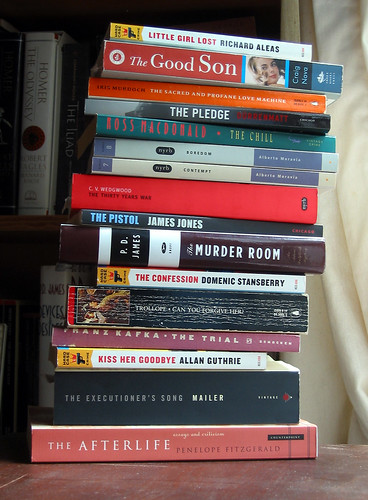
And here's mine:

In case you can't see the books, they are:
Little Girl Lost, by Richard Aleas; The Good Son, by Craig Nova; The Sacred and Profane Love Machine, by Iris Murdoch; The Pledge, by Friedrich Durrenmatt; The Chill, by Ross Macdonald; Boredom and Contempt by Alberto Moravia; The Thirty Years War, by C. V. Wedgwood; The Pistol, by James Jones; The Murder Room, by P. D. James; The Confession, by Domenic Stansberry; Can You Forgive Her?, by Anthony Trollope; The Trial, by Franz Kafka; Kiss Her Goodbye, by Allan Guthrie; The Executioner's Song, by Norman Mailer; and The Afterlife, by Penelope Fitzgerald


2 I thought of another possible organizational system that I didn't touch on the other day: books could be arranged by country. I fear, however, that my collection would replicate nearly all the inaccuracies of the Mercator Projection--though in at least one area I'd do better than Mercator: my utter lack of books by Greenlanders would mean that it would finally appear smaller than Africa. Iceland, on the other hand . . .

3 Speaking of photos of books, Stacey's photo of our Wodehouse books got picked up by The Winged Elephant, the Overlook Pres blog. Because I'm a fan of a couple of Overlook authors, I keep their blog in my reader, and when I opened that post I thought, "Weird. That looks like Stacey's photo." Their headline?
Look How Nice Our Books Look on Your Bookshelves?

Overlook's Wodehouse hardcovers are beautifully designed and produced, so I'm glad we got to help out their marketing staff by providing an example. There are few better gifts than the gift of Wodehouse, and there's no better Wodehouse than the Overlook editions.

Monday, June 25, 2007

The great outdoors


{Photos by rocketlass}

From The Journals of Lewis and Clark, entry by William Clark for Friday, August 23, 1805
proceed on with great dificuelty as the rocks were So sharp large and unsettled and the hill sides Steep that the horses could with the greatest risque and dificulty get on, no provisions as the 5 sammon given us yesterday by the Indians were eaten last night, one goose killed this morning; at 4 miles we came to a place the horses Could not pass without going into the river, we passed one mile to a verry bad riffle the water confined in a narrow Channel & beeting against the left Shore, as we have no parth further and the Mounts. jut So close as to prevent the possibility of horses proceeding down, I Deturmined to delay the party here and with my guide and three men proceed on down to examine if the river continued bad or was practicable.


From The Journals of Lewis and Clark, entry by Meriwether Lewis for Wednesday, August 14, 1805
In order to give Capt. Clark time to reach the forks of Jefferson's river I concluded to spend this day at the Shoshone Camp and obtain what information I could with rispect to the country.


Back from camping, all in one piece.

Friday, June 22, 2007

In the realm of the Oneiroi


{Albrecht Durer, Traumgesicht (Dream Vision), 1525}

From Christopher Dewdney's Acquainted with the Night (2004):
Night comes when you least expect it. You are making dinner or working late, you look out the window and the sky is already dark. The arrival of night can be elusive, mysterious, and in the city we don't often see it, though we always know when it has fallen. In the country night takes its time. A glorious sunset might flag its approach, yet it seems we can never pinpoint its exact arrival. Nightfall is a subtle process.

On the longest day of the year, it seems good to return, however haphazardly, to dreams; with the night losing, for now, its perpetual battle against the day, the powers of the Oneiroi, sons of Hypnos who serve as the rulers of dreaming, are surely at low ebb.

Besides, I'm going away for a few days to the country on a camping trip, and what better inducement to memorable dreams can there be than a night under stars and true, velvety darkness, the distractions of the city left behind?

From Three Poems (1972), by John Ashbery:
it needs pronouncing. To formulate oneself around this hollow, empty sphere . . . To be your breath as it is taken in and shoved out. Then, quietly, it would be as objects placed along the top of a wall: a battery jar, a rusted pulley, shapeless wooden boxes, an open can of axle grease, two lengths of pipe. . . . We see this moment from outside as within. There is no need to offer proof.

I don't actually know whether dream plays a role in Ashbery's writing process, but so often his poetry bears that half-submerged, almost . . . swamp-like quality of a dream, slowed and perhaps logically inexplicable yet organic and right. Proust might argue that it doesn't matter whether dream consciously plays a part. Samuel Beckett explains, in his Proust (1931):
There is no great difference, says Proust, between the memory of a dream and the memory of reality. When the sleeper awakes, this emissary of his habit assures him that his "personality" has not disappeared with his fatigue.


Dream memory, however, necessarily diverges from real memory when we get to the area of prophetic or warning dreams. My favorite of those is a dream from our only known presidential dreamer, Lincoln, a dream so famous that it's simply known as Lincoln's Dream. It comes to us from Lincoln's friend and bodyguard Ward Hill Lamon. In his Recollections of Abraham Lincoln, 1847-1865 (1895) he relates that a few days before his assassination Lincoln told him the following:
About ten days ago, I retired very late. I had been up waiting for important dispatches from the front. I could not have been long in bed when I fell into a slumber, for I was weary. I soon began to dream. There seemed to be a death-like stillness about me. Then I heard subdued sobs, as if a number of people were weeping. I thought I left my bed and wandered downstairs. There the silence was broken by the same pitiful sobbing, but the mourners were invisible. I went from room to room; no living person was in sight, but the same mournful sounds of distress met me as I passed along. I saw light in all the rooms; every object was familiar to me; but where were all the people who were grieving as if their hearts would break? I was puzzled and alarmed. What could be the meaning of all this? Determined to find the cause of a state of things so mysterious and so shocking, I kept on until I arrived at the East Room, which I entered. There I met with a sickening surprise. Before me was a catafalgue on which rested a corpse wrapped in funeral vestments. Around it were stationed soldiers who were acting as guards; and there was a throng of people, gazing mournfully upon the corpse, whose face was covered, others weeping pitifully. 'Who is dead in the White House?' I demanded of one of the soldiers, 'The President,' was his answer; 'he was killed by an assassin.' Then came a loud burst of grief from the crowd, which woke me from my dream. I slept no more that night; and although it was only a dream, I have been strangely annoyed by it ever since.


Even understanding as I do the reasonable questions about the story's veracity--let alone about the purported significance of a man in constant danger dreaming about his death--the chills induced by that dream take me right back to my childhood self, awake in the dark, scared by nightmares. But from Richard N. Current's The Lincoln Nobody Knows (1958), I recently learned of another allegedly prophetic dream ascribed to Lincoln, this one noted by Secretary of the Navy Gideon Welles in his diary:
It occurred on April 14, 1865. That morning Lincoln held a Cabinet meeting, and the occasion was especially dignified by the presence of General Grant, fresh from his victory at Appomattox. The President was hoping for news from General Sherman in North Carolina, where a Confederate army still was in the field. To the Cabinet conferees Lincoln remarked that he had no doubt news soon would come and would be good. For, he said, he had had a dream the previous night. It was a dream he had in advance of almost every important event of the war--always the same dream. In it he "seemed to be moving in some singular, indescribable vessel," and he "was moving with great rapidity towards an indefinite shore."
That night, Lincoln was shot.

I know I risk getting deep into the "And he had a secretary named Kennedy!"-style weeds here, but that dream, too, I find chilling. Yet whereas the first dream, when analyzed, seems a bit too pat, too perfect, this dream is the opposite: it spooks not so much because it seems prophetic as because it seems so vague--so deeply, utterly true to the texture of dream. I can feel the beat of the waves against the bow, see the wisps of cloud and fog obscuring the destination, imagine the odd patience that suffuses the lonely, quiet journey, the way the question of a final destination flits in and out of the dreamer's brain, strongly grasped one moment, lost and forgotten the next.

Imagine if Lincoln had been a lucid dreamer, like the Marquis Leon Hervey de Saint-Denys, who, as Christopher Dewdney explains in Acquainted with the Night, first brought lucid dreaming to widespread attention with his 1867 Dreams and How to Guide Them. Dewdney relates one of the Marquis' stories:
On coming out of a theater, I got into a hackney carriage, which moved off. I woke up almost immediately, without remembering this insignificant vision. I looked at the time on my watch. . . . and after having been completely awake for ten or fifteen minutes, I fell asleep again. It was here that the strange part of the dream began. I dreamed that I woke up in the carriage, which I remembered perfectly well having entered to go home (in the dream). I had the impression that I had dozed off for about a quarter of an hour, but without remembering what thoughts had passed through my mind during that time.
Surely the Oneiroi would be pleased to learn of the Marquis' confusion; at least they would know for sure which Marquis is dreaming and which Marquis is awake.

In looking up the Oneiroi, I learned that one of them, Phantasos, whose name means "apparition," appears in dreams as inanimate objects--which would help to explain those occasional dreams people have where ordinary, everyday items are infused with paralyzing horror. But I don't want to lead any readers to that sort of dream tonight, so I'll close with some more John Ashbery, a bit from Flow Chart (1991) wherein the vaguely ominous dream is held in abeyance:
But at times such as
These late ones, a moaning in copper beeches is heard, of regret,
not for what happened, or even for what could conceivably have happened, but
for what never happened and which therefore exists, as dark
and transparent as a dream. A dream from nowhere. A dream
with no place to go, all dressed up with no place to go, that an axe menaces, off and on, throughout eternity.

Sleep well. If you have good dreams, you might send them off to the proprietors of the Annandale Dream Gazette.

Wednesday, June 20, 2007

The fight against entropy


{Photos by rocketlass}

Alpha by author.
Library of Congress.
Dewey, the mostly discarded and disused.
Alpha by title.
By subject, as defined by your whims.

Short to tall.
Short to long.
Cheap to expensive.


Certain time-based schema
As my friend Marc files his books, by date of acquisition. In other words, rather than always working to squeeze newly acquired books into the space one has previously allotted--a perpetually failing attempt, however innocent, to pretend that one has not fallen all that much farther behind--one simply accepts that the road laid out by books is neverending, and one's progress on it will always be, at best, relative. Therefore: now; then.


Numerically, based on the first number mentioned in the text. The second number, and so forth, to break ties.
Biblically, based on the first biblical name mentioned and its position in the canonical Bible. As usual, the Apocrypha to break ties.


By spine color, in rainbow order.
By spine color, in reverse rainbow order.

Read; unread.
Read; unread; never to be read.
Given; purchased; borrowed; stolen.
Written by friends; written by enemies; written by those to whom one is indifferent.


Certain time-based schema
On every birthday, you pare your library to one book for every year you've lived. The remainder you give to the library. The list of books that seem worth retaining will, of course, change dramatically over the years; certain books will demand recall. It's not, however, a sin for the person who donated a book to steal it back, so long as another book will soon be donated to take its place. Thus: books kept; books donated. Repeat.


The scholar divides his books into known knowns, known unknowns, and unknown unknowns. The scholar is Donald Rumsfeld, and his library is a prison cell in which he is awaiting sentencing for war crimes. He has not seen another human for days.

Satisfying; disappointing.
Repudiated first novels; unfinished works posthumously published; all the rest of a life's work.
Wodehouse; not Wodehouse.


Certain time-based schema
Decades ago, a lover gave you a topless photo of herself, taken by a kind, though surely titillated, stranger as she sunned herself on a beach in southern France. She gave it to you when she left the country, to which she's never returned. One hazy night, you tucked it into a book; in the morning, you knew not which book. Therefore: books you owned as of that night; those you acquired later. The former are never lent without a surreptitious flip through the pages, which quickens the pulse.


Well books; unhealthy books.
By mood, and therefore by color.
Proust; books about Proust; not Proust.


Certain time-based schema
Your home burned, a spectacular conflagration that you were lucky to escape. The only book to survive, which a weary fireman handed to you, still sooty and warm to the touch, was an old edition, inherited from your grandfather, of J. M. Doughty's Travels in Arabia Deserta. You hire an old booksmith to hollow the book, and into it you pour the ashes of your library. Therefore: before the fire; after the fire.


Histories, in order from Herodotus; lies.
Ends; means.
Borges; not Borges. As all books are in some sense Borges, this schema is ultimately alpha by title.

Certain time-based schema
Decades ago, a lover gave you a smudged charcoal drawing of herself, nude, reclining on a divan. It had been drawn by her previous paramour at a time of panting happiness; her giving it to you was a brazen act of betrayal. Though you had no way to know at the time, that betrayal was the first of many, until finally it was unclear who was betraying whom, or for whom. One hazy night, you tucked it into a book; in the morning, you knew not which book. Therefore: books you owned as of that night; those you acquired later. The former are placed in a wooden frame, then encased in concrete. They will not be read.


Numerically, by number of pages.
Numerically, by number of words.
Numerically, by the numbers painted on the books' spines by your blind niece.
A Dance to the Music of Time; the less-coordinated.

Certain time-based schema
Your home burned, a spectacular conflagration that you were lucky to escape. No books survived. The ashes of your library you scatter on your lawn on a spring morning, where they fertilize a profusion of wildflowers. All books you acquire after the fire you immediately place in a hermetically sealed container that you sink to the bottom your moat--water being the only proof, in our chaotic world, against the return of fire. Therefore: before the fire; after the fire.


By last word, arranged so as to tell a coherent--and unexpectedly troubling--story.

The first book you read as a child; the last book you'll read as an old man; the multitude you've forgotten jumbled between; the countless books you'll never have time for strewn at your feet.

Monday, June 18, 2007

Memories of malevolence


(Photo by rocketlass)

Saturday night, Stacey and I had Marc, our old friend from my bookselling days (whom long ago became a minister in the Universal Life Church via the Internet so that he could perform our wedding ceremony), over for dinner to belatedly celebrate his and my birthdays.

As always, it was a great night full all sorts of talk--but always circling back to books. Late in the evening, I asked Marc if he'd ever read Laura Riding:

Marc Only her short stories. They're intense--incredibly oppressive. She could describe a tea party and you'd feel like she was in the teapot. In her way, she's as intense as Dickens.

Me But whereas Dickens is standing over your shoulder manically pointing things out because he thinks they're fascinating and he really wants to make sure you aren't going to miss them, she's directing your attention because she wants to make sure you're looking where she wants you to?

Marc Exactly. Those stories are scary. They'll set your chest hair on fire.

I asked Marc about Riding because all I really know of her is through her longtime association with Robert Graves, which I've mentioned in passing before. As Michael Dirda explains:
[Riding was] a hauntingly strange writer--the young Auden called her the "only living philosophical poet" and acknowledged her influence. . . . Graves admired her poems and started a correspondence that eventually led to Riding's being offered a job as his secretary. As anyone might guess, this was a bad idea. Before long, the two poets were lovers, though [Gates's wife] Nancy didn't seem to mind much. A rocky marriage slowly turned into a steady menage a trois.

From all accounts Riding possessed a charismatic, forceful personality, a superb mind, and a psychological acumen that permitted her to bend almost anyone to her will. . . . Robert once remarked, "You have no idea of Laura's holiness."
Having found what he perhaps had needed all his life, Graves really did seem to essentially worship Riding, but that didn't make their lives together any easier. There followed dual suicide attempts, a move to Mallorca, and, on Riding's part, a temporary (but lengthy) renunciation of sex. Later, the couple spent an extremely stormy, destructive, and mysterious summer in an old stone farmhouse in rural Pennsylvania. As Dirda explains, "No one likes to talk about the weeks that followed."

But someone eventually did. Those weeks form the malefic heart of Once As It Was (2002), a memoir by former New Directions president Griselda Jackson Ohannessian, who with her parents lived down the hill from the Graves-Riding farmhouse. Though the first two-thirds of the book are a remarkably charming, affectless, even naive account of a Depression childhood--one that calls to mind Flora Thompson's Lark Rise to Candleford--the story darkens with the arrival of Graves and Riding in 1939, the summer of Griselda's twelfth year. Of Riding, she says:
I thought Miss Riding a curious sight. She was wearing clothes that seemed to me more like a costume than everyday wear. Maria remembers a sort of elaborate hunting jacket, bright red. She was wearing dangling jewelry and I think she was carrying a parasol or fan. She noticeably had on makeup; one could see the layer of powder on her face. Her looks were intriguing. One didn't usually see ordinary people wearing ankle-length skirts or putting on makeup in the daytime back then. One minute she would seem almost ugly; another, she would look like a regal personage, maybe Egyptian, from long ago. She had very blue deep-set eyes and brown, bushy, wiry hair held back with a headband or a ribbon. Her voice seemed rather odd. She had a bit of a nasal twang and behind her English accent lurked a more plebeian American-city one.
(Graves, meanwhile, "was large and burly and looked as if he had bad breath, as indeed he did.")

Graves and Riding become fixtures at Griselda's parents' house, and it's not long before she begins to notice her parents and their friends falling meekly into line behind Riding:
I did not like the way the other grownups treated her. "Yes, Laura." "Of course, Laura." "You're right, Laura." I did not like Laura's acceptance of their deference. I wasn't comfortable in the heavy atmosphere--all the hustle and bustle, all the talk. Once, when crossing the front lawn, I passed them all sitting in a circle, no one speaking. Then Robert said something and Laura snapped at him. "Be quiet." And he was. I did not like the way either of them had behaved--he subservient, she dictatorial.
The tension builds in the family as Riding extends her control--though she's never able to extend that power to Griselda, which openly angers her. In the manner of Henry James or Richard Hughes, Ohannessian presents the scene through the surprising perceptiveness native to children: though the adults seem to be forcing themselves to deny it, Griselda clearly sees that the situation, suffused with secrecy and malevolence, is becoming untenable. Then one night at dinner Griselda's mother makes her stand:
The meal was almost over. It had not been a pleasant one. Suddenly Ma stood up and announced,
"I am taking the children for a walk."

"Robert will go with you," Laura said.

"No he will not," Ma replied.

"Not now, Katharine," Laura commanded.

"They are my children," Ma replied, "and if I want to take them on a walk, I will do so."

Did Laura say "You will not"? It was at the very least implied. Ma pushed back her chair, got up, and turned toward the door. I had a feeling that I had to stand up to Laura. I stood up, my troops stood too, and we followed Ma.
In the gathering dusk, they walk--and on the way Griselda's mother has an absolutely bloodcurdling breakdown, followed soon after by the first in what would become a decades-long series of institutionalizations.

Griselda, meanwhile, is left with her father and Graves, both completely in thrall to Laura; her confrontation with Riding a few nights later reads like something out of the creepiest of psychological horror novels:
I was stopped in my tracks by a great wave of fear. I was dizzy, there was a buzzing in my ears, I could hardly breathe, I was losing myself, I was going off my rocker. . . . Then I heard the click-clack--Laura's footsteps were always resounding. I knew without a trace of doubt that she was coming and she was coming quickly and I, having moved my bed catty-corner to the door, was trapped. There was no place to hide, no exit. I was cornered and she was coming and I knew she knew the condition I was in. She was going to push me over an edge--that's what I believed and still do.
At the last second, Riding is stopped in her tracks through the inexplicable intervention of what Griselda at the time--and, apparently, for the rest of her life--took to be some sort of higher power. Laura's uncanny power--at least where Griselda is concerned--is broken. At Bookexpo, I mentioned the creepiness of that scene to a woman working in the New Directions booth, and she assured me that Griselda retained that belief in the invisible but palpable workings of good and evil in the world to this day.

Years ago, I remember arguing with a girlfriend about the value of biography as an element of how we understand and judge writers. Back then, young and certain, I took a purist's position, scoffing at the notion that biography could provide any insight into a stand-alone work of art. Now, as evidenced by my love of Javier Marias's Written Lives, I find myself interested in writers' lives not only for what they might teach me about their work, but also, I'm not ashamed to say, on a much baser, near-prurient level as well. The Graves-Riding story is so complicated and fascinating, so shocking, that at this distance, the principals long dead, it has become a sort of work itself--odd and unpleasant, but damned hard to turn away from.

All of which is a roundabout way of saying, anyone read Riding? Is Marc right? Will her stories set my chest hair on fire? And, knowing all this, how can I not give her a try?

Sunday, June 17, 2007

Happily ever after?, part three

Part one is here and part two is here.

An interesting counterpoint to these examples—one that, I think, ultimately supports my thinking—is The Lord of the Rings. If ever there were a saga for which a neat, finalizing ending would be appropriate, it surely would be Tolkien's epic. After all, it's built around a quest and a war: complete the quest and win the war, and the saga is surely concluded. Tolkien gives us what we want, a big, dramatic ending followed by the crowning of Aragorn. The story should end there . . . but Tolkien seems to chafe at that idea. Evil, after all, is never vanquished, good never eternally triumphant, because as Crowley and Powell would surely agree, life—even in this fantasy world—still has to go on.

So instead of The End, Tolkien gives us The Scouring of the Shire. I don't think it's a successful chapter; it's a bit goofy and awkward after all the grand heroics. But it leads directly into what I think is one of Tolkien's most inspired ideas, the sailing of the heroes to the Grey Havens: after some years back at home, attempting to live an ordinary life, Frodo is called away across the sea to a place out of time and—more important—out of the story. For in the course of his adventures he was irrevocably changed, becoming, in a sense, infected with magic, poisoned by the realization that he was a character in a story that has now run its course. Made into a hero, he finds that with his quest over he cannot return to the continuing life of the world:
I tried to save the Shire, and it has been saved, but not for me. It must often be so, Sam, when things are in danger: some one has to give them up, lose them, so that others may keep them. . . . You will . . . keep alive the memory of the age that is gone, so that people will remember the Great Danger and so love their beloved land all the more. And that will keep you as busy and as happy as anyone can be, as long as your part of the Story goes on.
Tolkien’s writing here in keeping with the mythical tradition that requires the death of magic in order for the new, modern world to be born; in addition, it's plausible that he's writing from personal experience about war and the difficulty of a return to normal life. But I think he’s also writing about the vacuum that any fulfilled purpose can leave: having realized what one is to do and done it can leave ordinary life itself feeling like an insurmountable struggle. Tolkien thus manages to satisfy our deep-rooted desire for a saga to have a clear ending while at the same time reminding us that few stories can be so neat. In Middle-Earth, the Grey Havens await those whose stories have run their course, but such rest is not available to the other characters, nor to us: our stories having no clear end, we will simply go on living them.

Even as they divide fans, I think all of these examples argue strongly for the open-ended and indefinite. Perhaps it's just a product of my childhood of reading comic books—surely at this point the longest-running open-ended narrative form—with their eternal promise of a new chapter of the story every month, but I think Aegypt, Dance, and (I imagine, sight unseen) The Sopranos are all surely richer for their creators' willingness to abjure the clarity of a definite ending.

I do realize that this openness is just another storytelling technique. It's as much an illusion as perfect closure would be--but I wholeheartedly prefer it nonetheless, finding it at least a shade closer to true. Plato distrusted art in part because he worried that we would get wrapped up in its illusions and let them blind us to reality. This particular illusion seems the opposite of blinding—I have a hard time believing that any illusion designed to return our thoughts to the inexplicable continuity and multiplicity of real life can ever do anything but deepen, widen, and strengthen our appreciation of the world. What better use could be made of the imagination?

So in lieu of an end, I'll leave you with some Robert Burton, the passage from The Anatomy of Melancholy that Powell makes for Nick Jenkins a sort of key and touchstone:
Now come tidings of weddings, maskings, mummeries, entertainments, jubilees, embassies, tilts and tournaments, trophies, triumphs, revels, sports, plays: then again, as in a new shifted scene, treasons, cheating tricks, robberies, enormous villainies in all kinds, funerals, burials, deaths of princes, new discoveries, expeditions, now comical, then tragical matters. Today we hear of new lords and officers created, tomorrow of some great men deposed, and then again of fresh honours conferred; one is let loose, another imprisoned; one purchaseth, another breaketh: he thrives, his neighbour turns bankrupt; now plenty, then again dearth and famine; one runs, another rides, wrangles, laughs, weeps, &c. This I daily hear, and such like, both private and public news, amidst the gallantry and misery of the world; jollity, pride, perplexities and cares, simplicity and villainy; subtlety, knavery, candour and integrity, mutually mixed and offering themselves.

Saturday, June 16, 2007

Happily ever after?, part two

Part one is here.

My favorite novel, Anthony Powell's twelve-volume A Dance to the Music of Time also suffers from this same conflict between expectations and, for want of a better term, artistic integrity: many readers—even among Powell's biggest fans—find the ending of the sequence disappointing.

Over the course of three thousand pages, Powell's narrator, Nick Jenkins, gives us entree into the lives of dozens of characters as they move about in English high society through the first sixty or so years of the twentieth century. Jenkins and his friends and acquaintances grow up, meet, marry, have careers, live through (or die in) a war, and generally make their way in the world. Patterns repeat, characters recur, themes are drawn out, but the overriding sense of the novel is that time moves on, and we all are swept along in its currents—able, if we're lucky, to occasionally catch hazy glimpses of our hoped-for destinations.

More than any other novel I can think of, A Dance to the Music of Time thrives on the constant change inherent in real life, but Powell's willingness to accept change—in fact, to present it as his ultimate theme—leads, I think, to some of the frustrations people feel with the book’s closing volumes. Following the novel's undoubted high point in the war volumes, Powell closes the sequence by grappling with the first rumblings of the counterculture, which seem to put him off his footing a bit. His perceptions of the nascent New Age movement seem received rather than fully considered—even as he nicely links it to the spiritualism craze of Nick’s parents’ generation—and his overall understanding of the younger generation and their motivations seems a bit thin in comparison to his keen perceptiveness about his own cohort.

But though I accept that as a failure on Powell’s part, I still think that that distance and lack of clarity can be seen to make sense within the structure of the story. Dance is, after all, built around its narrator’s life, and as Nick ages, Powell allows him—and his story—to draw in a bit. Nick moves to the country and begins to circumscribe his life, as people tend to do as they get older. Always more an observer than a participant, he is now more than ever separate from the action he relates, no longer in the thick of the artistic and cultural moment as he was when young. As his friends and acquaintances move away, retire, or die, their positions are taken up by people whom Nick cannot possibly know as well. If he fails to fully apprehend this new generation (and their movements), isn’t that typical of the playing out of a generational shift? Powell could have artificially kept his older, more established characters at the center of the action and forced some sort of climax. Instead he simply allows us to watch them yield the floor, watch as the world Nick has known—and in which he has a defined place—begins its slow fade.

At the same time, the change has to do with more than just the misunderstanding of youth by their elders; as with so much else in the novel, it is also bound up with time itself. Like Nick, we fervently miss the old characters, while the new characters are not with us long enough to acquire the force of their antecedents. We simply don’t have time to get to know them as well. But that, too, is like life, I suspect: dominated by the intense friendships of youth, we seem never to have quite enough time for those we encounter in later life. And in that sense, even the less-memorable characters of the later books represent one of Powell's greatest strengths, his exploration of the ways in which friends and relations leave the stage of our lives, their places—if not their actual lines—eventually filled by new people; understanding and coping with those inevitable changes is one of the great challenges of life.

Dance does have a logical end point—the death of Jenkins's perpetual antagonist, Widmerpool—and Powell uses that death to bring the novel to a close, if not to the climax many readers are looking for. (In the style of Greek tragedy, Widmerpool's death happens offstage; like so much else in the novel, we hear about it rather than see it.). Jenkins dips into Burton's The Anatomy of Melancholy (an infinite book if ever there was one), and, sustained by its fecundity, its sense of the overwhelming richness of human existence, he reflects, looping back to the thoughts on time and the seasons with which he opened the book. We get no closer to an ending than the reminder Burton provides that this pageant has happened before, with different names and faces, and that through those we leave behind it will certainly happen again.

Despite surely realizing that for many readers this ending would rankle, Powell resists anything more neat. We never learn even the whereabouts, let alone the fates, of dozens of characters, major and minor. Instead we are left with, essentially, an affirmation of Powell's themes: while we seek for—and can find—patterns in our lives, the overall weave is too complicated to fully comprehend, and the skein is forever being rolled out in front of us, unknowable. Powell will provide no ultimate summing up because there can be none; all we can do is look closely and tell the story as we see it happen.

A final installment tomorrow, including, believe it or not, some thoughts on how I see this sort of ambiguous or forward-looking ending playing out in The Lord of the Rings.

Friday, June 15, 2007

Happily ever after?, part one

I’ve never seen The Sopranos, but from the inescapable coverage of last weekend’s final episode I get a sense that the show ended, not with a big denouement in which loose ends were tied and story lines wrapped up, but instead with openness, ambiguity, and a sense that tomorrow would be another day for the characters, even if we wouldn’t be around to see it. [People who’ve actually seen the episode: am I right?]

It seems that a lot of viewers, maybe even most, didn’t like that. They felt cheated, felt that their seven years of devotion had earned them the right to expect some clarity and certainty—maybe even closure—which is understandable. All stories lead us to expect an ending, but lengthy sagas tend to raise those expectations even higher: by their very scope they seem to implicitly promise to draw out for us life's hidden patterns--to organize and explain what appears to us every day as life's messiness. Perhaps better than any other fiction, long-form works meld our desire to understand characters and our desire to know what happens next; in the best of them, the two impulses eventually become indistinguishable. To keep our attention on both points over time saga creators toss countless balls into the air, and our natural impulse is to expect to eventually see each one safely caught again. We've been given something so great and capacious throughout the story that, as an enthralling saga nears its end, we hope for--even demand--something even bigger and greater as a proper send-off.

Yet at the same time if there is any fictional genre that should resist the temptation to tie things up neatly, to explain, or to deliver an anticipated payoff, it's this one. What is a saga or serial narrative after all but an acknowledgment that life doesn't fit in convenient packages, and that to understand it we must study at it at length and over time? What is it but an acknowledgment that every story we start to tell, if we're honest about it, begins immediately to spiral--if not out of our control, then at least to the very limits of it? More characters must be introduced to help us understand those we've seen, but with each new character is introduced a new story, whose end points, to the extent that they can be defined, are not necessarily the same as those of any of the other stories we're following.

Within a truly expansive and open saga, all that holds these multiple tracks of story and character together is a shared sense of the unstoppable forward motion of time. Given all that, there's nothing more artificial to the form than a final act that wraps up the story, distributing rewards and meting out punishments. More in keeping with the sense of real life that many long-form narratives are trying to convey would be something like what it seems the creators of The Sopranos have done: a pan away rather than a closing curtain--an insinuation, at least, that these lives will go on even after the cameras are gone.

As I've written about briefly already, a similar sense of frustration seems to have afflicted at least some readers of John Crowley's Aegypt sequence. They argue that after raising high expectations by suggesting in the early volumes that Pierce Moffett really might discover some long-lost occult wisdom with which to transform the world, in Endless Things Crowley essentially reneges on his promises. Instead of discovering secret wisdom, Pierce stops questing and settles down to live a quiet life as a husband and father, as close to content as he'll ever be. I've written already about why I think that ending, though unexpected, fits with Crowley's overall design and is the right one for the book--but even as I disagree with the disgruntled readers, I don't really blame them for wanting more. If a saga by its nature sets up grand expectations, then one in which the author hints broadly about hidden sources of secret wisdom would seem to promise even more of a payoff. By ending the story as he does, Crowley is essentially telling readers that Aegypt is, if they look closely, not the book they thought it was--it's a different (and, I would argue, deeper) one, offering not answers to mysteries but a reminder of why those mysteries, and the stories humans have invented to explain them, seem important in the first place. His frustration of our intentions is intentional (and, to be fair, reasonably well foreshadowed), but I could imagine it being deeply maddening nonetheless.

More tomorrow, including thoughts on how this applies to Anthony Powell and A Dance to the Music of Time (which, thanks to a suggestion from Ed (of The Dizzies), is where this all started).

Wednesday, June 13, 2007

Hard Man

The best way to describe Allan Guthrie's new crime novel Hard Man (2006) is with one word: Ouch.

Guthrie fills his story with almost non-stop violence. Page after page and scene after scene, people are getting hurt. We see them punched, kicked, elbowed, kneed, and head-butted. They get their heads cracked against the floor, and they get their heads cracked against the wall. They get stabbed, with big knives and small, knives that are designed as weapons and knives that are designed for cooking. They get hit with hammers and shot with nails--and, of course, bullets.

That should, by all rights, make for a terrible book, troubling and wearing in equal parts. But it doesn't. Hard Man is a solid crime novel, dramatic and fun--even funny--because Guthrie creates distinctly odd and memorable characters, by turns grotesque and believable. And he has a flair for the short sentences and terse language of the crime novel; here's how the book opens, for example:
Another hot day in July. That was four in a row. Pretty good for Scotland.

Not so good for the corpse in the boot.


The orgy of violence Hard Man is set into motion by a father who decides that he and his two sons, bottom-feeding Edinburgh crooks, need to scare off his teenage daughter's estranged husband, who has been making vague but disturbing threats. Like many of the characters in Guthrie's three novels, they overestimate their own fighting skill--and, perhaps more important, their own toughness. See if you can find the flaws in the father's thinking here, as they wait for their young, strong, and violent prey to answer his door:
Jacob had glanced at his sons, nodded, then rang the doorbell. He slapped a wrench against his open palm while he waited for an answer. Oh, aye. They were all tooled up, they'd handle Wallace no problem, reputation or not. He was only one man against three, and those three were Baxters. Admittedly Jacob wasn't a huge threat by himself, cause, well, he was sixty-six years old and not as fleet of foot as he once was. Flash, to be fair, was even less of a threat: skinny, small--not to be cruel to his younger son, but the word Jacob was looking for was "weedy." Rog was a different story. Hard to believe those two boys had the same parents. Rog was a big lad, weighed over twenty stone, gripped that hammer proudly in his massive fist, and Jacob felt pretty safe standing next to him. Rog was a bouncer. He was used to this kind of thing. And the suit Rog insisted on wearing all the time worked in his favor. Aye, Rog meant business in more ways than one.

Jacob was sure Wallace would cower in front of their combined might.
You of course won't be surprised to learn that Wallace does no such thing; when you learn that Rog is actually a bartender rather than a bouncer, you won't be surprised that Wallace gives all three a solid beating.

So the men turn to Pearce, who was the main character in Guthrie's Two-Way Split (2004) and made a cameo in his Kiss Her Goodbye (2005) (both of which I've written about before. Pearce is the center of this book, too, the real reason, aside from the action, humor, and grotesquerie, to keep reading. Unlike the three Baxters, Pearce is the real thing, a true hard man--but he has reached a point in his life when he's pretty sure that's not what he wants to be. All his life, he's responded to problems with violence--a method that, in some ways, has worked for him. But in Two-Way Split we saw him, fiercely pressed physically and emotionally by circumstances, attempting to control his violence; his acts of kindness--even heroism--late in the book suggested that he might be able to find a way forward. As Hard Man opens, Pearce is living quietly by the seaside in Edinburgh, alone except for his newly adopted three-legged dog, and trying to figure out what he'll do once his small stash of money runs out.

So when the Baxters offer him the job of guarding the girl (with implied roughing-up-Wallace duties), he's not interested. Following their own bizarre logic, they decide to kidnap his dog, and the ploy works. Before long, Pearce has been sucked into the inimitably incompetent world of the Baxters, and he soon finds himself up against Wallace--who, it turns out, is a much scarier man than anyone thought, and possibly a much harder man than Pearce himself, because he seems to have little of the human left in him. Pearce fights Wallace, Wallace fights all the Baxters, and a lot of people get grievously wounded as the story rushes to a bloody climax.

Guthrie revels--I really think that's the only word that fits--in exploring what his characters do and think about once they've been injured: the Baxters, in particular, resemble characters in Kafka or silent cinema, always leaving one thing half-done as they rush off to try to do another that's suddenly occurred to them, racing around Edinburgh bloodied and broken and trying, with their pain-clouded brains, to figure out what to do next. He also clearly loves the slang of Edinburgh low-lifes, larding the conversations of his characters with unfamiliar terms. I didn't start making notes until midway through the book, but even so I picked up quite a few good ones: girning, cowped, fiky, plonker, horsetosser.

Hard Man would almost be worth reading just for the novelty of the slang; add in the odd characters and the still-compelling figure of Pearce, and you've got a strong crime novel. It can be excruciating, but it's also frequently so over-the-top as to be hilarious--I probably laughed guiltily about as often as I gasped in horror. That certainly doesn't make for a book you would lend to your mother-in-law--but what self-respecting crime novelist would want anything less?

Monday, June 11, 2007

Some reading notes, sans theme


[Photo by rocketlass]

1. About half of Stacey's photos of me are of me reading. Seems about right.

2. On the L Friday on my way home from work, I sat next to a man who was reading a beat-up old mass market paperback of Sister Souljah's The Coldest Winter Ever (1999). Every time he turned a page, he would press the book open until its two garish covers touched, then return it to a normal reading position. It was a perfect demonstration of why I cringe any time I look at mass market paperbacks in a used bookstore.

3. Like a lot of (white?) folks, I mostly know Sister Souljah from Bill Clinton's opportunistic use of her in his 1992 campaign. Her Wikipedia entry notes that The Coldest Winter Ever was her first novel and that it was praised by the New Yorker; the book's Amazon page, however, features celebrity librarian Nancy Pearl saying that "although the novel's writing is amateurish, the message is sincere." Amazon also reveals that the book contains the following statistically improbably phrases: bad bitch, drug game, difference between writers, Long Island, Slick Kid, House of Success.

Given the countless novels set in New York, how many times does a writer have to use the phrase "Long Island" in order for it to be statistically improbable?

4. While I'm on the topic of books marketed at an African American audience: a while back, also on the L, I saw a woman reading a novel called Thong on Fire (2007), which I learn from the Internet is subtitled "An Urban Erotic Tale." Now, being a man, perhaps I don't have standing to weigh in on this, but wouldn't fire be among the last things one would want to associate with a thong?

5. If, like me, you enjoy noting what people on the train around you are reading, you'd probably enjoy Seen Reading, a blog by a woman in Toronto who notes what people are reading around her, makes a guess of what page they're on, then, after going to the bookstore and reading that page, draws on what she finds there to write a bit of speculation about the person and their day. It's well worth your time.

6. A last note on the the topic of things thought on the L: as I sat on the L this morning, I was working through this post in my mind, thinking about how I would have to make sure to include the story of the odd conversation I had at the Printer's Row Book Fair yesterday:
After studying the books for sale at my employer's booth for a bit, a woman said to me, "Why don't you have any good books?"

To which I, reasonably, replied, "We do--all of these books are good." For emphasis, I accompanied my confident statement with a sweeping gesture that encompassed the dozens of books on offer in front of me; we had, after all, only brought good books.

"No," said the woman, emphatically. "I mean good books--ones that are written by Sports Illustrated!"

To which I had no response.

But as I sat on the L thinking about how bizarre this exchange had been, it slowly dawned on me that it had never happened: I had simply dreamed the whole thing.

Which does, however, give me a good excuse to point you to the Annandale Dream Gazette, a virtual dream aggregator that should be in the Google reader of all dream fans.

7. From dream to nightmare: remember learning about Valley Forge in grade school? What I've learned this week from John Ferling's compulsively readable Almost a Miracle: The American Victory in the War of Independence (2007) is that Valley Forge was far worse than we were probably taught. Due to a variety of failings on the parts of the nascent Congress and the poorly (and, to be fair, hastily) organized Army, along with some plain old bad luck, the Continental Army ran out of most supplies almost the instant they made winter camp at Valley Forge. Ferling's description of the conditions for the enlisted men rival the horrors faced by Napoleon's army as it fled Moscow, so vividly and terrifyingly described by Adam Zamoyski in Moscow 1812 (2004). Ferling puts Washington's army's suffering in perspective:
Upward of 2,500 of Washington's men perished that winter, very nearly one man in seven of the Continentals that were with him late in December. (In contrast, about one American in thirty who were involved in operations in the Battle of the Bulge died in battle).


8. Relating events earlier in the war, Ferling describes the British government's surprise at the Americans' strong showings in early battles thus:
Incredibly, [Prime Minister] North's government had led Britain into a faraway war without a plan for waging it. All along it had presumed that the Americans would back down when faced with British force. The government also believed that if the rebels were so foolish as to resist, their army could not possibly be a match for regulars. It, and the rebellion, would be crushed in short order.

Okay, fellow contemporary Americans: any of that sound frustratingly familiar?

There's also another reason the Revolutionary War is important to remember right now: the American military's longstanding tradition of treating prisoners with justice was originated by George Washington's army, who understood the necessity of treating one's vanquished foes with humanity and dignity. The Bush administration's repudiation of that heritage is one of the blackest stains on its reprehensible record.

9. One of the strengths of Almost a Miracle is Ferling's eye for the odd story or detail that makes this long-ago conflict come alive--makes it become human again, even when it's horrifying. Here, he tells of a foraging operation in the Valley Forge winter where a conscript, John McCasland, and fifteen comrades
were sent on a patrol to search out Hessians who were suspected of being in the area. They found them occupying "a large and handsome mansion house," and discovered, too, that the Germans had posted only a single "large Hessian" outside as a sentinel. The guard had to be disposed of before the others could be taken, but no one wanted "to shoot a man down in cold blood." After some debate, those who were thought to be the best shots drew lots to determine whose job it would be to take out the sentry. McCasland won (or perhaps lost) the draw. While he readied himself, the others surrounded the house. Finally set, McCasland decided that he would not shoot to kill, but instead fire "to break his thigh. I shot the rifle and aimed at his hip," he remembered. The shot struck a tobacco box in the soldier's pants pocket, ricocheted and entered his leg "and scaled the bone of the thigh to the outside." Hearing the shot, the other Hessians immediately decided that they were heavily outnumbered and must surrender. As none spoke English, one "came out of the cellar with a large bottle of rum and advanced with it at arm's length as a flag of truce." The sixteen Americans took twelve Germans prisoner "and delivered them up to General Washington."

Sunday, June 10, 2007

Hot town, summer in the city

One can rarely go wrong by starting a post with Samuel Johnson:
No wise man will go to live in the country, unless he has something to do which can be better done in the country. For instance, if he is to shut himself up for a year to study science, it is better to look out to the fields, than to an opposite wall. Then, if a man walks out in the country, there is nobody to keep him from walking in again: but if a man walks out in London, he is not sure when he will walk in again. A great city is, to be sure, the school for studying life.

As usual, Dr. Johnson is right. The city is, doubtless, man's proper environment.

My afternoon began with some reading in the breezy quiet of the lakefront park, interspersed with some napping. Then by bike to the Printers' Row Book Fair, where I spent a few hours working my employer's booth and enjoying customers' excitement at discovering books on Chicago that they didn't even know existed.

I returned home to spend a few last hours of daylight sitting on the back steps reading about the American Revolution. I had intended to listen to the Cubs game while I read, but a party at the house four doors down was hosting a backyard party featuring a satisfyingly loud and effervescent Tejano band, so I enjoyed that instead, marveling not for the first time at the cultural conjunction that led a Spanish-language music to be built around the accordian and polka rhythms.

Looking across the yard of our next-door neighbors, I saw that their ten-year-old daughter, Grace, was sitting on their back steps at the same height as me, reading, as her golden retriever thumped her tail at her side.

"Hi Grace," I said. "What are you reading?"

"Marley and Me," she replied.

"Have you been warned that it gets really sad later?"

"I know. I'm ready for it."

My duty done, I returned to the American Revolution, the Tejano band bounced away in the background, and another summer day floated away.

Saturday, June 09, 2007

It's so nice to go trav'ling . . . ?


[Photo by rocketlass]

Because it seems I've been doing more than my share of traveling lately, I offer up some notes on getting around.

From Almost a Miracle: The American Victory in the War for Independence (2007), by John Ferling:
Little time passed before it was evident that the leadership had grossly underestimated the difficulties that would be confronted in the wilds of Maine. Within the initial three days--over a fifty-mile stretch that drew the army well beyond Maine's last settlement--the soldiery came on a succession of churning rapids and disquieting falls, including some "very bad rips," as one soldier noted, which resulted in far more portaging than had been anticipated. . . . The men were wet constantly--"you would have taken" them for "amphibious Animals," [Benedict] Arnold wrote to Washington--and the night temperatures routinely plummeted below freezing. Each morning the men awakened, said one, to find their clothing "frozen a pane of glass thick." Before he had been in the interior of Maine a week, Arnold reported the "great Fatigue" of his men and quietly worried over whether he had brought along a sufficient supply of food and blankets. The men grew concerned as well, not only about the dwindling supplies. They "most dreaded" the cold, fearing not only disease, but anxious at their fate should they fall on ice and fracture a leg or hip while deep in the wilderness.


Well, maybe it's better if one keeps out of the wilderness (let alone the Continental army), sticking to cities instead?

From Hubbub: Filth, Noise, and Stench in England (2007), by Emily Cockayne:
In a few cases [of deadly road accident] the driver was found guilty of causing an accident by failing to pay due care and attention. The attitudes of the carters and coachmen were questioned. In particular, commentators complained about the lackadaisical way the drivers positioned themselves on their vehicles so that they could not easily see the road ahead. It was recorded in 1692 that "most of the carters, Carmen, and draymen that pass and repass with their several carts, carriages, and drays through the public streets, lanes and places [of London and Middlesex] . . . make it their common and usual practice to ride negligently on their several carts." Often nobody guided the horse, "so that oftentimes their horses, carts, carriages, and drays run over young children and other their Majesties' subjects, passing in the streets about their lawful occasions, whereby many lose their lives."
It seems that at least one recognizable type of driver-for-hire has persisted through the centuries; imagine how much more imperiled the lives of those seventeenth-century Londoners would have been had their draymen had cellphones on which to chatter away throughout their shifts.

Speaking of which, Stacey saw a cabbie yesterday who would, I think, have done well in the rough-and-tumble of seventeenth-century London: after his running of a red light led to his cab blocking an intersection, he was verbally assailed by a stuck motorist--which he took as an occasion to, after shouting to his far, "Hold on!", get out of his cab and go fight the other motorist. The last Stacey saw of the incident was some police cars heading that way, lights flashing.

So maybe a train would be a better idea?

From a letter from E. B. White to Henry Allen of 22 February, 1955 telling about White's attempt to catch a 6:30 train,collected in Letters of E. B. White (1977, 2006):
I looked at my watch again and it said 6:31. We screamed into the station yard, jumped out, and the engineer saw us coming and I guess he took pity on me. They had the train all locked up, ready to go, the bell was ringing for the start. The taxi driver grabbed my bags and whirled down the platform, and I trotted behind , carrying my fish pole and the Freethy lunch box. The trainman saw this strange apparition appearing, and he opened up the coach door. I plunged on board and the driver threw the bags on, and away we went. I had no ticket, no Pullman receipt for my room, just a fish pole. For the next hour or two, I was known all through the train as "that man." But the porter got interested in my case, the way porters do, and he stuck me in the only empty bedroom and told me to sit there till we got to Waterville. The conductor stopped by, every few minutes, to needle me, and between visits I would close the door and eat a sandwich and mix myself a whiskey-and-milk, in an attempt to recuperate from my ordeal. At Waterville, the conductor charged in and said: "Put on your hat and follow me!" Then he dashed away, with me after him. He jumped off the train and disappeared into the darkness. When I located him in the waiting room he looked sternly at me and said, "Are you the man?"

"I'm the man," I replied.

"Well," he said, "go back and sit in the room."
Then planes, and luxury travel--being met at the airport and whisked away to a spa and all that instead.

From a letter from Jessica Mitford to Robert Truehaft of November 15, 1965, collected in Decca: The Letters of Jessica Mitford (2006):
I arrived more dead than alive, the plane being 2 hours late in the end. Shall draw a veil over that. Was met by a gliding lady (they all glide here, rather than walk) and driver. The latter drove me here, the glider having to leave and fetch another arriving flower. As you can imagine, I was pretty well sloshed by the time the plane finally downed.
Ultimately, perhaps the key is not to care about the mode, but just to set oneself into motion and hope for the best. I'll leave that for James Laughlin, who in the following note from his sort-of-autobiography, The Way It Wasn't (2006), seems not much to care about the details of his upcoming trip--and while I suppose such blithe unconcern is easier for a wealthy heir than for the rest of us, his approach does seem likely to be satisfying.
I am going to see Gertrude Stein for a few days on Friday and then I am going to Lausanne -- Basel -- Freiburg -- Strassbourg -- Stutgart (H. Baines) -- Wurzburg -- Erfurt -- Leipzig -- Dresden -- Prague -- Brunn -- Bratislava -- Budapest -- Vienna -- Linz -- Salzburg -- Ljubljana -- Zagreb -- Dubrovnik. What all this will add up to is not known, but if I write a poem in each place, I shall have had some practice in this matter.
Or I suppose you could travel by not traveling at all, as seems one explanation of an image featured in a show that Luc Sante's currently curating at apexart, The Museum of Crime and the Museum of God. It's an old black-and-white print that incorporates two photos, the larger one showing a black man in clerical robes waist-deep in a wide, muddy stream, an "x" scratched into the print near him.. The caption, apparently typed on it at the time the photo was printed, reads:
Reverend C. H. Parrish, D.O., standing in the River Jordan, April 13, '04, a short distance from the place where John the Baptist baptized the Saviour. See cross-mark.
The inset photo shows the same man in the same robes standing under a tall, thick, knobbly tree, and the caption reads:
Dr. Parrish standing under the Oldest Olive Tree (1800 years old) in the Garden of Gethsemane, April 16, '04.
Meanwhile, the print itself is captioned thus:
Photographed while attending the World's Fourth Sunday-School Convention, held at Jerusalem, April 18, '04.
All of which would be fine except that the two photos are obvious fakes: the man, who is exactly the same in both photos, has been cut from a different photo and pasted in place. In the river photo, he's been cut in half to show that he's partially submerged, while the olive tree photo presents him whole.

Now, perhaps there's a reason for this fakery. Perhaps the Reverend Parrish's photos from the Sunday-School conference simply didn't turn out, and he felt that a little cut-and-paste work would be more likely to draw his parishioners closer to holiness than seeing nothing at all from his trip. But what if that's not the case?

What if the Reverend Parrish didn't go to Jerusalem at all? Presuming that his parishioners paid for his trip, just what, this hundred years on, do we think he actually did with the money? Did it go to a lady friend in dire need of mink? Was it laid on a can't-miss horse? Or did it support a trip to some lesser locale than Jerusalem--someplace far less exotic, historical, and sacred, but for all that far more congenial, hospitable, and fun? Someplace like Atlantic City?

Oh, that's probably enough speculation for a lovely summer Saturday. I'll let Sammy Cahn close it out, with the end of his "It's Nice to Go Trav'ling":
It's very nice to be footloose
With just a toothbrush and comb
It's oh so nice to be footloose
But your heart starts singin' when you're homeward wingin' across the foam.

It's very nice to go trav'ling
But it's oh so nice to come home.
As Frank himself might say, ain't that the truth.

Thursday, June 07, 2007

John Crowley on the ideal reader


To cap my recent spate of blogging about John Crowley, I'm stealing something from Crowley's own blog. I steal with the best of intentions: Crowley posted the bit I'm stealing in a comment thread, and then he warned readers who haven't read Endless Things away from the thread, because some of the comments there reveal key details of the book's plot. Yet Crowley's comment--which was presumably written off the cuff, in response to what he rightly called a screed posted by a disappointed reader--deserves more attention than it's likely to get languishing in a comments section. Not that this blog is as widely read as Crowley's (Technorati, for example, puts a distance of about 1.5 million blogs between us), but I believe comments aren't indexed by Google, so lifting it to a searchable space may prove to be at least a small favor to Crowley's readers.

The reader who prompted Crowley's comment was deeply disappointed--even offended--by Endless Things, the resolving volume of the Aegypt tetralogy. He felt that Endless Things failed to deliver on the promises of the earlier volumes; Crowley's intentional shattering of some of the myths and patterns of the earlier volumes felt to him like a cop-out, even a betrayal. The reader's heartfelt question to Crowley was: what does an author owe his readers? Does he have to deliver on expectations? Does he have to make his purpose clear? Does he have to satisfy?

Crowley responded:
As to the general question of what I or any writer owes to readers, I would say that to the entirety or generality of them I owe nothing: the idea that I could aim to, say, please or satisfy anyone or everyone who (misled or misdirected) plunks down $25 for a book of mine is unintelligible to me: how could I even begin to think about that? The reader I aim to please, satisfy, move, mystify (pleasurably), delight and otherwise give good value to is not anyreader or everyreader but a sort of nonpersonal yet quite specific entity with whom I have been conducting a relationship or agon for years. You could call him or her or it my Ideal Reader. I know certain things about this personage: he (he is ungendered but needs some sort of pronoun) shares my particular sense of humor; he understands my cultural references and is alert to my distortions or play with them; he can pick up a few Latin tags; he cares little for politics (at least in fiction, where alone I know him), is generous even if orthodox in religion, does not divide the world into good and bad, or powerful and powerless, or stupid and smart; he enjoys playing complicated literary games with smart fair authors, and always supposes that what is asserted by the author is not always the case; enjoys (like Pierce) the sudden transvaluation of values called peripeteia, whether in jokes or tragedies; and oh many other things. I do not expect him to know my personal history; I do not expect him to have knowledge of my book before he has read it (as I do) or to grant me the leeway he would a friend or a sibling or a son, or give me credit for trying when I did not succeed in achieving. I am aware he may be smarter than I am, and see my faults more clearly than I do myself, which makes me cunning. Him I set out to please; will give my all to please; his pleasure is my own. I can't know, of course, if I do: I can only know whether to some extent I have pleased actual readers, or displeased, as in your case. To some extent some readers approximate my ideal, which delights and gratifies me; none matches it. They will all have to fend for themselves. No refunds.


Nothing in Crowley's statement is particularly groundbreaking or revolutionary--in fact, a similar philosophy has probably driven writers since they shed their overt patrons a couple of centuries ago--though Crowley does seem to have taken the idea of an ideal reader seriously, investing him with the love of literature, history, and religion that Crowley himself clearly enjoys. The very act of imagining an ideal reader, then setting words free on a page despite knowing that one's actual reader will fall short of that ideal is a significant part of the drama of making art, nearly as significant as the realization that one's art itself will always be far from perfect.

Far more important than the specifics of Crowley's statement is its very existence. That Crowley fans are now able to keep these words in mind--to agree with or argue with--as we read his books in the future (and agree and argue with them), is such a happy accident of this still-new medium that it deserves to be celebrated. As has happened countless times before, a reader finished a book, frustrated, and had questions. But this time he was able to put those questions instantly in front of the author--and get a response. A reply like Crowley's, though certainly not something an author owes his readers, does seem like a wonderful repayment of the time a reader--however intemperate--has committed to his book.

Later in the thread Crowley actually posted a brief "key" of sorts to Endless Things, which is the real reason that someone who hasn't yet read the book should avoid the thread. But if you have, and you're curious about Crowley's thoughts about his own work and purposes, it's well worth checking out; I'm heartened to find that it jibes in large part with my own take (and that of Christopher R. Beha in Bookforum). Unless, that is, Borges was right in his story "August 25, 1983," and
Every writer sooner or later becomes his own least intelligent disciple.
In which case, Crowley's wrong and so are we, and you'll just have to read Endless Things and make up your own mind. Which is what you were going to do anyway, wasn't it?

Tuesday, June 05, 2007

Reading Simenon in an airport

I've written before about the difficulty of selecting books to carry on a trip, and yesterday I decided that I may need to add a new categorical consideration to my pre-trip book packing: I should always pack a slim and claustrophobic novel to read in case of airport delays.

The needs of an airport reader, after all, are different from those of an airplane reader. The oppressive open-endedness of an airport delay also argues for the short novel over the epic or Victorian: unlike plane reading, which is conducted in full knowledge of its end point, airport delay reading should, if the reader wishes to stay sane, inherently reinforce the idea that he and his fellow passengers will surely be leaving soon, O'Hare's vagaries and incompetencies be damned. And the more claustrophobic and involving the narrative, the better, as few places are less conducive to reading than an airport full of delayed passengers; poetry won't long survive the blither-blather of CNN, the fuckery of Fox, and the soul-sucking cell-phone addictions of business types. A perfect airport delay novel will seamlessly trade the oppressiveness of the modern lounge for its own form of oppressiveness, escaped only at the turning of the last page--at which point, if the stars have aligned, your plane will be ready.

All of which leads to my nomination of Hesperus Press and the matchless New York Review of Books Classics line as the official publishers of airport delays. All of Hesperus's titles would fit the first criterion, as would a number of the NYRB's, while both lists are thick with murky foreign settings, eerie tales, and hideous crimes conducted under cover of darkness (or, in the case of Ivy Compton-Burnett, the thinnest veneer of politeness). Now if only I can get all the Hudson News stores to agree with me, the world of the airport will be a much better--if far more sinister--place.

Yesterday, trapped by rain at La Guardia, I occupied myself with Hesperus Press's recent translation of Georges Simenon's Three Crimes (1938). Simenon has been enjoying an English-language renaissance lately through the help of both of the aforementioned presses, and Three Crimes could be the model airport delay book: it's only 125 pages long, thoroughly sordid, and just fragmented and disjointed enough to require real attention. Three Crimes tells the story of a pair of men, friends of Simenon in his youth, who later committed violent murders, one man of his wife and mistress, the other of his mistress, his mother, and his former Jesuit confessor. There is almost no plotting to the book; Simenon is far less interested in the how of a murder than in the unfathomable skein of whys that led to it. So he opens with details of the murders, then slips back into his energetically dissipated youth in Liege and his adventures--which range from teenage seductions to vague black magic--with the murderers-to-be, in search of the roots of their crimes:
Why? How? Where should one begin, since there is no beginning, nor any other link, over the years and across space, between three crimes, between five or six deaths and between a handful of the living, except for myself?

I seem to hear Danse's voice, in the strange Court of the Assizes in Liege, pounding out the words, "When I was four years old my mother took me to the countryside, and there, in a farmyard, I saw a man killing a sow, first with a hammer, and then by slitting its throat. . . . "

When he was four years old, I did not know him; I wasn't even born. What is more, I wasn't there when, forty years later, in a small house in the French countryside, he killed his mother and his mistress in exactly the same way he had one seen a sow being killed.

. . . .

Three crimes! It's easily said. But before them?


The novel is formed around, and returns obsessively to, the fact of Simenon's once-close connection to the murderers and the question of why he, having shared with them so many of the same adventures and vices, did not like them become a killer. Ostensibly, he is glad to have been spared that outcome and is truly marveling at the workings of fate--but at least a hint of disappointment at his comparatively ordinary life seeps through. Any lifelong student of what is found creeping around under rocks is bound to wonder about the seductions of that life; it's hard not to see Simenon throughout Three Crimes imagining himself as murderer--maybe even, in the unwritten spaces between lines and pages, wondering about who his victims, unwittingly saved, might have been. I wouldn't go so far as to say that Simenon is wistful about that road less traveled by, but his mind does turn regularly in that direction:
I belonged to the most respectable newspaper in the town and I was the youngest of the journalists. I still recall that, for the first official dinner that I attended, I borrowed not a dinner jacket, which I considered common, but a gray morning coat, and I am not sure if I didn't wear with it a white tie and gloves the colour of fresh butter.

Well, some time after that, during a grand lunch, which was, I think, given the title of a lunch for the Fervent City, I suddenly stood up at the table of honour, where I happened to be with my colleagues, and spoke out loudly and clearly: "I'm clearing off! It's bloody boring!"

After which there was an immense void. When I woke up I was in my bed, with a heavy head thumping like a drum. A little later I found my mother sobbing and my brother looking at me in horror.

"What's happened?" I asked in a casual tone.

"Don't you know that some neighbours picked you up from the doorstep at six o'clock in the morning, and that three people were needed to carry you to your bed?"

No, I didn't know. And I examined with astonishment an enormous dagger, which had been found, it seemed, in the pocket of my gabardine.

"What have you done?"

How did I know? They could have declared that I had killed someone and I would have believed it.

But for all its probing of the psychological and social roots of murder, Three Crimes is at its best in its scenes, like that one, of Simenon's youthful escapades, sordid and reckless, which he retails with verve and relish. He tells in detail what he learns about what happened during that "immense void," for example:
And I learned that I had arrived at the newspaper office, without my hat, and with a broken walking stick in my hand, at about five o'clock in the afternoon, and that I vomited with all my might. The boss took care of me and tried to make me drink some hot coffee, in the usual way. But what is worse than that I hurled the coffee at his head, yelling, "You're a great coward and you betrayed me! That's exactly what you are! I know what I'm saying!"

Now [the next day] he just waits for me, as is only right. He starts by firing me. Then he calls me back, because he is a nice man and informs me that he will give it a try again with me, but that I won't be sent to banquets any more.

At this point, a colleague rings me up.

"Are you better? Did you find your dancing girl?"

"My dancing girl?"

"It would be a good idea to drop by the Trianon to apologise . . . "

In his ability to wed late-night stories of drink and dissipation with the closely observed details of grotesque crimes, Simenon comes across as a sort of unholy mix of Julian Maclaren-Ross, Anthony Powell, William Roughead, and Michael Lesy. Which, now that I think about it, would also serve as a good description of Luc Sante, whose article about Simenon in the current issue of Bookforum is a good place to learn more about Simenon and his four-hundred-book oeuvre.

[By the way, both Hesperus and the NYRB Classics have blogs that are worth checking out.]

Friday, June 01, 2007

Ludwig Bemelmans and his bar

Within my limited circle of friends, it's well known that my bedtime is midnight. Hell, I rarely make it that late: my official bedtime is really set for parties, when I'm willing to make conscious effort to keep the pumpkins at bay for longer than I would on an ordinary night.

But sometimes, one is in New York, and midnight signals the start of one's birthday . . .

This preamble therefore is essentially a disclaimer: any thoughts I type after midnight ought to be, de facto, invalid. On top of that, tonight's post doesn't really have anything to do with what I've been reading. On the L, plane, and bus today I read Craig Nova's remarkable novel The Good Son (1982); tonight's post, if you're willing to allow me to stretch it, applies at most to Ludwig Bemelmans's wonderful Hotel Bemelmans, which I've drawn from before.

Ludwig Bemelmans, after all, was, aside from being the creator of the beloved Madeline books, a raconteur--and, of particular interest to me, as a survivor of years of retail work, a raconteur who dealt primarily in stories of customer service, most often filtered through the hotel or restaurant industry. Though I have no real right to--in part because one martini too many for me means, I shudder to admit, two martinis--I thus feel a certain kinship with Bemelmans. Therefore, when I'm in New York I look at my calendar in advance to determine what night I will have free to spend at Bemelmans Bar in the Carlyle Hotel. The bar, chock full of Bemelmans drawings--perhaps done in lieu of payment for drinks?--and therefore enchanting even before the drinks are poured, is the deep-banquetted sort of place where the staff is conditioned to treat you as if you belonged, even though you clearly do not.

Tonight, I was by myself, and I had intended to simply order a martini and continue to blaze through The Good Son. As my friends--or my wife--could surely tell you, much as I enjoy good company, I am at heart somewhat solitary, and the thought of a quiet drink in a well-apportioned bar was quite pleasant. But foiling my plans was a jazz group, the Loston Harris trio, and I found myself, as it seems always happens in Bemelmans Bar, trying to draw. I sketched the trio, poorly, enjoyed their versions of "They Can't Take That Away from Me", and "Night and Day," and was disappointed to learn (it was, after all, soon to be my birthday) that they weren't prepared to play my second-favorite Johnny Mercer song, "I Thought about You,". All in all, I generally had a one-martini-too-many good time.

While I sat in a lovely banquette and enjoyed the trio, I did experience a moment that I think would have entertained Ludwig Bemelmans. Around 11, as the band was really getting into it, a trim, good-looking brunette in a skirt and tank top strolled into the bar--with a dog. The dog was somewhere between a rat terrier and a bulldog, and, I'll admit--despite my natural dislike of dogs--that it was a nice-looking pooch. I wondered to myself, as she sashayed by me to a corner table, if she would be allowed to stay. Ten minutes later, I got my answer, as she, heading very slowly for the door, explained in an Australian accent to the obvious tourists in front of me that "they're kicking me out because they think the dog is dirty." The headwaiter was at her elbow--polite but firm, not taking his eyes off her, in a way that should be familiar to anyone who's worked retail before--and as she dithered, thrusting the dog in Loston Harris's face, the headwaiter finally was forced to take decisive action, moving swiftly to her side and taking her elbow while saying, "Ma'am, you must leave now." That restrained politeness, in the face of what was, in the headwaiter's eyes, a legitimately grievous offense, placed me squarely in Ludwig Bemelmans territory, nearly one hundred years after he'd initially plowed it.

Finally--and this is only because it's my birthday, I've had one martini too many, and I like the idea of this concept spreading through the internets, I'll leave you with a little joke--to call it a meme is to give it too much credit, I'm afraid--that my friend Bob and I came up with a few years ago. The idea was for everyone in a group of friends to write a verse to "These Foolish Things" that would apply to them.

I'll start with my verse about myself, simply because I think Bob's verse about himself--which follows--is better:
A passage long that's read aloud at parties
It's sometimes funny, but more often arty
Oh, how the words you say cling
These foolish things
Remind me of you

And here's Bob's:
The food you ate that no one else would dare to
The thing that looked like--but was not a bear suit,
Oh, how your arguments cling
These foolish things
Remind me of you

I suppose drunk blogging is a tiny bit more forgivable than drunk dialing, but, regardless, thanks for sticking it out to the end on this one. If you're feeling particularly strong, I'd welcome your verses to "These Foolish Things" in comments.