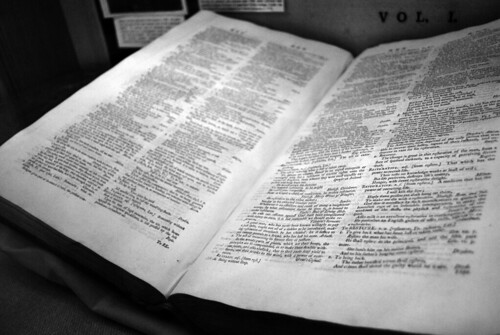
Showing posts with label Samuel Johnson. Show all posts

Wednesday, August 10, 2016

James Boswell in his journal

"A man much alone . . . to whom every word heard is precious."

That's V. S. Pritchett, writing about James Boswell. It's an aspect of Boswell's character I too often forget. I smile in appreciative amusement when I think of how he hoped his Corsican "adventure" would lead to his being known as Corsican Boswell, or at his combination of self-reproach, self-regard, and grasping ambition. (Pritchett catches that middle quality in a line plucked from the journal: "I think there is a blossom about me of something more distinguished than the generality of mankind.") But I too rarely think of Boswell the young man loosed on London, late of an uncongenial home, trying to make his way on little more than a family name and letters of introduction. We've been there, most of us, in some sense: just out of university, say, and attempting to build the foundations of our adult life. It can be lonely, tentative, frustrating. Pritchett depicts Boswell as "knocked off his balance by a severe Presbyterian upbringing," his will destroyed by his unappreciative father, to be
replaced by a shiftless melancholy, an abeyance of spirits.
No wonder, then, that when Boswell did meet Johnson, he glommed on to him. Pritchett, rightly, credits Johnson--whom he goes so far as to call "saintly"--with "the steadying of Boswell's fluctuating spirit and . . . the sustaining of his sympathetic fancy." Boswell can frequently be ridiculous; he's never wholly unsympathetic, and never more so than when we view him through that lens.

From Pritchett I wandered to Cyril Connolly, a review of a volume of Boswell's journals on its publication in the 1950s. The first volume of the journals had, at that point, only been widely available to the public for about ten years, the reassessment of Boswell precipitated by its keen observations and self-awareness barely underway. "There has been a tendency to patronise him," wrote Connolly, "or find him a bit of a bore." Connolly, though acknowledging that the journals covering Boswell's time abroad aren't of the best, wasn't having it:
In the life of Johnson, Boswell subordinates himself to his hero who epitomised the age he lived in. In the journal, he allowed his own forward-looking sensibility full scope.
And while Johnson, a figure who can make a reader's heart ache in sympathy with his internal and external struggles, can also be irritatingly self-important, Boswell is accessible. "It was his friend Johnson," writes Connolly, "who struggled so hard with the tragic sense of life. Boswell could always get drunk."

All of which led me back to the Journal, which is in its own way as inexhaustible as the Life of Johnson. Flipping through it, I hit upon an entry that followed a successful dinner party—success, for Boswell, meaning that the guest list was of a reasonably high standard, the conversation sparkled (and included him), and he didn't wake with a hangover. Reflecting on the evening, Boswell wrote, "I felt a completion of happiness. I just sat and hugged myself in my own mind."

Is there a better example of Pritchett's characterization of the Journal's genius, "the accidental and unforeseeable quality of life" it has, "which better organised, more sapient or more eloquent natures lose the moment they put pen to paper"? That simple expression--"hugged myself in my own mind"--is not one I'll forget; those two lines, now, will be how I, too, think of a good evening with friends.

Monday, April 27, 2015

Off, off, off with their heads!


{Photo by rocketlass.}

On the recommendation of the polymath Steve Donoghue, I recently read Jean Plaidy's novel of Mary, Queen of Scots, Royal Road to Fotheringay(1955), and its closing scene reminded me of two things:

1. That the execution of Mary, Queen of Scots was a bizarre event, featuring details no fiction writer would dare invent.

2. That execution by axe was a particularly troublesome and difficult method of administering capital punishment.

Here's how Plaidy tells the story of Mary's end, in the hall at Fotheringay at the end of years of imprisonment. By all accounts, Mary met her death with courage, and a dignity that the event itself could not come up to:
Bulle, the executioner, hesitated. This was his trade; his victim had forgiven him, knowing this; yet never before had he been called upon to wield the axe for one who affected him so deeply with her grace and dignity.

Every eye in the hall was upon him. He faltered. He dealt a blow. There was a gasp from the watchers, for the axe had slipped and though the blood of Mary Stuart gushed forth, she was merely wounded.

Trembling, Bulle again raised his axe; but his nerve was affected. Again he struck, and again he failed to complete his work.

It was with the third stroke that he severed the Queen's head from her body.

Then he grasped the beautiful chestnut hair, crying: "God save Queen Elizabeth! So perish all her enemies!"

But the head had rolled on to the bloodstained cloth which covered the scaffold, and it was a wig which the executioner held up before him.

There was silence in the hall as all eyes turned to the head with the cropped grey hair--the head of a woman grown old in captivity.
Though the history of executions is gruesome, it's hard to imagine much more ghastly than those botched attempts topped by the final indignity of the wig held aloft. Yet even that wasn't the strangest moment:
And as they watched, they saw a movement beneath the red velvet petticoat, and Mary's little Skye terrier, who unnoticed had followed his mistress into the hall, ran to the head and crouched beside it, whimpering.
It's one of those moments that both makes history come palpably alive and makes its figures seem fully human: Mary loved her dog, and her dog loved her, and death was necessarily a mystery to both.

While Mary's end is gruesome, others condemned to the axe over the centuries had it far worse. In Severed, Frances Larson runs through some horrible examples with chilling matter-of-factness:
Alcohol may have fortified the mind [of the executioner], but it certainly did not steady the hand, and no doubt it only added to the executioner's problems. One common excuse for failure was that the executioner had seen the condemned man's head double before him, and "therefore did not know which of the two was the real one." There are stories of swords slicing through jaws and axes hacking into shoulder blades and skulls, and of it taking two, three, five, even twenty attempts to dispatch the poor soul on the scaffold. It took three blows to sever the head of Mary, Queen of Scots in 1587, and many more in 1541 to kill Margaret Pole, Countess of Salisbury, who defied her fate by refusing to place her neck on the block.
Thinking of Margaret Pole's defiance beggars my imagination: even if I try to think myself into the frenzied state that surely would accompany the knowledge that I was about to (unjustly, I would assume) be killed, I can't imagine finding the courage to refuse the easier route at that moment, to force a more painful and gory death as a point of honor. It's astonishing. (Even Samuel Johnson wasn't quite able to feel confident about how he might approach the moment of execution, telling Boswell, "I know not whether I should wish to have a friend by me, or have it all between God and myself.")

Larson notes that these problems arise primarily because it is very hard to sever a human head with a single blow from a blade. But she also tells us that executioners received more than regret from their employment:
Despite the demands of the job, or perhaps because of them, when beheadings went well they could bring an executioner great distinction. From the mid-sixteenth century, wealthier European executioners hired assistants, who administered minor punishments, but the job of beheading people was always reserved for the master. Myths grew up around executioners and people told stories about their magical powers. It was said that they could recover lost children or stolen goods, that they could exorcise evil spirits and cure diseases with their touch, and that the swords in the executioner's house rattled whenever a person was condemned to death. There was the story of an executioner who had decapitated a standing man so fast that the only visible mark on the dead man's body was a thin stripe of blood around his neck.
That last reminds me of how Hilary Mantel in Bring Up the Bodies, without making Anne Boylen's death overly gruesome, nonetheless makes us feel the horror of it, and how powerfully Cromwell, who has reluctantly engineered the execution, feels it, too:
The queen is alone now, as alone as she has ever been in her life. . . . She raises one arm, again her fingers go to the coif, and he thinks, put your arm down, for God's sake put your arm down, and he could not will it more if--the executioner calls out sharply, "Get me the sword." The blinded head whips around. The man is behind Anne, she is misdirected, she does not sense him. There is a groan, one single sound, from the whole crowd. Then a silence, and into that silence, a sharp sigh or a sound like a whistle through a keyhole: the body exsanguinates, and its flat little presence becomes a puddle of gore.
The sound of the sword, the "flat little presence"--it's hard to read that passage and not shiver.

I wonder whether the condemned ever haunted the executioners? Larson's book offers no reports of ghosts, and I suppose that makes sense: surely from whatever realm a ghost might descend, she would have sufficient perspective to see, not the hand that wielded the blade, but the more blameful hand that signed the order, and thus had more fully earned a haunting.

I ask the question because when it's entirely possible that the very first thing I knew about English history when I was a kid was that Anne Boylen was said to haunt the Tower. The more I learn about her life and death and the manner of dying of the period, the more I understand. If I were her, I'd haunt Henry and his descendants down through eternity.

Monday, February 24, 2014

The root of the disagreement between Johnson and Swift?

Samuel Johnson's dislike of Jonathan Swift's work is famous. Jackson Bate offers the reasonable explanation that what Johnson saw in Swift was a dark reflection of himself--the self he could have been had he let his satiric bite run free rather than constantly attempting to check it and temper it with religious belief. Bate writes,
The Life of Swift strikes the modern reader as the only hopelessly biased Life. Here we can only try to remember Johnson's lifelong fear, especially after the breakdown in his fifties, of the powerful satiric bitterness of his own nature, and his dread--a dread with which he was constantly living--of falling into the anger and the sense of emptiness about life that he associated with Swift.
I suspect Evelyn Waugh may have played a similar role--a sort of "there but by the grace of god"-style role model--for satirically inclined interwar writers.

Bate's position is convincing, and it conforms to what we know of Johnson and of Swift (even as it does nothing to lessen the wish that their lives could have overlapped, giving them an opportunity to meet). But perhaps the explanation is simpler? Perhaps, it's rooted in a simple disagreement about the proper way to approach a hill?

As we saw on Friday, Johnson is documented as a hill-roller: in his fifties, while on the trip to Scotland with Boswell, he took a wistful roll down one, to the amusement (and, presumably, brief worry) of all around. Swift, on the other hand--well, let's let Leo Damrosch, author of last year's excellent biography, tell it:
Swift . . . became convinced that exercise was beneficial, in an era when medical theory discouraged it, and most people avoided it. At Moor Park, as he told Deane Swift long afterward, he would work for two hours and then take a break by running up to the top of a nearby hill and down again. "This exercise he performed in about six minutes; backwards and forwards it was about half a mile."
Oh, I'll admit it seems silly: Could two such great minds as these truly be set at odds by such a silly difference? Could a preference for rolling rather than running down a hill really be enough to cause Johnson to cast Swift beyond of the pale of his appreciation?

Perhaps not--but then, perhaps we should remember what Swift's friend Gulliver learned about the origins of the ongoing conflict between Lilliput and Blefuscu:
It began upon the following occasion. It is allowed on all hands, that the primitive way of breaking eggs, before we eat them, was upon the larger end; but his present majesty's grandfather, while he was a boy, going to eat an egg and breaking it according to the ancient practice, happened to cut one of his fingers. Whereupon the emperor his father published an edict, commanding all his subjects, upon great penalties, to break the smaller end of their eggs. The people so highly resented this law, that our histories tell us, there have been six rebellions raised on that account; wherein one emperor lost his life, and another his crown. These civil commotions were constantly fomented by the monarchs of Blefuscu; and when they were quelled, the exiles always fled for refuge to that empire. It is computed that eleven thousand persons have at several times suffered death, rather than submit to break their eggs at the smaller end.
Suddenly that hill is looking more like a mountain, isn't it?

Friday, February 21, 2014

Samuel Johnson gets silly

At the end of a too-long, too-busy work week, what better than to share too instances of Samuel Johnson being utterly silly? In case you haven't realized it from my Twitter feed, I've been immersed in Johnson the past ten days or so, going from Boswell to W. Jackson Bate's 1975 biography, and both are a reminder that Johnson is always more varied, more multifarious, than whatever impression is most recent in your mind.

And one of the ways he surprises is by being silly--physically silly. To wit, a moment at the top of a hill during his tour of the Hebrides with Boswell, as related by Bate, via the years-later memories of Johnson's companion that day, Bennet Langton:
Johnson, delighted by its steepness, said he wanted to "take a roll down." They tried to stop him. But he said he "had not had a roll for a long time," and taking out of his pockets his keys, a pencil, a purse, and other objects, lay down parallel at the edge of the hill, and rolled down its full length, "turning himself over and over till he came to the bottom."
Johnson was fifty-five at the time.

This one is even better. At conversation with the Reverend Alexander Grant, Johnson mentioned that Joseph Banks had recently sent back reports of a strange animal called a kangaroo. Then,
In order to render his description more vivid, Johnson rose from his chair and [in the words of Grant], "volunteered an imitation of the animal. The company stared . . . nothing could be more ludicrous than the appearance of a tall, heavy, grave-looking man, like Dr. Johnson, standing up to mimic the shape and motions of a kangaroo. He stood erect, put out his hands like feelers, and, gathering up the tails of his huge brown coat so as to resemble the pouch of the animal, made two or three vigorous bounds across the room.
May your weekend be suitably bouncy.

Wednesday, February 12, 2014

Johnson and Boswell

Winter finds me re-reading Boswell on Johnson. Which means admiring Boswell, and appreciating Boswell, and laughing at Boswell, and, necessarily and fundamentally, being grateful for Boswell. Good gods, how lucky we are to have had--exactly, perfectly, suitably--Boswell. In a certain sense, no stance but gratitude is appropriate; at the same time, being human, we can't help but, sentence by sentence, wrangle with him.

For example, when he makes fun of Dr. Johnson's friend and great comfort Mrs. Thrale. Boswell--whom we can never wholly free from self-interest, writes,
Mrs. Thrale, who frequently practised a coarse mode of flattery, by repeating his bon-mots in his hearing . . . 
etc., etc. No one, of course, collected or retailed Johnson's bon mots with anything near the assiduity of Boswell. He admits almost as much, or, at least, admits that he is a sponge for Johnson's wit. Mere pages later as he recounts what seems to have been a remarkably pleasant evening--the sort to perpetually tempt a time traveler--with Johnson at his home:
After the evening service, he said, "Come, you shall go home with me, and sit just an hour." But he was better than his word, for after we had drunk tea with Mrs. Williams, he asked me to go up to his study with him, where we sat a long time while together in a serene undisturbed frame of mind, sometimes in silence, and sometimes conversing, as we felt ourselves inclined, or more properly speaking, as he was inclined; for during all the course of my long intimacy with him, my respectful attention never abated, and my wish to hear him was such, that I constantly watched every dawning of communication from that great and illuminated mind.
Yet there is no question but what Johnson loved Boswell, occasional simpering and all, as a letter from August of 1775 reminds us:
Never, my dear Sir, do you take it into your head to think that I do not love you; you may settle yourself in full confidence both of my love and my esteem; I love you as a kind man, I value you as a worthy man, and hope in time to reverence you as a man of exemplary piety. I hold you, as Hamlet has it, "in my heart of hearts," and, therefore, it is little to say, that I am, Sir, your affectionate humble servant.
What more could an English-speaking, Western-raised reader want? The approbation, Sir, of Dr. Johnson, is sufficient--and beyond--unto the day. And if I may: All, all, all hail Boswell, today and every day when we find ourselves with a drink in our hands and an anecdote on our lips. We could do far worse than to choose him as our watchword and our guide.

Friday, January 17, 2014

Johnsoniana

A quick post tonight, for a three-day weekend looms, offering little but reading (and snow, to secure us in our indoor intentions). I'll merely share two poor snapshots that I took last week when an unexpected free afternoon in London allowed me to visit the house in Gough Square that Samuel Johnson lived in while composing the Dictionary. Like most house museums, it's small and unassuming, portraits and a few pieces of furniture offering the basic brushstrokes that help the imagination populate the rooms. And it's not hard to do: Johnson lumbering up and down the stairs and dominating the small rooms, the constant noise and commotion of the many permanent houseguests, the mess of papers and books that filled the garret as the work in progress progressed, letter by letter. One bit of additional period detail I didn't have to imagine: the clatter of horses' hooves echoed about the square, generated by two mounted police officers.

The snapshots are of items held in a vitrine full of Johnsoniana on the ground floor, commercial items created to commemorate (and capitalize on) various Johnson-related anniversaries. The first is a Dr. Johnson-shaped flask, sold in 1909 for his bicentennial.


The color is unquestionably unappealing, but the idea of having Johnson as a constant drinking companion does entice.

This, meanwhile, is a doorknocker, also from the twentieth century:


At its top is Litchfield Cathedral, in front of which is depicted the meeting of Johnson and Boswell. (Hooray to Boswell for achieving such prominence on the knocker!) Beneath Johnson's head--reasonably cast as the active part of the knocker--is, we're told, the figure of his cat.

Enjoy the weekend, folks. Happy reading to you.

Wednesday, October 09, 2013

Dr. Johnson tells a ghost story

I've written before that it's hard to imagine a much better writer to choose for an encounter with a ghost than Samuel Johnson. He has the appropriate mix of openness to experience and inherent skepticism, as well as an unusual (and gratifying) blend of empiricism and belief in the world beyond. (Who can forget his explosive response to the question of what he meant when he spoke of his fears of being among the damned? "Sent to Hell, Sir, and punished everlastingly.")

There are a handful of references to ghosts and contemporaneous ghost stories scattered throughout Boswell's Life, though most of them involve Johnson dismissing an account as lacking sufficient evidence. Skepticism on this front really does seem to have been his mode: though it is barely mentioned in Boswell's book, Johnson was part of the commission that determined that the famous Cock Lane Ghost was a fraud, and he played a role in publicizing that fact afterwards.


{Photos by rocketlass.}

There is one ghost story in Boswell's book, however, that is both more extended and treated with more credulity, and thus seems worth sharing in this ghostly month. Boswell, seeing Hogarth's engraving Modern Midnight Conversation, asks Johnson what he knows of Parson Ford, "who makes a conspicuous figure in the riotous groupe," then mentions that he thought he'd heard that the Parson's ghost had once been spotted. "Sir, it was believed," replies Johnson. He continues:
A waiter at the Hummums, in which house Ford died, had been absent for some time, and returned, not knowing that Ford was dead. Going down to the cellar, according to the story, he met him; going down again, he met him a second time. When he came up, he asked some of the people of the house what Ford could be doing there. They told him Ford was dead. The waiter took a fever, in which he lay for some time. When he recovered, he said he had a message to deliver to some women from Ford; but he was not to tell what, or to whom. He walked out; he was followed; but somewhere about St. Paul's they lost him. He came back, and said he had delivered the message, and the women exclaimed, "Then we are all undone!"
I'll admit to not being entirely sure how to interpret the women's reaction. Are they assuming that the delivery of a secret message to a secret--female--recipient means that Parson Ford had a hitherto unknown illicit life, and thus they are "undone" in a moral sense? Or are they simply reacting to seeming proof of supernatural forces at work?

Johnson, obviously intrigued by this story, goes into the evidence for its veracity:
Dr. Pellet, who was not a credulous man, inquired into the truth of this story, and, he said, the evidence was irresistible. My wife went to the Hummums; (it is a place where people get themselves cupped.) I believe she went with intention to hear about this story of Ford. At first they were unwilling to tell her; but, after they had talked to her, she came away satisfied that it was true. To be sure the man had a fever; and this vision may have been the beginning of it. But if the message to the women, and their behaviour upon it, were true as related, there was something supernatural. That rests upon his word, and there it remains.
Is that Johnson's wife, Tetty, out investigating? It certainly seems like it--and the spunk the story suggests makes a nice counterpoint to the lingering sense we still get of Tetty as an unpleasant invalid.

So chalk one up for the ghosts, sayeth Dr. Johnson. Oh, what I'd give for a whole book of Johnson's analyses of tales of hauntings--imagine teaming him up with John Aubrey's (too credulous) ear for rumor!


I'll close with a line from a story found in Otto Penzler's great anthology The Big Book of Ghost Stories, Joseph Shearing's "They Found My Grave." The story itself has nothing to do with Dr. Johnson--it's about seances and table-turnings in the late Victorian era--but this description of the most prominent of the spirits conjured at the sittings struck me as quite Johnsonian:
"Oh," smiled Mr. Lemoine, rising to indicate that the sitting was at an end. "He is a common type, a snob. When he was alive he boasted about his distinctions, visits to court, and so on; now he is dead he boasts of having seen God, being in Heaven, and the marvels of his grave."
A merciless analysis of character, a hint of ironic amusement, an eye for the power of vanity--doesn't that sound like the good Doctor?

Monday, September 23, 2013

Visiting Japan with Dr. Johnson

In 1772, the year before their tour of the Hebrides, James Boswell mentioned to Samuel Johnson that he was thinking of buying St Kilda, the most remote island of that chain. "Pray do, Sir," Johnson replied. "We shall go and pass a winter among the blasts there. We shall have some fine fish, and we shall take some dried tongue with us, and some books." To which Boswell, who, one suspects, had mentioned the prospect more as a form of boasting than in seriousness, answered, "Are you serious, Sir, in advising me to buy St Kilda? For if you should advise me to go to Japan, I believe I should do it."


{Photos by rocketlass.}

I read that passage on a thirteen-hour flight home from Japan earlier this month, and all I could think was how sad I was that Dr. Johnson--perhaps hoping to rid himself of the presence of Boswell, who, much as their friendship seems to have been genuine, surely was nonetheless an irritation at times--failed to order his friend to hie himself to Tokyo posthaste. What would Boswell have made of eighteenth-century Japan, utterly foreign to British sensibilities? I realize the journey's not truly to be wished, for it could only have come at the cost of the Life of Johnson, but that doesn't stop me from imagining a parallel universe Boswell visiting temples in Kyoto, telling tales of his bravery in support of Corsica (then explaining what and where Corsica is), and picking up ladies in the seedier districts.


On our trip, we took no dried tongue, but we did have some fine fish, and of course I took some books. Last time we visited Japan, four-and-a-half years ago, I read The Tale of Genji, which was a very good choice as reading material, but, at nearly four pounds, a lousy choice of a physical object to lug around. So this time I chose more wisely: I packed a similar number of pages, but spread across more books--among them books that I could leave behind when read, including a couple of disposable mass market paperbacks, a galley, and a copy of Norman Maclean's Young Men and Fire, which, fortunately, I can always get again at the office.

Young Men and Fire, which I was re-reading for the first time since it was first published, in 1992, was my company in Kyoto, and its quiet, meditative tale of loss and attempts at understanding it suited that ancient city. And finishing it there allowed me to improve the meager bookshelf in the Shunkoin Temple guest room, which, when we arrived, looked like this:


That's a Lilian Jackson Braun cat mystery; John Gardner's novelization of the Bond film Goldeneye; Daniel Kahneman's Thinking, Fast and Slow, a fine book but not exactly a vacation read; Less Than Zero; a forgettable thriller; and--the one book in the stack that would be a pleasure to find in a guest room--Dorothy Dunnett's Niccolo Rising. May Maclean find a new reader among the Americans and Aussies who seem to be the bulk of the temple's guests; may they be surprised to find a lost little bit of Montana in Kyoto.

Our return to Tokyo for one last night was the occasion of the trip's other book-related venture: meeting an online literary pal. Julian, one of three people behind the Only a Blockhead blog (its name keeping nicely with the Johnson theme), is an Englishman who's been living in Japan for decades, and I've been enjoying his thoughts on Japan and books both for years now, but this was our first actual meeting. He led us to the Park Hyatt Tokyo, high above the city, where he was kind enough to buy me and rocketlass drinks while we all talked books. It was a sheer pleasure, especially talking favorites and trading recommendations. Take my advice and meet your Internet friends, folks: I've yet to find that anyone I like through their online presence doesn't live up to that impression in reality.


{Note the book that Julian was reading when we walked up to him on the street: Sergio De La Pava's A Naked Singularity!}

We three--worn by late-summer heat, dressed casually for travel--didn't exactly reach the elegant heights of the 1950s Tokyo party described by Edmund de Waal in a memorable passage in The Hare with the Amber Eyes (a favorite shared with Julian):
Back in the corridor we move through an open doorway, under a Noh mask and into the sitting-room. The ceiling is of slatted wood. All the lamps are on. Objects are displayed on spare, dark, clean-lined Korean and Chinese furniture alongside comfortable low sofas, occasional tables and lamps, and ashtrays and cigarette boxes. A wooden Buddha from Kyoto sits on a Korean chest, a hand raised in blessing.

The bamboo bar holds an impressive quantity of liquor, none of which I can identify. It is a house made for parties. Parties with small children on their knees, and women in kimonos, and presents. Parties with men in dark suits seated round small tables, loquacious with whisky. Parties at New Year with cut boughs of pine trees hanging from the ceiling, and parties under the cherry trees, and once--in a spirit of poetry--a firefly-viewing party.
But the drinks were splendid, and the fellowship of books was with us, so what more could one reasonably ask for?

Elsewhere in The Life of Johnson, Johnson assures Boswell that "he never passed that week in his life which he would wish to repeat, were an angel to make the proposal to him." Having closed my trip by experiencing something along those lines in a peculiarly modern way, arriving home on a Saturday morning two hours before we'd left Tokyo, I can understand Dr. Johnson's sentiments. But two weeks in Japan to live again through the agency of an angel? Well, it would be hard not to be tempted.

Monday, April 15, 2013

Turning to Johnson

From W. Jackson Bate's Samuel Johnson: A Biography:
Because he was so susceptible to symbols, his impulse had always been to deny their power over the imagination and to try to put them at arm's length. The dignity of human nature required this if one was to remain a "free agent." Typical was the way he would dismiss the effect on us of the seasons ("imagination operating on luxury"). But now, in many ways, he was changing--not changing in his character but in what he said or admitted.

As November came to Litchfield, which he could reasonably doubt that he would ever see again, he felt the poignance of autumn as never before. One of Horace's odes especially (IV, vii) haunted him--the one in which the large revolving changes of nature, destroying and re-creating, are contrasted with the hopes and destiny of short-lived man. Before Johnson left Litchfield he translated it into English verse. The snows of winter--the ode begins--are melting as spring returns. The fields and woods are again green. But the human being, after entering his own winter, will not return. He will be like those millions of others who have entered the night--"ashes and a shade." The ode, in its clear-eyed existential honesty and mellow acceptance, typifies what Johnson had prized in Horace when he was a boy at Stourbridge--a union of qualities he had associated with Cornelius, who had seemed to the half-blind, half-deaf, awkward youth such a model of grace and classical acceptance of fact. Of the many translations of this famous ode, none catches the spirit of Horace more closely. At moments it is even more condensed than Horace. "Each revolving year," says Horace, "each hour that snatches the day, bids us not to hope for immortal life." Johnson wrote, "The changing year's successive plan / Proclaims mortality to man." Yet this is balanced by a flourish of stoic gaiety that goes beyond Horace. "Who knows whether the gods," asks Horace, "will add tomorrow's time to the sum of today?" In Johnson this becomes: "Who knows if Jove who counts our score / Will toss us in one morning more?"

Monday, August 29, 2011

"Our speeches in the day time cause our phantasy to work upon the like in our sleep," or, In dreams


"I had dreams, not nightmares but musical dreams, dreams about transparent questions . . . "--from Amulet, by Roberto Bolano
1 I was reading Neal Stephenson's Baroque Cycle, which I've not read.
"I think dreams have a great many sorts of explanation. Once the Freud virus has, as it were, got into you, you keep on looking at things in that way. But surely there's a lot of pure accident in dreams. One has kinds of obsessions and fears that can't be given a sexual meaning. I think the inventiveness and details of dreams are amazing."--from From a Small Corner in the House of Fiction: Conversations with Iris Murdoch
2 I am playing basketball with the Chicago Bulls. I take a pass and fling up an outside shot, which misses abysmally. I turn around to find Michael Jordan shaming me by wagging a long finger, while Dennis Rodman is doubled over, gripping his knees in helpless laughter.
"The Atlantes, according to my sources, never eat any living thing, and never dream, either."--from The Histories, by Herodotus
3 At my nephew's ninth birthday party I was surprised to notice two guests whose attendance I certainly had not expected: Marcel Proust and Eloise of the Plaza. I got the sense that they'd somehow been invited in error, that it was quite possible that they knew no one at the party aside from each other. That wasn't really a problem, however, as they gave the impression of being the sort of close friends who need little to no outside contact. Huddled together in a corner, they sipped from the tiny teacups of my niece's tea set and quietly shared private, gossipy jokes that caused them now and again to break out in skeins of poorly muffled giggles.
"I knew that in many dreams one must disregard the appearance of people, who may be disguised or may have exchanged faces with one another, like those mutilated saints on the fronts of cathedrals which have been repaired by ignorant archaeologists in a jumble of mismatched heads and bodies, attributes and names. Those we give to characters in our dreams can be misleading. The one we love can be recognized only by the quality of the pain we feel."--from In the Shadow of Young Girls in Flower, by Marcel Proust
4 I am running a marathon in some anonymous but lovely European mountain town. The course, which winds through the narrow, wandering late-medieval streets of the town, is convoluted and difficult to follow, but that difficulty, in the early part of the race, is a help, giving my mind something to focus on aside from the details of my exertion. But around mile twelve I realize quite suddenly that I'm all alone, the body of fellow runners having silently slipped away somewhere along the course. It's clear that I've take a wrong turn and left the course behind. Worried, I look around, hoping to find a guide or a map. All I see is a quaint-looking pastry shop spilling a warm glow of candlelight onto the crooked sidewalk. I enter the pastry shop, conscious of the salty sweat caking my body, and, with apologies for my gross condition, I ask the baker whether he might happen to have a map of the marathon course. Smiling, he reaches into the display case and selects a cookie baked in the shape of an elephant balancing on a ball. He pokes a pudgy finger at the intricate lines that, pressed into the cookie, make up the design. In a voice tinged with a vaguely Germanic accent, he says, "You simply follow these lines." The cookie is a map of the route; the route forms the shape of an elephant balancing on a ball.

With a smile on my face and a cookie in hand, I leave the shop and begin to trot back toward the course.
"It is not much of a dream, considering the vast extent of the domains of dreamland, and their wonderful productions; it is only remarkable for being unusually restless, and unusually real. He dreams of lying there, asleep, and yet counting his companion's footsteps as he walks to and fro. He dreams that the footsteps die away into distance of time and of space, and that something touches him, and that something falls from his hand. Then something clinks and gropes about, and he dreams that he is alone for so long a time, that the lanes of light take new directions as the moon advances in her course. From succeeding unconsciousness he passes into a dream of slow uneasiness from cold; and painfully awakes to a perception of the lanes of light--really changed, much as he had dreamed--and Jasper walking among them, beating his hands and feet."--from The Mystery of Edwin Drood, by Charles Dickens
5 One of the editors at my workplace had arranged for some prominent authors to give lectures on their craft to the entire office. First up were Ernest Hemingway and Joseph Conrad. They took turns speaking, and they actually had fairly interesting things to say about each other’s work. Hemingway was surprisingly self-effacing, and Conrad was exactly as I expected: formal, precise, and thoroughly serious.

It was only after I’d returned to my office following the lecture that I remembered that both Hemingway and Conrad were long dead. “Of course!” I thought. “Those must have been professional impersonators!”

I ran for the front desk, hoping to catch them before they left. Conrad was gone by the time I got there, but Hemingway was just stepping into the elevator. “Wait!” I shouted. “Who do you do when you’re not doing Hemingway?”

Hemingway turned. Then, smiling, he ripped off his mask, held it aloft, and jauntily shouted, "Yourcenar!”
"Against fearful and troublesome dreams, nightmare and such inconveniences, wherewith melancholy men are molested, the best remedy is to eat a light supper, and of such meats as are easy of digestion; no Hare, Venison, Beef, &c. not to lie on his back, not to meditate or think in the day time of any terrible objects, or especially talk of them before he goes to bed. For, as he said in Lucian after such conference, I seem to dream of Hecate, I can think of nothing but Hobgoblins; and, as Tully notes, for the most part our speeches in the day time cause our phantasy to work upon the like in our sleep, which Ennius writes of Homer: as a dog dreams of an hare, so do men dream on such subjects they thought on last."--from The Anatomy of Melancholy, by Robert Burton
6 I was at the zoo, watching a gorilla very close up through the bars of his cage. He gave me a quizzical look, tugged at his earlobe, then pointed at my earlobes while mouthing the word, "Earring?" I stared for a second, then remembered that I was wearing a big, gold pirate-style hoop in each ear.
"There is no great difference, says Proust, between the memory of a dream and the memory of reality. When the sleeper awakes, this emissary of his habit assures him that his 'personality' has not disappeared with his fatigue."--from Proust, by Samuel Beckett
7 I am reading James Boswell's Life of Johnson and find a typo that somehow turns an ordinary sentence into some sort of prognostication about my brother's life. As I read it I am amused but impressed, and I remember that Johnson himself left a cryptic note about dreams and brothers in his diary. The entry for January 23, 1759, the day of his mother's funeral, includes the line, "The dream of my Brother I shall remember." Johnson's brother, Nathanael, had died at only twenty-four, a possible suicide; his sole surviving letter is an indictment of Samuel for his harsh treatment.
"It makes a difference whether your dreams usually come true or not. . . . See then if you can follow my example, and give a happy interpretation to your dream."--from a letter to Suetonius Tranquillus by Pliny the Younger
8 I was at Wrigley Field to watch a Cubs game, and, as game time approached, I got out my scorebook to take down the starting lineup. The public address announcer began to rattle off the Cubs lineup. "Leading off, and playing right field . . . a sesame ball." I wrote it down. "Batting second, and playing second base, a furry kitten." I wrote it down. "Batting third, and playing first base, Stacey Shintani." On hearing my wife's name, I threw down my pencil and exclaimed to my seatmate, "They're trying to throw this game!"
"My earliest memory is of a dream. It was in the house where we lived when I was three or four years of age. I dreamed I was asleep in the house in an upper room.

Then I awoke and came downstairs and stood in the living room. The lights were on in the living room, although it was hushed and empty. The usual dark green sofa and chairs stood along the usual pale green walls. It was the same old living room as ever, I knew it well, nothing was out of place. And yet it was utterly, certainly, different. Inside its usual appearance the living room was as changed as if it had gone mad."--from "Every Exit is an Entrance (A Praise of Sleep)," by Anne Carson
9 I was reading—and greatly enjoying—Anthony Powell's’s biography of Robert Burton, author of The Anatomy of Melancholy. It was only after I woke up that I remembered that Powell never wrote a biography of Burton; that was Nick Jenkins, the narrator of Powell’s A Dance to the Music of Time, who serves as Powell’s stand-in.
"In some ways a narrative is like a dream. You don't analyze a dream--you just pass through it. A dream is sometimes healing and sometimes makes you anxious. A narrative is just the same--you are just in it. A novelist is not an analyst. He just transforms one scene into another. A novelist is one who dreams wide awake. He decides to write and he sits down and dreams away, then wraps it into a package called fiction which allows other people to dream. Fiction warms the hearts and minds of the readers. So I believe that there is something deep and enduring in fiction, and I have learned to trust the power of narrative."--Haruki Murakami, from a lecture in Cambridge, Massachusetts in 2005
10 I dreamed that Van Morrison was at a dinner party I was attending with about a dozen other friends. After dinner, he got up to play a few songs. He ran through a somewhat perfunctory "Moondance," then asked me if I would accompany him on vocals and guitar for a couple of numbers. I don't play guitar, and while I do like to sing, I'm far from a good singer. But, unwilling to refuse Van Morrison, I got up and faked my way through "The Way Young Lovers Do," strumming and singing along. I was sufficiently nervous that I forgot nearly half the lyrics, but Van sang them all beautifully.

Then he launched into Sam Cooke's "That's Where It's At," and suddenly everything was right: I happened across the right chords, was even able to throw in some simple, but convincing finger-picked flourishes, and Van and I sounded stunningly good singing together.
"He was also terrified with manifest warnings, both old and new, arising from dreams, auspices, and omens. He had never been used to dream before the murder of his mother. After that event, he fancied in his sleep that he was steering a ship, and that the rudder was forced from him: that he was dragged by his wife Octavia into a prodigiously dark place; and was at one time covered over with a vast swarm of winged ants, and at another, surrounded by the national images which were set up near Pompey's theatre, and hindered from advancing farther; that a Spanish jennet he was fond of, had his hinder parts so changed, as to resemble those of an ape, and having his head only left unaltered, neighed very harmoniously. The doors of the mausoleum of Augustus flying open of themselves, there issued from it a voice, calling on him by name."--from The Lives of the Twelve Caesars, by Suetonius
11 I was rereading Vladimir Nabokov's Laughter in the Dark, in the pages of which I encountered a book I hadn't noticed on my first reading: Ghost Whim, by Robin Anne Powter.

According to Nabokov's narrator, Ghost Whim is a cultural history of dreaming . . . but before I could learn what would happen if I read a nonexistent cultural history of dreaming inside an actual novel inside a dream, I woke up.
"Night comes when you least expect it. You are making dinner or working late, you look out the window and the sky is already dark. The arrival of night can be elusive, mysterious, and in the city we don't often see it, though we always know when it has fallen. In the country night takes its time. A glorious sunset might flag its approach, yet it seems we can never pinpoint its exact arrival. Nightfall is a subtle process."--from Acquainted with the Night, by Christopher Dewdney


Friday, October 22, 2010

Ghost writers


{Photo by rocketlass.}

Earlier this month, I wrote about Henry James’s ghost stories, which are among my favorites. But then I started thinking about James as a person—and realized that he’d be one of the last authors I would want to have describe an actual encounter with a ghost. Think about it: he’d circle around and around the visitation, honing his impressions to an ever-finer point, conveying each little nuance of feeling aroused by the ghost . . . and by the end, as in The Turn of the Screw, you wouldn’t even be sure he’d seen a ghost at all!

Which got me thinking: which author would be the best for reporting back on a supernatural encounter? Which of my favorites would I enter into the lists against the ghouls?

So many of my favorites would be, well, useless. Iris Murdoch would get too spiritual about it. Nancy Mitford would be too sarcastically dismissive. Evelyn Waugh would ascribe it to the DTs. Actually, any number of my favorite authors would probably ascribe it to the DTs.

But I think I’ve hit upon a couple who could be relied on to face down an apparition and come back with a satisfyingly detailed and interesting report. Here goes:

1 First, there’s William Hazlitt. If ever Hazlitt saw a ghost, there’s no record of it that I’ve found. But in his writings on English theater, collected as A View of the English Stage in 1818, he did give some idea of what he expected from a ghost.

First, there are the expected Shakespearian ghosts. In an account of a performance of Hamlet at Drury Lane in 1814, he tells us what he expects of a ghost:
We cannot speak too highly of Mr. Raymond's representation of the Ghost. It glided across the stage with the preternatural grandeur of a spirit. His manner of speaking the part was not equally excellent. A spirit should not whine or shed tears.
As for how we should behave in the presence of a presence, this appraisal of Eliza O’Neill’s portrayal of Juliet at Covent Garden in 1814, gives a good idea. O’Neill, he writes, she strikes only one false note: when she screams aloud at the sight of Tybalt’s ghost:
[T]here [is] a distinction to be kept up between physical and intellectual horror (for the latter becomes more general, internal, and absorbed, in proportion as it becomes more intense).
In other words, confronted with a ghost, Hazlitt might be terrified, but he wouldn’t lose his cool.

And an account of another stage ghost, from one of the many long-forgotten plays of the period, Frightened to Death?—a farce about a drunk whose friends, to force him to mend his ways, convince him he has died and is seeing ghosts—tells us something of the line of attack that Hazlitt might take on seeing a ghost:
A very laughable dialogue and duet here take place between the Ghost and the Ghost-seer, the latter inquiring of him with great curiosity about his ancestors in the other world, and being desirous to cultivate an acquaintance with the living apparition, in the hope of obtaining some insight into the state of that state “from which no traveller returns.”
Dignified terror and probing questions: a good starting point.

2 Then there’s Samuel Johnson. Who better than the good Doctor to tackle a ghost? I’ve quoted before—even recently—Dr. Johnson’s take on the subject of the afterlife, but it’s always worth revisiting for its characteristically Johnsonian quality of judicious language inflected by the inescapable force of human emotion:
It is wonderful that five thousand years have now elapsed since the creation of the world, and still it is undecided whether or not there has ever been an instance of the spirit of any person appearing after death. All argument is against it; but all belief is for it.
And it’s also worth remembering that, at one of the most fortuitous meetings in literary history, Johnson first appeared, if not as a ghost, then at least with the effect of one. Here’s Boswell, recounting their first meeting, on the premises of Mr. Davies’s bookshop:
At last, on Monday the 16th of May, when I was sitting in Mr. Davies's back parlour, after having drunk tea with him and Mrs. Davies, Johnson unexpectedly came into the shop; and Mr. Davies having perceived him through the glass door of the room in which we were sitting, advancing towards us,—he announced his awefi.il approach to me, somewhat in the manner of an actor in the part of Horatio, when he addresses Hamlet on the appearance of his father's ghost, " Look, my Lord, it comes."
Johnson, so far as we know, never met a ghost, but it’s not hard to imagine him standing up to one ferociously. I picture him demanding of the spirit credentials—some proof that its existence wasn’t the lingering effects of, as Scrooge put it, “an undigested bit of beef”—then, that established, hectoring it, absolutely unafraid, about the afterlife. Oh, the answers we could get were Dr. Johnson our inquisitor!

3 My final choice will surprise no longtime reader of this blog: Anthony Powell. Unlike the authors above, Powell had at least second-hand dealings with ghosts. The appearance of a ghost, offstage, plays a part in an unforgettable scene from the childhood of Nick Jenkins in A Dance to the Music of Time, as a maid is driven to breakdown by hauntings in the Jenkins family home. In his memoirs, To Keep the Ball Rolling, Powell revealed that the house in Dance was modeled closely on his childhood home, Stonehurst, which was itself home to ghosts: “a whiteish shape, misty, of no great density but some height” that appeared in the bedrooms of successive maids, and a terrifying, paralyzing presence that once accosted his mother as she lay abed. Wrote Powell,
Some parents would have tried to keep all this from a child of seven or eight. My father, left to himself, would probably have done so. My mother, on the other hand, regarded any such concealments as cutting off an essential aspect of life. Talk about “ghosts” was never at all curtailed on my account, and did not in the least disturb me. I have fairly strong feelings about the “atmosphere” of houses, but never, in fact, found that of Stonehurst in the least uneasy.
The choice of Powell, however, reflects less his experience with ghosts than my own sentimentality, and the nature of my preferred way of imagining a ghostly existence: if there must be an afterlife, and haunting, I’d like it to be as much like this life as possible. I want my ghosts to be congenial and chatty, retaining as much as conceivable of the concerns, amusements, foibles, and self-involvement of the living. And who better to engage that sort of ghost than Powell, as unfazed by differences of quickness as he was of rank, ever alert to oddity and humor? Who better to guide us through the land of the dead than the writer who’s done more than any other to guide me through the land of the living?

And for you? Who are your nominees?

Monday, October 04, 2010

Entering October Country


{Photos by rocketlass.}

It’s time.

Time to venture to October Country, which Ray Bradbury, in one of his familiar cascades of definition, described as,
that country where it is always turning late in the year. That country where the hills are fog and the rivers are mist; where noons go quickly, dusks and twilights linger, and midnights stay. That country composed in the main of cellars, sub-cellars, coal-bins, closets, attics, and pantries faced away from the sun. That country whose people are autumn people, thinking only autumn thoughts. Whose people passing at night on the empty walks sound like rain . . .
Time for hot cider and inexplicably cold rooms, for fireplaces and scratching . . . of branches? . . . at the window, for the night closing in so early, so early that you’re unexpectedly home alone for a few hours after dark before your spouse returns . . and the house, creaking and cracking, knows it; and the wind, howling and hissing, knows it; and your cats, suddenly skittish, know it.

October Country doesn’t require belief. If it did, I’d be on the other side of the line, looking in, myself. All it requires is susceptibility, a lack--however temporary--of active disbelief. We’ve all jumped when startled; October Country merely asks us to slow that jump, to savor it.

In the introduction to an anthology of scary stories he edited in 1944, Creeps by Night, Dashiell Hammett laid out what a proper visitor to October Country should bring with him in him:
To taste the full flavor of these stories you must bring an orderly mind to them, you must have a reasonable amount of confidence, if not in what used to be called the laws of nature, at least in the currently suspected habits of nature. If you believe in the ability and willingness of surgeons to transplant brains from skull to skull with shocking results, these stories may frighten you, but merely in the same way--though hardly to the same extent--that having to take ether in a strange hospital would frighten you. If you believe in ghosts, you can hope to derive from these stories at the very most a weak semblance of the sensation you would experience on being told there was a bogey-man in the closet, or on having the village cut-up wrapped in a sheet jump out at you. If you believe in werewolves, then it can make little difference to you, except perhaps academically, whether your heroine is eaten by one of them or shot down by a Cicero muscle-man. To the truly superstitious, the “weird” has only its Scotch meaning: “Something which actually takes place.”

The effectiveness of the sort of stories that we are here concerned with depends on the reader’s believing that certain things cannot happen and on the writer’s making him feel--if not actually believe--that they can but should not happen.
Throughout this month, let us choose the position of Hammett’s ideal reader--susceptible to the uncanny precisely because during the daylight hours we believe it has an opposite, that the world can be kenned. For on a dark autumn night, it’s hard to disagree with Dr. Johnson’s take on the topic:
It is wonderful that five thousand years have now elapsed since the creation of the world, and still it is undecided whether or not there has ever been an instance of the spirit of any person appearing after death. All argument is against it; but all belief is for it.
Bring on the ghosts.


Wednesday, June 09, 2010

Dr. Johnson is picky, or, What else is new?

As I read a bit of William Empson's Seven Types of Ambiguity today, I enjoyed the following passage, which shows the similar, if, in this case, opposed, types of rigor brought to bear on poetry by Empson and Samuel Johnson:
It is usual, of course, for a poet to feel his subject is a good one because it throws light on matters of another sort, because it illustrates life, or what not; such an unexpressed ambiguity is a very normal feature of good poetry. Often what on a first reading seems faulty or irrelevant has been put in to insist on this feeling; that is not to say it is not genuinely faulty, because unnecessary. Dr. Johnson's objections to Gray's Cat can, I think, only be answered in this way.
Selina, the cat, is called a nymph, with some violence both to language and sense; but there is good use made of it when it is done; for of the two lines--
What female heart can gold despise?
What cat's averse to fish?
the first refers merely to the nymph, and the second only to the cat.
The Doctor complains here that the separation is too neat, which is true enough; but since cat and nymph have been confused in the first part of the verse,it is a relief to the reason (such as he would have been the first to admit into poetry) that they should be separated at the end of it. As to the violence done to language, it is justified by a sort of honesty, because we are meant to be so conscious of it; that we are asked to make that collocation is the point of hte poem; and Johnson's pretty distinction between merely and only is unfair, because both nymph and cat are the main subject.
I rarely spend time on thoughts of an afterlife, but I do enjoy imagining a heavenly coffee-house encounter between the two in which they--while agreeing with Gray that "one false step is ne'er retrieved," and that one should "be with caution bold"--could hash out their different opinions of his execution of his theme.

Friday, February 26, 2010

"How many secrets may the man of genius learn from literary anecdotes!", or, Isaac D'Israeli and the fortunate limits of method

The impressively unsystematic nature of Isaac D'Israeli's thought and writing is perhaps best demonstrated by the fact that his clearest defense of his method doesn't appear until near the end of the first edition of his enormous (and ever-expanding) Curiosities of Literature. In the essay "Literary Anecdotes," he writes,
A writer of penetration sees connexions in literary anecdotes which are not immediately perceived by others; in his hands anecdotes, even should they be familiar to us, are susceptible of deductions and inferences, which become novel and important truths. Facts of themselves are barren; it is when these facts pass through our reflections, and become interwoven with our feelings, or our reasonings, that they are the finest illustrations; that they assume the dignity of “philosophy teaching by example;” that, in the moral world, they are what the wise system of Bacon inculcated in the natural knowledge deduced from experiments; the study of Nature in her operations. . . . For this reason, writers and artists should, among their recreations, be forming a constant acquaintance with the history of their departed kindred.
But D'Israeli doesn't rest his claims there--instead, he ups the ante a bit:
What perhaps he had in vain desired to know for half his life is revealed to him by a literary anecdote; and thus the amusements of indolent hours may impart the vigour of study; as we find sometimes in the fruit we have taken for pleasure the medicine which restores our health. How superficial is that cry of some impertinent pretended geniuses of these times, who affect to exclaim, “Give me no anecdotes of an author, but give me his works!” I have often found the anecdotes more interesting than the works.
A handful of writers featured in Javier Marias's catty, addictive Written Lives come to mind, though really one need only read D'Israeli to see his point: he tells of many a writer whose well-deserved literary obscurity does nothing to lessen the pleasures of the anecdotes retailed about him.

What makes this essay particularly interesting, however, is where D'Israeli carries his argument in subsequent paragraphs. First he recruits Dr. Johnson, avowed fan of anecdotes, to argue for his side, then he pivots on Johnson's acknowledgment that collectors "are not always so happy as to select the most important" in order to launch into a series of examples of anecdotes that offer little in the way of illumination:
Dr. J. Warton has informed the world that many of our poets have been handsome. This, certainly, neither concerns the world, nor the class of poets. It is trifling to tell us that Dr. Johnson was accustomed "to cut his nails to the quick." I am not much gratified by being informed, that Menage wore a greater number of stockings than any other person, excepting one, whose name I have really forgotten. The biographer of Cujas, a celebrated lawyer, says that two things were remarkable of this scholar. The first, that he studied on the floor, lying prostrate on a carpet, with his books about him; and, secondly, that his perspiration exhaled an agreeable smell, which he used to inform his friends he had in common with Alexander the Great!
It seems to me that D'Israeli gives the game away by that exclamation point at the end, if not by the earlier "I have really forgotten." Try as he might to make an argument that will bring him in line with Johnson and acknowledge a criticism he must surely have heard often from friends and acquaintances, he can't overcome his eye for a story: these tidbits are too good not to share--even when he's trying to select inanities, he can't help but choose entertaining ones.

In the essay's closing paragraph, D'Israeli even seems to acknowledge, if not the spirit of his disagreement with the point he claims to be trying to make, then at least a practical reason to object to overly assiduous weeding:
Yet of anecdotes which appear trifling, something may be alleged in their defence. It is certainly safer for some writers to give us all they know, than to try their discernment for rejection. Let us sometimes recollect that the page over which we toil will probably furnish materials for authors of happier talents.
Which seems worthy of a Friday night toast: to the literary magpies; long may they quest for shiny things in the quietest precincts of our libraries!

Tuesday, September 01, 2009

"Some suggestion . . . that things could have been even better."

As I mentioned last week, I came to my current re-reading of Anthony Powell's A Dance to the Music of Time straight from Proust, so I was particularly open to narrator Nick Jenkins's many references to In Search of Lost Time as he's reading it during The Military Philosophers, the last of the war volumes. The following one, which comes at the end of a trip through Cauberg--Proust's Balbec--with a group of foreign military attaches, is worth particular attention:
At the same time, a faint sense of disappointment superimposed on an otherwise absorbing inner experience was in its way suitably Proustian too: a reminder of the eternal failure of human life to respond a hundred per cent; to rise to the greatest heights without allowing at the same time some suggestion, however slight, to take shape in indication that things could have been even better.
Jenkins's--and thus Powell's--take on that disappointment hews closer to my experience than does Proust's, however much I might enjoy it. Being not, by nature, an idealist or a dreamer--I'm essentially a pragmatist, and (were it not for the unavoidable hint of self-congratulation contained in the description) might even call myself a realist--I find neither the ideal so high nor the actual so low as does Proust. Nick's more middling, muddling route--and the melancholy pleasure to be found therein--is closer to my style.

That relative calm also comes through in Jenkins's tendency to meditation, or reverie, a characteristic of the novel that is really standing out in this, my fourth or fifth time through Dance: a scene or a person or an exchange will remind Nick of a book or a painting, perhaps an old memory, and he will pause for a moment to suss out the similarities and differences, and what those might teach him about the current moment. What's struck me this time through is the inherent calm required for that approach, a fundamental wholeness of or confidence in himself that allows him to simultaneously operate on two timescales, that of the moment and the much longer, more lasting one of literature, friendship, and personal history.

It's a deeply appealing characteristic, one that allows Powell to perpetually remind us of the reason we read books, the insight that only they can offer. Acknowledgment of the fact that such insight is unavailable to large swaths of our fellow humans is something else that sets Powell apart from most novelists; I've quoted this passage from The Valley of Bones before, but it remains the most succinct statement of that fact that I know, and thus bears repeating:
I was impressed for the ten thousandth time by the fact that literature illuminates life only for those to whom books are a necessity. Books are unconvertible assets, to be passed on only to those who possess them already.
That thought arises from the fact that, in the Army, Jenkins encounters a situation that will be familiar to anyone who has worked a job that mixes classes: being identified, usually skeptically, as a reader. Jenkins eventually surrenders to being pegged as such:
I no longer attempted to conceal the habit, with all its undesirable implications. At least admitting to it put one into a recognisably odd category of persons from whom less need be expected than the normal run.
I'll close out my Powellian musings for the week by noting another aspect of Nick's character--and thus Powell's understanding--that I appreciate: the simple fact that anecdotes that will stun some friends will fall entirely flat with others, and that one of the greatest--if simplest--joys of friendship is the eager anticipation of a chance to tell certain friends certain stories that you know will leave them gobsmacked. Those of you who haven't read Dance but might should skip this next passage, which reveals more than you ought to know in advance, but which illustrates my point:
I had not set eyes on Widmerpool myself since the day Farebrother had recoiled from saluting him in Whitehall. Although, as an archetypal figure, one of those fabulous monsters that haunt the recesses of the individual imagination, he held an immutable place in my own private mythology, with the passing of Stringham and Templer I no longer knew anyone to whom he might present quite the same absorbing spectacle, accordingly with whom the present conjuncture could be at all adequately discussed.
E-mail, cell phones, and other electronic communication aids have brought those crucial friends closer to us, made the stories that are the stuff of friendship easier than ever to share, but of course nothing will ever bridge that final gap, which puts me in mind of two passages I first discovered in D. J. Enright's marvelous anthology The Oxford Book of Death (1983). The first, from "Tam Cari Capitas," by Powell's contemporary Louis MacNeice, reminds us that "When a friend dies out on us and is not there," we miss him most "not at floodlit moments," but
. . . in killing
Time where he could have livened it, such as the drop-by-drop
Of games like darts or chess, turning the faucet
On full at a threat to the queen or double top.
Then there's this from the ever-helpful Samuel Johnson, as recounted by Hester Lynch:
The truth is, nobody suffered more from pungent sorrow at a friend's death than Johnson, though he would suffer no one else to complain of their losses in the same way; "for (says he) we must either outlive our friends you know, or our friends must outlive us; and I see no man that would hesitate about the choice."
A sentiment which I believe neither Nick Jenkins nor the long-lived Anthony Powell would dispute.

Monday, June 15, 2009

To summer, such as it is--which, let's be honest, is surely good enough.


{Photo by rocketlass.}

On a lovely, still night that I would call unusually cool if it weren't in keeping with what we seem to be being offered in lieu of summer this year, what better than open windows, Blossom Dearie, and very dry martinis--
great, wing-shaped glasses of perfumed fire, tangy as the morning air,
as Elaine Dundy describes them in The Dud Avocado. I can't find Blossom Dearie's version of Irving Kahal and Harry Richman's "Moonlight Savings Time," the song that best captures tonight's mood, but this big band version by the High Hatters will surely do:


And if I may be allowed to trifle with the great Dr. Johnson's words, I'll swap gin for wine in these lines of conversation recorded by our friend Boswell, and be the happier for it:
Yes, Sir: but yet we must do justice to wine; we must allow it the power it possesses. To make a man pleased with himself, let me tell you, is a very great thing.
A glass to summer, and a glass, as always, to books.

Friday, January 30, 2009

BOOKLE’ARNED. adj. [from book and learned.] Versed in books, or literature: a term implying some slight contempt.


{Photos by rocketlass.}

In a review of two new biographies of Samuel Johnson (including Peter Martin's, about which I've written a bit before) in this week's New York Times Book Review, Leah Price succinctly notes one of the reasons that Johnson these days is more heard of than read:
We tend to go to past authors looking for kinds of writing that remain familiar today: single-authored, volume-length, recognizably literary works, especially novels.
Aside from Rasselas, which can be tough sledding for someone not already attuned to Johnson's thought and times, Johnson wrote no novels, nor did he write anything of convenient book length, the sort of work that one can chuck in one's bag and read on the subway for a week, from start to finish. Rather, as Price explains,
His best work was topical, collaborative, and either journalistic (especially the twice-weekly essay-periodicals like The Rambler, which he turned out as regularly as any blogger) or editorial (whether in the form of compilations, abridgments, translations or even a library catalog).
That said, the obstacles to reading Johnson today really aren't that great, once one realizes that he is best encountered in his essays: Oxford World's Classics publishes a bulky and satisfying volume, The Major Works, that provides a more than satisfactory introduction to Johnson, offering the best of his essays for the Rambler and Idler, a selection of his poetry, a few of his Lives of the Poets, and a generous selection of his incidental prose. It's a volume to leave on the nightstand or keep perpetually in one's shoulder bag, to be read a few pages at a time over the course of years.

That method doesn't really work, however, for Johnson's most astonishing achievement, his Dictionary. It's hard to find in unabridged form and unbearably awkward if so found--and even then, its form doesn't lend itself to the sort of constant, slow perusal appropriate to his other works. After all, dictionaries aren't exactly books for reading; even the best of them tend to pall once one's read a few pages straight through. Despite the Dictionary's many fascinating idiosyncracies, it's hard to imagine anyone without a professional interest in Johnson actually reading the whole volume cover to cover.


Fortunately, Yale University's Beinecke Library (the same people who bring you the wonderful Room 26 Cabinet of Curiosities blog) has come to the rescue: to celebrate Johnson's tercentenary, the Beinecke has started a blog on which they will post a new word from the first edition of the Dictionary every day. We're less than a month into the year--they've just crossed into "C"--and the project has already offered numerous delightful definitions.

Probably my favorite thus far is By-Coffeehouse--
BY-COFFEEHOUSE. n.s. A coffeehouse in an obscure place.
I afterwards entered a by-coffeehouse, that stood at the upper
end of a narrow lane, where I met with a nonjuror.
Addison. Spectator, No 403.
--which makes me want to adopt the term By-Bar, for a second-floor or alley bar; your help in the word's promulgation will be appreciated.

I'm also very partial to Browbeat, which Johnson defines thus:
To BRO’WBEAT. v.a. [from brow and beat.] To depress with
severe brows, and stern or lofty looks.
It is not for a magistrate to frown upon, and browbeat those
who are hearty and exact in their ministry; and, with a grave,
insignificant nod, to call a resolved zeal, want of prudence.
South.
What man will voluntarily expose himself to the imperious
browbeatings and scorns of great men? L’Estrange.
Count Tariff endeavoured to browbeat the plaintiff, while he
was speaking; but though he was not so imprudent as the
count, he was every whit as sturdy. Addison.
I will not be browbeaten by the supercilious looks of my ad-
versaries, who now stand cheek by jowl by your worship.
Arbuthnot and Pope’s Mart. Scriblerus.
Today, Merriam-Webster's defines browbeat a bit more metaporically--
To intimidate or disconcert by a stern manner or arrogant speech : bully
--which definition it does seem that the good Doctor, who was not known for the subtlety or tolerance of his disputation, might have grudgingly appreciated.

There's so much more worth perusing, from defunct words that could bear resurrection--such as "breakpromise"--to words whose definitions run off the rails, as in the case of "bezoar.". Put this one in your RSS reader, folks--you won't regret it.

{The Beinecke will also be mounting an exhibition this summer on the writing of Boswell's Life of Johnson, which means I really need to find a way to make it to New Haven the next time I'm in New York.}

Monday, January 05, 2009

"'Tis the most dangerous employment you can have"

I picked up Penguin's one-volume selection of the journals and letters of Fanny Burney, a novelist and friend of Samuel Johnson, after Johnson biographer Peter Martin claimed that her journal was nearly the equal of the diaries of Pepys and Boswell. I've just begun to read it, so I can't vouch for Martin's position yet, but I can already tell that it's going to provide two of my favorite literary pleasures: the revelation of how very different the thoughts and emotions of people in other ages could be from ours, and the reminder that they could also at times be nearly as recognizable and familiar as our own.

Frances Burney began her journal at age sixteen, and even knowing that the place and life of an upper-class sixteen-year-old in Georgian England were wildly different from those of any teen today, a recognizable teenage vitality and self-absorption shine through the distancing effect of the eighteenth-century prose in the early entries. What sixteen-year-old's journal hasn't opened with some entry like the following?
27 March 1768
To have some account of my thoughts, manners, acquaintance and actions, when the Hour arrive at which time is more nimble than memory, is the reason which induces me to keep a Journal: a Journal in which I must confess my every thought, must open my whole Heart!
The second entry in this selection offers even more recognizable youthful enthusiasm and drama:
July 1768
I am going to tell you something concerning myself, which, if I have not chanced to mention it before will I believe a little surprise you--it is, that I scarse wish for any thing so truly, really, and greatly, as to be in love--upon my word I am serious--and very gravely and sedately assure you that it is a real and true wish. I cannot help thinking it is a great happiness to have a strong and particular attachment to some one person, independent of duty, interest, relationship or pleasure: but I carry not my wish so far as for a mutual tendresse--No, I should be contented to love sola--and let Duets be reserved for those who have a proper sense of their superiourity. For my own part I vow and declare that the mere pleasure of having a great affection for some one person to which I was neither guided by fear, hope of profit, gratitude, respect--or any motive but mere fancy would sufficiently satisfy me, and I should not at all wish a return.
At the same time, we're reminded of the difference in eras by the vigor with which those around Burney discouraged her when they discovered her occupation. A year before starting her journal, she had sworn off writing as a waste of a woman's time, burning a manuscript containing "Elegies, Odes, Plays, Songs, Stories, Farces, Tragedies, and Epic Poems," as well as a novel, The History of Caroline Evelyn. Though her plunge into journal-keeping less than a year later may have demonstrated a change of heart on her part, it didn't reflect a change in the beliefs of her social circle, as this entry about a conversation with a friend of her mother reveals:
August 1768
I have been having a long conversation with Miss Young on journals. She has very seriously and earnestly advised me to give mine up--heighho-ho! Do you think I can bring myself to oblige her? What she says has great weight with me; but, indeed, I should be very loath to quite give my poor friend up. She says that it is the most dangerous employment young persons can have--it makes them often record things which ought not to be recorded, but instantly forgot.
The most dangerous employment young persons can have! Seems a bit quaint now, no?

But what I'm really looking forward to in the journals and letters are appearances by Johnson, Boswell, and others of their set. The account of a visit with Boswell in this long letter to her sister of October 1790 is priceless:
[Mr Guffardiere] proposed bringing [Mr Boswell] to call upon me; but this I declined, certain how little satisfaction would be given here by the entrance of a man so famous for compiling Anecdotes! But yet I really wished to see him again, for old acquaintance' sake, and unavoidable amusement from his oddity and good humour, as well as respect for the object of his constant admiration, my revered Dr Johnson.
Later, as Burney and Boswell approached the royal palace, where she was to attend to the Queen, Boswell made quite a scene:
He then told me that his Life of Dr Johnson was nearly Printed: and took a proof sheet out of his pocket to shew me! with crowds passing and re-passing, knowing me well, and staring well at him! . . . [H]e stopt me again at the Gate, and said he would read me a part of his work!

There was no refusing this: and he began,--with a Letter of Dr Johnson's to himself: he read it in strong imitation of the Doctor's manner, very well, and not caricature. But Mrs Schwellenberg was at her Window--a crowd was gathering to stand round the Rails,--and the King and Queen and Royal Family now approached from the Terrace.--I made a rather quick apology; and with a step as quick as my now weakened limbs have left in my power, I hurried to my apartment.
How fortunate we are, nearly two hundred and fifty years later, to have that scene--and to have the ability to know, intimately, through their own private accounts of their thoughts and feelings, both its actors!

Saturday, December 20, 2008

Too much liquid, even for two such large men


{Photos by rocketlass.}

This post began with the return of my grisly obsession with the horrors of medicinal bloodletting, prompted by this passage from Peter Martin's Samuel Johnson: A Life (2008):
[Johnson's] imagination was playing tricks on him, and he feared the worst for his lungs. "My physician bled me yesterday and the day before, first almost against his will, but the next day without any contest. I had been bled once before, so that I have lost in all 54 ounces." It was the third time he was bled that winter. Like many of his contemporaries, he was already well into phlebotomy, the surgical opening or puncture of a vein to draw out blood, a lifelong madness that he inflicted on his ailing body with more assiduity than most. Rather than wait on a physician, he often impatiently bled himself with grisly deliberateness for all manner of ailments: coughs and colds, flatulence, an "inflamed" eye, and especially breathing difficulties and shortness of breath. Fifty-four ounces is a great quantity of blood, though to the end of his life he believed that the practice was effective only if it were done in copious amounts.
I think Martin is understating the case: the entire human body only contains about 190 ounces. Blood donors often feel faint after giving a mere pint; I would describe a medicinal bloodletting that drained more than three times that amount as wildly insane, even by the standards of Johnson's day.

The memory of Johnson's copious bloodletting came to mind instantly Thursday when I encountered the following exchange between Archie Goodwin and Nero Wolfe in Rex Stout's Fer-de-Lance (1934):
"[W]e're licked as sure as you're full of beer."

[Wolfe's] eyes opened. "I'm going to cut down to five quarts a day. Twelve bottles. A bottle doesn't hold a pint."


Even for a man of Nero Wolfe's bulk (think Sydney Greenstreet, who, perhaps inevitably, was cast as Wolfe on the fun, but short-lived radio adaptation) five quarts per day of beer would seem to be a bit much. And that's the diet ration! A doctor hired to bleed Wolfe might be well-advised to get acquire a liquor license beforehand: then he could hang a neon sign and start pouring frothy pints straight from Wolfe's arm!

Tuesday, December 16, 2008

"A very poor creeper upon the earth," or, Johnsonian gleanings for a snowy night


Tonight, after waiting an inordinately long time for the bus as the snow piled high and I slowly lost sensation in my feet, I opened Peter Martin's Samuel Johnson: A Biography (2008), to find that Johnson, as he so often does, afforded me a bit of consolation. I, after all, required only a few minutes of warmth to banish the pain from my feet; Johnson, on the other hand, had to endure protracted bouts with gout. Quotes Martin:
"I enjoy all the dignity of lameness. . . . I am a very poor creeper upon the earth, catching at anything with my hands to spare my feet." "It is of my own acquisition, as neither my father had it or my mother."
The thought led me back to a passage in Boswell's Life, in which, to support his contention that Johnson was the author of a couple of lines of anonymous doggerel, he asks,
Why may not a poet suppose himself to have the gout, as well as to suppose himself to be in love, of which we have innumerable instances[?]
But why, oh why would a poet want to put himself through that?

Other gleanings from tonight's reading of Martin's splendidly quote-filled biography:

1 In his final years, Johnson lived in a house at 8 Bolt Court, to which he welcomed a remarkable mix of friends and charity cases as free boarders. According to Martin, by 1777, they numbered seven, though I can only put names to six: Francis Barber, Johnson's manservant; Anna Williams, a blind poet who had lived with Johnson for years; Dr. Robert Levet, described by Hester Thrale as a "superannuated surgeon," and by Johnson as "a brutal fellow, but I have a good regard for him for his brutality is in his manners, not his mind"; Poll Carmichael, a Scotswoman who may have been a reformed prostitute; and an old friend of Johnson's late wife, Mrs. Desmoulins, who moved in along with her daughter in 1777. As Martin puts it,
She completed the recipe for domestic chaos in the house, for she and Mrs Williams despised each other and the normal bickering in the house increased exponentially. Mrs Thrale was both amused and horrified that Johnson's house was "overrun with all sort of strange creatures, whom he admits for mere charity," "but as they can both be occasionally of service to each other, and as neither of them have any other place to go to, their animosity does not force them to separate." None of the inhabitants, in fact, liked Mrs Desmoulins. "Mr Levet who thinks his ancient rights invaded, stands at bay, fierce as ten furies," Johnson grumbled to Mrs Thrale; "Mrs Williams growls and scolds, but Poll does not much flinch." After a year with all of them, Johnson summed up the turmoil in the house: "We have tolerable concord at home, but no love. Williams hates everybody. Levet hates Desmoulins and does not love Williams. Desmoulins hates them both. Poll loves none of them."
It sounds like either a logic puzzle or a 1930s screenplay, some sort of cross between Ball of Fire and You Can't Take It With You; I will admit to enjoying the image of Johnson as the grumbly patriarch on a sitcom, perhaps played by Jeffrey Jones.

2 Descriptions of Johnson's unusual physical presence are common, many of them highlighting the tics that most people now agree were most likely symptoms of a neurological disorder. Two that are quoted in the final portion of Martin's book seem worth sharing, however, for their language alone. First, from the Reverend Thomas Campbell, an Irish clergyman who, on meeting Johnson, was unimpressed:
[He] has the aspect of an idiot, without the faintest ray of sense gleaming from any one feature--with the most awkward garb, and unpowdered grey wig, on one side only of his head--he is forever dancing the devil's jig, and sometimes he makes the most drivelling effort to whistle some thought in his absent paroxysms. . . . [He] flew in a passion rather too much.
Then there's this description from the more appreciative Fanny Burney, who is known to us now as the author of Evelina:
He is, indeed, very ill-favoured; is tall and stout, and stoops terribly; he is almost bent double. His mouth is almost continually opening and shutting, as if he was chewing. He has a strange method of frequently twirling his fingers, and twisting his hands. His body is in continual agitation, see-sawing up and down; his feet are never a moment quiet; and, in short, his whole person is in perpetual motion.
Martin writes that Burney's journals, "full and rich with the novelist's wit and vibrantly recorded scenes," deserve to be ranked with those of Pepys and Boswell. That's high praise; anyone out there willing to second it, and thus launch me on a library trip?

3 Johnson, as is well known, was at best opinionated, at worst downright difficult to get along with. The following exchange with his close friend Mrs. Thrale succinctly sums up Johnson's problem keeping his manners:
As he confessed to Mrs Thrale, "I am always sorry when I make bitter speeches & I never do it, but when I am insufferably vexed." "But you do suffer things to vex you, that nobody else would vex at."
James Boswell was often the source of that vexation. Though the more one reads about Johnson, the more on realizes that he really did feel warm friendship for Boswell, at the same time, his exasperation at Boswell's transparent attempts to draw him out on various topics regularly bubbled over. I can't resist closing with two of his complaints about his importunate friend that, though oft-quoted, still bring joy. First, to Boswell himself:
You have but two topics, yourself and me, and I'm sick of both.
Then, about Boswell to another friend:
Boswell's conversation consists entirely in asking questions, and it is extremely offensive.
Why is it that every time I see those lines I smile, loving both men more?