Showing posts with label crime novels. Show all posts

Wednesday, September 25, 2013

Westlake on Hammett and The Thin Man

The Getaway Car: A Donald Westlake Nonfiction Miscellany began with a single essay, "The Hardboiled Dicks," which Westlake originally delivered as a talk at the Smithsonian on May 13, 1982. It's an extended look at Westlake's chosen genre--interestingly, at a branch of it that he barely bothered with a writer, the detective novel--and it reveals Westlake to be a careful, attentive reader and a thoughtful critic of his fellow writers. Even now that it's been surrounded by another 65,000 or so words of Westlake's writing in what will eventually become the book, it remains a standout, full of history, analysis, and opinion, all backed up by extensive quotations from the writers in question.

Over the weekend, while I was making my final edits to the manuscript before turning it in, I found myself particularly drawn to Westlake's thoughts on Hammett. No writer was a more obvious influence on Westlake's style in the early years, which makes his acute analysis of Hammett's relationship to his material, as seen by reading between the lines of The Thin Man (1934), particularly interesting.

Westlake's essay traces the movement of hardboiled fiction from its roots in some sort of actual experience through its increasing stylization and eventual shift into ritual and pastiche. (Had Tarantino been making films in 1982, Westlake could have used him as an oblique example.) Hammett he locates at that point on the arc when experience (which Hammett had with the Pinkertons) was beginning to give way--and his argument is that Hammett knew it and didn't want any part of it. The Thin Man, he claims, is Hammett's exhausted riposte:. After quoting a scene where a low-level hood gets beat up for no explicable reason, Westlake writes,
This sequence doesn't come out of anything, and it doesn't lead to anything. Its only reason for existing at all is to show that Nick doesn't know what's going on any more, he's become a visitor to the scene he used to live in. And when I say Nick, I mean Hammett.

Hammett was a major writer, for a lot of reasons, one of them being that the texture in his writing comes so very much from himself. Writing inside an action genre, where subtleties of character and milieu are not primary considerations, he nevertheless was, word by word and sentence by sentence, subtle and many-layered, both allusive and elusive, delicate and aloof among all the smashing fists and crashing guns. He put himself in his writing, and that makes The Thin Man a very strange read, in that singular way that The Tempest is strange; inside the story, the writer can be seen, preparing his departure.
As Hammett's own experience of hardboiled characters faded into the past, Westlake argues, he was unwilling to take the next step, into the baroque and ritualistic and stagily imitative--that would be left to Chandler. (Whom Westlake never thought much of.) In the Library of America edition of Hammett's novels, there's a quote from an interview tucked away in the notes that backs up Westlake:
I stopped writing because I was repeating myself. It is the beginning of the end when you discover you have style.
Westlake sees the result--which he elsewhere included among his ten favorite books in the genre--as an unusual thing for the genre: not a disappointed, or cynical, or world-weary book, but a sad one:
You notice also the passing reference to literature that will or will not last. The Thin Man is a very sad book, made even sadder by how bravely and smilingly the narrator hides his sadness. Hammett is not leaving the hardboiled detective story. The genre is leaving him.
My interest piqued, I re-read the novel for the first time in a dozen years. And whereas the first time I read it, I saw it as a slightly cockeyed comedy, a slightly less fizzy kin to the William Powell-Myrna Loy version, this time I couldn't help but see what Westlake saw: it's a novel about confusion, where everyone expects Nick Charles, returned to New York and (reluctantly) to detecting after seven years away, to step right in and be the detective he was, to know things the way he used to know them . . . while all around him is oddity and incomprehensible behavior and incompetence and uncertainty. Friends aren't friends, while enemies aren't even worthy of the name; the closest Nick comes to camaraderie (Nora aside) is when a gangster he once sent up the river insists on reminiscing a bit--at least those memories are honest.

This is what good criticism does: it makes it hard to read a book the same way you read it before you encountered the critic's take on it. I would have read The Thin Man again eventually, but would I have seen in it the sense of dislocation and loss that Westlake showed me? The book ends with the expected closure, but it's closure rooted largely in conjecture, which Nora finds frustrating. She wants to know for sure, and she wants to know what will happen to the people left behind by the murders. Nick replies:
"Nothing new. They'll go on being Mimi and Dorothy and Gilbert just as you and I will go on being us and the Quinns will go on being the Quinns. Murder doesn't round out anybody's life except the murdered's and sometimes the murderer.

"That may be," Nora said, "but it's all pretty unsatisfactory."
The first time I read the book, I took that as one final joke, an expression of Nora's ever-amused, ever curious arm's-length relationship to Nick's work, and to crime itself. Now I read it as Westlake did: as a hand waved in irritated farewell. How can I not?

If you like Westlake, you're going to like this book, folks. I'm really proud of it, and I'm champing at the bit. A year. That's all we've got to wait now!

Monday, November 12, 2012

Parachute packs, routines, and reading


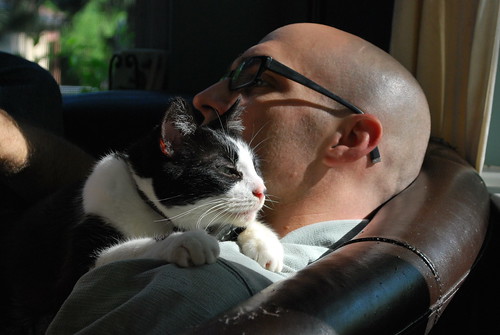
{Photo by rocketlass.}

I've spent the past couple of weekends binging on Don Winslow novels, racing through The Dawn Patrol, The Death and Life of Bobby Z, Savages, The Kings of Cool, and The Winter of Frankie Machine. In case you can't tell by the length of that list, I'm impressed: Winslow writes irresistible crime novels--fast-paced, smart, full of interesting, memorable characters and written with a wry humor in punchy, slang-filled sentences that he obviously had fun crafting. In addition, the southern California setting, centered around San Diego but running along the coast from Mexico to LA, is handled well. It's long been a truism that crime fiction needs to be rooted in a distinct locale, and while there are plenty of examples to the contrary (the Parker novels, for one), Winslow's books are a good reminder of what a well-described and fully understood setting can do: without being heavy-handed, each novel paints a bit more of the picture of SoCal crime past and present, high and low, secret and sanctioned, and taken together the panorama is richly peopled, extensive, and convincing. Though I'll probably bring my actual binge to a deliberate halt soon--all things in moderation, as Aristotle said, including all things in moderation--I'm glad that a bunch more Winslows will be waiting for me when I'm ready to return to him.

Two bits from The Winter of Frankie Machine, which I finished today, got me thinking and seemed worth sharing. The first comes when the Frankie of the title, a retired hit man, realizes he's in danger and has to run. He heads to an apartment he's kept as a bolt hole, and there he opens a safe that's in the closet:
Inside the safe is his "parachute pack"--an Arizona driver's license, an American Express Gold card and a Visa Gold card, all under the name Jerry Sabellico. Every month or so, he makes a phone purchase with the cards to keep them current, and pays them with checks from his Sabellico account. There's also ten thousand in cash in used, mixed bills.

And a new, clean, .38 Smith & Wesson with extra ammunition.
When I was a teenager and just getting into crime fiction, this was the sort of thing that would absolutely thrill me: it's like getting secret instructions for how to live life as a badass--just in case. Of course when you're an adult you should have a bolt hole, and of course it should have all those things in it.

Then you grow up, and you realize how glad you are that--no real surprise, let's be honest--you didn't end up living the kind of life that might require a quick getaway. Instead, you're living a life bound up in routine--which Winslow also addresses:
All Frank's days are busy, what with four businesses, an ex-wife, and a girlfriend to manage. The key to pulling it off is to stick to a routine, or at least try to.

He has tried--without conspicuous success--to explain this simple management technique to the kid Abe. "If you have a routine," he has lectured, "you can always deviate from it if something comes up. But if you don't have a routine, then everything is stuff that comes up. Get it?"
In some ways, though, even the routine as presented by crime novels is seductive: how many of us have actual routines that don't involve simply going to the office at roughly the same time every day? How many of us surf every morning then hit the same diner for breakfast? The detective (or the criminal, reformed or otherwise) chooses his routine rather than letting it bind him. Like the unchanging patterns of life at Nero Wolfe's brownstone, it's the comforting structure that we're supposed to fall for as readers, so that when the "stuff that comes up" happens, the disruption feels real and we're ready to go along for the ride.

Rather than a routine, what I have these days is a bunch of specific things I want to do each day. When I was a student, and then a young bookseller, I budgeted every week to the dollar (or, when I was selling books in the UK, to the pound). These days, I budget time to the hour instead, plotting days in advance when I'll make the space for running, for the piano, for writing. Habits rather than actual routine rule my days, the difference being that habits are easily rearranged, re-sorted--and few blocks of time fail to be earmarked in advance.

I think it's a good sign that such a situation doesn't even begin to make me long for a bolt hole, a parachute pack, or the sort of life where those are needed. It does, however, make me grateful for the occasional weekend that offers some wide open spaces for doing little but reading crime novels--and even more for a weekend when that reading turns out so well.

Friday, May 27, 2011

Matthew Scudder is back

I wrote last week about how impressed I was by Lester Dent's achievement in Honey in His Mouth of writing a good crime novel built around a fencepost-dumb protagonist. Today, I'm marveling at an even more impressive achievement, this one by Lawrence Block: his new Matthew Scudder book, A Drop of the Hard Stuff, is a crime novel that derives nearly all of its suspense, not from the crime under investigation, but from its protagonist's day-by-day, minute-by-minute struggle to keep from drinking. And it works: the book is completely gripping, as through page after page you alternate between dread and relief, pulled on by the palpable force of Scudder's will even as you (and he) worry that it may not be enough.

Ed Park's review of the book for Time is a good place to go for more; he does a nice job of setting the novel in context of the rest of Block's Scudder books, in which alcohol--and, in the past several novels, recovery--has always played a large part. I think it was from Scudder, rather than from any afterschool special, that I got my first sense of how powerful addiction could be, and how the struggle to overcome it could never quite be definitively won. But none of the novels until this one have focused so relentlessly on that struggle, and it's a testament to Block's writing, and more to his narrative voice as Scudder, that he makes it so compelling. Scudder sits with a Coke as informants drink, and he catches a whiff of whiskey; he walks to fill time he would once have spent drinking; he calls his sponsor at all hours and gets the sort of advice that is familiar to us from Bubbles's struggles on The Wire or David Foster Wallace's brilliant analysis in Infinite Jest, advice that is so simple, so basic, so no-nonsense that it ought not to work--and yet somehow does.

All that should make for a novel that is relentlessly grim, but that's not the case; in fact, A Drop of the Hard Stuff is also a lot of fun--even in extremis Scudder is a gentle ironist at heart, and the book full of the usual Block touches, the humor and observations and asides that make it obvious how he and Donald Westlake could be great friends. My favorite is this playful exchange between Scudder and an informant:
He was frowning in concentration. "Jack, Jack, Jack. Did he have a sobriquet?"

"A what?"

"A nickname, for Christ's sake. And don't tell me you didn't know the word."

"I knew it," I said. "I've come across it in print, but I'm not sure I ever heard anyone say it before. I certainly never heard anyone say it in Poogan's"

"It's a perfectly fine word. And it's not exactly the same as a nickname. Take Charles Lindbergh. His nickname was Lindy--"

"As in hop," I suggested.

"--and his sobriquet was the Lone Eagle. George Herman Ruth, nickname was Babe, sobriquet was the Sultan of Swat. Al Capone--"

"I get the idea."

"I just wanted to keep on saying it, Matthew. Sobriquet. I know it from reading, and I don't think I ever heard it before, and I know for certain I never said it before. I wonder if I'm pronouncing it correctly."

"I'm the wrong person to ask."

"I'll look it up," he said, and he picked up his glass and put it down without drinking. "Hi-Low Jack," he said. "Wasn't that his fucking sobriquet? Isn't that what they called him?"
And just like that, digression is folded back into plot, and Scudder is off on his quest.

Block is a treasure, and the fact that he's still turning out good novels--novels that show that he remains engaged and interested in his craft--is something to celebrate. It's good to have Matt Scudder back.

Wednesday, May 18, 2011

A noir numbskull

The only good thing about Hard Case Crime's long break between books--a hiatus, caused by a search for a new distribution partner, that will end in September with a new Lawrence Block novel that features a just possibly NSFW cover--is that it's given me a chance to read some of the earlier books that had fallen by the wayside.

One of those was Honey in His Mouth, a novel that Doc Savage creator Lester Dent wrote in 1956 but never published. It's a fun, bleak little crime novel, but what's most interesting about it is what Dent does with the figure of the noir protagonist. Noir for me is most interesting when it focuses on a relatively ordinary guy who, through bad luck or cupidity finds himself falling through the floor of his ordinary life and into a darker, more dangerous world. Usually, however, a writer--even a very good writer--can't resist the urge to make that everyman just a tiny bit more resourceful, quick-thinking, and calm under pressure than, well, every man. It's understandable: if you're going to put a man under pressure in order to see what it does to him, he can't fold on the first page. But it distances us from the character, encouraging us to project our wishes on him rather than see our failings; it can be fun, but it slights the realism that is in some important sense noir's stock in trade.

Dent doesn't fall victim to that temptation. First, his main character, Walter Harsh, is no hero: he's an extremely small-time con man. More important, Harsh is dumb. Stone dumb. Even more, he doesn't realize it. Instead, like, presumably, all failing con men, he assumes at every juncture that he's in the middle of putting one over on everyone else. He gets picked up by a crew of South Americans who want to hire him to impersonate their soon-to-be deposed dictator, and he barely asks a question, assuming all along that he'll end up on top. Here, for example, he falls for nothing more than a wink:
But Mr. Hassam at once did a thing which set hi min solid with Harsh. What Mr. Hassam did was give the wall safe a knowing glance, then wink at Harsh. He did this so the others did not observe. It had the same effect on Harsh that an orator is striving for when he opens his speech with a gut-buster joke It warmed up the audience, got it interested. The little smoky guy might be an operator, Harsh thought.
Then in this scene, Harsh's stupidity takes a more physical form, an unearned confidence in his fighting ability:
Brother leaned toward him. Hit him in the belly, Harsh thought, but hand him a good one so it would settle things. He brought his right fist up towards Brother's middle, but Brother pushed the hand aside easily.
Just as easily, Harsh gets his eardrums boxed. And, physically or metaphorically, he gets them boxed again and again and again, never letting the lesson teach him his limitations.

A stupid protagonist--a walking example of the Dunning-Kruger effect--is tough to pull off without boring or irritating your readers, but Dent does it, keeping the supporting cast interesting enough and the plot brisk enough that Walter Harsh remains amusing. Most noir plots, if enacted in reality, would end quickly, hero dead; Dent gives us a realistically incompetent lead and still manages to string us along nicely, and keep our interest, for 250 pages. It's quite a feat.

Monday, April 04, 2011

Donald Westlake, Brian Garfield, and Lawrence Block

Work and baseball and the piano--a trifecta sure to lead eventually to crime and the gutter--are preventing me from putting up a proper post today. But you're in luck: over at the blog of my employer, the University of Chicago Press, we've just posted an interview I conducted with Brian Garfield (author of, among other novels, Death Wish) about his long friendship with Donald Westlake, their many collaborations, and his aborted screenplay for Butcher's Moon.

Even better: Garfield was kind enough to send us some photos of Westlake and the crew at the fabled Mysterious Bookshop poker game, circa 1972. The sight of Westlake's giant goatee alone is worth clicking over for.


Oh, and Butcher's Moon is available now, along with the first two post-hiatus Parker novels, Comeback and Backflash. Westlake's friend (and fellow Mysterious Bookshop poker player) Lawrence Block has written three different dynamite forewords for this batch. I recommend you go get 'em on your lunch hour, then close the door to your office and read away the afternoon.

Wednesday, August 11, 2010

A Westlake by any other name---or make that many other names

After yesterday’s post about Parker, I thought you might an amusing passage I encountered today in A Jade in Aries (1970), the fourth of the five novels about disgraced copy Mitch Tobin that Donald Westlake wrote under the name Tucker Coe. Coe’s bio in this book reads:
A self-made conglomerate, Tucker Coe is a subsidiary of a writer better known to most readers under a different name, perhaps his own. A man who constructs his own walls for his own reasons, Mr. Coe lives with his family in the American Northwest and is currently at work on several projects, including a further expedition by Mitchell Tobin.
But savvy readers, if they hadn’t figured out Coe’s identity already, would surely have realized it after this big hint, which appears late in the novel:
Marty came on the line after a minute, and I said, “Hello. How are you doing?”

“Don!” he cried. “Good to hear from you!”

I said, “This is Mitch. Mitch Tobin.”

“For God’s sake,” he said. “Hiya, Mitch. You sound just like Don Stark. You don’t know him, do you?”

“No, I don’t.”

“I never realized it before,” he said. “It’s incredible.”
Ethan Iverson, in his indispensable annotated checklist of Westlake’s novels, writes that the Coe books, along with the four novels Westlake wrote as Samuel Holt,
are the only conventional private eye murder mysteries in the Westlake canon. It’s not surprising they are under pen names; Westlake was suspicious of the form. . . . The Coes and Holts are probably really only for Westlake completists, but they will make good reading for anyone who likes to try to “beat the detective” and solve the murder mystery before the hero does. The always-honest Westlake leaves the clues in plain sight; rather to my surprise, without trying, I solved a few of them myself.
I’d give the Coe novels, at least, a bit more credit than that: they’re not first-rate Westlake, but anyone who appreciates his lean, clear prose and his sympathetic eye for the odd, surprising, yet rarely inexplicable ways that people choose to live in this world will find plenty to like in them.

Tuesday, August 10, 2010

Parker purloining paperbacks? Preposterous!

My local bookstore, the 57th Street Books branch of the Seminary Co-op, has begun posting the winning stories in their Parker flash fiction contest, for which I served as one of the judges. Congratulations to Ryan Garms, whose "The Rare Book Score" took third place, and to Anders Runestad, who swiped second with "The Bookstore Heist," both of which are now up at the store's Front Table blog.

Keep an eye on the Front Table for the winning story later this week--and if 150-word semi-comic heists aren't enough to sate your need for crime, you can pick up the three newest Richard Stark reissues from my employer, the University of Chicago Press, Deadly Edge, Slayground, and Plunder Squad. In a great new foreword to the books, Hard Case Crime editor Charles Ardai describes them as marking a new plateau in Richard Stark's career to that point. Considering the number of times I gasped out loud while reading them, I can't disagree--along with the upcoming Butcher's Moon, this is as good, and as dark, as Parker gets.

Sunday, August 08, 2010

Lew Archer chats up a receptionist

John O'Hara having set me to thinking about the openings of books last week, I was pleased to find that Ross Macdonald's The Goodbye Look (1969), which I turned to this morning, has a great one.

Macdonald's novels don't mess around in their initial pages: Lew Archer nearly always has a case afoot within moments of the opening lines. But this one is even better than usual, offering a sampler of the qualities that make Archer such a compelling narrative voice--perceptiveness, natural sympathy, humor, and an openness to friendliness despite a lifetime's knowledge of the seamier side of human relationships:
The lawyer, whose name was John Truttwell, kept me waiting in the outer room of his offices. It gave the room a chance to work me over gently. The armchair I was sitting in was covered in soft green leather. Oil paintings of the region, landscapes and seascapes, hung on the alls around me like subtle advertisements.

The young pink-haired receptionist turned from the switchboard. The heavy dark lines accenting her eyes made her look like a prisoner peering out through bars.

"I'm sorry Mr. Truttwell's running so late. It's that daughter of his," the girl said rather obscurely. "He should have let her go ahead and make her own mistakes. The way I have."

"Oh?"

"I'm really a model. I'm just filling in at this job because my second husband ran out on me. Are you really a detective?"

I said I was.

"My husband is a photographer. I'd give a good deal to know who--where he's living."

"Forget it. It wouldn't be worth it."

"You could be right. He's a lousy photographer. Some very good judges told me that his pictures never did me justice."

It was the mercy she needed, I thought.
Later in the novel, Macdonald has Archer directly address his most salient quality: that of being a good listener, someone to whom people feel compelled to talk, more or less honestly and emotionally, to him with very little prompting:
We went down together in the elevator. In its automatic intimacy she said:

"I've spilled all my secrets. How do you make people do it?"

"I don't. People like to talk about what's hurting them. It takes the edge off the pain sometimes."
When people talk, Archer listens. Sometimes he judges, but mostly he listens, and in listening acknowledges that we all are frail and mistake-prone. In that, he's our ideal self, the one we always tell ourselves we want to be, simultaneously reminding us of our constant, vague wish to be better to those around us and of the risk--the emotional costs--of actually doing so.

Wednesday, July 28, 2010

One of the many attractions of writing a crime novel . . .

. . . would be getting to write scenes like this one, from Nic Pizzolatto's impressive, dark new novel, Galveston:
The girl said her name was Raquel and everyone called her Rocky. She was mostly terrified, and given what she'd been through, a lot of people might have switched off, but she talked like a mynah bird. I suspect that sometime before the night's events, she had learned that you can lie with anything. "My last name's Arceneaux." She pronounced it Arson, oh. "Are you going to kill me?"

"No. Stop asking me that."
Live through? Preferably not. Write? Hell, yes.

Sunday, February 14, 2010

Two sides of a coin, or, Parker and Dortmunder, Westlake and Stark

What better way to commemorate the St. Valentine's Day Massacre than by turning our attention to a heartless criminal?

Fans of Parker and Donald E. Westlake will enjoy this brief interview recently dug up by Trent, the proprietor of the Violent World of Parker site:


In one of the Parker novels--I think it's Plunder Squad--Parker explains why he has no problem with Brenda Mackey, wife and constant companion of his fellow heister Ed Mackey. Parker tends to view women as little but sources of trouble. He's a misogynist, but his misogyny, like all his other bad traits, is rooted in what he sees as practicality: time and again, he's watched men screw up a job because a woman turned their heads.

Brenda Mackey, however, escapes Parker's ire, and the reason is telling: she knows who she is, and, perhaps more important, likes who she is. As Parker puts it to himself, most people don't know who they are, and, if they do, they don't like who they are, wishing instead to be someone or something else, bigger or more impressive. Trying to be that person inevitably gets them--and those around them--into trouble. Brenda's self-knowledge, on the other hand, makes her a rock, reliable and safe.

That's what I love about the video above. There's nothing revelatory in Westlake's answers; his interviews over the years tended to feature a lot of the same questions, and thus the same well-rehearsed answers. Even so, it's a joy to watch him deliver them here, because he exudes a sense of pleasant contentment. It's impossible to watch that interview and not come away thinking that this is a man who knew himself and his place, and liked both--an impression that jibes with the testimony of friends and acquaintances. It's a quality I greatly prize, and to find it in someone who at the same time had the ambition to continually set himself complicated writing problems rather than resting on his laurels is remarkable.

The interview also seems like a good excuse to share a favorite passage from Jimmy the Kid, the Dortmunder novel that Westlake wrote in 1974, in which Dortmunder's crew attempts a kidnapping based on a plot they find in a crime novel called Child Heist, by none other than Richard Stark. Child Heist of course doesn't exist; in reality, the Stark novel that Westlake wrote that same year was the absolutely staggering Butcher's Moon, whose gripping, Red Harvest-like bloodbath would exhaust the Parker character for two decades.

What I love about this passage from Jimmy the Kid is the way that it reveals the continuity of approach between those two halves of Westlake's writing personality--tell me you can't imagine this description, soured by seriousness, being used to introduce a slightly corrupt businessman in a Parker novel who's about to find himself in over his head:
Herbert Harrington plucked his white handkerchief from his suit coat's breast pocket and patted the tiny bead of perspiration that gleamed on his pale high forehead. A calm, methodical, successful corporation attorney of fifty-seven, he was used to emergencies and crises that ran at a Wall Street pace: weeks of gathering storm clouds, spotted with occasional conferences or pubic rumor denials, then a flurry of phone calls, a massing of capital along the disputed border, and then perhaps three days or a week or even a month of concentrated buying, selling, merging, bankruptcy declarations and the like. Drama with sweep to it, emotional climaxes as carefully grounded and prepared for as in grand opera.

But this. They kidnap the boy at four o'clock in the afternoon, and by nine o'clock the same night they're demanding one hundred fifty thousand dollars for him. In old bills. In an equivalent situation on Wall Street, it would be three or four working days before anybody even admitted the boy had been taken. Then, there'd be a period of weeks or months when the kidnappers would publicly maintain the poster that they meant to keep the boy, had no interest in selling him, and wouldn't even consider any offers that might come their way. This logjam, assisted by continued denials from Herbert Harrington or his spokesmen that (a) he was interested in negotiating a repurchase, (b) that he was in a cash or tax position to make such a repurchase possible, or (c) that in fact he had ever had such a son at all, would eventually be broken by tentative feelers from both sides. Dickering, threats, go-betweens, all the panoply of negotiation would then be mounted and gone through like the ritual of High Mass, and it would be even more weeks before anything like a dollar amount was ever mentioned. And in fact dollars would be the very least of it; there would be stock options, rebates, one-for-one stock transfers, sliding scales, an agreement with some meat on it.
As for Butcher's Moon, well, you'll have to wait just a bit: it's on track to be republished by my employers, the University of Chicago Press, in the spring of 2011. Until then, you might occupy yourself by pre-ordering a copy of the final, long-lost Westlake novel, Memory, which Hard Case Crime will publish in April. As Parker would remind you, it's always good to be prepared.

Tuesday, January 12, 2010

"Do you randomly visit cops in the morning?"


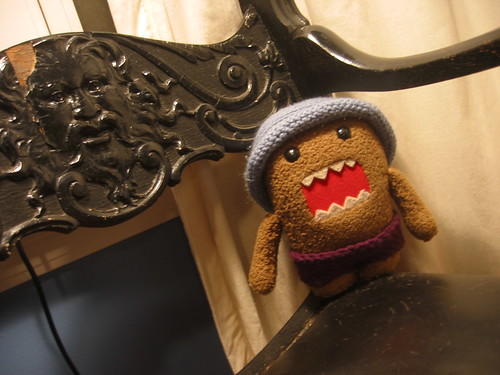
{Domo-kun is not a yakuza. He's far too kawaii for that. Photo by rocketlass.}

On the recommendation of the ever-reliable Sarah Weinman, last weekend I read Jake Adelstein's new book, Tokyo Vice: An American Reporter on the Police Beat in Japan (2009). It's got pretty much everything you want in true crime: danger; drama; appalling behavior; and a narrator who is easily obsessed, heedless of his own health and well-being, and prone to dangerous ethical compromises.

Adelstein, an American who went to college in Japan and stayed there as a reporter on the Yomiuri Shinbun, a prominent Japanese-language newspaper, offers a fascinating account of the seamier side of Japanese life. One great strength of the book is Adelstein's odd position: while he dives fully into the punishing three-deadlines-a-day, drinks-after-work, never-take-a-vacation life of a Japanese reporter, and thus comes as close as seems possible to being a part of and understanding this segment of Japanese life, at the same time he can't help but remain an outsider--which enables him to understand just which parts of Japan's treatment of issues of sex, gender, power, and crime will perplex, shock, or horrify American readers.

One of the least sordid, yet nonetheless most surprising aspects of the book for me was its depiction of the relationship between crime reporters and the police they cover. In order to cultivate police sources, reporters are expected to routinely visit cops at home--and bring gifts! Adelstein quotes at length from a memo one of his supervisors once sent to the paper's police reporters:
It's really sad that I have to write the ABCs of being a police reporter down for your losers. . . . If you just aimlessly visit cops at their homes during the evening, you won't get them to say anything. Anybody can get the addresses of detectives from their senpai [senior reporters] and go to the house, wait a couple of hours, and then, when they come home, butter them up and occasionally prime the pump with tickets to a Giants baseball game. . . . What are you doing to distinguish yourself from other reporters? Take a moment to reflect on your efforts.

Do you take care of the cop you want to crack? . . . Do you ask the cops to get food or something to drink with you? Do you make efforts to get the police to ride in the hired limousine with you? On a rainy day or when the snow falls, this is the perfect opportunity to send them from their house to the train station or vice versa.

Do you randomly visit cops in the morning? . . . If one of your cop buddies is sick, do you take the time to visit him in the afternoon? If you just go visit him in the evening, that's about the level of a first-year reporter for Yamagata [Hicksville] Television. If the wife or kids of the cops have a cold, buy some cold medicine, some orane juice, and take it to the house. . . .

Hanging out with your family and their family at the same time is the ultimate way to cultivate a source. Families that play together, stay together.

Have you ever taken your wife and kids with you on a Saturday and just stopped by "because you were in the neighborhood?"
What I find most stunning about this approach isn't the ethical questions it raises for both sides, or the demands it places on the reporter's time: it's the idea that the police would welcome it. It just seems insane that a cop, home from a long day at work, would want a relative stranger showing up at the house for a chat, no matter what gifts he might be bearing.

Clearly, between my preference for regular hours and for privacy in my home, I ought not to think of going into either reporting or policing in Japan. Which, given that my Japanese extends only so far as to apologize for my lack of Japanese, is probably for the best anyway.

Monday, November 02, 2009

Notes! On Agatha Christie and Nero Wolfe!

Too much time spent watching baseball and attempting to learn to play "Linus and Lucy" on the piano without driving rocketlass totally insane leads to . . . a Notes column! Newspapers may die, but the Notes column is eternal!

1 Recently, an article by John Curran in the Guardian in honor of Agatha Christie's 120th birthday sent me to The ABC Murders (1935). Like the last time I read Christie (prompted by Pierre Bayard's gamesmanship), I was pleasantly surprised at her light touch, which didn't register during my long-ago middle-school Poirot binge. Sure, the characters rarely rise above type and the dialogue is wooden, but the sense of fun that pervades the novel--even as its ostensible focus is brutal murder--is infectious. It even extends--unexpectedly--to Christie poking a little fun at herself and her formula, in this conversation between Poirot and his trusty friend Hastings:
"If you could order a crime as one orders a dinner, what would you choose?"

I fell in with his humour.

"Let me see now. Let's review the menu. Robbert? Forgery? No, I think not. Rather too vegetarian. It must be murder--red-blooded murder--with trimmings, of course."

"Naturally. The hors d'oeuvres."

"Who shall the victim be--man or woman? Man, I think. Some bigwig. American millionaire. Prime Minister. Newspaper proprietor. Scene of the crime--well, what's wrong with the good old library? Nothing like it for atmosphere. As for the weapon--well, it might be a curiously twisted dagger--or some blunt instrument--a carved stone idol--"

Poirot sighed.

"Or, of course, I said, there's poison--but that's always so technical. Or a revolver shot echoing in the night. Then there must be a beautiful girl or two--"

"With auburn hair," murmured my friend.

"Your same old joke. One of the beautiful girls, of course, must be unjustly suspected--and there's some misunderstanding between her and the young man. And then, of course, there must be some other suspects--an older woman--dark, dangerous type--and some friend or rival of the dead man's--and a quiet secretary--dark horse--and a hearty man with a bluff manner--and a couple of discharged servants or gamekeepers or something--and a damn fool of a detective rather like Japp--and well--that's about all."

"That is your idea of the cream, eh?"

"I gather you don't agree."

Poirot looked at me sadly.

"You have made there a very pretty resume of nearly all the detective stories that have ever been written."

2 Christie also offers a quick little joke at the expense of Sherlock Holmes:
"The crime," said Poirot, "was committed by a man of medium height with red hair and a cast in the left eye. He limps slightly on the right foot and has a mole just below the shoulder-blade."

"Poirot?" I cried.

For a moment I was completely taken in. Then the twinkle in my friend's eye undeceived me.

"Poroit!" I said again, this time in reproach.

"Mon ami, what will you? You fix upon me a look of doglike devotion and demand of me a pronouncement a la Sherlock Holmes!"
The ABC Murders appeared in 1935, a mere five years after Conan Doyle's death, and only eight years after the publication of the last Sherlock Holmes story, which makes me wonder when the first parody of Holmes appeared. How quickly did wags begin to treat Holmes's infallible perceptiveness as an object of humor? Somehow I doubt Christie was the first--and if Google Books had more than a limited preview of The Alternative Sherlock Homes (2003), I might be able to say for sure. Looks like this may require a trip to the library . . .

3 Then there's this exchange, which smacks more of the relationship between Nero Wolfe and Archie Goodwin than what usually prevails between Poirot and Hastings:
"Is that a way to fold a coat? And regard what you have done to my pyjamas. If the hairwash breaks what will befall them?"

"Good heaveans, Poirot," I cried, "this is a matter of life and death. What does it matter what happens to our clothes?"

"You have no sense of proportion, Hastings. We cannot catch a train earlier than the time that it leaves, and to ruin one's clothes will not be the least helpful in preventing a murder."
Unlike Archie, however, Hastings simply cannot be counted on for a wry rejoinder. I could imagine a Hastings who is more of an English Archie--think Bertie Wooster with a sidearm--but I don't picture him lasting long with Poirot, who seems to need less a goad than a foil.

4 Speaking of Nero Wolfe, it was his fault that the premise of The ABC Murders, described by John Curran as "beautifully simple," didn't surprise me this time around. The murders mounted, and I began to think I could see the motive behind them . . . but it took me a while to remember that I'd come across the same diabolical plan recently in "The Slaughtered Santas," an episode of the early 1950s "The Adventures of Nero Wolfe" radio show. {Spoilers here, for those who want them.}

5 The Nero Wolfe radio show, sadly, isn't as good as fans of the novels would have a right to hope; it arrived too late in the radio era to get the quality of writing Rex Stouts novels deserve. Still, there's undeniable pleasure in hearing the glorious Sydney Greenstreet in the title role--imagine him delivering this line, from Too Many Cooks (1935):
I have only so long to live--so many books to read, so many ironies to contemplate, so many meals to eat.
A list that's sad, but true, and to which I'd have to add that one only gets so many World Series, so in an effort to postpone winter's chill at least one more night, it's time to watch some baseball.

Wednesday, September 23, 2009

Things I learned from Donald E. Westlake . . .

. . . that I would never have suspected

From What's the Worst That Could Happen? (1996):
The casino part of each strip hotel is widespread, but it is also low-ceilinged and windowless, so that its air supply, except out at the very edge of the slot machines near the check-in desk and the main entrance, is completely artificial. It is air-conditioned, of course, with temperature and quality controlled from an air room near the rear of the hotel, next to the kitchens and very close to the loading dock. But air-conditioning isn't all. Each night between midnight and 8:00 A.M., the controlled air delivered from this room to the vast casino area is sweetened with just a little extra oxygen, to make it a richer air than human beings normally breathe on the planet Earth. This richer air makes people feel more a wake, happier, more energized. Because of this, they don't feel like going to bed, not quite yet. They feel like staying up, playing at the tables just a little longer, trying just a little harder. Who knows? Luck might turn.
Sounds like an opening for an unscrupulous set of characters like Dortmunder and his crew, no?

. . . that I already knew, but enjoy learning again and again

From What's the Worst That Could Happen? (1996):
When Stan Murch felt the need for temporary wheels, he liked to put on a red jacket and go stand in front of one of the better midtown hotels, preferably one with its own driveway past the entrance. It was usually no more than ten or fifteen minutes before some frazzled out-of-towner, vibrating like a whip antenna after his first experience driving in Manhattan traffic, would step out of his car and hand Stan the keys. One nice thing about this arrangement was that it wasn't technically car theft, since the guy did give Stan the keys. Another nice thing was that such people were usually in very nice, clean, new, comfortable cars. And yet another nice thing was that the former owner of the car would also give Stan a dollar.
. . . both of which would be number [insert large number here] in a series if only I'd bothered to keep track.* Oh, the many and varied debts I owe to Donald Westlake!

Monday, August 24, 2009

East Village noir


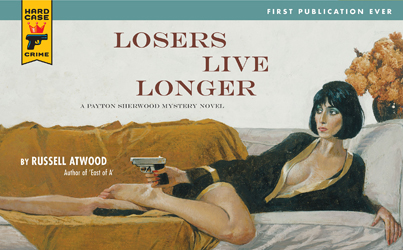
Any post about Russell Atwood's new crime novel Losers Live Longer (2009) has to start with the cover design: freed from traditional orientation by the extinction of the drugstore spinner rack, Robert McGinnis lets his long-legged lady (and, oh, how long-legged his ladies always are!) recline, a snub-nosed pistol resting in her hand almost as comfortably as she's resting in (and out of) her robe. It's one of the most striking covers Hard Case Crime has produced--booksellers, you should stock this one for the cover alone.

Fortunately, the contents prove worthy of the cover. As much fun as Hard Case's reprints and rediscoveries can be, it's the new books that are the most exciting, because it's always interesting to see the noir sensibility adapted to contemporary life--and because a good book by a working writer always holds out the promise of more. Russell Atwood's contribution to the genre is perhaps best summed up by the update of Raymond Chandler that passes through the head of his detective, Payton Sherwood, as he follows a lead through the East Village: "Down these gentrified streets a man must go . . . "

Sadly for Sherwood, those streets--his stomping ground--haven't been so productive lately, and as the novel opens he's sold most of his furniture, is in hock to his parents, and it looks like his days as a detective just might be numbered. (A former colleague, seeing his primitive computer setup, cracks, "What, you still using dial-up? Shit, Payton, churn your own fucking butter, too?") But then he gets five clients in one day.

Of course, a couple of them die, a couple of others pull guns on him and/or crack him over the head, and they're all, to no one's surprise (including his) connected . . . but you take what you can get, right? Atwood's plot is brisk and nicely complicated; this is the sort of novel wherein it occurs to you and the detective at the same time that a whole day has passed since you opened the book and he hasn't had a moment to take a deep breath, let alone eat or sleep.

The East Village got its moment in the reading public's sun last year with Richard Price's Lush Life. But whereas Price bore down on the neighborhood like an anthropologist, sussing out its various tribes and traditions, and the complicated commerce among them, Atwood simply immerses us in the streets, from Alphabet City all the way to the Hudson. This novel is about the city not because it can teach us important lessons about The Way We Live Now, but because the city is home, its quirks and dangers a part of the character of those who live there.

That doesn't mean Atwood's not interested in commenting on the urban environment--where would a hardboiled detective be without some ruminations on place and change?--but it does mean he approaches the subject with a lightness, and a humor, that is entirely absent from Price's work. This passage, which follows Sherwood rushing out the door of his office without his keys, or his shoes, is a good example:
But not to worry, this was the East Village. There'd be shoes. Time was you couldn't turn a corner in this neighborhood without coming across a tossed-out pair of two-tone loafers, or snakeskin cowboy boots, or zebra-striped high-tops, or glittery platform pumps. Things couldn't have changed that much.

This is the East Village, I told myself, there'll be shoes.

Unless, of course, the neighborhood had changed that much, like the rest of the city around it, desecrated and desiccated, its character and flavor all but gone. If so, then I was lost here.

Your neck of the woods, Owl had said. Yeh, 'cept these weren't my woods anymore, and now there was only my neck.
With that sort of wry sensibility, buttressed by self-deprecating humor and pleasantly understated pop culture references (I particularly enjoyed a throwaway reference to Jerome Bixby's "It's a Good Life."), Payton Sherwood is good company: bull-headed, unlucky, a sucker for attractive brunettes, with just enough of the knight-errant about him to ensure that a steady supply of beatdowns will keep coming his way.

In addition, Atwood offers just enough hints of a convincingly detailed backstory to suggest that Sherwood really does have a life beyond the novel; though his earlier novel featuring Sherwood, East of A (1999) is out of print, I've just ordered a used copy and will be interested to see what else Atwood has to tell us about him. Here's hoping it doesn't take him ten more years to write a third.

Saturday, August 08, 2009

Other books

As I was looking for the copyright date on the library copy of Donald E. Westlake's Bank Shot (1972) the other day, I happened to notice the page facing the title page, which reads:
Other Books

A Tale of Two Cities
The Magnificent Ambersons
So Big
W. C. Fields: His Follies and Fortunes
The Decline and Fall of the Roman Empire
The Merry Devil of Edmonton
An Account of Corsica
The Love Machine
Reader's Guide to Periodical Literature
An obvious joke, perhaps, but I'll admit to laughing out loud.

So Big
and The Love Machine, in case you're wondering, are not examples of the soft-core erotic novels that Westlake wrote with his friend Lawrence Block when both were hungry writers back in the early 1960s; they're novels by Edna Ferber and Jacqueline Susann, respectively (and, according to a listing at alibris, the love machine "is Robin Stone, a TV-network titan around whom women flock.")

Those soft-core novels will soon be seeing the light of day once again, however: via Sarah Weinman I recently learned that, according to Block, Subterranean Press will be reprinting all three in one volume titled Honey Girls and Hellcats next year.

Thursday, August 06, 2009

Life lessons from Donald Westlake

From Donald E. Westlake's Bank Shot (1972):
"Just because you've been working a con," Kelp said, "you figure everybody else is too."

"That's right," Dortmunder said.
Reading the second novel in Donald Westlake's Dortmunder series today, I was reminded of the fact that Westlake's books can in some ways serve as dramatized self-help or advice books: the Parker novels are better than any of poor Richard's aphorisms at conveying the virtues of hard work and dedication, while the Dortmunder novels . . . well, they're more like that class of self-help books that patiently teaches you how to cope with the world when everyone and everything seems to be conspiring to drive you insane. There's lots of counting to ten, or even to twenty:
Dortmunder had learned patience at great cost. The trial and error of life among human beings had taught him that whenever a bunch of them began to jump up and down and about at cross-purposes, the only thing a sane man could do was sit back and let them sort it out for themselves. No matter how long it took. The alternative was to ttry to attract their attention, either with explanations of the misunderstanding or with a return to the original topic of conversation, and to make that attempt meant that sooner or later you too would be jumping up and down and shouting at cross-purposes. Patience, patience; at the very worst, they would finally wear themselves out.
The risk of taking the time to count to ten, of course, is that it's always possible that by the time you get to eight, Parker will have sneaked in and taken all your stuff.

Monday, July 27, 2009

Dortmunder's last job, or, Donald Westlake Week concludes!

If you've never read one of Donald E. Westlake's comic caper novels starring tough-luck heister John Dortmunder, the opening lines of Get Real (2009), the fourteenth and final book in the series, will give you a good sense of their tone:
Dortmunder did not like to stand around on street corners. A slope-shouldered, glum-looking individual in clothing that hadn't been designed by anybody, he knew what he looked like when he stood for a while in one place on a street corner, and what he looked like was a person loitering with intent. The particular intent, as any copy casting an eye over Dotrumunder would immediately understand, was beside the point, and could be fine-tuned at the station; the first priority was to get this fellow in charge.

Which was why Dortmunder didn't like standing around on street corners: he hated to give cops the feeling there was duty to be done.
Though Westlake has never been quite as funny (nor as ridiculous) as P. G. Wodehouse, the precision of his prose has often brought Wodehouse to mind, as both men root a lot of their humor in getting phrasings just right, mixing high and low diction, slang and proper speech, surprising us by the juxtaposition. The above paragraph strikes me as being even more Wodehousian than usual--the "get this fellow in charge" could have come straight from any number of Wodehouse's self-righteous constables, who would gladly have sent Dotrmunder to prison for several years "without the option."

As the opening suggests, Westlake was still fully engaged with his craft as he wrote this, his final novel. And he's come up with an ingenious premise: a chance run-in leads to a TV producer hiring Dortmunder and the gang to star in a reality show about their work, a proposal so ridiculous that they go along with it. They've got nothing on tap at the moment anyway, and Dortmunder figures that while of course they're not going to actually commit any crimes while this self-important goofball's looking over their shoulders, they can at least take his money while they secretly figure out another job.

Complications and absurdities ensue--the most amusing of them being Murch's gleeful stealing of a car a day from the studio's disorganized, overcrowded garage of prop cars--the whole as light and gentle as we've come to expect from Dortmunder, the greatest pleasure coming not from the well-turned plot but from the fun of seeing the world through Donald Westlake's observant, perpetually amused eyes. Take the following description, for example, of a short, fat, extremely minor character known as My Nephew, named for the chain of shady discount stores he runs:
Now My nephew got to his feet, a complicated maneuver in three distinct sections. In section one, he leaned far forward with his broad palms flat on the desktop. In section two, he heaved himself with a loud grunt upward and back, becoming more or less vertical. In section three, he weaved forward and back, feet on floor and palms on desk, until he found his equilibrium. Then, lifting the palms from his desk and taking a loud breath, "Be right back," he said, turned, and waddled more briskly than you would have thought possible to a metal fire door in the wall behind the desk. He opened this door, stepped through a space barely wide enough for the purpose, and left, the door automatically shutting behind him.
We see this same sort of attention to--and care for--the details of the world and its people throughout Westlake's work, in serious, pyschologically acute form in the Parker novels, played for wry comedy in the Dortmunder novels.It's what makes him such great company.

Throughout Get Real, Dortmunder's biggest frustration is that the other guys unexpectedly come to like acting in the reality show, staging conversations in the fake bar that the producers have created, discussing fake plans with the pretty actress who's playing a girlfriend, actually getting to talk about their work a bit to people who are interested. At one point, when it looks as if the job they're secretly planning isn't going to come off, the other guys decide that they'd like to go ahead and do the show anyway. Dortmunder is appalled. "Money from wages," he reminds them,
is not the same as the same money from theft. Money from theft is purer. There's no indentured servitude on it, no knuckling under to whatever anybody else wants, no obedience. It isn't yours because you swapped it for your own time and work, it's yours because you took it.
If Parker ever felt that much need to explain himself, that speech could have come out of his mouth; it could serve as a heister's credo. "You people have completely forgot who and what you are," Dortmunder laments. But he hasn't: he's a heister, always has been and always will be. And if it's unsettling to think that Westlake's death left the cold steel of Parker out there on the loose, forever unapprehended and forever planning, it's a corresponding comfort to know that Dortmunder will remain free, too, walking around New York in his schlubby, put-upon way, the two of them maybe managing to keep the universe in some sort of rough balance.

Wednesday, July 22, 2009

Donald Westlake lives on in Memory


Those of you who spend as much nose-to-monitor, laptop-warming-lap time as I do may have seen this elsewhere already, but it's such good news that it's worth sharing nonetheless: Charles Ardai, publisher of Hard Case Crime, put out word over the weekend that he is going to publish a previously unknown Donald E. Westlake novel, titled
Memory, next April. The novel, writes Ardai,
is the story of a man who suffers an assault (after being caught in bed with another man's wife) and wakes up in a hospital bed suffering from a peculiar form of brain damage that doesn't make him unable to function but does make it hard for him to form new memories or retain old ones. Stuck far from home (and struggling even to remember where home used to be), paranoid about the attentions of the police, and desperate to reconstruct his lost life, Paul Cole sets out on an extraordinary private investigation: a missing persons case in which he himself is the missing person.
It's an explicitly existential novel, and a long one, and I think these were the reasons his then literary agent advised him to shelve it and concentrate instead on the more commercial sorts of crime fiction he was becoming known for.
According to Ardai, Lawrence Block, who passed on the manuscript with the blessing of Westlake's widow, had urged his friend to send the book out for publication many times over the years, but Westlake never got around to it; the opening chapter is available at the Hard Case Crime site, if you want to judge the book's quality for yourself.

Admittedly, for most of us (or maybe all of us except Ethan Iverson?), there was still plenty of Westlake left to read even before the discovery of Memory. The thought of an addition to the canon is exciting nonetheless, especially if it's as much a departure for Westlake as Ardai suggests; given how many approaches, how many variations on themes Westlake attempted over his career, exploring a new one will surely be a pleasure. And a writer who can immediately follow a stripped, yet rhythmic passage like this--
After the show, they went back to the hotel room, and to bed, for the seventeenth time in three weeks. He had chosen her because, being on the road with him, she was handy; and additionally because she was married, had already clipped the wings of one male, and could therefore demand nothing more from him than he was willing to give. Why she had chosen him he neither knew nor cared.
--with a description as straightforward, yet fine-tuned as this--
clench-faced sweaty blindness of physical passion
--is worth following almost anywhere he chooses to go.


Monday, April 13, 2009

Catching up with The Cutie

I've written a lot about the challenges of picking books to carry on a trip, but I've never before written about the related problem of timing your reading in the days leading up to a vacation. Like a baserunner bearing down on first, you have to make adjustments as that final day approaches so you hit it just right, having finished a book that you can then leave behind. Oh, there are remedies if you miscalculate--wrap up a novel a day too early, and you can always read some Samuel Johnson on the afternoon commute--but there is a satisfying neatness to turning the last page of a novel, giving your packed suitcases a proprietary eyeball, and switching off your bedside light, free of cares and ready to fly.

I'm an old hand at this tactic; one of the advantages of living in a house full of books is that there's always a slim novel to hand when one is needed. But when I found myself in that situation the day before we left for Japan in February, I didn't even have to go to the shelves, because that day the mail brought Hard Case Crime's reprint of Donald E. Westlake's first novel, The Cutie (1960), which turned out to be just about a perfect one-day read.

Published when Westlake was twenty-seven, The Cutie sees him already starting to work through a surprising number of the themes and ideas that would become hallmarks of his later work. The writing is crisp and clear, the tone is wry and funny without sacrificing drama or seriousness, and, most important, right off the bat Westlake's already focusing on the wrong side of the law. His protagonist, Clay, is the right-hand man of a New York mobster, responsible for everything from keeping the troops in line to performing the occasional hit, and he takes the attitude adopted by many of Westlake's later crooks: legal or illegal, this is a job, one that requires a specific set of skills that he happens to have. People want what his organization supplies, and if he didn't supply it, someone else would. No guilt, no compunction, no worries. End of story.

Only--and here's where The Cutie begins to reveal itself as the work of a real talent, beyond what you might expect from a first novel--Clay's too smart and perceptive to wholly swallow his own line. Oh, he's not really troubled by his occupation; though far more human than Westlake's later creation Parker, Clay does share some of his sociopathic tendencies. But he's nevertheless unable to deny the corruption that inevitably grows up in the shadow of a violent occupation--corruption, that is, not of public life, but of private. An encounter with a mob lawyer whose marriage is predicated on his wife's willfully not knowing anything about his work leads Clay to wonder about the fate of his own burgeoning relationship with a woman from the straight side. Can he keep deceiving her about what he does every day? And if so, would the man she was married to really be him at all? It's a question that, addresed or not, lurks behind any crime novel focused on the bad guys, and Westlake's resolution of it is pleasantly unexpected--and shows an admirable fidelity to the characters he's built.

Even better, however, is the ending, in which Westlake pulls off the extremely difficult feat of having a crucial realization dawn on Clay and the reader at exactly the same pace. It's flawlessly handled, and reading it, I could imagine the editor on whose desk this manuscript landed back in 1960 really perking up and starting to wonder what more this young writer might have up his sleeve.

This was the twenty-eighth Westlake novel I've read, which means I'm not even a third of the way through his oeuvre. The flood of tributes that poured in after his death this winter offered a lot of suggestions for where to go next; who knows--maybe by the time I reach a ripe old age, I will have matched Ethan Iverson and read all 100.

{Meanwhile, Parker fans should take note: the second batch of Parker reissues from my employer, the University of Chicago Press, just hit stores. They include The Mourner (1963), The Score (1964), and The Jugger (1965); The Score is one of my favorite of the early novels, for its audacity alone: Parker and a dozen heisters knock off a whole town in North Dakota. Up next, in the fall, are The Seventh (1965), The Handle (1966), and The Rare Coin Score (1967), all featuring an introduction by I've Been Reading Lately favorite Luc Sante!}

Thursday, March 12, 2009

"I was reflecting that of all Wolfe's thousand techniques for making himself obnoxious the worst was when he thought he was being funny."

After reading a novel about Nazis, however, well-written it might be, a retreat to novelistic comfort food seems essential. And what better comfort than that offered by Rex Stout, who, following my recent discovery of the pleasures afforded by his Nero Wolfe novels, offers me a near-Wodehousian quantity of books to enjoy?

The mention of Wodehouse is anything but accidental, as Stout's novels in their tight plots and attention to slanguage resemble nothing so much as what one would imagine Wodehouse himself might have turned out had he devoted himself to mysteries rather than the troubles of privileged kittenheads. Not that Stout's language reaches the brilliance of Wodehouse--to be honest, it's hard to think of anyone who matches Wodehouse when he's at his best. But Stout at least earns the comparison, both for the off-the-cuff beauty of Archie Goodwin's vocabulary and for the Blandings Castle-like sense that, much as the trappings of life may change, in essence Archie and Wolfe remain forever in Depression-era New York, their townhouse a fiercely held redoubt against modern existence.

So I turned to a recently published two-fer, which comprises Some Buried Caesar (1938) and The Golden Spiders (1953), and I was far from disappointed. Both offer circumstances that are unusual for Wolfe: he spends the entirety of the former not only outside his beloved 35th Street townhouse, but, god forbid, in rural New York, while the latter sees the case at its heart opened by, of all things, a child. Yet (and this is one of the keys to the appeal of the Wolfe novels) Wolfe himself is essentially the same no matter the circumstances: certain and secretive, imperial and imperious, finicky and forbidding. His unchanging, self-involved nature offers many of the same pleasures as his model, Sherlock Holmes--but, crucially, Wolfe, for all his peculiarities and sensitivities, suggests nothing of the strange neediness or even hard-fought weakness that occasionally flicker around the edges of Holmes's personality. Wolfe will never need us or our mysteries--but if we need him, we can rely on Nero Wolfe completely. If, that is, we can put up with him.

To aid us in that mission, we have, as ever, Archie Goodwin, whose Bertie Woosterian vocabulary serves as an excellent distraction from his Jeevesian competence. If Archie can tolerate Wolfe, then surely so can we. He serves as our eyes and our sounding board, testing theories and attempting to interpret Wolfe's monumental self-confidence. Without Archie, these books could easily have been little but puzzle mysteries, chances to test our wits against Wolfe's complicated plans and cryptic pronouncements; Archie's constant attention to character and motive are a large part of what enlarges them so that they become something more, a sort of compromise among Conan Doyle, S. S. Van Dine, and the noir masters whom Stout's work is, by design, too light to openly acknowledge.

And then there's Archie's language, which is a treat in and of itself. Whether he's describing how out of place a dandyish thug looks on a country ranch--
[T]he proper environment for that type is bounded by 42nd and 96th Streets on the south and north, and Lexington Avenue and Broadway on the east and west. In their habitat they don't look bad, in fact they help a lot in maintaining the tone, but out in the country like that, still wearing a Crawnley town suit including vest and a custom-made shirt and a Monteith tie, they jar.
--or being pleasantly surprised by the secretary at a highbrow magazine--
Having on Sunday bought a copy of the magazine that Vincent Lipscomb edited, and looked through it before passing it to Wolfe, I had supposed that any female employed by it would have all her points of interest, if any, inside her skull; but a curvy little number with dancing eyes, seated at a switchboard, gave me one bright glance and then welcomed me with a smile which indicated that the only reason she had taken the job was that she thought I would show up someday.
--or dismissing an unctuous PR flack--
In size he had been shortchanged, the top of his head being about level with the tip of my nose. With his thin brown mustache trimmed so it wasn't quite parallel with the thick lips of his wide mouth, I wouldn't have called him well designed to make the sort of impression desirable for a handler of public relations, but I admit I'm prejudiced about a mustache trying to pass as a plucked eyebrow.
--or just describing his own movements--
The basement floor was concrete. I navigated it, now as silently as silence.
--Goodwin's running monologue is idiosyncratic, worldly, goofily self-regarding, and, most important, great fun. He's wonderful company.

Now to read the remaining sixty-nine Nero Wolfe novels. After all, if I don't do that, how will I know whether Stout ever came up with a better closing line that the one that ends The Golden Spiders? It's damn hard to top "What the hell," you've gotta admit.