Showing posts with label The End of the Affair. Show all posts

Monday, June 16, 2008

The Good Soldier

From The Good Soldier (1915), by Ford Madox Ford
It is very singular that Leonora should not have aged at all. I suppose that there are some types of beauty and even of youth made for the embellishments that come with enduring sorrow. That is too elaborately put. I meant that Leonora, if everything had prospered, might have become too hard and, maybe, overbearing. As it was, she was tuned down to appearing efficient--and yet sympathetic. That is the rarest of all blends. And yet I swear that Leonora, in her restrained way, gave the impression of being intensely sympathetic. When she listened to you she appeared also to be listening to some sound that was going on in the distance. But still, she listened to you and took in what you said, which, since the record of humanity is a record of sorrows, was, as a rule, something sad.
In the midst of a narrative in which nearly every sentence needs to be vetted for its degree of disingenuousness, self-deception, or flat-out falsehood--a narrative that (as you can see from the effortless backtracking of "That is too elaborately put.") continually pulls up from under itself the tracks that it has mere moments before carefully laid--that passage strikes me as unexpectedly straightforward, true, and memorable. It reflects, of course, a perspective; a different sensibility might find human life to be not a litany of sorrows but a succession of surprising joys. But it is a believable, clear, and mostly honest perspective, a rare moment of seeming candor in a tale rife with misprision and deception.

Julian Barnes wrote well about the novel a week or so ago in The Guardian, prompting me to reread it after fifteen years away; I found its power, if anything, increased. I'll have more to say about it later this week if I get organized--and, I hope, about its relationship (and the relationship of its rhetorical stance) to Graham Greene's The End of the Affair, but for now, I'll leave you with Barnes's take on the novel's unforgettable first sentence, every word of which--Barnes's words, that is--is, unlike the fraught narrative in question, perfectly true:
"This is the saddest story I have ever heard." What could be more simple and declaratory, a statement of such high plangency and enormous claim that the reader assumes it must be not just an impression, or even a powerful opinion, but a "fact"? Yet it is one of the most misleading first sentences in all fiction. This isn't - it cannot be - apparent at first reading, though if you were to go back and reread that line after finishing the first chapter, you would instantly see the falsity, instantly feel the floorboard creak beneath your foot on that "heard".
The creak of the floorboard, indeed--a better image of that line is hard to imagine.

Wednesday, June 04, 2008

Cataloging the Imaginary Library


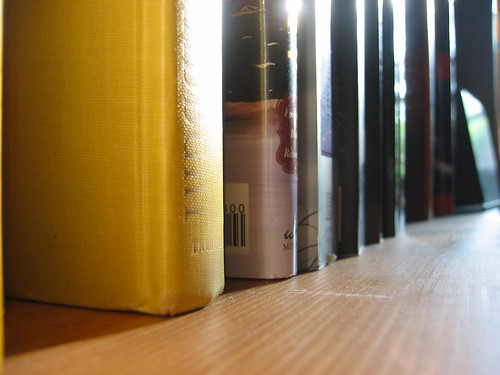
{Photo by rocketlass.}

Vladimir Nabokov's The Real Life of Sebastian Knight (1941) is a novel purporting to be a biography of a recently dead writer, penned by his half-brother. As such, it's full of the titles of books that don't exist outside the world of the novel. Like other prolific fake-titlers, such as Anthony Powell (J. G. Quiggin's Unburnt Boats, St. John Clarke's Fields of Amaranth, etc.), Nabokov seems to have greatly enjoyed the task of naming these phantom books, which at their best reside comfortably at the mysterious juncture of plausibility, originality, and amusement.

When, the day after reading Sebastian Knight, I encountered yet more fake titles in Nabokov's Laughter in the Dark (1938), then even more--though tipped more towards verisimilitude--last night in Graham Greene's The End of the Affair (1951), I began to think . . . what better, more Borgesian use could there be for the infinite capacity of the Internet than to assemble a catalog of the world's Fictional Library?

Thus was born a new feature! If I end up sticking with this over the months and building a ridiculously long list, I'll probably at some point figure out a different place to put them and a different way to organize them. For now, however, those of you who enjoy the art of fake titling as much as I do can simply enjoy this first batch:
From Graham Greene's The End of the Affair
For Ever Fido (1912), author unknown
The Ambitious Host, by Maurice Bendrix
The Crowned Image, by Maurice Bendrix
The Grave on the Water-Front, by Maurice Bendrix

From Vladimir Nabokov's Laughter in the Dark
Memoirs of a Forgetful Man, by Udo Conrad
History of Art: Volumes One through Ten, by Nonnenmacher

From Vladimir Nabokov's The Real Life of Sebastian Knight
The Laws of Literary Imagination, author unknown
The Tragedy of Sebastian Knight, by Mr. Goodman
Fall of Man, by Godfrey Goodman
Recollections of a Lifetime, by Samuel Goodrich
The Doubtful Asphodel, by Sebastian Knight
The Funny Mountain, by Sebastian Knight
Lost Property, by Sebastian Knight
The Prismatic Bezel, by Sebastian Knight
Success, by Sebastian Knight
Finally, I can't resist sharing some of the titles of go-getting business books featured in Ed Park's great new novel Personal Days (2008):
Every Worker's War Chest, by Fred Glass
Office Politics 101, by Randall Slurry
Climbing the Seven-Rung Ladder: The Business of Business, by Chad Ravioli and Khader Adipose
The Business Warrior's 30-Day Mental Fitness Plan (Revised Edition), by Cody Waxing
Yes, I Drank the Kool-Aid--and I Went Back for Seconds, by M. Halsey Patterson
Mine for the Taking: or, Some (INCREDIBLY!) Irreverent Notes on the Business of Wealth, by Parker Edwards
Letters to a Young Tycoon, by Percy Ampersand, edited by Percy Ampersand IV
Because part of the fun of that section of Ed's book is coming across these and other titles, I won't share nearly all of them--but maybe Ed will offer more at his reading at Chicago's lovely Book Cellar in Lincoln Square tomorrow night. Come out and see for yourself! Thursday, June 5th at 7 o'clock, 4736 N. Lincoln Avenue!