Showing posts with label Death of a Doxy. Show all posts

Wednesday, May 15, 2013

In the beginning

One reason I appreciate blogging is that it mostly relieves you of the stress of writing an opening. While each post is an individual piece of writing, it also has a place in an ongoing conversation; a blogger is allowed to presume that he and his readers are already friends, having been chatting about books for years now, with today's post just another byway in an endlessly digressive, destinationless journey. The problem of openings is thus solved.

Novelists, on the other hand--well, I feel comfortable assuming that it's hard for them not to obsess about that first paragraph. It's the handshake and greeting of someone new at a party--but unlike a meeting in real life, if your new acquaintance doesn't instantly find you engaging, he can just turn his back on you without apology or risk of censure, and you may never get a chance to convince him he got the wrong impression.

In just the past few days, I've read three great openings. Each one is different in tone and substance from the others, but they all succeeded: they made me want to keep going.

The first is from Dan Kennedy's caustic, uncomfortable--but very good--dark comedy American Spirit:
Ten years ago when someone asked Matthew the question, "Where do you see yourself in ten years?" he remained silent and tried to look like he had an answer and was only considering how to phrase it. Inside the head, however, the only answer he could hear was, Those days will eat me alive, and Matthew knew that probably wasn't what you were supposed to say. It's ten years later and if he can swing this storm of time that's standing still in front of him, fortune will smile like it never has. But it is hard to find a hint of promise in a calendar found suddenly blank; Monday through Friday wiped clean against one's own wishes or plans, a wide-open grid of Valium-and-Heineken-kissed dead end days with a horizon way past the weeks on the page. Maybe thirty-five now, maybe forty, close enough anyway--in America these days, one's forties seem to start at twenty-five.
What a combination of ominous content and tightly rhythmic prose! The implied whisper I always hear in italic speech--Those days will eat me alive--makes that unvoiced thought shiver with actual fear. And there's no way I wouldn't want to keep reading a writer who can manage the knocking of consonants (and consonance) in "It's ten years later and if he can swing this storm of time that's standing still in front of him, fortune will smile like it never has," with its hint of a corporate lingo persisting with bloody-nosed bravado amid failure. Kennedy's book is kin to other recent novels of male failure and degeneration--there are echoes here of Sam Lipsyte and Benjamin Anastas--but Kennedy's attention to his prose, and the compelling way he conveys his protagonist's internal narration, with its mix of startling truth and mediated (and medicated) self-deception, makes it stand out.

The second comes from one of my old standbys, Rex Stout. The problem of opening for a genre novelist, especially one writing about a series character, is on the one hand less acute (because his readers already know his work) but on the other more difficult (because he's written about these characters and similar situations over and over and over again already). In Death of a Doxy (1966), Stout solves the problem by simply throwing readers right in:
I stood and sent my eyes around. It's just routine, when leaving a place where you aren't supposed to be, to consider if and where you have touched things, but that time it went beyond mere routine. I made certain. There were plenty of things in the room--fancy chairs, a marble fireplace without a fire, a de luxe television console, a coffee table in front of a big couch with a collection of magazines, and so forth. Deciding I had touched nothing, I turned and stepped back into the bedroom. Nearly everything there was too soft to take a fingerprint--the wall-to-wall carpet, the pink coverlet on the king-size bed, the upholstered chairs, the pink satin fronts on the three pieces of furniture. I crossed for another look at the body of a woman on the floor a couple of feet from the bed, on its back, with the legs spread out and one arm bent. I hadn't had to touch it to check that it was just a body or to see the big dent in the skull, but was there one chance in a million that I had put fingers on the heavy marble ashtray lying there? The butts and ashes that had been in it were scattered around and it was a good bet that it had made the dent in the skull. I shook my head; I couldn't possibly have been such an ape.
Longtime readers of Nero Wolfe stories will, I think, recognize immediately that there's something off here: we've seen Archie Goodwin at plenty of crime scenes, and in plenty of places where he shouldn't be--but this time the worry feels different, more deep-rooted. So we read on, and we soon learn why . .  .

I'll close with the opening of Alice Thomas Ellis's The Clothes in the Wardrobe (1987):
I remembered her all my life. For years the image of her had hung in my mind like a portrait in a high room, seldom observed but unchanging. Sometimes, unawares, I would see her again suddenly revealed in the vaulting halls of my head. She was sitting on a grassy bank, leaning forward a little, a cigarette between her fingers, and she was speaking. I could not remember what she was saying, nor even if I had understood her, but I knew that what she was saying must be, in some sense, significant. She wore a cream-coloured cotton frock with large puffed sleeves, sprigged with tiny brown flowers; he stockings were cream-coloured too and on her feet were white, barred shoes. Her hair grew in dry red curls, dark red like rust or winter bracken. She was not at all beautiful, but even with her likeness before me I had always assumed that she must be, since she carried such conviction in her forgotten words and her enduring appearance. Her name was Lili.
This one, I'll admit, comes close to cliche: even a beginning writing student could see the way to create suspense and intrigue with an opening like this. What saves it for me is the imagery ("the vaulting halls of my head," "dark red like rust or winter bracken"), and the fact that the words--the content of the woman, in some sense--have been lost, and what remains is simply the deep understanding of her significance. Ellis's novel is now, thankfully, back in print, available as part of The Summer House Trilogy from Paul Dry Books. I've raved about her quite a bit before, and my enthusiasm is undimmed.

Sunday, April 28, 2013

What Nero Wolfe was disliking on TV in 1966

As I've noted before, one of the great pleasures of Rex Stout's Nero Wolfe books is their essential timelessness. Like Wodehouse, Stout found his world--essentially 1930s New York--and stayed there. Both authors make passing acknowledgments of change, but they don't allow external changes to affect their characters or settings in any substantial way.

Which is one reason that I always notice when Archie mentions that Wolfe once in a while watches TV. Wolfe gets a TV pretty early--a real Stout fanatic would have the date at his fingertips, but I'll just say I vaguely remember him having one in a novel from the very early 1950s (and having a remote for it!). But Death of a Doxy (1966) is the first time I've encountered any specifics about what Wolfe actually watches. Archie, having been out all day on a Sunday, thinks it likely that while he was gone Wolfe engaged in
his weekly battle with television. That may occur almost any evening, when he has got disgusted with a book, but usually it's a Sunday afternoon, because that's when TV is supposed to be dressed for company. He turns on one channel after another, getting grimmer and grimmer, until he's completely assured that it is getting worse instead of better, and quits.
What Wolfe fan doesn't immediately want to know what Wolfe was watching on that Sunday in January or February of 1966?

I turned to my old friend Jim Ellwanger, whose knowledge of TV is encyclopedic. Within hours, he'd replied in great, fascinating (to this fan of Wolfe and TV history) detail:
My first thought is that my father turned 17 in February 1966, and being in New Jersey, he got the same TV channels Nero Wolfe did in Manhattan -- and probably had the same opinion about them.

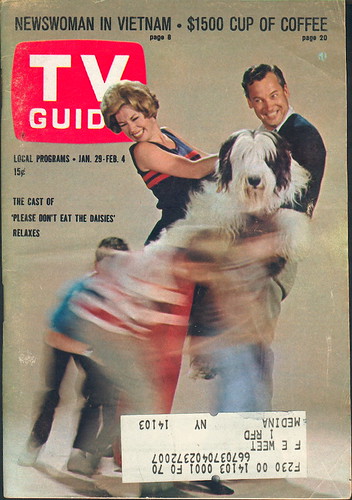
Anyway, I actually have a TV Guide from the time period in question, the January 29, 1966, issue.


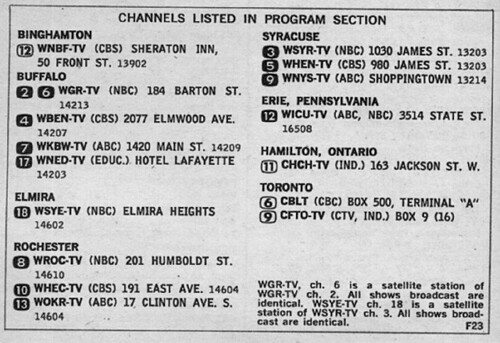
It's not the New York City edition, it's the Western New York State edition. Still, I can tell you exactly what network shows aired (and it's a pretty safe bet that they all aired on the owned-and-operated stations in New York):

12:30 (CBS) Face the Nation: "Scheduled: Secretary of the Treasury Henry H. Fowler is interviewed in Washington by CBS News correspondents Martin Agronsky and David Schoumacher; and Edwin L. Dale, Washington Bureau, New York Times. (Live)"

1:00 (NBC) Meet the Press: "(COLOR)" [unfortunately, no further details in this TV Guide]

1:30 (ABC) Issues and Answers: "Former Vice President Richard M. Nixon is interviewed in New York City by White House correspondent William H. Lawrence." [This is the predecessor to what's now "This Week."]

2:00 (ABC) NBA Basketball: "The Cincinnati Royals meet the Hawks at Kiel Auditorium, St. Louis. Chris Schenkel and Bob Cousy report. (Live)"

2:30 (CBS) CBS Sports Spectacular: "Scheduled: hunting and bowling. The finals of the $100,000 National Individual Match Game Bowling Championships are telecast live from Lansing, Mich. Also: Hunting authority Lee Wulff narrates films of turkey and quail shooting in Georgia. (Live and tape; 90 min.)"

4:00 (NBC) NBC Sports in Action: "Scheduled: lumberjacking and the Wengen International Ski Races. The ski races started Jan. 11 near Wengen, Switzerland. The World Lumberjack Championships were held last fall at Hayward, Wis. (60 min.)"

4:00 (ABC) The American Sportsman: "(COLOR) Actor Fess Parker joins guide Fred Bear to track down a Canadian grizzly in Northwestern British Columbia. Off Islamorada, Fla., fishing expert Joe Brooks goes after tarpon. Also: a comic underwater look at an Australian grouper (sea bass) that can't decide whether to swallow an attractive but somewhat suspicious piece of bait. (60 min.)"

4:30 (CBS) Ages of Man: "(SPECIAL) Sir John Gielgud reads from the works of Shakespeare in the conclusion of this adaptation of his one-man Broadway show. (60 min.) 'Mister Ed' is pre-empted." [In this, its final season, the regular time slot for "Mister Ed" was Sundays at 5:00 -- its last first-run episode aired 2/6/66.]

5:00 (NBC) Mutual of Omaha's Wild Kingdom: "(COLOR) 'Chacma Country,' second of a two-part study of the chacma baboon. In Southern Africa's Victoria Falls region, host Marlin Perkins and Jim Fowler follow the baboons on a search for water and food."

5:30 (NBC) G.E. College Bowl: "(COLOR) The University of Tulsa (Okla.) vs. Newcomb College, New Orleans. Moderator: Robert Earle. (Live)"

5:30 (CBS) Ted Mack's Original Amateur Hour: "Ted Mack introduces tenor Victor LaTorre; the Dukes, vocal-instrumental group; Elyse's Twirlettes, baton twirlers; singer Ronald Henry; tap dancer LaVerne Huselton; the Fraine Brothers, vocal group; ventriloquist Cassie Booker; and singer Linda Powell."


In addition to Nero Wolfe's network stations (2/WCBS, 4/WNBC, and 7/WABC), he also had three independent stations (5/WNEW, 9/WOR, and 11/WPIX) and an educational station (13/WNDT), and, if he could get UHF, he also had a second educational/public-interest station (31/WNYC). The latter two may not have been on the air for all of Sunday afternoon; the one educational station in Western New York, 17/WNED in Buffalo, didn't sign on until 4:00 P.M., and its programming looked like this:

4:00 Antiques: "George Michael shows a collection of antique bottles, and describes their origins and uses."

4:30 French Chef: "Julia Child shows how to prepare Reine de Saba (Queen of Sheba) cake."

5:00 Open Mind: "'What Kind of Preschool Education for Your Child?' A discussion of the relative merits of the progressive, public and Montessori methods of early education. (60 min.)"

As for the programming that aired on the independent stations, as well as on the network stations in between network programming, there were a couple of syndicated series and specials that were on multiple stations in Western New York:

The Flying Fisherman: "(COLOR) Gadabout fishes for bass at Reelfoot Lake in Tennessee."

Ski Championships: "(SPECIAL) In the first of three televised meets sponsored by the newly formed National Professional Ski League, skiers compete individually and as members of three-man teams. Entrants in today's races, taped Jan. 26-27 at Stratton, Vt., are Olympic gold medalists Stein Eriksen (Norway), Pepi Gramshammer (Austria), Christian Pravda (Switzerland), and Hias Leitner (Germany). (60 min.)"

Other than that were the movies. Some of the titles that aired in Western New York on this particular Sunday:

The Ghost Goes West (1936)
Elephant Boy (1937)
Ma and Pa Kettle (1949)
The Son of Hercules in the Land of Darkness (1964)
Reap the Wild Wind (1942)
Drum Beat (1954)
Damn Yankees (1958)
As they say: education isn't so much about knowing the answer to a question, as knowing where to get the answer. Jim, that's where.