Showing posts with label John Keats. Show all posts

Sunday, March 26, 2017

Byron

Lord Byron is one of those figures about whom I feel compelled to read--yet am very much glad never to have had to meet in the flesh. "He is as remorseless as he is unprincipled," wrote Mary Shelley, who was, let us remember, patient enough to put up with the all but intolerable Shelley. Were we to meet Byron, would his charm charm? Or would our (or my, at least) innate skepticism toward the hearty and demonstrative save us? It seems unlikely; it saved so few. Women, men--everyone fell for Byron. And no one loved Byron more than Byron. As Anthony Powell put it, "Shakespeare had an extraordinary grasp of what other people were like; Byron of what he himself was like."

I'm fresh off Fiona MacCarthy's excellent biography of the poet, which succeeds at the not simple task of making us see, at least to some extent, Byron's appeal, while never denying the ways in which he could be high-handed, unthinking, and cruel. She also helps us imagine his fame--which, rooted in a combination of class, scandal, a sense of generational change, and propelled by an epic poem published at the right moment, can be hard to grasp. Obviously no poets are parallel figures today--perhaps a particularly flamboyant film star? A Jude Law who also was the author of Infinite Jest? Yet however much we push ourselves to imagine a different era, when we open Childe Harold to its first lines we are instantly reminded of how vast is the gulf between then and now:
Oh, thou, in Hellas deemed of heavenly birth,
Muse, formed or fabled at the minstrel's will!
Since shamed full oft by later lyres on earth,
Mine dares not call thee from thy sacred hill:
Yet there I've wandered by thy vaunted rill;
Yes! sighed o'er Delphi's long-deserted shrine
Where, save that feeble fountain, all is still;
Nor mote my shell awake the weary Nine
To grace so plain a tale—this lowly lay of mine.
That's the poem that was such a sensation as to catapult its creator to stardom overnight. The later work Don Juan, at least, does open more promisingly--it's hard to top Byron's first lines there:
I want a hero, an uncommon want,
When every year and month sends forth a new one,
Till after cloying the gazettes with cant,
The age discovers he is not the true one.
But even it quickly descends into unpromising territory, its second and third stanzas dense with names of figures of contemporary fame. (To be fair, it does get much livelier.)

One reads about Byron today, however, not so much for himself--for the balance between his charm and his self-obsession is ever precarious, even in his truly wonderful letters and journals)--as for his place in his circle and his cultural moment, and for the way that everyone around him weighed in at some point. Mary Shelley's take is above; here's Claire Clairmont, writing a bitterly creative mock obituary:
He dead extended on his bed, covered all but his breast, which many wigged doctors are cutting open to find out (as one may be saying) what was the extraordinary disease of which this great man died--His heart laid bare, they find an immense capital I carved on its surface, and which had begun to pierce the breast--They are all astonishment. One says, "A new disease." Another: "I never had a case of this kind before." A third "what medicines would have been proper" the fourth holding up his finger "A desert island."
Then there's Byron's own takes on his contemporaries. Keats's poetry was "a Bedlam vision produced by raw pork and onions"; after Wordsworth published Poems, in Two Volumes, he wrote, "I reviewed Wordsworth's trash of the time." And there's his incessant baiting of Southey. This comes rom a letter to James Hogg: "Southey should have been a parish-clerk, and Wordsworth a man-midwife--both in darkness. I doubt if either of them ever got drunk, and I am of the old creed of Homer the wine-bibber." Then there was the very public assault in Don Juan:
Thou shalt believe in Milton, Dryden, Pope;
Thou shalt not set up Wordsworth, Coleridge, Southey;
Because the first is crazed beyond all hope,
The second drunk, the third so quaint and mouthey.
Though I think we have to note that "mouthey" is little but a lazy answer to a thorny problem of rhyme, the charge of quaintness at least seems fair.

Now that I've finished MacCarthy's biography, and seen poor Byron safely dead in Missolonghi, I'm left with two outcomes: first, a desire, which I will probably act on this month, to read Don Juan for the first time in nearly twenty years, and, second, the list below, which I am beginning to think may be my greatest contribution to literary culture:
Mary Shelley: Kanga
Percy: Rabbit
Wordsworth: Owl
Keats: Piglet
Byron: Tigger
Charles Lamb: Pooh
My Twitter friend Hannah Hedgehog and my actual friend Caleb Crain both astutely noted that William Hazlitt can serve as Eeyore, at which point our Romantic Hundred Acre Wood is fully populated. As Anthony Powell wrote of some of the more scabrously satirical verses of Don Juan, "It surely must be admitted that this is the right sort of stuff."

Tuesday, July 03, 2012

Birthday wishes

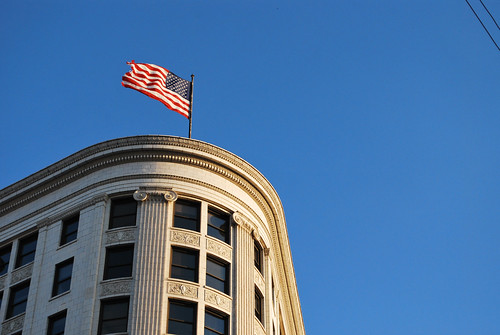
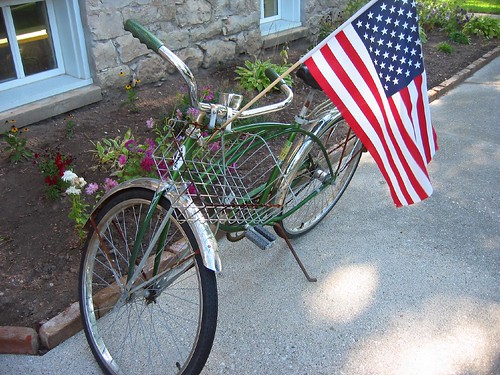
{Photos by rocketlass.}

I suspect that the fact of my being an American is a lot like the fact of my being male: it affords me almost incalculable unearned privilege, and, while I can (and do try to) think about it and analyze the way that it plays, subconsciously and overtly, into my thoughts and feelings and assumptions--most likely into all of them--and thereby gain some distance from and knowledge of the essence of that identity, at the same time the distance will never be such that I can say, definitively, "This is what it is like to be an American," or still less, "This is what it would be like not to be an American."

Anglophilia and analysis only take you so far, the former because, really?, the latter because rational analysis cannot always chase out such deeply woven currents of being.

So for my nation's birthday, I offer some disjointed recent gleanings to accompany the delightfully ridiculous weeklong orgy of explosives in which my neighborhood annually indulges.

First, I'll draw on a letter sent by John Keats in October 1818 to his brother and sister-in-law, George and Georgiana Keats, then resident in Louisville, Kentucky:
Dilke, whom you know to be a Godwin perfectibility man, pleases himself with the idea that America will be the country to take up the human intellect where England leaves off--I differ with him greatly. A country like the United States, whose greatest Men are Franklins and Washingtons, will never do that. They are great Men, doubtless, but how are they to be compared to those our countrymen Milton and the two Sydneys? The one is a philosophical Quaker full of mean and thrifty maxims, the other sold the very Charger who had taken him through all his battles. Those Americans are great, but they are not the sublime Man--the humanity of the United States can never reach the sublime.
Oh, how much one could disagree with Keats about Franklin! Washington, fine: impressive, great, a man for whose sense of duty it's impossible not to be grateful--but at the same time always coming across as emotionally and intellectually a bit flat. Jefferson you can wrangle with, Hamilton you can joust with, Lincoln--well, it's best we not derail this with my love of Lincoln. Washington you are stuck simply admiring.

But Franklin? All the smallness and greatness of humanity in one package, endlessly inventive and endlessly humane, beguiled by the ladies, in love with France, distracted almost in almost exactly inverse proportion to the direct discipline of his maxims, embodying in his pot-bellied person the linchpin of American democracy. Oh, how not to love Franklin?

As for the sublime . . is it wrong of me to think that, at a minimum, the late Donna Summer achieved it around minute ten of a couple of her greatest disco anthems?

But in general one can't quite trust the English on the subject, can one? George III would be proud of what Jessica Mitford reports in this letter, sent on August 8, 1959 from London to civil rights activist Marge Franz:
One rather noticeable thing is the solid anti-Americanism of all sections of the population, rich & poor, right & left. I've yet to meet one person who has the least desire to go to America, or one who has been there & liked it. It is a queer mixture of ordinary English chauvinism, snobbishness, intellectual snobbishness, & disapproval of American policies. Rather well worth analyzing & cataloguing, it might make a good article. . . . Madeau Stewart, 35 year old executive at BBC, no doubt solid conservative: "Aren't Americans awfully ignorant on the whole? Don't you find it depressing not having anyone to talk to?"
Mitford's take on the attitude of the English in the Eisenhower years is corroborated by this passage from a letter sent by George Lyttelton to Rupert Hart-Davis on May 15, 1957:
It is all wrong, I know, but I cannot ever take Americans quite seriously--I mean their tastes and judgments and values, though now and then one strikes an absolutely Class I man, e. g. the late Judge Wendell Holmes. But either I always have bad luck with their novelists, or I just don't know my way about. I remember liking Steinbeck's first best-seller, but last week, seeing his name, I wasted half-a-crown on his The Wayward Bus to read in the train. Not a single character who was not either loathsome or silly.
As someone who works in publishing--and buys a ridiculous number of books--I can't help but apply Keats's epithet for Franklin's maxims, "mean," to anyone well-situated who laments the cost of a disappointing book. The time wasted, certainly, but the cost?

That said, the marketing person in me can't help but be amused by what follows:
The blurb calls it a ruthless picture, showing what people are really like, i.e. all in need of an ounce of civet. Is the whole of U.S.A. thinking of nothing but the female bosom?
An understandable question, but the answer is no: even then, there was Ray Bradbury, among the least sex-obsessed of novelists, who in his Paris Review interview said,
I like to think of myself going across America at midnight, conversing with my favorite authors.
And then there's the sublimity--unquestionable, I say--of this exchange, overheard at Mineta San Jose International Airport (ah, Mineta, a Japanese-American reminder of America's gloriously diverse essence) on Monday:
TODDLER
Making gestures representing an explosion
Boom! Boom!

DAD
Stop it.

TODDLER
Boom! Boom! BOOM!
And finally . . . well, you didn't believe me earlier when I said I would leave Lincoln out of this, did you? From the glory that is the First Inaugural:
I am loath to close. We are not enemies, but friends. We must not be enemies. Though passion may have strained it must not break our bonds of affection. The mystic chords of memory, stretching from every battlefield and patriot grave to every living heart and hearthstone all over this broad land, will yet swell the chorus of the Union, when again touched, as surely they will be, by the better angels of our nature.
Good god, I love that man. Enjoy the holiday, fellow patriots. Watch out for explosions, ye better angels.

Friday, April 03, 2009

Literary biography and poetry on command

The strain of criticism that dismisses literary biography tends to do so on the grounds that to plumb an author's life for keys to his work is pointless, likely to lead to overly simplified and pointlessly reductive interpretations. While I do believe that a life can frequently have interpretive value, and I'm therefore willing to fight on that front on occasion, that's not really where my love of literary biography lies. What I really enjoy in a well-written biography is its placing of a writer in a fully realized world, surrounded by contemporaries--allies and enemies alike--and subject to all the day-to-day fluctuations and demands of friendship, family, and love that we all endure, while at the same time trying to render their accumulated experiences as art.

In that regard, Richard Holmes's Shelley: The Pursuit (1974) is no disappointment. Shelley emerges whole, a figure far more maddening than admirable, yet impossible to dismiss or disregard, while around him, his friends and family--Mary Shelley, Lord Byron, Leigh Hunt, William Godwin, and others--sparkle with all the life of an age of great change and fervor. What literature fan could fail to thrill at the thought of the rainy summer of 1816, when the Shelleys and Lord Byron wrote ghost stories to assuage their cabin fever, and Mary Shelley produced Frankenstein?

Holmes is particularly good at exploring the process by which Shelley wrote, comparing casual notebook entries, early drafts, and finished poems to trace a work from inspiration to completion. But one of my favorite moments in the book so far is an account of a couple of more compressed processes of creation, one that brings in that sense of a living artistic community that I enjoy so much. It starts with a contest that, in the quality of its entrants, is reminiscent of the ghost story competition:
[I]n Hunt circles poetry was a social art, and on 14 February [1817] three competitive sonnets on the subject of the Nile were written during an evening party at Lisson Grove. The competitors were Hunt, Keats, and Shelley. Not surprisingly, perhaps, Hunt's is far the most competent while both Keats's and Shelley's betray embarrassment.
One could easily imagine Keats and Shelley reacting differently, being goaded by the quality of the competition--thought at that point Shelley didn't think all that much of Keats's abilities, and Shelley himself had only a handful of notable poems under his belt.

Holmes goes on, however, to tell of a subsequent contest with a more lasting outcome:
Egyptian subjects were very much in vogue, for in the autumn of 1817 the British Museum had taken receipt of fragments and sculptures from the empire of the Ramases. . . . Among these were the celebrated Rosetta Stone, and the massive figure of Ramases II taken from the King's Funerary Temple at Thebes. . . . Visits to the British Museum with Horace Smith prompted Shelley to suggest that they might both produce a sonnet on the subject. Smith, the stockbroker poet who had agreed to be Shelley's financial agent in London, faithfully produced a workmanlike poem.
The Wikipedia is kind enough to offer us the text of Smith's sonnet:
On A Stupendous Leg of Granite, Discovered Standing by Itself in the Deserts of Egypt, with the Inscription Inserted Below

In Egypt's sandy silence, all alone,
Stands a gigantic Leg, which far off throws
The only shadow that the Desert knows:
"I am great OZYMANDIAS," saith the stone,
"The King of Kings; this mighty City shows
"The wonders of my hand." The City's gone,
Nought but the Leg remaining to disclose
The site of this forgotten Babylon.
We wonder, and some Hunter may express
Wonder like ours, when thro' the wilderness
Where London stood, holding the Wolf in chace,
He meets some fragments huge, and stops to guess
What powerful but unrecorded race
Once dwelt in that annihilated place.
As you've already figured out, Shelley's poem was the everlasting "Ozymandias," a poem that manages to retain its power even when it's first encountered in the deadening confines of a high school English lit textbook, retains its power:
Ozymandias

I met a traveller from an antique land
Who said: Two vast and trunkless legs of stone
Stand in the desert. Near them on the sand,
Half sunk, a shatter'd visage lies, whose frown
And wrinkled lip and sneer of cold command
Tell that its sculptor well those passions read
Which yet survive, stamp'd on these lifeless things,
The hand that mock'd them and the heart that fed.
And on the pedestal these words appear:
"My name is Ozymandias, king of kings:
Look on my works, ye Mighty, and despair!"
Nothing beside remains: round the decay
Of that colossal wreck, boundless and bare,
The lone and level sands stretch far away.
Smith's poem is far from terrible--I particularly like the sibilance of "Egypt's sandy silence," and the insight that the stone leg would, in that flat land, throw "the only shadow that the Desert knows." But Shelley's imagery is so much stronger, from the "frown / And wrinkled lip and sneer of cold command," which sounds like the harsh features it depicts, to the rythmic and sonic perfection of "The hand that mock'd them and the heart that fed."

In the preface to his Revolt of Islam, Shelley wrote,
How far I shall be found to possess that more essential attribute of Poetry, the power of awakening in others sensations like those which animate my own bosom, is that which, to speak sincerely, I know not.
"Ozymandias," written quickly, on command, and about a subject to which many poets and writers had recently turned their hands with less success, does just that: Shelley's skepticism and distrust of power come through clearly and convincingly, even two centuries later.

Monday, April 28, 2008

On the science of bleeding, or, And people wonder why I don't particularly like doctors!


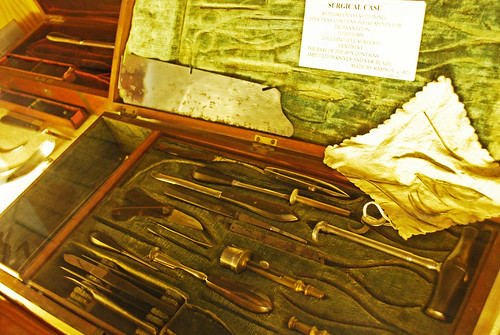
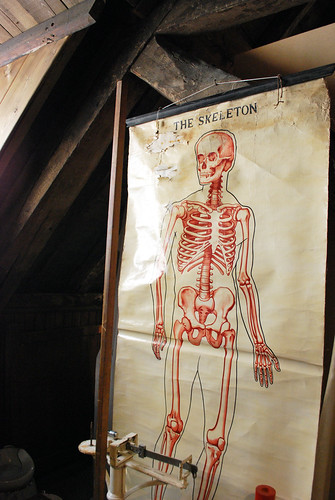
{Photos by rocketlass.}

Near the conclusion of Henry Fielding's black comedy of rascality The Life of Mr Jonathan Wild the Great (1743), Thomas Heartfree, a good man falsely condemned for a variety of frauds actually perpetrated by the amoral Jonathan Wild, learns of his reprieve mere moments before ascending the gallows. Fielding writes,
It would be impertinent to offer at a description of the joy this occasioned to the two friends, or to Mrs Heartfree, who was now again recovered. A surgeon, who was happily present, was employed to bleed them all.
I read that passage on the way home from London, a few days after a visit to the old operating theater in the garret of St. Thomas's church, where multi-bladed bleeding implements were nestled in display cases alongside other terrifying tools of early modern medicine. Being confronted with the reality of that most cringe-making of outdated medical practices reminded me of my first encounter with therapeutic bleeding, which I imagine I share with many a bookish kid. It came at the hands of Robert Louis Stevenson, in those glorious opening scenes of Treasure Island (1883), where an ordinary boyhood is disrupted by the arrival of mysterious strangers--one of whom has a stroke:
"The man has had a stroke, as I warned him. Now, Mrs. Hawkins, you just run up-stairs to your husband, and, tell him, if possible, nothing about it. I must do my best to save this fellow's trebly worthless life, and Jim here will get me a basin."

When I got back with the basin, the doctor had already ripped up the captain's sleeve and exposed his great sinewy arm. It was tattooed in several places. "Here's luck," "A fair wind" and "Billy Bones his fancy," were very neatly and clearly executed on the forearm; and up near the shoulder there was a sketch of a gallows and a man hanging from it--done, as I thought, with great spirit. "Prophetic," said the doctor, touching this picture with his finger. "And now, Master Billy Bones, if that be your name, we ll have a look at the colour of your blood. Jim," he said, "are you afraid of blood?"

"No, sir," said I.

"Well, then," said he, "you hold the basin;" and with that he took his lancet and opened a vein.

A great deal of blood was taken before the captain opened his eyes and looked mistily about him. First he recognised the doctor with an unmistakable frown; then his glance fell upon me, and he looked relieved But suddenly his colour changed and he tried to raise himself crying:--

"Where's Black Dog?"

"There is no Black Dog here," said the doctor, "except what you have on your own back. You have been drinking rum, you have had a stroke, precisely as I told you, and I have just, very much against my own will, dragged you headforemost out of the grave."
I remember being both horrified and fascinated when I first read that, feeling instantly that I was in a world markedly different from my own--almost certainly my first experience of literature's enlivening of the past.

The operating theater, which was placed in the garret of St. Thomas's church in the mid-19th century when the adjacent St. Thomas's Hospital was desperate for space, was sealed up around the turn of the century and forgotten for more than fifty years. Now it is a fun little museum, alternating displays of herbs (with signs explaining their real and supposed medicinal powers, such as coral's powers over "Monsters, Incubii, Succubii, Phantasmata and all Evil Spirits") with cases of medical implements that were once state-of-the-gruesome-art. The operating theater itself encapsulates the horrors of Victorian medicine: as a placard explains, it rests on a false floor above three inches of sawdust, so that blood spilled by the doctors--who wore frock coats "stiff and stinking with pus"--wouldn't seep through into the sanctuary below.


Of most interest to the literary tourist, however, is the fact that John Keats studied at St. Thomas's, and presumably attended lectures in the operating theater. But Keats soon realized that he was not suited for a medical career: according to Lord Houghton,
When he had once entered upon the practical part of his business, he found his mind so oppressed with an over-wrought apprehension of doing harm that he determined on abandoning the course of life to which he had devoted a considerable portion of his small fortune.
A letter Keats sent to a friend in 1817 pinpoints the decision in a moment of distraction while bleeding a patient:
My last operation was the opening of a man's temporal artery. I did it with the utmost nicety, but reflecting on what passed through my mind at the time, my dexterity seemed a miracle, and I never took up the lancet again.
At least Keats realized his shortcomings; a contemporaneous account of his medical mentor, Mr. Morgan, related in the operating theater museum, is postively chilling:
A tall, ungainly, awkward man, with stooping shoulders and a shuffling walk, as deaf as a post, not overburdened with brains, but very good-natured, and liked by everyone. His surgical acquirements were very small,his operations very badly performed, and accompanied with much bungling, if not worse.
It seems that Keats probably made the right decision in choosing the relatively developed art of poetry over the still-blind gropings of Regency medicine. Remind me not to visit the past unless I'm sure my time machine is prepared to yank me back at the first sign of sickness.