Showing posts with label Peter Martin. Show all posts

Saturday, December 20, 2008

Too much liquid, even for two such large men


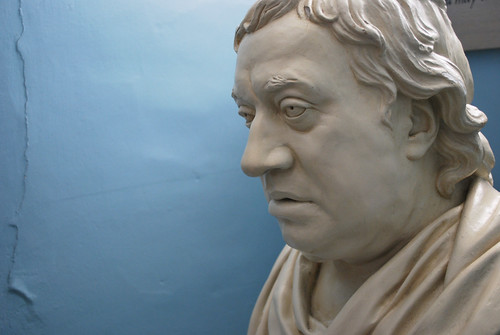
{Photos by rocketlass.}

This post began with the return of my grisly obsession with the horrors of medicinal bloodletting, prompted by this passage from Peter Martin's Samuel Johnson: A Life (2008):
[Johnson's] imagination was playing tricks on him, and he feared the worst for his lungs. "My physician bled me yesterday and the day before, first almost against his will, but the next day without any contest. I had been bled once before, so that I have lost in all 54 ounces." It was the third time he was bled that winter. Like many of his contemporaries, he was already well into phlebotomy, the surgical opening or puncture of a vein to draw out blood, a lifelong madness that he inflicted on his ailing body with more assiduity than most. Rather than wait on a physician, he often impatiently bled himself with grisly deliberateness for all manner of ailments: coughs and colds, flatulence, an "inflamed" eye, and especially breathing difficulties and shortness of breath. Fifty-four ounces is a great quantity of blood, though to the end of his life he believed that the practice was effective only if it were done in copious amounts.
I think Martin is understating the case: the entire human body only contains about 190 ounces. Blood donors often feel faint after giving a mere pint; I would describe a medicinal bloodletting that drained more than three times that amount as wildly insane, even by the standards of Johnson's day.

The memory of Johnson's copious bloodletting came to mind instantly Thursday when I encountered the following exchange between Archie Goodwin and Nero Wolfe in Rex Stout's Fer-de-Lance (1934):
"[W]e're licked as sure as you're full of beer."

[Wolfe's] eyes opened. "I'm going to cut down to five quarts a day. Twelve bottles. A bottle doesn't hold a pint."


Even for a man of Nero Wolfe's bulk (think Sydney Greenstreet, who, perhaps inevitably, was cast as Wolfe on the fun, but short-lived radio adaptation) five quarts per day of beer would seem to be a bit much. And that's the diet ration! A doctor hired to bleed Wolfe might be well-advised to get acquire a liquor license beforehand: then he could hang a neon sign and start pouring frothy pints straight from Wolfe's arm!

Tuesday, December 16, 2008

"A very poor creeper upon the earth," or, Johnsonian gleanings for a snowy night


Tonight, after waiting an inordinately long time for the bus as the snow piled high and I slowly lost sensation in my feet, I opened Peter Martin's Samuel Johnson: A Biography (2008), to find that Johnson, as he so often does, afforded me a bit of consolation. I, after all, required only a few minutes of warmth to banish the pain from my feet; Johnson, on the other hand, had to endure protracted bouts with gout. Quotes Martin:
"I enjoy all the dignity of lameness. . . . I am a very poor creeper upon the earth, catching at anything with my hands to spare my feet." "It is of my own acquisition, as neither my father had it or my mother."
The thought led me back to a passage in Boswell's Life, in which, to support his contention that Johnson was the author of a couple of lines of anonymous doggerel, he asks,
Why may not a poet suppose himself to have the gout, as well as to suppose himself to be in love, of which we have innumerable instances[?]
But why, oh why would a poet want to put himself through that?

Other gleanings from tonight's reading of Martin's splendidly quote-filled biography:

1 In his final years, Johnson lived in a house at 8 Bolt Court, to which he welcomed a remarkable mix of friends and charity cases as free boarders. According to Martin, by 1777, they numbered seven, though I can only put names to six: Francis Barber, Johnson's manservant; Anna Williams, a blind poet who had lived with Johnson for years; Dr. Robert Levet, described by Hester Thrale as a "superannuated surgeon," and by Johnson as "a brutal fellow, but I have a good regard for him for his brutality is in his manners, not his mind"; Poll Carmichael, a Scotswoman who may have been a reformed prostitute; and an old friend of Johnson's late wife, Mrs. Desmoulins, who moved in along with her daughter in 1777. As Martin puts it,
She completed the recipe for domestic chaos in the house, for she and Mrs Williams despised each other and the normal bickering in the house increased exponentially. Mrs Thrale was both amused and horrified that Johnson's house was "overrun with all sort of strange creatures, whom he admits for mere charity," "but as they can both be occasionally of service to each other, and as neither of them have any other place to go to, their animosity does not force them to separate." None of the inhabitants, in fact, liked Mrs Desmoulins. "Mr Levet who thinks his ancient rights invaded, stands at bay, fierce as ten furies," Johnson grumbled to Mrs Thrale; "Mrs Williams growls and scolds, but Poll does not much flinch." After a year with all of them, Johnson summed up the turmoil in the house: "We have tolerable concord at home, but no love. Williams hates everybody. Levet hates Desmoulins and does not love Williams. Desmoulins hates them both. Poll loves none of them."
It sounds like either a logic puzzle or a 1930s screenplay, some sort of cross between Ball of Fire and You Can't Take It With You; I will admit to enjoying the image of Johnson as the grumbly patriarch on a sitcom, perhaps played by Jeffrey Jones.

2 Descriptions of Johnson's unusual physical presence are common, many of them highlighting the tics that most people now agree were most likely symptoms of a neurological disorder. Two that are quoted in the final portion of Martin's book seem worth sharing, however, for their language alone. First, from the Reverend Thomas Campbell, an Irish clergyman who, on meeting Johnson, was unimpressed:
[He] has the aspect of an idiot, without the faintest ray of sense gleaming from any one feature--with the most awkward garb, and unpowdered grey wig, on one side only of his head--he is forever dancing the devil's jig, and sometimes he makes the most drivelling effort to whistle some thought in his absent paroxysms. . . . [He] flew in a passion rather too much.
Then there's this description from the more appreciative Fanny Burney, who is known to us now as the author of Evelina:
He is, indeed, very ill-favoured; is tall and stout, and stoops terribly; he is almost bent double. His mouth is almost continually opening and shutting, as if he was chewing. He has a strange method of frequently twirling his fingers, and twisting his hands. His body is in continual agitation, see-sawing up and down; his feet are never a moment quiet; and, in short, his whole person is in perpetual motion.
Martin writes that Burney's journals, "full and rich with the novelist's wit and vibrantly recorded scenes," deserve to be ranked with those of Pepys and Boswell. That's high praise; anyone out there willing to second it, and thus launch me on a library trip?

3 Johnson, as is well known, was at best opinionated, at worst downright difficult to get along with. The following exchange with his close friend Mrs. Thrale succinctly sums up Johnson's problem keeping his manners:
As he confessed to Mrs Thrale, "I am always sorry when I make bitter speeches & I never do it, but when I am insufferably vexed." "But you do suffer things to vex you, that nobody else would vex at."
James Boswell was often the source of that vexation. Though the more one reads about Johnson, the more on realizes that he really did feel warm friendship for Boswell, at the same time, his exasperation at Boswell's transparent attempts to draw him out on various topics regularly bubbled over. I can't resist closing with two of his complaints about his importunate friend that, though oft-quoted, still bring joy. First, to Boswell himself:
You have but two topics, yourself and me, and I'm sick of both.
Then, about Boswell to another friend:
Boswell's conversation consists entirely in asking questions, and it is extremely offensive.
Why is it that every time I see those lines I smile, loving both men more?


Thursday, November 20, 2008

At the table with Dr. Johnson


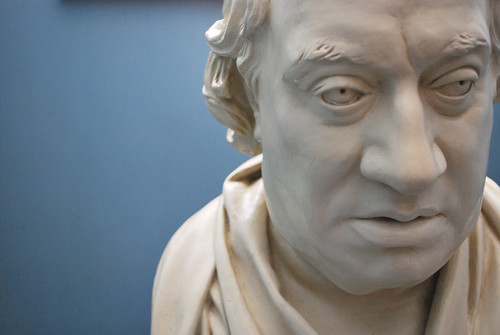
{Photo by rocketlass.}

After a too-large dinner of beans on toast--the perfect antidote to the biting, blustery sleaze of a typical Chicago November--I find myself reminded of a passage from Peter Martin's Samuel Johnson (2008) about Dr. Johnson at the table. While on a trip with Joshua Reynolds,
Johnson nonplussed everyone by swallowing no fewer than thirteen pancakes at a single sitting. They stayed three weeks in Plymouth. . . . He is supposed to have amazed his hostess there, too--who was counting assiduously--by drinking seventeen cups of tea in one sitting. When he asked for more, she cried out, "What! Another, Dr Johnson?", to which he replied, "Madam, you are rude."
Though, strictly speaking, Johnson's reply was out of line, it does seem that, once one has poured seventeen cups of tea for a guest, to balk at the eighteenth smacks of churlishness.

As for alcohol, though Johnson once assured James Boswell that "there was no man alive who had seen him drunk," Johnson's friend Edmund Hector met that assertion with a laugh. Martin offers Boswell's account of Hector's rebuttal, a tale of a night of drinking with Ford, one of Johnson's relatives:
[Ford] was it seems a hard drinker and he engaged Johnson and Hector to spend the evening with him at the Swan Inn. Johnson said to Hector, "This fellow will make us both drunk. Let us take him by turns, and get rid of him." It was settled that Hector should go first. He and Ford had drunk three bottles of port before Johnson came. When Johnson arrived, however, Hector found he had been drinking at Mr Porter's instead of saving himself. Hector went to bed at the Swan leaving Johnson to drink on with Ford. Next morning he perceived that Johnson who had been his bed-fellow had been very drunk and he damned him. Johnson tried to deny the charge. Literally speaking Hector had not seen him drunk, though he was sure of the fact.
I don't really want to know on what grotesque evidence Hector based his assessment; the mention of their sharing a bed makes me fear the dreaded bed-puke. Regardless, I love the image of a young Johnson, laboring under the brutalities of a grisly hangover, yet remaining determined to split hairs and win the argument by clinging to the slimmest reed of fact.

Martin goes on to explain that
Boswell himself acknowledged elsewhere that even in later life, although Johnson could be "rigidly abstemious,", he was not "a temperate man either in eating or drinking." He could keep himself from drinking, but once he started it was hard for him to control it.
And he knew the dangers of giving in to drink; as he wrote of Addison,
In the bottle, discontent seeks for comfort, cowardice for courage, and bashfulness for confidence. . . . He that feels oppression from the presence of those to whom he knows himself superior, will desire to set loose his powers of conversation; and who, that ever asked succour from Bacchus, was able to preserve himself from being enslaved by his auxiliary?
In the presence of Johnson, we ought to find ourselves in the opposite position to that in which he paints Addison: we should be oppressed by his superiority. Yet Johnson's raging appetites--and the fact that for the most part he did control them, and thought less of himself when he failed to do so--like so many other aspects of his complicated personality, help to render him fully human and accessible, his accomplishments all the more admirable for their origins in a man whose flaws could at times be nearly as prodigious as his talents.

Sunday, November 02, 2008

The Dangers of the Doctor


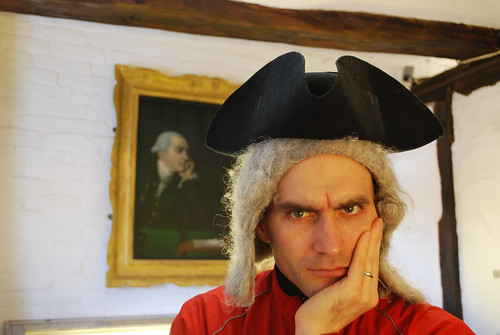
{Photo by rocketlass.}

I spent last week reading Peter Martin's new biography of Samuel Johnson and James Boswell's old one on alternating halves of my daily commute. As I flagged pages and noted passages, I quickly discovered that it would be very easy to accidentally turn this blog into Apposite or Amusing Things Said or Written by Dr. Johnson that I've Been Reading Lately. Such as this:
It is laudable in a man to wish to live by his labours; but hs should write so as he may live by them, not so as he may be knocked on the head.
Or, speaking of a "dull tiresome fellow":
That fellow seems to me to possess but one idea, and that is a wrong one.
Or, from a letter to Joseph Baretti, this apology for not having written sooner:
Yet it must be remembered, that he who continues the same course of life in the same place, will have little to tell. One week and one year are very like another. The silent changes made by time are not always perceived; and if they are not perceived, cannot be recounted.
Those lines alone would be sufficient to make the letter memorable, but Johnson outdoes himself later:
Those who have endeavoured to teach us to die well, have taught few to die willingly; yet I cannot but hope that a good life might end at last in a contented death
Fortunately--because, however domineering the great man's mind and personality may have been, this blog is not supposed to be all about Dr. Johnson--those lines about death reminded me of a couple of thoughts from Jules Renard. In his journal, Renard takes death less seriously than Johnson, though this first jotting could be read as at least half-lament:
Please, God, don't make me die too quickly! I wouldn't mind seeing how I die.
This last one, however, is little more than an amusing thought, simultaneously a wry acknowledgment of Renard's age and a smirk at the fashionable fatalism of youth:
I am no longer capable of dying young.
A fine thought with which to escape the shadow of Johnson for a few hours, and on which to end a Halloween weekend. Back to your graves, ghoulies. See you next year.

Friday, October 31, 2008

"When years come upon you, you will find that poring over books will be an irksome task."


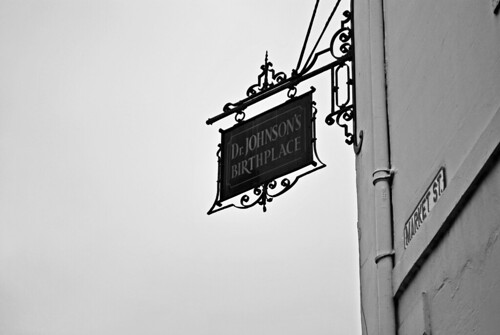
{Photos by rocketlass.}

The headline of this post comes from an admonition that Samuel Johnson reportedly received from an old man at Oxford in 1763 who urged him, "Ply your book diligently now," before old age robbed him of his thirst for knowledge. Johnson, forever afraid of his natural indolence, took the urging to heart, making up a plan; here's how Peter Martin explains it in his thoughtful and well-written new Samuel Johnson: A Biography (2008):
On 21 November 1729, in an effort to get down to study, he made a self-disciplining table of how much reading he could get done in a week, month and year if he read ten pages per day: 60, 240, and 2880 respectively. To begin with a meagre ten pages per day may suggest just how indolent he thought he had become. He soon realized that ten pages per day would get him nowhere, so he tabulated what he could achieve based on 30, 50, 60, 150, 300, 400 and 600 per day, though he did not take the last four as far as computing annual totals, realising the stark fantasy in such an exercise. Sixty would yield 17,280 for a year, and apparently he thought that was as much as he could realistically read. Such computations would become almost chronic with him as he struggled to impose order on a sense of disorder, "as it fixed his attention steadily upon something without, and prevented his mind from preying upon itself." He even counted the number of lines to be read in The Aeneid and other works by Virgil, as well as in works by Euripides, Horace, Ovid, Theocritus and Juvenal.
I remember making calculations of that sort when I was a teenage boy who loved math and ordered systems; the tendency reappears now and then in my adult life, usually when I'm contemplating a seemingly insurmountable stack of pages requiring careful proofreading. For the most part, though, I'm satisfied these days with making some progress on one or two of the several books I'm always lugging with me on my commute, numbers and plans be damned.

Given my recent preoccupation with the copious quantities of unread matter lining the walls (and, let's be frank piled on the floor) of my house, it probably won't surprise you that I was struck by Johnson's approach to the problem. More troubling, however, for the bibliophile surrounded by books, is this account later in the biography of the fate of Edward Harley, the cataloging of whose vast library Johnson took on as paid work in his pre-Rambler, pre-Dictionary years:
Harley, friend of Pope and son of Robert Harley the Tory Lord Treasurer in the reign of Queen Anne, was owner of the great estate of Wimpole Hall in Cambridgeshire. He owned a vast collection of books, manuscripts, and tracts that he housed at Wimpole Hall, his house in Dover Street, and his magnificent mansion in Cavendish Square. The size of the collection included some fifty thousand books and seven thousand volumes of manuscripts, not to mention coins, engravings, Greek and Roman antiquities, and more than five hundred paintings.
That doesn't sound bad, does it? So what's the problem, you ask? Why does this book blogger, who mere months ago broke down and bought all-new bookcases, feel a chill wind sweep over him on reading about Harley? Because Martin goes on to explain:
His need to build elegant places to house them eventually brought on severe financial worries that may have hastened his death.
If you need me, I'll be over here, culling my shelves for donations to the Chicago Public Library.