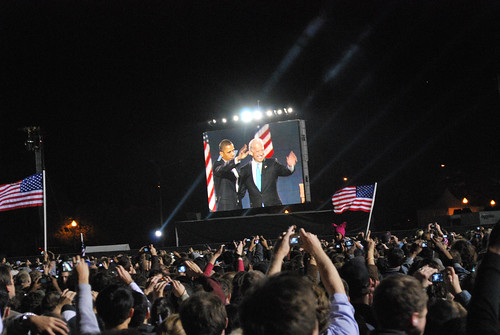
{Photo by rocketlass.}
A final election-related reading post, then I’ll return to my usual mishmash of Samuel Johnson, crime novels, Anthony Powell, and such.
Just before the election, Scott McLemee of Inside Higher Ed asked a group of scholars to suggest reading material for the incoming president. Eric Rauchway, a historian whom you may know from his blog, The Edge of the American West, responded by urging Barack Obama to read Isaiah Berlin’s essay on Franklin Delano Roosevelt. Since Eric knows more about the (First?) Great Depression than almost anyone else, I took this as the excuse I’d been waiting for to pick up Berlin’s The Proper Study of Mankind: An Anthology of Essays (1997), which contains the FDR piece. The whole essay is well worth reading (which has been true of every bit of Berlin’s writing that I’ve encountered over the years), and you should go buy the book posthaste.
That call to action will serve as my admittedly weak compensation for the copyright laws I’m about to break. One portion of the essay—far too long to qualify for my calling this reprinting fair use—is of particular interest in the situation we now find ourselves in, making the transition from George W. Bush to Barack Obama. See if Berlin's description of one type of political leader, exemplified by Woodrow Wilson, brings any particular president to mind:
Indeed he was very different from Wilson. For they represent two contrasting types of statesman, in each of which occasionally men of compelling stature appear. The first kind of statesman is essentially a man of single principle and fanatical vision. Possessed by his own bright, coherent dream, he usually understands neither people nor events. He has no doubts or hesitations and by concentration of will-power, directness and strength he is able to ignore a great deal of what goes on outside him. This very blindness and stubborn self-absorption occasionally, in certain situations, enable him to bend events and men to his own fixed pattern. His strength lies in the fact that weak and vacillating human beings, themselves too insecure or incapable of deciding between alternatives, find relief and peace and strength in submitting to the leadership of a single leader of superhuman size, to whom all issues are clear, whose universe consists entirely of primary colours, mostly black and white, and who marches towards his goal looking neither to right nor to left, buoyed up by the violent vision within him. Such men differ widely in moral and intellectual quality, and, like forces of nature, do both good and harm in the world. To this type belong Garibaldi, Trotsky, Parnell, de Gaulle, perhaps Lenin too--the distinction I am drawing is not a moral one, not one of value but one of type. There are great benefactors, like Wilson, as well as fearful evil-doers, like Hitler, within this category.Hmm. How many days until he vacates the White House?
Then take a look at the second type. The fit isn’t perfect, but I do see similarities to what we can know so far of Barack Obama’s leadership style:
The other kind of effective statesman is a naturally political being, as the simple hero is often explicitly anti-political and comes to rescue men, at least ostensibly, from the subtleties and frauds of political life. Politicians of this second type possess antennae of the greatest possible delicacy, which convey to them, in ways difficult or impossible to analyse, the perpetually changing contours of events and feelings and human activities round them--they are gifted with a peculiar, political sense fed on a capacity to take in minute impressions, to integrate a vast multitude of small evanescent unseizable detail, such as artists possess in relation to their material. Statesmen of this type know what to do and when to do it, if they are to achieve their ends, which themselves are usually not born within some private world of inner thought, or introverted feeling, but are the crystallisation, the raising to great intensity and clarity, of what a large number of their fellow citizens are thinking and feeling in some dim, inarticulate, but nevertheless persistent fashion. In virtue of this capacity to judge their material, very much as a sculptor knows what can be moulded out of wood and what out of marble, and how and when, they resemble doctors who have a natural gift for curing, which does not directly depend upon that knowledge of scientific anatomy which can be learned only by observation or experiment, or from the experiences of others, though it could not exist without it. This instinctive, or at any rate incommunicable, knowledge of where to look for what one needs, the power of divining where the treasure lies, is something common to many types of genius, to scientists and mathematicians no less than to businessmen and administrators and politicians. Such men, when they are statesmen, are acutely aware of which way the thoughts and feelings of human beings are flowing, and where life presses on them most heavily, and they convey to these human beings a sense of understanding their inner needs, of responding to their own deepest impulses, above all of being alone capable of organising the world along lines which the masses are instinctively groping for. To this type of statesman belonged Bismarck and Abraham Lincoln, Lloyd George and Thomas Masaryk, perhaps to some extent Gladstone, and to a minor degree Walpole. Roosevelt was a magnificent virtuoso of this type, and he was the most benevolent as well as the greatest master of his craft in modern times.I don’t mean to push this too far in seriousness--and I’m not sure by any means that this is what Eric was aiming for in suggesting the essay to Obama--but given that I’m still enjoying the afterglow of Tuesday’s events, I’m willing to temporarily allow myself to dream absurdly big. Another FDR would sure be nice.
{Side note: the comparison to Czech statesman Thomas Masaryk should be of particular interest for University of Chicago folks, as Masaryk is honored on the campus with a statue of a Bohemian guardian knight of legend who stares protectively down the length of the Midway.}
In case the perceptiveness and finely crafted prose of Berlin’s essay hasn’t yet convinced you to you to buy The Proper Study of Mankind, I’ll salve my conscience for my copyright abuse by closing with another great line, one that could serve as a pithy account of the essential questions that drove Berlin’s thought. It comes from his 1990 essay “The Pursuit of the Ideal”:
Only barbarians are not curious about where they come from, where they are, where they appear to be going, whether they wish to go there, and if so, why, and if not, why not.This has been a good week for thinking about those sorts of questions; the next time we gather as a nation to make this choice, maybe we’ll have some better answers to all of them.