Showing posts with label The Hardy Boys. Show all posts

Friday, August 19, 2011

The very existence of this entry, I fear, suggests that I need a hobby (beyond, that is, this blogging thing).


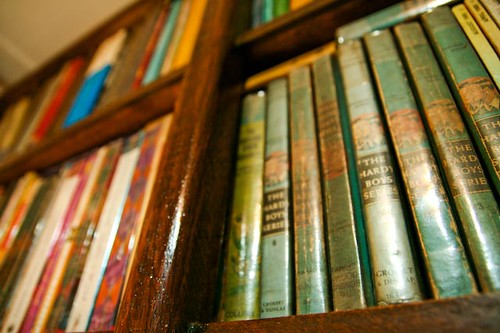
{Photo by Flickr user penreyes, used under a Creative Commons license that reserves some rights.}

At a party a couple of weeks ago, my friend Joseph Clayton Mills and I got onto the topic of Chet Morton, friend of the Hardy Boys; brother of Joe Hardy's girlfriend, Iola; and inveterate hobbyist. I mentioned my favorite of Chet's one-per-book hobbies, taxidermy, and Joseph countered that he was always most impressed by Chet's brief passion for falconry.

"Falconry?" I asked. "Where in Bayport would Chet have encountered falconry, the sport of kings?"

Then, earlier this week, I stumbled upon what I thought might be the answer: perhaps Chet's interest in falconry began with a session of George Plimpton's Video Falconry on Biff Hooper's Colecovision?


This led Joseph to some quick research on the subject of Chet's hobbies. The list on Wikipedia, he reported, is "woefully inadequate," but the entry did deliver this remarkable bit of information:
Chet is one of the most popular characters in The Hardy Boys. In fact, by the mid-sixties, Chet had become so popular that in 1965 the Stratemeyer Syndicate was planning to develop a series about him and his hobbies.

It seems that the Stratemeyer Syndicate did a lot of work on this series (even some complete chapters were written), yet the Syndicate never began to publish it.
And that's not all:
A list of proposed titles in the Chet Morton series were found in the Stratemeyer Archives at the New York Public Library.
1. Chet Morton and the Funny Putty Caper
2. Chet Morton and the Talking Turkey
3. Chet Morton and the Mighty Muscle Builder
4. Chet Morton and the Stolen Flea Circus
5. Chet Morton and his Electronic Exam Passer
6. Chet Morton and his Bird-Brain Blimp
7. Chet Morton and the Monkey’s Uncle
8. Chet Morton and the Flying Fruitcake
9. Chet Morton and the Mystery at Tucks Cove
10 Chet Morton and the Mystery at the Friar Tuck House
11 Chet Morton and the Mystery of Ben's Bat
Those aren't quite Invisible Library titles, but I couldn't resist at least passing them on to my fellow invisible librarian, Ed Park, who replied, "Why do I feel like these could all be euphemisms in House of Holes??"

Surely someone's already working on the Chet Morton fanfiction, right?

Monday, December 28, 2009

Early reading experiences

One aspect of Laura Miller's The Magician's Book which I was pleasantly surprised by was her treatment of childhood reading, of how children experience and understand books. Her account is built largely on memory, like this attempt to reconstruct her first encounter with Narnia:
What remains is a dim recollection of how life was shaped before I knew about Narnia, and a more distinct sense of what it was like afterward. I had found a new world, which at the same time felt like a place I'd always known existed. It wouldn't have occurred to me to be wistful about the fact that I'd never read this perfect book for the first time again. All I wanted was more.
But she also offers other perspectives, including accounts from educators, psychologists, and other authors. Here, for example, is a quick look at the absence of parents from most good children's books:
In the great enterprise of growing up, a child's imagination practices the painless, surgical removal of an attachment that, however essential it may be at the moment, will sooner or later have to be left behind. The same child (myself, for example) who finds imagining her parents' deaths to be heart-freezingly scary will also fantasize about the exciting escapade of being left entirely to her own devices. In her memoir, Welcome to Lizard Motel, the educator Barbara Feinberg describes leading a children's creativity workshop whose participants liked pretending they were orphans, though not, one litle girl clarified, "the sad part of orphans."
Then there's this almost unbearably cute anecdote about the reaction of some friend's children to a picture book she was reading to them:
When I got to the part where a whistling Andy nears a turn in the road and notices just the tip of the runaway lion's tail peeping around the corner, [three-year-old] Desmond scrambled anxiously to the other end of the sofa and hid behind a cushion. Next we read Chris Van Allsburg's The Polar Express, and, at the moment when Santa put his arm around the book's narrator and called for a cheer from the crowd of onlooking children, Desmond sat up straight, radiating pride.
That sort of reflection is sprinkled throughout The Magician's Book, a recurring reminder that we are not the same people--and certainly not the same readers--we were when we first encountered the books of childhood that we recall so fondly.

Almost any serious reader risks slipping into rapturous tones when describing childhood reading. It's one of the rare instances of nostalgia in which there seems little danger of memory playing us false--the experience really was that intense, that all-encompassing.

But when I think of myself as an enthusiastic young reader, I think of an incident that's far more pedestrian: when I was in kindergarten, I read my first Hardy Boys book, The Tower Treasure, and I loved it. Detectives, robberies, mysteries--this was how the world should be! The clues and questions mounted, and just when it seemed that things couldn't get any more dramatic, Frank and Joe discovered who was behind the crimes: a hobo!

Only, the problem was, I thought the word "hobo" meant "ghost." The world of the Hardy Boys was even wilder than I'd imagined--and suddenly I wasn't so sure I wanted to be a detective!

I don't remember how long it took me to figure out I'd made a mistake, but thirty years later I still think of it every time I encounter a difficult passage in a book. I am not the reader I once was, indeed.