Showing posts with label Gillian Flynn. Show all posts

Friday, June 13, 2014

Highsmith takes aim at one of the evils of life

Donald Westlake and Gillian Flynn led me back to Patricia Highsmith this week. Westlake, unsurprisingly, did so through The Getaway Car. Sadly, there wasn't much in Westlake's files on Highsmith, which is too bad, since I would have loved to read an extended analysis of her everyday sociopaths in light of Parker's more focused pathology. But Westlake did discuss Highsmith at least once, in the context of the work he did on a film version of Ripley Under Ground, and I was able to include that. If you want a thumbnail version of it while you wait for the book itself to arrive in September, you can head over to Nick Jones's Existential Ennui, where he's recently posted about it.

Gillian Flynn, meanwhile, last week led a Wall Street Journal book club on the Highsmith novel that most influenced her, Deep Water (1957). And hoo, boy, now that I've read it I can see why: it's about a marriage made toxic by infidelity and acquiescence . . . and just a touch of sociopathy. As in the Ripley novels--or, to draw the circle more tightly, Burke Devore in Westlake's The Ax--the husband Highsmith creates is plausible and ordinary, yet capable of monstrous acts. It's that everydayness that frightens, and draws us in; only slowly do we realize that the disconnect between his mind and his emotions, his behavior and his analysis of that behavior, is fundamental, and deadly.

It's Friday night and I'm behind-hand a bit after a day spent dealing with dull yet time-consuming new (108-year-old) house problems, so I'll just hit a couple of more sociological points then leave you with a passage that amused me. First, the sociology: Highsmith's couple is ensconced in the upper middle class of 1950s suburban Connecticut, the land of Cheever and Updike (and, at one remove, John O'Hara). And, murder aside, there are aspects of that life that--no matter how much Cheever and Updike we read--remain jaw-dropping to an upper middle class twenty-first-century urbanite. To wit:
1 Oh, lord, how they drink. Don't get me wrong--I'm mid-martini right now myself--but that will be the evening's martini. For the 1950s suburban set, that would be mere pre-gaming. Actual social drunkenness, for me (and most of my cohort) is an occasional error, regretted; if Highsmith and her peers are to be believed, in that set it was common, bordering on constant. Combine that with a relative lack of entertainment options and a narrow range of acquaintance, and no wonder there was all that sleeping around . . .

2 Pants. Oh, midcentury men's pants. Highsmith's murderous husband finds himself eating better and drinking less, and he becomes
pleasantly conscious of the fact that his front was absolutely straight now, that there was no bulge at all below his braided belt.
The braided belt we'll abhor, then leave. It's the "below" that I want to deal with. Look at this picture of Bogart (and, I think, IBRL favorite Sydney Greenstreet in the wheelchair?) if you need a reminder.


Good god, men at midcentury wore their pants too high. Even Bogart can't carry off that look.
And now, to carry you into the weekend, I'll share the one moment in the novel when Highsmith allows a character to acknowledge the presence of evil in the world:
The likelihood of typographical errors in spite of rigorous proofreading was going to be the subject of an essay that he would write one day, Vic thought. There was something demoniacal and insuperable about typographical errors, as if they were part of the natural evil that permeated man's existence, as if they had a life of their own and were determined to manifest themselves no matter what, as surely as weeds in the best-tended gardens.
In the current paperback edition of Deep Water, published by Norton, the next typographical error doesn't appear for more than ten pages.

Monday, August 08, 2011

Crime time!


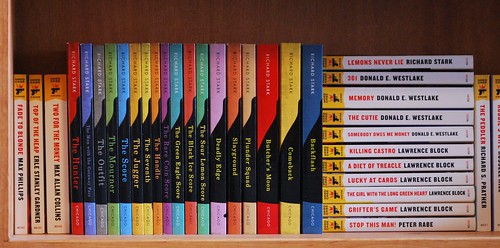
{Photos by rocketlass.}

Sorry, can't blog today. Too busy reading Gillian Flynn's Dark Places.

Oh, fine. How about a quick crime novel roundup, and then I'll go back to trying to figure out what wonderfully horrible twist Flynn's going to surprise me with next?

1 The new batch of Parker novels is out now from the University of Chicago Press: Flashfire (2000) and Firebreak (2001). They've got an introduction by Terry Teachout that's one of the best we've published. Teachout points out that despite his sociopathic tendencies, "Parker kills only when absolutely necessary, a clear sign that he isn't crazy"; does a nice job of drawing the distinction between Stark's Parker and Westlake's Dortmunder; and quotes my favorite Dortmunder line, which just might be my favorite Westlake line, period:
Whenever things sound easy, it turns out there's one part you didn't hear.
Flashfire is one of the best in the series, featuring a lot of heists, a strong female character (who's a civilian, no less!), and some truly great exchanges between Parker and a Florida sheriff. It's easy to why Hollywood chose this one to launch the upcoming Parker movie series.

2 Over the weekend I continued my progress through the rest of Westlake's novels. I started with a darkly comic novel called Two Much (1975), in which one of Westlake's least honorable and least likable protagonists cons two rich twin sisters into thinking that he, too, is a twin--and a separate twin is sleeping with each sister. It's a great example of two Westlake strengths: his enjoyment of playing out the implications of a puzzle he sets for himself and his understanding, most clearly on display in the Parker novels, that our instinct as readers is to want the narrator to get away with what he's doing almost regardless of how awful it is or how amoral he is. Present us with a problem and we want to see it solved; Westlake knew that better than anyone I can think of.

3 The other Westlake I read this weekend was refreshingly light: Good Behavior (1985), which finds John Dortmunder and his gang trying to kidnap a nun . . . on behalf of her convent. It won't surprise you that the gang ends up dressed in habits:
Very strange. When nothing shows but your face, enclosed by the white oval of a wimple and the featureless black of a nun's costume, you wouldn't expect much by way of individual character to show through, but it did, it did. . . . Tiny, whose face mostly consisted of knuckles anyway, was barely plausible as the kind of false nun who, in the Middle Ages, poisoned and robbed unwary travelers. Stan Murch looked like a pilgrim in The Canterbury Tales, probably the one with ideas for alternate routes to Canterbury. . . . Kelp was surely someone whose sister was the pretty one, while Dortmunder looked mostly like a missionary nun who was already among the cannibals and headhunters before realizing she'd lost her faith.
It's all as ridiculous as it sounds, and it makes for one of the best of the Dortmunder series.

4 While Hard Case Crime will officially mark their welcome return next month with the publication of Lawrence Block's new book of smut and crime, Getting Off (which I'm looking forward to reading soon alongside Nicholson Baker's new book of smut and smut, House of Holes), they'll also be publishing a new book by Max Allan Collins, Quarry's Ex (2011). Collins is at his best when writing about Quarry, whose character is perfectly suited for Collins's tight mix of violence, quips, and social observation, and I've really enjoyed watching him flesh out the hitman's backstory these past couple of years. Quarry's Ex is a strong addition to that story. It should show up in stores in September; it's available for pre-order now.

5 I'll close by returning to Gillian Flynn, so that I can return to reading Gillian Flynn: last summer, at the start of the annual Stahl family vacation, I gave a copy of Flynn's first novel, Sharp Objects, to my sister. She blazed through it, then lent it to my brother. As he was nearing the end, my sister and I sat and watched him, waiting for him to get to that part, so we could see how he reacted. He kept looking up and laughing at us . . . and then he got to that part. He stopped laughing.