Showing posts with label Italo Calvino. Show all posts

Tuesday, May 06, 2008

Travelers and affinities, expected and unexpected


{Photo by rocketlass.}

1 I nodded off on the L on my way home from work yesterday while reading Thomas Hardy's The Hand of Ethelberta (1866), and my half-dreams were of the novel--but as if it had been written by Alvaro Mutis, whose Maqroll stories I had spent the weekend reading. Waking, I was amused at the ease with which the world-weariness of Mutis had infiltrated Hardy's uncharacteristically comic novel.

If you'd asked me, I would have said the two writers had nothing in common, but the dream reminded me that Hardy's more typically tragic novels do share with Maqroll a certain fatalistic vision. I was reminded of an exchange I've quoted before from a conversation that Hardy had with Princeton professor Henry Van Dyke in 1909, about Tess:
"Yes," he said gravely, "I love her best of all."

"Why, then, did you kill her? Was there no other way to end the book"

"There was no other way," he replied, still more gravely. "I did not kill her. It was fated."
Maqroll would understand, though whereas he tends to complacently accept, or even welcome, his fate, Tess is unforgettable because she rails against hers--and by vigorously opposing it, hastens its tragic arrival.

2 Near the end of John Updike's review of The Adventures and Misadventures of Maqroll in the January 13, 2003 issue of the New Yorker, he writes,
Lone rangers, from Don Quixote to Sam Spade and James Bond, are customarily engaged in combat against bad guys; they afford themselves the escapism of a virtuous quest, a perpetual cleanup. Maqroll instead presents himself as one of the bad guys, "on the periphery of laws and codes," and proposes that bad guys aren't so bad, as they smuggle and pimp and deal their way through the world.
When I read that yesterdy morning, it crystallized a thought that had been nagging me all weekend: Maqroll is also strange kin to Richard Stark's robber, Parker. Maqroll is wildly different from Parker in that he is essentially harmless, his underlying innocence somehow surviving the questionable morality of many of his occupations. But this weekend as Maqroll demonstrated again and again his preternatural ability to wait out events--as in this scene from Un Bel Morir,
Then two booming explosions echoed down the ravine. They sounded like bazookas or high-powered grenades. . . . An unexpected sense of relief lightened his step. What he had feared so much was finally here. Uncertainty had ended, and with it the anxiety that deforms and poisons everything. Once again men had begun the dark work of summoning death. Everything was in order. Now he would try to get out alive.
--I was reminded of the following exchange, between a police artist and two officers, from Stark's most recent Parker novel, Dirty Money (2008):
"I think, Gwen Reversa told her, "the main thing wrong with the picture now is, it makes him look threatening."

"That's right," Captain Modale said.

The artist, who wasn't the one who'd done the original drawing, frowned at it. "Yes, it is threatening," she agreed. "What should it be instead?"

"Watchful," Gwen Reversa said.

"This man," the captain said, gesturing at the picture, "is aggressive, he's about to make some sort of move. The real man doesn't move first. He watches you, he waits to see what you're going to do."
But while Parker waits for your move so that he can make his, Maqroll waits for your move so that he can figure out which exit to start wandering quietly towards.

3 Finally, there's the inescapable link with Italo Calvino's best book, Invisible Cities (1972), and its inspiration, Marco Polo's captivating, untrustworthy account of his travels to the far East. In Calvino's hands, Polo's journeys are stripped of their purpose as trading missions and transformed into compulsive wanderings, real and imagined:
"Journeys to relive your past?" was the Khan's question at this point, a question which could also have been formulated: "Journeys to recover your future?"

And Marco's answer was: "Elsewhere is a negative mirror. The traveler recognizes the little that is his, discovering the much he has not had and never will have."
As portrayed by Calvino, Marco Polo's travels, and his fantastical accounts of them to Kublai Khan, are in some sense quest for the home, with its clarity and understanding, that for the compulsive traveler lies forever just around the corner--or perhaps in the irretrievable past. As Polo, locked in a jail cell in Venice, first set down his adventures, I think Maqroll would have been welcome company:
He thought perhaps there really was no place for him in the world, no country where he could end his wandering. Just like the poet who had been his companion on long visits to countless bars and cafes in a rainy Andean city, the Gaviero could say, "I imagine a Country, a blurred, fogbound Country, an enchanted magical Country where I could live. What Country, where? . . . Not Mosul or Basra or Samarkand. Not Karlskrona or Abylund or Stockholm or Copenhagen. Not Kazan or Kanpur or Aleppo. Not in lacustrian Venice or chimerical Istambul, not on the Ile de France or in Tours or Stratford-on-Avon or Weimar or Yasnaia Poliana or in the baths of Algiers," and his comrade continued to evoke cities where he perhaps had never been. "I, who have known them all," thought Maqroll, "and in many have turned life's most surprising corners, now I'm running from this shit hamlet without knowing exactly why I let myself be caught in the most stupid trap that destiny ever set for me. All that's left for me now is the estuary, nothing but the marshes in the delta. That's all."
Or, as the Bible puts it,
Foxes have holes, and birds of the air have nests; but the Son of man hath not where to lay his head.
So the travelers shoulder their packs and keep on with their journeys:
Carried by the current, the barge sailed into the night as if it were entering a lethal, unknown world. The Gaviero, without turning around, waved goodbye with his hand. Leaning on the tiller, he looked like a tired Charon overcome by the weight of his memories, on his way to find the rest he had been seeking for so long, and for which he would not have to pay anything.

Thursday, February 21, 2008

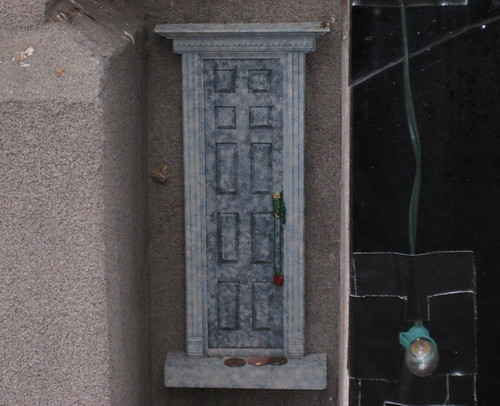
There's a different world . . . a more mysterious world . . . right there . . . just through that door. All we have to do is open it . . .


{Photo by Flickr user andshewas, used under a Creative Commons license.}

Steven Millhauser's brief but powerful story "The Other Town," which is included in his new collection, Dangerous Laughter (2008), tells of a town that for centuries has lived across a woods from an unpopulated exact replica of itself. The origin of the replica is unknown, but in the flush latter-day of the story, it has become a combination of theme park and obsession, supported by tax dollars and run with the guarantee that any change, however minor, in the physical details of the primary town will within two hours be mirrored in the other town. (Techniques that will allow for instant replication are rumored to be just around the corner.) Ruminating on the value of the other town, the narrative voice--which is, as so often in Millhauser, an unnamed collective of town opinion--offers the following justification:
The real value of the town . . . lies in the way it permits us to see our own town more clearly or completely. Preoccupied as we are with domestic and financial cares, we pass through our lives noticing so little of what's really around us that we might be said to inhabit an invisible town; in the other town, the visible town, our attention is seized, we feel compelled to look at things closely, to linger over details that would otherwise fail to exist at all. In this way the other town leads us to a fuller or truer grasp of things.
The passage makes for a nice capsule description of the effect of Steven Millhauser's stories as well: though his tales nearly always involve an element of the fantastic--or at least the improbable--they are so firmly grounded in our material world that they throw that world itself into sharp relief, reminding us even as they break from it that it, too, has dark corners and hidden secrets, roads not taken and doors never opened. At their best, Millhauser's stories combine the intellectual rigor of Borges, the whimsy of Calvino, and the exquisite prose of Nabokov; they conjure up our own world, so bright and detailed that we can no longer pass through it inattentively--and then they give it a little twist.

After a story, labeled as an Opening Cartoon, that hilariously explores the inner life of Tom-and-Jerry-style cartoon characters, Dangerous Laughter is divided into three sections that roughly correspond to Millhauser's three most common types of story, though shared elements run through all three: Impossible Architectures, Heretical Histories, and Vanishing Acts. Impossible Architectures, as the name suggests, is Millhauser at his most Calvino-esque: he writes on such topics as a craze for doming one's home, the aforementioned other town, or a tower stretching to heaven. Technology, once loosed, outstrips human ability to understand it--but the result, rather than a sci-fi dystopia, is most often simply an altered version of the reality we're used to: we are accommodating by nature, and the new situation quickly becomes commonplace.

Heretical Histories, on the other hand, offer us views of, as the narrator of the extremely good "A Precursor of the Cinema" says of its painter of inexplicably animated paintings,
a turn, a dislocation, a bold error, a venture into a possible future that somehow failed to take place.
In these stories--which as a category would include his Pulitzer Prize-winning Martin Dressler (and his better, shorter, and very similar "The Dream of the Consortium")--we see the deepest logics of both art and capitalism worked out: everyone pushes always for more and better, more and better. In one story, fashion designers goad one another to ever-dizzier heights of absurdity, while in another an inventor in a Menlo Park-style laboratory presses onward in his quest to understand the sensation of touch. In both these categories of story, Millhauser's inventiveness is at the fore: he sinks a new idea deeply into the material reality we know already, then offers genuine, exhilarating surprises.

The last category, Vanishing Acts, is the least useful as a descriptive grouping--but the stories I would place there, based on what Millhauser has included under that name in this volume, are my favorites in his ouvre. Though they bring out Millhauser's richest, most lavishly descriptive language, they tend to be more restrained in their invention, more tied to our experience--but in a sense, that is where they derive their power. Most often, these stories are set in some vague post-World War II American towns--railroad towns, maybe bedroom communities, perhaps up the Hudson.

It is usually summer, and we are before the ubiquity of air conditioning, so windows are open and escape is so simple. We are also long before the Internet and its easy answers, or even, most often, television and its link to the world outside one's town. Word travels by rumor, and teenagers--a group that has just begun to be identified as such--occupy a liminal world of many questions and few answers. Parents are mostly absent, like in Peanuts, though we catch occasional glimpses of them; they're usually troubled, possibly fuzzed by the haze of the post-war pharmaceutical cornucopia. (I can imagine a whole series of counterstories, the tales of the parents--their parties and golf outings, their furtive affairs--that occur during the exact moments when Millhauser is taking us on the journey of the children. I suppose that's the land of Cheever, or Updike.)

That world seems clearly the land of Millhauser's own youth, in the way that Ray Bradbury's stories of small-town life refract his own upbringing--and there are times, especially when he uses the dangerous multiperson narrative voice, when Millhauser treads awfully close to the nostalgia that so often ensnares Bradbury. But he almost always avoids it, most often by reminding us of the mysterious power of the unknown--and, specifically, of the power of sex, simultaneously a force and an experience, seeming at times the only real divide between the fading pleasures of childhood and the still-mysterious world of the grown-ups. The best story in Dangerous Laughter, "The Room in the Attic," traffics almost wholly in sublimated sex, ratcheting up the tension as day after day the narrator spends hours sitting in a darkened attic room playing games of "guess what's touching you" with the never-seen sister of his best friend.

For all the worries and often-frustrated desires expressed in these stories, the best of them--such as the novella Enchanted Night (1999) and "A Game of Clue," from The Barnum Museum (1990)--also serve to remind us of that feeling (occasionally still available to us, but common when we were teens) that the world really does offer myriad possibilities, and its mysteries can be construed as inherently romantic.

Not all of Millhauser's stories work, even in this strong collection. Both the aforementioned story about fashion and another, "The Disappearance of Elaine Coleman," never quite overcome relatively banal premises, while "Dangerous Laughter," about a craze for unrestrained laughter that sweeps a town's youth, mostly lies dead on the page, its central conceit never coming to life. Yet even the failed stories offer shining prose and the occasional memorable insight. "Dangerous Laughter," for example, offers us the following, once the teens' passion for laughter has turned to its opposite, a rage for tears:
The pleasures of weeping proved more satisfying than the old pleasures of laughter, probably because, when all was said and done, we weren't happy, we who were restless and always in search of diversion.
Perhaps it's that relentless search for diversion that unifies all of Millhauser's stories: it drives the capitalists and inventors, the artists and their audiences, and of course the teens. Change, innovation, new experience are all inherently seductive--and Millhauser shows us both that seduction and its consequences: the loss of control, the loss of certainty, the loss, even, of oneself. And then, with his lush prose and his endless inventions, he seduces us again and again regardless.

Monday, July 24, 2006

Once upon a time there were two robots

One day Trurl the constructor put together a machine that could create anything starting with n. When it was ready, he tried it out, ordering it to make needles, then nankeens and negligees, which it did, then nail the lot to narghiles filled with nepenthe and numerous other narcotics. The machine carried out his instructions to the letter. Still not completely sure of its ability, he had it produce, one after the other, nimbuses, noodles, nuclei, neutrons, naphtha, noses, nymphs, naiads, and natrium. This last it could not do, and Trurl, considerably irritated, demanded an explanation.

So begins Stanislaw Lem’s The Cyberiad (1967), and so it continues, through tale after tale of the constructor robot, Trurl, his friend Klaupacius, and their frequently vexing creations. As my previous exposure to Lem was limited to his best-known novel, Solaris (1961), I was surprised by the tone of The Cyberiad. Light, playful, drunk with the possibilities of words (Kings Atrocitus and Ferocitus, a religion called Pneumatological Dracolatry, gallivamps, libidinators, and cossetoria—I can’t begin to imagine the headaches translator Michael Kandel faced.), and featuring stories within stories and enough beatings to satisfy even Cervantes, it’s far closer in tone to Italo Calvino’s Cosmicomics (1965) or Borges’s stories than to the deep seriousness of Solaris. Lem’s robots take commissions from untrustworthy kings, attempt to outdo each other in making robots (storytelling robots, machines to grant every wish, eight-story thinking machines), and drink mulled electrolyte from Leyden jars. It’s great fun throughout.

But the farther I got into The Cyberiad, the more I realized how much it is like Solaris. In that book, Lem relates the entire history of academic and scientific dispute about the planet Solaris and its apparently sentient ocean, theories posited and refuted, careers made and lost as each exploratory mission adds to the sum of knowledge about the planet. The novel has shades of Borges’s masterpiece, “Tlon Uqbar, Orbus Tertius,” as if Lem has found in some dusty library a whole room of scholarship about this unknown planet Solaris. There’s a palpable sense of excess, a sense that Lem has explained only what he absolutely must in order for us to understand his story.

The same holds true for The Cyberiad. At first, it appears that Lem may have violated the first rule of fantasy writing—namely, that though a fantasy writer is creating a new universe not bound by our laws, that universe must, regardless, have laws, or there is no hope of tension, drama, or plot. Trurl and Klaupacius, after all, seem able to create just about anything. But I soon realized that, while possibility in this universe seems nearly endless, and the robots don’t seem to be bound by the laws of physics, they’re strait-jacketed by slightly skewed laws of logic.

So, for example, a machine that can make anything starting with the letter “n” can only work in one language, or it would be a Machine That Could Do Anything in the Whole Alphabet. If one makes for an untrustworthy king a Perfect Advisor, but buries within it orders never to harm its creator, then one has failed to make a perfect advisor and is liable to prosecution. And, if a region is plagued by dragons, a sensible solution would be to fire an improbability ray to decrease the already small probability that dragons might exist. We are in a distinct universe, and Lem is telling us about whatever bits of it Trurl and Klaupacius wander through.

It’s as if Lem has swallowed Saint Anselm, Descartes, and Frege and presented them to us in parables starring robots who take their cues from the Three Stooges. If that sounds like fun, The Cyberiad is for you. Why I didn’t start reading Lem a dozen years ago when I was discovering Borges and Calvino I don’t know, but I’m glad to have finally gotten to him. As he puts it at the book’s close,
Even if the story isn’t true, it does have a grain of sense and instruction to it, and it’s entertaining as well, so it’s worth the telling.

Sunday, April 16, 2006

Of fashion and matters sartorial, part 6 of 8

Stories of fashion got me thinking . . . and writing fiction for the first time in years. That's one of the many dangers of pulling Invisible Cities off the shelf—it ought to be in the back cover copy for that book, like a surgeon general's warning.


From Certain of the Chronicles, by Levi Stahl (2006)
In the later years of the Jade Emperor’s reign, his armies discovered and subjugated a mountainous land familiar from legend for its intricate works of embroidery. The people who dwelled in that land dressed in nothing but the most extravagantly decorated fabrics. To those who understood the customs of the land, the mere choice of pieces of clothing, and the particulars of its decoration, revealed the story of the wearer and his family, their achievements and position. To those who did not understand that language, the embroidery was simply art, captivating, like the shy smile of a woman one has not yet met.

On their return to the capital, the Emperor’s top generals brought him the finest examples of that artistry. The ornate capes, robes, dresses, and hats that the generals presented were decorated with fluttering birds’ wings, sinuous tendrils of flowering vines, indescribably powerful fish, quick with life, swimming in pristine alpine lakes.

Hidden behind their opaque screens, the Emperor’s advisors anticipated his nonchalant response. Reduced as he was in his waning years, he felt a constant need of variety and surprise in the forms of extravagance that were brought to him. He had worn beautiful clothing before. He had seen fashions come and go. Skilled as they were, these creations did not impress him. He waved away the generals, his own silks fluttering, bidding them bother him no more with such trifles. They shuffled disconsolate from the room and exhausted their wrath on their blameless adjutants.

But the generals, unwittingly, left behind them a surprise. In their place stood a young man, wrapped several times round in a gold—no, mustard—no, plum robe, his unlined face the only part of him visible above its folds. It was unclear, even to the elite guards, how he had reached the inner chamber.

He spoke. His dialect was rough, uncultured. The habitues of the court could barely comprehend him. “Your Imperial Majesty was wrong to reject the offered works. They are the finest fruits of a culture far older and more sophisticated than the one that has placed you on the throne of heaven. Were there gods, they would rebuke you. But Your Imperial Majesty’s blindness will be forgiven—because I wear what the Emperor desires.”

Hearing the word "wrong," the Court Executioner slid his sword silently from its scabbard. But at the smallest of signals—a puff of breath—from the Emperor, he stopped. The Court Executioner froze. His blade glinted mercilessly in the warm, fading evening light.

Tuesday, April 11, 2006

Of fashion and matters sartorial, part 2 of 8

To be fair to Julian MacLaren-Ross, the reason I started reading him in the first place was because he is said to be the model for the rackety writer X. Trapnel in Anthony Powell's A Dance to the Music of Time. So Powell bears responsibility for this topic, too—which is fair, because he, too, had an eye for clothes. Mostly, however, his interest was in how they reflected social convention or position and how, when divorced from their social value, they were often, essentially, absurd.

Like tattoos.

From Marco Polo's The Travels of Marco Polo (1298-99)
[In Kanigu province,] both men and women have their bodies marked with the needle all over, in figures of beasts and birds; and there are among them practitioners whose sole employment it is to execute these ornaments upon the hands, the legs, and the breast. When a black colouring stuff has been rubbed over these punctures, it is impossible either by water or otherwise, to efface the marks. The man or woman who exhibits the greatest profusion of these figures, is esteemed the most handsome.


From Anthony Powell’s A Question of Upbringing (1951)
“But my dear Peter,” [said Stringham], “Why do you always go about dressed as if you were going to dance up and down a row of naked ladies singing ‘Dapper Dan was a very handy man,’ or something equally lyrical? You get more like an advertisement for gents’ tailoring every day.”


From CĂ©leste Alberet’s Monsieur Proust (1973)
As well as tails and dinner jacket, he had several jackets which he wore with striped trousers, and to these he added a black jacket with piping. Everything was of course made to measure.

He had a collection of waistcoats, handsome but plain. I remember he had one made because he particularly liked the material. It was red silk with a white silk lining. He tried it on and showed me. I can see him now turning this way and that in front of the mirror, then saying:

“Definitely not. It would be all right for a dandy like Bonii de Castellane, but I don’t want to look ridiculous.”

And he never wore it. I put it away in the cupboard.


From Italo Calvino’s Invisible Cities (1972)
The city of Leonia refashions itself every day: every morning the people wake between fresh sheets, wash with just-unwrapped cakes of soap, wear brand-new clothing, take from the latest model refrigerator still unopened tins, listening to the last-minute jingles from the most up-to-date radio. . . . So you begin to wonder if Leonia’s true passion is really, as they say, the enjoyment of new and different things, and not, instead, the joy of expelling, discarding, cleansing itself of a recurrent impurity.