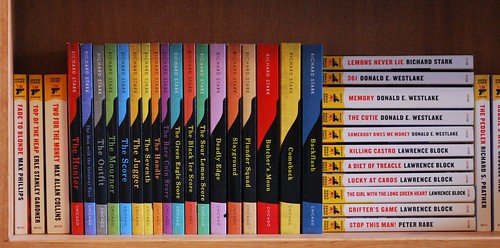
Showing posts with label Richard Stark. Show all posts

Tuesday, May 24, 2016

Darwyn Cooke (1962–2016)

What to say about Darwyn Cooke?

He's dead, and that is awful. That's the first thing, the reason I'm writing this. He was only fifty-four. Cancer. I can't imagine what his family and friends are going through. My heart aches for them.

For the rest of us, well, it's a version of that pain many of us felt recently when Prince died. The grief that can't help but be awkward because it's simultaneously real and attenuated--it's genuine grief felt about a person we knew only through their work. Yet . . . I have no qualms about calling it actual grief. We develop a relationship with the people who make the art we love, the art that gives our world so much of its depth and richness. The "they" whom we love may ultimately bear only a passing resemblance to the person grieved by friends and family, but if the art is genuine, there's nonetheless a reality there: the self bleeds through; the artist, if we take engage with them seriously, takes on a form and role not wholly dissimilar to that of once-close friends who are now distant, encountered mostly in virtual spaces. I have no trouble saying that I love, actually love, Willie Nelson, Aretha Franklin, Rex Stout, Barbara Pym, Henry James, Anthony Powell, and on and on. I wouldn't have wanted to spend a country weekend with Tolstoy, let alone be married to him, but lord, I love that man despite. It's real, and it is a powerful force in shaping the world--so much of it constructed, moment to moment, by my own reflections on it--in which I live and act every day. Darwyn Cooke made my life better, and I'm my grief that he won't be able to keep making beautiful, creative art is genuine.


I never met Darwyn Cooke. We exchanged e-mails a couple of times in the course of his work illustrating and designing the cover of my dreams for The Getaway Car. But mostly I knew him as any fan did: through his wonderful comics art and stories. Let's start with Parker.


In the fifty-plus years since Donald Westlake sat down at the typewriter and discovered Richard Stark's voice, there's been no one who translated Parker into a visual medium as effectively and faithfully as Cooke. His clean-lined midcentury style, redolent of both the silver age and, in its backgrounds, architecture, and use of watercolors, midcentury magazine illustration, put Parker squarely in his era. And Cooke's creativity in storytelling and narrative technique, which saw him combine panel-to-panel comics, fake magazine stories, cartoony comic strips, and more, enabled him to turn Stark's brilliantly clockwork plots into suspenseful pages.


At the same time, he captured an aspect of the Parker novels that is often overlooked: their humor. Richard Stark was Westlake's hardboiled voice, but like a recidivist criminal, he wasn't a man who could ever go wholly straight. I love these two panels from The Score on that front--we've all wanted to say this to Grofield at one point or another.


The Parker adaptations were wonderful. But they're not even Cooke's greatest achievement. I've been reading comics off and on for thirty years. I have a deep and abiding love for superheroes, and a considered awareness of what they can be at their best--and of what we all too often find ourselves accepting as good enough, through some mix of nostalgia and appreciation of comfort food. I'm the twelve-year-old boy who wore out issues of The Amazing Spider-Man with re-reading and can still access reverberations of those feelings, yet knows, to quote (let's imagine) Ben Grimm, that most of it ain't Proust.


The New Frontier, a six-issue miniseries written and drawn by Cooke and published by DC in 2004, is better than that. It's the best comic I've ever read. Hands down. In it, Cooke re-tells the story of DC's Silver Age--of the characters and the moment that people still think of when they hear "comic book" or "superhero," the birth of the Justice League and team-ups between Batman and Robin and Superman, Flash and Wonder Woman and Green Lantern and all.


Cooke does so in a visual style that honors, without wholly aping, the style of the 1950s comics he's drawing on--and setting it within the larger visual and design sensibility of the period. An attentive reader of The New Frontier stares at least as much at furniture and signage as at super-sculpted physiques.


This was a beautiful era visually, among the cherished remnants of which we live today, and Cooke gives us that almost casually throughout the series. But that's only part of his period aim. His larger point was to put these stories themselves, and the characters who powered them, into the actual context of their era.


Written out that way, it sounds like a terrible idea, a recipe for tendentious tales of nuclear fears and the Red Scare. In Cooke's hands, it becomes something different, something that feels honest and organic. Re-reading it now, it calls to mind the later seasons of Mad Men, when the writers had gotten past the first season's tendency to superciliously gawp at history and instead were telling actual stories of a time now lost--which enabled them to generate the only nostalgia that's not toxic: an honest, clear-eyed nostalgia, one that acknowledges that every passing of time entails loss, no matter how it's balanced by gains.


That tug, the pull of the imperfect past, is powerful in The New Frontier. We feel the energy, hope, and technocratic drive of postwar America, even as we acknowledge its darker side.


At the same time, Cooke avoided two major contemporary pitfalls, darkness and irony. His Silver Age is beset by actual problems, the Cold War being the source of most of them. But the tone of the comic is light and hopeful: these are superheroes, people who can do things we can only imagine--and the whole point of imagining them in the first place is to give us people to look up to, to trust in, to thrill to. Cooke lets them be heroes. And he also lets the relative simplicity of the era remain untroubled. Look at this full page, where Robin meets Batman for the first time.


That's powerful earnestness, and Cooke is letting it stand. Throughout the series, he shows us the 1950s inflected by our own time-shifted understanding, but at the same time he lets the era be itself, with nearly all its relative innocence. These are that rare thing: comics that adults and kids can enjoy alike. It's a genuinely thrilling, exhilarating series.


Nearly seventy years after the creation of Superman, sixty-five since Batman, and half a century after the creation of the Justice League, who would have thought there would be anything new to say? There will always be new adventures, of course; that's the beauty of mythological-style characters and serial narrative. But who could have imagined that there would be anything to say, especially looking backwards, that feels as fundamental as what Cooke created in re-telling the story of these heroes? With due deference to the giants, not just from DC but from Marvel and indies, on whose shoulders it was built, The New Frontier is the greatest comics series ever written.

Rest in peace, Darwyn Cooke. You made something truly special, and we'll never forget it.

Friday, August 01, 2014

Westlake and Manchette

My friend who manages 57th Street Books (my home bookstore) pushed Jean-Patrick Manchette's The Prone Gunman (1981) into my hands this week, and I'm glad he did: it's a short, taut, bleak thriller about a hit man forced to postpone retirement, and it reads very much like a French cousin to Donald Westlake's work as Richard Stark. The passage that most directly called Stark to mind was this one, wherein Terrier, the hit man, gets the drop on a man who's been following him:
"They said you were an okay guy, that you might knock me around a little, but I only had to say I was a gofer and give you the name of the Rossi brothers and you would let me go! You're going to let me go now, aren't you?"

"Sure."

Terrier drew back a little on his seat and stopped pressing the barrel of the HK4 against the throat of the young man. The latter tearfully rubbed his neck.

"Oh! Thank you, thank you!"

"Take this message to Cox," said Terrier as he put a slug into his heart.
Reading that, Parker fans will no doubt find themselves thinking of a scene from Butcher's Moon. As Parker strides through the middle of a gang war he's fomented, he confronts a low-level gangster who pleads for mercy:
"I'm only the messenger!"

"Now you're the message," Parker told him, and shot him.
As Timothy Peltason points out in his excellent essay on the Parker books in the current issue of the Yale Review, Parker isn't generally one for snappy lines. Talking is generally a waste of time, and never more so than when you're about to shoot somebody. But at that moment in Butcher's Moon, he (or his creator) can't resist--and, slightly out of character though it may be, it has become one of Parker's signature moments. It's fun to see it echoed--most likely unknowingly--by Manchette.

Friday, January 25, 2013

From the desk of Donald E. Westlake. Or maybe Richard Stark? Or Samuel Holt? Or Tucker Coe? Or . . . ?

We'll keep the writers' letters theme rolling along today--though today's entry is our first look at the future of collections of writers' letters: it's from an e-mail. It comes to us courtesy of Ethan Iverson, jazz pianist and expert on the writing of Donald Westlake, an e-mail that Westlake sent to Iverson sometime around 2005:
I’ve always loved Point Blank sort of the way the Neanderthal mother loved that first hairless mutant: did that come from me? And I never get over being astonished at how far that original toss has sailed. In addition to the lowly origins you mentioned, there's also the fact that it was supposed to be a one-off, that I had Parker arrested by the cops at the end of The Hunter, which is part of why I didn't bother to give him a first name. A Pocket Books editor named Bucklin Moon (honest: discovered Chester Himes) asked me if I could somehow arrange Parker's escape and bring him back. It's all careful planning, all careful planning.
There's more of their e-mail exchanges at Iverson's blog, where he offers an indispensable annotated guide to nearly all of Westlake's books.

Those of you who follow me on Twitter already know why I picked Westlake for today: tonight is the nationwide premiere of Parker, an adaptation of the novel Flashfire that stars Jason Statham as Parker, the first time that Parker's name has actually been used for the character onscreen. I'm not seventeen, so I'm not seeing the movie tonight, but I'm looking forward to seeing it soon, and I've definitely been enjoying the flurry of attention that it's brought to the series as a whole.

In addition to Michael Weinreb's excellent essay on Westlake for Grantland (The Outfit "doesn't so much begin as get straight to the goddamned point."), there's Nick Pinkerton's look at Parker's checkered cinematic history for the Village Voice (File under Things I Did Not Know: "Jim Jarmusch . . . can be seen reading a Stark novel on an airplane in 1994's pseudo-documentary Tigrero."), and A. O. Scott's appreciative review of the film in the New York Times.

As Parker's main publisher, my colleagues and I have been doing our part, too. I wrote a post for the Press blog about the books and movie, including five tips for keeping yourself from being robbed by Parker. (And let's be clear: if you'd told fourteen-year-old me that I would get paid to write about crime novels, and later that day get to trade e-mails with Lawrence Block, I would have been pretty damn impressed with future me.) But the big news we got to share this week was that we'd launched a new Parker website that features infographics of Parker's take from each heist (and the bodies he left behind), Parker's rules to live (heist) by, and, biggest and best, a complete, sortable guide to all 498 characters to cross Parker's path in the twenty-four novels. I've been kicking around the idea of doing a Parker character guide since we first started publishing the books, and with the help of my incredibly hard-working colleagues--as attentive to detail as Parker himself--we've made it happen.

So pick up your copy of The Hunter and settle in for the weekend, folks. Oh, but don't forget to lock your doors first. You never know who might be casing the place.

Friday, March 16, 2012

Alan Grofield takes the stage

It’s been a good spring for fans of Donald Westlake. First, Hard Case Crime published a never-before-seen Westlake novel, The Comedy Is Finished, which I wrote about a couple of weeks back. And now my own employer, the University of Chicago Press, has released the four novels that Westlake wrote about Parker’s sometime-partner Alan Grofield. We’ve put out three in paperback—The Damsel, The Dame, and The Blackbird—and one, Lemons Never Lie, will soon be available as an e-book only (since you can get the paperback from Hard Case Crime).

No fan of Parker or Stark would pretend that these four books are as good as the best of Parker, but that’s a tall order—they’re plenty good and well worth reading in their own right. What’s most fun about them is Grofield himself: ladies’ man, actor, wit, and, equally important, fully capable heister. As Sarah Weinman writes in her introduction to the series,
Grofield was a lab rat for Westlake, who liked to experiment with tone—veering, somewhat wildly, between dark violence, witty banter, and absurdist humor—and plot.
In these books, Grofield finds himself in romantic adventures, locked room mysteries, espionage plots, and straight-up heists—and, always the actor, he casts himself as the heroic leading man in each.

The opening paragraph of The Damsel (1967) is the first indication that things in Grofield's world are different than in Parker’s. Whereas the best-known Parker opening line, from Firebreak, is “When the phone rang, Parker was in the garage, killing a man,” Grofield’s book opens with the girl:
Grofield opened his right eye, and there was a girl climbing in the window. He closed that eye, opened the left, and she was still there.
She brings trouble, of course, but in the life of a faithless Romeo like Grofield, what lady doesn’t?

The window is in Grofield’s hotel room in Mexico City, where he’s recovering after nearly being killed in The Handle. He’s still a bit punchy, which gives the humor in this exchange, from later in the first chapter, an entertainingly absurd edge:
She said, “Are you one of them?”

“That depends. Sometimes I’m one of them and other times it doesn’t seem worth the effort. I haven’t been one of them lately because I haven’t been well.”

The glitter was slowly fading from her eyes. In a more human voice she said, “What are you talking about?”

“Be damned if I know. Are we supposed to be talking about something?” He tried to sit up, but the wound in his back gave him a twinge. He grimaced and shook his head. “It gets worse,” he said. “Before it gets better, it gets worse.”
Moments later, still completely confused, the visitor decides Grofield’s no danger:
“I’ll trust you,” she said, taking another step closer to the bed. “God knows, I have to trust somebody.”

“You wouldn’t talk like that if I had full use of my faculties.”
As the girl will soon learn, Grofield’s both right and wrong: he’s not the sort of man her mother would trust, for example, but he can definitely be counted on to get her out of a jam. And any damsel (or reader) in distress will find him great company along the way

Wednesday, September 21, 2011

Four from the office

As I've noted before, I usually try to keep my life as a blogger and my life as the promotions director of the University of Chicago Press separate. This blog is, after all, something I write on my own time about my life as a reader, and while my reading definitely informs the work I do at the office, they're separate worlds, and, by design, the blog reflects that.

But occasionally they overlap--and this is a very good week for that. So, with apologies for seeming to be shilling for my employers, four notes about Chicago books that I've had a hand in and am thus particularly excited about:

1 The fifth Parker novel, The Score, is the free e-book of the month from Chicago for September--and this time, like with the Anthony Powell giveaway back in December, it's free not just from the Press directly, but also from all the major e-book retailers. I've been writing about Richard Stark ever since I first started reading the Parker novels nearly four years ago; being part of bringing these novels back into print has been one of the things I'm most proud of in a twelve-year career in publishing.

The Score is a great place to start reading Parker: it's one of the most exciting books in the series, but it's also got a lightness of tone that's unusual and welcoming--there's none of the gaspingly brutal violence of, say, Plunder Squad here. I'm confident that the thousands of people who download this freebie won't need much convincing to move from that to one of the other nineteen Parkers that Chicago now has available. If you need more convincing, check out my many posts about Stark in the archives, or visit Ethan Iverson's checklist of Donald Westlake's complete oeuvre.

2 George Pelecanos's new novel, The Cut, features a character who teaches literature to public high school students in DC . . . and one of the books on his syllabus is Stark's The Hunter. After reading aloud the opening page, he asks the students what the description of Parker, all hands and shoulders and implicit violence, makes them feel:
"Way his hands are swinging," said another, "it's like he don't care about nothin."

"He doesn't belong in that suit," said William Rogers, aka Moony.

"Exactly," said Leo. "The suit doesn't fit him, both literally and metaphorically. It's a costume to him. He'd be more comfortable walking naked through a jungle. The Parker books are crime novels, but they're also about a man whose physicality stands in contrast to a working world that, at the time, had become increasingly mechanized and deskbound."

"I don't get what you're sayin, Mr. Lucas."

"Parker is a man of action. He's defined by what he does rather than what he says."
Later, in a touch I suspect Westlake would have appreciated, when the teacher asks the class what they liked about the book, a kid pipes up, "It's short."

3 Another book I had a hand in returning to print has just arrived in bookstores, and it couldn't be more different from Stark's work: Francoise Sagan's A Certain Smile. Sagan's second novel (after the explosively successful Bonjour Tristesse), it is, I think, better than her famous debut: its characters are more convincingly imagined, its prose--full of quotably pithy lines--more stripped-down, its world-weariness feeling a tad more earned. In the Economist, Molly Young called it "a popsicle of a book," and that's not far off, if you can imagine a popsicle leavened with a delectable dash or two of bitters. As autumn draws in, what better way to spend some time than sighing over the prematurely cynical love affairs of a beautiful young French student? Lay in a stock of Gauloises and enjoy!

4 And, fnally, what is perhaps the book I'm most excited about this fall, Dmitry Samarov's Hack: Stories from a Chicago Cab, should be showing up in bookstores everywhere any day now. I've been a fan for a few years now of Dmitry's blog about the people he meets and the strange things he sees while driving a cab, and I'm pleased to have played a part in transforming that blog into a book. If you're fascinated by urban life, and you've always wondered about that slice of it that only cabbies see, this is the book for you: it's full of wonderful (and some horrible) anecdotes and unforgettable images of people with their guard down, revealing things to this stranger behind the wheel that, you sense, they don't even tell their closest friends. It's an amazing book, and it's powered by Dmitry's deep empathy: up against people at their worst day after day, he somehow keeps from being crushed. Indeed, what makes his stories stand out is that even as he marvels at oddity he never loses sight of the fact that it's human oddity, and thus worthy of our forbearance and care.

Dmitry will be appearing at a number of venues in Chicago this fall, including a launch party on October 1 at the Rainbo where I'll be one of the many readers (and certainly the least famous). And if you're on Twitter, definitely follow him: you'll get plenty of late-night stories of unusual fares.

Publishing's a job, like any other. But once in a while, you simply feel lucky to be a part of it. With these books, that's definitely where I stand.

Monday, August 08, 2011

Crime time!


{Photos by rocketlass.}

Sorry, can't blog today. Too busy reading Gillian Flynn's Dark Places.

Oh, fine. How about a quick crime novel roundup, and then I'll go back to trying to figure out what wonderfully horrible twist Flynn's going to surprise me with next?

1 The new batch of Parker novels is out now from the University of Chicago Press: Flashfire (2000) and Firebreak (2001). They've got an introduction by Terry Teachout that's one of the best we've published. Teachout points out that despite his sociopathic tendencies, "Parker kills only when absolutely necessary, a clear sign that he isn't crazy"; does a nice job of drawing the distinction between Stark's Parker and Westlake's Dortmunder; and quotes my favorite Dortmunder line, which just might be my favorite Westlake line, period:
Whenever things sound easy, it turns out there's one part you didn't hear.
Flashfire is one of the best in the series, featuring a lot of heists, a strong female character (who's a civilian, no less!), and some truly great exchanges between Parker and a Florida sheriff. It's easy to why Hollywood chose this one to launch the upcoming Parker movie series.

2 Over the weekend I continued my progress through the rest of Westlake's novels. I started with a darkly comic novel called Two Much (1975), in which one of Westlake's least honorable and least likable protagonists cons two rich twin sisters into thinking that he, too, is a twin--and a separate twin is sleeping with each sister. It's a great example of two Westlake strengths: his enjoyment of playing out the implications of a puzzle he sets for himself and his understanding, most clearly on display in the Parker novels, that our instinct as readers is to want the narrator to get away with what he's doing almost regardless of how awful it is or how amoral he is. Present us with a problem and we want to see it solved; Westlake knew that better than anyone I can think of.

3 The other Westlake I read this weekend was refreshingly light: Good Behavior (1985), which finds John Dortmunder and his gang trying to kidnap a nun . . . on behalf of her convent. It won't surprise you that the gang ends up dressed in habits:
Very strange. When nothing shows but your face, enclosed by the white oval of a wimple and the featureless black of a nun's costume, you wouldn't expect much by way of individual character to show through, but it did, it did. . . . Tiny, whose face mostly consisted of knuckles anyway, was barely plausible as the kind of false nun who, in the Middle Ages, poisoned and robbed unwary travelers. Stan Murch looked like a pilgrim in The Canterbury Tales, probably the one with ideas for alternate routes to Canterbury. . . . Kelp was surely someone whose sister was the pretty one, while Dortmunder looked mostly like a missionary nun who was already among the cannibals and headhunters before realizing she'd lost her faith.
It's all as ridiculous as it sounds, and it makes for one of the best of the Dortmunder series.

4 While Hard Case Crime will officially mark their welcome return next month with the publication of Lawrence Block's new book of smut and crime, Getting Off (which I'm looking forward to reading soon alongside Nicholson Baker's new book of smut and smut, House of Holes), they'll also be publishing a new book by Max Allan Collins, Quarry's Ex (2011). Collins is at his best when writing about Quarry, whose character is perfectly suited for Collins's tight mix of violence, quips, and social observation, and I've really enjoyed watching him flesh out the hitman's backstory these past couple of years. Quarry's Ex is a strong addition to that story. It should show up in stores in September; it's available for pre-order now.

5 I'll close by returning to Gillian Flynn, so that I can return to reading Gillian Flynn: last summer, at the start of the annual Stahl family vacation, I gave a copy of Flynn's first novel, Sharp Objects, to my sister. She blazed through it, then lent it to my brother. As he was nearing the end, my sister and I sat and watched him, waiting for him to get to that part, so we could see how he reacted. He kept looking up and laughing at us . . . and then he got to that part. He stopped laughing.


Wednesday, November 24, 2010

Thanksgiving just isn't complete without a visit from Parker

The day before Thanksgiving was forever changed for me back in 2007, when I stopped at 57th Street Books on my lunch hour and picked up my first Parker novel, Ask the Parrot (2007) . . . which I spent the next five hours reading furiously. I've written before about that day and its aftermath, in which I got to help convince my employer, the University of Chicago Press, to bring the Parker series back into print, to both great sales and great acclaim. Next spring we'll publish the sixteenth through the eighteenth volumes in the series--including the elusive, brilliant Butcher's Moon--and, as Thanksgiving rolls around, I remain thankful that I've been able to be a part of introducing so many readers to Parker's violent, amoral oeuvre.

So today, in honor of Parker, and the unexpected gift that his creator, Donald E. Westlake, bestowed on me that Thanksgiving, I'll share a passage from another of Westlake's books, the strange, borderline brilliant Adios, Scheherazade (1970). Drawn from Westlake's own experience as a young writer-for-hire, the book is told from the point of view of a man who has been writing soulless, formulaic sex novels for a paycheck for too long; in ten chapters that are at times funny, at others distinctly uncomfortable, it tells the story of his disintegration--and, just maybe, re-integration and renewal.

The passage I want to share is one of those self-referential notes that the multi-pseudonymed Westlake loved to scatter through his work:
The movie I saw last night was called Point Blank, which could also be the title of my life, particularly if you reverse the order of the words, and it was about Lee Marvin being a gangster of some kind and the gangster syndicate owes him ninety-three thousand dollars and he wants it. The whole movie is about him trying to get his ninety-three thousand dollars. It was sort of spoiled for me because all the way through I kept thinking, Lee, what if you get the ninety-three thousand dollars? Do you think that'll make you happy? It won't. You'll just spend it, and then next month you'll need ninety-three thousand dollars more, and you'll have to go through all this shit all over again, and after a while you'll just give up and move to San Francisco and jump in the bay, because San Francisco has the highest suicide rate in the nation, and I know why. It's because when people are desperate they move somewhere else, and because the sun goes from east to west so do people, and eventually they wind up in Los Angeles, where they either go crazy or move to San Francisco. If they go crazy they can live in Los Angeles for the rest of their lives, but if they go to San Francisco there's no place to go after that, the only thing westward is the ocean, so plunk they go. So forget the ninety-three thousand dollars, Lee, you and me and all the rest of us we're just rats in a maze, the only thing to do is stop the world I want to get off. Therefore, Lee, go to San Francisco, go directly to San Francisco, do not pass Go, do not collect ninety-three thousand dollars.
Point Blank, you'll remember, is what the John Boorman movie of Westlake's first Parker novel, The Hunter, was titled.

What Parker fan hasn't wondered the same thing about Parker? Someday the heists have to end, and then what? Parker's associate Handy McKay retired to Presque Isle, Maine, but can any of us imagine that for Parker? As the Restless Kind wondered last week, "Where do these guys end up? What and who are they in 2010 and what have they left in their wake?"

I like to think that retirement is still ever-distant on the horizon, and that Parker and Claire will sit down to a turkey tomorrow in their house by the lake, the quiet and peace of the winter evening broken only by the calls of geese. A knife and gun are, ever, close to hand, but the knife is for carving the turkey, and the gun is for another day, another problem.

Tuesday, August 10, 2010

Parker purloining paperbacks? Preposterous!

My local bookstore, the 57th Street Books branch of the Seminary Co-op, has begun posting the winning stories in their Parker flash fiction contest, for which I served as one of the judges. Congratulations to Ryan Garms, whose "The Rare Book Score" took third place, and to Anders Runestad, who swiped second with "The Bookstore Heist," both of which are now up at the store's Front Table blog.

Keep an eye on the Front Table for the winning story later this week--and if 150-word semi-comic heists aren't enough to sate your need for crime, you can pick up the three newest Richard Stark reissues from my employer, the University of Chicago Press, Deadly Edge, Slayground, and Plunder Squad. In a great new foreword to the books, Hard Case Crime editor Charles Ardai describes them as marking a new plateau in Richard Stark's career to that point. Considering the number of times I gasped out loud while reading them, I can't disagree--along with the upcoming Butcher's Moon, this is as good, and as dark, as Parker gets.

Friday, May 14, 2010

Rob a bookstore . . . get some books!


Usually, business owners want Parker to stay as far away as possible. My local bookstore, 57th Street Books, is inviting him in. Sort of. They're having a contest, calling for people to write and submit stories about Parker knocking over a bookstore--and because Parker hates wasted effort, they're only accepting stories of 350 words or less.

The winner will receive a set of the first twelve Richard Stark reissues from my employer, the University of Chicago Press. Second prize is a copy of Darwyn Cooke's graphic adaptation of The Hunter, and third will get you a Parker poster. You can find all the details here.

Oh, and I'm going to be one of the judges. Get writing, Parker fans!

Wednesday, March 24, 2010

"He was incapable of writing an e-mail that wasn't funny," or, Charles Ardai and I talk Westlake

Over at the blog of my employer, the University of Chicago Press, an interview was posted today that I conducted with Charles Ardai, editor and co-founder of Hard Case Crime, on the occasion of his publication of Westlake's never-before-published novel Memory and Chicago's publication of Parker novels ten through twelve (The Black Ice Score, The Green Eagle Score, and The Sour Lemon Score), all of which should be on the shelves of your local bookstore any day now. I think you'll enjoy checking it out.

And, oh, lordy, if you've not read The Sour Lemon Score, let me warn you: it really should be titled in the Old Testament style, something more like The Sour Lemon Score of Sour Lemon Scores. It goes that badly. Which, let's be honest, is what us Parker fans are always looking for anyway, right?

Sunday, February 14, 2010

Two sides of a coin, or, Parker and Dortmunder, Westlake and Stark

What better way to commemorate the St. Valentine's Day Massacre than by turning our attention to a heartless criminal?

Fans of Parker and Donald E. Westlake will enjoy this brief interview recently dug up by Trent, the proprietor of the Violent World of Parker site:


In one of the Parker novels--I think it's Plunder Squad--Parker explains why he has no problem with Brenda Mackey, wife and constant companion of his fellow heister Ed Mackey. Parker tends to view women as little but sources of trouble. He's a misogynist, but his misogyny, like all his other bad traits, is rooted in what he sees as practicality: time and again, he's watched men screw up a job because a woman turned their heads.

Brenda Mackey, however, escapes Parker's ire, and the reason is telling: she knows who she is, and, perhaps more important, likes who she is. As Parker puts it to himself, most people don't know who they are, and, if they do, they don't like who they are, wishing instead to be someone or something else, bigger or more impressive. Trying to be that person inevitably gets them--and those around them--into trouble. Brenda's self-knowledge, on the other hand, makes her a rock, reliable and safe.

That's what I love about the video above. There's nothing revelatory in Westlake's answers; his interviews over the years tended to feature a lot of the same questions, and thus the same well-rehearsed answers. Even so, it's a joy to watch him deliver them here, because he exudes a sense of pleasant contentment. It's impossible to watch that interview and not come away thinking that this is a man who knew himself and his place, and liked both--an impression that jibes with the testimony of friends and acquaintances. It's a quality I greatly prize, and to find it in someone who at the same time had the ambition to continually set himself complicated writing problems rather than resting on his laurels is remarkable.

The interview also seems like a good excuse to share a favorite passage from Jimmy the Kid, the Dortmunder novel that Westlake wrote in 1974, in which Dortmunder's crew attempts a kidnapping based on a plot they find in a crime novel called Child Heist, by none other than Richard Stark. Child Heist of course doesn't exist; in reality, the Stark novel that Westlake wrote that same year was the absolutely staggering Butcher's Moon, whose gripping, Red Harvest-like bloodbath would exhaust the Parker character for two decades.

What I love about this passage from Jimmy the Kid is the way that it reveals the continuity of approach between those two halves of Westlake's writing personality--tell me you can't imagine this description, soured by seriousness, being used to introduce a slightly corrupt businessman in a Parker novel who's about to find himself in over his head:
Herbert Harrington plucked his white handkerchief from his suit coat's breast pocket and patted the tiny bead of perspiration that gleamed on his pale high forehead. A calm, methodical, successful corporation attorney of fifty-seven, he was used to emergencies and crises that ran at a Wall Street pace: weeks of gathering storm clouds, spotted with occasional conferences or pubic rumor denials, then a flurry of phone calls, a massing of capital along the disputed border, and then perhaps three days or a week or even a month of concentrated buying, selling, merging, bankruptcy declarations and the like. Drama with sweep to it, emotional climaxes as carefully grounded and prepared for as in grand opera.

But this. They kidnap the boy at four o'clock in the afternoon, and by nine o'clock the same night they're demanding one hundred fifty thousand dollars for him. In old bills. In an equivalent situation on Wall Street, it would be three or four working days before anybody even admitted the boy had been taken. Then, there'd be a period of weeks or months when the kidnappers would publicly maintain the poster that they meant to keep the boy, had no interest in selling him, and wouldn't even consider any offers that might come their way. This logjam, assisted by continued denials from Herbert Harrington or his spokesmen that (a) he was interested in negotiating a repurchase, (b) that he was in a cash or tax position to make such a repurchase possible, or (c) that in fact he had ever had such a son at all, would eventually be broken by tentative feelers from both sides. Dickering, threats, go-betweens, all the panoply of negotiation would then be mounted and gone through like the ritual of High Mass, and it would be even more weeks before anything like a dollar amount was ever mentioned. And in fact dollars would be the very least of it; there would be stock options, rebates, one-for-one stock transfers, sliding scales, an agreement with some meat on it.
As for Butcher's Moon, well, you'll have to wait just a bit: it's on track to be republished by my employers, the University of Chicago Press, in the spring of 2011. Until then, you might occupy yourself by pre-ordering a copy of the final, long-lost Westlake novel, Memory, which Hard Case Crime will publish in April. As Parker would remind you, it's always good to be prepared.

Saturday, September 26, 2009

Wish fulfillment

In preparation for a review I'll be writing for the Second Pass, I'm currently re-reading Hilary Mantel's brilliant new novel, Wolf Hall, and it's reminded me of an e-mail exchange I had recently with Jenny Davidson of Light Reading about Stieg Larsson's The Girl with the Dragon Tattoo--and why I seem to be the only crime novel fan (and maybe the only person, period) who actively dislikes it.*

Jenny nailed it, explaining that I didn't like Larsson's book largely because I'm not into wish-fulfillment novels--and that's what the novel's two leads represent. Mikael and Salander are smarter, more talented, more dramatic, better looking, and sexier versions of ourselves, engaged in more exciting and dramatic adventures than we ever encounter. Jenny's right: it just doesn't appeal to me. I don't buy it, and, more, I don't really even want it: life is fine without approaching perfection, and as someone with generally low ambitions, the few dreams I have are too reasonable to require authorial intervention.

What re-reading Wolf Hall has reminded me is that there is one particular kind of wish-fulfillment to which I am susceptible: that of simple, understated functional hyper-competence. I've written before, in joking fashion, about Mantel's portrayal of Thomas Cromwell's wide range of abilities, and how those help create an aura of fear, even awe, that is a great help in his multifarious activities on behalf of Henry VIII. Without ever bragging, or seeming to place too much importance on the fact, Cromwell demonstrates again and again that in almost any field he knows what he's doing. And even though I know that what I'm reading is fiction--however much the historical Cromwell may underlie Mantel's portrait--I find myself thrilling to that competence every time.

A similar feeling draws me to Richard Stark's Parker. Though he is clearly not a character Stark wants us to emulate, or even like, at the same time his relentless drive for perfection is hard not to admire. He is the best at what he does, and while he doesn't make me want to rob banks, he does make me want to be that capable.

Of course, to remain convincing such functional competence has to stay just this side of perfection. Parker does make mistakes, and even Cromwell can't retain the king's favor forever. On the other hand--to take an example that's been in the news lately, Robert Langdon, hero of Dan Brown's novels, is so endlessly, flawlessly skilled that his perfection quickly becomes risible, smacking far more of cack-handed authorial grant than of a lifetime of dedication.

But in the hands of a skilled author--like when Mantel shows us Thomas Cromwell casually calculating the value of Thomas More's carpet, then filing the answer away to use later against his rival--such demonstrated skill calls up some long-dormant childhood definition of masculinity, a belief that a real man is one who can do things. I know better, know the many ways in which such a definition is limited, complicated, even ridiculous . . . but reading about Cromwell I suddenly find myself wondering again about the skills I don't have, thinking maybe I should take boxing lessons, or brush up my Spanish, or improve my dismal swimming skills.

Nah. More likely I'll just continue with my autumn project of trying to re-learn how to play the piano. Surely a man who can make a strong martini and play "One for My Baby" can count on folks cutting him some slack in other areas, right? {Of course, first I have to manage the much simpler "Swanee River." Baby steps, baby steps.}

Thursday, July 23, 2009

Darwyn Cooke takes on Parker, as Donald Westlake Week continues!


{Parker, as drawn by Darwyn Cooke.}

I think I have to just give in: this week has unexpectedly become Donald Westlake—and thus Richard Stark—week. {There are worse weeks in which to find oneself.} Right after posting Tuesday’s news about the lost Westlake novel that Hard Case Crime is going to publish next spring, I picked up the new graphic adaptation of the first Parker novel, The Hunter, by comics artist Darwyn Cooke--a book that, as a fan of The New Frontier, Cooke’s beautiful and thoughtful reimagining of the DC Universe’s Silver Age and the origin of the Justice League, I’ve been looking forward to for nearly a year.


With that series, Cooke showed that his style is perfectly suited to depict late 1950s-early 1960s America—the sleek, futuristic design; the skinny ties and tight skirts; the cocktails and hi-fis and wood paneling. But those of us who followed his work on Catwoman know that he also has a feeling for noir, taking pleasure in the accommodating shadows and odd angles that let a touch of Depression-and-wartime darkness leach into the shiny new world of jet-setters and playboys.

His Hunter doesn’t disappoint. Through page after page, Cooke translates Stark’s terse prose into imagery that, while never distracting from the action that is the heart of Stark's book, immerses the reader in a sort of visual tour of the details of 1962 New York City. The opening spread of the Manhattan skyline is marvelous, while the first page of the book, which depicts Parker crossing the George Washington Bridge, is a brilliant piece of visual storytelling--and if you're familiar with the illustration style of the period, that page will give you chills: it doesn't so much feel like Cooke has imitated the old techniques and approaches as that he's imbibed them, or even transported us back to when they were new, stylish, and full of endless promise.

Cooke’s Parker, meanwhile, moves through these panels with all the ruthlessness and danger that he displays in Stark's novels. If anything, his power and relentlessness are even more clear in this adaptation than in the original, visible in the reactions of bystanders, the quivering of his enemies, the efficiency and speed of his movements. If you're a Parker fan, you really don't want to miss this. A second volume--possibly interweaving the second and third novels--is scheduled for next summer, and I'm hoping beyond hope that Cooke sticks with this project at least long enough to get to the wild settings and grim determination of Slayground.

Meanwhile, this month also sees the publication of the next three Parker novels in the reprint series that my employer, the University of Chicago Press, embarked on last year: The Handle, The Seventh, and The Rare Coin Score--which introduces Claire--should be hitting the shelves of your local bookstore any minute now. They've even got a great introduction by I've Been Reading Lately favorite Luc Sante!

I recommend you make sure your hideout is well-stocked with gin and vermouth, take your phone off the hook, and settle in for the weekend.

Monday, April 13, 2009

Catching up with The Cutie

I've written a lot about the challenges of picking books to carry on a trip, but I've never before written about the related problem of timing your reading in the days leading up to a vacation. Like a baserunner bearing down on first, you have to make adjustments as that final day approaches so you hit it just right, having finished a book that you can then leave behind. Oh, there are remedies if you miscalculate--wrap up a novel a day too early, and you can always read some Samuel Johnson on the afternoon commute--but there is a satisfying neatness to turning the last page of a novel, giving your packed suitcases a proprietary eyeball, and switching off your bedside light, free of cares and ready to fly.

I'm an old hand at this tactic; one of the advantages of living in a house full of books is that there's always a slim novel to hand when one is needed. But when I found myself in that situation the day before we left for Japan in February, I didn't even have to go to the shelves, because that day the mail brought Hard Case Crime's reprint of Donald E. Westlake's first novel, The Cutie (1960), which turned out to be just about a perfect one-day read.

Published when Westlake was twenty-seven, The Cutie sees him already starting to work through a surprising number of the themes and ideas that would become hallmarks of his later work. The writing is crisp and clear, the tone is wry and funny without sacrificing drama or seriousness, and, most important, right off the bat Westlake's already focusing on the wrong side of the law. His protagonist, Clay, is the right-hand man of a New York mobster, responsible for everything from keeping the troops in line to performing the occasional hit, and he takes the attitude adopted by many of Westlake's later crooks: legal or illegal, this is a job, one that requires a specific set of skills that he happens to have. People want what his organization supplies, and if he didn't supply it, someone else would. No guilt, no compunction, no worries. End of story.

Only--and here's where The Cutie begins to reveal itself as the work of a real talent, beyond what you might expect from a first novel--Clay's too smart and perceptive to wholly swallow his own line. Oh, he's not really troubled by his occupation; though far more human than Westlake's later creation Parker, Clay does share some of his sociopathic tendencies. But he's nevertheless unable to deny the corruption that inevitably grows up in the shadow of a violent occupation--corruption, that is, not of public life, but of private. An encounter with a mob lawyer whose marriage is predicated on his wife's willfully not knowing anything about his work leads Clay to wonder about the fate of his own burgeoning relationship with a woman from the straight side. Can he keep deceiving her about what he does every day? And if so, would the man she was married to really be him at all? It's a question that, addresed or not, lurks behind any crime novel focused on the bad guys, and Westlake's resolution of it is pleasantly unexpected--and shows an admirable fidelity to the characters he's built.

Even better, however, is the ending, in which Westlake pulls off the extremely difficult feat of having a crucial realization dawn on Clay and the reader at exactly the same pace. It's flawlessly handled, and reading it, I could imagine the editor on whose desk this manuscript landed back in 1960 really perking up and starting to wonder what more this young writer might have up his sleeve.

This was the twenty-eighth Westlake novel I've read, which means I'm not even a third of the way through his oeuvre. The flood of tributes that poured in after his death this winter offered a lot of suggestions for where to go next; who knows--maybe by the time I reach a ripe old age, I will have matched Ethan Iverson and read all 100.

{Meanwhile, Parker fans should take note: the second batch of Parker reissues from my employer, the University of Chicago Press, just hit stores. They include The Mourner (1963), The Score (1964), and The Jugger (1965); The Score is one of my favorite of the early novels, for its audacity alone: Parker and a dozen heisters knock off a whole town in North Dakota. Up next, in the fall, are The Seventh (1965), The Handle (1966), and The Rare Coin Score (1967), all featuring an introduction by I've Been Reading Lately favorite Luc Sante!}

Friday, January 02, 2009

R. I. P. Donald E. Westlake (1933-2008)


From Nobody Runs Forever (2004), by Richard Stark
Parker kept climbing. There was no way to know how high the hill was. He climbed to the north, and eventually the slope would start down the other side. He'd keep ahead of the dogs, and somewhere along the line he'd find a place to hole up. He could keep away from the pursuit until dark, and then he'd decide what to do next. He kept climbing.
Donald E. Westlake himself warned us that this day was coming: the title of his twenty-second novel about Parker the heister, Nobody Runs Forever, serves as a reminder that even those of us who work in less risky occupations are nonetheless living on borrowed time. And what better use to make of that time than to sit down every single day at the typewriter and explore the vicissitudes of humanity, inventing characters and getting them into trouble just to see how they might get out of it? Do it long enough, do it well enough, and you just might create something that runs forever after all.

No bookie will quote you odds on forever, but I'll lay a bet that Westlake's creations will keep running for a long, long time. A master craftsman, he's known primarily for two very different series: the comic caper novels featuring hard-luck heister John Dortmunder and the hard-boiled heist novels featuring Parker, written under the name Richard Stark. I've written extensively already about the Parker novels; for now, suffice to say that if you love crime novels, or even just good, smart, meticulously crafted writing, you should grab a copy of The Hunter and clear your schedule for the night.

I'm proud to have been able, a year ago, to play a part in the decision by my employer, the University of Chicago Press, to begin republishing the early volumes of the series; watching the books find new readers has been a sheer joy. While I think Westlake was amused by the idea of Parker stalking the staid, respectable halls of a university press, I also know that he was pleased to have joined a list that includes one of his own favorite writers, Anthony Powell. And though I never met Westlake, in all the e-mail exchanges my colleagues and I had with him, we found him to be unfailingly kind, warm, appreciative, and witty--everything you want your literary heroes to turn out to be. The raft of other tributes that have appeared since his death paint a similar picture.

Late last night I got to thinking about the sort of afterlife that one ought to imagine for Donald Westlake. I initially pictured a world full of the heists of Parker's dreams, the ones that run like clockwork, where you don't even have to draw your gun and there's not a layabout, double-crosser, goofball, or incompetent in sight.

But would that really suit someone as interested in human foibles as Donald Westlake? We wouldn't want him to get bored, after all. So, whoever sets up the strings to knock off the heavenly vaults, you might consider tossing in a grifter, a hothead, or even an idiot once in a while. Don't worry: Westlake will know how to keep them in line.

Saturday, December 06, 2008

In honor of Repeal


{Photos by rocketlass.}

From Richard Stark's Plunder Squad (1971)
Ducasse made himself a gin and tonic without ice. He held the glass up, grinning at it as thought it were a foolishness he'd somehow become saddled with, and said, "You know how I got onto this stuff?"

The furniture tended to white imitation Italian Provincial. Parker sat in a chair with a comfortable back and uncomfortable arms and said, "No, I don't."

"Every time I'm in a hotel," Ducasse said, "sooner or later I'm in a conversation I don't want overheard. And that's when the ice runs out. In a motel, you just take the bucket and walk down to the machine, but in a place like this you've got to call room service. It takes half an hour, and in come a guy looks invariably like an undercover narcotics man. And everybody sits around not talking and not wanting their face seen. So I trained myself to drink this shit without ice." He took a swig and made a face. "It's like drinking iodine."
Perhaps that was what the Shadow meant when he warned that the weed of crime bears bitter fruit.

Still better, I suppose, than drinking something that tastes like licking paperclips, which is how a character in Charles Ardai's Fifty-to-One (2008) describes a gin and tonic she's served by an overbearing mobster. I begin to think I should add a new axiom to my collection: Never trust a mobster who serves bad gin. Post-Prohibition, that is--during Prohibition, I suppose even an otherwise sound mobster might reasonably on occasion have been reduced to serving a gin of less than Platonic form.

But yesterday's seventy-fifth anniversary of Repeal surely deserves that we take a more warmly appreciative tone. Geoffrey Gates gets us partway there with this line from his account of his first visit to a party thrown by George Plimpton, collected in the wonderfully fun and ridiculous George, Being George (2008):
This was what I'd been waiting for since college: this waft of conversation, liquor, perfume, smoke, and the exact noise level I've always liked.
It's to Kingsley Amis's Lucky Jim (1954), however, that we should turn for a truly enthusiastic description of the art of imbibing:
In a moment he'd taken a bottle of port from among the sherry, beer, and cider which filled half a shelf inside. It was from this very bottle that Welch had, the previous evening, poured Dixon the smallest drink he'd ever been seriously offered. Some of the writing on the label was in a Romance language, but not all. Just right: not too British, and not too foreign either. The cork came out with a festive, Yule-tide pop which made him wish he had some nuts and raisins; he drank deeply. Some of the liquor coursed refreshingly down his chin and under his shirt-collar. The bottle had been about three-quarters full when he started, and was about three-quarters empty when he stopped. He thumped and clinked it back into position, wiped his mouth on the sideboard-runner, and, feeling really splendid, gained his bedroom without opposition.
Which, with a certain sad inevitability, brings us to the next morning. Jim Dixon's hangover is epic, but in deference to those of you who may have over-indulged yesterday, we'll pass over it in silence, choosing instead to check in with Bertie Wooster--for Bertie, though he finds himself at the opening of The Code of the Woosters (1938) in similarly dire straits, has the incomparable Jeeves to see him through:
He shimmered out, and I sat up in bed with that rather unpleasant feeling you get sometimes that you're going to die in about five minutes. On the previous night, I had given a little dinner at the Drones to Gussie Fink-Nottle as a friendly send-off before his approaching nuptials with Madeline, only daughter of Sir Watkyn Bassett, CBE, and these things take their toll. Indeed, just before Jeeves came in, I had been dreaming that some bounder was driving spikes through my head--not just ordinary spikes, as used by Jael the wife of Heber, but red-hot ones.

He returned with the tissue-restorer. I loosed it down the hatch, and after undergoing the passing discomfort, unavoidable when you drink Jeeves's patent morning revivers, of having the top of the skull fly up to the ceiling and the eyes shoot out of their sockets and rebound from the opposite wall like racquet balls, felt better. It would have been overstating it to say that even now Bertram was back again in mid-season form, but I had at least slid into the convalescent class and was equal to a spot of conversation.

"Ha!" I said, retreiving the eyeballs and replacing them in position.
So here's to FDR, who not only got us out of a Depression, but forever drained the bathtub of gin as well, letting us once again enjoy the good stuff instead. Bottoms up.

Monday, November 24, 2008

Definitely something to be thankful for


{Photo by rocketlass.}

When rocketlass and I trek the 300 miles to visit my parents, I usually do the driving; long drives make her sleepy, so while she sleeps I sing along to Sinatra and Sam Cooke. The drive last Thanksgiving was different, however, because that was when I read my first Parker novel.

I picked up Richard Stark's Ask the Parrot (2006) on my lunch hour the day before Thanksgiving and dove into it as I sat in my office waiting for a call from rocketlass to say that she was ready to leave work. By the time she was free, I was 100 pages in, and as she pulled up in front of my office, I had to break the news that my driving services would be unavailable for the next 188 pages. Fortunately, she understands what it's like to be in the thrall of a book—we’d be a sorry couple if she didn’t—and she was patient with me while I followed Parker into and out of jams.

One year later, I’ve read twenty Parker novels and been involved in bringing three back into print (with three more on the way in the spring!), and each one has been a treat. But now I’m left with only four that I’ve not read, none of which I’ve currently got in hand. What am I to do when I find myself in need of Stark’s no-nonsense prose and Parker’s no-nonsense work ethic?

Saturday I chose the next-best thing: one of Stark’s novels starring Parker’s cohort Alan Grofield. Stark wrote four of them in the late 1960s and early ’70s, one of which, Lemons Never Lie (1971, reprinted a couple of years ago by Hard Case Crime), was my introduction to Stark himself. Grofield­—who pulls heists to support his career as a small-time, but serious, stage actor—shares Parker’s competence, but whereas Parker is all lethal business, Grofield is, well, goofy. He’s an ironic wit, a ladies’ man, and a deft reader of character who has a bad habit of shooting off his mouth at people holding guns. Though the situations in which he finds himself are no less dangerous than those that confront Parker, the tone is lighter, as if Stark has mixed in a dollop of the comic crime novels he writes under his real name of Donald Westlake.

There’s no better demonstration of the difference between Parker and Grofield than to read the Parker novel Slayground (1971) back-to-back with the Grofield novel The Blackbird (1969). Both books open with the same scene: the crash of a getaway car carrying both Grofield and Parker. Grofield is knocked unconscious and taken, under guard, to the hospital, while Parker, carrying the money, slips into a shuttered amusement park.

Slayground shows us Parker stripped to his essence: he becomes more than ever simply a machine for survival. Trapped by mob types in the amusement park, his every thought and action is bent on escape, his indomitable will his primary weapon. It’s one of Stark’s most brutal and effective novels, tense and inventive.

In The Blackbird, meanwhile, Grofield catches a break—sort of. A pair of federal agents offers him freedom in exchange for his help in a cracked espionage scheme, and though he’s sure it won’t work, he goes along because, well, it’s probably better than jail. Calamities of various sorts ensue, and he finds himself in the frozen wastes of far-north Canada, getting frostbite and being shot at by two or three different groups. But even as the situation makes him understandably grumpy, he retains a certain degree of humor, even nonchalance. This passage is a clear example of how his approach differs from Parker’s:
Grofield had no way of knowing where he was or who anybody was or what anybody wanted. He had never been so helpless in his life, and was tending to react to it by simply giving up, on the basis that if it won't do any good to struggle, don't struggle.
To some extent that represents Grofield's real philosophy, but at the same time, once his back is against the wall, he'll struggle almost as mightily, and almost as well, as Parker himself.

Just as Grofield's not quite as tough or dangerous as his partner in crime, the Grofield novels are slighter and less ambitious than the Parker novels. But they're fun nonetheless—and when you're out of Parker novels, they'll certainly do until a new one comes along.

Tuesday, September 16, 2008

Stark descriptions

An important date with C. C. Sabathia has kept me away from the computer for long enough that I can't offer a proper post tonight. Instead, I'll just quickly share a couple of sharply observed moments I've come across during my current Richard Stark jag. First, from Slayground (1971), a line I love about a guy working boring guard duty:
The guy was leaning against the wall there, smoking, looking at his cigarette between puffs as though trying to understand the principle of its operation.
Later in the novel, Parker gets the drop on a crooked but easily scared cop:
Parker nodded at the gun on Dunstan's hip. "Now there's that," he said. "I want you to take it out very slow, using thumb and forefinger only, and holding it only by the butt. Go ahead."

Dunstan did it, moving so slowly Parker almost told him to speed it up. But sweat was breaking out on Dunstan's face now, the idea of drawing the gun with Parker armed and standing in front of him was shaking him up so much he was liable to faint, so Parker waited him out, and when Dunstan finally held the gun out to him Parker took it, flipped open the chamber, and shook the cartridges out. Then he gave the gun back to Dunstan and told him, "Put it back in your holster." When Dunstan started trying to do it while holding the gun with thumb and forefinger, he said, "No, you can hold it the regular way now." Dunstan made a nervous embarrassed laugh and put the gun away.
Currently I'm about halfway through The Rare Coin Score, which introduces us to Claire, who will come to play a big role in Parker's life. As often happens when Parker can't instantly size up someone he meets, their first encounter doesn't go so well. She shows up at his hotel when he's expecting someone to arrive to tell him about a planned heist; surprised to see a woman, he rudely runs her through some code words before letting her in, then:
She came in, still unruffled and self-possessed, saying, "Is all that caution really needed at this point?"

He shut the door. "I didn't expect a woman," he said.

"Oh? Why not?"

"It's unprofessional."

She smiled slightly, with one side of her mouth. "It doesn't sound like a very rewarding profession."
Having first come across Claire in Stark's later novels, I'd always thought of her as a Jeanne Tripplehorn or Lara Flynn Boyle type, but that answer's straight Bacall. No wonder she turns out to be able to more or less keep up with Parker; I'd never have the guts to bet against Bacall.

Monday, September 15, 2008

Anyone else in Chicago feel like we've been plunked down in "All Summer in a Day"?

To get Ray Bradbury's grim short story off my mind, and to close out this rainy, rainy, rainy weekend, some lists (with all appropriate apologies to Sei Shonagon).

Things that are in no way resistant to--let alone proof against--water

1 The right member of the pair of shoes I chose to wear on a walk to the sandwich shop.

Things that once were Crispi but now most certainly are not

1 A Chicken Sandwicu left forlorn on the sidewalk during the two rainiest days in Chicago history.

Things which, though they might have stayed dry, instead got wet

1 My face, upturned along with my umbrella, to espy a V of passing geese.
2 My right sock.

Hard-to-find Parker novels by Richard Stark which, having miraculously appeared on my desk at the office, seem to be exactly what I needed to distract me from the monsoon

1 Deadly Edge
2 Slayground

What Parker would have to say about the incredible amount of rain that's fallen this weekend.

1 . . .

Tuesday, September 09, 2008

And in this corner . . . James Joyce vs. Richard Stark!

First thing Monday morning, as I sat down on the L, I dove into James Joyce's Ulysses, making good on a tipsy promise to my friend Carrie Olivia Adams. {Regular readers will remember that a similar promise, to one Erin Hogan, led to my reading Infinite Jest earlier this summer. Surely there's a lesson here? Oh, right: don't drink with people who read.}

I'll admit that for the first thirty pages or so I felt a bit at sea, enjoying Joyce's language but not always sure what was going on, content to simply let the flow of the words wash over me. After a while, though, I started to find my sea legs {Good god, this metaphor is getting worse all the time! But if there's one rule of metaphor, it's this: when the anchor of metaphor threatens to pull you under the waves, the important thing is to keep swimming!} and was ready to settle in for the long haul.

But that was before Richard Stark's The Seventh (1966) unexpectedly appeared on my desk, a veritable Crusoe's island for the tired swimmer. The lure of a Parker novel is not to be denied, and, promise or not, Joyce would have to wait a few hours.

Though every Parker novel follows the same basic set-up, Stark obviously enjoys trying out variations on the pattern, and in The Seventh he mixes things up by making the heist relatively minor, almost perfunctory. Parker and six other heisters hold up the box office at a college football stadium, and the operation goes off without a hitch--until, that is, someone steals the whole take from right under Parker's nose. The aftermath is full of surprises (and as violent and amoral as ever), and the result is one of the best novels in the series.

The main reason The Seventh stands out is that Stark's eye for detail and character is in top form, brought out especially in the rich language of his descriptions. Here's how he introduces the heister who's set up the job:
Little Bob Negli was sitting on the green leatherette sofa in the back room, smoking a cigar half as tall as him. He was a shrimp: four feet eleven and one-half inches tall. He had the little man's cockiness, standing and moving like the bantam-weight champion of the world, chomping dollar cigars, wearing clothes as fancy as he could find, sporting a pompadour in his black hair that damn near brought his height up to normal. He looked like something that had been shrunk and preserved in the nineteenth century.
Or take this detail he throws in about the girlfriend of one of Parker's partners, who's been wearing only a too-short sweatshirt:
She was still dressed the same way, and she'd been sitting on a cane chair, and her bottom now looked like a rounded pink waffle.

The physical details draw the characters for us, but it's the way Stark uses them to give insights into personality--both those of the person observed and of the observer--that make them memorable. For example, in this description of a police detective, Parker sees beyond the immediate physical impression of the man to the very different reality underneath:
He was no more than thirty, but he had all the style of fifty; dressed in his undershirt and trousers and a pair of brown slippers, carrying a rolled napkin in his left hand, walking with the male approximation of a woman in late pregnancy. He wasn't stout at all, but he gave an impression of soft overweight. His round face was gray with lack of sleep and the need of a shave, and his dry brown hair had already receded from his forehead.

But it was all crap. His eyes were slate gray, and all they did was watch. The way he held his right hand, his revolver was still on his hip somewhere.
Then there's this more straightforward psychological account of an amateur killer:
He couldn't really encompass the concept that he had murdered two people and tried to murder a third. He did these things because in their moments they were the only possible things he could do, but at no time did it seem to him that these actions were a part of the fabric of his personality. He was sure he wasn't the type; he did these extraordinary things because he had been thrust into extraordinary situations. In the normal course of events he would no more murder anyone than he would spit on the flag. His having killed Ellen, and then Morey, and then having tried to kill the stranger, were all atypical actions which he would not want anyone to have judged him by.
It reads like nothing so much as Georges Simenon in his romans durs--a debt that Stark acknowledges with a passing reference to Simenon's detective Maigret later in the novel.

All this is in service of the usual criminal pleasures of a Parker novel, of which there are plenty, of the "Parker filled his pockets with pistols, and left the apartment" variety. And there's one jaw-dropping surprise: Parker laughs. Sure, it's a bitter, sardonic laugh, uttered at the end of a trail of dead bodies, but still--Parker laughing is at least as chillingly unexpected as anything Stark's ever written.

And now, refreshed and invigorated, I dive back into Joyce.