{Photo by Flickr user andshewas, used under a Creative Commons license.}
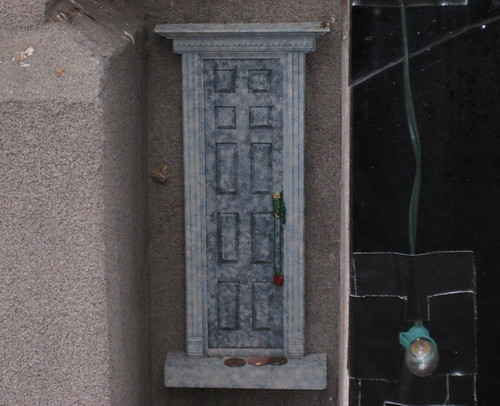
Steven Millhauser's brief but powerful story "The Other Town," which is included in his new collection, Dangerous Laughter (2008), tells of a town that for centuries has lived across a woods from an unpopulated exact replica of itself. The origin of the replica is unknown, but in the flush latter-day of the story, it has become a combination of theme park and obsession, supported by tax dollars and run with the guarantee that any change, however minor, in the physical details of the primary town will within two hours be mirrored in the other town. (Techniques that will allow for instant replication are rumored to be just around the corner.) Ruminating on the value of the other town, the narrative voice--which is, as so often in Millhauser, an unnamed collective of town opinion--offers the following justification:
The real value of the town . . . lies in the way it permits us to see our own town more clearly or completely. Preoccupied as we are with domestic and financial cares, we pass through our lives noticing so little of what's really around us that we might be said to inhabit an invisible town; in the other town, the visible town, our attention is seized, we feel compelled to look at things closely, to linger over details that would otherwise fail to exist at all. In this way the other town leads us to a fuller or truer grasp of things.The passage makes for a nice capsule description of the effect of Steven Millhauser's stories as well: though his tales nearly always involve an element of the fantastic--or at least the improbable--they are so firmly grounded in our material world that they throw that world itself into sharp relief, reminding us even as they break from it that it, too, has dark corners and hidden secrets, roads not taken and doors never opened. At their best, Millhauser's stories combine the intellectual rigor of Borges, the whimsy of Calvino, and the exquisite prose of Nabokov; they conjure up our own world, so bright and detailed that we can no longer pass through it inattentively--and then they give it a little twist.
After a story, labeled as an Opening Cartoon, that hilariously explores the inner life of Tom-and-Jerry-style cartoon characters, Dangerous Laughter is divided into three sections that roughly correspond to Millhauser's three most common types of story, though shared elements run through all three: Impossible Architectures, Heretical Histories, and Vanishing Acts. Impossible Architectures, as the name suggests, is Millhauser at his most Calvino-esque: he writes on such topics as a craze for doming one's home, the aforementioned other town, or a tower stretching to heaven. Technology, once loosed, outstrips human ability to understand it--but the result, rather than a sci-fi dystopia, is most often simply an altered version of the reality we're used to: we are accommodating by nature, and the new situation quickly becomes commonplace.
Heretical Histories, on the other hand, offer us views of, as the narrator of the extremely good "A Precursor of the Cinema" says of its painter of inexplicably animated paintings,
a turn, a dislocation, a bold error, a venture into a possible future that somehow failed to take place.In these stories--which as a category would include his Pulitzer Prize-winning Martin Dressler (and his better, shorter, and very similar "The Dream of the Consortium")--we see the deepest logics of both art and capitalism worked out: everyone pushes always for more and better, more and better. In one story, fashion designers goad one another to ever-dizzier heights of absurdity, while in another an inventor in a Menlo Park-style laboratory presses onward in his quest to understand the sensation of touch. In both these categories of story, Millhauser's inventiveness is at the fore: he sinks a new idea deeply into the material reality we know already, then offers genuine, exhilarating surprises.
The last category, Vanishing Acts, is the least useful as a descriptive grouping--but the stories I would place there, based on what Millhauser has included under that name in this volume, are my favorites in his ouvre. Though they bring out Millhauser's richest, most lavishly descriptive language, they tend to be more restrained in their invention, more tied to our experience--but in a sense, that is where they derive their power. Most often, these stories are set in some vague post-World War II American towns--railroad towns, maybe bedroom communities, perhaps up the Hudson.
It is usually summer, and we are before the ubiquity of air conditioning, so windows are open and escape is so simple. We are also long before the Internet and its easy answers, or even, most often, television and its link to the world outside one's town. Word travels by rumor, and teenagers--a group that has just begun to be identified as such--occupy a liminal world of many questions and few answers. Parents are mostly absent, like in Peanuts, though we catch occasional glimpses of them; they're usually troubled, possibly fuzzed by the haze of the post-war pharmaceutical cornucopia. (I can imagine a whole series of counterstories, the tales of the parents--their parties and golf outings, their furtive affairs--that occur during the exact moments when Millhauser is taking us on the journey of the children. I suppose that's the land of Cheever, or Updike.)
That world seems clearly the land of Millhauser's own youth, in the way that Ray Bradbury's stories of small-town life refract his own upbringing--and there are times, especially when he uses the dangerous multiperson narrative voice, when Millhauser treads awfully close to the nostalgia that so often ensnares Bradbury. But he almost always avoids it, most often by reminding us of the mysterious power of the unknown--and, specifically, of the power of sex, simultaneously a force and an experience, seeming at times the only real divide between the fading pleasures of childhood and the still-mysterious world of the grown-ups. The best story in Dangerous Laughter, "The Room in the Attic," traffics almost wholly in sublimated sex, ratcheting up the tension as day after day the narrator spends hours sitting in a darkened attic room playing games of "guess what's touching you" with the never-seen sister of his best friend.
For all the worries and often-frustrated desires expressed in these stories, the best of them--such as the novella Enchanted Night (1999) and "A Game of Clue," from The Barnum Museum (1990)--also serve to remind us of that feeling (occasionally still available to us, but common when we were teens) that the world really does offer myriad possibilities, and its mysteries can be construed as inherently romantic.
Not all of Millhauser's stories work, even in this strong collection. Both the aforementioned story about fashion and another, "The Disappearance of Elaine Coleman," never quite overcome relatively banal premises, while "Dangerous Laughter," about a craze for unrestrained laughter that sweeps a town's youth, mostly lies dead on the page, its central conceit never coming to life. Yet even the failed stories offer shining prose and the occasional memorable insight. "Dangerous Laughter," for example, offers us the following, once the teens' passion for laughter has turned to its opposite, a rage for tears:
The pleasures of weeping proved more satisfying than the old pleasures of laughter, probably because, when all was said and done, we weren't happy, we who were restless and always in search of diversion.Perhaps it's that relentless search for diversion that unifies all of Millhauser's stories: it drives the capitalists and inventors, the artists and their audiences, and of course the teens. Change, innovation, new experience are all inherently seductive--and Millhauser shows us both that seduction and its consequences: the loss of control, the loss of certainty, the loss, even, of oneself. And then, with his lush prose and his endless inventions, he seduces us again and again regardless.


