Showing posts with label Stephen King. Show all posts

Tuesday, October 14, 2014

Tidbits of Lovecraft, Poe, and Stephen King


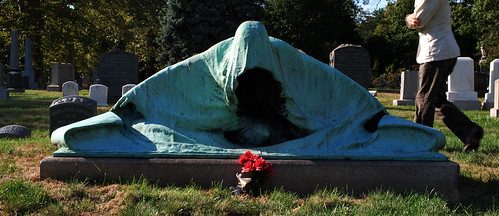
{Photo by rocketlass.}

On this sunless day, lashed by the first true rains of autumn--the ones that test the tenacity of the lingering leaves and remind you, through their insidious chill, that you're nothing but bones, cold bones, under your skin, let's have a post about Lovecraft and Poe.

As anyone who follows me on Twitter knows, I spend a lot of time reading writers' letters. What you may not know is that a lot of that reading begins with searches on Google Books: I'll go to a volume that's set up for previewing and see what I find through a search for a particular term. Often, the choice is topical: lately it's been "autumn," for example, or "night," or "ghosts."

Last night found me with Lovecraft's letters, and even though they're only readable in snippet form on Google Books, the returns were satisfying. "Weird," for example, brought me this pithy statement of purpose:
The weird artist should invent his own fantastic violations of natural law.
"Strange" turned up this:
The way I think of strange phenomena and outside intrusions is as a dreamer helplessly and passively watching a panorama flit past him.
"Nightmare," meanwhile, brought a letter in which Lovecraft describes in great detail a particularly horrible nightmare from childhood, one so intense that it led me to dig deeper and turn up more of the letter, which was written to Harry Otto Fischer in February of 1937:
But it is in dreams that I have known the real clutch of stark, hideous, maddening, paralysing fear. My infant nightmares were classics, & in them there is not an abyss of agonising cosmic horror that I have not explored. I don't have such dreams now — but the memory of them will never leave me. It is undoubtedly from them that the darkest & most gruesome side of my fictional imagination is derived. At the ages of 3, 4, 5, 6, 7, & 8 I have been whirled through formless abysses of infinite night and adumbrated horrors as black & as seethingly sinister as any of our friend Fafhrd's « splatter-stencil » triumphs. That's why I appreciate such triumphs so keenly. I have seen these things ! Many a time I have awaked in shrieks of panic, & have fought desperately to keep from sinking back into sleep & its unutterable horrors. At the age of six my dreams became peopled with a race of lean, faceless, rubbery, winged things to which I applied the home-made name of night-gaunts. Night after night they would appear in exactly the same form — & the terror they brought was beyond any verbal description. Long decades later I embodied them in one of my Fungi from Yuggoth pseudo-sonnets, which you may have read. Well — after I was 8 all these things abated, perhaps because of the scientific habit of mind which I was acquiring (or trying to acquire). I ceased to believe in religion or any other form of the supernatural, & the new logic gradually reached my subconscious imagination. Still, occasional nightmares brought recurrent touches of the ancient fear — & as late as 1919 I had some that I could use in fiction without much change. The Statement of Randolph Carter is a literal dream transcript. Now, in the sere & yellow leaf (I shall be 47 in August), I seem to be rather deserted by stark horror. I have nightmares only 2 or 3 times a year, & of these none even approaches those of my youth in soul-shattering, phobic monstrousness. It is fully a decade & more since I have known fear in its most stupefying & hideous form. And yet, so strong is the impress of the past, I shall never cease to be fascinated by fear as a subject for aesthetic treatment. Along with the element of cosmic mystery & outsideness, it will always interest me more than anything else. It is, in a way, amusing that one of my chief interests should be an emotion whose poignant extremes I have never known in waking life!
To some degree, that letter helps me understand Lovecraft's preference for the inchoate and indescribable--the horror beyond human comprehension--because what are dream terrors if not embodiments of horror that cannot be described without surrendering their potency?

Earlier in that letter, Lovecraft also offers an account of how he turned his childhood fear of the dark into a fascination:
In infancy I was afraid of the dark, which I peopled with all sorts of things; but my grandfather cured me of that by daring me to walk through certain dark parts of the house when I was 3 or 4 years old. After that, dark places held a certain fascination for me.
I will admit to a certain skepticism about the grandfather's approach, which seems needlessly cruel. It does, however, seem to have worked--to the extent, that is, that you consider Lovecraft to have been mentally healthy. Ahem.

With Lovecraft on my mind, I turned to Michael Schmidt's gargantuan The Novel: A Biography, a book that I've taken such pleasure dipping into and arguing in the month I've owned it that I already know I'll be pulling it down from the shelves regularly for years to come. Schmidt treats Lovecraft briefly, largely as an entree to a slightly longer consideration of Stephen King ("His bibliography is vast, but the novels are generally substantial and serious in intent.") and in conjunction with Poe, and in a short space he offers some useful analysis:
Poe can still frighten a reader, especially late at night. It has to do, as Nabokov understood, with language, with the spaces that vowels carve out of the darkness and the way night loosens the hold of the literal world so that things move and happen in unanticipated ways. Shadows detach from their forms and develop a will. Poe and Lovecraft have much in common. Like Poe's, Lovecraft's favored medium is the tale, not the novel. Poe worked by a faultless instinct, Lovecraft sometimes willfully and by design. He is more interested in places than people, places with inherences; there is a general haunting about his worlds, which start as literal and then degrade. Gothic horror inheres, an aspect of reality, "cosmic" to use his word, rather than of invention.
When he points out Lovecraft's attachment to place over person, it instantly seems obvious, yet I've never before seen it put quite so succinctly.

It's worth briefly setting that--and Lovecraft's interest in the cosmic nature of horror in general--against Schmidt's analysis of Stephen King's approach:
Central to fiction is a simple paradigm, what King calls in an interview "an intrusion of the extraordinary into ordinary life and how we deal with it." What interests him is not the mechanics of the intrusion--ghouls, rabid dogs, ghosts--but what the characters do in response.
Exactly--and watching those responses, and realizing how strong is King's faith that somewhere along the line someone will respond with the combination of grit and inherent goodness that is required to beat back the dark, accounts for a big part of King's appeal. There's no writer I know of, other than perhaps Dorothy Dunnett, who writes so convincingly about simple human determination, a quality that we all can use as autumn draws in.

Monday, October 22, 2012

Thirteen thoughts on reading Stephen King's It at thrity-seven, twenty-one years after I first read it

Spoilers, like ghouls, may abound in the too-long post below. Consider this your warning (about the former; as for the latter you're on your own. It's October, after all).

1 If you were a teenager diving into the work of Stephen King in 1990, two books towered over all his others: The Stand and It. There was an obvious reason: they were the biggest, easily, clocking in at 1,200 and 1,100 pages, respectively. But It loomed larger for a more important reason: where The Stand was freaky, mind-bending, and extravagant, It was scary. Everyone you knew who'd read it said it was the scariest book they'd ever read. Including your sister, who knew scary books. So you devoured it. And it was.

2 All these years later, I retain an acknowledged soft spot for King. Oh, all the people who take to book review and op-ed pages, real or virtual, every couple of years to rehash the now-tired complaints about him have plenty of points. In fact, they're usually right about most of the details of their critique. HIs prose can be clunky, even laughably shoddy at times. He is unabashed about going for the gross-out. His dialogue is often terrible. But in at least eight or ten books, that doesn't matter a whit, because they simply work: these are machines designed to frighten you, and, teen or adult, they do.

3 One critique that the genre-guarding op-ed tut-tutters never seem to make is that King isn't funny. But he isn't--and he thinks he is. I bet he's funny (in a goofy uncle sort of way) in person, but on the page his jokes, usually found in dialogue, fall completely flat, barely eliciting a groan. As someone who prizes comedy in novels, I'm surprised again and again by how often King makes what he obviously thinks are jokes . . . and how hard it is to imagine even him actually laughing at them.

4 I remembered It being the scariest book I'd ever read. More than two decades later, it's still scary. The opening--which in the afterword to Cemetery Dance's twenty-fifth-anniversary edition King says he came up with only after figuring out the basic contours of his story--remains incredibly effective. What could be more terrifying than for a boy, having summoned up enough bravery to look into a storm drain--already a source of visceral fear of a non-supernatural sort--to see something alive down there? And to have that something be a clown? A clown who knows his name? We've all known about Pennywise for so long now that it's hard to imagine just how effective that first appearance must have been; even with foreknowledge, the scene remains satisfyingly chilling.

5 That scene--and especially the vicious, animalistic physical violence of Pennywise's attack when it comes--looms over the rest of the book, which, contrary to my memories, never quite reaches that level of fright again. And it's in part because of a relative lack of physicality: Pennywise and It spend most of the book tormenting the characters through visions rather than physical danger. Some of the visions (fortune cookies that spurt blood, for example) are plenty creepy, but for much of the book it's hard to believe the characters are in any physical danger. Whether it's because I'd encountered them before, or because I'm older and less susceptible, the visions simply weren't as frightening as I'd remembered.

6 One aspect of the book, however, is much more interesting when read in adulthood: that it all starts with a bunch of people in their late thirties receiving a phone call telling them it's time to make good on a promise that's now twenty-seven years old--a promise that, until that second, they don't remember at all. Once remembered, however, it has an irresistible power, drawing them inexorably back into the fight they thought they'd finished when they were teens.

That set-up allows King to cut back and forth between the heroes fighting It as eleven-year-olds and their struggles to work up the emotional, intellectual, and physical strength and courage to fight him again as adults. It's an incredibly effective way to dramatize the book's true themes of the difficulties of growing up and the surprising power and resilience that we have, even if we may not realize it, when we're children. It also can't help but draw us in: is there any way of being sure that we didn't make a similar promise at some point in our youth? Any way to know that we won't ever receive such a phone call?

7 In the afterword to the Cemetery Dance edition, King writes explicitly about that theme:
I worked on the book in a dream. I remember very little about the writing of it, except for the idea that I'd gotten hold of something that felt very big to me, and something that talked about more than monsters. To me, It has always been a book about making the terrible transition over the bridge from childhood to adulthood (it's no accident that the final act Bill and his friends perform as child heroes is sexual).

8 The end of that quote alludes to the moment in the book that was, when I first read it, the most shocking: when the teens, in order to seal their bond and be able to defeat it, have sex. Teenage me, you might imagine, didn't really know what to make of that, and it bulked hugely in my memory for more than twenty years. But when I returned to the book as an adult, I found that the scene passes quickly, important but not outsized, in the midst of a number of surprise and struggles. Is it just that I already knew about it this time around, or is it nothing more than a function of being older? (I've also long wondered what that scene is like for a woman to read rather than a man--since King is a man and all but one of the characters is a boy, there is an imbalance that even the teenage me found uncomfortable.) Its inclusion is a strange, gutsy, and, yes, uncomfortable decision, but it doesn't color the whole novel the way it did when I was a teen.

9 That said, the ending overall, which I'd remembered being disappointing, like so many of King's endings, actually worked much better for me this time around. When I was a teen, what I wanted was a clear, complete explanation of who and what Pennywise and It were. (Much like at the same age I wanted an explicit, numbered list of Spenser's rules for living from Robert Parker.) To find that they were essentially ancient, cosmic concepts that are almost incomprehensible was a disappointment. Older, more prepared to accept that some, if not most, things are ultimately inexplicable, I didn't find myself minding it at all.

10 Elsewhere in the afterword to the Cemetery Dance edition, King explains why he decided to make It manifest itself in familiar horror movie forms:
I began thinking about the differences between our childhood fears--monsters, abandonment, monsters, mistreatment, monsters, bullies, monsters--and our more mundane adult fears, like whether or not our job's insurance program covers dental. It seemed to me that we forgot the vividness of those childhood fears as we grew to adults, which might make us uniquely vulnerable to them if they ever came back . . . not as the shadows of tree-limbs on the wall or an imagined movie-poster monster in the closet, but as real things.
The Lovecraftian idea of the mind broken by a horror too great for it to comprehend is a powerful one, and King plays nicely with the different ways that might work with the very different minds of adults and children. One thing I would find hard about parenting, if I had to do it, would be that: the realization that children's fears are as real and powerful as any of our own--more so, perhaps--and that there's only so much we can do to allay them. And, more to King's point, that if we had, as adults, to deal with the uncertainty, powerlessness, and sheer vivid imaginative malleability of our young lives, we just might snap.

11 King has long been obsessed with childhood, as are many imaginative writers, but It is, I think the place where he makes the best use of it (with, perhaps, the exception of "The Body"). What's long puzzled me--and perhaps should be the subject of a standalone post--is the power of his nostalgia. As a child of the late 1970s and early 1980s, I don't have it at all. I have fond memories of family and friends and experiences, but I'm under absolutely no illusions that things were better, or more interesting, then. King, though . . . well, I wonder. He's obsessed with the rock music of that period, for example, seeming to still view it as a liberating force. Then there are bicycles and bullies and rock fights and and muscle cars and exploring and all the other incidentals of childhood, all seen through a relatively rosy haze. And that nostalgia started early--he wasn't even forty when he wrote It. Is this a generational trait or a personal one?

12 Speaking of generational traits: one strange omission in It is Vietnam. King cleverly comes up with the idea of all his heroes being childless--a penalty, they only later intuit, for their first victory over It. But while he sketches out their lives between 1957 and 1984 in some detail, Vietnam doesn't, if I remember correctly, come up at all. Yet they should have lost friends and family members, felt the fear and horror of it themselves. It's an odd omission, and I can't figure out whether it's intentional.

13 King's generation is famously skeptical of authority. That skepticism not infrequently verged into paranoia--a paranoia that, while understandable, makes some cultural products of the late 1960s and early 1970s tough to take nowadays, when we live in a more open, if no less easy, relationship with the darker aspects of our society, our government, and our elders. That paranoia underlies much of It, in the sense that the town itself, through its silence, is complicit in the horrors of its history.

But to me what feels more powerful, and much more frightening, is the sense of the ancient nature of the evil. We are but small people in a vast cosmos, and out there somewhere in that vastness there are powers. We rile them at our risk.

Wednesday, June 06, 2012

Some disorganotes on the will and willpower

I've been thinking a lot lately, in a completely disjointed way, about the will and willpower. It's something that's never too far from my mind: for twenty years I've been running every other day, almost without fail, and I'm still regularly astonished at the interaction between my will and my physical capacities. I'm just going to keep going, I tell myself, and unless I've been operating at the limits of my abilities for hours--near the end of a marathon, say--my body finds the reserves it needs to obey. The interplay between will and body is as mysterious, and rewarding, as almost anything I know.

Of course one of the reasons we care about sports is because of the hyper-focused lens they offer through which to think about the less clear-cut challenges we face in everyday life. Thus, some jottings on will in sports and elsewhere.

1 It started with Sergio De La Pava, whose stunning essay "A Day's Sail," on boxing and Virginia Woolf, published in Triple Canopy last year, is as much about will and determination as anything. That theme also comes through in A Naked Singularity, taking its most explicit form in the interpolated essay on the career of Colombian boxer Wilfred Benitez. In an interview for the blog of Elliott Bay Books in Seattle De La Pava explained why he's drawn to boxing:
Boxing, when functioning properly, is the best vehicle I know of for the mass representation of a particular human’s naked will; what we gain from that is the result of extrapolation, because we need previews of what happens when your flimsy trappings melt away and it’s just you against unfeeling constants.
In "A Day's Sail," De La Pava broadens that point:
If we’re to then talk about greatness in relation to this pursuit we’ll have to make a perhaps counterintuitive distinction right at the outset. Bach, Gould, Tolstoy, Woolf, are giants so we rightly turn to their work to experience greatness in their fields. Not generally so in boxing. A partial list of the pursuit’s giants is something like Louis, Robinson, Ali, Duran, and Armstrong. All brilliant, all have signature moments, but with the exception of Ali’s “Thrilla in Manila” none can match moments produced by far lesser personages. The reason is that two individuals in a boxing ring are fighting, and greatness there seems less a product of skill and talent than of concepts like will and tenacity—precisely the attributes you’ll need, not skillful intelligence, if diagnosed with cancer for example.
2 The summer I was twenty-three and first working in a Stateside bookstore, the first job I'd ever had that didn't have a definite end point--graduation, expiring work permit, etc.--I played a lot of basketball. Probably four nights a week I was out on the court, sometimes with friends, sometimes with strangers. Up that point, I'd barely played basketball at all. And I wasn't good at it, by any means. I'm short, first of all, and, second, while it's amazing what a lot of practice can do, you're never going to be skilled at a sport as difficult as basketball if you don't really start playing until your twenties.

But I loved it--and what I loved was exactly what De La Pava's saying about boxing above: more than any other team sport I'd played, it was about willpower and tenacity. I couldn't shoot, could barely dribble, but despite my height I could guard and was a strong rebounder--solely because I was unwilling to give up, unwilling to give ground, unwilling to stop working. Even now, when I don't really play any more, I get viscerally excited when I watch the pros playing great defense. They're so much better than me and anyone I played with that they might as well be playing a wholly different sport--but nonetheless there's a look in their eyes that's familiar, and thrilling.

Tom Ley wrote well about willpower and basketball for Deadspin the other day in an article about how Rajan Rondo was almost singlehandedly keeping the Celtics alive--despite being far from the best player on the floor. Ley writes,
Fans and writers love to talk about players "rising to the moment" or playing their best when the "lights are brightest." All of that talk us is usually bullshit. Nobody really has any idea what's going on inside the mind of an NBA player during the course of a game. Whether he is embracing the moment or scared shitless is hardly ever discernible.
And then he goes on to tell about a moment in the previous night's game where Rondo, facing down the best player since Jordan, made clear what was in his mind--and that it was all fight:
[H]e found himself defending LeBron James at the top of the three-point line as the fourth quarter was coming to an end, score tied at 99. Rondo stared James down and screamed, "Let's do it!" at him.
Willpower = swagger = the Celtics are still alive. Man, I love sports. It's worth clicking through to Deadspin to watch the clip of that moment--the look in Rondo's eyes is indescribable.

3 On the non-sports front, I keep thinking of LBJ. In the second volume of his four-and-counting-volume biography of Lyndon Johnson, Robert Caro focuses on the 1948 Senate race. Early on, Caro reminds us of what LBJ drummed into his assistants:
If you do everything, you'll win.
In the 1948 campaign, that meant staying on the trail for weeks while suffering what ought to have been debilitating pain from kidney stones, shaking hand after hand despite his own being cracked and bleeding, and maintaining a schedule that wore out assistant after assistant. Writes Caro,
Dorothy Nichols was to be asked what she remembered about the 1948 campaign. "Three hours of sleep," she would reply. Three hours of sleep--or less.
Johnson slept even less:
Even when he was supposed to be resting, they came to realize, he wasn't. At the noon rest stop, Lyndon Johnson would indeed get into bed. But when someone came to waken him after an hour or so, he would almost invariably be awake--awake and ready with a long list of things to be done, things he had thought of during the hour. He had been "on the phone the whole time," Mrs. Nichols would say, or "he had somebody--local people or somebody on the staff--in there planning."
Aide Ed Clark put LBJ's relentless drive in perspective:
"I never saw anyone campaign as hard as [Johnson had in his 1937 campaign.] I never thought it was possible for a man to work that hard." If that campaign had been Johnson's main chance, this campaign, the 1948 campaign, might be his last chance. Was 1937 the hardest Lyndon Johnson ever worked? Ed Clark would be asked. "Oh, no," Clark said. "In 1948, he worked harder."
There is a lot about LBJ to dislike and disapprove of, and Caro's impressively nuanced portrait doesn't stint on revealing it. But his tenacity and willpower remain awe-inspiring--and just plain inspiring--throughout.

4 And finally to novels. I know of no authors who write better about physical exhaustion, and our ability to will ourselves beyond it, than Stephen King and Dorothy Dunnett. In book after book, their heroes are battered and bloodied and driven to exhaustion, but at the moment when the temptation to give up is greatest, they choose to fight on.

In King Hereafter Dunnett writes of a worn-out King Thorfinn's response to hearing that the day's battle has gone terribly against him:
To weep would solve nothing, or to fall into panic, or to obey the heave of the belly, the sudden gripe of the bowel, that came not only to messnegers.

But above belly and bowel was a controlling head.
Later, in a break in the battle, he pauses:
In action, you felt almost no pain at all. Out of action, you did.
And wounded, he fights on and leads his men on, beyond weariness, trying to protect his kingdom and his family.

King's heroes tend to be ordinary people thrust into horrors, Dunnett's extraordinary men driving themselves beyond exhaustion as they take on responsibility for the lives and safety of everyone who comes into their orbit. King aims to shock and surprise and terrify, Dunnett to entertain--but underlying the work of both writers is a simple but powerful theme: the body, damaged and broken as it may be, takes orders from the mind--and so long as those orders are to keep fighting, you haven't lost yet.

Monday, October 03, 2011

{Photos by rocketlass.} It's that time again . . . And where better to start our October journey than with Stephen King, a passage from Pet Sematary (1983):
It's probably wrong to believe there can be any limit to the horror which the human mind can experience. On the contrary, it seems that some exponential effect begins to obtain as deeper and deeper darkness falls--as little as one may like to admit it, human experience tends, in a good many ways, to support the idea that when the nightmare grows black enough, horror spawns horror, until finally blackness seems to cover everything. And the most terrifying question of all may be just how much horror the human mind can stand and still maintain a wakeful, staring, unrelenting sanity That such events have their own Rube Goldberg absurdity goes almost without saying. That may be the point at which sanity begins either to save itself or to buckle and break down; that point at which one's sense of humor begins to reassert itself.
When King is at his best--as he is for large parts of the frequently terrifying Pet Sematary--he is remarkably convincing on that point, putting his characters under more and more pressure, stripping away one by one the defenses of disbelief and rationality, leaving them to confront the horror plain. Like no other writer I can think of except Dorothy Dunnett, he makes us believe in--and understand--just how far a person can keep going, keep pushing, keep fighting despite exhaustion, pain, injury, and loss. As Ambrose Bierce put it in "The Boarded Window,"
There is a point at which terror may turn to madness; and madness incites to action.
When the choice is to surrender to death or to keep fighting the impossible battle, King's characters choose to fight--a reminder that even as his books are about death and destruction and fear, he ultimately believes more in what's in the human than what's in the darkness.

Wednesday, November 17, 2010

Time, change, and the King

Last Saturday, I indulged my semi-annual desire to read Stephen King by sitting in our front room and reading Christine (1983)*, barely moving as the autumn day swept by, ever darker. Reading King is in a lot of ways the closest I can get to feeling like I’m back in high school, as if I have all the time in the world and there’s nothing better I can do with it than immerse myself in his world and watch the pages fly by.

Back then, I was reading to be scared. And while King at his best can definitely still scare me, I usually find myself more interested in the way he connects our fears to everyday life, and the way that he relies on a well-realized background of ordinary life to simultaneously ground his horrors and throw them into sharper relief. The premise of Christine--evil spirit possesses a teenager through an indestructible ’58 Plymouth Fury—is among his most ridiculous, but it works, primarily because the larger story (and the real fear that underlies it) is about the way that adolescence wreaks havoc with what we oh-so-temporarily thought was a settled world. The narrator realizes that he’s losing his best friend to the car—and its supernatural powers—but it’s impossible for an adult reader not to also see the loss as an allegory for any of the changes that tear friendships apart, from relationships to religion to, looming largest in this case, addiction. (Yet at the same time, one thing that I admire about King is that he never surrenders to his allegory, never lets it detract from the actual horror he’s trying to put across. Sure, the automotive possession in this case may be an allegory for addiction, but it’ll still smear you across the pavement if you don’t watch out.)

Is there any other point in our lives where we’re simultaneously so future-oriented and so unable to look beyond the present moment as in high school? We know we’ll eventually be leaving all this behind, yet at the same time we can’t imagine life without these friends, these trappings, our selves as they are right this minute. And, as someone who seems to never have forgotten what it was like to live through high school, King gets it. He describes high school in Christine as a very conservative place underneath the surface glitz, with most high school students, deep down, being “about as funky as a bunch of Republican bankers at a church social.” He writes:
What's now is forever--ask any Republican banker and he'll tell you that's just the way the world ought to run.

High school kids and Republican bankers . . . when you're little you take it for granted that everything changes constantly. When you're a grown-up, you take it for granted that things are going to change no matter how much you try to maintain the status quo (even Republican bankers know that--they may not like it, but they know it.) It's only when you're a teenager that you talk about change constantly and believe in your heart that it never really happens.
Christine was marvelously exciting; I blew through the last fifty pages of it with barely a blink. But what I’ll remember from it is that passage, that reminder of just what it was like to live that often-unrecognized high school contradiction.

All of which is a long preamble to a notice that tomorrow marks five years since I started this blog. Growing up, we get used to measuring out life in four-year chunks: get through high school to go to college, get through college to . . . and then the four-year chunks stop. The easily sliced-up and labeled chunks of any kind stop. The years pile up—pleasantly, but with a sometimes disturbing quiet and rapidity, too.

So occasionally it’s good to be reminded that once upon a time, four years seemed like an eternity, five years nigh unfathomable. For any of you who’ve been reading this blog that long, please accept my thanks. Newer readers have my thanks as well. If I’ve drawn you to a book or two you’ve enjoyed, then I’ve not been wasting my time.

Wednesday, October 28, 2009

"It was only during the age of candlelight that the race of ghosts really flourished," or, Edmund Wilson as uncanny anthologist

Since first discovering the giant Modern Library anthology Great Tales of Terror and the Supernatural last fall, I've admired it as much for its timing as for its quality: it was published in early 1944, when the war, though going far better than it had been a few years before, was still a long way from being over. I love picturing editors Phyllis Cerf Wagner and Herbert Wise drawing up a list of stories, followed by the staff at Random House diligently securing permissions, then designing and printing the book--all with the aim of putting a bit of a supernatural scare into people who had plenty of entirely natural dangers to scare them.

But seemingly the editors knew what they were doing--or at least they weren't alone in the publishing world in thinking that readers might find eerie tales a welcome distraction: on turning to Edmund Wilson's review of the book in the May 25, 1944 issue of the New Yorker* (from which the current edition of the book takes his quote praising "a sudden revival of the appetite for tales of horror"), I discovered the review was occasioned by the publication of no fewer than six volumes of this sort that spring: The Pocket Mystery Reader, The Pocket Book of Mystery Stories, Tales of Terror (with an introduction by Boris Karloff), Creeps by Night (edited by Dashiell Hammett), Best Ghost Stories of M. R. James, and this "prodigous anthology," which Wilson rates as "the best of them" because it is so comprehensive and "not unintelligently edited." Wilson does, however, note that it suffers from
the fault of so many American omnibuses and anthologies of being too cumbersome to handle in bed, the only place where one is likely to read ghost stories.
Perhaps I shouldn't be surprised, looking back, that the public displayed such a taste in the depths of the war. Wilson offers a straightforward explanation that remains convincing all these years later:
First, the longing for mystic experience, which seems always to manifest itself in periods of social confusion, when political progress is blocked: as soon as we feel that our own world has failed us, we try to find evidence for another world; second, the instinct to inoculate ourselves against panic before the real terrors loose in the world--the Gestapo, the G. P. U., tank attacks, bombing from the air, and empty cities mined with booby traps--by injections of imaginary horror that soothe us with the momentary illusion that the forces of madness and murder may be tamed and compelled to provide us with a mere dramatic amusement.
Beyond this general observation, Wilson barely bothers to treat the books under consideration in his review, except to say that, for all their merits,
I find it very hard to imagine that any of these particular could scare anybody over ten.
Instead, he uses the anthologies as a launching pad for an sketching out of his own anthology of unsettling tales:
These collections, of course, aim primarily at popular entertainment; they do not pretend to a literary standard. But I should like to suggest that an anthology of considerable interest and power could be compiled by assembling some horror stories by really first-rate modern writers, in which they have achieved their effects not merely by attempting to transpose into terms of contemporary life the old fairy tales of goblins and phantoms but by probing psychological caverns where the constraints of that life itself have engendered disquieting obsessions.
Had he lived long enough to read Stephen King, I expect Wilson would have hated his writing, but I think that as an anthologist he would have been alert to stories that define fear in the way that King did in his interview with the Paris Review in 2006:
I don't think there's anything that I'm not afraid of, on some level. But if you mean, What are we afraid of, as humans? Chaos. The outsider. We're afraid of change. We're afraid of disruption.**
The real fun comes, however, when Wilson starts putting names to the concepts:
I should start off with Hawthorne and Poe, who are represented in these collections, but I should include, also, Melville and Gogol, who are not. The first really great short stories of horror came in the early or middle nineteenth century, when the school of gothic romance had achieved some sophistication and was adopting the methods of realism. All four of these writers wrote stories that were at the same time tales of horror and psychological or moral fables. They were not interested in spooks for their own sake; they knew that their demons were symbols, and they knew what they were doing with these symbols. We read the tales of Poe in our childhood, when all that we are likely to get out of them is shudders, yet these stories are all poems that express the most intense emotions. "The Fall of the House of Usher" is not merely an ordinary ghost story; the house--see the opening paragraph--is an image for a human personality, and its fate--see the fissure that runs through the wall--is the fate of a disrupted mind. And as for Gogol, he probably remains the very greatest master in this genre. I should put in at least "Viy" and "The Nose"--the former, a vampire story, one of the most terrific things of its kind ever written, and the latter, though it purports to be comic, almost equally a tale of horror, for it is charged with the disguised, lurking meaning of a fear taking shape as a nightmare.
I'm a bit surprised that he rates Poe's lush, overheated prose so highly (though admittedly "Usher" is one of those rare Poe productions with which it's hard to find any fault), especially when he later damns Arthur Machen, arguing that his story "The Great God Pan"
seems to me to sum up in a fatal way everything that was most "ham" in the aesthetic satanism of the fin-de-siecle.
Still, it's hard to argue with Wilson's list thus far: Hawthorne's explorations of the dark underbelly of public rectitude are foundational for American strange tales, Poe's influence is inescapable, and Melville and Gogol are at their most memorable when they're at their most strange. Later, Wilson adds Conrad, Kipling, Henry James***, Robert Louis Stevenson, Algernon Blackwood, and Walter de la Mare, before finally closing with Kafka, who writes
at the same time satires on the bourgeoisie and visioins of moral horror; narratives that are logical and compel our attention and fantasies that generate more shudders than the whole of M. R. James and Algernon Blackwood combined. A master can make it seem more horrible to be pursued by two little balls than the spirit of a malignant Knight Templar, and more natural to turn into a cockroach than to be bitten by a diabolic spider.****
Wilson, in other words, does a fairly good job of setting the tone of his anthology, and even though none of his authors would come near qualifying as going out on a limb, the review nonetheless makes me wish he'd followed through on this idea; I would enjoy seeing how he'd flesh out the anthology.

All of which leads me to a question: where would you start if you were to compile an anthology of strange, uncanny, and/or supernatural tales? What authors would you have to include? Any you would exclude on principle?

For me, I think it would have to start with Ray Bradbury, whose unsettling mix of nostalgia and dark secrets has troubled me ever since childhood--and, I think, would have pleased Wilson (if he could get beyond Bradbury's occasionally overwrought prose); I'd probably try one of the stories from The Martian Chronicles, which I could assure Wilson--were he to pop up on the Ouija board some October night--are very much capable of frightening reasoning adults.

And for you?

Tuesday, November 18, 2008

Anniversaries

Three years ago today I wrote the first post at I've Been Reading Lately. Nearly six hundred posts later, I can't think of a better way to mark the anniversary than to commemorate another, more impressive milestone: the publication of the fiftieth book under the Hard Case Crime imprint.

I discovered Hard Case Crime the same way a lot of readers did: through the extensive coverage of their publication of Stephen King's The Colorado Kid, which was the subject of one of my first posts. Three years and thirty-seven books later, I still look forward to the arrival of each month's new title in my mailbox.

The fiftieth book, Fifty-to-One, by founding editor Charles Ardai, starts with the ingenious premise that the occasion is the fiftieth anniversary of Hard Case Crime, and it follows the adventures of the line's founder, Charley Borden, along with a dancing girl from South Dakota newly landed in the big city and the mobsters on whose wrong side--a mile wide, unsurprisingly--they soon find themselves.

In addition, Ardai has given his novel another twist: it consists of fifty chapters, named after (and related to) the titles of each of the books in the series. Being familiar with the series, I found myself looking forward to how this Oulipian conceit would force Ardai to figure out ways to finagle his way around such unpromising titles as A Diet of Treacle, Lemons Never Lie, and Grave Descend; I particularly liked his solutions to David Dodge's Plunder of the Sun and the Robert Bloch two-fer Shooting Star/Spiderweb.

But the rules Ardai has set for himself are only part of the fun. As a celebration should, Fifty-to-One feels like a book that was as much fun to write as it is to read. Its ramshackle charms remind me of nothing so much as late-1930s Hollywood movies, wherein you get the sense that the filmmakers threw in everything they thought their audience would enjoy and assumed they'd keep up with the plot. Gunplay, romance, sharp dialogue, character actors--it's all here, along with a heist, some bookies, the FBI, and more. The heroine plays like a more innocent Barbara Stanwyck (which would make her, what, Claudette Colbert?), and the baddies arrayed against her could surely accommodate Edward G. Robinson and Sydney Greenstreet; meanwhile, Ardai has resisted the urge to cast the series's founder as a flawless, lantern-jawed leading man, leaving him instead in the nebbishier reaches of the previously unexplored nexus between Ugarte and Han Solo.

As the pleasantly wild plot ticks through its surprises, we're also treated to a loving reconstruction of the seedier side of 1958 New York City, its racetracks and nightclubs, subways and taxicabs--Ardai even takes a few well-deserved shots at evil old Robert Moses. The most fun, though, are the cameos, from an violent Mickey Spillane to the wryly comic young writers Donald Westlake and Lawrence Block, who serve as a sort of pulp Bert and Ernie--or, more accurately, Ernie and Ernie.

Unapologetically a romp, Fifty-to-One carries none of the seriousness or psychological weight of the novels Ardai has written under the pen name of Richard Aleas, the second of which, Songs of Innocence, is one of the best crime novels I know. But it's a sheer joy to read, and a worthy celebration of a series that has brought me countless pleasure over the past three years.

Congratulations on reaching fifty, Hard Case. Here's to fifty more good years to come.

Tuesday, October 30, 2007

"The gruesomely conscious realm of ghostly fear and cold terror," or, The Haunted Commonplace Book!


{Resting, London. Photo by rocketlass.}

From a gravestone in Norfolk churchyard, collected in Everybody's Book of Epitaphs, W. H. Howe, editor
Underneath this sod lies John Round
Who was lost in the sea and never was found.

From Jean-Claude Schmitt's Ghosts in the Middle Ages: The Living and the Dead in Medieval Society (1994, 1998 translation by Teresa Lavender Fagan):
Historians and ethnologists commonly speak of a "belief in ghosts." But what does this really mean, and how can the historian ascertain past beliefs? One of the recent advances in the "anthropology of beliefs" is to question the ill-considered uses of the notion of "belief." We must be careful not to reify belief, to turn it into something established once and for all, something that individuals and societies need only express and pass on to each other. It is appropriate to substitute a more active notion for the term "belief": the verb "to believe." In this way a belief is a never-completed activity, one that is precarious, always questioned, and inseparable from recurrences of doubt.

That seems in keeping with Shirley Jackson's argument, in the lecture I quoted from yesterday, that even those of us who claim not to believe in ghosts are a quick glimpse in the wrong direction away from changing our minds. We don't believe, but . . .

From the entry for "ghost" in David Pickering's Cassell's Dictionary of Superstitions (1995):
Measures that may be taken against encountering ghosts include, according to Scottish tradition, wearing a cross of Rowan wood fastened with red thread and concealed in the lining of one's coat.

From "Mujina" by Lafcadio Hearn, collected in Kwaidan: Stories and Studies of Strange Things (1904):
Then that O-juchu turned round, and dropped her sleeve, and stroked her face with her hand, ;--and the man saw that she had no eyes or nose or mouth,--and he screamed and ran away.

From "The Banshee," in Jorge Luis Borges's The Book of Imaginary Beings (1967, 2005 translation by Andrew Hurley):
No one seems ever to have seen one. They are less a shape than a wailing that lends horror to the nights of Ireland and (according to Sir Walter Scott's Letters on Demonology and Witchcraft) the mountain regions of Scotland. Heard outside one's window, they herald the death of some member of the family.


{Weeping girl in Cemetiere Mont-Royal, Montreal. Photo by rocketlass.}

Most of us skeptics these days ground our rejection of the concept of ghosts not so much on our not having seen one but on basic rationality. The efforts of William James and his colleagues to find proof of spirit manifestations were, after all, a bust, and no verifiable evidence has emerged since. Rationality, therefore, demands that we at the very least put ghosts in the category of unlikely. And yet, the sun still goes down, and the autumn nights still carry their unsettling chill . . .

From Jean-Claude Schmitt's Ghosts in the Middle Ages (1994, 1998 translation by Teresa Lavender Fagan):
A persistent yet somewhat ambiguous and contradictory refusal to admit the possibility that the dead might return in dreams or perhaps in conscious visions characterized the ecclesiastical culture of the early Middle Ages. . . . In a religious way of thinking long fragmented by a fundamental dualism--the antagonism between the devil and the saints, between the phantasmagorias of the former and the controlled apparitions of the latter--there was very little room for ghosts or for the oneiric and ambivalent revelations of ordinary dead people.

From D. J. Enright's introduction to the "Loving Revenants" chapter of The Oxford Book of the Supernatural (1994):
That these visitors rarely convey a message of much overt significance has found its reasons. What motivates them rather than the delivery of urgent intelligence is the natural desire to glimpse their children, their loved ones, to revisit places where they lived or worked (a pantry, a library, an altar), returning, in the words of Hardy's poem, to where the living person "found life largest, best." Such appearances are more for the sake of the revenant, then.


{Gravestone of an aviator, San Michele Island, Venice. Photo by rocketlass.}

Of course, unlike most of human history--or for example, thinking back to yesterday's post, the years following World War I--now we are able to pass through our days with little thought of death. It's something that happens elsewhere, to other people. Such a denial makes every aspect of modern life easier, from conspicuous consumption to support for distant wars. Death no longer visibly stalks us, and though we know that means he'll ultimately sneak up and pounce us instead, we have become very good at denying that inevitability.

From Johan Huizinga's The Autumn of the Middle Ages (1921, 1996 translation by Rodney J. Payton and Ulrich Mammitzch):
No other age has so forcefully and continuously impressed the idea of death on the whole population as did the fifteenth century, in which the call of the memento mori echoes throughout the whole of life. Denis the Carthusian, in the book he wrote for the guidance of the nobleman, makes the exhortation that "when he goes to bed, he should imagine not that he is putting himself to bed, but that others are laying him in his grave." . . . . In the fourteenth century, the strange word "macabre" appeared, or, as it was originally spelled, "Macabré." "Je fis Macabré la dance," ("I made the Dance Macabre") says the poet Jean Le Fevr in 1376. It is a personal name and this might be the much disputed eytmology of the word. It is only much later that the adjective is abstraced from "le danse macabre" that has acquired for us such a crisp and particular nuance of meaning that with it we can label the entire late medieval vision of death. The motif of death in the form of the "macabre" is primarily found in our times in village cemeteries where one can still sense its echo in verses and figures. By the end of hte Middle Ages, this notion had become an important cultural conception. There entered into the realm surrounding the idea of death a new, grippingly fantastic element, a shiver that arose from the gruesomely conscious realm of ghostly fear and cold terror.

Ah, but us ghost story fans at least have October as our memento mori, our occasion for focusing our attentions on the fate we'll all share--and, while eschewing the comforts of religion, thinking on the possibility that it might not be the end after all.


{St. Boniface Cemetery, Chicago. Photo by rocketlass.}

From "The Girl I Left Behind Me" by Muriel Spark, collected in The Ghost Stories of Muriel Spark (1994):
I opened the door and my sadness left me at once. With a great joy I recognized what it was I had left behind me, my body lying strangled on the floor. I ran toward my body and embraced it like a lover.

From Edgar Allan Poe's "The Masque of the Red Death" (1842):
And now was acknowledged the presence of the Red Death. He had come like a thief in the night. And one by one dropped the revellers in the blood-bedewed halls of their revel, and died each in the despairing posture of his fall. And the life of the ebony clock went out with that of the last of the gay. And the flames of the tripods expired. And Darkness and Decay and the Red Death held illimitable dominion over all.

From Stephen King's Salem's Lot (1975):
It became unspeakable.

Wednesday, October 24, 2007

Have you checked the children?


{Photo by Odlandscape.}

Yesterday I used some lines from Michel Tournier's The Mirror of Ideas to describe adult fears. Later in that essay, Tournier notes,
The child walking in the dark comforts himself with a song. Jean Cocteau tells that when he tried this remedy, he ended up being terrified by the words he invented to the song.
Children's fears burgeon that way--kids aren't yet all that good at the sort of denial of unwanted thoughts that most adults master; they're not as good at coaxing their minds away from the things that have scared them. If adult fear is rooted in death, a child's fear is rooted in a more general not-knowing: the world is large and little-understood, even by a perceptive kid. There is much to fear.

Returning once more to the book that kicked off I've Been Reading Lately's ghost and monster week, 'Salem's Lot: Stephen King marks that distinction between children and adults, writing that adult fears are
pallid compared to the fears every child lies cheek to jowl with in his dark bed, with no one to confess to in hope of perfect understanding but another child. . . . with the thing under the bed or in the cellar every night, the thing which leers and capers and threatens just beyond the point where vision will reach. The same lonely battle must be fought night after night and the only cure is the eventual ossification of the imaginary faculties, and this is called adulthood.
That openness to fear lines up, too, with the position held by many who actually believe in the supernatural that children are more open to and aware of the otherworldly. They haven't yet, the argument goes, set limits on which of their perceptions they're willing to accept, which to dismiss before they even reach the level of consciousness. Rebecca West, in The Fountain Overflows (1957), her somewhat autobiographical novel of growing up in a poor and talented family, allows her young characters some of that perceptiveness. For a few months the children live with--and maybe even psychically generate--a poltergeist. In another particularly striking scene, late at night in a deserted stables, the young narrator's sensitivity is nearly powerful enough to bring to life--even for her mother--the spectral horses she sees stamping and snorting in the stalls:
My mother's eyes moved to my face. The horses in the stalls became luminous shapes. We knew that if we willed it, if we made a movement of the mind comparable with the action of throwing all one's weight on one foot, we could make them visible as ourselves.
All of which returns me to my own story of seeing a ghost, about which I wrote last October:
I have no memory of it, but I've been told by my parents, no wild-eyed new-agers they, that it happened when I was three or four, while our family was being given a tour of a house in Colonial Williamsburg. I turned to my mother and, pointing to the empty corner of a room and said, "Look, Mommy--there's a ghost." The guide blanched and told my parents that the house was rumored to be haunted.

Even though it's not much of a story, and I don't remember a bit of it, that surely has to land me squarely in the large category of "I don't believe in ghosts, but . . . ."

I suppose one could keep far worse company than William James.

Monday, October 22, 2007

Premonitions and apparitions


{"The Ghost of Bernadette Soubirous," photographer unknown, circa 1890}

Too busy to do any real posting today, but in keeping with the Hallowe'en theme, how about a couple of warnings . . . (cue scary organ music) . . . of impending Death!

The first warning wouldn't have actually been all that helpful, taking as it did the form of barking. It's a memory of a story Thomas Hardy told publisher Sir Newton Flower, collected in Thomas Hardy Remembered (2007), edited by Martin Ray:
Here is an odd thing about [Hardy's dog] Wessex. One November night, William Watkins, who founded the Society of Dorset Men in London, went to call on Hardy after dinner, as was his custom whenever he was in Dorset. It was a night of wild storm. This is Hardy's story of the episode to me:

"For some reason Wessex rushed wildly round the house, growling and barking. He dashed at the front door; then came back again. Watkins and I opened the door, and Wessex ran out into the storm, still barking. I thought there might be marauders about, but we could find nobody. We came in; we got Wessex in. An hour later, Watkins, after a final cup of coffee, went back to his hotel in Dorchester, and died in his bed that night. What did Wessex know?"

Far creepier--though just as impossible to verify--is Alec Guinness's story, from Blessings in Disguise (1985), of meeting James Dean in Los Angeles; as with so many other stories this week, I owe D. J. Enright for including this one in his Oxford Book of the Supernatural:
[O]n the way back to the restaurante he turned into a car-park, saying, "I'd like to show you something." Among the other cars there was what looked like a large, shiny, silver parcel wrapped in cellophane and tied with ribbon. "It's just been delivered," he said, with bursting pride. "I haven't even driven it yet." The sports-car looked sinister to me, although it had a large bunch of red carnations resting on the bonnet. "How fast is it?" I asked. "She'll do a hundred and fifty," he replied. Exhausted, hungry, feeling a little ill-tempered in spite of Dean's kindness, I heard myself saying in a voice I could hardly recognize as my own, "Please, never get in it." I looked at my watch. "It is now ten o'clock, Friday the 23rd of September, 1955. If you get in that car you will be found dead in it by this time next week." He laughed. "Oh, shucks! Don't be so mean!" I apologized for what I said, explaining it was lack of sleep and food. . . . We parted an hour later, full of smiles. No further reference was made to the wrapped-up car. . . . In my heart I was uneasy--with myself. At four o'clock on the afternoon of the following Friday James Dean was dead, killed while driving the car.

A sinister, deadly automobile--sounds like a topic for Stephen King, whose appearance at Fenway Park recently was responsible for this week's delving into the ghostly in the first place.

I'll bring the week of Hallowe'en postings to close--for now!--with a passage from M. R. James's "A School Story." What's great about the passage is that you don't even need to know its context to enjoy the dread that grows through this account of a night visitation:
"I didn't hear anything at all," he said, "but about five minutes before I woke you I found myself looking out of this window here, and there was a man sitting or kneeling on Sampson's window-sill and looking in, and I thought he was beckoning." "What sort of man?" McLeod wriggled. "I don't know," he said, "but I can tell you one thing--he was beastly thin: and he looked as if he was wet all over: and," he said, looking round and whispering as if he hardly liked to hear himself, "I'm not at all sure that he was alive."

In such cases, I recommend that one err on the side of assuming that the creepy stranger is, in fact, not alive.

Finally, for those of you who are bored at work: a Google search on "I don't believe in ghosts, but" is guaranteed to keep you entertained for many an hour. It even led me to a great line supposedly from Edgar Allan Poe, which, though the attribution appears sketchy, does seem apt:
I don't believe in ghosts, but I've been running from them all my life.

Wednesday, October 17, 2007

Entering October Country


{Purported nineteenth-century kit for killing vampires, made by a Professor Ernst Blomberg.}

After seeing Stephen King slagging Fox Sports during Friday's Red Sox-Indians game, I decided to honor his forthrightness by reading 'Salem's Lot (1975). Back in high school, I plowed through thousands of pages of King's novels, but aside from The Colorado Kid (2005), the novella he published with Hard Case Crime, which I wrote about here, I hadn't read anything by him for fifteen years. As a teenager, I had found his books terrifying, impossible to put down--even brilliant. But what would I think as an adult?

The verdict? Still frightening. Still hard to put down. And, while 'Salem's Lot certainly isn't brilliant, I'm not disappointed.

King made his name by injecting horror into carefully drawn scenes of everyday life. The nightmares in his novels are frightening precisely because he's locating them in the most innocuous of small towns--but, as writers from Sherwood Anderson on have reminded us, small towns teem with dark secrets. (King even name-checks Anderson and Edward Arlington Robinson--an odd coincidence, since I'd just been reading about both in Edmund Wilson.) He shows how easily an uncanny, supernatural evil can prey on, exploit, or even arise from the ordinary meanness and evils of small-town life. In the case of 'Salem's Lot, that evil takes the form of a millennia-old vampire, the perfect creature, metaphorically, to feed on the late-night, basement, and close-shuttered underbelly of a town.

In the early part of the novel, King depicts a Maine town that despite its 1970s setting seems trapped in the late '50s: boys still build models of Universal movie monsters, teens still hang out at the soda shop, men still live in a boarding house. Yet, as King himself acknowledges in his Introduction, where he admits, "I have always been more a writer of the moment than I wanted to be," the creeping malaise and toxicity of the early '70s are never far from the surface.

King spends a lot of energy and pages establishing the town and its people, and though his dialogue frequently ends up sounding a bit too much like Sheriff Tupper telling Miss Fletcher about the strange doings in Cabot Cove, for the most part his work establishing characters pays off. His creations don't always come to life--the three primary male characters are essentially interchangeable--but when they do they nudge us just enough farther in our suspension of belief to tip the scales from shock to horror. This line from a boy whose father has just been killed is a good example, rendered simultaneously sad and chilling by the fact that we've come to trust the boy's precocious perceptiveness:
It's better this way. My father . . . he would have made a very successful vampire. . . . He . . . he was good at everything he tried. Maybe too good.

Once the action starts, King slathers on the gore, as he is wont to do. But what's much scarier are the quiet moments when fear first enters a room. Take this scene, where a young woman sits in the kitchen of her old English teacher's house, trying to convince him that he had not heard a vampire sucking dry his houseguest the previous night. As they talk, he breaks in:
"Be quiet."
He had cocked his head forward. She stopped talking and listened. Nothing . . . except perhaps a creaky board. She looked at him questioningly, and he shook his head. "You were saying."
Moments later, midsentence,
He ceased again, listening.

This time the silence spun out, and when he spoke again, the soft certainty in his voice frightened her. "There's someone upstairs."
The "soft certainty" of those moments when the trustworthy and rational convince us that it's time we start believing the unbelievable are King at his best.

I was surprised to find that King is also quite good at describing the landscape and the play of the seasons. Though his prose in these passages sometimes tiptoes to the edge of purple, it rarely crosses over, despite his efforts to invest the whole of nature with a human dread. Here he writes of a Maine autumn:
It stays on through October and, in rare years, on into November. Day after day the skies are a clear, hard blue, and the clouds that float across them, always west to east, are calm white strips with gray keels. The wind begins to blow by the day, and it is never still. It hurries you along as you walk the roads, crunching the leaves that have fallen in mad and variegated drifts. The wind makes you ache in some place that is deeper than your bones. It may be that it touches something old in the human soul, a chord of race memory that says Migrate or die--migrate or die. . . . And if there are no cars or planes, and if no one's Uncle John is out in the wood lot west of town banging away at a quail or pheasant; if the only sound is the slow beat of your own heart, you can hear another sound, and that is the sound of life winding down to its cyclic close, waiting for the first winter snow to perform last rites.

'Salem's Lot gets less interesting as the ratio of humans to vampires begins to fall; it becomes a race to an end that we can see coming--there are only so many ways to kill a vampire, after all. But that's nothing like the galactic disappointment I felt at sixteen at the end of 1,100 pages of It, nor is it a disingenuous abjuration of the very idea of an ending, like he employed in The Colorado Kid, so I won't complain.

But now it's a drizzly, windy October night, and it seems wrong to read something that's not scary. Time to curl up with my well-loved copy of The Oxford Book of the Supernatural and some M. R. James. No sneaking up on me, please.

Friday, October 12, 2007

We interrupt Edmund Wilson Week with this Important Update from Fenway Park


{Photo by rocketlass.}

Early in tonight's Red Sox-Indians game at Fenway Park, the dreadful Fox TV cameras spotted lifelong Sox fan Stephen King reading in the stands. Now, as I've admitted before, I read at the ballpark--but only when I'm alone, and only between innings. King, on the other hand, was reading during the game.

He fully redeemed himself later, though. When sideline reporter Chris Myers sat next to him and asked him about being caught reading, King responded:
The great thing about baseball is that you can get eighteen pages read just in the inning breaks. And now that Fox is doing the games, you can read twenty-seven pages because the commercial breaks are longer!

In honor of King's performance, I may finally have to act on my vague, long-standing, inexplicable urge to read Salems Lot. It's the right time of year for vampire stories, after all.

Postscript:
Too bad the Red Sox weren't playing the Yankees--Stephen King could probably have written a whole novel about their zombie problem.


{Animated gif of Zombie Shelley Duncan by rocketlass.}

Wednesday, December 28, 2005

Brevity is the soul of my weekend

Over the Christmas holiday, due to my insatiable nephew, most of my reading consisted cards from Star Wars Monopoly (You win second place in a beauty contest on Kashyyyk. Collect $10.) and from the game Stacey and I made him, Special Delivery: Penguins!

But because even the newfangled children of today have to sleep sometimes, I did get to read some short books. Having been thinking about Tolstoy (due to the central role a copy of War and Peace plays in Special Delivery: Penguins!), I read The Death of Ivan Ilyich. After the full meals that are Anna Karenina and War and Peace, it’s a slightly unsatisfying snack. Though Tolstoy delivers interesting brief impressions of a few peripheral characters, his sympathy and understanding—the characteristics that perpetually animate the two masterpieces—is restricted to Ivan. Ivan’s despair at his death is palpable and convincing, but I couldn’t help but want to peep around the door and see what his somewhat caricatured wife was really thinking, why she acted the way she did, and how she would explain her actions to herself. That’s what Anna Karenina and War and Peace deliver: you get to peep around every door, and everyone is, if not explained, at least given the chance to appear in their full humanity.

I followed Tolstoy with, of all people, Stephen King, whose The Colorado Kid appeared in the new Hard Case Crime series this fall as a pulp paperback, complete with newly commissioned lurid cover art, poor-quality paper, and a $6.99 price. It’s the tale of an unidentified dead body (If you want to avoid plot revelations, you should skip the rest of this post.), retailed by two too-crusty-to-be-true aged newspapermen, proprietors of a Maine island weekly, to their attentive young female intern. Throughout, the narrators telegraph the author's intention to provide no solution to the mystery, but it’s still jarring when the last page arrives without any answers. King’s unapologetic afterword attempts to explain his thinking: most of what we know in life is unexplained, and often the answers we give to questions are answers of convenience, designed to let us rest easy rather than be troubled by uncertainty. He’s right, but he’s attempting to defeat a genre that has demonstrated, time and again, that what we want as readers is a sense of order wrested from the chaos of the universe, the convincing lie that elements are not picked at random, but are chosen and patterned and explicable. It’s not just mysteries that do that for us, of course—everything from the Arabian Nights to A Dance to the Music of Time is built around the value of explanation, the sense that in time, the truth will out. King’s defiance is a stunt, solitary and self-destroying: if all mystery stories were like The Colorado Kid, there would soon be no mystery stories.

He's also disingenuously mixing our responses to true stories and our responses to fiction. If we read fiction, in large part, to think about what things might happen to people and how they might behave in response, we read nonfiction to find out what did happen to people and how they did respond. I'm certainly not at the point of fully understanding the ways that the knowledge of reality underlying a story changes our relationship to that story, but it clearly does, and King's trying, at least in part, to pretend otherwise.

And that leads me to the final place King has gone wrong in his thinking: he's ignored a major reason that unsolved mysteries are interesting: they might be soluble. More facts might come to light. We might someday learn for sure what happened to D. B. Cooper. We might learn how Ed Delahanty died. The disappearance of the Roanoke settlers might be explained. Anything is possible, because these are real mysteries.

The mystery of the Colorado Kid, on the other hand, will forever be unsolved, because the one person who might know the answer refuses to solve it. No new facts will come to light, because there are no facts, only fictions, and their creator has declared that we get no more of them. Thus the unsolved mystery becomes, instead, an unfinished mystery, which is a far, far less interesting creature.

This is all not to say that The Colorado Kid is entirely not worth reading. It's a short, fast read. King—perhaps because extreme brevity was part of his remit—doesn’t overwrite, doesn’t splatter gore, doesn’t get sidetracked. He spools out the thread of a good story, doling out details at the right pace and in the right order. He just runs out too soon. And the Hard Case Crime series bears watching: it appears to be, aside from King’s attention-getting volume, a reprint series, to which one can subscribe for $8.99 per month for two volumes. That gimmick in and of itself has hooked me; I'll let you know when I get the first shipment.

Tomorrow, the other books I read over the weekend. I hope you all had a good holiday.