Showing posts with label Haruki Murakami. Show all posts

Monday, August 29, 2011

"Our speeches in the day time cause our phantasy to work upon the like in our sleep," or, In dreams


"I had dreams, not nightmares but musical dreams, dreams about transparent questions . . . "--from Amulet, by Roberto Bolano
1 I was reading Neal Stephenson's Baroque Cycle, which I've not read.
"I think dreams have a great many sorts of explanation. Once the Freud virus has, as it were, got into you, you keep on looking at things in that way. But surely there's a lot of pure accident in dreams. One has kinds of obsessions and fears that can't be given a sexual meaning. I think the inventiveness and details of dreams are amazing."--from From a Small Corner in the House of Fiction: Conversations with Iris Murdoch
2 I am playing basketball with the Chicago Bulls. I take a pass and fling up an outside shot, which misses abysmally. I turn around to find Michael Jordan shaming me by wagging a long finger, while Dennis Rodman is doubled over, gripping his knees in helpless laughter.
"The Atlantes, according to my sources, never eat any living thing, and never dream, either."--from The Histories, by Herodotus
3 At my nephew's ninth birthday party I was surprised to notice two guests whose attendance I certainly had not expected: Marcel Proust and Eloise of the Plaza. I got the sense that they'd somehow been invited in error, that it was quite possible that they knew no one at the party aside from each other. That wasn't really a problem, however, as they gave the impression of being the sort of close friends who need little to no outside contact. Huddled together in a corner, they sipped from the tiny teacups of my niece's tea set and quietly shared private, gossipy jokes that caused them now and again to break out in skeins of poorly muffled giggles.
"I knew that in many dreams one must disregard the appearance of people, who may be disguised or may have exchanged faces with one another, like those mutilated saints on the fronts of cathedrals which have been repaired by ignorant archaeologists in a jumble of mismatched heads and bodies, attributes and names. Those we give to characters in our dreams can be misleading. The one we love can be recognized only by the quality of the pain we feel."--from In the Shadow of Young Girls in Flower, by Marcel Proust
4 I am running a marathon in some anonymous but lovely European mountain town. The course, which winds through the narrow, wandering late-medieval streets of the town, is convoluted and difficult to follow, but that difficulty, in the early part of the race, is a help, giving my mind something to focus on aside from the details of my exertion. But around mile twelve I realize quite suddenly that I'm all alone, the body of fellow runners having silently slipped away somewhere along the course. It's clear that I've take a wrong turn and left the course behind. Worried, I look around, hoping to find a guide or a map. All I see is a quaint-looking pastry shop spilling a warm glow of candlelight onto the crooked sidewalk. I enter the pastry shop, conscious of the salty sweat caking my body, and, with apologies for my gross condition, I ask the baker whether he might happen to have a map of the marathon course. Smiling, he reaches into the display case and selects a cookie baked in the shape of an elephant balancing on a ball. He pokes a pudgy finger at the intricate lines that, pressed into the cookie, make up the design. In a voice tinged with a vaguely Germanic accent, he says, "You simply follow these lines." The cookie is a map of the route; the route forms the shape of an elephant balancing on a ball.

With a smile on my face and a cookie in hand, I leave the shop and begin to trot back toward the course.
"It is not much of a dream, considering the vast extent of the domains of dreamland, and their wonderful productions; it is only remarkable for being unusually restless, and unusually real. He dreams of lying there, asleep, and yet counting his companion's footsteps as he walks to and fro. He dreams that the footsteps die away into distance of time and of space, and that something touches him, and that something falls from his hand. Then something clinks and gropes about, and he dreams that he is alone for so long a time, that the lanes of light take new directions as the moon advances in her course. From succeeding unconsciousness he passes into a dream of slow uneasiness from cold; and painfully awakes to a perception of the lanes of light--really changed, much as he had dreamed--and Jasper walking among them, beating his hands and feet."--from The Mystery of Edwin Drood, by Charles Dickens
5 One of the editors at my workplace had arranged for some prominent authors to give lectures on their craft to the entire office. First up were Ernest Hemingway and Joseph Conrad. They took turns speaking, and they actually had fairly interesting things to say about each other’s work. Hemingway was surprisingly self-effacing, and Conrad was exactly as I expected: formal, precise, and thoroughly serious.

It was only after I’d returned to my office following the lecture that I remembered that both Hemingway and Conrad were long dead. “Of course!” I thought. “Those must have been professional impersonators!”

I ran for the front desk, hoping to catch them before they left. Conrad was gone by the time I got there, but Hemingway was just stepping into the elevator. “Wait!” I shouted. “Who do you do when you’re not doing Hemingway?”

Hemingway turned. Then, smiling, he ripped off his mask, held it aloft, and jauntily shouted, "Yourcenar!”
"Against fearful and troublesome dreams, nightmare and such inconveniences, wherewith melancholy men are molested, the best remedy is to eat a light supper, and of such meats as are easy of digestion; no Hare, Venison, Beef, &c. not to lie on his back, not to meditate or think in the day time of any terrible objects, or especially talk of them before he goes to bed. For, as he said in Lucian after such conference, I seem to dream of Hecate, I can think of nothing but Hobgoblins; and, as Tully notes, for the most part our speeches in the day time cause our phantasy to work upon the like in our sleep, which Ennius writes of Homer: as a dog dreams of an hare, so do men dream on such subjects they thought on last."--from The Anatomy of Melancholy, by Robert Burton
6 I was at the zoo, watching a gorilla very close up through the bars of his cage. He gave me a quizzical look, tugged at his earlobe, then pointed at my earlobes while mouthing the word, "Earring?" I stared for a second, then remembered that I was wearing a big, gold pirate-style hoop in each ear.
"There is no great difference, says Proust, between the memory of a dream and the memory of reality. When the sleeper awakes, this emissary of his habit assures him that his 'personality' has not disappeared with his fatigue."--from Proust, by Samuel Beckett
7 I am reading James Boswell's Life of Johnson and find a typo that somehow turns an ordinary sentence into some sort of prognostication about my brother's life. As I read it I am amused but impressed, and I remember that Johnson himself left a cryptic note about dreams and brothers in his diary. The entry for January 23, 1759, the day of his mother's funeral, includes the line, "The dream of my Brother I shall remember." Johnson's brother, Nathanael, had died at only twenty-four, a possible suicide; his sole surviving letter is an indictment of Samuel for his harsh treatment.
"It makes a difference whether your dreams usually come true or not. . . . See then if you can follow my example, and give a happy interpretation to your dream."--from a letter to Suetonius Tranquillus by Pliny the Younger
8 I was at Wrigley Field to watch a Cubs game, and, as game time approached, I got out my scorebook to take down the starting lineup. The public address announcer began to rattle off the Cubs lineup. "Leading off, and playing right field . . . a sesame ball." I wrote it down. "Batting second, and playing second base, a furry kitten." I wrote it down. "Batting third, and playing first base, Stacey Shintani." On hearing my wife's name, I threw down my pencil and exclaimed to my seatmate, "They're trying to throw this game!"
"My earliest memory is of a dream. It was in the house where we lived when I was three or four years of age. I dreamed I was asleep in the house in an upper room.

Then I awoke and came downstairs and stood in the living room. The lights were on in the living room, although it was hushed and empty. The usual dark green sofa and chairs stood along the usual pale green walls. It was the same old living room as ever, I knew it well, nothing was out of place. And yet it was utterly, certainly, different. Inside its usual appearance the living room was as changed as if it had gone mad."--from "Every Exit is an Entrance (A Praise of Sleep)," by Anne Carson
9 I was reading—and greatly enjoying—Anthony Powell's’s biography of Robert Burton, author of The Anatomy of Melancholy. It was only after I woke up that I remembered that Powell never wrote a biography of Burton; that was Nick Jenkins, the narrator of Powell’s A Dance to the Music of Time, who serves as Powell’s stand-in.
"In some ways a narrative is like a dream. You don't analyze a dream--you just pass through it. A dream is sometimes healing and sometimes makes you anxious. A narrative is just the same--you are just in it. A novelist is not an analyst. He just transforms one scene into another. A novelist is one who dreams wide awake. He decides to write and he sits down and dreams away, then wraps it into a package called fiction which allows other people to dream. Fiction warms the hearts and minds of the readers. So I believe that there is something deep and enduring in fiction, and I have learned to trust the power of narrative."--Haruki Murakami, from a lecture in Cambridge, Massachusetts in 2005
10 I dreamed that Van Morrison was at a dinner party I was attending with about a dozen other friends. After dinner, he got up to play a few songs. He ran through a somewhat perfunctory "Moondance," then asked me if I would accompany him on vocals and guitar for a couple of numbers. I don't play guitar, and while I do like to sing, I'm far from a good singer. But, unwilling to refuse Van Morrison, I got up and faked my way through "The Way Young Lovers Do," strumming and singing along. I was sufficiently nervous that I forgot nearly half the lyrics, but Van sang them all beautifully.

Then he launched into Sam Cooke's "That's Where It's At," and suddenly everything was right: I happened across the right chords, was even able to throw in some simple, but convincing finger-picked flourishes, and Van and I sounded stunningly good singing together.
"He was also terrified with manifest warnings, both old and new, arising from dreams, auspices, and omens. He had never been used to dream before the murder of his mother. After that event, he fancied in his sleep that he was steering a ship, and that the rudder was forced from him: that he was dragged by his wife Octavia into a prodigiously dark place; and was at one time covered over with a vast swarm of winged ants, and at another, surrounded by the national images which were set up near Pompey's theatre, and hindered from advancing farther; that a Spanish jennet he was fond of, had his hinder parts so changed, as to resemble those of an ape, and having his head only left unaltered, neighed very harmoniously. The doors of the mausoleum of Augustus flying open of themselves, there issued from it a voice, calling on him by name."--from The Lives of the Twelve Caesars, by Suetonius
11 I was rereading Vladimir Nabokov's Laughter in the Dark, in the pages of which I encountered a book I hadn't noticed on my first reading: Ghost Whim, by Robin Anne Powter.

According to Nabokov's narrator, Ghost Whim is a cultural history of dreaming . . . but before I could learn what would happen if I read a nonexistent cultural history of dreaming inside an actual novel inside a dream, I woke up.
"Night comes when you least expect it. You are making dinner or working late, you look out the window and the sky is already dark. The arrival of night can be elusive, mysterious, and in the city we don't often see it, though we always know when it has fallen. In the country night takes its time. A glorious sunset might flag its approach, yet it seems we can never pinpoint its exact arrival. Nightfall is a subtle process."--from Acquainted with the Night, by Christopher Dewdney


Wednesday, March 09, 2011

Murakami and Millhauser


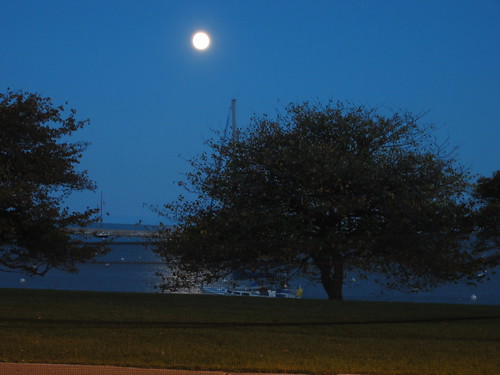
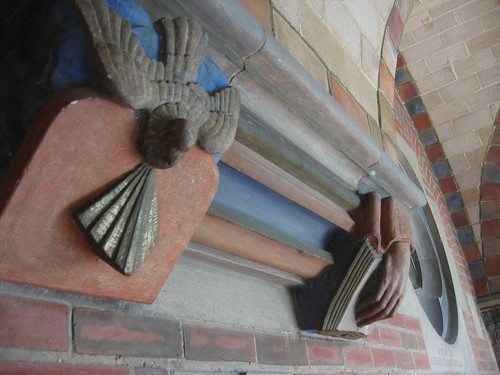
{Photos by rocketlass.}

Anticipation of the upcoming English translation of Haruki Murakami's 1Q84 (and the building consensus that it's his masterpiece) sent me back to my shelves this week to read some of the unread Murakami that has been patiently waiting there. I ended up choosing After Dark (2004, English translation by Jay Rubin, 2007), a slim novel that takes place over the course of the wee hours of one night in Tokyo.

After Dark is a slight novel, and it's far from Murakami's best. Only a few of its characters really come to life, and the elliptical connections between them seem less the product of the Dickensian fecundity of urban crowding than of the banal natural intersections of life in a contemporary capitalist economy. And yet . . . there's still something to the book that makes it valuable. It's a mood, really, a sustained hush that does seem to embody the feeling of the quiet little hours of the dead of night, as if things done in the dark will never be shewn forth in the light--not because they are evil, or even inherently secret, but because the world of sleepers that surrounds them makes everything seem, and maybe actually be, fundamentally less real.


As I finished the book, emerging into the day and the L train as if I, too, were rising up from sleep, I realized with a start what After Dark is. It's a companion, a rewriting, an opposite-side-of-the-world take on Steven Millhauser's Enchanted Night (1999). I happened recently to casually link Millhauser and Murakami, in my post on my preference for not interpreting Kafka, but I'd never thought of them in such close conjunction as this before. Millhauser, for all the pleasures his books afford, has always seemed too artful--even, at times, arch--to truly be a companion to Murakami's more organically strange imagination.

Yet when he's at his best, Millhauser offers many of the same pleasures, seen through a distinctly American frame. He transposes Murakami's tales of urban ennui and solitude to midcentury America, with its booming suburbs and their tenuous, newly constructed social bonds; its small towns seeing the first downhill steps of their decline; the awkwardly pubescent dreams of its baby boom children; the solitude (and dreaming) created by its push for conformity; the secrets, the secrets, the secrets. Some of this is territory mapped out by Ray Bradbury--hell, some of it is territory mapped out by Sherwood Anderson--but Millhauser buries some rue at the heart of Bradbury's nostalgia, swaps out the fear and menace of the dark in favor of the fears generated by desire, and polishes his language to a richly elegant sheen.

On to Enchanted Night. It's short, only 109 pages, and, like After Dark, it's easily dismissed as a minor work. It follows the events of one hot summer night in a town in southern Connecticut--which, mostly, means following the restless sleep and secret perambulations of a number of characters. There are magical surprises; there is desire, requited and unrequited; there is the reminder, inescapably woven throughout, that before air conditioning the world, windows open, sheets wet, was a different place. What there is not, really, is an attempt to claim anything larger for the story, to draw it together or build with it--Millhauser, it seems, is content to let us be innocent peeping Toms here, watching omnisciently what we usually miss out on while under the spell of the oneiri.

But, perhaps because Millhauser had the sense to keep the book brief, it works. It's a volume I go back to regularly, always on summer nights, when--any teens who happen to be reading are advised to turn away now--the weather makes it seem like life ought to offer more possibilities than it does (however acceptably bounteous those possibilities are when exposed to daylight), like Good God!, we ought to be out in this doing things, rather than sitting at home, reading and watching baseball. Here--think of summer, and try it:
In the warm night air, under the dark blue sky, Laura feels soothed: she can breathe now, out in the open,as if the suburban night under the wide sky is a western prairie. She thinks of cowboys in old movies, saddlebags, snorting horses, blankets under the stars. Yep. Ah, reckon. No sidewalks here--she walks along the edge of the road, under streetlights arching out from telephone poles. In the tangerine-colored light she watches her shadow stretching out longer and longer, a taffy girl, a telescope girl. Where to go?
Or this:
The moon, climbing so slowly that no one notices, shines down on Main Street. It casts a deep shadow on one side of the street and an eerie brightness on the other, where the sidewalk is bone-white and the little glass windows of the parking meters glisten as if they are wet.
And now let's bring Murakami back into the mix. Here's his opening:
Eyes mark the shape of the city.

Through the eyes of a high-flying bird, we take in the scene from midair. In our broad sweep, the city looks like a single gigantic creature--or more like a single collective entity created by many intertwining organisms. . . . Midnight is approaching, and while the peak of activity has passed, the basal metabolism that maintains life continues undiminished, producing the basso continuo of the city's moan, a monotonous sound that neither rises nor falls but is pregnant with foreboding.
Or this:
The room is dark, but our eyes gradually adjust to the darkness. A woman lies in bed, asleep. A young, beautiful woman: Mari's sister, Eri. Eri Asai. We know this without having been told so by anyone. Her black hair cascades across the pillow like a flood of dark water.

We allow ourselves to become a single point of view, and we observe her for a time. Perhaps it should be said that we are peeping in on her.
The hiddenlife of nighttime, for both authors, generates a second, secret level of voyeurism, of godlike viewing of people who, shielded by the darkness, think of their actions as fundamentally private, unknowable. The effect is to make us feel as if we're being let in on a secret, even if that secret, analyzed in the day, is as simple as the realization that everyone has secrets.

Murakami's night is crowded, neon-lit, yet atomized; Millhauser's is near-silent, dewed, and oddly hopeful. I love, love, love, love, love the idea that they are twinned, that After Dark is Murakami's answer to Enchanted Night-- and let's not forget that Murakami deals in doubles and doppelgangers and dualities--that After Dark's night, young and urban, follows the sweatier summer wanderings of Enchanted Night like night follows day--like these two spots on opposite sides of the globe take turns with the sun.


Read them together, then go for a late-night walk. 'Tis good medicine they'll bring ye.

Monday, November 09, 2009

On Doubles

In the newest volume of The Paris Review Interviews, Haruki Murakami offers an interesting analysis of his relationship to his protagonists:
INTERVIEWER
Your protagonists often seem to serve as projections of your own point of view into the fantastic world of your narratives--the dreamer in the dream.

MURAKAMI
Please think about it this way: I have a twin brother. And when I was two years old, one of us--the other one--was kidnapped. He was brought to a faraway place and we haven't seen each other since. I think my protagonist is him. A part of myself, but not me, and we haven't seen each other for a long time. It's a kind of alternative form of myself. In terms of DNA we are the same, but our environment has been different, so our way of thinking would be different.
That description is sure to resonate with longtime readers of Murakami--though when I think of his obsession with doubling and twinning, I tend to think not of his mid-30s male protagonists but of the young, attractive women who enter their lives. The interviewer, too, picks up on that, and later asks Murakami about it:
INTERVIEWER
There seem to be two distinct types of women in your novels: those with whom the protagonist has a fundamentally serious relationship--often this is the woman who disappears and whose memory haunts him--and the other kind of woman, who comes later and helps him in his search, or to do to the opposite--to forget. This second type of woman tends to be outspoken, eccentric, and sexually frank, and the protagonist interacts with her in a much warmer and more humorous way than he had with the missing woman, with whom he never quite connected. What purpose do these two archetypes serve?

MURAKAMI
My protagonist is almost always caught between the spiritual world and the real world. In the spiritual world, the women--or men--are quiet, intelligent, modest. Wise. In the realistic world, as you say, the women are very active, comic, positive. They have a sense of humor. The protagonist's mind is split between these totally different worlds and he cannot choose which to take. I think that's one of the main motifs in my work. It's very apparent in Hard-Boiled Wonderland, in which his mind is actually, physically split. In Norwegian Wood, as well, there are two girls and he cannot decide between them, from the beginning to the end.
"Split," though Murakami is applying it here to his male characters, seems the appropriate description: to my mind, it's less that Murakami's offering polarities than that he's sorting the elements that make up one person into two different characters, as if his protagonists' understanding of the ultimate complexity of others is fundamentally limited, affecting his ideas of how to relate to them--and, perhaps, even precipitating the losses he endures.

Soon after reading that interview, I read Steve Rasnic Tem and Melanie Tem's fantastic, creepy story "The Man on the Ceiling," which is included in Poe's Children: The New Horror (2008, edited by Peter Straub), and this passage, written in Steve's voice, jumped out at me for obvious reasons:
As a child I was a persistent liar. I lied slyly, I lied innocently, and I lied enthusiastically. I lied out of confusion and I lied out of a profound disappointment. One of my more elaborate lies took shape during the 1960 presidential election. While the rest of the country was debating the relative merits of Kennedy and Nixon, I was explaining to my friends how I had been half of a pair of Siamese twins, and how my brother had tragically died during the separation.

This was, perhaps, my most heartfelt lie to date, because in telling this tale I found myself grieving over the loss of my brother, my twin. I had created my first believable character, and my character had hurt me.

Later I came to recognize that about that time (I was ten), the self I had been was dying, and that I was slowly becoming the twin who had died and gone off to some other, better fiction.
What's particularly fascinating about this--in light of Murakami's talk of a twinned self and intentionally doubled or split characters--is that "The Man on the Ceiling" is written by a husband-and-wife team, authors of many books, who are working together for the first time, telling a story about the fears, nightmares, and strengths of their marriage and their family. Steve Tem may have lost his imaginary twin, but as becomes apparent in the story, in his wife he has found, if not a replacement, then at least a reflection; the story's honest appraisal of the odd combination of intimacy, trust, fear, and ultimate separateness that turns a pair into a couple is moving and unforgettable.

Monday, November 12, 2007

Tangentially Connected Things (with apologies to Sei Shonagon)


1 Maybe Sei Shonagon's ghost was flitting around the Internets this weekend, because I wasn't the only one writing about her. While I used her words primarily as window dressing for a post about Iris Murdoch, selfdivider actually wrote well about her and her Pillow Book. The opening of his post is irresistible:
I have no doubt that Walter Benjamin, in his previous incarnation, was a Japanese woman named Sei Shonagon, born in 966 AD, serving in the court of Empress Teishi.

2 If you've not read The Pillow Book of Sei Shonagon, I can recommend it wholeheartedly. It's a real treat, the occasional diary-like entry about her life at the Imperial court mixing with more general appreciations of the details (and frustrations) of everyday life. Her greatest form--and what causes selfdivider to link her with Benjamin--is the list. On Saturday I mentioned in passing her list of "Pleasing Things," but that list is so ordinary as to be unrepresentative. She's often far more unexpected in her choice of categories--as in this one, for example:
Squalid Things

The back of a piece of embroidery.

The inside of a cat's ear.

A swarm of mice, who still have no fur, when they come wriggling out of their nest.

The seams of a fur robe that has not yet been lined.

Darkness in a place that does not give the impression of being very clean.

A rather unattractive woman who looks after a large brood of children.

A woman who falls ill and remains unwell for a long time. In the mind of her lover, who is not particularly devoted to her, she must appear rather squalid.

Or this one:
Things That Should Be Short

A piece of thread when one wants to sew something in a hurry.

A lamp stand.

The hair of a woman of the lower classes should be neat and short.

The speech of a young girl.
There's an intimacy to Sei Shonagon's self-presentation in The Pillow Book that's stunning, born not from the revelation of private details but from the single strong sensibility that informs every entry. As with Hazlitt or, to a lesser degree, Montaigne, I close the book feeling as if I've met a person; to read it is, in a way that is astonishing considering that more than a millennium separates her from us, to feel that one knows its writer.

3 Speaking of selfdivider, I meant to link to his blog months ago when he posted a translation of an interview with Haruki Murakami that he found in a Korean magazine. If you're a Murakami fan--and especially if, like me, you find yourself responding to his cryptic clarity with an effort to divine larger authorial statements--it's well worth your time.

4 In my post Saturday about Iris Murdoch, I mentioned how much I like her first novel, Under the Net, largely because of its energy and the love of London that comes through in Murdoch's detailed descriptions. In one of the interviews collected in the book that prompted that post, From a Tiny Corner in the House of Fiction: Conversations with Iris Murdoch, Murdoch talks with her husband, critic John Bayley, and others at a 1986 symposium on her work, Murdoch explains that she would like to think that she's been getting better at her craft over the years, then says,
Someone told me this morning that they thought Under the Net was the best one, which I found very distressing!
In response, John Bayley points out one of the best aspects of that novel, the sense it gives throughout of being utterly contingent, of the possibility that the ultimate resolution of the plot could take any of a number of forms:
BAYLEY: Curiously I think Under the Net is the only one of your novels where you can feel that the novelist doesn't know how it's going to end, if you see what I mean. Actually, this is an important criterion about novels, historically speaking, that a great many novelists did write quite genuinely not knowing how to end the thing; when novels came out in installments, of course, it was quite common. I may be quite wrong about Under the Net; you probably did know how it was going to end, but it has a kind of freshness that is very mysterious, and that we strangely associate with something that is not planned.

MURDOCH: Well, yes, I did know how Under the Net was going to end. But I think this is a matter of style. It is quite an interesting point, isn't it, that some novels can seem like that, and it may be better if you have that feeling. I mean there can be a sense of too much presence of the author, a feeling that the author is going to bring the thing through to the end, come what may, in a particular way.
How could I--a partisan of the baggy and organic, a lover of the carefully arranged formlessness of Penelope Fitzgerald's best novels, a raving fan of Moby-Dick--do anything but agree? (And yet I love form, too, whether it's the jeweled perfection of The Great Gatsby or the interpenetrating circles of John Crowley's Aegypt cycle. At least I've never pretended to be consistent.)

5 Since Iris Murdoch and Jane Austen wrestled for my reading attention this weekend, it seems right to take note of something Murdoch told Simon Price in 1984:
I think my two favorite characters in literature are Achilles and Mr. Knightley in Emma. Perhaps that represents two sides of one's character, or something, but I find that I identify with both of them.
Knightley is easy to understand: he's a strong, interesting, good character. (Side note: though I know I long ago offered evidence that I was never a teenage girl, the fact that I find him far more compelling than Darcy surely provides more, right?) The choice of Achilles on the other hand--rage personified,
murderous, doomed, that cost the Achaeans countless losses
--surprises, even perplexes me. What did Murdoch see there to identify with? His rage? His ambition, which caused him to willingly choose an early death rather than forego the only eternal life he could imagine, that of lasting fame for his exploits?

As an even-tempered, unambitious sort, I've always had a bit of trouble with Achilles; for me Achilles--and the values he represents--serves as a reminder of how distant Homer's world was from ours. His values, his cares, are almost as far from mine as is possible to imagine. Yet at the same time, I've always felt an affinity with Odysseus. Sure, he's possibly the least trustworthy person in literature, but nearly every subterfuge is entered into with the same goal: keeping him alive another day. While I'd like to think I'm more scrupulous, it would require an inappropriate level of self-regard to think that I wouldn't appreciate some of Odysseus's tactics were I to find myself in similar situations.

6 All of which leads me to a larger question: just who are my favorite characters in literature? Oddly enough, I hadn't thought about that question, really, until I read about Murdoch's choices. Unlike her, I think if I put together a list it won't consist of characters with whom I particularly identify; rather--like Odysseus--they'd be characters who I can't stop thinking about, who seem forever capable of revealing new surprises. So to add to Odysseus, here's a list that came more or less off the top of my head during tonight's run:
Bjartur from Independent People

Tess from Tess of the D'Urbervilles

Lieutenant Amanda Turck from James Gould Cozzens's Guard of Honor

Bartleby the Scrivener

Jayber Crow, from Wendell Berry's books about the Port William Membership

King David

Barnby, Uncle Giles, and Tuffy Weedon from A Dance to the Music of Time

First Sergeant Milt Warden from From Here to Eternity

Lyra from the His Dark Materials trilogy

Sir Lancelot

Stepan Arkadyevitch Oblonsky from Anna Karenina

Huckleberry Finn

Philip Marlowe

Mrs. Aubrey from Rebecca West's The Fountain Overflows

Rose Ryder from John Crowley's Aegypt series

And who are yours?

Wednesday, September 05, 2007

Murakami and Laika, part two

Part one is here.

Appropriately enough for the novel that followed the tales-within-tales of Murakami's grandly ambitious The Wind-Up Bird Chronicle, the uncanny enters Sputnik Sweetheart through a story, told by a woman with whom Sumire has fallen in love. It's a stunningly creepy account of a late-night experience at a carnival that turned her hair white and, she says, essentially broke her--and her life--irrevocably into two pieces. From there, the strangeness builds, and the Greek island begins to resemble a de Chirico painting, shadowy and depopulated, but with hints of threatening life around every corner; following more than a hundred pages of straightforward realism, the eruption of the fantastic--and chilling--is all the more believable and compelling. From the start we knew that the novel would end with loss, and the strange events surrounding that loss, never clearly explained, serve both to deepen its impact and make it seem sadly inevitable.

My friend Kristi calls Murakami a pessimist, while I've argued before on this blog that he strikes me as at worst a grudging optimist. After I read Norwegian Wood, I wrote that Murakami's vision, without denying life's traumas, seems to honor the simple effort of daily living:
Norwegian Wood is crowded with suicides, nearly all by teenagers. . . . . Some of the kids have fairly clear reasons, while others are essentially inexplicable, but the overall sense is that, faced with the quotidian difficulties of life, they decided they were unable to continue. In the face of so much death, there is a real sense of hard-won victory, of tangible achievement in the simple fact that the narrator is still alive twenty years later, able to vividly recall and tell us this story of his youth. His life has included great loss, disappointment, and sorrow, but he has kept going.
We don't know for sure that the narrator of Sputnik Sweetheart will make that choice, but the book closes on a note of quiet determination.

Which brings me back to Laika. What is Murakami trying to say by linking his story to that one? Is Kristi right about Murakami's pessimism? That doesn't seem so far-fetched: after all, Laika's story is one of sheer hopelessness--there was never a way out for her, just as it seems that there was no way Murakami's narrator in could have kept his love.

I recently told a friend that an essential part of writing a blog like this is a willingness to make decisions about works of art and seem reasonably confident about them--despite knowing that somewhere down the road I might change my mind, or be convinced that I was wrong. In interpreting Laika's story I will admit to being less confident than usual; Murakami's stories are richly multivalent, and I fear that I may be seeing what I want to see. As I continue reading my way through Murakami's oeuvre, I realize that I may reach a different position.

But for now I prefer to read the story as support for my view of Murakami the grudging optimist. We are all like Laika to some extent, set in motion by forces we don't know and can't understand, heading to a destination we can't even conceive clearly. Of course, most of us are much luckier than Laika, our fates nowhere near as horrid--but at the same time, like her we are constantly watching people and things we love and cherish fall away beneath us, loss perhaps the only constant in our long lives.

Yet our space capsule keeps moving, ultimately out of our control, and we have to keep moving with it--so we might as well look out the window and continue thinking about what we see. Faced with the inevitability of loss, we must find a way to give that loss meaning while simultaneously attempting to retain what we can't afford to lose, our very self. So we tell stories, and we pass them on, and meanwhile we pay attention to the things of the world--the art, yes, but also the ephemera and the junk, the very stuff that hedges us about and helps, whether we like it or not, to define who we are.

We can't possibly come through life whole, but if we shore up enough of that everyday stuff, after a terrible loss we just might be able use it as a sort of mold, a place in which to re-form the shattered self. The first step, Murakami seems to remind us again and again, is simply to keep taking the first step.

Murakami and Laika, part one

Every time I write about Haruki Murakami's novels, I find myself moving past a simple evaluation or recommendation (That part is easy: they're deeply rewarding and you should read them.) to consider instead just what Murakami is trying to say, what his larger intentions might be. His meanings are never quite clear; he surrounds them with an organic strangeness, an obscurantism that seems not so much willful--let alone ill-intentioned--as inherent and essential.

To open Sputnik Sweetheart (1999), however, Murakami employs a tool that writers have long used as a way to draw readers' attention to their underlying themes and intentions: an epigraph. Taken from The Complete Chronicle of World History, it reads:
On October 4, 1957, the Soviet Union launched the world's first man-made satellite, Sputnik I, from the Baikanor Space Center in the Republic of Kazakhstan. Sputnik was 58 centimeters in diameter, weighed 83.6 kilograms, and orbited the earth in 96 minutes and 12 seconds.

On November 3 of the same year, Sputnik II was successfully launched, with the dog Laika on board. Laika became the first living being to leave the earth's atmosphere, but the satellite was never recovered, and Laika ended up sacrificed for the sake of biological research in space.


Seemingly ever since the launch, people have found Laika's story powerfully moving, and artists and writers have drawn on it in various forms. (Jeanette Winterson recently turned Laika into a central component of her retelling of the myth of Atlas, Weight.) Why, in the face of the many indisputably worse acts perpetrated by humans in recent decades, does this one story resonate so strongly? In large part, unquestionably, it's simply because Laika was a dog, and many people are irrationally sensitive to the welfare of dogs in a way that they are not about other animals, including humans. But I think it's also--maybe even primarily--because the horrific circumstances make it unusually easy for us to put ourselves in Laika's place and imagine what she felt: from everything you can tell, you're doing what you should do, behaving how you're supposed to behave, when suddenly everything you've known is gone and you've been utterly abandoned. It's an image of deep loss and despair, mixed with a cruel, incomprehensible fate--and that's the pall that Murakami's epigraph casts over Sputnik Sweetheart.

Opening the book in that mood, I was reminded of Murakami's Norwegian Wood, which shares that air of inevitable loss. And sure enough, from the elegaic first paragraph on, Sputnik Sweetheart reads like a stranger, more sinister cousin of Norwegian Wood. They tell stories that are similar in their rough outline, of doomed love affairs, but while Norwegian Wood is narrated by a middle-aged man looking back on his college years, Sputnik Sweetheart is related by a twenty-four-year-old who has only recently experienced--and not by any means yet come to grips with--the events he describes. Both men love a young woman who cannot, for various reasons, return that love; the men turn instead to other women who are attractive, interesting, and sympathetic but who will never be able to displace the unavailable lover. In both novels, the desired women remove themselves to remote locations while the men are left alone, biding their time, yearning. Murakami's treatment of that yearning is deeply poignant in both books, though it takes noticeably different forms in the prose of the two novels--more wistful in the case of Norwegian Wood's older narrator, affectless to the point of naivete in the case of Sputnik Sweetheart, a reminder that Murakami's straightforward style, despite its seeming transparency, is the product of skill and care.

For half of its length, Sputnik Sweetheart also seems to share the commitment to realism that makes Norwegian Wood stand out among Murakami's novels. None of his trademark fantastical strangeness, or, really, even his quirkiness, is to be found--until suddenly the narrator receives a late-night phone call from the Greek island where the young woman, Sumire, has been staying, and the uncanny breaks into his reality.

This is getting very long, so I'll save the rest for tomorrow.

Friday, August 24, 2007

'Cos I ain't got no interest in them

One of the first things I read this morning was an article that Leila at Bookshelves of Doom pointed me to that highlighted the dismal results of an AP poll about American reading habits. Twenty-seven percent of adults surveyed, the poll revealed, hadn't read a book in the past year, and the median number of books read overall was four (though the figure jumped to seven when non-readers were excluded). Now, for those of us who love and/or make our living from books, those are unquestionably depressing figures. Though we can take heart from learning the unsurprising news that Democrats and liberals read more than Republicans and conservatives, we also have to worry that older folks read more books than younger people--not a good sign for the future.

But at the same time, it's important to remember that reading has always fought an uphill battle--against illiteracy, poverty, and lack of time long ago, and against long commutes, big-screen TVs, and video games today. Just as there have always been those of us to whom reading is a central part of life, there have also been those who couldn't or wouldn't open a book.

While I do think reading, any sort of reading, is deeply valuable, I've never been a Cynthia-Ozick-style literature-as-medicine sort: I want people reading because they want to read, because they think there may be something in a novel that expands on the movie version, because they're curious about what Grandpa saw in the war, or because Johnny Damon has great hair. Reading that is clearly pitched as a form of self-improvement can too quickly become reading as punishment--an unlikely recipe for the sort of quiet, contemplative inwardness that reading generates at its best. That's not saying that we should be complacent, especially if we hope to make a living from books in thirty years, but at the same time we have to be realistic about the competition for attention that books face--and we can't delude ourselves into thinking that there was ever a golden age when everyone was reading serious books.

I was thinking about all this on the train this morning when I came across a brief note about reading habits in David Kynaston's Austerity Britain. Kynaston reports the results of research in 1947 into reading habits by the government-sponsored public opinion survey group Mass-Observation (an unparalleled source of detailed information about British life in the 1940s). He opens with a result that reading advocates would be happy to elicit today:
"Reading" was given as the favourite hobby by three in ten of the middle class, by two in ten of the skilled working class, and by one in ten of the unskilled.
Though I don't know for sure, I imagine that the number for all categories would be lower today in both the United States and Britain--but when you think of how little was competing for leisure-time attention with books in those days, the figures don't seem quite so daunting. At the same time, almost half the 1947 sample, Kynaston reveals, admitted to never reading books at all; the reasons they gave for not reading, like so many of the verbatim responses collected by Mass-Observation questioners, are fascinating:
None of them subjects is interesting to me. All I like is gangster stories, though there's precious much chance of reading here. Three rooms we got and three kids knocking around. No convenience, no nothing except water. I'm glad to get out of the house I can tell you.

Cos I ain't got no interest in them--they all apparently lead up to the same thing.

I'm not very good at reading, I never was. I've never liked it some'ow.

Too long. I like to get straight into a story. I have started books and I have to read through the first pages two or three time. I like to get stuck straight into a story--there's too much preliminary if you see what I mean.

I find the next-to-last respondent almost unbearably poignant--"some'ow" he doesn't like something he was never good at, that he probably was never taught how to do properly. The respondent who might read gangster stories, were it not for the chaos of the house, could be a contemporary parent--and he reminds me of another Mass-Observation subject Kynaston quotes elsewhere, this one on the subject of religion:
Well, I believe in God, but I can't say I'm religious. You get a bit hasty when you've so many children.

The final respondent, though, I think I could help--I know lots of novels that "get straight into a story," with no messing around. If anyone wants to lend me their time machine, I'll load it up with Lawrence Block novels (and maybe, if I want to really freak him out, some Murakami), pop back to 1947, and drop them off at that guy's local library. Anything I should be sure to bring back?

Wednesday, August 22, 2007

Some advice, or a field report from the War on Rest


{Photos by rocketlass.}

If you ever find yourself, after dinner, intending quickly to write about Geoff Dyer's Out of Sheer Rage, which you've just finished, and soon after to get to bed at a reasonable hour, then I recommend that you do not pick up the copy of Sputnik Sweetheart that a friend has just returned, no matter how innocuous it looks lying there on the kitchen counter.

Nor, if you do find yourself going so far as to pick it up, do I recommend thinking to yourself, "I've not read any Murakami for a while," then opening the book and a beer at the same time.

For if you do, I can now tell you from experience, a few hours later you'll read this passage:
I glanced at the full-length mirror as I passed by, at my face reflected in it. A strange expression was on my face. That was my face, all right, but where did that look come from? I didn't feel like retracing my steps and investigating further.

Sumire stood at the entrance to her new place to see me off. She waved goodbye, something she rarely did.

In the end, like so many beautiful promises in our lives, that dinner date never came to be.

Then a few hours after that, when the darkness has driven you from your perch on the back steps and the cicadas have claimed the cemetery next door as their sovereign domain once again until dawn, you'll come to this passage:
In the sky above the summit, the coarse-looking moon loomed awfully near. A hard ball of stone, its skin eaten away by the merciless passage of time. Ominous shadows on its surface were blind cancer cells stretching out feelers toward the warmth of life. The moonlight warped every sound, washed away all meaning, threw every mind into chaos.


Finally, when you close the book, pointedly not looking at the clock, all hope for a reasonable amount of sleep will have long since slunk away, defeated.


In the war on rest, the novel remains a fierce, indefatigable partisan.

Monday, August 06, 2007

Borges's memory, memories of Borges


{Henri Rousseau, Tiger in a Tropical Storm (Surprised!), 1891}

On a night in the mid-1960s, as a young Alberto Manguel read aloud to Jorge Luis Borges from Kipling's stories, Borges lamented,
What a pity not to have been born a tiger.
I think we can be pardoned for being glad that he didn't get his wish.


{Borges in the Hotel Beaux, Paris, 1969}

As a sixteen-year-old in 1964, Manguel became another in a long line of readers who supplied Borges with his necessary daily allowance of those words he could no longer see, and he's gathered his memories of those evenings into a slim book, With Borges (2006). Simultaneously a book of anecdotes and a meditation on Borges and his work, it's a charming, pleasant little book--the sort of book I wish were available for every writer I love. (Just how unobtrusive was Anthony Powell as he watched his contemporaries at parties? What did Haruki Murakami talk about with his patrons and his fellow clerks when he worked in a record store? How irritating--or frustrating--was Casanova for his male friends?)

The Borges that Manguel presents is not unfamiliar or surprising. We encounter yet again his odd reading tastes--in some sense arrested in a precocious adolescence--the Kipling, Chesterton, Homer, Dante, Stevenson, Cervantes that he read over and over again. We are reminded of his unusual reading prejudices:
One could construct a perfectly acceptable history of literature consisting only of the authors Borges rejected: Goethe, Rabelais, Flaubert (except the first chapter of Bouvard et Pechuchet), Calderon, Stendhal, Zweig, Maupassant, Boccaccio, Proust, Zola, Balzac, Galdos, Lovecraft, Edith Wharton, Neruda, Alejo Carpentier, Thomas Mann, Garcia Marquez, Amado, Tolstoi, Lope de Vega, Lorca, Pirandello.
Even after Tolstoy, there are half a dozen or so of my favorites there (and then there's the one that's most surprising to me, Maupassant, whose style and subjects I would have expected to resonate with Borges). But it was a matter, he explained in an interview, of simply reading what he liked:
I am a pleasure-seeking reader: I've never allowed my sense of duty to have a hand in such a personal matter as that of buying books.
I think Borges is being somewhat disingenuous there: his reading carried with it a whiff of the obsessional as well, and obsessions, though they may begin in pleasure, rarely end there. Yet it's hard to criticize Borges's choices: as readers we are all riddled with holes, gaps intentional or unintentional, and almost no one has drawn on his reading as fruitfully as Borges, reading and rereading and interpreting and distilling books until they became something totally new.

What Manguel gives us instead of a new view of Borges is a more intimate view--still focused on books, because books were Borges, it seems--a fascinating glimpse of his conversation and passing comments. We learn that he was never satisfied with his story "Shakespeare's Memory," one of my favorites, and that he felt he had never quite honored its inspiration, which was an overheard line in a dream: "I will sell you the memory of Shakespeare." After revealing that Borges asserted the questionable proposition that a writer should not be so impolite as to surprise the reader, Manguel points out, rightly, that Borges, instead, sought conclusions
that were astonishing but obvious. Recalling that Ulysses, tired of prodigies, wept for love at the sight of his green Ithaca, he concluded: "Art should be like that Ithaca--of green eternity, not of prodigies."
Following a discussion of the lost Library of Alexandria--a loss which one would expect a librarian and bibliophile to include among eternity's great laments--Borges explained that
The number of themes, of words, of texts, is limited. Therefore nothing is ever lost. If a book is lost, then someone will write it again, eventually. That should be enough immortality for anyone.
Presumably the Library at Alexandria didn't serve double duty the way that we learn Borges's personal library did: when he found himself with currency, he would tuck it into various books; when he needed money, he would pluck books from the shelves until he found some. {Side note: the book collection as bank, an organizational schema I failed to consider.} Perhaps that was simply another aspect of the playful side of Borges, which appears again and again, as when Manguel reports that Borges
once recited the "Our Father" in Old English, in a crumbling Saxon chapel near Dr. Johnson's Lichfield, "to give God a little surprise."
I suppose it's okay to surprise God--after all, such opportunities are surely rare, and thus such a surprise wouldn't be the cheap shot that surprising one's readers would be.

But the best of playful Borges, and probably my favorite moment in the book, the one I'll recall the other anecdotes and opinions have been forgotten, is an admonition by Borges to his five- or six-year-old nephew:
If you behave, I'll give you permission to think of a bear.
It's Borges at his cleverest and lightest--and yet that line also hints at the essence of his art. Thought is all, subjectivity is can nearly create its own realities--and even the simplest statement can be momentarily dislocating. It reminds me of his "Argumentum Ornithologicaum," collected in Dreamtigers (1964):
I close my eyes and see a flock of birds. The vision lasts a second or perhaps less; I don't know how many birds I saw. Were they a definite or an indefinite number? This problem involves the question of the existence of God. If God exists, the number is definite, because how many birds I saw is known to God. If God does not exist, the number is indefinite, because nobody was able to take count. In this case, I saw fewer than ten birds (let's say) and more than one; but I did not see nine, eight, seven, six, five, four, three, or two birds. I saw a number between ten and one, but not nine, eight, seven, six, five, etc. That number, as a whole number, is inconceivable; ergo, God exists.


{Photo by rocketlass}

Sometimes, just as an elephant cannot not be thought of, one may actually need permission to think of a bear.

I'll close with Manguel's account of what could be taken as Borges's ethos:
He believed, against all odds, that our moral duty was to be happy, and he believed that happiness could be found in books, even though he was unable to explain why this was so. "I don't know exactly why I believe that a book brings us the possibility of happiness," he said, "but I am truly grateful for that modest miracle."

Its intentionally limited compass could certainly be argued with--in my morally healthiest moments, I'd replace happiness there with justice--but at the end of a night of passing happily from one book to another book to another book as thunderstorms rumble in the background, I'll gladly adopt it, however temporarily, as my own.

Monday, July 23, 2007

A recipe for restless sleep


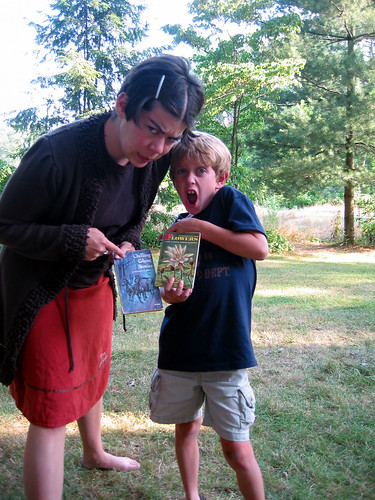
{Stacey: Let's read Chilling Ghost Stories!
Carson: How about we read Flowers instead?}

This is a new version of a longtime family favorite, guaranteed to produce a frothy mix of vaguely frustrating and disturbing dreams, full of shadowy characters, betrayals, and the low hum of constant danger.


Restless Sleep

{Ingredients}

1 spy novel, all but the last hundred pages read
1 breathlessly anticipated seventh volume of an unprecedentedly popular children's series
1 dry gin martini, up, with olive

{Preparation}

Begin reading the remaining pages of SPY NOVEL in time to be finished by 9:30. Set aside and let rest for fifteen minutes (It can later be lent to one's father.). Prepare and drink MARTINI. When clock reads 10:00, settle into comfortable reading position and begin reading BREATHLESSLY ANTICIPATED CHILDREN'S BOOK. Read one hundred pages, or until clock says 11:00. Set book aside (Remainder can be enjoyed as leftovers for up to three days.). Sleep; dreams should follow apace.


As an adaptation of a family staple, this recipe is fairly forgiving--quantities and times need not be exact for you to achieve the desired result. In a pinch, substitutions can be allowed--I find that Luc Sante's Low Life, Mark Smith's The Death of the Detective, Patricia Highsmith's Ripley novels, or Ecclesiastes work well in place of the spy novel, while the role of the children's book can be reasonably approximated by Philip Pullman's His Dark Materials trilogy, the collected works of Charles Schulz, or, oddly enough, any of the novels of Haruki Murakami. There is no substitute for the martini.

Friday, May 25, 2007

The hour is late, and night draws in on silent feet


(Photo by Rocketlass)

Though Chicago is nowhere near as mysterious as Venice, this is the best time of year for sitting late on the back steps and watch the city night steal in over the dark cemetery behind our house, its silent occupants waiting patiently for their hours to come. The sodium vapor lights in the alley slowly expand their dominion, the day sounds--of cars and talk and alley basketball--turn to night sounds--of sirens and breaking bottles and the distant music of party chatter. The evenings unfold slowly, and the mosquitoes have yet to renew their annual war on all warm-blooded creatures, so with books and a martini I remain outside until darkness forbids further reading.

From After Dark (2004, English translation 2007), by Haruki Murakami
Through the eyes of a high-flying night bird, we take in the scene from midair. In our broad sweep, the city looks like a single gigantic creature--or more like a single collective entity created by many intertwining organisms. Countless arteries stretch to the ends of its elusive body, circulating a continuous supply of fresh blood cells, sending out new data and collecting the old, sending out new consumables and collecting the old. To the rhythm of its pulsing, all parts of the body flicker and flare up and squirm. Midnight is approaching, and while the peak of activity has passed, the basal metabolism that maintains life continues undiminished, producing the basso continuo of the city's moan, a monotonous sound that neither rises nor falls but is pregnant with foreboding.


From Lois the Witch (1856), by Elizabeth Gaskell
Evening was coming on, and the wood fire was more cheerful than any of the human beings surrounding it; the monotonous whirr of the smaller spinning-wheels had been going on all day, and the store of flax downstairs was nearly exhausted, when Grace Hickson bade Lois fetch down some more from the storeroom, before the light so entirely waned away that it could not be found without a candle, and a candle it would be dangerous to carry into that apartment full of combustible materials, especially at this time of hard frost when every drop of water was locked up and bound in icy hardness. So Lois went, half shrinking from the long passage that led to the stairs leading up into the storeroom, for it was in this passage that the strange night-sounds were heard, which everyone had begun to notice and speak about in lowered tones.


From At Day' Close: Night in Times Past (2005), by A. Roger Ekirch
"He that does ill hates the light," affirmed a Scottish proverb. Numerous folk, besides burglars, robbers, and other hardened rogues, exploited the evening darkness, often for illicit purposes. Petty criminals were far more numerous, if less feared. For poor families, social and legal constraints of all sorts eased. Indigent households buried their dead at night to escape paying parish dues, which had the added benefit of protecting gravesites from thieves, often needy themselves. Where grave robbers at night stole clothing and caskets, "resurrection men" unearthed entire bodies, freshly interred in churchyards, to sell for medical dissection. . . . The best time for treasure hunting fell after midnight, with some evenings preferred to otehrs depending on the moon's phase. Silence was critical. As a defense against demons, it was customary to draw one or more circles at the supposed spot. More alarming to authorities, malevolent spirits might be invoked to assist in unearthing the treasure. An English statute in 1542 threatened hunters with the death penalty for "invocacions and conjurations of sprites" to "get knowledge for their own lucre in what place treasure of golde and silver shulde or mought be found."


From Peter Haining's introduction to The Ghost-Feeler: Stories of Terror and the Supernatural, by Edith Wharton
It is a strange fact that for the first twenty-seven years of her life, a woman who is today regarded by several authorities on ghost fiction as one of the foremost writers of supernatural stories of her time, was quite unable to sleep in any room that contained so much as a single book of such tales. So unnerved was Edith Wharton by supernatural fiction that she later admitted to destroying any that she came across in the home.


From Blitz: The Night of December 29, 1940 (2005), by Margaret Gaskin
On his brief fact-finding mission from New York, PM editor Ralph Ingersoll had found the most striking aspects of Blitz life were "the normalcy of life by day and the dramatic suddenness with which that life stops at sundown." Though he had adjusted to it, he just "couldn't get over" it at first: in London, "The two worlds, the world of peace and the world of war, exist side by side, separated by only a few minutes of twilight.


From Religio Medici (1643), by Sir Thomas Browne (encountered in The Oxford Book of Death (1983), edited by D. J. Enright
I believe . . . that those apparitions and ghosts of departed persons are not the wandring souls of men, but the unquiet walks of Devils, prompting and suggesting us unto mischief, blood, and villainy; instilling and stealing into our hearts that the blessed Spirits are not at rest in their graves, but wander solicitous of the affairs of the World. But that those phantasms appear often, and do frequent Cemeteries, Charnel-houses, and Churches, it is because those are the dormitories of the dead, where the Devil, like an insolent Champion, beholds with pride the spoils and Trophies of his Victory over Adam.


From The Year of the Death of Ricardo Reis (1984, English translation 1991), by Jose Saramago
The evidence of death is the veil with which death masks itself. Ricardo Reis has gone past the tomb he was looking for. No voice called out, Hello, it's here, yet there are still those who insist that the dead can speak. What would become of the dead if there were no means of identifying them, no name engraved on a tombstone, no number as on the doors of the living.


One's only recourse, clearly, is to stay awake, keeping company with the owls and the nightjars, opossums and rats. If it means closing one's book when it's too dark to read, well, at least night also belongs to the hoboes and raconteurs, who can surely keep us entertained until dawn.

Saturday, February 10, 2007

On dreams

From The Divine Comedy of Dante Alighieri, Volume 1: Inferno (1308), translated by Robert M. Durling:
In the middle of the journey of our life, I came to
myself in a dark wood, for the straight way was lost
Ah, how hard a thing it is to say what that wood
was, so savage and harsh and strong that the
thought of it renews my fear!

It is so bitter that death is little more so! But to
treat of the good that I found there, I will tell of
the other things I saw.
I cannot really say how I entered there, so full of
sleep was I at the point when I abandoned the true
way.


As I've said before, coincidences sometimes become connections, and with dreams on the brain after reading Robert Herrick's "The Vine," dreams were what I seemed to keep stumbling across (better than into, I suppose) this week.

First, in reading a review of Haruki Murakami's Blind Willow, Sleeping Woman (2006) by Christian Caryl in the March 1, 2007 issue of the New York Review of Books, I was struck by the following passage from a lecture Murakami delivered at a Cambridge, Massachusetts church in 2005:
In some ways a narrative is like a dream. You don't analyze a dream--you just pass through it. A dream is sometimes healing and sometimes makes you anxious. A narrative is just the same--you are just in it. A novelist is not an analyst. He just transforms one scene into another. A novelist is one who dreams wide awake. He decides to write and he sits down and dreams away, then wraps it into a package caleld fiction which allows other people to dream. Fiction warms the hearts and minds of the readers. So I believe that there is something deep and enduring in fiction, and I have learned to trust the power of narrative.

This seems to jibe with my assessment of Murakami's writing from back in the summer. I opened that post by recounting a dreamstory from Akira Kurosawa's film Dreams, and I followed it by arguing in favor of letting things sometimes just be what they are in Murakami's work, letting the inexplicable remain unexplained. The meaning is there--and for each book I could give some guesses at it--but it isn't to be extracted; it's of a piece with the presentation, hewing to an internal, organic logic that bears more resemblance to dream than to reality. It blunts our usual attempts to understand and only delivers up sense once we've begun to succumb to Murakami's own patterns of thought and causality.

I then was reading Anne Carson's wonderfully strange book, Decreation: Poetry, Essays, Opera (2005). Opening an essay called "Every Exit is an Entrance (A Praise of Sleep)," which travels from Homer, Socrates, and Aristotle to Virginia Woolf, Elizabeth Bishop, and Tom Stoppard, is the following:
My earliest memory is of a dream. It was in the house where we lived when I was three or four years of age. I dreamed I was asleep in the house in an upper room.

Then I awoke and came downstairs and stood in the living room. The lights were on in the living room, although it was hushed and empty. The usual dark green sofa and chairs stood along the usual pale green walls. It was the same old living room as ever, I knew it well, nothing was out of place. And yet it was utterly, certainly, different. Inside its usual appearance the living room was as changed as if it had gone mad.

Later in life, when I was learning to reckon with my father, who was afflicted with and eventually died of dementia, this dream recovered itself to me, I think because it seemed to bespeak the situation of looking at a well-known face, whose appearance is exactly as it should be in every feature and detail, except that it is somehow, deeply and glowingly, strange.

The dream of the green living room was my first experience of such strangeness, and I find it as uncanny today as I did when I was three. But there was no concept of madness or dementia available to me at that time. So, as far as I can remember, I explained the dream to myself by saying that I had caught the living room sleeping. I had entered it from the sleep side. And it took me years to recognize, or even to frame a question about, why I found this entrance into strangeness so supremely consoling. For despite the spookiness, inexplicability, and later tragic reference of the green living room, it was and remains for me a consolation to think of it lying there, sunk in its greenness, breathing its own order, answerable to no one, apparently penetrable anywhere and yet so perfectly disguised in the propaganda of its own as to become in a true sense something incognito at the heart of our sleeping house.

Despite very different surface tones and effects, the works of Murakami and Anne Carson (who won me as a fan ten years ago by describing in a poem the taste of a metal screen door as "medieval") share an organic strangeness, an underlying sense that one thing follows another not because anyone expects or asks it to but simply because that's what it does.

Lewis Carroll refined that sort of logic, running it through his memories of the operations of a child's mind, in creating Alice's Adventures in Wonderland (1865). Things happen in Wonderland for reasons that are not immediately obvious, but when Alice challenges the creatures she finds there they can always explain their actions--and their logic, though frequently frustrating, is very hard to refute. I may be forgetting something, but I don't remember Alice ever winning an argument in Wonderland--do you?

Says D. J. Enright, who is the one who got me thinking about Alice, in his Interplay: A Kind of Commonplace Book (1995):
What is essential to children's books--as distinct from some others--is good sense. . . . Without a basis of logic, or at least a strong presence, fantasy is mere whimsy.
That, I would argue, goes the same for dreams: no matter how impenetrable their underlying rules and assumptions may be once we're awake, while we're within the dream we can feel the press of them, the lines of causality that keep us from being all that troubled by what would otherwise be inexplicable.

Enright returns to Alice:
"The reader looks in vain for any immediate reason why Alice should have dreamt such a dream or for any very edifying result deriving from it": Illustrated Times, 16 December 1865, reviewing Alice in Wonderland. But easy to see why the author chatted fluently to children and started to stammer as soon as grown-ups came on the scene.


Finally, because it's fun to end with a scare, I'll leave you with a dream a friend of mine had many years ago. I'll call her Mona, rather than her real name, since I've not ever asked her if I may write about this dream:
After sitting up late into the night reading in bed in her little room at the top of the stairs, Mona drifted off to a troubled sleep. At about the midpoint of the night, she was abruptly awakened by a scraping, creaking sound; the window by her bed was being slowly pushed up. She turned her head, but then her muscles froze completely.

An arm slipped through the narrow opening, and, feeling its way with its fingers across the sill and onto the bedcovers, like a blind elephant searching out food with its trunk, it began plucking at the tousled covers, looking for Mona. After a few seemingly endless moments of being frozen in terror, Mona let loose with a blood-curdling scream; jerking upright, she woke up. The window was closed. It had all been a dream.

Breathing hard, heart pounding, Mona attempted to collect herself. As she reached to turn on her lamp, her window scraped open, and an arm pushed through, reaching out for her. She screamed again . . . and she woke up again.

This time, Mona left her bedroom and sat on the staircase for a while, lights blazing, and smoked some cigarettes. She slept the rest of the night on the couch.
Sleep well.

Wednesday, February 07, 2007

Some notes on sex in words

1) A while back I praised Lawrence Block's Lucky at Cards (1964), a sharp little crime novel about a card cheat. In that post, I neglected to mention the book's one real flaw--one which bedevils many a writer, crime and otherwise: the sex scenes.

The success of noir frequently depends on the ability of an author to convey the powerful pull of a dangerous woman, and Block holds his own there:
I saw the legs first--long and slender, and a skirt bending at the knees. I folded my cards and had a look at the rest.

She wasn't quite beautiful. The body was perfect, with hooker's hips and queen-sized breasts and a belly that had just the right amount of bulge to it. The hair was the color of a chestnut when you pick the husk from it. She had the hair bound up in a French roll. It was stylish as hell, but you started imagining how this female was with her hair down and spread out over a white pillow.

The face was heart-shaped, with a pointed chin and wide-spaced eyes. Green eyes. There were little tension lines in the corners of those eyes, and matching lines around the mouth. Her mouth was too full and her nose was a little too long, and that's why I said she wasn't beautiful, exactly. But perfection always puts me off. There's something dry and sterile about an utterly beautiful woman. This one didn't put me off at all. She kept me staring hard at her.

But when they get to bed . . .
The room was on a high floor, so no one could have seen us, but we never thought about that at the time one way or the other. The lovemaking was too fast, too furious, too compulsive. There was deep need and dark hunger, and flesh merging with flesh, and an orchestral swell out of Tschaikovsky that led to a coda of pure Stravinsky.

That vital dissonance was always there. That harsh and bitter beauty that tossed the conventional harmonies out the window.
Suddenly things are all cloudy, portentous, and overblown.

I don't mean to take Block in particular to task here. What he's succumbed to is the inherent peril of the sex scene in any kind of literature. Too much specificity starts to sound like porn; too little tends, it seems, to create a sort of vacuum, into which such pretentious nonsense as Hemingway's earth-moving orgasms begin to creep in. It's inherently difficult. I think Murakami, for one, usually handles sex pretty well, if only because he keeps it within the affectless range of his ordinary prose, letting it be simply something else that might happen to a person--though, of course, it can end up, even for his characters, being much more.

2) Block at his worst at least never describes a penis as a "blade of flesh," as Max Allan Collins did in a passage I've already taken him to task for. Good god, it's been months and I still can't purge that horrid phrase from my mind. Sorry to make you suffer with me.

3) I tend to side with those who choose simply to pass over the details--the waves crashing on the shore approach. I like, for example, the following scene by Anthony Powell in A Buyer's Market (1952), wherein the narrator, Nick Jenkins, having just come from a funeral, loses his virginity in the back room of an antique shop to a rackety left-wing revolutionist named Gypsy Jones--later referred to by Jenkins's best friend as "La Pasionara of Hendon Central." Though Powell is without a doubt circumspect to the point of obscurity in this passage, it is of a piece with his presentation of Jenkins's thought processes throughout, and it seems particularly suited to this situation, when Jenkins, viewing himself as, in a sense, late to the having-had-sex party, thinks on the event:
The lack of demur on her part seemed quite in accordance with the almost somnambulistic force that had brought me into that place, and also with the torpid, dreamlike atmosphere of the afternoon. At least such protests as she put forward were of so formal and artificial an order that they increased, rather than diminished, the impression that a long-established rite was to be enacted, among Staffordshire figures and papier-mache trays, with the compelling, detached formality of nightmare. . . . I was conscious of Gypsy changing her individuality, though at the same time retaining her familiar form; this illusion almost conveying the extraordinary impression that there were really three of us--perhaps even four, because I was aware that alteration had taken place within myself, too--of whom the pair of active participants had been, as it were, projected from out of our normally unrelated selves.

In spite of the apparently irresistible nature of the circumstances, when regarded through the larger perspectives that seemed, on reflection, to prevail--that is to say of a general subordination to an intricate design of cause and effect--I could not help admitting, in due course, the awareness of a sense of inadequacy. There was no specific suggestion that anything had, as it might be said, "gone wrong"; it was merely that any wish to remain any longer present in those surroundings had suddenly and violently decreased, if not disappeared entirely. This feeling was, in its way, a shock. Gypsy, for her part, appeared far less impressed than myself by consciousness of anything, even relatively momentous, having occurred. In fact, after the brief interval of extreme animation, her subsequent indifference, which might almost have been called torpid, was, so it seemed to me, remarkable.

A "brief interval of extreme animation." Now that's as good a brief definition as I've heard . . . unless, that is, you're Sting.

4)
Of course, for those willing to attempt writing about sex, it can provide fodder for plenty of comedy, or pathos--or both. Kingsley Amis chose the "both" option in this passage from The Old Devils (1987):
Most of those whose marriages have turned out less than well, say, might have been considered to have their ideas of how or why but not to know much about when. According to himself Peter was an exception. If challenged he could have named at least the month and year in which he and Muriel had been making love one night and roughly halfway through in his estimation, what would have been halfway through, rather, she had asked him how much longer he was going to be.
The whole thing, especially in the context of the rest of the novel, is sad, but it's the "in his estimation" that elevates it simultaneously into the realm of comedy.

5) According to his biographers, when it came to sex, Kingsley Amis ought to have known. A review in the Literary Review of a new biography by Zachary Leader explained that Amis's operating philosophy seems to have been
If it moves, fuck it. If it doesn't, drink it.
From that review I also learned that once, when Amis fell asleep on the beach, his first wife wrote on his ample stomach
One Fat Englishman. Will Fuck Anything.
Need I have specified "first" wife?

6) Thinking of sex as comedy has reminded me of a favorite poem, Robert Herrick's "The Vine" (1648):
I dreamed this mortal part of mine
Was metamorphosed to a vine,
Which crawling one and every way
Enthralled my dainty Lucia
Methought her long small legs and thighs
I with my tendrils did surprise
Her belly, buttocks, and her waist
By my soft nervelets were embraced.
About her head I writhing hung,
And with rich clusters (hid among
The leaves) her temples I behung,
So that my Lucia seemed to me
Young Bacchus ravished by his tree.
My curls about her neck did crawl,
And arms and hands they did enthrall,
So that she could not freely stir
(All parts there made one prisoner).
But when I crept with leaves to hide
Those parts which maids keep unespied,
Such fleeting pleasures there I took
That with the fancy I awoke;
And found (ah me!) this flesh of mine
More like a stock than like a vine.

I owe my knowledge of this poem to Campbell McGrath, who included it on his syllabus for an extremely good poetry writing class I took as a freshman in college. If you don't know McGrath's work, Spring Comes to Chicago (1996) is a good place to start; I owe him at least that much of a plug in exchange for his introducing me to Herrick.

7) And, finally, speaking of sex in possibly inappropriate places (like the classroom): at my office, someone has recently put on the fridge a magnetic poetry set specifically geared to an office. Last week someone arranged
Office affairs teach collegiality.

This week, it's become
Office affairs teach ennui.

I have to admit: I have my doubts about both sentiments.