Tuesday, October 23, 2007

The unknown


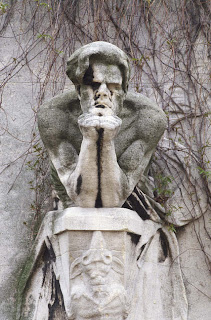
{Photo by Secret Agent Martens.}

I know I rashly wrote yesterday that I was wrapping up my series of posts on ghosts and spirits, but it turns out that just like Jason Voorhees, I'm not quite finished yet. Hallowe'en's still a ways away; who knows how many times I'll lurch back into view with more scares?

From Moby-Dick (1851), by Herman Melville
Though in many of its aspects this visible world seems formed in love, the invisible spheres were formed in fright.
Note how Melville moves from the potential, the seeming, to the definite: what we can see we cannot know, but what we cannot see we know deep in our bones. Good tellers of ghost stories have always known that; as Michel Tournier explains in The Mirror of Ideas (1994),
There is such a thing as an atavistic fear, digging its roots down to an ancestral past sleeping in our hearts; eternal humanity trembles with us in the presence of mystery. . . . It is the darkness itself that frightens--not the monsters hiding in it.
The merest hints of horror catch in the soul; the less a storyteller describes, the less he provides for our rational minds to attack and reject. As M. R. James wrote in "Ghosts--Treat Them Gently,"
On the whole, then, I say you must have horror and also malevolence. Not less necessary, however, is reticence.

Limn lightly the horror--give us, as Peter Ackroyd puts it,
the sudden stillness in a wood, or the sound of footsteps in an empty street
--and we will supply the rest. Even Stephen King, not someone usually associated with reticence, demonstrates that he knows the power of the undescribed when he uses it to create the most chilling moment in 'Salem's Lot. At midnight, a man at the gate of a graveyard raises his voice in prayer to his dark lord, then:
There was no sound but that brought on the breeze. The figure stood silent and thoughtful for a time. Then it stooped and stood with the figure of a child in his arms.

"I bring you this."

It became unspeakable.
By claiming to have come up against the limits of what language will even tolerate, King frees our imaginations to run on the darkest of paths, which of course they will do. For despite what we tell ourselves when encouraged by daylight, as the night steals in we remember that fear is built into the very structure of the universe. All that awaits us is the greater unknown of death. And while we feverishly distract ourselves from its approach, death for its part can afford to be patient.

From The Zurau Aphorisms (2004), by Franz Kafka, translated by Michael Hoffman
The dogs are still playing in the yard, but the quarry will not escape them, never mind how fast it is running through the forest already.
Is it any wonder that we take pleasure, however perverse, in telling ghost stories?

Monday, October 22, 2007

Premonitions and apparitions


{"The Ghost of Bernadette Soubirous," photographer unknown, circa 1890}

Too busy to do any real posting today, but in keeping with the Hallowe'en theme, how about a couple of warnings . . . (cue scary organ music) . . . of impending Death!

The first warning wouldn't have actually been all that helpful, taking as it did the form of barking. It's a memory of a story Thomas Hardy told publisher Sir Newton Flower, collected in Thomas Hardy Remembered (2007), edited by Martin Ray:
Here is an odd thing about [Hardy's dog] Wessex. One November night, William Watkins, who founded the Society of Dorset Men in London, went to call on Hardy after dinner, as was his custom whenever he was in Dorset. It was a night of wild storm. This is Hardy's story of the episode to me:

"For some reason Wessex rushed wildly round the house, growling and barking. He dashed at the front door; then came back again. Watkins and I opened the door, and Wessex ran out into the storm, still barking. I thought there might be marauders about, but we could find nobody. We came in; we got Wessex in. An hour later, Watkins, after a final cup of coffee, went back to his hotel in Dorchester, and died in his bed that night. What did Wessex know?"

Far creepier--though just as impossible to verify--is Alec Guinness's story, from Blessings in Disguise (1985), of meeting James Dean in Los Angeles; as with so many other stories this week, I owe D. J. Enright for including this one in his Oxford Book of the Supernatural:
[O]n the way back to the restaurante he turned into a car-park, saying, "I'd like to show you something." Among the other cars there was what looked like a large, shiny, silver parcel wrapped in cellophane and tied with ribbon. "It's just been delivered," he said, with bursting pride. "I haven't even driven it yet." The sports-car looked sinister to me, although it had a large bunch of red carnations resting on the bonnet. "How fast is it?" I asked. "She'll do a hundred and fifty," he replied. Exhausted, hungry, feeling a little ill-tempered in spite of Dean's kindness, I heard myself saying in a voice I could hardly recognize as my own, "Please, never get in it." I looked at my watch. "It is now ten o'clock, Friday the 23rd of September, 1955. If you get in that car you will be found dead in it by this time next week." He laughed. "Oh, shucks! Don't be so mean!" I apologized for what I said, explaining it was lack of sleep and food. . . . We parted an hour later, full of smiles. No further reference was made to the wrapped-up car. . . . In my heart I was uneasy--with myself. At four o'clock on the afternoon of the following Friday James Dean was dead, killed while driving the car.

A sinister, deadly automobile--sounds like a topic for Stephen King, whose appearance at Fenway Park recently was responsible for this week's delving into the ghostly in the first place.

I'll bring the week of Hallowe'en postings to close--for now!--with a passage from M. R. James's "A School Story." What's great about the passage is that you don't even need to know its context to enjoy the dread that grows through this account of a night visitation:
"I didn't hear anything at all," he said, "but about five minutes before I woke you I found myself looking out of this window here, and there was a man sitting or kneeling on Sampson's window-sill and looking in, and I thought he was beckoning." "What sort of man?" McLeod wriggled. "I don't know," he said, "but I can tell you one thing--he was beastly thin: and he looked as if he was wet all over: and," he said, looking round and whispering as if he hardly liked to hear himself, "I'm not at all sure that he was alive."

In such cases, I recommend that one err on the side of assuming that the creepy stranger is, in fact, not alive.

Finally, for those of you who are bored at work: a Google search on "I don't believe in ghosts, but" is guaranteed to keep you entertained for many an hour. It even led me to a great line supposedly from Edgar Allan Poe, which, though the attribution appears sketchy, does seem apt:
I don't believe in ghosts, but I've been running from them all my life.

Deep, dark well


{Photo by rocketlass.}

Yesterday, following a very pleasant marathon on a beautiful autumn day, I was throwing a frisbee with my father, brother, and nephew in my brother's backyard when I stumbled over a cracked slab of concrete. It was about a two feet long and a foot wide, and though my brother had mowed around it for a couple of years, he'd never looked under it. My father, however, is not the sort to leave an inexplicable slab of concrete uninvestigated, so he started prying it up.

He quickly dislodged the concrete to reveal a narrow well, edged in poorly laid brick and strung across with cobwebs. As he and my brother leaned over to drop a stone into its depths, my mind immediately started running to ghost stories, to the thought of what might have been secreted away in that well, restrained under the slab, and now unwittingly freed to do mischief.

The well was far from ancient, no more than sixty years old--but in our fast-moving culture anything undisturbed for decades begins to seem a likely repository for the ghostly or malefic. What might that well have conjured up for M. R. James, whose characters so often suffer horrible fates simply because of their curiosity about the old and unexplained? I thought of James's story, "A Warning to the Curious," which features a cursed Anglo-Saxon crown, dug up in the dead of night, that must later be reburied at the same fell hour. The man who must rebury it seems possessed:
I never saw anything like the dash with which he flung himself at a particular spot in the side of the mound, and tore at it, so that in a very few minutes the greater part of his body was out of sight. We stood holding the coat and the bundle of handkerchiefs, and looking, very fearfully, I must admit, about us. There was nothing to be seen. . . . Yet, in all this quiet, an acute, an acrid consciousness of a restrained hostility very near us, like a dog on a leash, that might be let go at any moment.
The crown is reburied, but the damage has already been done--despite his furious efforts to rectify his error, the man is ultimately hounded to his death by the spirits he disturbed. What is done can never fully be undone. And as my brother and dad replaced the concrete slab--having, it seems, angered no spirits--I thought of John Bellairs, whose frightening young adult novels so often feature artifacts whose dangers are not immediately apparent; instead, they bide their time before unleashing their deadly powers of fascination. As we left the yard, I warned my brother to beware at least until Hallowe'en, to be sure to fight with all his will against any late-night urge, however innocuous-seeming, to go check out the well.

I don't actually believe any of this. I know that there's nothing in that well aside from spiders and mud. But so much of the fun of stories is a willful succumbing, and so much of what's fun about reading at this time of year is giving in to the idea that maybe we're wrong: maybe our rationality is just a way of closing off possibilities that are too horrifying to think about--a way of setting boundaries to the universe so that we can pretend to be its masters.

I'm reminded of a passage from the introduction to Michael E. Bell's study of New England vampire folklore, Food for the Dead (2001). Bell writes about a course in his first year of graduate school at UCLA taught by folklore scholar Wayland Hand:
My epiphany came the day Wayland told us about the disappearance of giants from Europe. This was not a rapid, catastrophic event like the extinction of the dinosaurs. It was, rather, a more lengthy demise with the final death blow administered by the Industrial Revolution. As Wayland talked about the giants, I noticed that he stopped lookin at us, and his eyes seemed to focus somewhere beyond the windowless walls of our Bunche Hall classroom. His voice, naturally soft, grew softer. He spoke about how Christians stigmatized the giants as devils, in league with Satan. He described how industry's widening circle of smoke and clamor finally pushed the giants from their homes. His voice dropped to a near whisper, and I'm sure I saw tears well up, as he described how the giants shrank, deeper and deeper into the forests and caves. Demonized, and no longer able to find refuge, the giants vanished. When Wayland concluded, It dawned on me that he wasn't talking only about giants no longer appearing in the folklore record. He was describing the extinction of a species. I thought, this is incredible: Wayland Hand, a meticulous, reasoning scholar--a professional folklorist--actually believes in giants.

Of course Hand didn't actually believe in giants--but he did believe, strongly, in stories, which generate their power in part by being just convincing enough that we're temporarily willing to reject reality in favor of their slightly different explanation of the way the world works. As D. J. Enright notes Dr. Johnson saying,
It is wonderful that five thousand years have now elapsed since the creation of the world, and still it is undecided whether or not there has ever been an instance of the spirit of any person appearing after death. All argument is against it; but all belief is for it.

And as the wind whips past my windows, kicking up a rustle of leaves in the cemetery next door, I'm willing--for the length of one story, one novel, one October night--to think that maybe there's something to those hoary old tales. There may not have been anything in the well yesterday, but maybe we were just lucky. In a different story, on a different day . . .

Thursday, October 18, 2007

Some revenants


{"Ghost Stories," photo by Santheo.}

From "The Dreamers," by Isak Dinesen, in Seven Gothic Tales (1934)
The still night was bewildering in its deep silence and peace, as if something had happened to the world; as if the soul of it had been, by some magic, turned upside down. The free monsoon came from far places, and the seas wandered on under its sway, on her long journey, in the face of the dim luminous moon. . . . The waves looked solid, as if one might safely have walked upon them, while it was into the vertiginous sky that one might sink and fall, into the turbulent and unfathomable depths of silvery worlds, of bright silver or dull and tarnished silver, forever silver reflected within silver, moving and changing, towering up, slowly and weightless.


From "Young Goodman Brown," by Nathaniel Hawthorne, in Mosses from an Old Manse (1846)
"Dearest heart," whispered she, softly and rather sadly, when her lips were close to his ear, "prithee put off your journey until sunrise and sleep in your own bed to-night. A lone woman is troubled with such dreams and such thoughts that she's afeard of herself sometimes. Pray tarry with me this night, dear husband, of all nights in the year."


From "A Useless Window," by Carrie Olivia Adams, in A Useless Window (2006)
Other,

are you hearing this?
The night sky dims:

We will lose our way
in these red chambers.

Our palms with the look
of blood already.


From Religio Medici (1643), by Thomas Browne, collected in The Oxford Book of Death (1983), edited by D. J. Enright:
I believe . . . that those apparitions and ghosts of departed persons are not the wandring souls of men, but the unquiet walks of Devils, prompting and suggesting us unto mischief, blood, and villainy; instilling and stealing into our hearts that the blessed Spirits are not at rest in their graves, but wander solicitous of the affairs of the World. But that those phantasms appear often, and do frequent Cemeteries, Charnel-houses, and Church, it is because those are the dormitories of the dead, where the Devil, like an insolent Champion, beholds with pride the spoils and Trophies of his Victory over Adam.


From "The Double," by Jorge Luis Borges, in The Book of Imaginary Beings (1967, 2005 translation by Andrew Hurley):
In Germany, it is called the Doppelganger; in Scotland, the fetch, because it comes to fetch men to their deaths.


From Certain of the Chronicles, by Levi Stahl

Hither and Yon,
or,
I, Doppelganger


One darkling October
I met myself going--
When I was a-coming,
I met myself going.

I looked me all over
With no way of knowing
As I was a-coming
Where I could be going.

But I knew 'tweren't right
So I took all affright
And scattered my bones
In the depths of the night,

And scattered my bones
In the depths of the night.

"There are terrible spirits, ghosts, in the air of America."


{Etching for The Inferno by Gustave Doré}

So said D. H. Lawrence in a 1924 piece on Edgar Allan Poe. One would think that Lawrence ought to know a thing or two about vampires. He suffered from tuberculosis, the disease often thought to be at the root of a lot of vampire lore, and he was relentlessly concerned with issues of sex, power, the will, and transgresion, concepts that are central to vampire stories. Who knows--maybe Lawrence even was a vampire? Maybe I should ask Geoff Dyer what he thinks?

Jean-Jacques Rousseau, on the other hand, was a determined skeptic, taking up the topic in a letter to Christophe de Beaumont, Archbishop of Paris, in 1763:
If there is in the world one attested story it is that of the Vampires. Nothing is missing: proces-verbaux, certificates from Notabilities, Surgeons, Priests, Magistrates. The juridical proof is most complete. With all this, who believes in Vampires? Shall we all be damned for not having belived?

I found both the above quotes in The Oxford Book of the Supernatural (1994), which is edited by D. J. Enright and, like any Enright production, is jammed full of endlessly quotable stuff. Sadly, it's out of print, but it's readily available used. I'll probably try to steal more from it between now and Hallowe'en, but for today I'll just give you Enright's rundown of some reported causes of vampirism:
The sins and misfortunes reckoned to lead to the condition have included some weird items: committing suicide, of course, but also working on Sundays, smoking on holy days, drinking to excess, and having sexual intercourse with one's grandmother; more innocently, those born on Christmas Day are doomed to the same fate in punishment of their mothers' presumptuousness in conceiving on the same day as the Virgin Mary.
Though I don't know any . . . ahem . . . grandmotherfuckers, a couple of other items on that list, if accurate, would lead me to conclude that there must be more vampires out there than I had previously thought.

Do you think that buzzing a vampire into the foyer counts as inviting him in? The Wikipedia is unhelpfully silent on the topic. Methinks I'll eschew the buzzer at least until Hallowe'en has passed. And regardless, I'm going to have to be more careful about whom I invite over to our baseball open house.

Wednesday, October 17, 2007

Entering October Country


{Purported nineteenth-century kit for killing vampires, made by a Professor Ernst Blomberg.}

After seeing Stephen King slagging Fox Sports during Friday's Red Sox-Indians game, I decided to honor his forthrightness by reading 'Salem's Lot (1975). Back in high school, I plowed through thousands of pages of King's novels, but aside from The Colorado Kid (2005), the novella he published with Hard Case Crime, which I wrote about here, I hadn't read anything by him for fifteen years. As a teenager, I had found his books terrifying, impossible to put down--even brilliant. But what would I think as an adult?

The verdict? Still frightening. Still hard to put down. And, while 'Salem's Lot certainly isn't brilliant, I'm not disappointed.

King made his name by injecting horror into carefully drawn scenes of everyday life. The nightmares in his novels are frightening precisely because he's locating them in the most innocuous of small towns--but, as writers from Sherwood Anderson on have reminded us, small towns teem with dark secrets. (King even name-checks Anderson and Edward Arlington Robinson--an odd coincidence, since I'd just been reading about both in Edmund Wilson.) He shows how easily an uncanny, supernatural evil can prey on, exploit, or even arise from the ordinary meanness and evils of small-town life. In the case of 'Salem's Lot, that evil takes the form of a millennia-old vampire, the perfect creature, metaphorically, to feed on the late-night, basement, and close-shuttered underbelly of a town.

In the early part of the novel, King depicts a Maine town that despite its 1970s setting seems trapped in the late '50s: boys still build models of Universal movie monsters, teens still hang out at the soda shop, men still live in a boarding house. Yet, as King himself acknowledges in his Introduction, where he admits, "I have always been more a writer of the moment than I wanted to be," the creeping malaise and toxicity of the early '70s are never far from the surface.

King spends a lot of energy and pages establishing the town and its people, and though his dialogue frequently ends up sounding a bit too much like Sheriff Tupper telling Miss Fletcher about the strange doings in Cabot Cove, for the most part his work establishing characters pays off. His creations don't always come to life--the three primary male characters are essentially interchangeable--but when they do they nudge us just enough farther in our suspension of belief to tip the scales from shock to horror. This line from a boy whose father has just been killed is a good example, rendered simultaneously sad and chilling by the fact that we've come to trust the boy's precocious perceptiveness:
It's better this way. My father . . . he would have made a very successful vampire. . . . He . . . he was good at everything he tried. Maybe too good.

Once the action starts, King slathers on the gore, as he is wont to do. But what's much scarier are the quiet moments when fear first enters a room. Take this scene, where a young woman sits in the kitchen of her old English teacher's house, trying to convince him that he had not heard a vampire sucking dry his houseguest the previous night. As they talk, he breaks in:
"Be quiet."
He had cocked his head forward. She stopped talking and listened. Nothing . . . except perhaps a creaky board. She looked at him questioningly, and he shook his head. "You were saying."
Moments later, midsentence,
He ceased again, listening.

This time the silence spun out, and when he spoke again, the soft certainty in his voice frightened her. "There's someone upstairs."
The "soft certainty" of those moments when the trustworthy and rational convince us that it's time we start believing the unbelievable are King at his best.

I was surprised to find that King is also quite good at describing the landscape and the play of the seasons. Though his prose in these passages sometimes tiptoes to the edge of purple, it rarely crosses over, despite his efforts to invest the whole of nature with a human dread. Here he writes of a Maine autumn:
It stays on through October and, in rare years, on into November. Day after day the skies are a clear, hard blue, and the clouds that float across them, always west to east, are calm white strips with gray keels. The wind begins to blow by the day, and it is never still. It hurries you along as you walk the roads, crunching the leaves that have fallen in mad and variegated drifts. The wind makes you ache in some place that is deeper than your bones. It may be that it touches something old in the human soul, a chord of race memory that says Migrate or die--migrate or die. . . . And if there are no cars or planes, and if no one's Uncle John is out in the wood lot west of town banging away at a quail or pheasant; if the only sound is the slow beat of your own heart, you can hear another sound, and that is the sound of life winding down to its cyclic close, waiting for the first winter snow to perform last rites.

'Salem's Lot gets less interesting as the ratio of humans to vampires begins to fall; it becomes a race to an end that we can see coming--there are only so many ways to kill a vampire, after all. But that's nothing like the galactic disappointment I felt at sixteen at the end of 1,100 pages of It, nor is it a disingenuous abjuration of the very idea of an ending, like he employed in The Colorado Kid, so I won't complain.

But now it's a drizzly, windy October night, and it seems wrong to read something that's not scary. Time to curl up with my well-loved copy of The Oxford Book of the Supernatural and some M. R. James. No sneaking up on me, please.

Monday, October 15, 2007

Ignorance and Impudent Puppies, or, A Postscript to Edmund Wilson Week

Though I'll continue reading away at the new Library of America volumes here and there for a good long while, I'll close Edmund Wilson Week with two entries from James Laughlin's wonderful autobiography in scrapbook form, The Way It Wasn't (2006):
WILSON, EDMUND

F. Scott Fitzgerald's The Crack-Up went through about five printings and we keep it in print. But it got me in Dutch with Edmund Wilson because the papers came from him and I didn't show him proofs until it was too late. He had systematically crossed out the name of every friend they'd had at Princeton, though the book said nothing bad about them. And I put the names back in, John Peal Bishop and this one and that one. Edmund wrote to me on one of his cards, "You are an impudent puppy."


Which isn't as bad as the assessment of Wilson himself that one of Laughlin's authors delivered:
DAHLBERG

DREADFUL EDWARD

I should have spotted from something he said when I first took him out to lunch that Edward Dahlberg was going to be a problem. Over a BLT on 4th Street (no New Directions author has ever been lunched at the Four Seasons) Edward told me, quite seriously, that Edmund Wilson was "a very ignorant man."

Sunday, October 14, 2007

"Vaudeville has alway been an American specialty," or, Edmund Wilson Week concludes

Earlier this week I gave Edmund Wilson the edge in moral standing over V. S. Naipaul, because Wilson's pointed critiques of the work of his friends Ring Lardner and Scott Fitzgerald were delivered when the men were alive and could respond--either with anger or, what was surely Wilson's hope, better writing--while Naipaul's dismissal of his friend Anthony Powell's work appeared only after Powell was safely dead. To be fair, therefore, I should write about another piece in the first Library of American volume of Wilson's critical work, "The All-Star Literary Vaudeville," which he published anonymously in a multi-authored collection called American Criticism (1926). In it, Wilson runs through seemingly every working writer of the period, totting up their many faults and their relatively few successes. His opening disclaimer, that
he feels a certain human sympathy with all [the American literary movement's] manifestations, even with those of which, artistically, he disapproves
and that he has,
for his own satisfaction, for the appeasement of his own conscience, made an attempt to draw up a balance-sheet of his opinions in regard to his contemporaries, not merely in disparagement of those whom he considers rather overrated but in justice to those he admires,
falls a little flat when cloaked in anonymity. Say what you will about the reviewing approach of Dale Peck, but he at least signs his name to his bloodbaths.

Wilson further compromises himself with the closing sentence of that initial paragraph:
If he succeeds in disturbing one editor or reviewer, in an atmosphere where now for some time politeness and complacency have reigned, he will feel that he has not written in vain.
That stated desire to provoke seems even more to require that Wilson be up-front about his identity; if he felt, as he apparently did, that the world of reviewing had grown too comfortable, then he ought to have been willing to accept some of that discomfort as the price of honesty. That he wasn't is understandable, but at this distance of years it's difficult to excuse, both on his part and on the part of his editor. (Alongside of all this is the question of just who Wilson would have fooled. I may have to pick up a biography to see how quickly he was outed--the piece certainly reads like Wilson's usual work.)

It's easy to see why the essay, properly attributed, would have made for uncomfortable cocktail parties. In a note to The Shores of Light, the collection in which it was reprinted in 1952, Wilson mentions that Maxwell Bodenheim described him as "a fatuous policeman, menacingly swinging his club," and it's hard to disagree--even though Wilson also notes that he "qualified or softened" some of his initial judgments for the reissue. To take a few:
Dos Passos is ridden by adolescent resentments and seems given to documenting life from the outside rather than knowing it by intimate experience.

Sinclair Lewis, with a vigorous satiric humor, has brought against certain aspects of American civilization an indictment that has its local importance, but, when one has been through Main Street and Babbitt, amusing though they certainly are, one is not left with any appetite to reader further novels by Lewis: they have beauty neither of style nor of form and they tell us nothing new about life.

To follow the moral disintegration of Hurstwood in Sister Carrie is to suffer all the agonies of being out of work without being rewarded by the aesthetic pleasure which art is supposed to supply.

Vachel Lindsay's best poems . . . are spoiled by the incurable cheapness and looseness which are rampant in the rest of his work.

[Eugene] O'Neill is hysterically embittered.

Robert Frost has a thin but authentic vein of poetic sensibility; but I find him excessively dull, and he certainly writes very poor verse.

H.D., like Carl Sandburg, writes well, but, like Sandburg, there is not much in her.

Even H. L. Mencken, whom Wilson claims is "underrated as a writer of English prose" and whom he calls "perhaps a prophet rather than a critic," comes under fire for his ideas, which are "neither many nor subtle."

Yet once we get over the shock of Wilson's baldly brutal phrases, his opinions hold up pretty well eighty years later. As an Illinoisan, I'm supposed to leap to the defense of Dreiser, Sandburg, and Lindsay, but the only one of the three I've ever found congenial is Sandburg, and even there I have to agree with Wilson, who locates Sandburg's appeal in his skill with language, while lamenting that "his ideas seem rather obvious, his emotions rather meager." I can't speak to his assessments of H. D. or Dos Passos, not having read them, but his take on Sinclair Lewis is dead-on, succinctly marking the difference between the satire of Lewis and the richer, more pointed, and better-written work of Evelyn Waugh. Moreover, two of the writers whom Wilson chooses to single out for unmitigated praise, Edith Wharton and Stephen Crane, have only seen their reputations grow since the '20s.

Wilson does make some mistakes, of course. Frost he misjudges--I could see how one might deem some of Frost's story-like poems as "poor verse," but I don't understand how he could be viewed as dull. Wilson undervalues Marianne Moore, seeming not to get her organic strangeness, while Edna St. Vincent Millay (with whom he'd conducted a disastrously passionate affair) he overrates slightly, calling her "perhaps one of the most important of our poets." Edward Arlington Robinson, meanwhile, whom he heralds as "one of the poets of our time most likely to survive as an American classic," has survived, but feels remarkably dated; in fact, it's hard to see how he wouldn't have already seemed a bit musty in the late '20s.

What I find most surprising in "The All-Star Literary Vaudeville," however, is just how many of the poets and writers of the period have survived. Very few of the artists Wilson notes are entirely unfamiliar, and the majority of them would be recognized by even a relatively casual fan of American literature. Wilson's individual assessments--correct or not--aren't as interesting in themselves as they are as a whole, the record of a period of impressive creative flowering as it appeared, in the moment, to a particularly astute reader whose general interests and tastes we already know. Quibble with Wilson as I will over his failure of nerve, I'm glad to have this record. And his dazzling closing paragraph, a perfect example of his way with brief, effective descriptions, is so good as to almost make me forgive him his anonymity:
When time shall have weeded out our less important writers, it is probably that those who remain will give the impression of a literary vaudeville: H. L. Mencken hoarse with preaching in his act making fun of preachers; Edna St. Vincent Millay, the soloist, a contralto with deep notes of pathos; Sherwood Anderson holding his audience with naive but disquieting bedtime stories; Theodore Dreiser with his newspaper narrative of commonplace scandals and crimes and obituaries of millionaire, in which the reporter astonishes the readers by being rash enough to try to tell the truth; T. S. Eliot patching from many cultures a dazzled and variegated disguise for the shrinking and scrupulous soul of a hero out of Henry James.
And if those writers are the vaudeville acts, Wilson places himself in the role of their emcee, or possibly their clown. I can't help but imagine him typing that last period, then wiping his brow and taking a tiny little bow.
Friday, October 12, 2007

We interrupt Edmund Wilson Week with this Important Update from Fenway Park


{Photo by rocketlass.}

Early in tonight's Red Sox-Indians game at Fenway Park, the dreadful Fox TV cameras spotted lifelong Sox fan Stephen King reading in the stands. Now, as I've admitted before, I read at the ballpark--but only when I'm alone, and only between innings. King, on the other hand, was reading during the game.

He fully redeemed himself later, though. When sideline reporter Chris Myers sat next to him and asked him about being caught reading, King responded:
The great thing about baseball is that you can get eighteen pages read just in the inning breaks. And now that Fox is doing the games, you can read twenty-seven pages because the commercial breaks are longer!

In honor of King's performance, I may finally have to act on my vague, long-standing, inexplicable urge to read Salems Lot. It's the right time of year for vampire stories, after all.

Postscript:
Too bad the Red Sox weren't playing the Yankees--Stephen King could probably have written a whole novel about their zombie problem.


{Animated gif of Zombie Shelley Duncan by rocketlass.}

"These luminosities are too low-burning and evanescent," or, Edmund Wilson Week Continues!

A the end of the week, I'm in the same spot where I began it: still reading through the first of the two new Library of America volumes of Edmund Wilson's literary essays. I'm enjoying reading Wilson as much for his style as for his insight. He writes long sentences that perpetually shift and redirect themselves, subordinate clause leading to subordinate clause—perhaps interrupted by an interjection—leading to another clause until, at the end, the reader emerges from the thicket of thought to see, just ahead, clear and shining and difficult to dispute, Wilson's point.

Here, for example, is his somewhat arch take on Hart Crane, from the May 11, 1927 issue of the New Republic:
Mr. Crane has a most remarkable style, a style that is strikingly original--almost something like a great style, if there could be such a thing as a great style which was, not merely not applied to a great subject, but not, so far as one can see, applied to any subject at all.
Not to appear to claim too much for myself, but if you've read much of this blog, I think you'll see why I find Wilson's prose congenial. It might even seem that I've used him as a model, but much as I enjoy his writing, I discovered it long after I'd discovered (and begun to abuse) the comma, semicolon, and all the glorious constructions they enable.

However, just as Wilson is sometimes wrong in his judgments, he is also sometimes guilty of an offense with which Stacey frequently charges me: he writes sentences that, however clear, are just too damned long. Take this monstrosity, from earlier in the piece quoted above:
Mr. E .A. Robinson's Tristram has been extravagantly admired in some quarters; but, though it is undoubtedly more easily readable than his other Arthurian poems, though it contains a better story more energetically told and though it is by no means poor in those flashes of moral vision that make the weaker poems of Robinson more interesting than the strongest of many of his contemporaries, it seems to me that these luminosities are too low-burning and evanescent to justify the whole of a long narrative that reads at its worst like a movie scenario and at its best like a novel of adultery of the nineties, full of long well-bred conversations of which the metaphysical archness sounds peculiarly incongruous in the moths of the heroes of medieval legend.
There really ought to be a break for cocktails in there somewhere around "moral vision"; otherwise, it seems cruel to ask anyone to endure the forced march that follows "low-burning and evanescent."

Those overstuffed nightmares are relatively rare, however, and more than made up for by lines like these further comments on Hart Crane, which benefit from Wilson’s habit of delaying the payoff:
His poetry is a disponible, as they say about French troops. We are eagerly waiting to see to which part of the front he will move it: just at present it is killing time in the cafes behind the lines.

None of this would matter, however, if Wilson weren’t an interesting and acute reader of literature. The conclusion of his “Poe at Home and Abroad,” for example, both situates Edgar Allan Poe and notes the sources of his power:
It was Poe who sent out the bridge from the romanticism of the early nineteenth century to the symbolism of the later; and symbolism, as M. Seylaz points out, though scarcely any of its original exponents survive, now permeates literature. We must not, however, expect that Poe should be admired or understood in his capacity of suspension across this chasm by critics who are hardly aware that either of its banks exist.

Earlier in that piece, which is from the December 8, 1926 issue of the New Republic, Wilson writes:
[T]he real significance of Poe’s short stories does not lie in what they purport to relate. Many are confessedly dreams; and, as with dreams, though they seem absurd, their effect on our emotions is serious. And even those that pretend to the logic and the exactitude of actual narratives are, nevertheless, also dreams.
Who knew that Wilson could write like Borges?

As interesting and thoughtful as Wilson’s piece on Poe is, it’s still not as pithy or unforgettable as this dual description of Poe and Twain by V. S. Pritchett, who these days may be my favorite critic:
Everything really American, really non-English, comes out of that pair of spiritual derelicts, those two scarecrow figures with their half-lynched minds.
Though "spiritual derelicts" is satisfyingly apt, I will admit to being a bit vague about what Pritchett means by “half-lynched minds.” But the phrase does possess a certain emotional power and rightness not unlike that achieved by the best of the aforementioned Symbolists, who, as Wilson explains:
contrive[d] to communicate emotions by images whose connection with the subject and whose relevance to one another we may not always understand.


Pritchett’s description stands in the shadow of Hemingway’s mannered, six-words-too-long assessment of Twain’s greatest book:
All modern American literature comes from one book by Mark Twain called Huckleberry Finn.
Hemingway's line is such a commonplace now as to have lost any force it might once have had, but Pritchett’s, eerie and sidelong, retains its power. With one sentence, he changed forever how I will approach both Twain and Poe. In my reading so far, Wilson hasn't delivered any judgment quite so stiletto-sharp, but he's opened up new ways for me to think about writers I enjoy. To a critic who can do that, I'll gladly raise my glass; it's what all of us who write about books aim for, and any day in which we succeed can surely be counted a good one.

Wednesday, October 10, 2007

Baudelaire, Borges, and the devilish--as Edmund Wilson Week continues!


{Charle's Baudelaire's monument in the Cimetiere du Montparnasse.}

In a piece on the decadent writers for the New Yorker from October 1923, collected in the first of the new Library of America volumes, Edmund Wilson writes,
The school which began with Baudelaire and is now dissolving with Arthur Symons derived its principal force from its constant conviction of sin. The decadents talked much about "paganism," but their point of view was not pagan: it was a reaction against Victorian Christianity by people who were still Christians and Victorians. . . . How can you believe that sin is "the good" and at the same time believe it to be sin? From the point of view of the person who is really convinced of the sinfulness both of the pleasures of the flesh and of the play of the intelligence, they are things to be sedulously shunned; from a point of view really pagan, they do not become an issue at all. Baudelaire had to pretend to take the Devil seriously while he was spending his artistic life endeavoring to make him attractive; and his successors followed his example.

Wilson has hit upon the primary problem with rebellion as a position in general: a significant part of the attraction of rebellion is--and, it seems clear, always has been--simply doing what one is not supposed to do. Yet that very pleasure can only occur if one allows that the rules one is breaking have some essential power. What's fun is to realize that Wilson wrote this from the heart of the rebellion that was 1920s Greenwich Village--and that he and his milieu were not even that distant in time from the decadents about whom he was writing. Baudelaire had been long dead, but Aubrey Beardsley, Oscar Wilde, and Paul Verlaine, to take a few, had only died--and thus left off outraging society--twenty-five years or so earlier. When Wilson goes on to write that Baudelaire, like other fin-de-siecle writers, seems diminished now--that we can't read them
with the enthusiasm of their contemporaries. The effectiveness of the subjects dealt with depends on one's being shocked by them, and when the prejudices to be baited have been removed, the works of art are no longer exciting.
--an unspoken question lingers: If those artists' creations had, in a sense, been assimilated in such a short time, what clues did that give about the fate of the more outre works--and lives--of Wilson's own contemporaries?

For all his careful contextualization, however, Wilson never goes so far as to outright dismiss Baudelaire. For that, we have to turn to Borges, who, in a letter to his friend Adolfo Bioy Casares, positively erupts on the topic:
It is ridiculous to fill literature with cushions and furniture and show evil in a positive light. Baudelaire helps one gauge whether a person understands anything at all about poetry, whether he is an imbecile or not: anyone who admires Baudelaire is an imbecile.

If Borges is limiting the category of imbecile to people who admire Baudelaire, then I escape easily. But if--as seems likely from the context--by "admire" Borges actually means "enjoy," then an imbecile I am, at least once in a while. I suppose there are worse things to be--like maybe a devil?


Tuesday, October 09, 2007

Picturing Edmund Wilson, only more raffish and disreputable


Does it mark me as irredeemably weird that when I see the above photo of a young Edmund Wilson, all I can think is that he needs a slim Douglas Fairbanks mustache?


Especially given that Wilson's social set would have balked at facial hair at that time, wouldn't such a carefully groomed appendage replace his somewhat off-putting air of sheltered uprightness--even preciousness--with a satisfying hint of raffish disdain?

I suppose I could be wrong--I am not, after all, one to argue in favor of mustaches on most faces. A mustache on Edmund Wilson could easily end up more like this description of some middle-aged, mendicant orphans from Anthony Powell's From a View to a Death (1933):
Hair grew on their faces but not successfully. It was sporadic, and in the case of one of the Orphans only was it of sufficient density to form a moustache. Nor was this entirely satisfactory as a feature on account of its colour and unpleasant texture.


Then I imagine Wilson delivering himself of a passage like this one--
I cannot accept the opinion of Mr. Maurice Hewlett and others who have asserted that the new collection of Byron letters, Lord Byron's Correspondence . . . only supply more conclusive evidence that Byron was a "blackguard" and a "cad." This is to simplify the matter too much. It is to assume that when Byron writes "Maid of Athens, ere we part, Give oh give me back my heart!" in one breath and in the next tells Hobhouse that "the old woman, Theresa's mother, was mad enough to imagine that I was going to marry the girl, but I have better amusement," and when he sneers at his wife in his private correspondence, not long after having written, "even though unforgiving, never 'Gainst thee shall my heart rebel, he is sincere in his cynicism but not in his warmth of emotion. It is to assume that one cannot take a personal relation with cynicism and seriousness at the same time--that Childe Harold and Manfred do not represent realities of Byron's experience as well as Don Juan.
--the bristles of a slender mustache trembling all the while, and I begin to think that such an addition might well push him all the way over into priggishness, which would be too bad, since his position on Byron in that passage does, after all, seem eminently reasonable.

Alas, just as with my desire to hear how Frank Sinatra would have sounded had he, rather than Ray Charles, recorded Modern Sounds in Country and Western Music, we'll never know. Such are the minor tragedies of history.

"I have supressed the worst of my aberrations."


Oh, these are going to be fun: the Library of America has just issued two volumes of Edmund Wilson's literary essays and reviews. Just flipping through the first volume, I find, appropos of my realization yesterday that I needed to read more Edith Wharton, from the March 1923 issue of Vanity Fair:
Has Mrs. Wharton ever been given her rightful place as the foremost of living American novelists and one of the foremost living novelists of the world?
I don't know whether she reached that point during her lifetime, but her critical standing seems pretty solid now. Then, as if Wilson knows exactly what to write to get me to clap my hat on my head and light out for the bookshop, he continues,
Has Thomas Hardy ever done anything better than Ethan Frome?

Then there's a piece on Ring Lardner from the July 1924 issue of the Dial. Wilson takes Lardner, whom he, along with Fitzgerald, counted as a friend, to task for "being timid about coming forward in the role of serious writer." Comparing Lardner to Sinclair Lewis, he writes,
[W]hen Lardner comes closest to Lewis, as in the story called The Golden Honeymoon, he is less likely than Lewis to caricature, and hence to falsify, because he is primarily interested in studying a kind of person rather than in drawing up an indictment
--which seems to perfectly describe both Lardner's sympathetic openness and Lewis's brutally accurate satire, so vicious it's draining. But Wilson goes even farther, first leveling some more pointed criticism before taking what even eighty years later seems a breathtaking leap:
For all his saturnine tone, his apparent scorn of vulgar values, he seems committed to popular journalism. He does not even care to admit that he has tried to do work on a higher level. . . . Yet he would seem to come closer than anyone else among living American writers to possessing the combination of qualities that made Huckleberry Finn a masterpiece.
The whole essay reads as what it surely was meant to be: a direct, public challenge to a talented writer who was not, in Wilson's opinion, measuring up.

Sadly, we already know the answer to the question Wilson asks later,
Will Ring Lardner, then, go on to his Huckleberry Finn or has he already told all he knows?
For what Wilson wonders about in prospect in 1924, Fitzgerald would wonder about his friend in retrospect less than a decade later, in the obituary appreciation of Lardner that I wrote about recently. "So one is haunted," Fitzgerald wrote, "not only by a sense of personal loss but by a conviction that Ring got less percentage of himself down on paper than any other American of the first flight."

In my earlier post on that obituary, I pointed out that as Fitzgerald was writing about Lardner, surely he also was thinking about his own frittering away of his talent. And in fact, two years before challenging Lardner, Wilson had publicly challenged his friend Fitzgerald, too, who had just published his second novel, The Beautiful and the Damned (1922):
[H]e has been given imagination without intellectual control of it; he has been given the desire for beauty without an aesthetic ideal; and he has been given a gift for expression without very many ideas to express.
That's candidness to the point of brutality, and I wonder how Fitzgerald took it. (A task for my next library visit!) But even as he calls This Side of Paradise (1920) "a preposterous farrago," slashes Fitzgerald for his slack language, and even mixes in some personal criticism--"Conversations about politics or general ideas have a way of snapping back to Fitzgerald"--Wilson is clearly aiming to urge his friend to push past what is easy or comfortable. To that end, he mixes in serious, though measured praise. This Side of Paradise is "exciting" and "animated with life," and
[I]t would be quite unfair to subject Scott Fitzgerald, who is still in his twenties and has presumably most of his work before him, to a rigorous overhauling. His restless imagination may yet produce something durable.
He saves his strongest praise for the conclusion, where, though still couched in doubts, it obviously points a possible way for his friend to better understand--and thus deploy--his own talent:
But, in any case, even the work that Fitzgerald has done up to date has a certain moral importance. In his very expression of the anarchy by which he finds himself bewildered, of his revolt which cannot fix on an object, he is typical of the war generation--the generation so memorably described on the last page of This Side of Paradise as "grown up to find all gods dead, all wars fought, all faiths in men shaken."

It's interesting to come across this pair of essays a week after
I lamented the news
that V. S. Naipaul dismisses the work of his longtime friend Anthony Powell in his most recent collection; while both writers are harshly criticizing friends, their differences in moral standing in doing so seem stark.

Powell, after all, is dead; nothing Naipaul says will make him a better writer. And while it is not incumbent on everyone to avoid speaking ill of the dead, a friend should surely hold fire in all but the most extraordinary circumstances. Though I've not yet read Naipaul's piece on Powell, his striking lack of generosity--especially when set in contrast to Fitzgerald's honest yet appreciative assessment of Lardner--will render it extremely difficult to approach without distaste, and even doubt.

Wilson's words, on the other hand, though surely hurtful at the time (possibly even unnecessarily so, as there's a sense in both essays of the brash overconfidence of youth, of words running away with him) are far easier to justify, aimed as they were at the stimulation of talents that he clearly admired--and delivered while the men were still around to take issue with them or even prove him wrong. It's easy to imagine both Fitzgerald and Lardner cursing Wilson, maybe even to his face, but it's hard to imagine them dismissing his critique out of hand.

Sunday, October 07, 2007

The Touchstone


It was lines like this--
Through the open door he saw young Hollingsworth rise with a yawn form the ineffectual solace of a brandy-and-soda and transport his purposeless person to the window
--that had me asking, less than two pages into Edith Wharton's novella The Touchstone (1900), why I'd not read more of her books. Until I picked up this one at the Melville House booth at the Brooklyn Book Festival, the only Wharton I had read had been a pleasantly creepy volume of her ghost stories. I'm going to have to rectify that, and soon.

The Touchstone is brief, but full of interesting thoughts about honor, honesty, and intimate relationships, all related in well-honed prose. Take this description of a wealthy book collector, which leaves us in no doubt as to the sort of man he is:
Some people are judged by their actions, others by their ideas; and perhaps the shortest way of defining Flamel is to say that his well-known leniency of view was vaguely divined to include himself. Simple minds may have resented the discovery that his opinions were based on his perceptions; but there was certainly no more definite charge against him than that implied in the doubt as to how he would behave in an emergency, and his company was looked upon as one of those mildly unwholesome dissipations to which the prudent may occasionally yield.


Even her more descriptive passages often reveal character; here her protagonist, Glennard, with a lost love on his mind, returns home:
In his sitting room, the tacit connivance of the inanimate had centred the lamp-light on a photograph of Alexa Trent, placed, in the obligatory silver frame, just where memory officiously reminded him, Margaret Aubyn's picture had long throned in its stead.
Glennard is trying not to think about the late Margaret Aubyn because she used to love him and he has a cache of her letters to him--a cache that, because she was a famous writer, could be sold to a publisher, solving his money problems and making possible his marriage to the woman whose photo has displaced hers. Knowing that he is betraying a trust, he sells the letters, and what follows is an unshakable, obsessive guilt that comes close to destroying the very marriage that his betrayal enabled.

Wharton describes Glennard's states of mind, and in particular the emotions and deceptions that fuel his discussions with his wife,with a penetrating acuity similar to that of Henry James--but without the sense one gets from James of an extended worrying about a point before landing on it, like a dog turning circles before lying down. Instead, Wharton's sentences are balanced and precise, and her metaphors, while striking, are clear and insightful. Here, for example, in the midst of an argument with his wife, Glennard realizes he has been too harsh, angering her:
He felt her close on him, like a panting foe; and her answer was a flash that showed the hand on the trigger.
And later, when Glennard finds himself on the verge of confessing his guilt to his wife, their conversation tiptoes up to the revelation, and
something in her voice made him feel that he and she stood at last in that naked desert of apprehension where meaning skulks vainly behind speech.
Other novelists of dialogue as combat, such as Barbara Pym or Ivy Compton-Burnett, leave the emotional ground underlying conversation up to the reader to infer; Wharton instead draws out every shift in that terrain with a marriage counselor's focus on nuance and intention.

So Melville House's Art of the Novella series is now two for two, and it's set me on the Wharton trail. But where next--The Age of Innocence or Ethan Frome?

Friday, October 05, 2007

Some devils


James Hogg's odd little novel of dark, supernatural religion, The Private Memoirs and Confessions of a Justified Sinner (1824) tells the tale of a Scottish family whose two sons are raised in starkly opposing fashion. The elder, George, is raised by the father and given no religious instruction; he becomes a relatively ordinary, carefree, slightly dissolute young carouser, neither particularly good nor particularly bad. The younger, Robert, is raised by the mother and a Minister who is her secret paramour--both strict Calvinists--and taught from a young age that he is one of the elect, destined to be saved, and that no action he takes on earth can change his status as a chosen favorite of God. The novel tells of the elder brother's death at the hands of the younger, and along the way it offers dark reflections on faith, certainty, fanaticism, and religion itself.

The brothers, always different, truly begin to part ways when Robert, the Calvinist, meets an intelligent, worldly, charming man of about his own age who becomes his closest friend and mentor. The friend, who staunchly supports the concept of predestination, tells Robert:
Religion is a sublime and glorious thing, the bond of society on earth, and the connector of humanity with the Divine nature; but there is nothing so dangerous to man as the wresting of any of its principles, or forcing them beyond their due bounds: this is of all others the readiest way to destruction.
A sensible warning--but the friend offers it in the course of urging Robert to murder the man in cold blood for preaching a heretical gospel of piety and good works. The action might seem reprehensible, he admits, but as the man is preaching lies, his death would further God's plan--and, he is quick to remind Robert, as one of the elect Robert need not fear eternal judgment for any earthly action.


The friend, as you have surely guessed, is the devil, and I've not encountered a more seductive devil since Milton ennobled Lucifer. As in the above statement, he mixes lies and truth in toxic fashion, turning meaning on its head and playing deftly on his victim's self-regard and self-confidence. As he explains soon after he first meets Robert:
My countenance changes with my studies and sensations. . . . It is a natural peculiarity in me, over which I have not full control. If I contemplate a man's features seriously, mine own gradually assume the very same appearance and character. And what is more, by contemplating a face minutely, I not only attain the same likeness, but, with the likeness, I attain the very same ideas as well as the same mode of arranging them, so that, you see, by looking at a person attentively, I by degrees assume his likeness, and by assuming his likeness I attain to the possession of his most secret thoughts. This, I say, is a peculiarity in my nature, a gift of the God that made me; but whether or not give me for a blessing, he knows himself, and so do it. At all events, I have this privilege,--I can never be mistaken of a character in whom I am interested.
That perceptiveness, supported by a seemingly straightforward--if horrifying--rationality and clarity of purpose make him a chilling figure. All he's doing, after all, is taking the hideous, self-serving doctrine in which Robert already believes (as did many Scots, which is what drove Hogg to write the book in the first place) and pushing it to its logical conclusions. There is in Hogg's devil none of the self-loathing of Milton's Lucifer--no "Which way I fly is Hell; myself am Hell" here. Instead, Hogg's devil is cold purposefulness incarnate; his urging to Robert on their path to murder could be adopted as a universal fanatics' creed:
Let us be up and doing in our vocation. For me, my resolution is taken, and I never for a moment lose sight of it.


I hope to write more about Confessions of a Justified Sinner later this month--particularly on how it relates to The Testament of Gideon Mack, another Scottish novel published, consciously in its shadow, earlier this year. For now, though, I'll switch gears and leave you, not with a seductive devil who subtly invites your complicity, but with one of his more demonstrative brethren.


I owe Larry McMurtry for this bit from an obituary for Billy the Kid from the Santa Fe Weekly Democrat, which he included in a piece on the Kid in the the October 25, 2007 New York Review of Books:
No sooner had the floor caught the descending form, which had a pistol in one hand and a knife in the other, than there was a strong odor of brimstone in the air, and a dark figure with the wings of a dragon, claws like a tiger, eyes like balls of fire, and horns like a bison, hovered over the corpse for a moment, and with a fiendish laugh said "Ha! Ha! This is my meat!" and then sailed off through the window. He did not leave his card, but he is a gentleman well known by reputation ,and there by hangs a "tail."
Hmm. I think this may be a case where the old saw is correct: the devil you know--cackling and clawed and smoking--is surely a better bet than the devil you don't--sly, sneaking, and supportive of all your mistakes and blind spots.

Tuesday, October 02, 2007

"A selection of rambles around very familiar themes"

I'm going to have to at least take a look at V. S. Naipaul's new book, A Writer's People, even if I don't buy it, because all the early reviews have mentioned Naipaul's dismissal of Anthony Powell--an impressively ungenerous act, considering that the two were friends for decades.

If A. N. Wilson--himself seemingly a cranky bastard of the first order, but far more entertaining these days than Naipaul--is correct in this piece for the Telegraph, Naipaul's critique of Powell is insubstantial and unconvincing. Wilson cites the particularly damning (and, in the case of late Naipaul, not surprising) point that Naipaul seems to have completely missed Powell's comedy, a form at which Powell is equalled only by a handful of other writers I know. Wilson's overall take, expressed with typical bluntness, is that Naipaul
seems to have slipped from being a great writer who is occasionally idiotic into being an old bore who does not know when he is making a fool of himself,
which does seem to be a good description of someone who goes around telling everyone that the novel "has run out of things to say."

I do very much like some of Naipaul's work, in particular The Enigma of Arrival (1987), which at the time I first read it seemed to share a tone, and possibly even a heart, with Sarah Orne Jewett's The Country of the Pointed Firs (1896), a book I reread with much pleasure. Naipaul's and Jewett's narrators both describe remote places--rural England and the desolate fishing villages of Maine, respectively--where they are outsiders; but that very position of exclusion allows them to focus their penetrating attention to really see and understand these beautiful locales, with their rich history and uncertain future. Both narrators seem barely removed from their creators, and while neither they nor their creators are ever quite able to feel at home in these places, through their attention they allow us to do so. I'm drawing on decade-old memories of reading the books back-to-back, but my memory is of a connection as strong as it was unexpected, an undeniable kinship stretching across a century.

Naipaul's book on the American South, A Turn in the South (1989), on the other hand, struck me as an interesting, useful book for anyone who was already familiar with the South--someone, for example, who like me grew up just north of the Mason-Dixon line. His outsider's approach, in this case, helps us to see the familiar anew. But while I'm no fan of Southern history or culture, I think it likely that someone approaching Naipaul's book without some local knowledge would come away with both a slightly incorrect and a slightly harsher opinion of the region than is appropriate--which made me wonder about the quality of the confident judgments and pronouncements that fill his book about traveling in some Muslim nations, Among the Believers (1981).

Oddly, I've never read the novel that many consider Naipaul's masterpiece, A House for Mr. Biswas (1961). Perhaps once I've looked at his piece on Powell, if I find myself agreeing with A. N. Wilson that Naipaul has descended to simply "making an ass of himself," I'll give Mr. Biswas a try. Though it's sad to watch a sharp thinker and talented writer go wrong, it's useful to remind oneself that their good work in the past remains. Knowing about their present activities will change how we read the work--there's no way around that--but it takes a near-superhuman effort of idiocy to fully destroy a good book.

Taking up a challenge


{I like Carnation, Lily, Lily, Rose.}

Ed at the Dizzies has thrown down a challenge, based on a bit from Roland Barthes about likes and dislikes. So, with the full understanding that, to steal a line from the financial services industry, past likes and dislikes do not guarantee future &etc., etc., etc. . . .


{I like anniveraries.}

I like
Rocketlass, baseball, distance running, Anthony Powell, cooking, gin martinis, Wodehouse, well-written history, Don Knotts, Jimmy Edmonds, J'onn J'onzz--the Martian Manhunter, film noir, crime novels, pizza, my bicycle, vintage suits, penguins, Chicago, New York, London, Murakami, public transit, steaming bowls of chunky vegetable soup, fake-meat bratwursts, sudden downpours on city streets, Barbara Pym, birds, Emmylou Harris, Melville, singing along at the top of my range to Sam Cooke's Live at the Harlem Square Club, Johnny Mercer songs, chili, James Kochalka, Iris Murdoch, Spider-man, Peter O'Toole, Yi Yi, Dickens, Borges, The Rules of the Game, peanut butter and jelly, Tolstoy, Chicago's lakefront bike path, the Pre-Raphaelites, vegetarian biscuits and gravy, Watership Down, Ben Grimm, Evelyn Waugh, Wrigley Field, the whole month of October, Pedro Martinez, Jack Benny, Sinatra, Wendell Berry, horchata, the word "quondam", the King James version, thunderstorms, Thomas Hardy, Luc Sante, swearing, my job, Calvino, Plato, bunny rabbits, mornings, fedoras, Tivo, Stevie Wonder, Nick Lowe, having guests, Proust, playing catch, Sherlock Holmes, Ian McShane, writing letters, receiving letters, Maborosi, Edward Lear, books as objects.


{I do not like the Giambi Zombie.}

I do not like
Telephones, pre-packaged food, gardening, The Old Man and the Sea, Sting, the Olympics, The Corrections, the Yankees, the Green Goblin, Bush, Cheney, sophistry, cars, anise, absinthe, tattered used books, The Science of Sleep, non-gin martinis, the fact that Idaho and Illinois have the same number of senators, Finnegans Wake, prog rock, smoky bars, mass-market paperbacks, The Fortress of Solitude, that moment in novels when the characters decamp to Mexico, Ravelstein, Billy Joel, unreliability, the movie of The Chocolate War, the Punisher, the concept of an afterlife, every Wilco album after Being There, Aristotle, The Plot against America, advertising, On the Road, The Royal Tenenbaums, Babel Tower, basil, commercial radio, sleeping late.


{I do not like Rudy Giuliani.}

Since this is an unusual sort of post, I'll also take it as an occasion to point out that I've Been Reading Lately is likely to be a bit quieter than usual this month. With lots of deadlines at work, the end of marathon training, and our annual baseball open house, October is by far my busiest month. Last October I dealt with that by posting irregularly. This October I aim to post regularly, but the posts are likely to be less substantial--much more, "Hey, check this out!" and much less, "Here's what I learned when I checked this out!" Regardless, I hope there'll be some stuff here that you'll enjoy, and everything should be back to normal soon after the last out of the World Series.